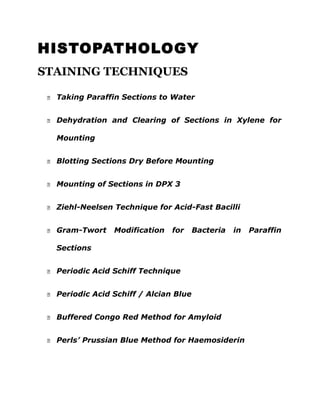
HISTOPATHOLOGY
STAINING TECHNIQUES
 Taking Paraffin Sections to Water
 Dehydration and Clearing of Sections in Xylene for
Mounting
 Blotting Sections Dry Before Mounting
 Mounting of Sections in DPX 3
 Ziehl-Neelsen Technique for Acid-Fast Bacilli
 Gram-Twort Modification for Bacteria in Paraffin
Sections
 Periodic Acid Schiff Technique
 Periodic Acid Schiff / Alcian Blue
 Buffered Congo Red Method for Amyloid
 Perls’ Prussian Blue Method for Haemosiderin
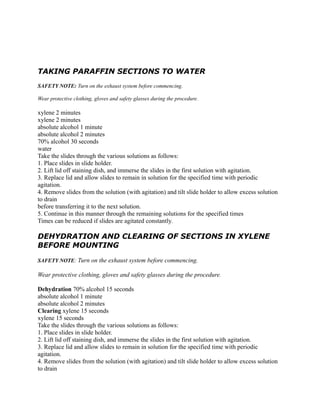
TAKING PARAFFIN SECTIONS TO WATER
SAFETY NOTE: Turn on the exhaust system before commencing.
Wear protective clothing, gloves and safety glasses during the procedure.
xylene 2 minutes
xylene 2 minutes
absolute alcohol 1 minute
absolute alcohol 2 minutes
70% alcohol 30 seconds
water
Take the slides through the various solutions as follows:
1. Place slides in slide holder.
2. Lift lid off staining dish, and immerse the slides in the first solution with agitation.
3. Replace lid and allow slides to remain in solution for the specified time with periodic
agitation.
4. Remove slides from the solution (with agitation) and tilt slide holder to allow excess solution
to drain
before transferring it to the next solution.
5. Continue in this manner through the remaining solutions for the specified times
Times can be reduced if slides are agitated constantly.
DEHYDRATION AND CLEARING OF SECTIONS IN XYLENE
BEFORE MOUNTING
SAFETY NOTE: Turn on the exhaust system before commencing.
Wear protective clothing, gloves and safety glasses during the procedure.
Dehydration 70% alcohol 15 seconds
absolute alcohol 1 minute
absolute alcohol 2 minutes
Clearing xylene 15 seconds
xylene 15 seconds
Take the slides through the various solutions as follows:
1. Place slides in slide holder.
2. Lift lid off staining dish, and immerse the slides in the first solution with agitation.
3. Replace lid and allow slides to remain in solution for the specified time with periodic
agitation.
4. Remove slides from the solution (with agitation) and tilt slide holder to allow excess solution
to drain
before transferring it to the next solution.
5. Continue in this manner through the remaining solutions for the specified times.
Times can be reduced if slides are agitated constantly.
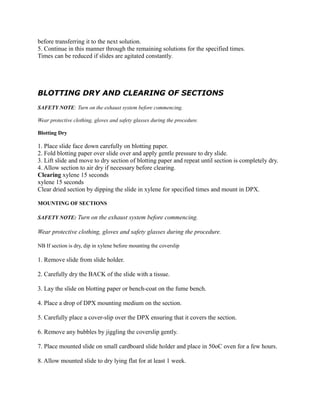
BLOTTING DRY AND CLEARING OF SECTIONS
SAFETY NOTE: Turn on the exhaust system before commencing.
Wear protective clothing, gloves and safety glasses during the procedure.
Blotting Dry
1. Place slide face down carefully on blotting paper.
2. Fold blotting paper over slide over and apply gentle pressure to dry slide.
3. Lift slide and move to dry section of blotting paper and repeat until section is completely dry.
4. Allow section to air dry if necessary before clearing.
Clearing xylene 15 seconds
xylene 15 seconds
Clear dried section by dipping the slide in xylene for specified times and mount in DPX.
MOUNTING OF SECTIONS
SAFETY NOTE: Turn on the exhaust system before commencing.
Wear protective clothing, gloves and safety glasses during the procedure.
NB If section is dry, dip in xylene before mounting the coverslip
1. Remove slide from slide holder.
2. Carefully dry the BACK of the slide with a tissue.
3. Lay the slide on blotting paper or bench-coat on the fume bench.
4. Place a drop of DPX mounting medium on the section.
5. Carefully place a cover-slip over the DPX ensuring that it covers the section.
6. Remove any bubbles by jiggling the coverslip gently.
7. Place mounted slide on small cardboard slide holder and place in 50oC oven for a few hours.
8. Allow mounted slide to dry lying flat for at least 1 week.
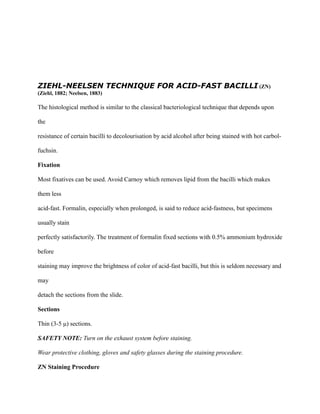
ZIEHL-NEELSEN TECHNIQUE FOR ACID-FAST BACILLI (ZN)
(Ziehl, 1882; Neelsen, 1883)
The histological method is similar to the classical bacteriological technique that depends upon
the
resistance of certain bacilli to decolourisation by acid alcohol after being stained with hot carbol-
fuchsin.
Fixation
Most fixatives can be used. Avoid Carnoy which removes lipid from the bacilli which makes
them less
acid-fast. Formalin, especially when prolonged, is said to reduce acid-fastness, but specimens
usually stain
perfectly satisfactorily. The treatment of formalin fixed sections with 0.5% ammonium hydroxide
before
staining may improve the brightness of color of acid-fast bacilli, but this is seldom necessary and
may
detach the sections from the slide.
Sections
Thin (3-5 μ) sections.
SAFETY NOTE: Turn on the exhaust system before staining.
Wear protective clothing, gloves and safety glasses during the staining procedure.
ZN Staining Procedure
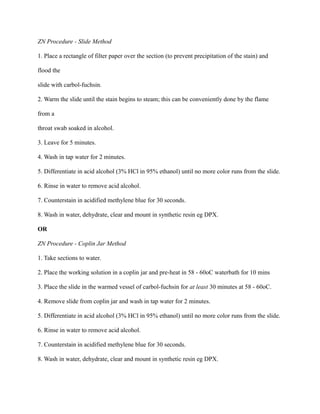
ZN Procedure - Slide Method
1. Place a rectangle of filter paper over the section (to prevent precipitation of the stain) and
flood the
slide with carbol-fuchsin.
2. Warm the slide until the stain begins to steam; this can be conveniently done by the flame
from a
throat swab soaked in alcohol.
3. Leave for 5 minutes.
4. Wash in tap water for 2 minutes.
5. Differentiate in acid alcohol (3% HCl in 95% ethanol) until no more color runs from the slide.
6. Rinse in water to remove acid alcohol.
7. Counterstain in acidified methylene blue for 30 seconds.
8. Wash in water, dehydrate, clear and mount in synthetic resin eg DPX.
OR
ZN Procedure - Coplin Jar Method
1. Take sections to water.
2. Place the working solution in a coplin jar and pre-heat in 58 - 60oC waterbath for 10 mins
3. Place the slide in the warmed vessel of carbol-fuchsin for at least 30 minutes at 58 - 60oC.
4. Remove slide from coplin jar and wash in tap water for 2 minutes.
5. Differentiate in acid alcohol (3% HCl in 95% ethanol) until no more color runs from the slide.
6. Rinse in water to remove acid alcohol.
7. Counterstain in acidified methylene blue for 30 seconds.
8. Wash in water, dehydrate, clear and mount in synthetic resin eg DPX.
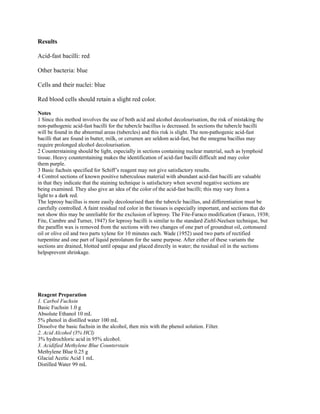
Results
Acid-fast bacilli: red
Other bacteria: blue
Cells and their nuclei: blue
Red blood cells should retain a slight red color.
Notes
1 Since this method involves the use of both acid and alcohol decolourisation, the risk of mistaking the
non-pathogenic acid-fast bacilli for the tubercle bacillus is decreased. In sections the tubercle bacilli
will be found in the abnormal areas (tubercles) and this risk is slight. The non-pathogenic acid-fast
bacilli that are found in butter, milk, or cerumen are seldom acid-fast, but the smegma bacillus may
require prolonged alcohol decolourisation.
2 Counterstaining should be light, especially in sections containing nuclear material, such as lymphoid
tissue. Heavy counterstaining makes the identification of acid-fast bacilli difficult and may color
them purple.
3 Basic fuchsin specified for Schiff’s reagent may not give satisfactory results.
4 Control sections of known positive tuberculous material with abundant acid-fast bacilli are valuable
in that they indicate that the staining technique is satisfactory when several negative sections are
being examined. They also give an idea of the color of the acid-fast bacilli; this may vary from a
light to a dark red.
The leprosy bacillus is more easily decolourised than the tubercle bacillus, and differentiation must be
carefully controlled. A faint residual red color in the tissues is especially important, and sections that do
not show this may be unreliable for the exclusion of leprosy. The Fite-Faraco modification (Faraco, 1938;
Fite, Cambre and Turner, 1947) for leprosy bacilli is similar to the standard Ziehl-Neelsen technique, but
the paraffin wax is removed from the sections with two changes of one part of groundnut oil, cottonseed
oil or olive oil and two parts xylene for 10 minutes each. Wade (1952) used two parts of rectified
turpentine and one part of liquid petrolatum for the same purpose. After either of these variants the
sections are drained, blotted until opaque and placed directly in water; the residual oil in the sections
helpsprevent shrinkage.
Reagent Preparation
1. Carbol Fuchsin
Basic Fuchsin 1.0 g
Absolute Ethanol 10 mL
5% phenol in distilled water 100 mL
Dissolve the basic fuchsin in the alcohol, then mix with the phenol solution. Filter.
2. Acid Alcohol (3% HCl)
3% hydrochloric acid in 95% alcohol.
3. Acidified Methylene Blue Counterstain
Methylene Blue 0.25 g
Glacial Acetic Acid 1 mL
Distilled Water 99 mL
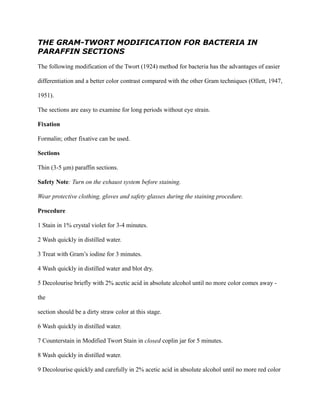
THE GRAM-TWORT MODIFICATION FOR BACTERIA IN
PARAFFIN SECTIONS
The following modification of the Twort (1924) method for bacteria has the advantages of easier
differentiation and a better color contrast compared with the other Gram techniques (Ollett, 1947,
1951).
The sections are easy to examine for long periods without eye strain.
Fixation
Formalin; other fixative can be used.
Sections
Thin (3-5 μm) paraffin sections.
Safety Note: Turn on the exhaust system before staining.
Wear protective clothing, gloves and safety glasses during the staining procedure.
Procedure
1 Stain in 1% crystal violet for 3-4 minutes.
2 Wash quickly in distilled water.
3 Treat with Gram’s iodine for 3 minutes.
4 Wash quickly in distilled water and blot dry.
5 Decolourise briefly with 2% acetic acid in absolute alcohol until no more color comes away -
the
section should be a dirty straw color at this stage.
6 Wash quickly in distilled water.
7 Counterstain in Modified Twort Stain in closed coplin jar for 5 minutes.
8 Wash quickly in distilled water.
9 Decolourise quickly and carefully in 2% acetic acid in absolute alcohol until no more red color
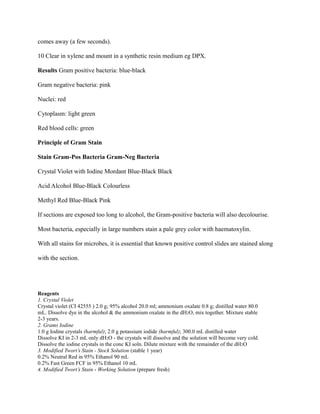
comes away (a few seconds).
10 Clear in xylene and mount in a synthetic resin medium eg DPX.
Results Gram positive bacteria: blue-black
Gram negative bacteria: pink
Nuclei: red
Cytoplasm: light green
Red blood cells: green
Principle of Gram Stain
Stain Gram-Pos Bacteria Gram-Neg Bacteria
Crystal Violet with Iodine Mordant Blue-Black Black
Acid Alcohol Blue-Black Colourless
Methyl Red Blue-Black Pink
If sections are exposed too long to alcohol, the Gram-positive bacteria will also decolourise.
Most bacteria, especially in large numbers stain a pale grey color with haematoxylin.
With all stains for microbes, it is essential that known positive control slides are stained along
with the section.
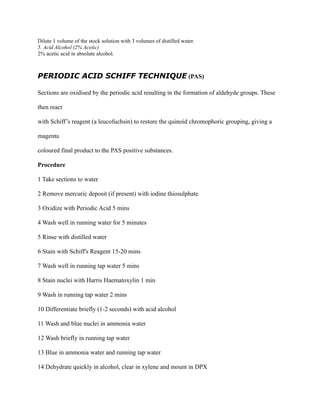
Reagents
1. Crystal Violet
Crystal violet (CI 42555 ) 2.0 g; 95% alcohol 20.0 ml; ammonium oxalate 0.8 g; distilled water 80.0
mL. Dissolve dye in the alcohol & the ammonium oxalate in the dH2O, mix together. Mixture stable
2-3 years.
2. Grams Iodine
1.0 g Iodine crystals (harmful); 2.0 g potassium iodide (harmful); 300.0 mL distilled water
Dissolve KI in 2-3 mL only dH2O - the crystals will dissolve and the solution will become very cold.
Dissolve the iodine crystals in the conc KI soln. Dilute mixture with the remainder of the dH2O
3. Modified Twort’s Stain - Stock Solution (stable 1 year)
0.2% Neutral Red in 95% Ethanol 90 mL
0.2% Fast Green FCF in 95% Ethanol 10 mL
4. Modified Twort’s Stain - Working Solution (prepare fresh)
Dilute 1 volume of the stock solution with 3 volumes of distilled water.
5. Acid Alcohol (2% Acetic)
2% acetic acid in absolute alcohol.
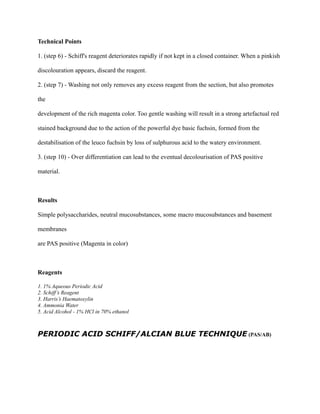
PERIODIC ACID SCHIFF TECHNIQUE (PAS)
Sections are oxidised by the periodic acid resulting in the formation of aldehyde groups. These
then react
with Schiff’s reagent (a leucofuchsin) to restore the quinoid chromophoric grouping, giving a
magenta
coloured final product to the PAS positive substances.
Procedure
1 Take sections to water
2 Remove mercuric deposit (if present) with iodine thiosulphate
3 Oxidize with Periodic Acid 5 mins
4 Wash well in running water for 5 minutes
5 Rinse with distilled water
6 Stain with Schiff's Reagent 15-20 mins
7 Wash well in running tap water 5 mins
8 Stain nuclei with Harris Haematoxylin 1 min
9 Wash in running tap water 2 mins
10 Differentiate briefly (1-2 seconds) with acid alcohol
11 Wash and blue nuclei in ammonia water
12 Wash briefly in running tap water
13 Blue in ammonia water and running tap water
14 Dehydrate quickly in alcohol, clear in xylene and mount in DPX
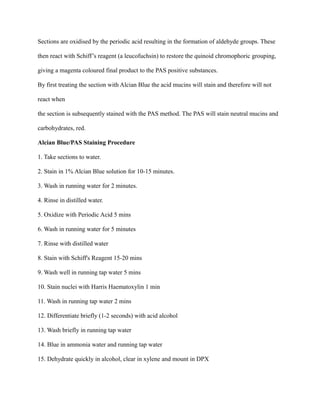
Technical Points
1. (step 6) - Schiff's reagent deteriorates rapidly if not kept in a closed container. When a pinkish
discolouration appears, discard the reagent.
2. (step 7) - Washing not only removes any excess reagent from the section, but also promotes
the
development of the rich magenta color. Too gentle washing will result in a strong artefactual red
stained background due to the action of the powerful dye basic fuchsin, formed from the
destabilisation of the leuco fuchsin by loss of sulphurous acid to the watery environment.
3. (step 10) - Over differentiation can lead to the eventual decolourisation of PAS positive
material.
Results
Simple polysaccharides, neutral mucosubstances, some macro mucosubstances and basement
membranes
are PAS positive (Magenta in color)
Reagents
1. 1% Aqueous Periodic Acid
2. Schiff’s Reagent
3. Harris’s Haematoxylin
4. Ammonia Water
5. Acid Alcohol - 1% HCl in 70% ethanol
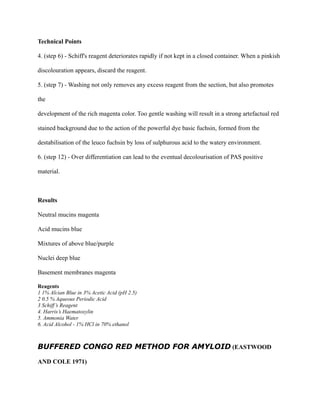
PERIODIC ACID SCHIFF/ALCIAN BLUE TECHNIQUE (PAS/AB)
Sections are oxidised by the periodic acid resulting in the formation of aldehyde groups. These
then react with Schiff’s reagent (a leucofuchsin) to restore the quinoid chromophoric grouping,
giving a magenta coloured final product to the PAS positive substances.
By first treating the section with Alcian Blue the acid mucins will stain and therefore will not
react when
the section is subsequently stained with the PAS method. The PAS will stain neutral mucins and
carbohydrates, red.
Alcian Blue/PAS Staining Procedure
1. Take sections to water.
2. Stain in 1% Alcian Blue solution for 10-15 minutes.
3. Wash in running water for 2 minutes.
4. Rinse in distilled water.
5. Oxidize with Periodic Acid 5 mins
6. Wash in running water for 5 minutes
7. Rinse with distilled water
8. Stain with Schiff's Reagent 15-20 mins
9. Wash well in running tap water 5 mins
10. Stain nuclei with Harris Haematoxylin 1 min
11. Wash in running tap water 2 mins
12. Differentiate briefly (1-2 seconds) with acid alcohol
13. Wash briefly in running tap water
14. Blue in ammonia water and running tap water
15. Dehydrate quickly in alcohol, clear in xylene and mount in DPX
Technical Points
4. (step 6) - Schiff's reagent deteriorates rapidly if not kept in a closed container. When a pinkish
discolouration appears, discard the reagent.
5. (step 7) - Washing not only removes any excess reagent from the section, but also promotes
the
development of the rich magenta color. Too gentle washing will result in a strong artefactual red
stained background due to the action of the powerful dye basic fuchsin, formed from the
destabilisation of the leuco fuchsin by loss of sulphurous acid to the watery environment.
6. (step 12) - Over differentiation can lead to the eventual decolourisation of PAS positive
material.
Results
Neutral mucins magenta
Acid mucins blue
Mixtures of above blue/purple
Nuclei deep blue
Basement membranes magenta
Reagents
1 1% Alcian Blue in 3% Acetic Acid (pH 2.5)
2 0.5 % Aqueous Periodic Acid
3 Schiff’s Reagent
4. Harris’s Haematoxylin
5. Ammonia Water
6. Acid Alcohol - 1% HCl in 70% ethanol
BUFFERED CONGO RED METHOD FOR AMYLOID (EASTWOOD
AND COLE 1971)
Fixative
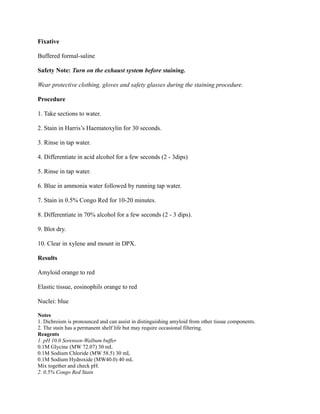
Buffered formal-saline
Safety Note: Turn on the exhaust system before staining.
Wear protective clothing, gloves and safety glasses during the staining procedure.
Procedure
1. Take sections to water.
2. Stain in Harris’s Haematoxylin for 30 seconds.
3. Rinse in tap water.
4. Differentiate in acid alcohol for a few seconds (2 - 3dips)
5. Rinse in tap water.
6. Blue in ammonia water followed by running tap water.
7. Stain in 0.5% Congo Red for 10-20 minutes.
8. Differentiate in 70% alcohol for a few seconds (2 - 3 dips).
9. Blot dry.
10. Clear in xylene and mount in DPX.
Results
Amyloid orange to red
Elastic tissue, eosinophils orange to red
Nuclei: blue
Notes
1. Dichroism is pronounced and can assist in distinguishing amyloid from other tissue components.
2. The stain has a permanent shelf life but may require occasional filtering.
Reagents
1. pH 10.0 Sorensen-Walbum buffer
0.1M Glycine (MW 72.07) 30 mL
0.1M Sodium Chloride (MW 58.5) 30 mL
0.1M Sodium Hydroxide (MW40.0) 40 mL
Mix together and check pH.
2. 0.5% Congo Red Stain
Congo Red 0.5g
Absolute alcohol 50ml
pH 10.0 Sorensen-Walbum Buffer 50ml
3. Harris’s Haematoxylin
4. Ammonia Water
5. Acid Alcohol - 1% HCl in 70% ethanol
6. 70% Alcohol - 70% ethanol
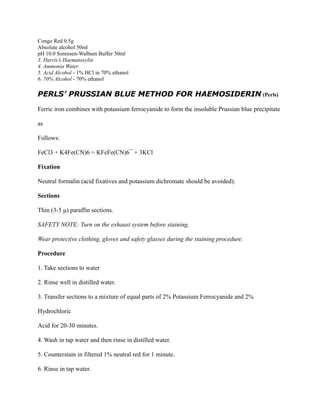
PERLS’ PRUSSIAN BLUE METHOD FOR HAEMOSIDERIN (Perls)
Ferric iron combines with potassium ferrocyanide to form the insoluble Prussian blue precipitate
as
Follows:
FeCl3 + K4Fe(CN)6 = KFeFe(CN)6¯ + 3KCl
Fixation
Neutral formalin (acid fixatives and potassium dichromate should be avoided).
Sections
Thin (3-5 μ) paraffin sections.
SAFETY NOTE: Turn on the exhaust system before staining.
Wear protective clothing, gloves and safety glasses during the staining procedure.
Procedure
1. Take sections to water
2. Rinse well in distilled water.
3. Transfer sections to a mixture of equal parts of 2% Potassium Ferrocyanide and 2%
Hydrochloric
Acid for 20-30 minutes.
4. Wash in tap water and then rinse in distilled water.
5. Counterstain in filtered 1% neutral red for 1 minute.
6. Rinse in tap water.
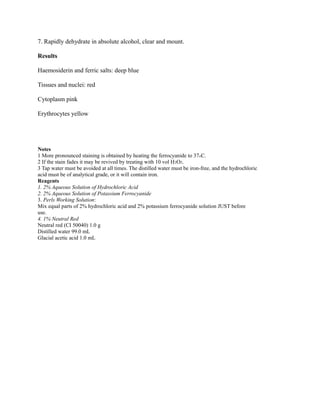
7. Rapidly dehydrate in absolute alcohol, clear and mount.
Results
Haemosiderin and ferric salts: deep blue
Tissues and nuclei: red
Cytoplasm pink
Erythrocytes yellow
Notes
1 More pronounced staining is obtained by heating the ferrocyanide to 37oC.
2 If the stain fades it may be revived by treating with 10 vol H2O2.
3 Tap water must be avoided at all times. The distilled water must be iron-free, and the hydrochloric
acid must be of analytical grade, or it will contain iron.
Reagents
1. 2% Aqueous Solution of Hydrochloric Acid
2. 2% Aqueous Solution of Potassium Ferrocyanide
3. Perls Working Solution:
Mix equal parts of 2% hydrochloric acid and 2% potassium ferrocyanide solution JUST before
use.
4. 1% Neutral Red
Neutral red (CI 50040) 1.0 g
Distilled water 99.0 mL
Glacial acetic acid 1.0 mL

Histopathology

  • 1.
    HISTOPATHOLOGY STAINING TECHNIQUES  TakingParaffin Sections to Water  Dehydration and Clearing of Sections in Xylene for Mounting  Blotting Sections Dry Before Mounting  Mounting of Sections in DPX 3  Ziehl-Neelsen Technique for Acid-Fast Bacilli  Gram-Twort Modification for Bacteria in Paraffin Sections  Periodic Acid Schiff Technique  Periodic Acid Schiff / Alcian Blue  Buffered Congo Red Method for Amyloid  Perls’ Prussian Blue Method for Haemosiderin
  • 2.
    TAKING PARAFFIN SECTIONSTO WATER SAFETY NOTE: Turn on the exhaust system before commencing. Wear protective clothing, gloves and safety glasses during the procedure. xylene 2 minutes xylene 2 minutes absolute alcohol 1 minute absolute alcohol 2 minutes 70% alcohol 30 seconds water Take the slides through the various solutions as follows: 1. Place slides in slide holder. 2. Lift lid off staining dish, and immerse the slides in the first solution with agitation. 3. Replace lid and allow slides to remain in solution for the specified time with periodic agitation. 4. Remove slides from the solution (with agitation) and tilt slide holder to allow excess solution to drain before transferring it to the next solution. 5. Continue in this manner through the remaining solutions for the specified times Times can be reduced if slides are agitated constantly. DEHYDRATION AND CLEARING OF SECTIONS IN XYLENE BEFORE MOUNTING SAFETY NOTE: Turn on the exhaust system before commencing. Wear protective clothing, gloves and safety glasses during the procedure. Dehydration 70% alcohol 15 seconds absolute alcohol 1 minute absolute alcohol 2 minutes Clearing xylene 15 seconds xylene 15 seconds Take the slides through the various solutions as follows: 1. Place slides in slide holder. 2. Lift lid off staining dish, and immerse the slides in the first solution with agitation. 3. Replace lid and allow slides to remain in solution for the specified time with periodic agitation. 4. Remove slides from the solution (with agitation) and tilt slide holder to allow excess solution to drain
  • 3.
    before transferring itto the next solution. 5. Continue in this manner through the remaining solutions for the specified times. Times can be reduced if slides are agitated constantly. BLOTTING DRY AND CLEARING OF SECTIONS SAFETY NOTE: Turn on the exhaust system before commencing. Wear protective clothing, gloves and safety glasses during the procedure. Blotting Dry 1. Place slide face down carefully on blotting paper. 2. Fold blotting paper over slide over and apply gentle pressure to dry slide. 3. Lift slide and move to dry section of blotting paper and repeat until section is completely dry. 4. Allow section to air dry if necessary before clearing. Clearing xylene 15 seconds xylene 15 seconds Clear dried section by dipping the slide in xylene for specified times and mount in DPX. MOUNTING OF SECTIONS SAFETY NOTE: Turn on the exhaust system before commencing. Wear protective clothing, gloves and safety glasses during the procedure. NB If section is dry, dip in xylene before mounting the coverslip 1. Remove slide from slide holder. 2. Carefully dry the BACK of the slide with a tissue. 3. Lay the slide on blotting paper or bench-coat on the fume bench. 4. Place a drop of DPX mounting medium on the section. 5. Carefully place a cover-slip over the DPX ensuring that it covers the section. 6. Remove any bubbles by jiggling the coverslip gently. 7. Place mounted slide on small cardboard slide holder and place in 50oC oven for a few hours. 8. Allow mounted slide to dry lying flat for at least 1 week.
  • 4.
    ZIEHL-NEELSEN TECHNIQUE FORACID-FAST BACILLI (ZN) (Ziehl, 1882; Neelsen, 1883) The histological method is similar to the classical bacteriological technique that depends upon the resistance of certain bacilli to decolourisation by acid alcohol after being stained with hot carbol- fuchsin. Fixation Most fixatives can be used. Avoid Carnoy which removes lipid from the bacilli which makes them less acid-fast. Formalin, especially when prolonged, is said to reduce acid-fastness, but specimens usually stain perfectly satisfactorily. The treatment of formalin fixed sections with 0.5% ammonium hydroxide before staining may improve the brightness of color of acid-fast bacilli, but this is seldom necessary and may detach the sections from the slide. Sections Thin (3-5 μ) sections. SAFETY NOTE: Turn on the exhaust system before staining. Wear protective clothing, gloves and safety glasses during the staining procedure. ZN Staining Procedure
  • 5.
    ZN Procedure -Slide Method 1. Place a rectangle of filter paper over the section (to prevent precipitation of the stain) and flood the slide with carbol-fuchsin. 2. Warm the slide until the stain begins to steam; this can be conveniently done by the flame from a throat swab soaked in alcohol. 3. Leave for 5 minutes. 4. Wash in tap water for 2 minutes. 5. Differentiate in acid alcohol (3% HCl in 95% ethanol) until no more color runs from the slide. 6. Rinse in water to remove acid alcohol. 7. Counterstain in acidified methylene blue for 30 seconds. 8. Wash in water, dehydrate, clear and mount in synthetic resin eg DPX. OR ZN Procedure - Coplin Jar Method 1. Take sections to water. 2. Place the working solution in a coplin jar and pre-heat in 58 - 60oC waterbath for 10 mins 3. Place the slide in the warmed vessel of carbol-fuchsin for at least 30 minutes at 58 - 60oC. 4. Remove slide from coplin jar and wash in tap water for 2 minutes. 5. Differentiate in acid alcohol (3% HCl in 95% ethanol) until no more color runs from the slide. 6. Rinse in water to remove acid alcohol. 7. Counterstain in acidified methylene blue for 30 seconds. 8. Wash in water, dehydrate, clear and mount in synthetic resin eg DPX.
  • 6.
    Results Acid-fast bacilli: red Otherbacteria: blue Cells and their nuclei: blue Red blood cells should retain a slight red color. Notes 1 Since this method involves the use of both acid and alcohol decolourisation, the risk of mistaking the non-pathogenic acid-fast bacilli for the tubercle bacillus is decreased. In sections the tubercle bacilli will be found in the abnormal areas (tubercles) and this risk is slight. The non-pathogenic acid-fast bacilli that are found in butter, milk, or cerumen are seldom acid-fast, but the smegma bacillus may require prolonged alcohol decolourisation. 2 Counterstaining should be light, especially in sections containing nuclear material, such as lymphoid tissue. Heavy counterstaining makes the identification of acid-fast bacilli difficult and may color them purple. 3 Basic fuchsin specified for Schiff’s reagent may not give satisfactory results. 4 Control sections of known positive tuberculous material with abundant acid-fast bacilli are valuable in that they indicate that the staining technique is satisfactory when several negative sections are being examined. They also give an idea of the color of the acid-fast bacilli; this may vary from a light to a dark red. The leprosy bacillus is more easily decolourised than the tubercle bacillus, and differentiation must be carefully controlled. A faint residual red color in the tissues is especially important, and sections that do not show this may be unreliable for the exclusion of leprosy. The Fite-Faraco modification (Faraco, 1938; Fite, Cambre and Turner, 1947) for leprosy bacilli is similar to the standard Ziehl-Neelsen technique, but the paraffin wax is removed from the sections with two changes of one part of groundnut oil, cottonseed oil or olive oil and two parts xylene for 10 minutes each. Wade (1952) used two parts of rectified turpentine and one part of liquid petrolatum for the same purpose. After either of these variants the sections are drained, blotted until opaque and placed directly in water; the residual oil in the sections helpsprevent shrinkage. Reagent Preparation 1. Carbol Fuchsin Basic Fuchsin 1.0 g Absolute Ethanol 10 mL 5% phenol in distilled water 100 mL Dissolve the basic fuchsin in the alcohol, then mix with the phenol solution. Filter. 2. Acid Alcohol (3% HCl) 3% hydrochloric acid in 95% alcohol. 3. Acidified Methylene Blue Counterstain Methylene Blue 0.25 g Glacial Acetic Acid 1 mL Distilled Water 99 mL
  • 7.
    THE GRAM-TWORT MODIFICATIONFOR BACTERIA IN PARAFFIN SECTIONS The following modification of the Twort (1924) method for bacteria has the advantages of easier differentiation and a better color contrast compared with the other Gram techniques (Ollett, 1947, 1951). The sections are easy to examine for long periods without eye strain. Fixation Formalin; other fixative can be used. Sections Thin (3-5 μm) paraffin sections. Safety Note: Turn on the exhaust system before staining. Wear protective clothing, gloves and safety glasses during the staining procedure. Procedure 1 Stain in 1% crystal violet for 3-4 minutes. 2 Wash quickly in distilled water. 3 Treat with Gram’s iodine for 3 minutes. 4 Wash quickly in distilled water and blot dry. 5 Decolourise briefly with 2% acetic acid in absolute alcohol until no more color comes away - the section should be a dirty straw color at this stage. 6 Wash quickly in distilled water. 7 Counterstain in Modified Twort Stain in closed coplin jar for 5 minutes. 8 Wash quickly in distilled water. 9 Decolourise quickly and carefully in 2% acetic acid in absolute alcohol until no more red color
  • 8.
    comes away (afew seconds). 10 Clear in xylene and mount in a synthetic resin medium eg DPX. Results Gram positive bacteria: blue-black Gram negative bacteria: pink Nuclei: red Cytoplasm: light green Red blood cells: green Principle of Gram Stain Stain Gram-Pos Bacteria Gram-Neg Bacteria Crystal Violet with Iodine Mordant Blue-Black Black Acid Alcohol Blue-Black Colourless Methyl Red Blue-Black Pink If sections are exposed too long to alcohol, the Gram-positive bacteria will also decolourise. Most bacteria, especially in large numbers stain a pale grey color with haematoxylin. With all stains for microbes, it is essential that known positive control slides are stained along with the section. Reagents 1. Crystal Violet Crystal violet (CI 42555 ) 2.0 g; 95% alcohol 20.0 ml; ammonium oxalate 0.8 g; distilled water 80.0 mL. Dissolve dye in the alcohol & the ammonium oxalate in the dH2O, mix together. Mixture stable 2-3 years. 2. Grams Iodine 1.0 g Iodine crystals (harmful); 2.0 g potassium iodide (harmful); 300.0 mL distilled water Dissolve KI in 2-3 mL only dH2O - the crystals will dissolve and the solution will become very cold. Dissolve the iodine crystals in the conc KI soln. Dilute mixture with the remainder of the dH2O 3. Modified Twort’s Stain - Stock Solution (stable 1 year) 0.2% Neutral Red in 95% Ethanol 90 mL 0.2% Fast Green FCF in 95% Ethanol 10 mL 4. Modified Twort’s Stain - Working Solution (prepare fresh)
  • 9.
    Dilute 1 volumeof the stock solution with 3 volumes of distilled water. 5. Acid Alcohol (2% Acetic) 2% acetic acid in absolute alcohol. PERIODIC ACID SCHIFF TECHNIQUE (PAS) Sections are oxidised by the periodic acid resulting in the formation of aldehyde groups. These then react with Schiff’s reagent (a leucofuchsin) to restore the quinoid chromophoric grouping, giving a magenta coloured final product to the PAS positive substances. Procedure 1 Take sections to water 2 Remove mercuric deposit (if present) with iodine thiosulphate 3 Oxidize with Periodic Acid 5 mins 4 Wash well in running water for 5 minutes 5 Rinse with distilled water 6 Stain with Schiff's Reagent 15-20 mins 7 Wash well in running tap water 5 mins 8 Stain nuclei with Harris Haematoxylin 1 min 9 Wash in running tap water 2 mins 10 Differentiate briefly (1-2 seconds) with acid alcohol 11 Wash and blue nuclei in ammonia water 12 Wash briefly in running tap water 13 Blue in ammonia water and running tap water 14 Dehydrate quickly in alcohol, clear in xylene and mount in DPX
  • 10.
    Technical Points 1. (step6) - Schiff's reagent deteriorates rapidly if not kept in a closed container. When a pinkish discolouration appears, discard the reagent. 2. (step 7) - Washing not only removes any excess reagent from the section, but also promotes the development of the rich magenta color. Too gentle washing will result in a strong artefactual red stained background due to the action of the powerful dye basic fuchsin, formed from the destabilisation of the leuco fuchsin by loss of sulphurous acid to the watery environment. 3. (step 10) - Over differentiation can lead to the eventual decolourisation of PAS positive material. Results Simple polysaccharides, neutral mucosubstances, some macro mucosubstances and basement membranes are PAS positive (Magenta in color) Reagents 1. 1% Aqueous Periodic Acid 2. Schiff’s Reagent 3. Harris’s Haematoxylin 4. Ammonia Water 5. Acid Alcohol - 1% HCl in 70% ethanol PERIODIC ACID SCHIFF/ALCIAN BLUE TECHNIQUE (PAS/AB)
  • 11.
    Sections are oxidisedby the periodic acid resulting in the formation of aldehyde groups. These then react with Schiff’s reagent (a leucofuchsin) to restore the quinoid chromophoric grouping, giving a magenta coloured final product to the PAS positive substances. By first treating the section with Alcian Blue the acid mucins will stain and therefore will not react when the section is subsequently stained with the PAS method. The PAS will stain neutral mucins and carbohydrates, red. Alcian Blue/PAS Staining Procedure 1. Take sections to water. 2. Stain in 1% Alcian Blue solution for 10-15 minutes. 3. Wash in running water for 2 minutes. 4. Rinse in distilled water. 5. Oxidize with Periodic Acid 5 mins 6. Wash in running water for 5 minutes 7. Rinse with distilled water 8. Stain with Schiff's Reagent 15-20 mins 9. Wash well in running tap water 5 mins 10. Stain nuclei with Harris Haematoxylin 1 min 11. Wash in running tap water 2 mins 12. Differentiate briefly (1-2 seconds) with acid alcohol 13. Wash briefly in running tap water 14. Blue in ammonia water and running tap water 15. Dehydrate quickly in alcohol, clear in xylene and mount in DPX
  • 12.
    Technical Points 4. (step6) - Schiff's reagent deteriorates rapidly if not kept in a closed container. When a pinkish discolouration appears, discard the reagent. 5. (step 7) - Washing not only removes any excess reagent from the section, but also promotes the development of the rich magenta color. Too gentle washing will result in a strong artefactual red stained background due to the action of the powerful dye basic fuchsin, formed from the destabilisation of the leuco fuchsin by loss of sulphurous acid to the watery environment. 6. (step 12) - Over differentiation can lead to the eventual decolourisation of PAS positive material. Results Neutral mucins magenta Acid mucins blue Mixtures of above blue/purple Nuclei deep blue Basement membranes magenta Reagents 1 1% Alcian Blue in 3% Acetic Acid (pH 2.5) 2 0.5 % Aqueous Periodic Acid 3 Schiff’s Reagent 4. Harris’s Haematoxylin 5. Ammonia Water 6. Acid Alcohol - 1% HCl in 70% ethanol BUFFERED CONGO RED METHOD FOR AMYLOID (EASTWOOD AND COLE 1971)
  • 13.
    Fixative Buffered formal-saline Safety Note:Turn on the exhaust system before staining. Wear protective clothing, gloves and safety glasses during the staining procedure. Procedure 1. Take sections to water. 2. Stain in Harris’s Haematoxylin for 30 seconds. 3. Rinse in tap water. 4. Differentiate in acid alcohol for a few seconds (2 - 3dips) 5. Rinse in tap water. 6. Blue in ammonia water followed by running tap water. 7. Stain in 0.5% Congo Red for 10-20 minutes. 8. Differentiate in 70% alcohol for a few seconds (2 - 3 dips). 9. Blot dry. 10. Clear in xylene and mount in DPX. Results Amyloid orange to red Elastic tissue, eosinophils orange to red Nuclei: blue Notes 1. Dichroism is pronounced and can assist in distinguishing amyloid from other tissue components. 2. The stain has a permanent shelf life but may require occasional filtering. Reagents 1. pH 10.0 Sorensen-Walbum buffer 0.1M Glycine (MW 72.07) 30 mL 0.1M Sodium Chloride (MW 58.5) 30 mL 0.1M Sodium Hydroxide (MW40.0) 40 mL Mix together and check pH. 2. 0.5% Congo Red Stain
  • 14.
    Congo Red 0.5g Absolutealcohol 50ml pH 10.0 Sorensen-Walbum Buffer 50ml 3. Harris’s Haematoxylin 4. Ammonia Water 5. Acid Alcohol - 1% HCl in 70% ethanol 6. 70% Alcohol - 70% ethanol PERLS’ PRUSSIAN BLUE METHOD FOR HAEMOSIDERIN (Perls) Ferric iron combines with potassium ferrocyanide to form the insoluble Prussian blue precipitate as Follows: FeCl3 + K4Fe(CN)6 = KFeFe(CN)6¯ + 3KCl Fixation Neutral formalin (acid fixatives and potassium dichromate should be avoided). Sections Thin (3-5 μ) paraffin sections. SAFETY NOTE: Turn on the exhaust system before staining. Wear protective clothing, gloves and safety glasses during the staining procedure. Procedure 1. Take sections to water 2. Rinse well in distilled water. 3. Transfer sections to a mixture of equal parts of 2% Potassium Ferrocyanide and 2% Hydrochloric Acid for 20-30 minutes. 4. Wash in tap water and then rinse in distilled water. 5. Counterstain in filtered 1% neutral red for 1 minute. 6. Rinse in tap water.
  • 15.
    7. Rapidly dehydratein absolute alcohol, clear and mount. Results Haemosiderin and ferric salts: deep blue Tissues and nuclei: red Cytoplasm pink Erythrocytes yellow Notes 1 More pronounced staining is obtained by heating the ferrocyanide to 37oC. 2 If the stain fades it may be revived by treating with 10 vol H2O2. 3 Tap water must be avoided at all times. The distilled water must be iron-free, and the hydrochloric acid must be of analytical grade, or it will contain iron. Reagents 1. 2% Aqueous Solution of Hydrochloric Acid 2. 2% Aqueous Solution of Potassium Ferrocyanide 3. Perls Working Solution: Mix equal parts of 2% hydrochloric acid and 2% potassium ferrocyanide solution JUST before use. 4. 1% Neutral Red Neutral red (CI 50040) 1.0 g Distilled water 99.0 mL Glacial acetic acid 1.0 mL