VITAMIN B12
Vitamin B12
(Cobalamin)
• Vitamin B12 is generic name for group of
compounds called corrinoids
– corrin nucleus
– atom of cobalt in center
– attached are one of following
• CN = cyanocobalamin (CNCbl)
• OH=hydroxocobalamin (OHCbl)
• 5’-adenosyl=adenosylcobalamin*(AdoCbl)
• -CH3=methylcobalamin* (MeCbl)
Vitamin B12
P
H2N
N
N O
NH2
NH2
O
NH2
O
HO H
O
OH
N
H
O
O
O
N
Co
N
O
O O-
O
C
NH
H2N
H2N
N
N
Sources
• Seldom found in foods from plants
• Synthesis is limited to bacteria. Rumen microbial
synthesis depend on the supply of cobalt in the
diet
• Animal products
– Derive their cobalamin from micro-organisms
– Meat, poultry, fish, shellfish, eggs, milk, milk products
– Liver is a good source
• Supplements
– Cyanocobalamin and hydroxycobalamin
Sources of Vitamin B12 in Foods
Food Vitamin B12
(µg/100g)
Food Vitamin B12
(µg/100g)
Meats
Beef 1.94-3.64
Beef brain 7.83
Beef kidney 38.3
Beef liver 69-122
Chicken 0.32
Chicken liver 24.1
Ham 0.8
Pork 0.55
Turkey 0.379
Dairy products
Milk 0.36
Cheeses 0.36-1.71
Yoghurt 0.06-0.62
Fish and sea food
Herring 4.3
Salmon 3.2
Trout 7.8
Tuna 2.8
Clams 19.1
Oysters 21.2
Lobster 1.28
Shrimp 1.9
Other
Eggs, whole 1.26
Eggs white 0.09
Eggs yolk 9.26
Vegetables,grains,fruits none contain vitamin
B12
Digestion/Absorption
• Ingested cobalamins must be released from food
matrix
– Attached to polypeptides in foods
– Release occurs via action of pepsin
• Functions at low pH
• Requires adequate HCl production
• Released cobalamin interacts with:
– R-binders (R-protein), Transcobalamin (TCI),
Haptocorrin (Hc)
• R protein (found in saliva and gastric juice)
• Non-specific
• Complex moves from stomach into SI
• In duodenum, R protein is hydrolyzed by proteases
– Inhibited by pancreatic insufficiency
Absorption
• Cobalamins bind to IF in proximal intestine
– Cobalamin-IF complex travel to ileum
– Binds to receptors and is slowly absorbed into enterocyte
• Can occur by passive diffusion when pharmacologic
amounts are given
– Used for people not producing IF
• Malabsorption occurs
– Achlorydia
– Lack of IF
– Pancreatic insufficiency
• Absorption rate decreases with increased intake (80% to
3%)
In Circulation
• Cobalamins bound to one of three proteins called
transcobalamins
– TCI = binds 90% of vitamin B12 and may function as
circulating storage form (hoptocorrin)
– TCII = carries newly absorbed cobalamin to tissues and
helps with uptake of cobalamin
• Receptors on cells for TCII
– TCIII = delivers cobalamin from periphery back to liver
– Methylcobalamin and adenosylcobalamin found
primarily in blood
• Stored in liver (adenosylcobalamin)
Vitamin B12 Absorption in Ileum
Pernicious Anemia Toh, B-H et al. NEJM 337:1441,1991
End stage of type A chronic atrophic (autoimmune) gastritis
B12
R + B12
B12
B12
IF + B12
IF . B12
TCII . B12
IF
IF
IF
IF
IF
R
R
Pancreatic proteases
(degradation of R protein)
Acid pH
Ileal receptor
Stomach
Vitamin B12 absorption
Transport
• TC receptors are degraded upon cellular
uptake to release B12.
• All vitamin within cell is bound to protein:
– Methionine synthetase (cytosol) and
methymalonyl-CoA mutase (mitochondria)
• Distribution in tissues
– Total body store 2-5mg
– Liver (60%)
– Long biological half life: 350-400 days in human.
– Low reserve in infant: about 25 μg.
– Plasma: methylcobalamin (60-80% of total)
Vitamin B12
• Metabolism
– Whole-body turnover ~ 0.1% / day
– Turnover rate is about 2.5 μg/day
– Loss of vitamin mainly due to fecal loss
• Excretion: 0.1-0.2% of total body reserve
Metabolic Roles of Vitamin B12 in Animals
Enzyme Metabolic function
Adenosylcobalamin
Methylmalonyl-CoA mutase Conversion of methylmalonyl-CoA to succinyl-CoA in
the degradation of propionate.
L-α-Leucine mutase Conversion of L-α-Leucine to aminoisocapronate as
the first step in the synthesis/degradation of the
amino acid
Methylcobalamin
Methionine synthetase Methylation of homocysteine to produce methionine,
serving as the methyl group carrier between the
donor 5-methyl-FH4 and the acceptor homocysteine
Functions
• Three known enzymatic reactions require
Vitamin B12
– Methylcobalamin required for methionine
synthesis from Hcy (cytosol)
• Nitrous oxide inhibits MS
• Oxidizes cobalt from 1+ to 3+ state
• Must be in +1 state to function as coenzyme
– Adenosylcobalamin
• Required for two reactions
• Both are mutases and function in mitochondria
Possible role of vitamin B12 in choline and methionine
synthesis
Serine Methionine
Vitamin B6 CH3-cobalamin S-adenosyl
CO2 transmethylase homocysteine
CH3-cobalamin
Ethanolamine Choline
Adenosylcobalamin
• Methylmalonyl CoA mutase
– Converts L-methylmalonyl CoA generated from
propionyl CoA to succinyl CoA
– Propionyl CoA generated from oxidation of
• Odd chain fatty acids
• Valine,methionine, isoleucine, threonine
– In cobalamin deficiency
• Methylmalonyl CoA and methylmalonic acid (MMA)
accumulate; see rise in blood and urine
• Have observed genetic defects in methylmalonyl CoA mutase
and adenosylcobalamin synthesis
Vitamin B12-dependent isomerization of
methylmalonyl CoA to succinyl CoA
Valine CO2 methylmalonyl
Isoleucine mutase
Methionine Propionyl CoA Methylmalonyl CoA Succinyl CoA krebs’
Threonine adenosyl Cycle
cobalamin
Adenosylcobalamin
• Leucine Aminomutase
– Requires adenosylcobalamin as co-enzyme
– B leucine generated from bacteria in gut may be
converted to L-leucine in body
– Beta leucine may also be generated from L-leucine
and undergo transamination and provide
alternate route for leucine catabolism
Signs of Vitamin B12 Deficiency
Organ system Signs
General
Growth Decrease
Vital organs Hepatic, cardiac and renal steatosis
Fetus Hemorrhage, myopathy, death
Circulatory
Erythrocytes Anemia
Nervous Peripheral neuropathy
Deficiency
• Definite association
– Megaloblastic anemia
– Neuropathy
• Possible association
– Atheroma
• Hcy
• Pernicous anemia : no increase
– NTDs
• B12 association
– Hepatic steatosis
• Ethanol inhibits methionine synthase
• Methionine and choline deficiency
Megaloblastic anemia
• Low B12  low methionine and THF  high tHcy
and 5-CH3-THF
• Low THF  low 5,10-CH2-THF  low conversion
of dUMP to dTMP  low DNA synthesis
• Low methionine and SAM: low methylene
reductase
– 5,10-CH2-THF 5-CH3-THF (irreversible)
– 5-CH3-THF: poor substrate for glutamate synthetase,
poor incorporation into CH3-Cbl (folate deficiency)
Neuropathy
• Undetected Vitamin B12 deficiency leads to
neuropathy (10+ years)
• Cause
– Related to availability of methionine for SAM??
– SAM required for methylation reactions
• Essential for myelin maintenance and thus neural function
• Neuropathy induced in animals by N2O inhalation
• Neuropathy associated with N2O inhalation in
Humans
• Congenital deficiency
Congenital Disorders of Vitamin B12 Metabolism
Condition Missing/deficient factor Signs/symptoms
Methylmalonic aciduria
Lack of intrinsic factor
Imerslund-Gräsbeck syndrome
Lack of transcobalamins
Lack of R proteins
Methylmalonyl-CoA mutase
Intrinsic factor
IF receptors
Transcobalamins
R proteins
Methylmalonic aciduria,
homocysteinuria, lethargy, muscle
cramps, vomiting, mental
retardation
Signs consistent with vitamin
B12 deficiency
Specific malabsorption of vitamin
B12
Severe (fatal) megaloblastic
anemia appearing early in life
None
Disorders of Cbl absorption
• Malabsorption of food
• Achlorydia: Corrected with synthetic source
• Pancreatic Insufficiency
– Low pancreatic enzymes, bicarbonate, affect intestinal pH
• Pernicious anemia
– Low If secretion, antibodies (blocking and binding)
• Gastrectomy and destruction of gastric mucosa
» Treat with pharmacologic amounts of Vit B12
• Decreased absorptive surface
– Ileal resection, celiac and tropical sprue, ileitis
• Parasitic Infections (Tape Worm)
• Infestation of the intestinal lumen:
– Competition with bacteria
• AIDS: Low B12 (uptake of IF-B12 complex)
Vitamin B12 deficiency
• Disorders of transport
– TCII deficiency (1st or 2nd month of life)
• Inherited disorders of Cbl metabolism
– Disorders of AdoCbl (CblA and CblB) and
methylmalonyl CoA mutase
• OHCbl to AdoCbl!!
• No megaloblastic anemia or neuropathy
• Defects in cellular CH3-Cbl and AdoCbl synthesis
– Treatment with OH-Cbl: variable response
• Defects in CH3-Cbl syntheis
– Failure to thrive, vomiting, anemia, neuropathy
Vitamin B12 (Cobalamin)
Common initial sign of
B12 deficiency:
The red sore tongue, with
atrophy of the papillae is often
present in pernicious anemia
and, in the case illustrated,
angular stomatitis is also
present.
Vitamin B12 (Cobalamin)
Pallor of pernicious anemia:
There is a pronounced lemon-
yellowish tint to the skin together with
faint icterus of the sclerae due to
hyperbilirubinanemia. The skin is
often velvety smooth, yet inelastic. It
is remarkable how frequently patients
have blonde or prematurely grey hair
and light-colored irises.
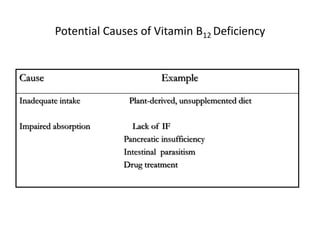
Potential Causes of Vitamin B12 Deficiency
Cause Example
Inadequate intake Plant-derived, unsupplemented diet
Impaired absorption Lack of IF
Pancreatic insufficiency
Intestinal parasitism
Drug treatment
Vitamin B12 Deficiency
• Inadequate absorption is primarily responsible
• Inadequate intake is more common among
vegetarians
– Prevent with consumption of fortified cereals
• Occurs in stages
– Low serum concentrations
– Low cell concentrations
– Decreased DNA synthesis
• High Hcy and MMA
– Megaloblastic Anemia
Assessment
– Serum B12
– MMA*
– Hcy
– Schilling test
• Used to determine problems with absorption
• Administer radioactive vitamin B12 and measure its
urinary excretion

Vit b12

  • 1.
  • 2.
    Vitamin B12 (Cobalamin) • VitaminB12 is generic name for group of compounds called corrinoids – corrin nucleus – atom of cobalt in center – attached are one of following • CN = cyanocobalamin (CNCbl) • OH=hydroxocobalamin (OHCbl) • 5’-adenosyl=adenosylcobalamin*(AdoCbl) • -CH3=methylcobalamin* (MeCbl)
  • 3.
    Vitamin B12 P H2N N N O NH2 NH2 O NH2 O HOH O OH N H O O O N Co N O O O- O C NH H2N H2N N N
  • 4.
    Sources • Seldom foundin foods from plants • Synthesis is limited to bacteria. Rumen microbial synthesis depend on the supply of cobalt in the diet • Animal products – Derive their cobalamin from micro-organisms – Meat, poultry, fish, shellfish, eggs, milk, milk products – Liver is a good source • Supplements – Cyanocobalamin and hydroxycobalamin
  • 5.
    Sources of VitaminB12 in Foods Food Vitamin B12 (µg/100g) Food Vitamin B12 (µg/100g) Meats Beef 1.94-3.64 Beef brain 7.83 Beef kidney 38.3 Beef liver 69-122 Chicken 0.32 Chicken liver 24.1 Ham 0.8 Pork 0.55 Turkey 0.379 Dairy products Milk 0.36 Cheeses 0.36-1.71 Yoghurt 0.06-0.62 Fish and sea food Herring 4.3 Salmon 3.2 Trout 7.8 Tuna 2.8 Clams 19.1 Oysters 21.2 Lobster 1.28 Shrimp 1.9 Other Eggs, whole 1.26 Eggs white 0.09 Eggs yolk 9.26 Vegetables,grains,fruits none contain vitamin B12
  • 6.
    Digestion/Absorption • Ingested cobalaminsmust be released from food matrix – Attached to polypeptides in foods – Release occurs via action of pepsin • Functions at low pH • Requires adequate HCl production • Released cobalamin interacts with: – R-binders (R-protein), Transcobalamin (TCI), Haptocorrin (Hc) • R protein (found in saliva and gastric juice) • Non-specific • Complex moves from stomach into SI • In duodenum, R protein is hydrolyzed by proteases – Inhibited by pancreatic insufficiency
  • 7.
    Absorption • Cobalamins bindto IF in proximal intestine – Cobalamin-IF complex travel to ileum – Binds to receptors and is slowly absorbed into enterocyte • Can occur by passive diffusion when pharmacologic amounts are given – Used for people not producing IF • Malabsorption occurs – Achlorydia – Lack of IF – Pancreatic insufficiency • Absorption rate decreases with increased intake (80% to 3%)
  • 8.
    In Circulation • Cobalaminsbound to one of three proteins called transcobalamins – TCI = binds 90% of vitamin B12 and may function as circulating storage form (hoptocorrin) – TCII = carries newly absorbed cobalamin to tissues and helps with uptake of cobalamin • Receptors on cells for TCII – TCIII = delivers cobalamin from periphery back to liver – Methylcobalamin and adenosylcobalamin found primarily in blood • Stored in liver (adenosylcobalamin)
  • 9.
    Vitamin B12 Absorptionin Ileum Pernicious Anemia Toh, B-H et al. NEJM 337:1441,1991 End stage of type A chronic atrophic (autoimmune) gastritis
  • 10.
    B12 R + B12 B12 B12 IF+ B12 IF . B12 TCII . B12 IF IF IF IF IF R R Pancreatic proteases (degradation of R protein) Acid pH Ileal receptor Stomach Vitamin B12 absorption
  • 11.
    Transport • TC receptorsare degraded upon cellular uptake to release B12. • All vitamin within cell is bound to protein: – Methionine synthetase (cytosol) and methymalonyl-CoA mutase (mitochondria) • Distribution in tissues – Total body store 2-5mg – Liver (60%) – Long biological half life: 350-400 days in human. – Low reserve in infant: about 25 μg. – Plasma: methylcobalamin (60-80% of total)
  • 12.
    Vitamin B12 • Metabolism –Whole-body turnover ~ 0.1% / day – Turnover rate is about 2.5 μg/day – Loss of vitamin mainly due to fecal loss • Excretion: 0.1-0.2% of total body reserve
  • 13.
    Metabolic Roles ofVitamin B12 in Animals Enzyme Metabolic function Adenosylcobalamin Methylmalonyl-CoA mutase Conversion of methylmalonyl-CoA to succinyl-CoA in the degradation of propionate. L-α-Leucine mutase Conversion of L-α-Leucine to aminoisocapronate as the first step in the synthesis/degradation of the amino acid Methylcobalamin Methionine synthetase Methylation of homocysteine to produce methionine, serving as the methyl group carrier between the donor 5-methyl-FH4 and the acceptor homocysteine
  • 14.
    Functions • Three knownenzymatic reactions require Vitamin B12 – Methylcobalamin required for methionine synthesis from Hcy (cytosol) • Nitrous oxide inhibits MS • Oxidizes cobalt from 1+ to 3+ state • Must be in +1 state to function as coenzyme – Adenosylcobalamin • Required for two reactions • Both are mutases and function in mitochondria
  • 15.
    Possible role ofvitamin B12 in choline and methionine synthesis Serine Methionine Vitamin B6 CH3-cobalamin S-adenosyl CO2 transmethylase homocysteine CH3-cobalamin Ethanolamine Choline
  • 16.
    Adenosylcobalamin • Methylmalonyl CoAmutase – Converts L-methylmalonyl CoA generated from propionyl CoA to succinyl CoA – Propionyl CoA generated from oxidation of • Odd chain fatty acids • Valine,methionine, isoleucine, threonine – In cobalamin deficiency • Methylmalonyl CoA and methylmalonic acid (MMA) accumulate; see rise in blood and urine • Have observed genetic defects in methylmalonyl CoA mutase and adenosylcobalamin synthesis
  • 17.
    Vitamin B12-dependent isomerizationof methylmalonyl CoA to succinyl CoA Valine CO2 methylmalonyl Isoleucine mutase Methionine Propionyl CoA Methylmalonyl CoA Succinyl CoA krebs’ Threonine adenosyl Cycle cobalamin
  • 18.
    Adenosylcobalamin • Leucine Aminomutase –Requires adenosylcobalamin as co-enzyme – B leucine generated from bacteria in gut may be converted to L-leucine in body – Beta leucine may also be generated from L-leucine and undergo transamination and provide alternate route for leucine catabolism
  • 19.
    Signs of VitaminB12 Deficiency Organ system Signs General Growth Decrease Vital organs Hepatic, cardiac and renal steatosis Fetus Hemorrhage, myopathy, death Circulatory Erythrocytes Anemia Nervous Peripheral neuropathy
  • 20.
    Deficiency • Definite association –Megaloblastic anemia – Neuropathy • Possible association – Atheroma • Hcy • Pernicous anemia : no increase – NTDs • B12 association – Hepatic steatosis • Ethanol inhibits methionine synthase • Methionine and choline deficiency
  • 21.
    Megaloblastic anemia • LowB12  low methionine and THF  high tHcy and 5-CH3-THF • Low THF  low 5,10-CH2-THF  low conversion of dUMP to dTMP  low DNA synthesis • Low methionine and SAM: low methylene reductase – 5,10-CH2-THF 5-CH3-THF (irreversible) – 5-CH3-THF: poor substrate for glutamate synthetase, poor incorporation into CH3-Cbl (folate deficiency)
  • 22.
    Neuropathy • Undetected VitaminB12 deficiency leads to neuropathy (10+ years) • Cause – Related to availability of methionine for SAM?? – SAM required for methylation reactions • Essential for myelin maintenance and thus neural function • Neuropathy induced in animals by N2O inhalation • Neuropathy associated with N2O inhalation in Humans • Congenital deficiency
  • 23.
    Congenital Disorders ofVitamin B12 Metabolism Condition Missing/deficient factor Signs/symptoms Methylmalonic aciduria Lack of intrinsic factor Imerslund-Gräsbeck syndrome Lack of transcobalamins Lack of R proteins Methylmalonyl-CoA mutase Intrinsic factor IF receptors Transcobalamins R proteins Methylmalonic aciduria, homocysteinuria, lethargy, muscle cramps, vomiting, mental retardation Signs consistent with vitamin B12 deficiency Specific malabsorption of vitamin B12 Severe (fatal) megaloblastic anemia appearing early in life None
  • 24.
    Disorders of Cblabsorption • Malabsorption of food • Achlorydia: Corrected with synthetic source • Pancreatic Insufficiency – Low pancreatic enzymes, bicarbonate, affect intestinal pH • Pernicious anemia – Low If secretion, antibodies (blocking and binding) • Gastrectomy and destruction of gastric mucosa » Treat with pharmacologic amounts of Vit B12 • Decreased absorptive surface – Ileal resection, celiac and tropical sprue, ileitis • Parasitic Infections (Tape Worm) • Infestation of the intestinal lumen: – Competition with bacteria • AIDS: Low B12 (uptake of IF-B12 complex)
  • 25.
    Vitamin B12 deficiency •Disorders of transport – TCII deficiency (1st or 2nd month of life) • Inherited disorders of Cbl metabolism – Disorders of AdoCbl (CblA and CblB) and methylmalonyl CoA mutase • OHCbl to AdoCbl!! • No megaloblastic anemia or neuropathy • Defects in cellular CH3-Cbl and AdoCbl synthesis – Treatment with OH-Cbl: variable response • Defects in CH3-Cbl syntheis – Failure to thrive, vomiting, anemia, neuropathy
  • 26.
    Vitamin B12 (Cobalamin) Commoninitial sign of B12 deficiency: The red sore tongue, with atrophy of the papillae is often present in pernicious anemia and, in the case illustrated, angular stomatitis is also present.
  • 27.
    Vitamin B12 (Cobalamin) Pallorof pernicious anemia: There is a pronounced lemon- yellowish tint to the skin together with faint icterus of the sclerae due to hyperbilirubinanemia. The skin is often velvety smooth, yet inelastic. It is remarkable how frequently patients have blonde or prematurely grey hair and light-colored irises.
  • 28.
    Potential Causes ofVitamin B12 Deficiency Cause Example Inadequate intake Plant-derived, unsupplemented diet Impaired absorption Lack of IF Pancreatic insufficiency Intestinal parasitism Drug treatment
  • 29.
    Vitamin B12 Deficiency •Inadequate absorption is primarily responsible • Inadequate intake is more common among vegetarians – Prevent with consumption of fortified cereals • Occurs in stages – Low serum concentrations – Low cell concentrations – Decreased DNA synthesis • High Hcy and MMA – Megaloblastic Anemia
  • 30.
    Assessment – Serum B12 –MMA* – Hcy – Schilling test • Used to determine problems with absorption • Administer radioactive vitamin B12 and measure its urinary excretion

Editor's Notes

  • #3 CNCbl Mw 1355 Fe in heme and seroheme Mg in chlorophyll Cu in turacin ( pigment of turaco bird feathers) Ni in F430 Conversion of CNCbl or OHCbl to AdoCbl: the reaction require thiol or dithiol, reduced flavin and ATP (coenzyme thynthetase) AdoCbl and MeCbl unstable to light CNCbl is slowly decomposed by strong visible light CNCbl stable to air, in dry form stable to 1000C for few hours Aqueous solution at pH 4-7 can be autoclaved at 120oC
  • #7 Hc high affinity for MECbl and AdoCbl at acidic condition In intestine: high pH affect Hc not IF (B12 transferred to IF) Function of Hc in SI is to remove Cbl anlogues Absorption of B12 in the last 60 cm of Ileum
  • #8 IF secretion by stomach cells, stimulated gastric histamine and acetylcholine After small dose (10-20ug): Cbl appears in blood 3-4 hours later and peak at 8-12 hours Large doses: passive diffusion: in blood within minutes Uptake of IF-Cbl by TCII depend on Ca, pH 6 and components in bile Absorbed Cbl is converted to AdoCbl and MeCbl in mitochondria of ileal cells, in blood bound to TCII ( appears after 3 hours (TCII1/2 life 6hrs) Enterohepatic cycle
  • #9 TCI : ½ life 9.3-9.8 days Source of TCI: liver, intestine, endothelial cells Uptake of IF-Cb  TCII depend on Ca, Ph6 and components in bile Absorbed Cb converted to Ad and MCbl: mitochondria of ileal cells In blood bound to TCII after 3 hrs (TCII ½ life 6hrs) Vitamin AdoCbl and meCbl: high affinity for Hc than IF at acidic condition High pH: proteolysis of Hc not IF Enterocyte cell wall receptors (IFCR)
  • #12 Cbl converted to Me Cbl in cytosol and binds to Methionine synthetase (cytosol) or converted to AdoCbl in mitochondria and binds to methymalonyl-CoA mutase (mitochondria) In liver, RBC, Kidney, brain mainly: AdoCbl (70%) In human: 0.5-9ug of Cbl  gut via bile  65-75% reabsorbed by IF-dependent process
  • #23 Normal ratio of: SAM:SAHcy in brain is 4:1, in B12 deficiency SAHcy and Hcy accumulate Other organs can remethylate Hcy via betaine (kidney and liver) Neuropathy induced in animals by N2O (nitrous oxide) inhalation In monkeys irreversible inhibition of methionine synthase Neuropathy associated with N2O inhalation in Humans Acute N2O inhalation: megaloblastic anemia Chronic inhalation: neuropathy Congenital deficiency Methylene reductase, methionine synthetase, adometh synthase, methylcobalamin synthesis
  • #31 MMA rise in renal failure