Drugs in
Lactation
Al-Quran
“Mothers shall suckle their children two years
completely” 2:233
Hadith
“A woman in her pregnancy to the time of
her delivery to the time of her weaning is like
a soldier in the way of Allah.”
Points under discussion
Anatomy of lactating breast.
Hormonal regulation of lactation.
Guidelines for chemotherapy during
lactation.
Different drugs that may or may not be given
during lactation.
And drugs that affect lactation itself.
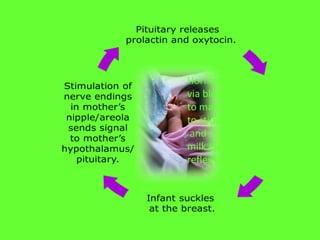
Hormones travel
via bloodstream
to mammary gland
to stimulate milk production
and
milk ejection
reflex (let-down
Maternal Factors
That Support
Optimal Lactation
• Normal breast anatomy
• Intact neuroendocrine reflex
• Good general health and nutritional status
• Effective support system
The guidelines for chemotherapy
during lactation:
The following principles should be followed
when prescribing for breastfeeding mothers:
Avoid unnecessary drug use and limit use of
over-the-counter (OTC) products.
.
• Avoid use of drugs known to cause
serious toxicity in adults or children.
• Assess the benefit/risk ratio for both
mother and infant
Drugs licensed for use in infants
do not generally pose a hazard.
Neonates(and particularly premature
infants)are at greater risk from exposure to
drugs via breast milk, because of immature
excretory functions & consequent risk of
accumulation.
• A regimen that presents minimum amount of
drug to infant should be followed.
• Its best to avoid long acting preparations
especially of those drugs which cause serious
side effects(e .g. antipsychotic agents).
• Multiple drug regimens should be avoided.
Infants exposed to drugs via breast milk
should be monitored regularly.
Shortest course should be employed.
Look out!!!
These drugs appear in milk in toxic amounts and
should be avoided at all costs:
• Only a few drugs pose a clinically significant
risk to breastfed babies.
• In general, antineoplastic, drugs of abuse,
some anticonvulsants, ergot alkaloids, and
radiopharmaceuticals should not be taken.
• levels of amiodarone, cyclosporine, and
lithium should be monitored
Other drugs
Anti-hypertensives
• Beta blockers: lipid soluble agents
preferred. Lipid solubility governs plasma
protein binding which is the major
determinant of passage of drug in milk.
• Water soluble agents like atenolol and
nadolol should be avoided in neonates.
• They cause
hypotension,hypothermia,bradycardia an
cyanosis.
• Safe beta-
blockers:betoxalol,labetalol,metopr
olol,propranolol,timolol etc.
Thiazides: they are used except in very
high doses because they suppress
lactation.
Angiotensin-converting enzyme inhibitors:
Captopril,Enalapril are used.
Calcium-channel blockers:
Diltiazem,nifedipine,Verapamil
,Hydralazine are used because
they have low levels in milk.
Anti-coagulants
• ORAL ANTICOAGLANTS:
Warfarin: anticoagulant of choice. Very low
levels in milk.
Phenindione: contraindicated!!! may cause
hematoma.
Heparins: not absorbed by infant.
Anti-asthma agents
Preferred route of administration is via
inhalation.
SAFE DRUGS:
• BETA ANTAGONIST: Terbutaline,salbutamol
etc.They are safe after oral dosing.
• XANTHINES: theophylline. May cause infant
irritation and fretful sleep and should be
avoided in premature infants.
• .
• CORTICOSTEROIDS: prednisolone(up
to 50mg daily)low levels in milk.
• ANTI-MUSCARINIC AGENTS:
ipratropium,oxitropium.
Anti-convulsants
• sodium valproate, carbamazepine. These
are safe drugs but anti convulsants are
mostly avoided because they usually tend
to have serious adverse affects.
Contraindicated:
Phenobarbitone:long half life. Adverse
effects include sedation, poor feeding and
possible deaths have been reported.
Primodone: metabolized to 2 active
metabolites including phenobarbitone.
Clonazepam: may cause apnea in infant.
Latest drug in use
Paxil (paroxitene)
Anti-depressants
Monitor for drowsiness and poor feeding.
• Tricyclic antidepressants which are non-
sedating like imipramine & nortriptyline may
be used.
• Contraindicated:
Tricyclic sedating anti-de-
pressants like amitriptyline-
diothiepin and MAOIs.
Anti-diarrheals
First line treatment for acute diarrhea is fluid
and electrolyte replacement. Drugs described
below are only second-line treatment.
Adsorbents: kaolin.
Anti-motility ag-
ents: codeine pho-
sphate and lopera-
mide.
Anti-histamines
Preferred agent is non-sedating, has a favorable ADR
profile, a relatively short half-life and has data to support
safe usage in breast feeding.
Safe drugs:
Non-sedating antihistamines like cetrizine and loratidine.
 Contraindicated: sedating agents such as
chlorpheniramine, clesmatine, diphenydramine,
promethazine :cause risk of drowsiness and poor-
feeding.
 And non-sedating such as Acrivastine & Astemizole:
long half life and risk of accumulation esp. in neonates.
corticosteroids
Corticosteroids generally appear in low levels in
milk.
Preferred route is via inhalation.
Injections unlikely to pose any danger to infant.
Topical applications to the breast area should
be washed and dried before feeding.
Examples:
Dexamethasone,Prednisolone,Fludrocortisone
etc.
Laxatives
Agents that are non-absorbable or poorly
absorbed from the GIT e.g.
 bulk-forming agents:ispaghula,methyl
cellulose.
fecal softeners: arachis oil, docusate.
osmotic agents: lactulose etc.,
are preferred.
Non-steroidal anti inflammatory drugs
COX-inhibitors:
diclofenac,ibuprofen,ketorolac.
contraindicated:
Azapropazone,mafenamic acid.
Topical NSAIDS:
ibuprofen,diclofenac.
Vitamins
Vitamin A: low doses-yes
high doses-NO, because of risk of
hypervitaminosis.
Vitamin B: all forms can be taken
without any risk.
Vitamin C: can be taken.
Vitamin D: small doses
can be given and
improve milk content.
Vitamin K:can be
given. Has no effects
on milk content.
Antibiotics
• No studies show human risk
but animal studies suggest
potential toxicity.
• Animal fetal toxicity
demonstrated ;human risk
undefined.
• beta-
lactams,cephalosporins,clin
damycin,erythromycin,metr
onidazole,sulfonamides,azit
hromycin.
• Chloramphenicol,clarithrom
ycin,flouroquinolones,trime
thoprim,vancomycin,genta
micin,trimethoprim-
sufamethoxazole.
• Human fetal risk
present but benefits
outweigh risks.
• Tectracyclines,aminogly
cosides(or except for
gentamicin).
Some important antibiotics
• Penicillin: 3-15% of the drug in serum is
excreted in milk. The clearance of drug in
newborns is less efficient and can result in
hi.conc.
• Cephalosporins: hypoprothrombinemia &
bleeding disorders.
• Vancomycin: fever and chills.
• Chloramphenicol: penetrates into milk and
dose should be reduced. Excess dosage results
in : Grey baby syndrome
-characterized by
vomiting,flaccidity,hypothermia,cyanosis,shock
and collapse.
• Tetracycline: photosensitivity and vestibular
reaction.
Drugs affecting lactation
Lactation stimulators:
Centrally acting:
influence prolactin
secretion.
Peripherally acting:
increase breast tissue
growth.
Centrally acting:
o Reserpine:inibits formation and secretion of
dopamine from hypothalamus.
o Phenothiazine(dopamine antagonist): inhibits
alpha-adrenergic receptor on hypothalamic
cell.
o metoclopramide,domperidone:dopamine
receptor antagonists.
Peripheral acting:
o Androgen , progesterone & oxytocin: increase
breast tissue growth.
Lactation inhibitors:
Centrally acting.
Peripherally acting.
Centrally acting:
o Ergocryptine:dopamine agonist but devoid of
alpha-adrenergic activity.
o Barbiturates & pyridoxine: decrease in milk
flow.
o L-Dopa: decreases level of prolactin.
Peripherally acting: estrogen promotes ductal
growth but suppress lactation.
Thank you.

Lactation

  • 2.
  • 3.
    Al-Quran “Mothers shall suckletheir children two years completely” 2:233 Hadith “A woman in her pregnancy to the time of her delivery to the time of her weaning is like a soldier in the way of Allah.”
  • 4.
    Points under discussion Anatomyof lactating breast. Hormonal regulation of lactation. Guidelines for chemotherapy during lactation. Different drugs that may or may not be given during lactation. And drugs that affect lactation itself.
  • 5.
    Hormones travel via bloodstream tomammary gland to stimulate milk production and milk ejection reflex (let-down
  • 6.
    Maternal Factors That Support OptimalLactation • Normal breast anatomy • Intact neuroendocrine reflex • Good general health and nutritional status • Effective support system
  • 7.
    The guidelines forchemotherapy during lactation: The following principles should be followed when prescribing for breastfeeding mothers: Avoid unnecessary drug use and limit use of over-the-counter (OTC) products. .
  • 8.
    • Avoid useof drugs known to cause serious toxicity in adults or children. • Assess the benefit/risk ratio for both mother and infant
  • 9.
    Drugs licensed foruse in infants do not generally pose a hazard. Neonates(and particularly premature infants)are at greater risk from exposure to drugs via breast milk, because of immature excretory functions & consequent risk of accumulation.
  • 10.
    • A regimenthat presents minimum amount of drug to infant should be followed. • Its best to avoid long acting preparations especially of those drugs which cause serious side effects(e .g. antipsychotic agents). • Multiple drug regimens should be avoided.
  • 11.
    Infants exposed todrugs via breast milk should be monitored regularly. Shortest course should be employed.
  • 12.
    Look out!!! These drugsappear in milk in toxic amounts and should be avoided at all costs: • Only a few drugs pose a clinically significant risk to breastfed babies. • In general, antineoplastic, drugs of abuse, some anticonvulsants, ergot alkaloids, and radiopharmaceuticals should not be taken. • levels of amiodarone, cyclosporine, and lithium should be monitored
  • 13.
  • 14.
    Anti-hypertensives • Beta blockers:lipid soluble agents preferred. Lipid solubility governs plasma protein binding which is the major determinant of passage of drug in milk. • Water soluble agents like atenolol and nadolol should be avoided in neonates. • They cause hypotension,hypothermia,bradycardia an cyanosis.
  • 15.
  • 16.
    Thiazides: they areused except in very high doses because they suppress lactation. Angiotensin-converting enzyme inhibitors: Captopril,Enalapril are used.
  • 17.
  • 18.
    Anti-coagulants • ORAL ANTICOAGLANTS: Warfarin:anticoagulant of choice. Very low levels in milk. Phenindione: contraindicated!!! may cause hematoma. Heparins: not absorbed by infant.
  • 19.
    Anti-asthma agents Preferred routeof administration is via inhalation. SAFE DRUGS: • BETA ANTAGONIST: Terbutaline,salbutamol etc.They are safe after oral dosing. • XANTHINES: theophylline. May cause infant irritation and fretful sleep and should be avoided in premature infants. • .
  • 20.
    • CORTICOSTEROIDS: prednisolone(up to50mg daily)low levels in milk. • ANTI-MUSCARINIC AGENTS: ipratropium,oxitropium.
  • 21.
    Anti-convulsants • sodium valproate,carbamazepine. These are safe drugs but anti convulsants are mostly avoided because they usually tend to have serious adverse affects. Contraindicated: Phenobarbitone:long half life. Adverse effects include sedation, poor feeding and possible deaths have been reported.
  • 22.
    Primodone: metabolized to2 active metabolites including phenobarbitone. Clonazepam: may cause apnea in infant. Latest drug in use Paxil (paroxitene)
  • 23.
    Anti-depressants Monitor for drowsinessand poor feeding. • Tricyclic antidepressants which are non- sedating like imipramine & nortriptyline may be used. • Contraindicated: Tricyclic sedating anti-de- pressants like amitriptyline- diothiepin and MAOIs.
  • 24.
    Anti-diarrheals First line treatmentfor acute diarrhea is fluid and electrolyte replacement. Drugs described below are only second-line treatment. Adsorbents: kaolin. Anti-motility ag- ents: codeine pho- sphate and lopera- mide.
  • 25.
    Anti-histamines Preferred agent isnon-sedating, has a favorable ADR profile, a relatively short half-life and has data to support safe usage in breast feeding. Safe drugs: Non-sedating antihistamines like cetrizine and loratidine.  Contraindicated: sedating agents such as chlorpheniramine, clesmatine, diphenydramine, promethazine :cause risk of drowsiness and poor- feeding.  And non-sedating such as Acrivastine & Astemizole: long half life and risk of accumulation esp. in neonates.
  • 26.
    corticosteroids Corticosteroids generally appearin low levels in milk. Preferred route is via inhalation. Injections unlikely to pose any danger to infant. Topical applications to the breast area should be washed and dried before feeding. Examples: Dexamethasone,Prednisolone,Fludrocortisone etc.
  • 27.
    Laxatives Agents that arenon-absorbable or poorly absorbed from the GIT e.g.  bulk-forming agents:ispaghula,methyl cellulose. fecal softeners: arachis oil, docusate. osmotic agents: lactulose etc., are preferred.
  • 28.
    Non-steroidal anti inflammatorydrugs COX-inhibitors: diclofenac,ibuprofen,ketorolac. contraindicated: Azapropazone,mafenamic acid. Topical NSAIDS: ibuprofen,diclofenac.
  • 29.
    Vitamins Vitamin A: lowdoses-yes high doses-NO, because of risk of hypervitaminosis. Vitamin B: all forms can be taken without any risk. Vitamin C: can be taken.
  • 30.
    Vitamin D: smalldoses can be given and improve milk content. Vitamin K:can be given. Has no effects on milk content.
  • 31.
    Antibiotics • No studiesshow human risk but animal studies suggest potential toxicity. • Animal fetal toxicity demonstrated ;human risk undefined. • beta- lactams,cephalosporins,clin damycin,erythromycin,metr onidazole,sulfonamides,azit hromycin. • Chloramphenicol,clarithrom ycin,flouroquinolones,trime thoprim,vancomycin,genta micin,trimethoprim- sufamethoxazole.
  • 32.
    • Human fetalrisk present but benefits outweigh risks. • Tectracyclines,aminogly cosides(or except for gentamicin).
  • 33.
    Some important antibiotics •Penicillin: 3-15% of the drug in serum is excreted in milk. The clearance of drug in newborns is less efficient and can result in hi.conc. • Cephalosporins: hypoprothrombinemia & bleeding disorders. • Vancomycin: fever and chills.
  • 34.
    • Chloramphenicol: penetratesinto milk and dose should be reduced. Excess dosage results in : Grey baby syndrome -characterized by vomiting,flaccidity,hypothermia,cyanosis,shock and collapse. • Tetracycline: photosensitivity and vestibular reaction.
  • 35.
    Drugs affecting lactation Lactationstimulators: Centrally acting: influence prolactin secretion. Peripherally acting: increase breast tissue growth.
  • 36.
    Centrally acting: o Reserpine:inibitsformation and secretion of dopamine from hypothalamus. o Phenothiazine(dopamine antagonist): inhibits alpha-adrenergic receptor on hypothalamic cell. o metoclopramide,domperidone:dopamine receptor antagonists.
  • 37.
    Peripheral acting: o Androgen, progesterone & oxytocin: increase breast tissue growth. Lactation inhibitors: Centrally acting. Peripherally acting.
  • 38.
    Centrally acting: o Ergocryptine:dopamineagonist but devoid of alpha-adrenergic activity. o Barbiturates & pyridoxine: decrease in milk flow. o L-Dopa: decreases level of prolactin. Peripherally acting: estrogen promotes ductal growth but suppress lactation.
  • 39.