Vitamin B12, also called cobalamin, is a water-soluble
vitamin. It is one of eight B vitamins. It synthesized by only
microorganisms and not by animals and plants. It was the
last vitamin to be discovered.
Functions:
‱It is needed to absorb iron, Ca, and vitamin A.
‱A key role in the normal functioning of the brain and nervous
system via the synthesis of myelin (myelinogenesis).
‱The formation of red blood cells.
‱It is involved in the metabolism of every cell of the human
body, especially affecting DNA synthesis, fatty acid and
amino acid metabolism.
Vitamin B12
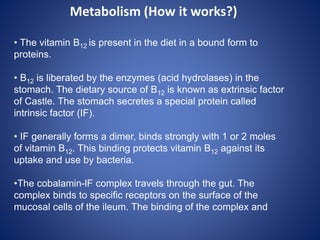
‱ The vitamin B12 is present in the diet in a bound form to
proteins.
‱ B12 is liberated by the enzymes (acid hydrolases) in the
stomach. The dietary source of B12 is known as extrinsic factor
of Castle. The stomach secretes a special protein called
intrinsic factor (IF).
‱ IF generally forms a dimer, binds strongly with 1 or 2 moles
of vitamin B12. This binding protects vitamin B12 against its
uptake and use by bacteria.
‱The cobalamin-lF complex travels through the gut. The
complex binds to specific receptors on the surface of the
mucosal cells of the ileum. The binding of the complex and
Metabolism (How it works?)
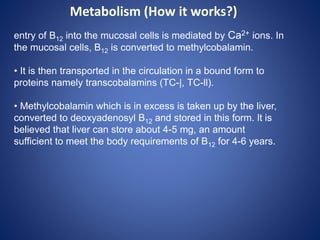
entry of B12 into the mucosal cells is mediated by Ca2+ ions. In
the mucosal cells, B12 is converted to methylcobalamin.
‱ It is then transported in the circulation in a bound form to
proteins namely transcobalamins (TC-|, TC-ll).
‱ Methylcobalamin which is in excess is taken up by the liver,
converted to deoxyadenosyl B12 and stored in this form. lt is
believed that liver can store about 4-5 mg, an amount
sufficient to meet the body requirements of B12 for 4-6 years.
Metabolism (How it works?)
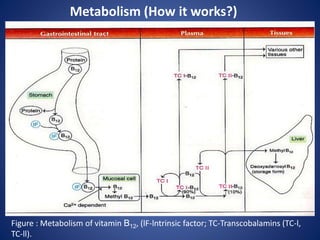
Figure : Metabolism of vitamin B12, (lF-lntrinsic factor; TC-Transcobalamins (TC-l,
TC-ll).
Vitamin B12 deficiency may develop if have:
‱ Atrophic gastritis, in which stomach lining has
thinned.
‱ Conditions that affect your small intestine, such as -
Crohn's disease, celiac disease, bacterial growth, or
a parasite Immune system disorders, such as -
Graves' disease or lupus.
‱ Because plants do not synthesize vitamin B12,
individuals who consume diets completely free of
animal products (vegan diets) are at risk of vitamin
B12 deficiency.
Vitamin B12 Deficiency (Why develop in our body?)
Vitamin B12 deficiency may develop if have:
‱ With age, it can become harder to absorb vitamin
B12. Elderly people over age 60 who produce less
stomach acid, thereby increasing their probability of
B12 deficiencies.
‱ It can also happen if have had weight loss surgery
or another operation that removed part of stomach,
if drink heavily, or if have taken acid-reducing
medications for a long time.
‱ Pernicious anemia, which makes it hard for body to
absorb vitamin B12. It is characterized by low
hemoglobin levels, decreased number of
erythrocytes and neurological manifestations.
Vitamin B12 Deficiency (Why develop in our body?)
One or more of the following causes are attributed to the occurrence
of pernicious anemia.
1. Autoimmune destruction of gastric parietal cells that secrete
intrinsic factor. In the absence of IF, vitamin B12 cannot be absorbed.
2. Hereditary malabsorption of vitamin B12.
3. Partial or total gastrectomy-these individuals become intrinsic
factor deficient.
4. Insufficient production of IF and/or gastric HCl, occasionally seen
in older people.
5. Dietary deficiency of B12, is seen among the strict vegetarians of
low socioeconomic group in the developing countries (India, Srilanka,
etc.).
From the foregoing discussion, it is clear that pernicious anemia is
more a disease of the stomach than due to the deficiency of vitamin
B12.
Vitamin B12 Deficiency (Why develop in our body?)
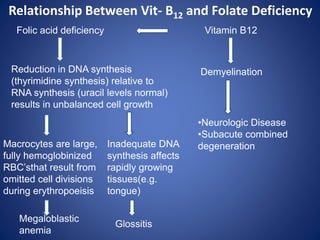
Folic acid deficiency Vitamin B12
Relationship Between Vit- B12 and Folate Deficiency
Demyelination
‱Neurologic Disease
‱Subacute combined
degeneration
Reduction in DNA synthesis
(thyrimidine synthesis) relative to
RNA synthesis (uracil levels normal)
results in unbalanced cell growth
Macrocytes are large,
fully hemoglobinized
RBC’sthat result from
omitted cell divisions
during erythropoeisis
Inadequate DNA
synthesis affects
rapidly growing
tissues(e.g.
tongue)
Megaloblastic
anemia
Glossitis
Vitamin B12 deficiency ( Sign & Symptoms)
If you have vitamin B12 deficiency, you could become anemic. A
mild deficiency may cause no symptoms. But if untreated, it
may lead to symptoms such as:
‱Weakness, tiredness, or lightheadedness
‱Heart palpitations and shortness of breath
‱Pale skin
‱A smooth tongue
‱Constipation, diarrhea, loss of appetite, or gas
‱Nerve problems like numbness or tingling, muscle weakness,
and problems walking
‱Vision loss
‱Mental problems like depression, memory loss, or behavioral
changes
Vitamin B12 Deficiency in case of Maternal & Child
Health Care
‱ A vitamin B12 deficiency is associated with increased risk for
several adverse pregnancy outcomes for both mother and
fetus. These risks include-
i. neural tube defects,
ii. intrauterine growth retardation,
iii. preeclampsia and
iv. early miscarriage.
‱ Even more frighteningly, the neurological and developmental
delays in babies that can be caused by a vitamin B12 deficiency
are irreversible.
‱ According to the World Health Organization, vitamin B12 is
just as important in preventing neural tube and other
neurological defects in infants.
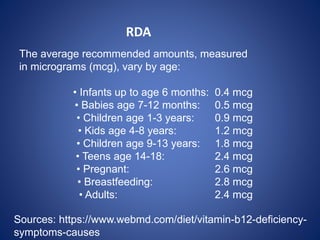
The average recommended amounts, measured
in micrograms (mcg), vary by age:
‱ Infants up to age 6 months: 0.4 mcg
‱ Babies age 7-12 months: 0.5 mcg
‱ Children age 1-3 years: 0.9 mcg
‱ Kids age 4-8 years: 1.2 mcg
‱ Children age 9-13 years: 1.8 mcg
‱ Teens age 14-18: 2.4 mcg
‱ Pregnant: 2.6 mcg
‱ Breastfeeding: 2.8 mcg
‱ Adults: 2.4 mcg
RDA
Sources: https://www.webmd.com/diet/vitamin-b12-deficiency-
symptoms-causes
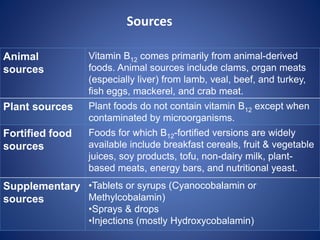
Animal
sources
Vitamin B12 comes primarily from animal-derived
foods. Animal sources include clams, organ meats
(especially liver) from lamb, veal, beef, and turkey,
fish eggs, mackerel, and crab meat.
Plant sources Plant foods do not contain vitamin B12 except when
contaminated by microorganisms.
Fortified food
sources
Foods for which B12-fortified versions are widely
available include breakfast cereals, fruit & vegetable
juices, soy products, tofu, non-dairy milk, plant-
based meats, energy bars, and nutritional yeast.
Supplementary
sources
‱Tablets or syrups (Cyanocobalamin or
Methylcobalamin)
‱Sprays & drops
‱Injections (mostly Hydroxycobalamin)
Sources
‱ Most people can prevent vitamin B12 deficiency by eating
enough meat, poultry, seafood, dairy products, and eggs.
‱ If have pernicious anemia or have trouble absorbing vitamin
B12, need shots of vitamin B12 at first. May need to keep getting
these shots of vitamin B12, take high doses of a supplement, or
get it nasally after that.
‱ If don’t eat animal products, changediet to include vitamin B12
fortified grains, a supplement or B12 injections, or a high-dose
oral vitamin B12 if deficient.
‱ Older adults who have a vitamin B12 deficiency should take a
daily B12 supplement or a multivitamin that contains B12.
‱ For most people, treatment resolves the problem. But, any
nerve damage that happened due to the deficiency could be
permanent.
Treatment & Prevention
Vitamin B12

Vitamin B12

  • 2.
    Vitamin B12, alsocalled cobalamin, is a water-soluble vitamin. It is one of eight B vitamins. It synthesized by only microorganisms and not by animals and plants. It was the last vitamin to be discovered. Functions: ‱It is needed to absorb iron, Ca, and vitamin A. ‱A key role in the normal functioning of the brain and nervous system via the synthesis of myelin (myelinogenesis). ‱The formation of red blood cells. ‱It is involved in the metabolism of every cell of the human body, especially affecting DNA synthesis, fatty acid and amino acid metabolism. Vitamin B12
  • 3.
    ‱ The vitaminB12 is present in the diet in a bound form to proteins. ‱ B12 is liberated by the enzymes (acid hydrolases) in the stomach. The dietary source of B12 is known as extrinsic factor of Castle. The stomach secretes a special protein called intrinsic factor (IF). ‱ IF generally forms a dimer, binds strongly with 1 or 2 moles of vitamin B12. This binding protects vitamin B12 against its uptake and use by bacteria. ‱The cobalamin-lF complex travels through the gut. The complex binds to specific receptors on the surface of the mucosal cells of the ileum. The binding of the complex and Metabolism (How it works?)
  • 4.
    entry of B12into the mucosal cells is mediated by Ca2+ ions. In the mucosal cells, B12 is converted to methylcobalamin. ‱ It is then transported in the circulation in a bound form to proteins namely transcobalamins (TC-|, TC-ll). ‱ Methylcobalamin which is in excess is taken up by the liver, converted to deoxyadenosyl B12 and stored in this form. lt is believed that liver can store about 4-5 mg, an amount sufficient to meet the body requirements of B12 for 4-6 years. Metabolism (How it works?)
  • 5.
    Metabolism (How itworks?) Figure : Metabolism of vitamin B12, (lF-lntrinsic factor; TC-Transcobalamins (TC-l, TC-ll).
  • 6.
    Vitamin B12 deficiencymay develop if have: ‱ Atrophic gastritis, in which stomach lining has thinned. ‱ Conditions that affect your small intestine, such as - Crohn's disease, celiac disease, bacterial growth, or a parasite Immune system disorders, such as - Graves' disease or lupus. ‱ Because plants do not synthesize vitamin B12, individuals who consume diets completely free of animal products (vegan diets) are at risk of vitamin B12 deficiency. Vitamin B12 Deficiency (Why develop in our body?)
  • 7.
    Vitamin B12 deficiencymay develop if have: ‱ With age, it can become harder to absorb vitamin B12. Elderly people over age 60 who produce less stomach acid, thereby increasing their probability of B12 deficiencies. ‱ It can also happen if have had weight loss surgery or another operation that removed part of stomach, if drink heavily, or if have taken acid-reducing medications for a long time. ‱ Pernicious anemia, which makes it hard for body to absorb vitamin B12. It is characterized by low hemoglobin levels, decreased number of erythrocytes and neurological manifestations. Vitamin B12 Deficiency (Why develop in our body?)
  • 8.
    One or moreof the following causes are attributed to the occurrence of pernicious anemia. 1. Autoimmune destruction of gastric parietal cells that secrete intrinsic factor. In the absence of IF, vitamin B12 cannot be absorbed. 2. Hereditary malabsorption of vitamin B12. 3. Partial or total gastrectomy-these individuals become intrinsic factor deficient. 4. Insufficient production of IF and/or gastric HCl, occasionally seen in older people. 5. Dietary deficiency of B12, is seen among the strict vegetarians of low socioeconomic group in the developing countries (India, Srilanka, etc.). From the foregoing discussion, it is clear that pernicious anemia is more a disease of the stomach than due to the deficiency of vitamin B12. Vitamin B12 Deficiency (Why develop in our body?)
  • 9.
    Folic acid deficiencyVitamin B12 Relationship Between Vit- B12 and Folate Deficiency Demyelination ‱Neurologic Disease ‱Subacute combined degeneration Reduction in DNA synthesis (thyrimidine synthesis) relative to RNA synthesis (uracil levels normal) results in unbalanced cell growth Macrocytes are large, fully hemoglobinized RBC’sthat result from omitted cell divisions during erythropoeisis Inadequate DNA synthesis affects rapidly growing tissues(e.g. tongue) Megaloblastic anemia Glossitis
  • 10.
    Vitamin B12 deficiency( Sign & Symptoms) If you have vitamin B12 deficiency, you could become anemic. A mild deficiency may cause no symptoms. But if untreated, it may lead to symptoms such as: ‱Weakness, tiredness, or lightheadedness ‱Heart palpitations and shortness of breath ‱Pale skin ‱A smooth tongue ‱Constipation, diarrhea, loss of appetite, or gas ‱Nerve problems like numbness or tingling, muscle weakness, and problems walking ‱Vision loss ‱Mental problems like depression, memory loss, or behavioral changes
  • 11.
    Vitamin B12 Deficiencyin case of Maternal & Child Health Care ‱ A vitamin B12 deficiency is associated with increased risk for several adverse pregnancy outcomes for both mother and fetus. These risks include- i. neural tube defects, ii. intrauterine growth retardation, iii. preeclampsia and iv. early miscarriage. ‱ Even more frighteningly, the neurological and developmental delays in babies that can be caused by a vitamin B12 deficiency are irreversible. ‱ According to the World Health Organization, vitamin B12 is just as important in preventing neural tube and other neurological defects in infants.
  • 12.
    The average recommendedamounts, measured in micrograms (mcg), vary by age: ‱ Infants up to age 6 months: 0.4 mcg ‱ Babies age 7-12 months: 0.5 mcg ‱ Children age 1-3 years: 0.9 mcg ‱ Kids age 4-8 years: 1.2 mcg ‱ Children age 9-13 years: 1.8 mcg ‱ Teens age 14-18: 2.4 mcg ‱ Pregnant: 2.6 mcg ‱ Breastfeeding: 2.8 mcg ‱ Adults: 2.4 mcg RDA Sources: https://www.webmd.com/diet/vitamin-b12-deficiency- symptoms-causes
  • 13.
    Animal sources Vitamin B12 comesprimarily from animal-derived foods. Animal sources include clams, organ meats (especially liver) from lamb, veal, beef, and turkey, fish eggs, mackerel, and crab meat. Plant sources Plant foods do not contain vitamin B12 except when contaminated by microorganisms. Fortified food sources Foods for which B12-fortified versions are widely available include breakfast cereals, fruit & vegetable juices, soy products, tofu, non-dairy milk, plant- based meats, energy bars, and nutritional yeast. Supplementary sources ‱Tablets or syrups (Cyanocobalamin or Methylcobalamin) ‱Sprays & drops ‱Injections (mostly Hydroxycobalamin) Sources
  • 14.
    ‱ Most peoplecan prevent vitamin B12 deficiency by eating enough meat, poultry, seafood, dairy products, and eggs. ‱ If have pernicious anemia or have trouble absorbing vitamin B12, need shots of vitamin B12 at first. May need to keep getting these shots of vitamin B12, take high doses of a supplement, or get it nasally after that. ‱ If don’t eat animal products, changediet to include vitamin B12 fortified grains, a supplement or B12 injections, or a high-dose oral vitamin B12 if deficient. ‱ Older adults who have a vitamin B12 deficiency should take a daily B12 supplement or a multivitamin that contains B12. ‱ For most people, treatment resolves the problem. But, any nerve damage that happened due to the deficiency could be permanent. Treatment & Prevention