VITAMIN B12
(COBALAMIN)
BY
IBEKWE CHIGOZIE BLESSING
GROUP 12
• Vitamin B12, also called cobalamin, is a water-
soluble vitamin that has a key role in the normal
functioning of the brain and nervous system via the
synthesis of myelin (myelinigenesis), and the
formation of red blood cells. It is one of eight B
vitamins. It is involved in the metabolism of
every cell of the human body, especially
affecting DNA synthesis, fatty acids and amino acid
metabolism.
SOURCES OF VITAMIN B12
• Animal sources
Animals store vitamin
B12 in liver and muscle and some pass the
vitamin into their eggs and milk; meat, liver,
eggs and milk are therefore sources of the
vitamin for other animals, including people.
Insects are a source of B12 for animals (including
other insects and humans).
• Microbial sources
B12 is produced in nature only by
some prokaryotes (certain bacteria
and archaea); it is not made by
any multicellular or single-celled eukaryotes. It
is synthesized by some gut bacteria in humans
and other animals, but humans cannot absorb
the B12 made in their guts, as it is made in
the colon which is too far from the small
intestine, where absorption of
B12 occurs. Ruminants, such as cows and sheep,
absorb B12 produced by bacteria in their guts.
• Grazing animals pick up B12 and bacteria that
produce it from the soil at the roots of the plants
they eat.]
• Feces are a rich source of vitamin B12 and many
species, including, dogs, and cats eat feces.
DIETARY RECOMMENDATION
• The current Estimated Average Requirements
(EARs) for vitamin B12 for women and men ages
14 and up is 2.0 μg/day; the Recommended
Dietary Allowances (RDA) is 2.4 μg/day.
SYNTHESIS AND INDUSTRIAL
PRODUCTION
• Neither plants nor animals are independently
capable of constructing vitamin
B12. Only bacteria and archaea have the enzymes
required for its biosynthesis. Like all
tetrapyrroles, it is derived
from uroporphyrinogen III.
This porphyrinogen is methylated at two pyrrole
rings to give dihydrosirohydrochlorin, which is
oxidized to sirohydrochlorin, which undergoes
further reactions, notably a ring contraction, to
give the corrin ring.
• Industrial production of B12 is achieved
through fermentation of selected
microorganisms. Streptomyces griseus, a
bacterium once thought to be a yeast, was the
commercial source of vitamin B12 for many
years. The species Pseudomonas
denitrificans and Propionibacterium
freudenreichii subsp. shermanii are more
commonly used today. These are frequently
grown under special conditions to enhance yield.
FORMS OF VITAMIN B12
• The four forms (vitamers) of B12 are all deeply
red colored crystals and water solutions, due to
the color of the cobalt-corrin complex.
• Adenosylcobalamin (adoB12)
and methylcobalamin (MeB12) are the two
enzymatically active cofactor forms of B12 that
naturally occur in the body. Most of the body's
reserves are stored as adoB12 in the liver. These
are converted to the other methylcobalamin
form as needed.
• Cyanocobalamin : This is a form of B12 that
can be metabolized in the body to an
active coenzyme form. The cyanocobalamin
form of B12 does not occur in nature normally,
but is a byproduct of the fact that other forms of
B12are avid binders of cyanide (–CN) which they
pick up in the process of activated
charcoal purification of the vitamin after it is
made by bacteria in the commercial process.
Since the cyanocobalamin form of B12 is easy to
crystallize and is not sensitive to air-oxidation, it
is typically used as a form of B12 for food
additives and in many common multivitamins
• Hydroxocobalamin : This is another form of
B12 that is not normally present in the human
body. Hydroxocobalamin is sometimes denoted
B12a. This form of B12 is the form produced by
bacteria, and is what is converted to
cyanocobalmin in the commercial charcoal
filtration step of production. Hydroxocobalamin
has an avid affinity for cyanide ions and has
been used as an antidote to cyanide poisoning. It
is supplied typically in water solution for
injection.
MECHANISM OF ACTION
• Vitamin B12 functions as a coenzyme, meaning
that its presence is required for enzyme-
catalyzed reactions. Three types of enzymes:
• Isomerases : Rearrangements in which a
hydrogen atom is directly transferred between
two adjacent atoms with concomitant exchange
of the second substituent, X, which may be a
carbon atom with substituents, an oxygen atom
of an alcohol, or an amine. These use the
adoB12 (adenosylcobalamin) form of the vitamin.
• Methyltransferases : Methyl (–CH3) group
transfers between two molecules. These use
MeB12 (methylcobalamin) form of the vitamin.
• Dehalogenases : Reactions in which a halogen
atom is removed from an organic molecule.
Enzymes in this class have not been identified in
humans.
ABSORPTION AND DISTRIBUTION
• Methyl-B12 is absorbed by two processes. The
first is an intestinal mechanism using intrinsic
factor through which 1–2 micrograms can be
absorbed every few hours. The second is a
diffusion process by which approximately 1% of
the remainder is absorbed.
DEFICIENCY
• Vitamin B12 deficiency can potentially cause severe
and irreversible damage, especially to the brain and
nervous system. At levels only slightly lower than
normal, a range of symptoms such
as fatigue, lethargy, depression, poor memory,
breathlessness, headaches, and pale skin, among
others, may be experienced, especially in elderly
people (over age 60) who produce less stomach acid
as they age, thereby increasing their probability of
B12 deficiencies. Vitamin B12 deficiency can also
cause symptoms of mania and psychosis.
• Vitamin B12 deficiency is most commonly caused
by low intakes, but can also result from
malabsorption, certain intestinal disorders, low
presence of binding proteins, and use of certain
medications. Vitamin B12 is rare from plant
sources, so vegetarians are more likely to suffer
from vitamin B12 deficiency. Infants are at a
higher risk of vitamin B12 deficiency if they were
born to vegetarian mothers. The elderly who
have diets with limited meat or animal products
are vulnerable populations as well.
MEDICAL USE OF B12
• Vitamin B12 is used to treat vitamin
B12 deficiency, cyanide poisoning, and hereditary
deficiency of transcobalamin II. It is given as part of
the Schilling test for detecting pernicious anemia.
• For cyanide poisoning, a large amount of
hydroxocobalamin may be given intravenously and
sometimes in combination with sodium thiosulfate.
The mechanism of action is straightforward: the
hydroxycobalamin hydroxide ligand is displaced by
the toxic cyanide ion, and the resulting harmless
B12 complex is excreted in urine

Vitamin b12

  • 1.
  • 2.
    • Vitamin B12,also called cobalamin, is a water- soluble vitamin that has a key role in the normal functioning of the brain and nervous system via the synthesis of myelin (myelinigenesis), and the formation of red blood cells. It is one of eight B vitamins. It is involved in the metabolism of every cell of the human body, especially affecting DNA synthesis, fatty acids and amino acid metabolism.
  • 4.
    SOURCES OF VITAMINB12 • Animal sources Animals store vitamin B12 in liver and muscle and some pass the vitamin into their eggs and milk; meat, liver, eggs and milk are therefore sources of the vitamin for other animals, including people. Insects are a source of B12 for animals (including other insects and humans).
  • 5.
    • Microbial sources B12is produced in nature only by some prokaryotes (certain bacteria and archaea); it is not made by any multicellular or single-celled eukaryotes. It is synthesized by some gut bacteria in humans and other animals, but humans cannot absorb the B12 made in their guts, as it is made in the colon which is too far from the small intestine, where absorption of B12 occurs. Ruminants, such as cows and sheep, absorb B12 produced by bacteria in their guts.
  • 6.
    • Grazing animalspick up B12 and bacteria that produce it from the soil at the roots of the plants they eat.] • Feces are a rich source of vitamin B12 and many species, including, dogs, and cats eat feces.
  • 7.
    DIETARY RECOMMENDATION • Thecurrent Estimated Average Requirements (EARs) for vitamin B12 for women and men ages 14 and up is 2.0 μg/day; the Recommended Dietary Allowances (RDA) is 2.4 μg/day.
  • 8.
    SYNTHESIS AND INDUSTRIAL PRODUCTION •Neither plants nor animals are independently capable of constructing vitamin B12. Only bacteria and archaea have the enzymes required for its biosynthesis. Like all tetrapyrroles, it is derived from uroporphyrinogen III. This porphyrinogen is methylated at two pyrrole rings to give dihydrosirohydrochlorin, which is oxidized to sirohydrochlorin, which undergoes further reactions, notably a ring contraction, to give the corrin ring.
  • 9.
    • Industrial productionof B12 is achieved through fermentation of selected microorganisms. Streptomyces griseus, a bacterium once thought to be a yeast, was the commercial source of vitamin B12 for many years. The species Pseudomonas denitrificans and Propionibacterium freudenreichii subsp. shermanii are more commonly used today. These are frequently grown under special conditions to enhance yield.
  • 10.
    FORMS OF VITAMINB12 • The four forms (vitamers) of B12 are all deeply red colored crystals and water solutions, due to the color of the cobalt-corrin complex. • Adenosylcobalamin (adoB12) and methylcobalamin (MeB12) are the two enzymatically active cofactor forms of B12 that naturally occur in the body. Most of the body's reserves are stored as adoB12 in the liver. These are converted to the other methylcobalamin form as needed.
  • 11.
    • Cyanocobalamin :This is a form of B12 that can be metabolized in the body to an active coenzyme form. The cyanocobalamin form of B12 does not occur in nature normally, but is a byproduct of the fact that other forms of B12are avid binders of cyanide (–CN) which they pick up in the process of activated charcoal purification of the vitamin after it is made by bacteria in the commercial process. Since the cyanocobalamin form of B12 is easy to crystallize and is not sensitive to air-oxidation, it is typically used as a form of B12 for food additives and in many common multivitamins
  • 12.
    • Hydroxocobalamin :This is another form of B12 that is not normally present in the human body. Hydroxocobalamin is sometimes denoted B12a. This form of B12 is the form produced by bacteria, and is what is converted to cyanocobalmin in the commercial charcoal filtration step of production. Hydroxocobalamin has an avid affinity for cyanide ions and has been used as an antidote to cyanide poisoning. It is supplied typically in water solution for injection.
  • 13.
    MECHANISM OF ACTION •Vitamin B12 functions as a coenzyme, meaning that its presence is required for enzyme- catalyzed reactions. Three types of enzymes: • Isomerases : Rearrangements in which a hydrogen atom is directly transferred between two adjacent atoms with concomitant exchange of the second substituent, X, which may be a carbon atom with substituents, an oxygen atom of an alcohol, or an amine. These use the adoB12 (adenosylcobalamin) form of the vitamin.
  • 14.
    • Methyltransferases :Methyl (–CH3) group transfers between two molecules. These use MeB12 (methylcobalamin) form of the vitamin. • Dehalogenases : Reactions in which a halogen atom is removed from an organic molecule. Enzymes in this class have not been identified in humans.
  • 15.
    ABSORPTION AND DISTRIBUTION •Methyl-B12 is absorbed by two processes. The first is an intestinal mechanism using intrinsic factor through which 1–2 micrograms can be absorbed every few hours. The second is a diffusion process by which approximately 1% of the remainder is absorbed.
  • 16.
    DEFICIENCY • Vitamin B12deficiency can potentially cause severe and irreversible damage, especially to the brain and nervous system. At levels only slightly lower than normal, a range of symptoms such as fatigue, lethargy, depression, poor memory, breathlessness, headaches, and pale skin, among others, may be experienced, especially in elderly people (over age 60) who produce less stomach acid as they age, thereby increasing their probability of B12 deficiencies. Vitamin B12 deficiency can also cause symptoms of mania and psychosis.
  • 17.
    • Vitamin B12deficiency is most commonly caused by low intakes, but can also result from malabsorption, certain intestinal disorders, low presence of binding proteins, and use of certain medications. Vitamin B12 is rare from plant sources, so vegetarians are more likely to suffer from vitamin B12 deficiency. Infants are at a higher risk of vitamin B12 deficiency if they were born to vegetarian mothers. The elderly who have diets with limited meat or animal products are vulnerable populations as well.
  • 18.
    MEDICAL USE OFB12 • Vitamin B12 is used to treat vitamin B12 deficiency, cyanide poisoning, and hereditary deficiency of transcobalamin II. It is given as part of the Schilling test for detecting pernicious anemia. • For cyanide poisoning, a large amount of hydroxocobalamin may be given intravenously and sometimes in combination with sodium thiosulfate. The mechanism of action is straightforward: the hydroxycobalamin hydroxide ligand is displaced by the toxic cyanide ion, and the resulting harmless B12 complex is excreted in urine

Editor's Notes

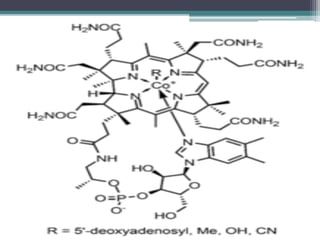
  • #4 STRUCTURE OF VITAMIN B12