
GAS CHROMATOGRAPHY
         VAN DEE METER
            EQUATION

            PREPARED BY:
             Ms. SONAM M. GANDHI
             GUIDED BY:
               PROF A.CENDILKUMAR
7/23/2012                           1
INTRODUCTION
• In the mid 1950s a group of Dutch
  chemicals engineers began a study of the
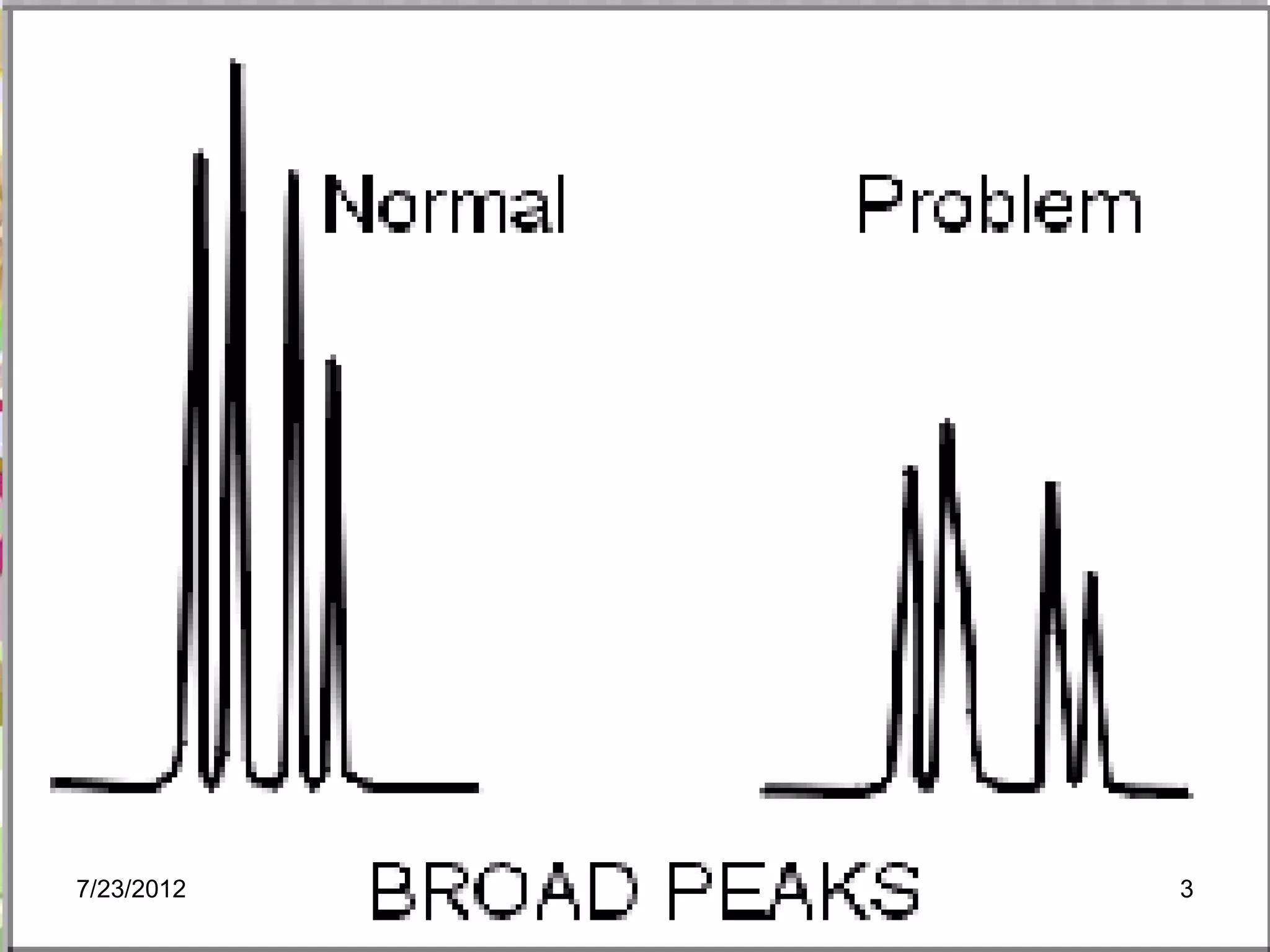
  process that caused band broadening in
  chromatography.
• They derived an expression called as the
  VAN DEEMETER equation, relating the
  height    equivalent to a theoretical
  plate(HETP) to a number of experimental
  parameters , which are
7/23/2012                                2
7/23/2012   3
• Diameter of the stationary phase particles.
• The diffusion coefficients of the solute in
  the stationary phase and mobile phase.
• Flow rate of the mobile phase.


7/23/2012                                       4
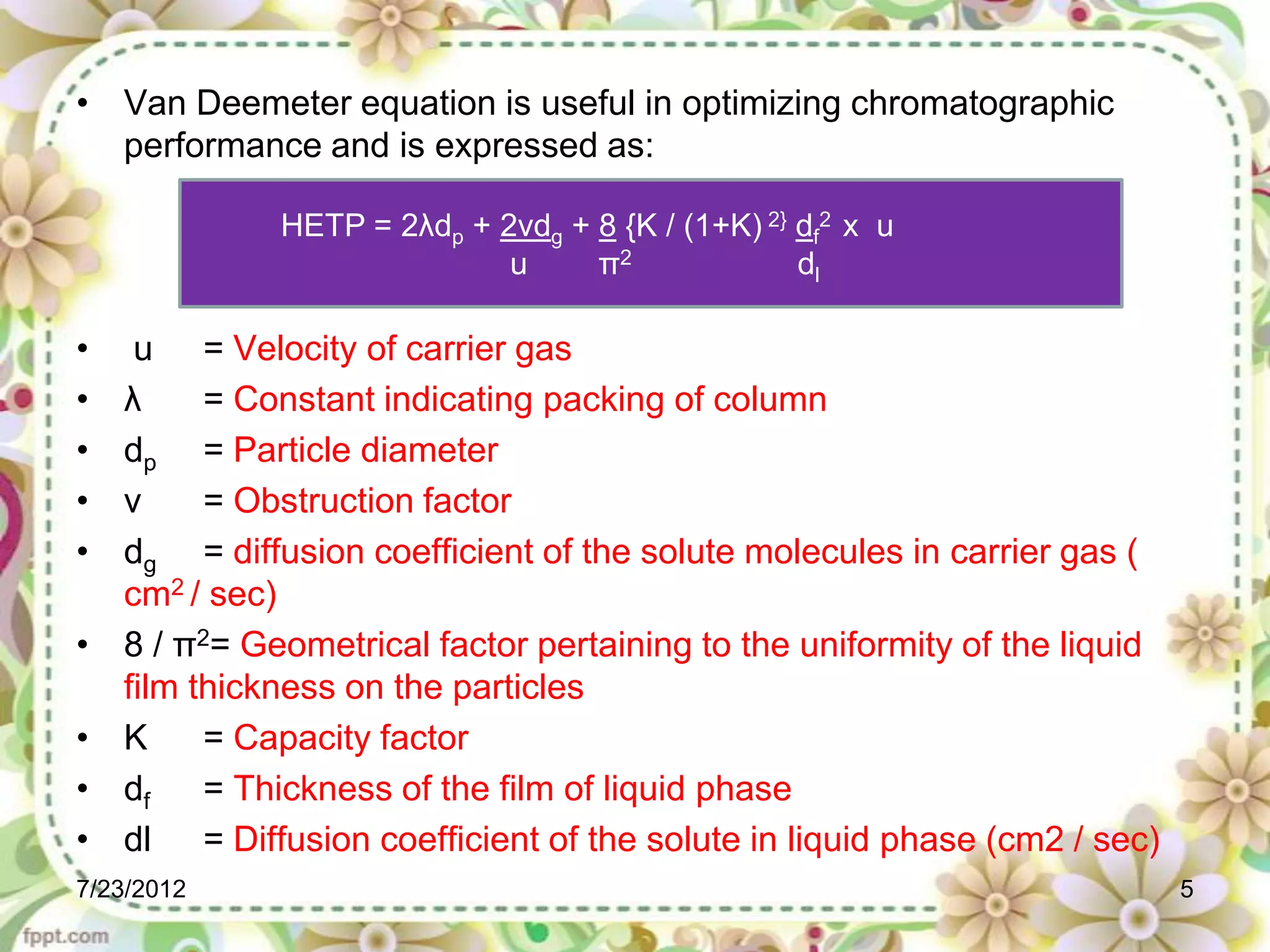
• Van Deemeter equation is useful in optimizing chromatographic
  performance and is expressed as:

              HETP = 2λdp + 2νdg + 8 {K / (1+K) 2} df2 x u
                             u     π2              dl

•    u = Velocity of carrier gas
•   λ     = Constant indicating packing of column
•   dp = Particle diameter
•   ν     = Obstruction factor
•   dg = diffusion coefficient of the solute molecules in carrier gas (
    cm2 / sec)
•   8 / π2= Geometrical factor pertaining to the uniformity of the liquid
    film thickness on the particles
•   K     = Capacity factor
•   df    = Thickness of the film of liquid phase
•   dl = Diffusion coefficient of the solute in liquid phase (cm2 / sec)
7/23/2012                                                                   5
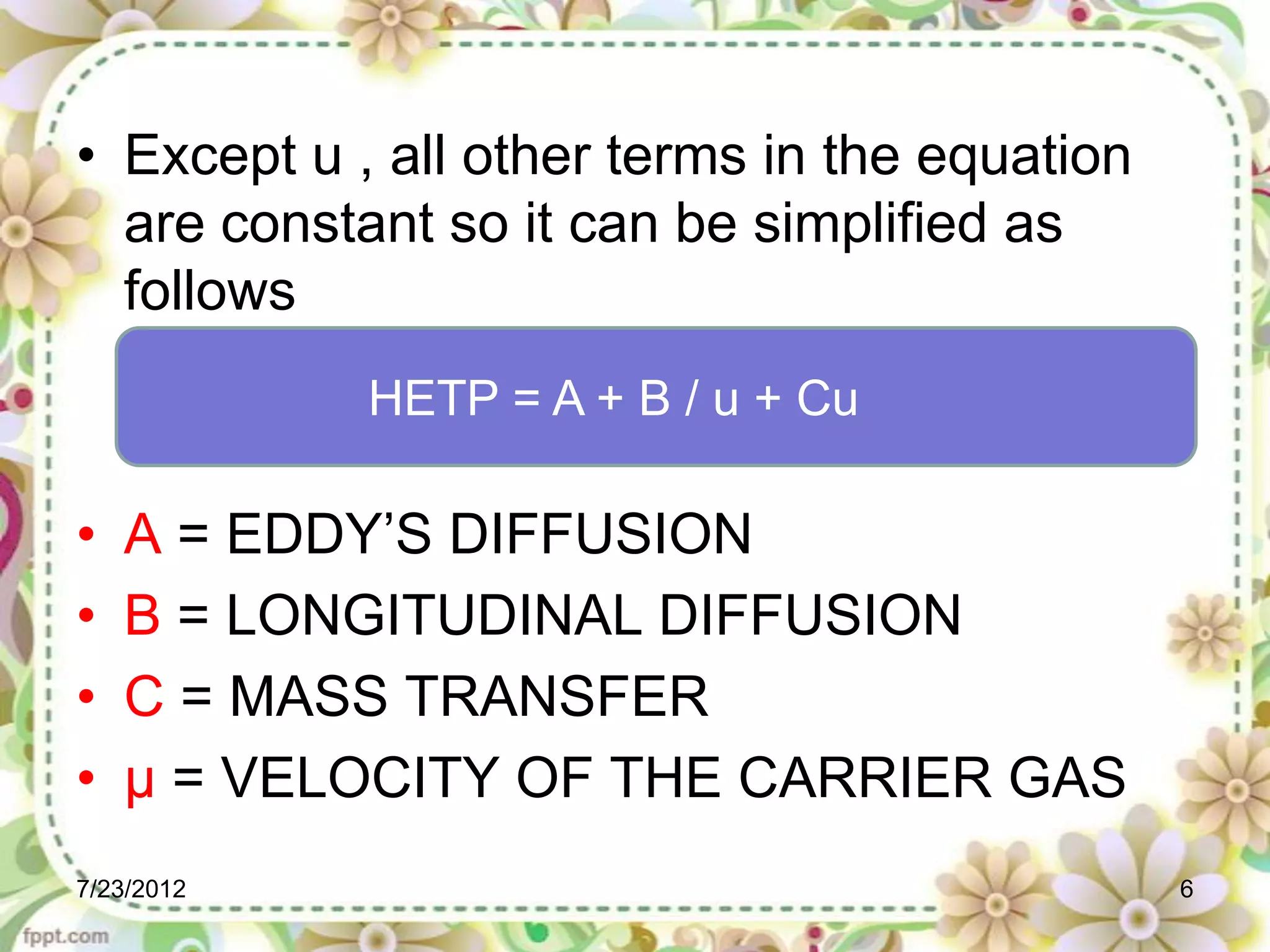
• Except u , all other terms in the equation
  are constant so it can be simplified as
  follows
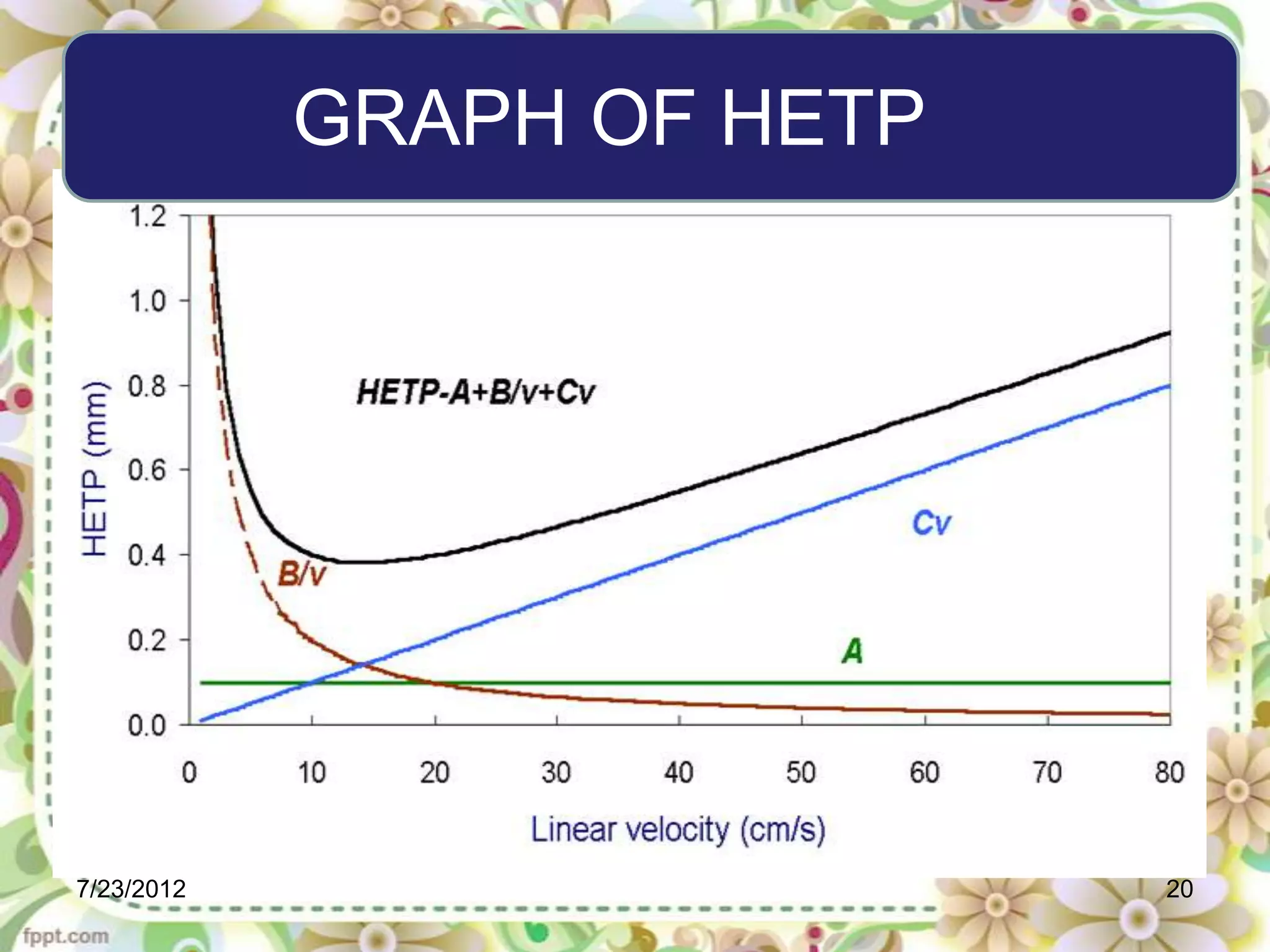
            HETP = A + B / u + Cu

•   A = EDDY’S DIFFUSION
•   B = LONGITUDINAL DIFFUSION
•   C = MASS TRANSFER
•   µ = VELOCITY OF THE CARRIER GAS
7/23/2012                                      6
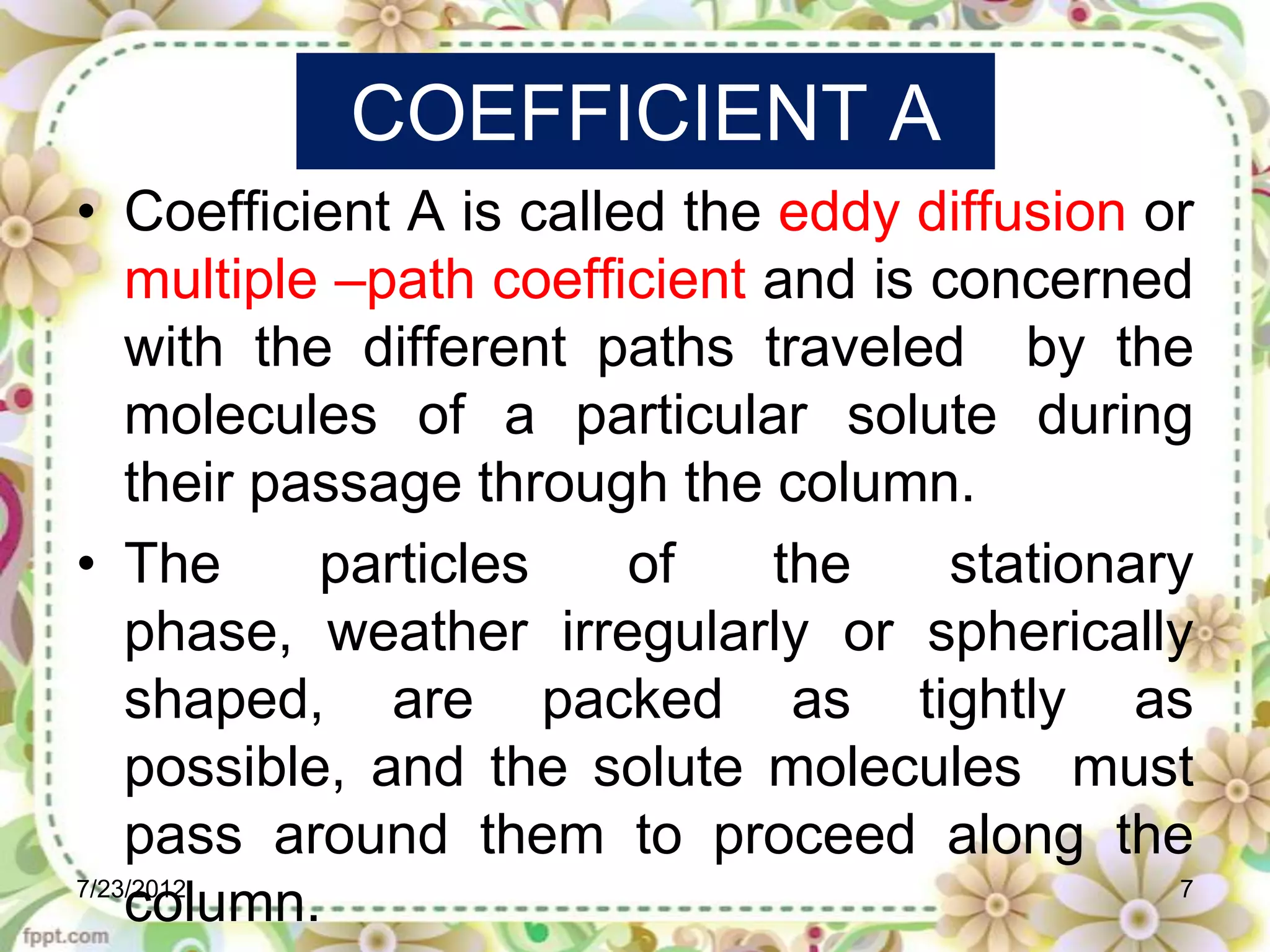
COEFFICIENT A
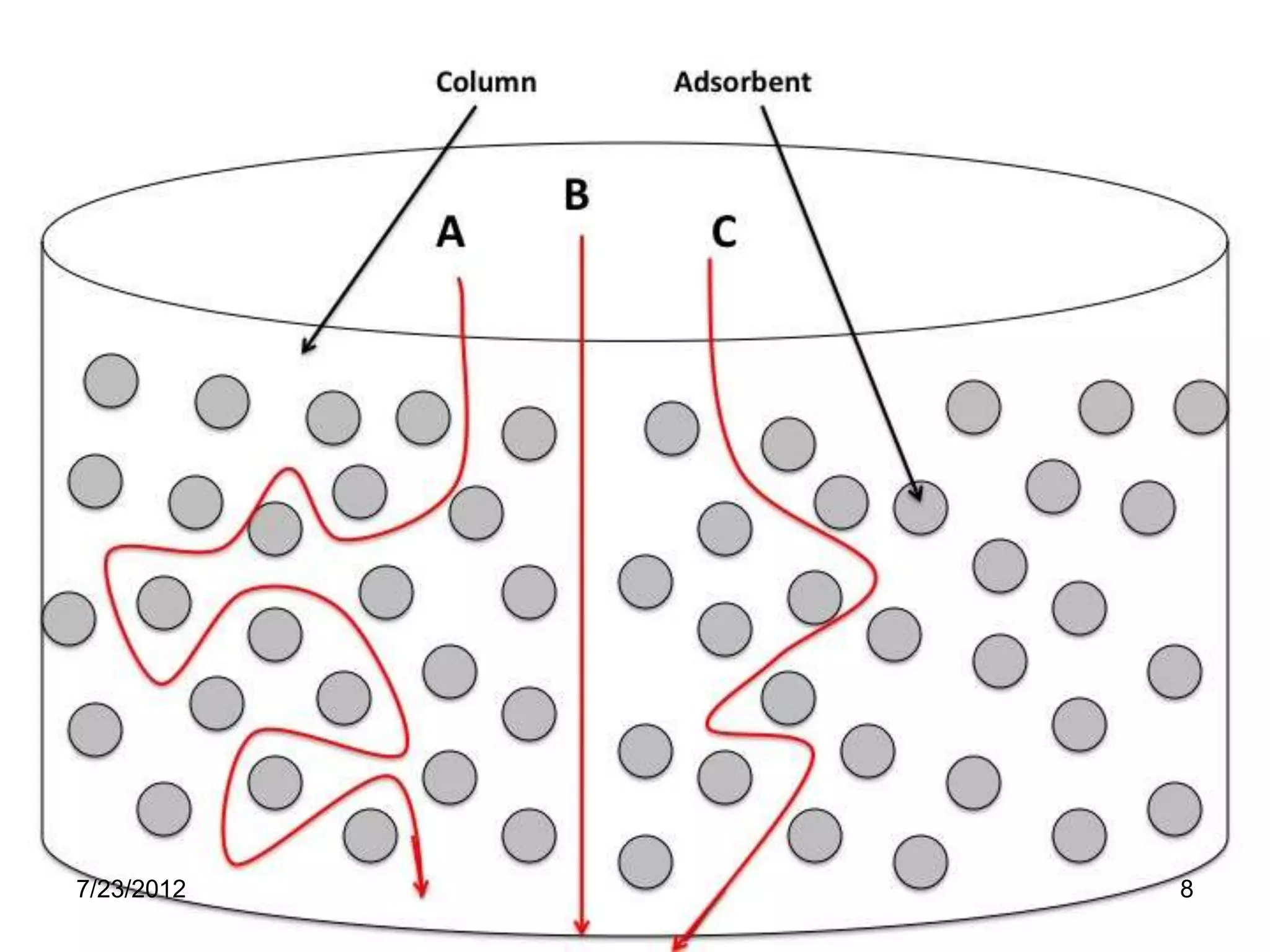
• Coefficient A is called the eddy diffusion or
    multiple –path coefficient and is concerned
    with the different paths traveled by the
    molecules of a particular solute during
    their passage through the column.
• The       particles    of    the     stationary
    phase, weather irregularly or spherically
    shaped, are packed as tightly as
    possible, and the solute molecules must
    pass around them to proceed along the
7/23/2012                                        7
    column.
…


7/23/2012       8
• Because of the large number of possible
  paths , some molecules of the same kind
  will reach the end of the column before
  others .
• Faster molecules found in the leading
  edge of the peak , and slower ones form
  the tailing edge.
• The net effect of this distribution is band
  broadening.
7/23/2012                                   9
• In a modern chromatographic column
  ,which is packed with small , uniformly
  sized particles , the value of A is minimal
  and the contribution of this term to
  increasing the HETP is negligible.
• In GLC column , which contains no solid
  particles, the value of A is zero.


7/23/2012                                  10
7/23/2012   11
COEFFICENT B
       In the van dee meter equation is termed the
         coefficient of longitudinal diffusion. Because
         the concentration of solute is lower at the
         edges of the band than in the center ,a
         gradient exists and, during travel of the band
         through the column, solute is diffusing
         continually through the mobile phase away
         from the center of the band.
       This phenomenon occurs at both the leading
         & trailing edges of the peak & contributes
7/23/2012
         further to band broadening.                  12
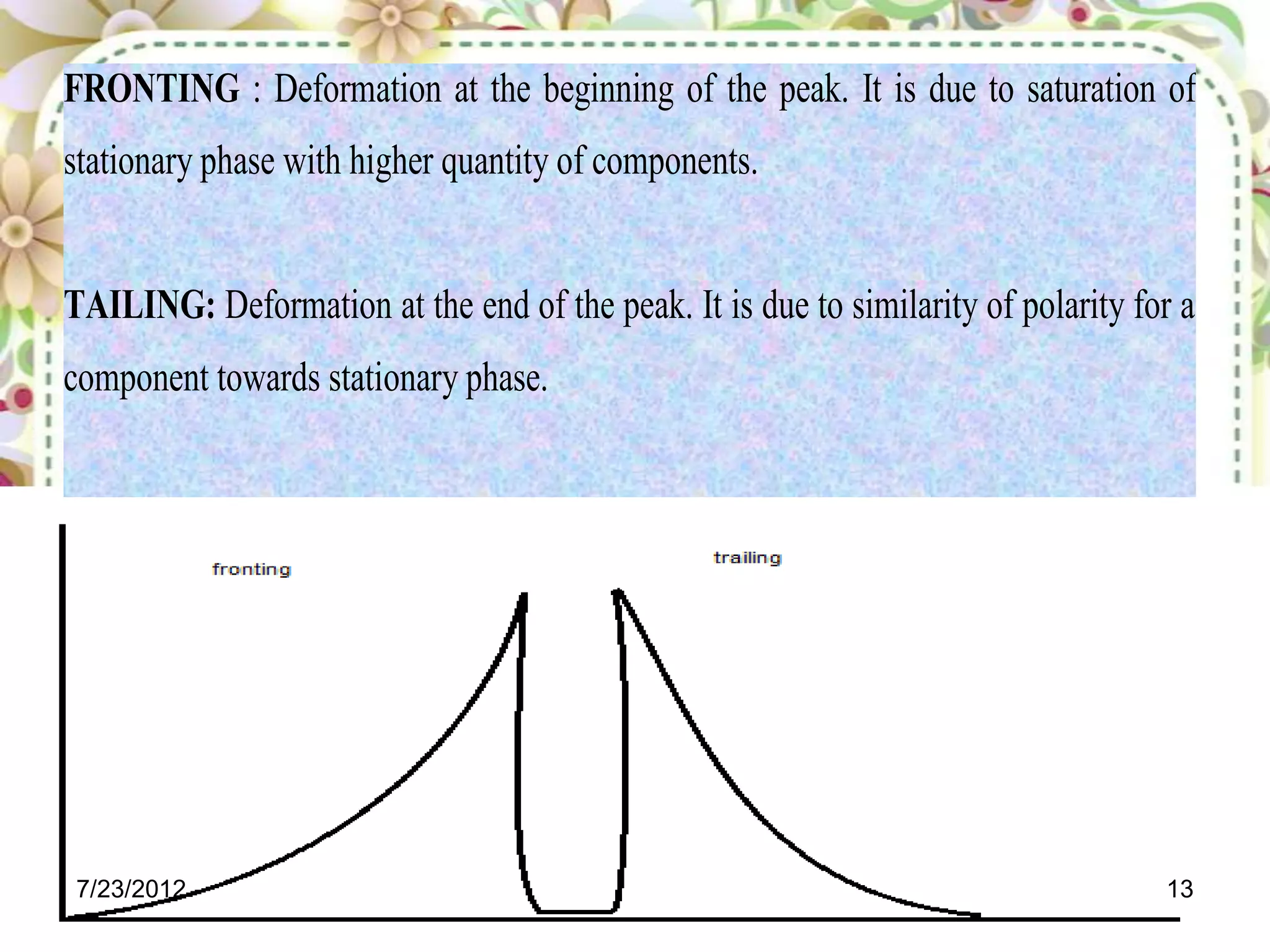
FRONTING : Deformation at the beginning of the peak. It is due to saturation of
stationary phase with higher quantity of components.


TAILING: Deformation at the end of the peak. It is due to similarity of polarity for a
component towards stationary phase.


7/23/2012                                                                          13
• The equation predicts that the contribution
  to the HETP of this is inversely
  proportional to the
• mobile phase velocity
• The effect is more pronounced at low flow
  rates.
• Diffusion effects are more severe in GC
  than in liquid chromatography because
  diffusion coefficient are several orders of
  magnitude higher in the gas.
7/23/2012                                  14
• The contribution of longitudinal diffusion to
  band broadening can be lessened by the
  proper adjustment of flow rates.


7/23/2012                                    15
COEFFICENT C
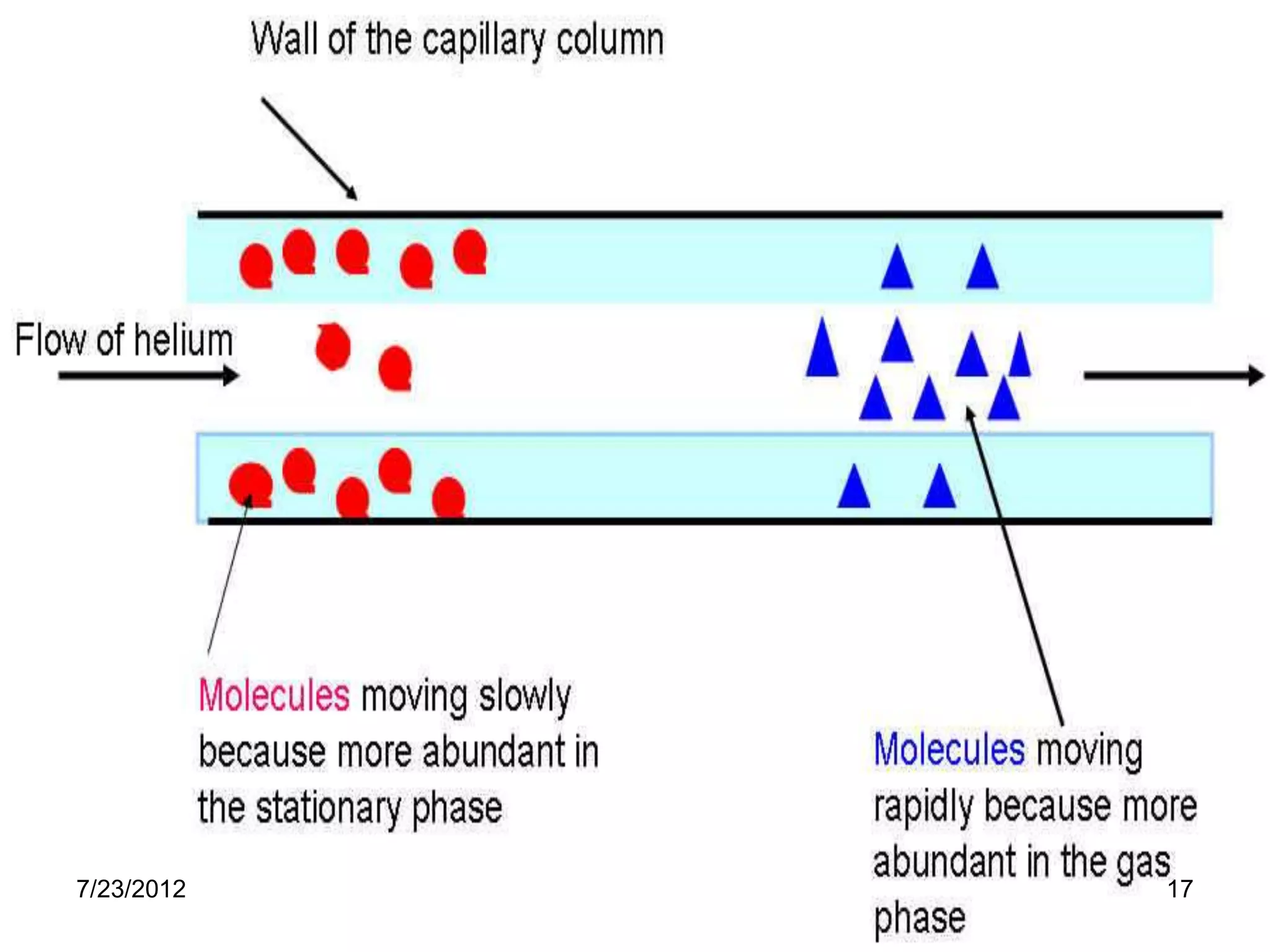
• The co efficient of mass transfer, is
    concerned with the transfer of the solute
    between the two phases.
• Because the mobile phase is moving
    rapidly, equilibrium between the two
    phases may not be attained .
• Therefore, some solute molecules in the
    mobile phase are not transferred to the
    stationary phase quickly enough, and,
    result are carried ahead of the center of
7/23/2012                                   16
    the band.
7/23/2012   17
• Those in the stationary phase are retained
  too long and ,hence, lag behind.
• In contrast to longitudinal diffusion , the
  contribution to the plate height of this term
  directly proportional to the flow rate; thus,
  to minimize the overall effect, a
  compromise in flow rate is necessary.
• Mass transfer effects also may be
  lessened by using a very thin coating of
  the stationary phase so that the area, in
7/23/2012                                    18
• Contact       with the mobile phase is
  maximized while diffusion deep in to the
  stationary phase is reduced.
• An efficient GC column will have several
  thousand theoretical plates , and capillary
  columns will have in excess of 10,000
  theoretical plates.


7/23/2012                                  19
GRAPH OF HETP


7/23/2012                   20
Significance:

• It explains the factors responsible for band
  broadening.
• It also gives the optimum flow rate of M.P
  so as to get minimum HETP.
• Use full in optimizing the chromatographic
  performance.

7/23/2012                                    21
7/23/2012   22

Vandeemeter equation

  • 1.
    GAS CHROMATOGRAPHY VAN DEE METER EQUATION PREPARED BY: Ms. SONAM M. GANDHI GUIDED BY: PROF A.CENDILKUMAR 7/23/2012 1
  • 2.
    INTRODUCTION • In themid 1950s a group of Dutch chemicals engineers began a study of the process that caused band broadening in chromatography. • They derived an expression called as the VAN DEEMETER equation, relating the height equivalent to a theoretical plate(HETP) to a number of experimental parameters , which are 7/23/2012 2
  • 3.
  • 4.
    • Diameter ofthe stationary phase particles. • The diffusion coefficients of the solute in the stationary phase and mobile phase. • Flow rate of the mobile phase. 7/23/2012 4
  • 5.
    • Van Deemeterequation is useful in optimizing chromatographic performance and is expressed as: HETP = 2λdp + 2νdg + 8 {K / (1+K) 2} df2 x u u π2 dl • u = Velocity of carrier gas • λ = Constant indicating packing of column • dp = Particle diameter • ν = Obstruction factor • dg = diffusion coefficient of the solute molecules in carrier gas ( cm2 / sec) • 8 / π2= Geometrical factor pertaining to the uniformity of the liquid film thickness on the particles • K = Capacity factor • df = Thickness of the film of liquid phase • dl = Diffusion coefficient of the solute in liquid phase (cm2 / sec) 7/23/2012 5
  • 6.
    • Except u, all other terms in the equation are constant so it can be simplified as follows HETP = A + B / u + Cu • A = EDDY’S DIFFUSION • B = LONGITUDINAL DIFFUSION • C = MASS TRANSFER • µ = VELOCITY OF THE CARRIER GAS 7/23/2012 6
  • 7.
    COEFFICIENT A • CoefficientA is called the eddy diffusion or multiple –path coefficient and is concerned with the different paths traveled by the molecules of a particular solute during their passage through the column. • The particles of the stationary phase, weather irregularly or spherically shaped, are packed as tightly as possible, and the solute molecules must pass around them to proceed along the 7/23/2012 7 column.
  • 8.
  • 9.
    • Because ofthe large number of possible paths , some molecules of the same kind will reach the end of the column before others . • Faster molecules found in the leading edge of the peak , and slower ones form the tailing edge. • The net effect of this distribution is band broadening. 7/23/2012 9
  • 10.
    • In amodern chromatographic column ,which is packed with small , uniformly sized particles , the value of A is minimal and the contribution of this term to increasing the HETP is negligible. • In GLC column , which contains no solid particles, the value of A is zero. 7/23/2012 10
  • 11.
  • 12.
    COEFFICENT B  In the van dee meter equation is termed the coefficient of longitudinal diffusion. Because the concentration of solute is lower at the edges of the band than in the center ,a gradient exists and, during travel of the band through the column, solute is diffusing continually through the mobile phase away from the center of the band.  This phenomenon occurs at both the leading & trailing edges of the peak & contributes 7/23/2012 further to band broadening. 12
  • 13.
    FRONTING : Deformationat the beginning of the peak. It is due to saturation of stationary phase with higher quantity of components. TAILING: Deformation at the end of the peak. It is due to similarity of polarity for a component towards stationary phase. 7/23/2012 13
  • 14.
    • The equationpredicts that the contribution to the HETP of this is inversely proportional to the • mobile phase velocity • The effect is more pronounced at low flow rates. • Diffusion effects are more severe in GC than in liquid chromatography because diffusion coefficient are several orders of magnitude higher in the gas. 7/23/2012 14
  • 15.
    • The contributionof longitudinal diffusion to band broadening can be lessened by the proper adjustment of flow rates. 7/23/2012 15
  • 16.
    COEFFICENT C • Theco efficient of mass transfer, is concerned with the transfer of the solute between the two phases. • Because the mobile phase is moving rapidly, equilibrium between the two phases may not be attained . • Therefore, some solute molecules in the mobile phase are not transferred to the stationary phase quickly enough, and, result are carried ahead of the center of 7/23/2012 16 the band.
  • 17.
  • 18.
    • Those inthe stationary phase are retained too long and ,hence, lag behind. • In contrast to longitudinal diffusion , the contribution to the plate height of this term directly proportional to the flow rate; thus, to minimize the overall effect, a compromise in flow rate is necessary. • Mass transfer effects also may be lessened by using a very thin coating of the stationary phase so that the area, in 7/23/2012 18
  • 19.
    • Contact with the mobile phase is maximized while diffusion deep in to the stationary phase is reduced. • An efficient GC column will have several thousand theoretical plates , and capillary columns will have in excess of 10,000 theoretical plates. 7/23/2012 19
  • 20.
  • 21.
    Significance: • It explainsthe factors responsible for band broadening. • It also gives the optimum flow rate of M.P so as to get minimum HETP. • Use full in optimizing the chromatographic performance. 7/23/2012 21
  • 22.