
EFFECT OF SYSTEM PARAMETERS ON CONTROLLED
            RELEASE DRUG DELIVERY


                            PRESENTED BY :
              GANDHI SONAM MUKESHCHANDRA


                                             1
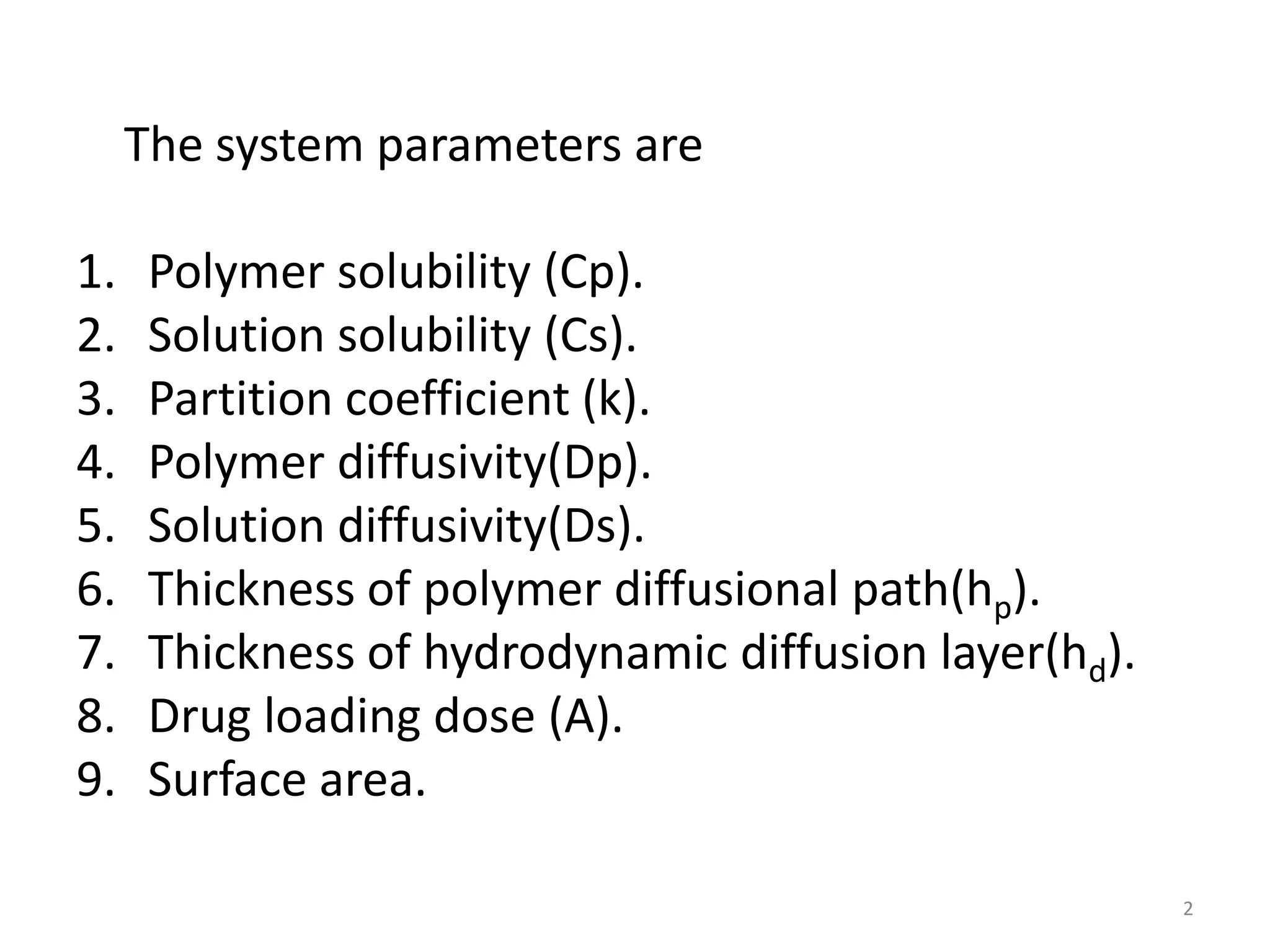
The system parameters are

1.    Polymer solubility (Cp).
2.    Solution solubility (Cs).
3.    Partition coefficient (k).
4.    Polymer diffusivity(Dp).
5.    Solution diffusivity(Ds).
6.    Thickness of polymer diffusional path(hp).
7.    Thickness of hydrodynamic diffusion layer(hd).
8.    Drug loading dose (A).
9.    Surface area.

                                                       2
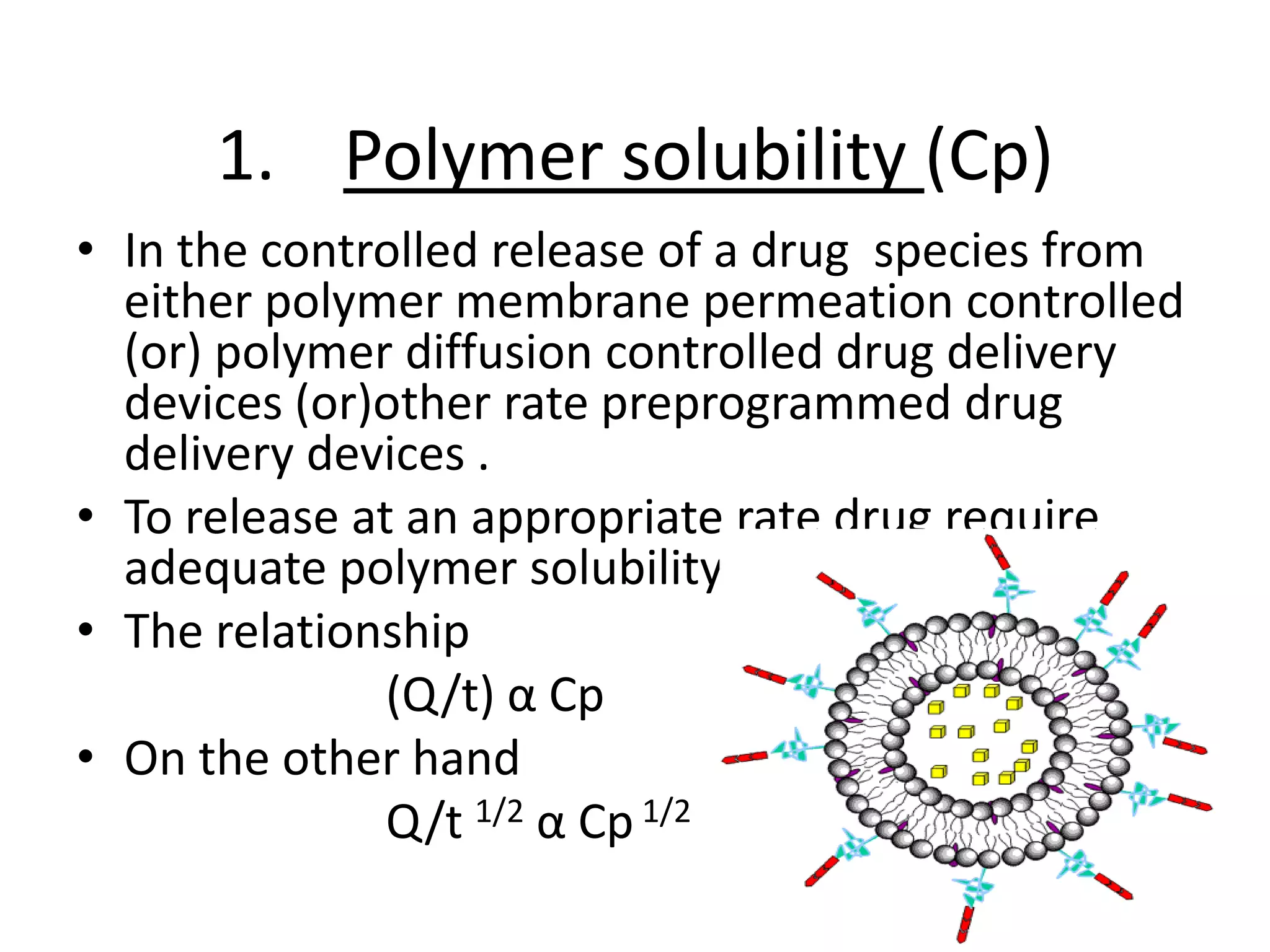
1. Polymer solubility (Cp)
• In the controlled release of a drug species from
  either polymer membrane permeation controlled
  (or) polymer diffusion controlled drug delivery
  devices (or)other rate preprogrammed drug
  delivery devices .
• To release at an appropriate rate drug require
  adequate polymer solubility.
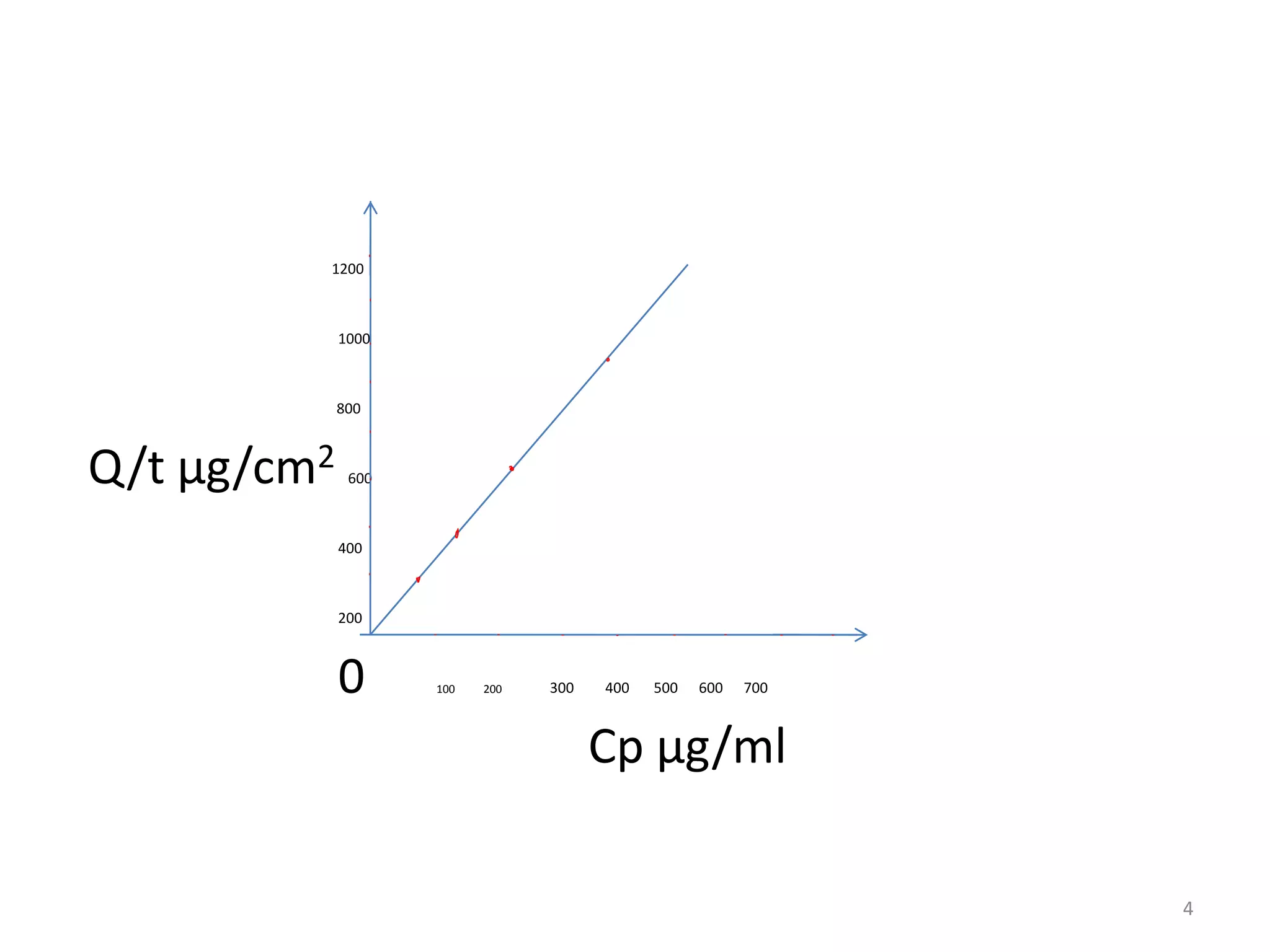
• The relationship
               (Q/t) α Cp
• On the other hand
               Q/t 1/2 α Cp 1/2
                                                 3
1200


             1000


             800


Q/t µg/cm2    600


             400


             200


             0      100   200   300   400   500   600   700


                                      Cp µg/ml

                                                              4
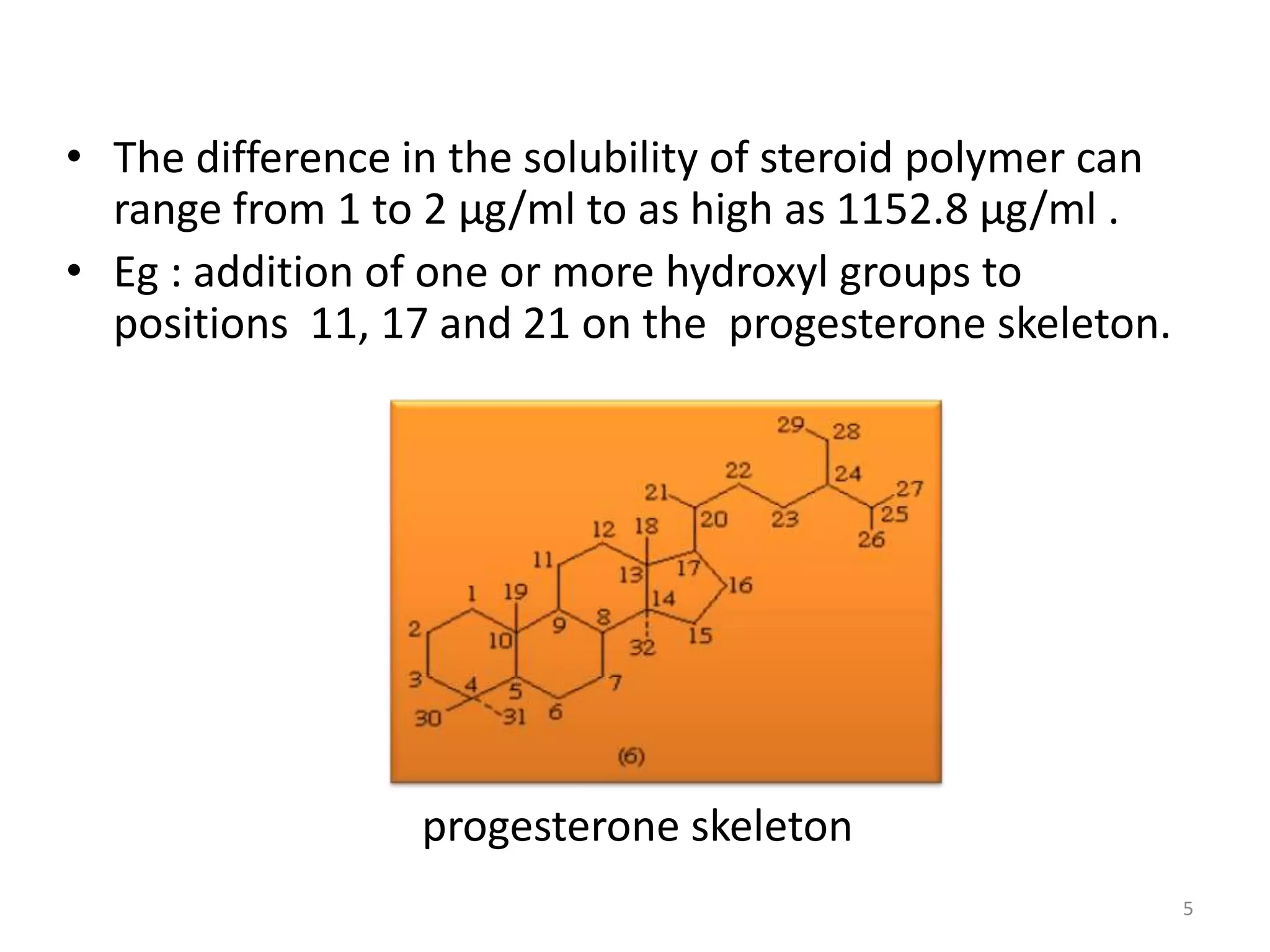
• The difference in the solubility of steroid polymer can
  range from 1 to 2 µg/ml to as high as 1152.8 µg/ml .
• Eg : addition of one or more hydroxyl groups to
  positions 11, 17 and 21 on the progesterone skeleton.


                  progesterone skeleton
                                                            5
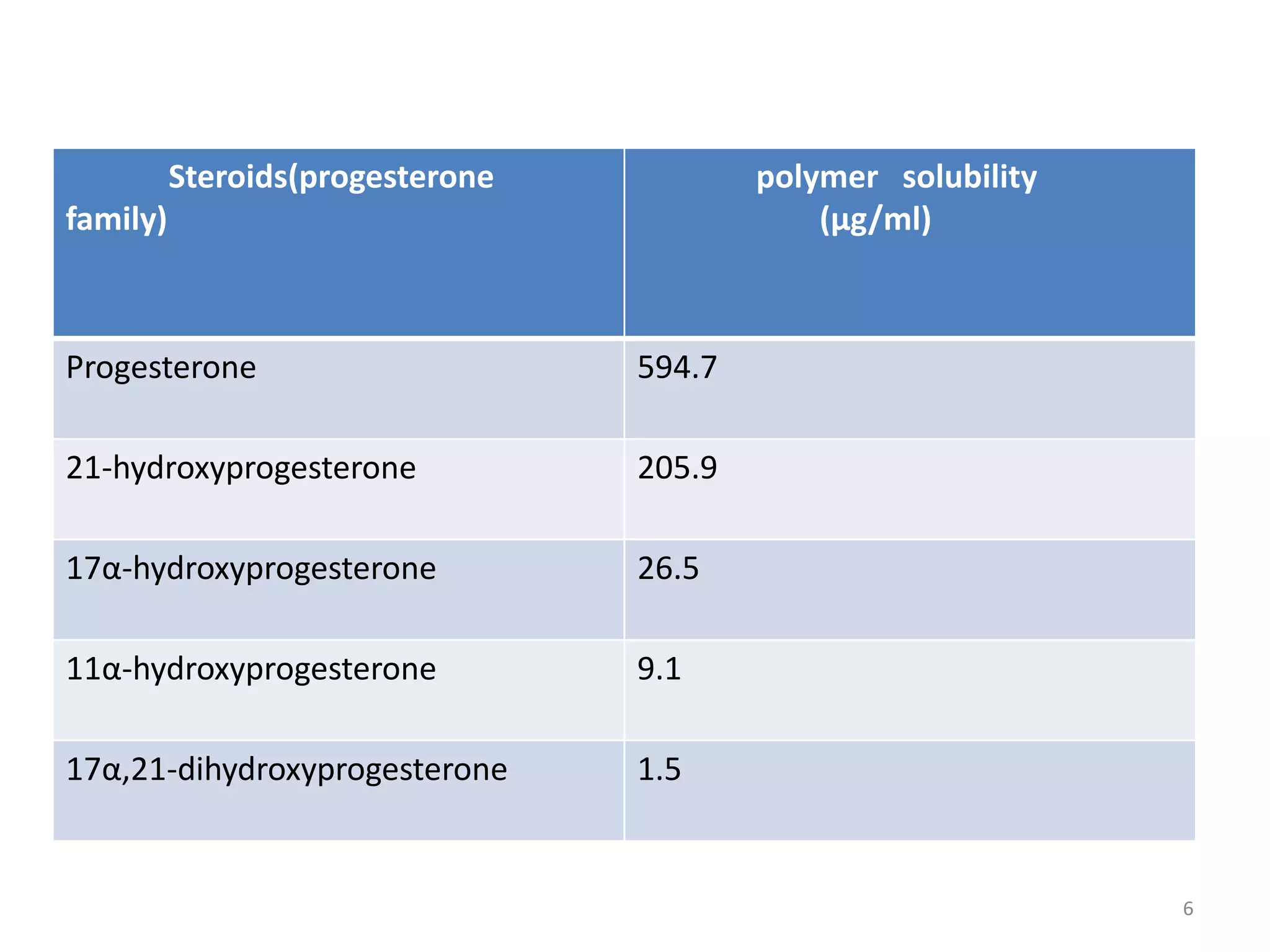
Steroids(progesterone           polymer solubility
family)                                       (µg/ml)


Progesterone                      594.7

21-hydroxyprogesterone            205.9

17α-hydroxyprogesterone           26.5

11α-hydroxyprogesterone           9.1

17α,21-dihydroxyprogesterone      1.5


                                                               6
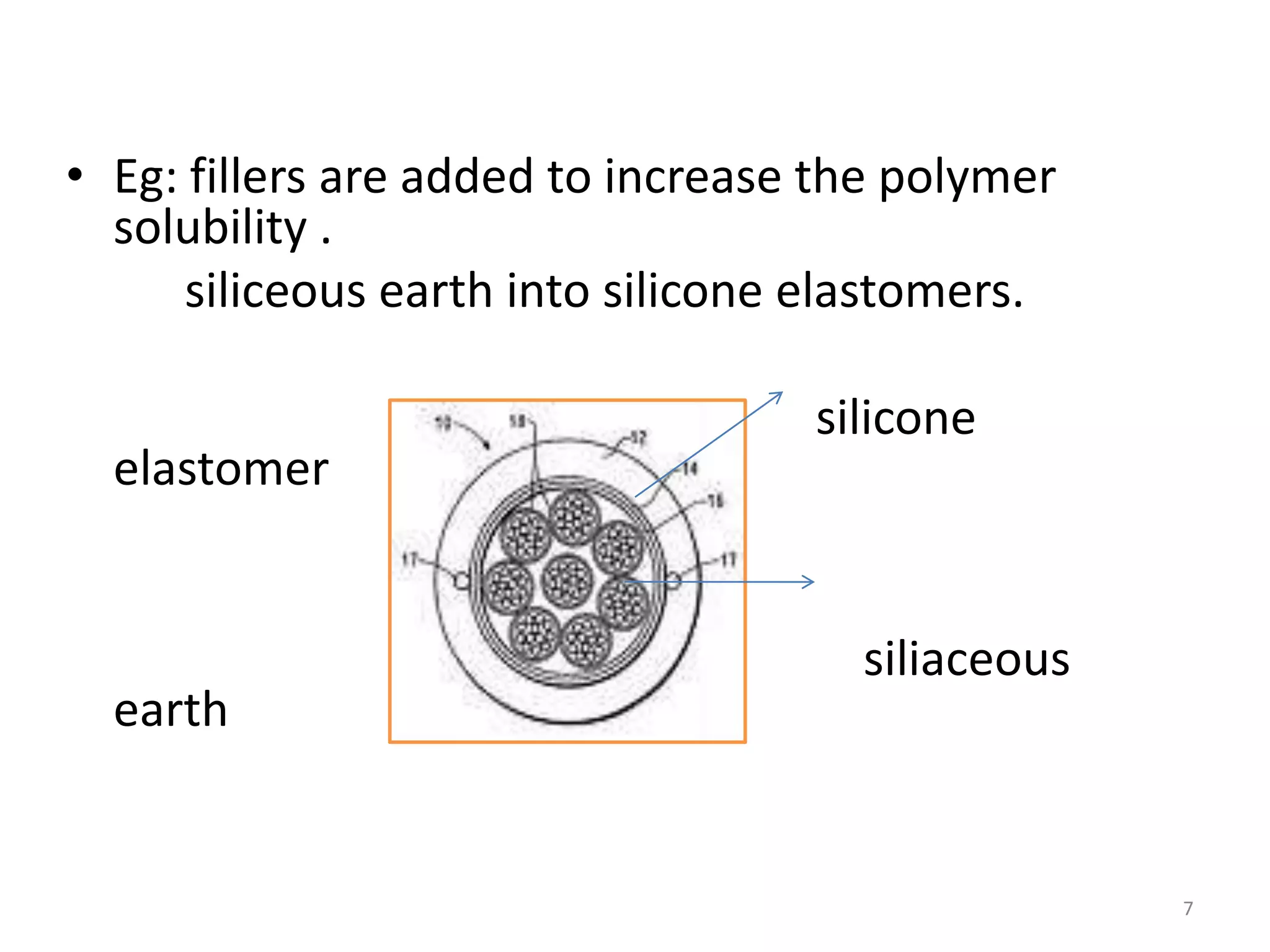
• Eg: fillers are added to increase the polymer
  solubility .
      siliceous earth into silicone elastomers.

                                   silicone
  elastomer


                                     siliaceous
  earth


                                                  7
2.Solution solubility (Cs).
• Invivo sink condition should be maintained.
   can be done by,
Concentration in the bulk should be zero.
By maintaining the solution concentration very
  high than the bulk concentration by using a co-
  solvent.
       Cs >>Cb
  Eg- ethynodiolacetate
 The invitro release rates of steroids ,is greater in
  the human plasma than the normal saline.
                                                        8
• Aqueous solubility of the drug varies significantly
   similar to that of polymer solubility, dependent on the
   upon the difference in the chemical structure ,types
   and physicochemical nature .
  Eg- esterification of testosterone reduces aqueous
   solubility.

  In the matrix type of drug delivery systems the effect of
  solution solubility affects both the mechanism and rate
  profiles of controlled drug release system.

 The solubility can be increased by micelle formation
  , complex formation ,cosolvency.
                                                              9
3.Partition coefficient(K).
• The partition coefficient of a drug for its interfacial
  partitioning from the surface of a drug delivery device
  towards an elution medium .
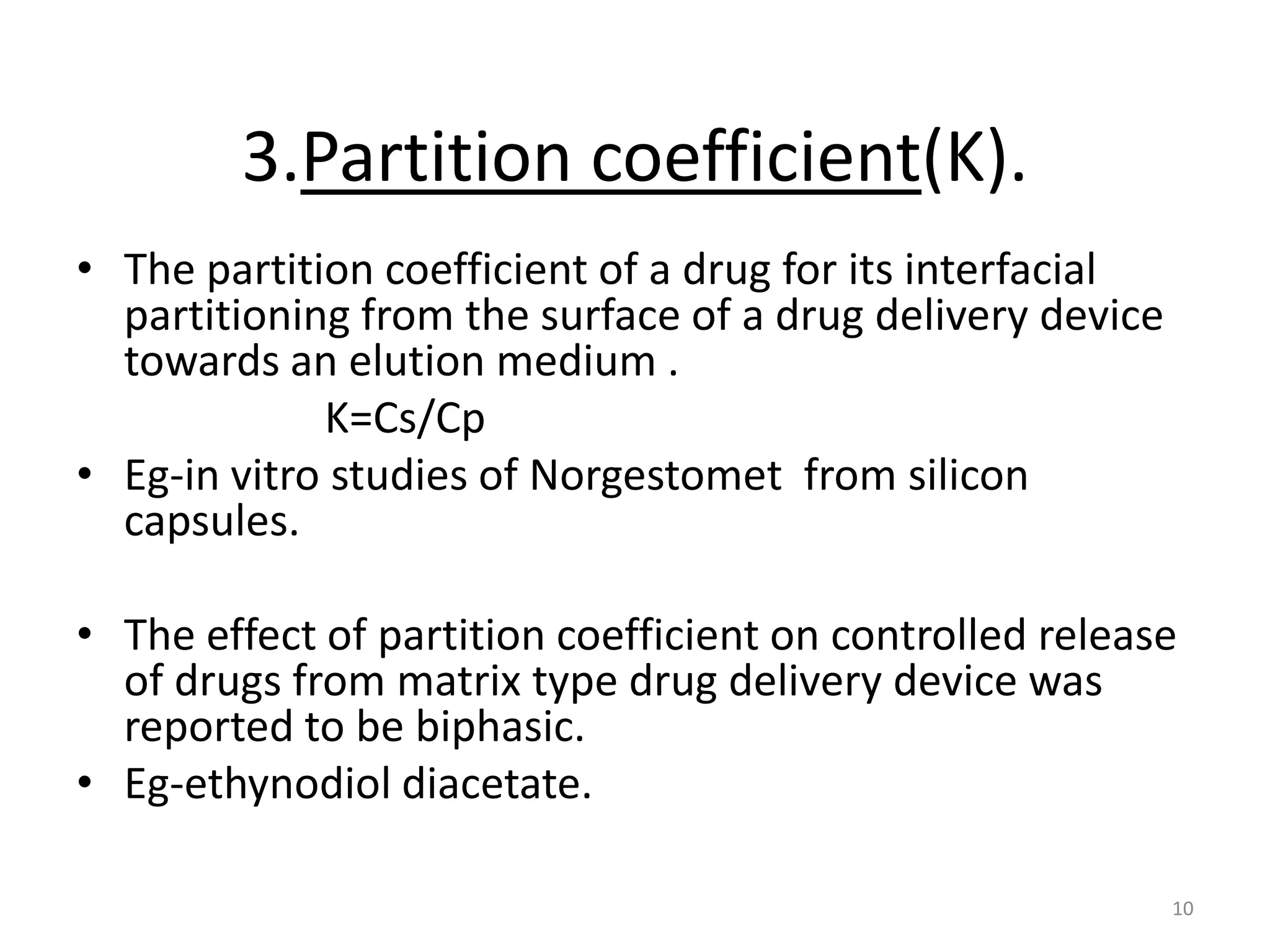
             K=Cs/Cp
• Eg-in vitro studies of Norgestomet from silicon
  capsules.

• The effect of partition coefficient on controlled release
  of drugs from matrix type drug delivery device was
  reported to be biphasic.
• Eg-ethynodiol diacetate.

                                                            10
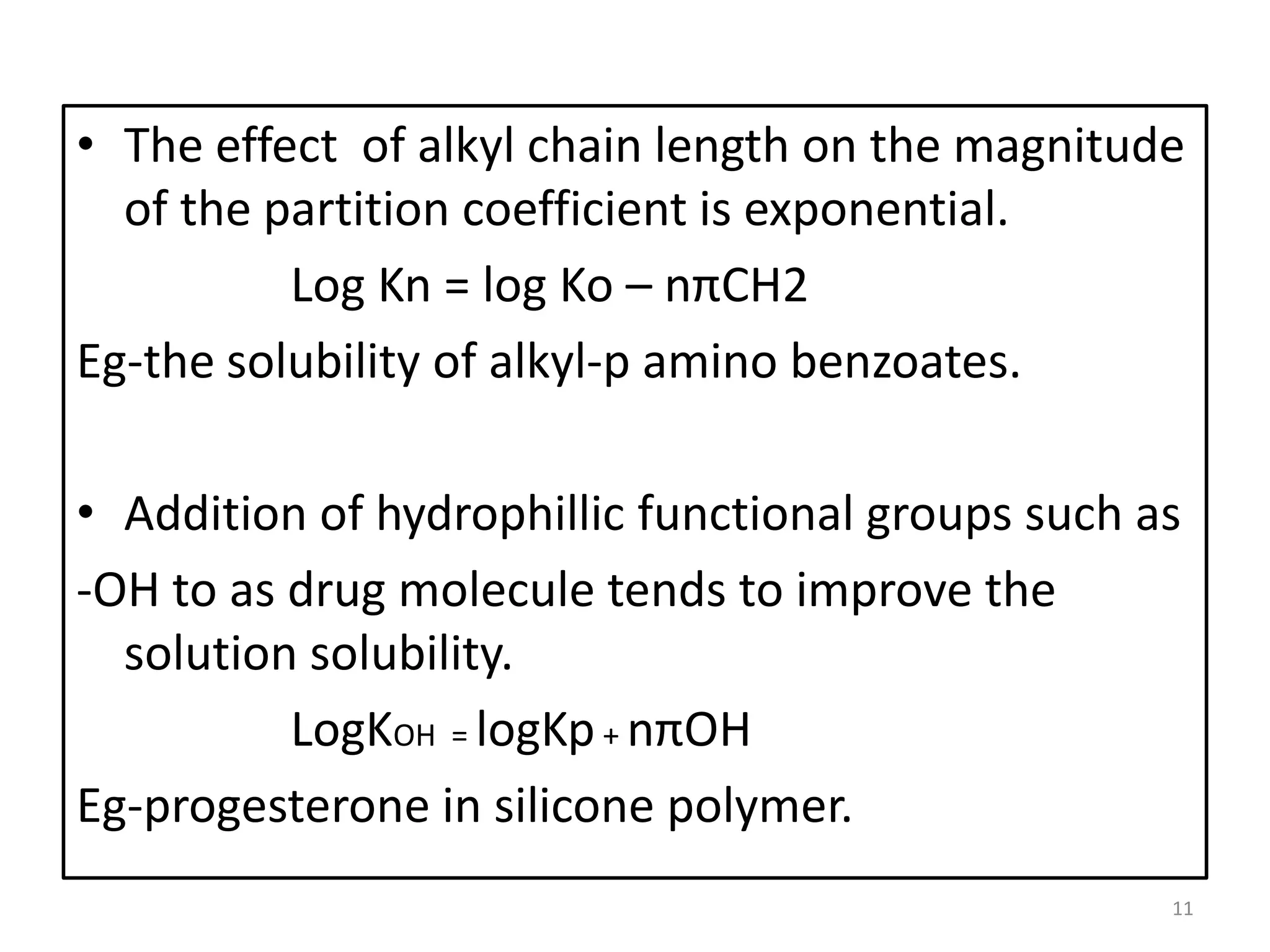
• The effect of alkyl chain length on the magnitude
  of the partition coefficient is exponential.
          Log Kn = log Ko – nπCH2
Eg-the solubility of alkyl-p amino benzoates.

• Addition of hydrophillic functional groups such as
-OH to as drug molecule tends to improve the
  solution solubility.
          LogKOH = logKp + nπOH
Eg-progesterone in silicone polymer.
                                                   11
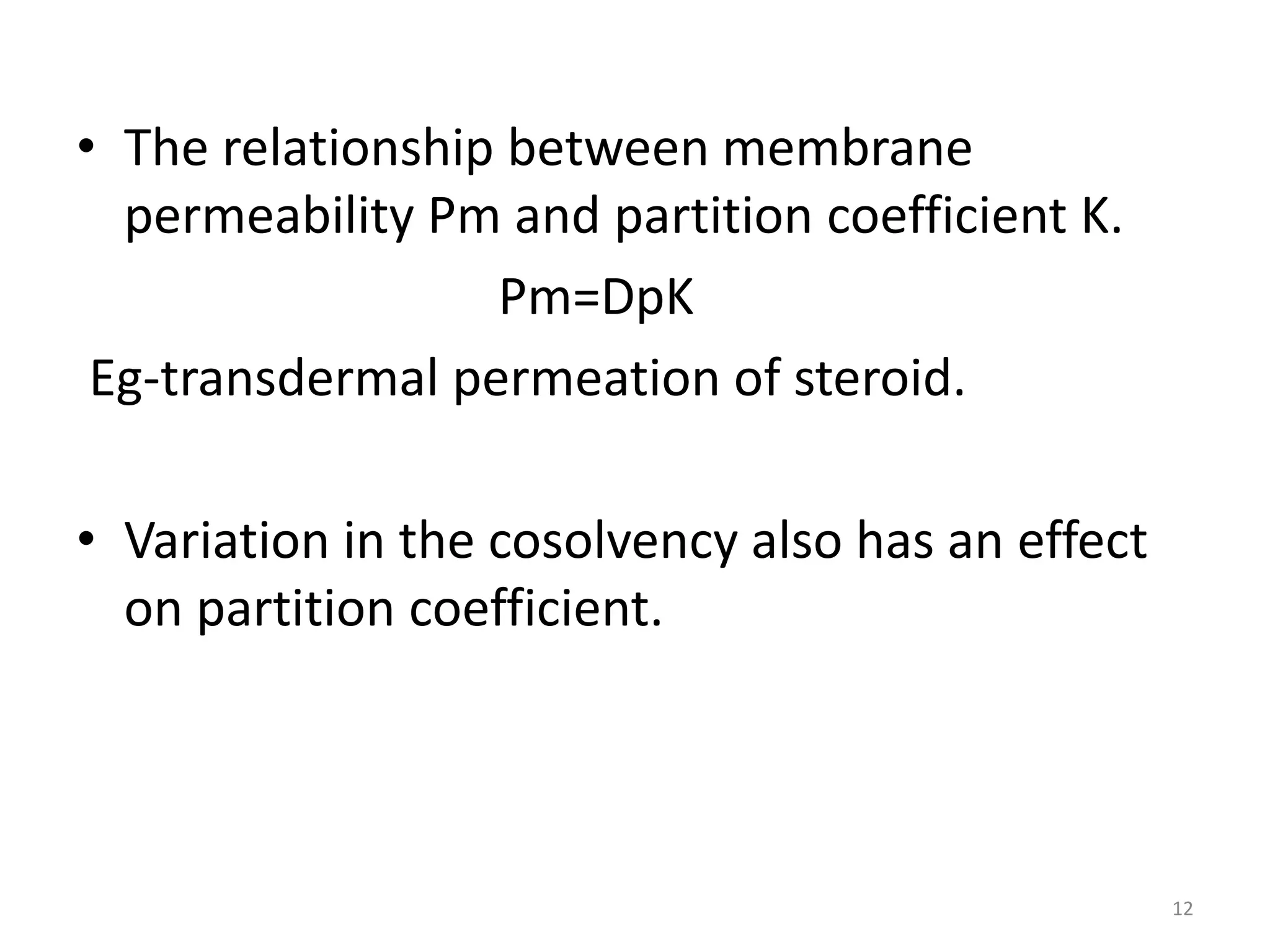
• The relationship between membrane
  permeability Pm and partition coefficient K.
                  Pm=DpK
 Eg-transdermal permeation of steroid.

• Variation in the cosolvency also has an effect
  on partition coefficient.


                                                   12
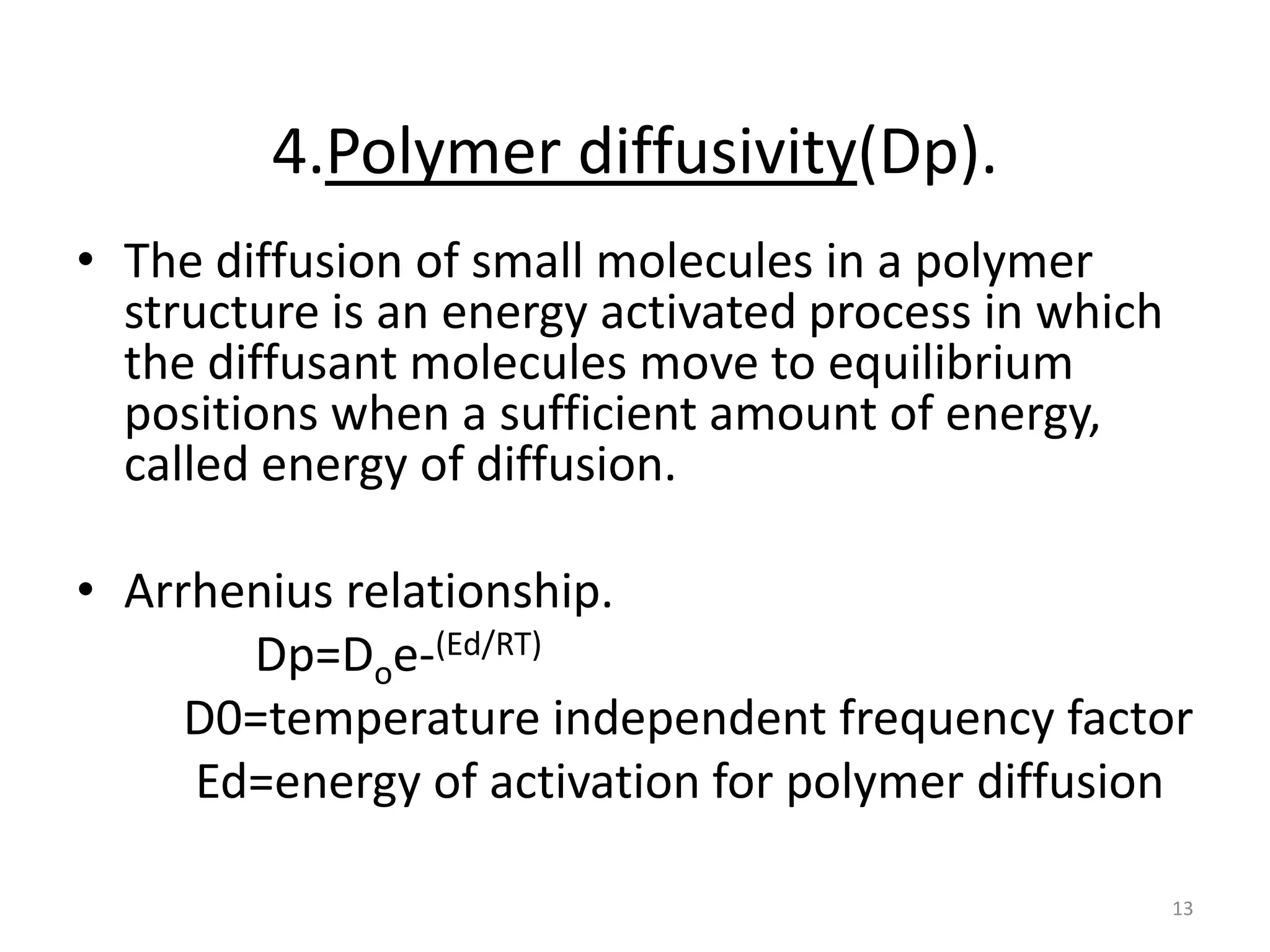
4.Polymer diffusivity(Dp).
• The diffusion of small molecules in a polymer
  structure is an energy activated process in which
  the diffusant molecules move to equilibrium
  positions when a sufficient amount of energy,
  called energy of diffusion.

• Arrhenius relationship.
       Dp=Doe-(Ed/RT)
     D0=temperature independent frequency factor
     Ed=energy of activation for polymer diffusion

                                                      13
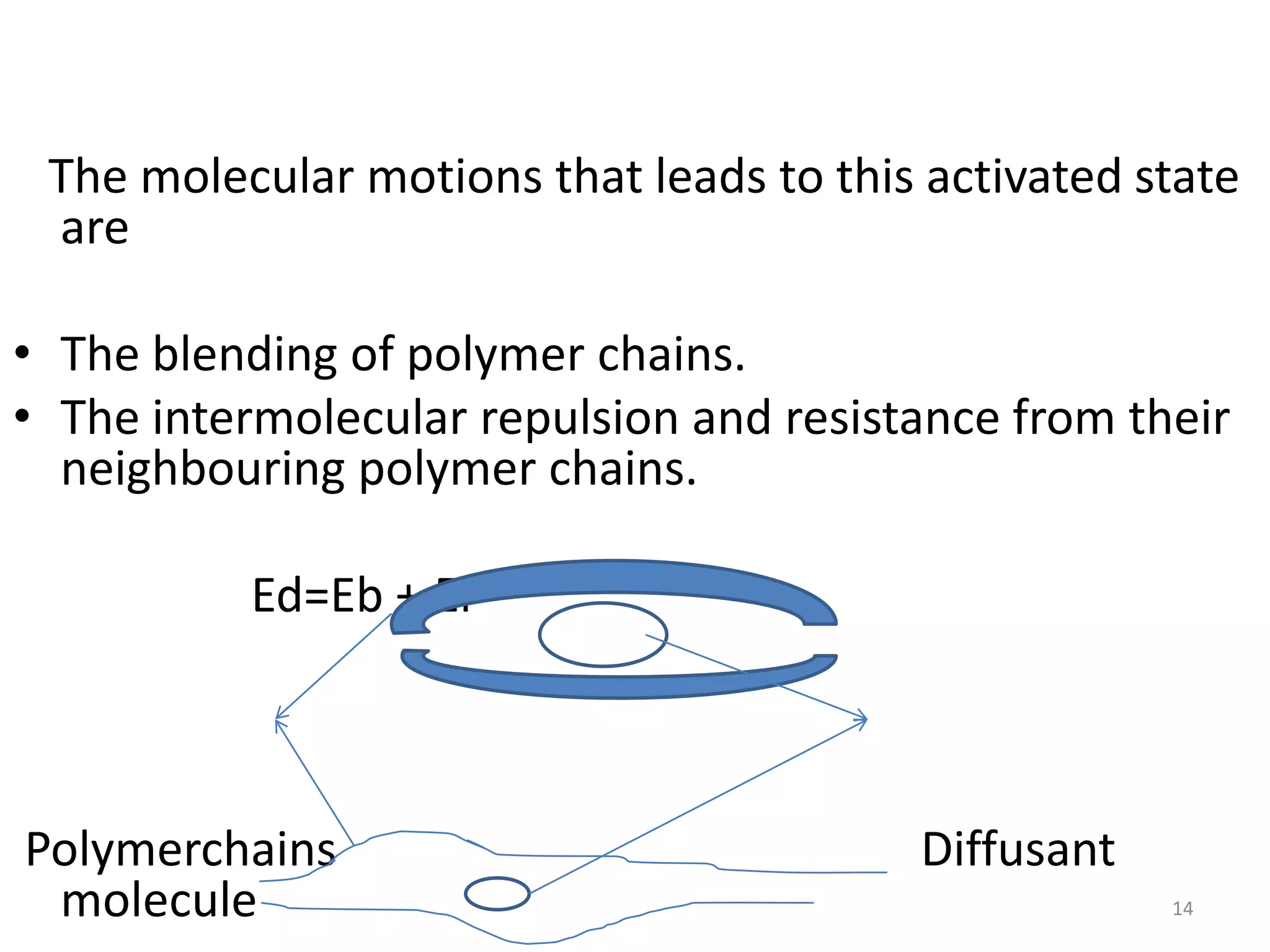
The molecular motions that leads to this activated state
 are

• The blending of polymer chains.
• The intermolecular repulsion and resistance from their
  neighbouring polymer chains.

          Ed=Eb + Er


Polymerchains                            Diffusant
 molecule                                            14
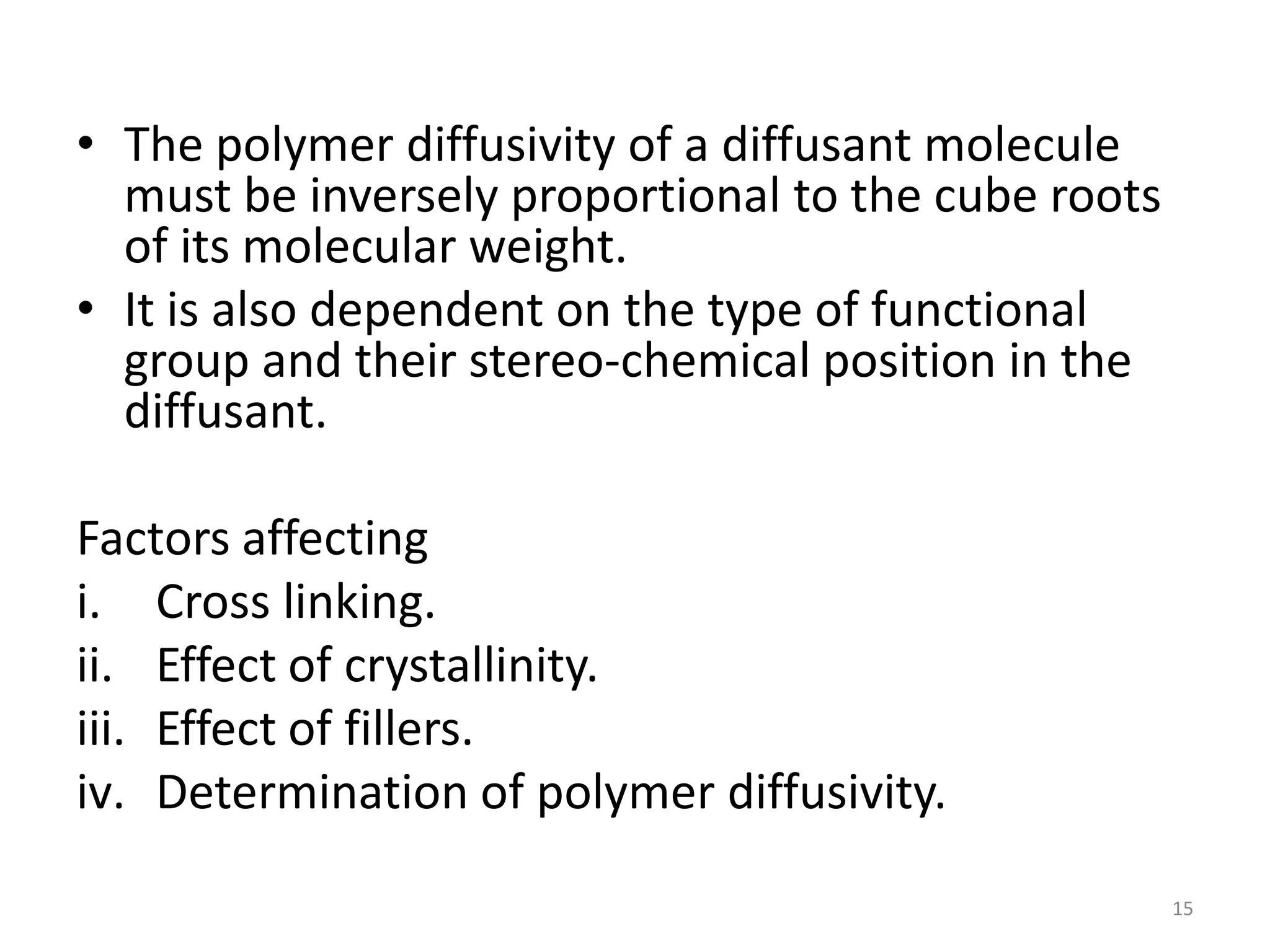
• The polymer diffusivity of a diffusant molecule
  must be inversely proportional to the cube roots
  of its molecular weight.
• It is also dependent on the type of functional
  group and their stereo-chemical position in the
  diffusant.

Factors affecting
i. Cross linking.
ii. Effect of crystallinity.
iii. Effect of fillers.
iv. Determination of polymer diffusivity.

                                                     15
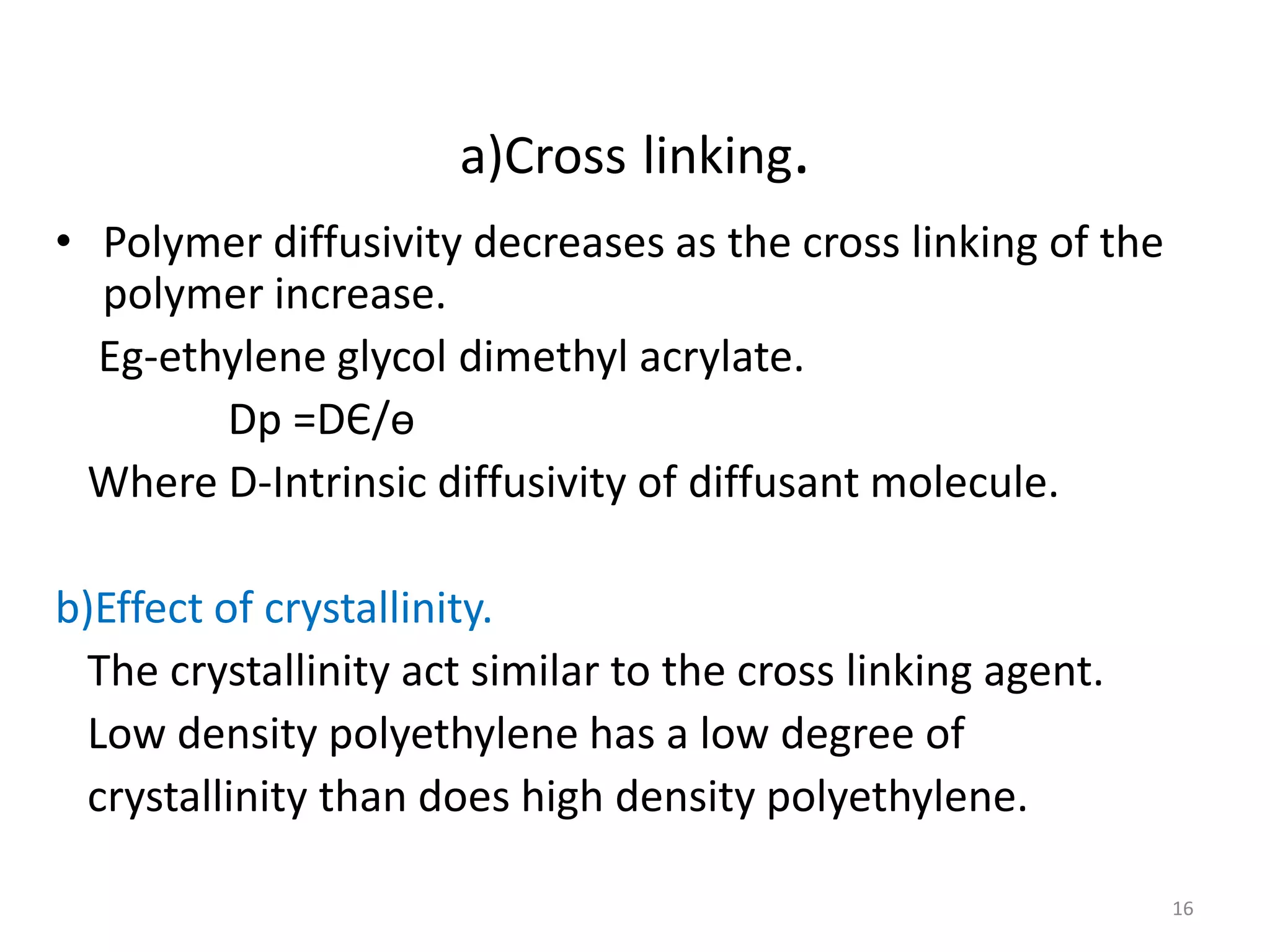
a)Cross linking.
• Polymer diffusivity decreases as the cross linking of the
  polymer increase.
  Eg-ethylene glycol dimethyl acrylate.
        Dp =DЄ/ѳ
  Where D-Intrinsic diffusivity of diffusant molecule.

b)Effect of crystallinity.
 The crystallinity act similar to the cross linking agent.
 Low density polyethylene has a low degree of
 crystallinity than does high density polyethylene.

                                                              16
c)Effect of fillers.
Fillers are often incorporated into a polymer to enhance its mechanical
    strength.
Eg-finely ground silica.

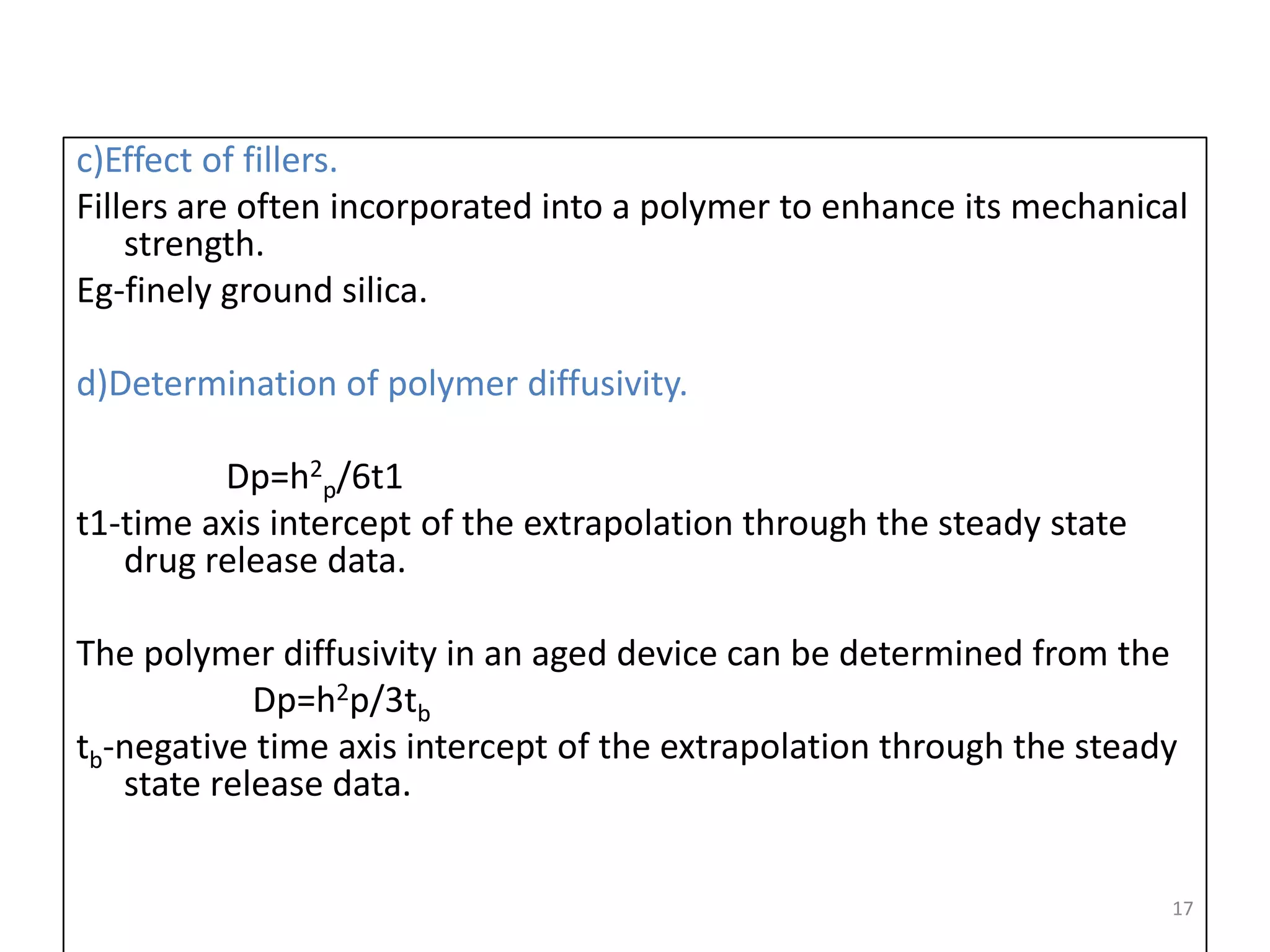
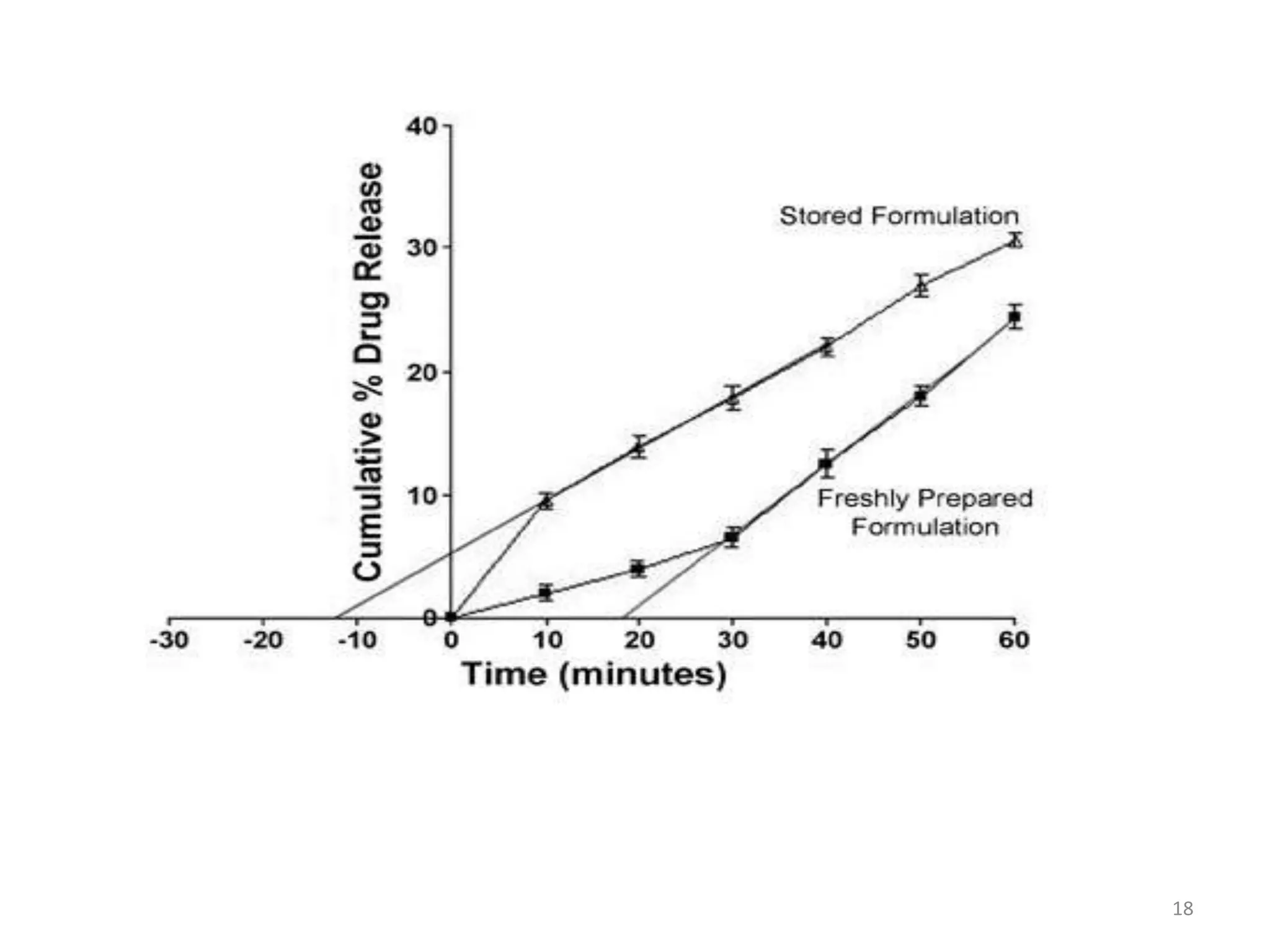
d)Determination of polymer diffusivity.

         Dp=h2p/6t1
t1-time axis intercept of the extrapolation through the steady state
   drug release data.

The polymer diffusivity in an aged device can be determined from the
            Dp=h2p/3tb
tb-negative time axis intercept of the extrapolation through the steady
   state release data.


                                                                       17
18
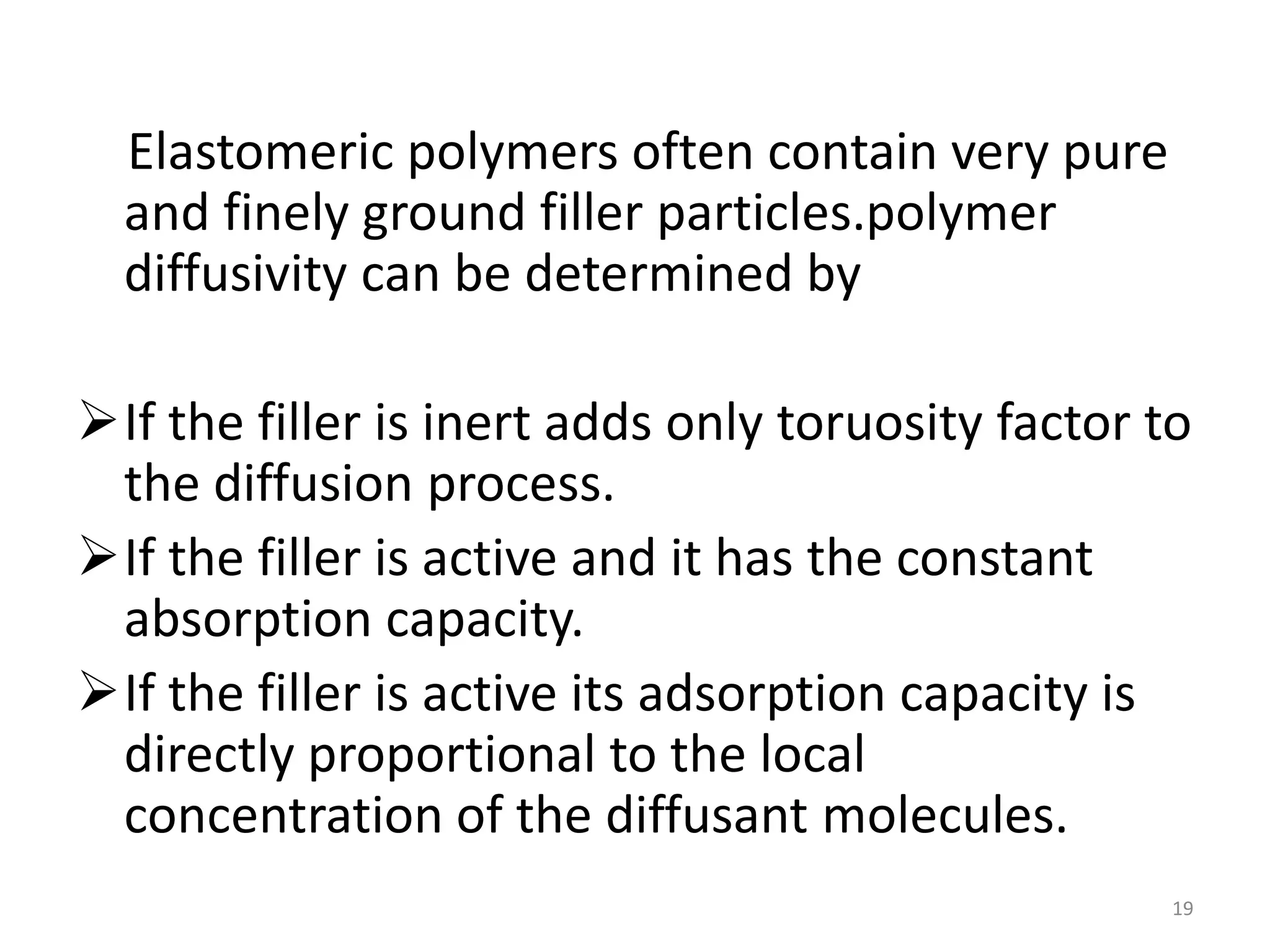
Elastomeric polymers often contain very pure
  and finely ground filler particles.polymer
  diffusivity can be determined by

If the filler is inert adds only toruosity factor to
 the diffusion process.
If the filler is active and it has the constant
 absorption capacity.
If the filler is active its adsorption capacity is
 directly proportional to the local
 concentration of the diffusant molecules.
                                                    19
REFERENCES.

1.Novel drug delivery system by………………………………………….Y.W.Chein.

2.Sustained controlled release drug delivery systems by…….Robinson J.R.

3.www.images.google.com

4.www.wickipedia.com


                                                                          20
21

Effect of system parameters on controlled release drug delivery

  • 1.
    EFFECT OF SYSTEMPARAMETERS ON CONTROLLED RELEASE DRUG DELIVERY PRESENTED BY : GANDHI SONAM MUKESHCHANDRA 1
  • 2.
    The system parametersare 1. Polymer solubility (Cp). 2. Solution solubility (Cs). 3. Partition coefficient (k). 4. Polymer diffusivity(Dp). 5. Solution diffusivity(Ds). 6. Thickness of polymer diffusional path(hp). 7. Thickness of hydrodynamic diffusion layer(hd). 8. Drug loading dose (A). 9. Surface area. 2
  • 3.
    1. Polymer solubility(Cp) • In the controlled release of a drug species from either polymer membrane permeation controlled (or) polymer diffusion controlled drug delivery devices (or)other rate preprogrammed drug delivery devices . • To release at an appropriate rate drug require adequate polymer solubility. • The relationship (Q/t) α Cp • On the other hand Q/t 1/2 α Cp 1/2 3
  • 4.
    1200 1000 800 Q/t µg/cm2 600 400 200 0 100 200 300 400 500 600 700 Cp µg/ml 4
  • 5.
    • The differencein the solubility of steroid polymer can range from 1 to 2 µg/ml to as high as 1152.8 µg/ml . • Eg : addition of one or more hydroxyl groups to positions 11, 17 and 21 on the progesterone skeleton. progesterone skeleton 5
  • 6.
    Steroids(progesterone polymer solubility family) (µg/ml) Progesterone 594.7 21-hydroxyprogesterone 205.9 17α-hydroxyprogesterone 26.5 11α-hydroxyprogesterone 9.1 17α,21-dihydroxyprogesterone 1.5 6
  • 7.
    • Eg: fillersare added to increase the polymer solubility . siliceous earth into silicone elastomers. silicone elastomer siliaceous earth 7
  • 8.
    2.Solution solubility (Cs). •Invivo sink condition should be maintained. can be done by, Concentration in the bulk should be zero. By maintaining the solution concentration very high than the bulk concentration by using a co- solvent. Cs >>Cb Eg- ethynodiolacetate The invitro release rates of steroids ,is greater in the human plasma than the normal saline. 8
  • 9.
    • Aqueous solubilityof the drug varies significantly similar to that of polymer solubility, dependent on the upon the difference in the chemical structure ,types and physicochemical nature . Eg- esterification of testosterone reduces aqueous solubility. In the matrix type of drug delivery systems the effect of solution solubility affects both the mechanism and rate profiles of controlled drug release system. The solubility can be increased by micelle formation , complex formation ,cosolvency. 9
  • 10.
    3.Partition coefficient(K). • Thepartition coefficient of a drug for its interfacial partitioning from the surface of a drug delivery device towards an elution medium . K=Cs/Cp • Eg-in vitro studies of Norgestomet from silicon capsules. • The effect of partition coefficient on controlled release of drugs from matrix type drug delivery device was reported to be biphasic. • Eg-ethynodiol diacetate. 10
  • 11.
    • The effectof alkyl chain length on the magnitude of the partition coefficient is exponential. Log Kn = log Ko – nπCH2 Eg-the solubility of alkyl-p amino benzoates. • Addition of hydrophillic functional groups such as -OH to as drug molecule tends to improve the solution solubility. LogKOH = logKp + nπOH Eg-progesterone in silicone polymer. 11
  • 12.
    • The relationshipbetween membrane permeability Pm and partition coefficient K. Pm=DpK Eg-transdermal permeation of steroid. • Variation in the cosolvency also has an effect on partition coefficient. 12
  • 13.
    4.Polymer diffusivity(Dp). • Thediffusion of small molecules in a polymer structure is an energy activated process in which the diffusant molecules move to equilibrium positions when a sufficient amount of energy, called energy of diffusion. • Arrhenius relationship. Dp=Doe-(Ed/RT) D0=temperature independent frequency factor Ed=energy of activation for polymer diffusion 13
  • 14.
    The molecular motionsthat leads to this activated state are • The blending of polymer chains. • The intermolecular repulsion and resistance from their neighbouring polymer chains. Ed=Eb + Er Polymerchains Diffusant molecule 14
  • 15.
    • The polymerdiffusivity of a diffusant molecule must be inversely proportional to the cube roots of its molecular weight. • It is also dependent on the type of functional group and their stereo-chemical position in the diffusant. Factors affecting i. Cross linking. ii. Effect of crystallinity. iii. Effect of fillers. iv. Determination of polymer diffusivity. 15
  • 16.
    a)Cross linking. • Polymerdiffusivity decreases as the cross linking of the polymer increase. Eg-ethylene glycol dimethyl acrylate. Dp =DЄ/ѳ Where D-Intrinsic diffusivity of diffusant molecule. b)Effect of crystallinity. The crystallinity act similar to the cross linking agent. Low density polyethylene has a low degree of crystallinity than does high density polyethylene. 16
  • 17.
    c)Effect of fillers. Fillersare often incorporated into a polymer to enhance its mechanical strength. Eg-finely ground silica. d)Determination of polymer diffusivity. Dp=h2p/6t1 t1-time axis intercept of the extrapolation through the steady state drug release data. The polymer diffusivity in an aged device can be determined from the Dp=h2p/3tb tb-negative time axis intercept of the extrapolation through the steady state release data. 17
  • 18.
  • 19.
    Elastomeric polymers oftencontain very pure and finely ground filler particles.polymer diffusivity can be determined by If the filler is inert adds only toruosity factor to the diffusion process. If the filler is active and it has the constant absorption capacity. If the filler is active its adsorption capacity is directly proportional to the local concentration of the diffusant molecules. 19
  • 20.
    REFERENCES. 1.Novel drug deliverysystem by………………………………………….Y.W.Chein. 2.Sustained controlled release drug delivery systems by…….Robinson J.R. 3.www.images.google.com 4.www.wickipedia.com 20
  • 21.