PRESENTED BY
SUBODH S SATHEESH
MPHARM
PHARMACEUTICS
ECPS
1
PHARMACEUTICAL ANALYSIS-GAS
CHROMATOGRAPHY
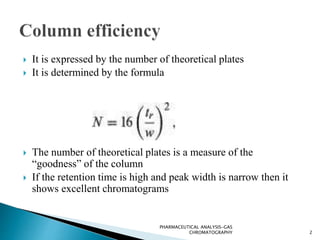
 It is expressed by the number of theoretical plates
 It is determined by the formula
 The number of theoretical plates is a measure of the
“goodness” of the column
 If the retention time is high and peak width is narrow then it
shows excellent chromatograms
2
PHARMACEUTICAL ANALYSIS-GAS
CHROMATOGRAPHY
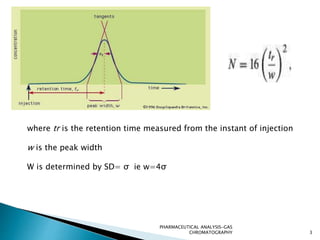
where tr is the retention time measured from the instant of injection
w is the peak width
W is determined by SD= σ ie w=4σ
3
PHARMACEUTICAL ANALYSIS-GAS
CHROMATOGRAPHY
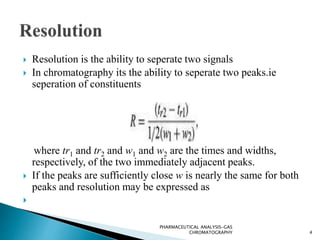
 Resolution is the ability to seperate two signals
 In chromatography its the ability to seperate two peaks.ie
seperation of constituents
where tr1 and tr2 and w1 and w2 are the times and widths,
respectively, of the two immediately adjacent peaks.
 If the peaks are sufficiently close w is nearly the same for both
peaks and resolution may be expressed as

4
PHARMACEUTICAL ANALYSIS-GAS
CHROMATOGRAPHY
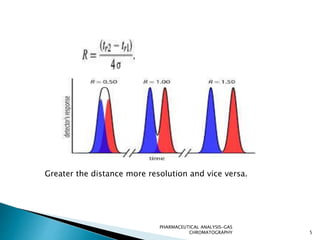
Greater the distance more resolution and vice versa.
5
PHARMACEUTICAL ANALYSIS-GAS
CHROMATOGRAPHY
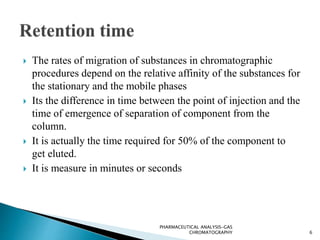
 The rates of migration of substances in chromatographic
procedures depend on the relative affinity of the substances for
the stationary and the mobile phases
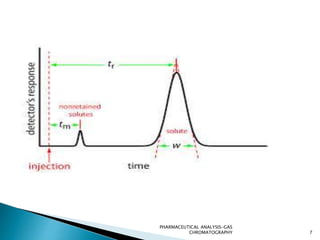
 Its the difference in time between the point of injection and the
time of emergence of separation of component from the
column.
 It is actually the time required for 50% of the component to
get eluted.
 It is measure in minutes or seconds
6
PHARMACEUTICAL ANALYSIS-GAS
CHROMATOGRAPHY
7
PHARMACEUTICAL ANALYSIS-GAS
CHROMATOGRAPHY
 It is the volume of carrier gas required to elute
components from the column to the time the peak
maximum is obtained.
 Retention volume depends upon flowrate and retention
time
 VR= tR-FC
8
PHARMACEUTICAL ANALYSIS-GAS
CHROMATOGRAPHY
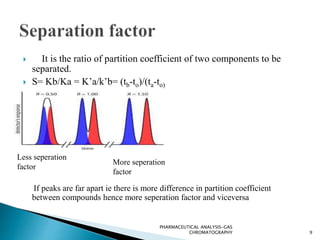
 It is the ratio of partition coefficient of two components to be
separated.
 S= Kb/Ka = K’a/k’b= (tb-to)/(ta-to)
If peaks are far apart ie there is more difference in partition coefficient
between compounds hence more seperation factor and viceversa
Less seperation
factor
More seperation
factor
9
PHARMACEUTICAL ANALYSIS-GAS
CHROMATOGRAPHY
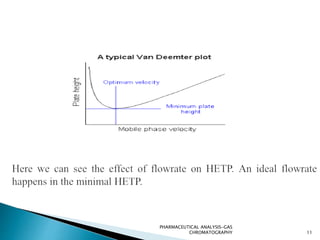
 HETP is numerically equal to the column length divided by
the number of theoretical plates in the column
 It varies from to one column to another as well as one solute to
other
 The more efficient the column the better the resolution and the
smaller the HETP.
 HETP=Length of column / no of theoretical plates
10
PHARMACEUTICAL ANALYSIS-GAS
CHROMATOGRAPHY
11
PHARMACEUTICAL ANALYSIS-GAS
CHROMATOGRAPHY
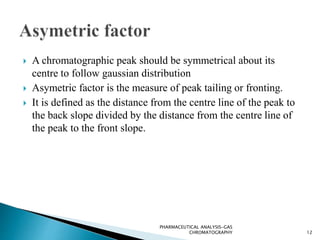
 A chromatographic peak should be symmetrical about its
centre to follow gaussian distribution
 Asymetric factor is the measure of peak tailing or fronting.
 It is defined as the distance from the centre line of the peak to
the back slope divided by the distance from the centre line of
the peak to the front slope.
12
PHARMACEUTICAL ANALYSIS-GAS
CHROMATOGRAPHY
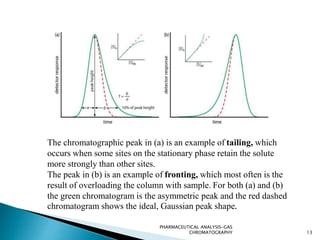
The chromatographic peak in (a) is an example of tailing, which
occurs when some sites on the stationary phase retain the solute
more strongly than other sites.
The peak in (b) is an example of fronting, which most often is the
result of overloading the column with sample. For both (a) and (b)
the green chromatogram is the asymmetric peak and the red dashed
chromatogram shows the ideal, Gaussian peak shape.
13
PHARMACEUTICAL ANALYSIS-GAS
CHROMATOGRAPHY
 Its function is to separate sample components to
discrete peaks
 It should have reasonable chemical and thermal
stability
 There are a lot liquid stationary phases available for gas
chromatography. But there is no solvent that meet all
the requirements of a perfect stationary phase
14
PHARMACEUTICAL ANALYSIS-GAS
CHROMATOGRAPHY
 Liquid phase should not permeate too deeply into the fine
pores of the support structure as slow diffusion in and out of
pores affects column efficiency
 It should be chemically inert
 It should be a good solvent for sample component
 Liquid phase should have low volatility and high stability at
elevated temperatures otherwise they can contribute to
interference in analysis
15
PHARMACEUTICAL ANALYSIS-GAS
CHROMATOGRAPHY
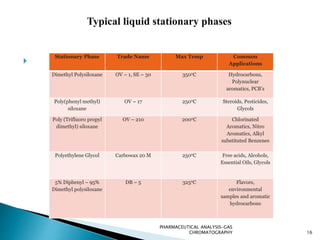

Stationary Phase Trade Name Max Temp Common
Applications
Dimethyl Polysiloxane OV – 1, SE – 30 350oC Hydrocarbons,
Polynuclear
aromatics, PCB’s
Poly(phenyl methyl)
siloxane
OV – 17 250oC Steroids, Pesticides,
Glycols
Poly (Trifluoro propyl
dimethyl) siloxane
OV – 210 200oC Chlorinated
Aromatics, Nitro
Aromatics, Alkyl
substituted Benzenes
Polyethylene Glycol Carbowax 20 M 250oC Free acids, Alcohols,
Essential Oils, Glycols
5% Diphenyl – 95%
Dimethyl polysiloxane
DB – 5 325oC Flavors,
environmental
samples and aromatic
hydrocarbons
Typical liquid stationary phases
16
PHARMACEUTICAL ANALYSIS-GAS
CHROMATOGRAPHY
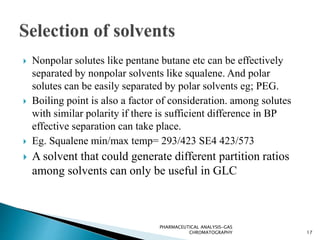
 Nonpolar solutes like pentane butane etc can be effectively
separated by nonpolar solvents like squalene. And polar
solutes can be easily separated by polar solvents eg; PEG.
 Boiling point is also a factor of consideration. among solutes
with similar polarity if there is sufficient difference in BP
effective separation can take place.
 Eg. Squalene min/max temp= 293/423 SE4 423/573
 A solvent that could generate different partition ratios
among solvents can only be useful in GLC
17
PHARMACEUTICAL ANALYSIS-GAS
CHROMATOGRAPHY
 H KAUR Instrumental methods of chemical analysis
ninth edition 2013 ;1091-1092
 Skoog holler crouch Instrumental analysis 2012 841-
846
 B K sharma Instrumental methods of chemical analysis
twenty fourth edition 2005 c188-191
 En.wikipedia.org gas chromatography
18
PHARMACEUTICAL ANALYSIS-GAS
CHROMATOGRAPHY
MANY THANKS
19
PHARMACEUTICAL ANALYSIS-GAS
CHROMATOGRAPHY

Column efficiency parameters

  • 1.
    PRESENTED BY SUBODH SSATHEESH MPHARM PHARMACEUTICS ECPS 1 PHARMACEUTICAL ANALYSIS-GAS CHROMATOGRAPHY
  • 2.
     It isexpressed by the number of theoretical plates  It is determined by the formula  The number of theoretical plates is a measure of the “goodness” of the column  If the retention time is high and peak width is narrow then it shows excellent chromatograms 2 PHARMACEUTICAL ANALYSIS-GAS CHROMATOGRAPHY
  • 3.
    where tr isthe retention time measured from the instant of injection w is the peak width W is determined by SD= σ ie w=4σ 3 PHARMACEUTICAL ANALYSIS-GAS CHROMATOGRAPHY
  • 4.
     Resolution isthe ability to seperate two signals  In chromatography its the ability to seperate two peaks.ie seperation of constituents where tr1 and tr2 and w1 and w2 are the times and widths, respectively, of the two immediately adjacent peaks.  If the peaks are sufficiently close w is nearly the same for both peaks and resolution may be expressed as  4 PHARMACEUTICAL ANALYSIS-GAS CHROMATOGRAPHY
  • 5.
    Greater the distancemore resolution and vice versa. 5 PHARMACEUTICAL ANALYSIS-GAS CHROMATOGRAPHY
  • 6.
     The ratesof migration of substances in chromatographic procedures depend on the relative affinity of the substances for the stationary and the mobile phases  Its the difference in time between the point of injection and the time of emergence of separation of component from the column.  It is actually the time required for 50% of the component to get eluted.  It is measure in minutes or seconds 6 PHARMACEUTICAL ANALYSIS-GAS CHROMATOGRAPHY
  • 7.
  • 8.
     It isthe volume of carrier gas required to elute components from the column to the time the peak maximum is obtained.  Retention volume depends upon flowrate and retention time  VR= tR-FC 8 PHARMACEUTICAL ANALYSIS-GAS CHROMATOGRAPHY
  • 9.
     It isthe ratio of partition coefficient of two components to be separated.  S= Kb/Ka = K’a/k’b= (tb-to)/(ta-to) If peaks are far apart ie there is more difference in partition coefficient between compounds hence more seperation factor and viceversa Less seperation factor More seperation factor 9 PHARMACEUTICAL ANALYSIS-GAS CHROMATOGRAPHY
  • 10.
     HETP isnumerically equal to the column length divided by the number of theoretical plates in the column  It varies from to one column to another as well as one solute to other  The more efficient the column the better the resolution and the smaller the HETP.  HETP=Length of column / no of theoretical plates 10 PHARMACEUTICAL ANALYSIS-GAS CHROMATOGRAPHY
  • 11.
  • 12.
     A chromatographicpeak should be symmetrical about its centre to follow gaussian distribution  Asymetric factor is the measure of peak tailing or fronting.  It is defined as the distance from the centre line of the peak to the back slope divided by the distance from the centre line of the peak to the front slope. 12 PHARMACEUTICAL ANALYSIS-GAS CHROMATOGRAPHY
  • 13.
    The chromatographic peakin (a) is an example of tailing, which occurs when some sites on the stationary phase retain the solute more strongly than other sites. The peak in (b) is an example of fronting, which most often is the result of overloading the column with sample. For both (a) and (b) the green chromatogram is the asymmetric peak and the red dashed chromatogram shows the ideal, Gaussian peak shape. 13 PHARMACEUTICAL ANALYSIS-GAS CHROMATOGRAPHY
  • 14.
     Its functionis to separate sample components to discrete peaks  It should have reasonable chemical and thermal stability  There are a lot liquid stationary phases available for gas chromatography. But there is no solvent that meet all the requirements of a perfect stationary phase 14 PHARMACEUTICAL ANALYSIS-GAS CHROMATOGRAPHY
  • 15.
     Liquid phaseshould not permeate too deeply into the fine pores of the support structure as slow diffusion in and out of pores affects column efficiency  It should be chemically inert  It should be a good solvent for sample component  Liquid phase should have low volatility and high stability at elevated temperatures otherwise they can contribute to interference in analysis 15 PHARMACEUTICAL ANALYSIS-GAS CHROMATOGRAPHY
  • 16.
     Stationary Phase TradeName Max Temp Common Applications Dimethyl Polysiloxane OV – 1, SE – 30 350oC Hydrocarbons, Polynuclear aromatics, PCB’s Poly(phenyl methyl) siloxane OV – 17 250oC Steroids, Pesticides, Glycols Poly (Trifluoro propyl dimethyl) siloxane OV – 210 200oC Chlorinated Aromatics, Nitro Aromatics, Alkyl substituted Benzenes Polyethylene Glycol Carbowax 20 M 250oC Free acids, Alcohols, Essential Oils, Glycols 5% Diphenyl – 95% Dimethyl polysiloxane DB – 5 325oC Flavors, environmental samples and aromatic hydrocarbons Typical liquid stationary phases 16 PHARMACEUTICAL ANALYSIS-GAS CHROMATOGRAPHY
  • 17.
     Nonpolar soluteslike pentane butane etc can be effectively separated by nonpolar solvents like squalene. And polar solutes can be easily separated by polar solvents eg; PEG.  Boiling point is also a factor of consideration. among solutes with similar polarity if there is sufficient difference in BP effective separation can take place.  Eg. Squalene min/max temp= 293/423 SE4 423/573  A solvent that could generate different partition ratios among solvents can only be useful in GLC 17 PHARMACEUTICAL ANALYSIS-GAS CHROMATOGRAPHY
  • 18.
     H KAURInstrumental methods of chemical analysis ninth edition 2013 ;1091-1092  Skoog holler crouch Instrumental analysis 2012 841- 846  B K sharma Instrumental methods of chemical analysis twenty fourth edition 2005 c188-191  En.wikipedia.org gas chromatography 18 PHARMACEUTICAL ANALYSIS-GAS CHROMATOGRAPHY
  • 19.