Electronic Band Structure of Solids Introduction to Solid State Physics   http://www.physics.udel.edu/~bnikolic/teaching/phys624/phys624.html
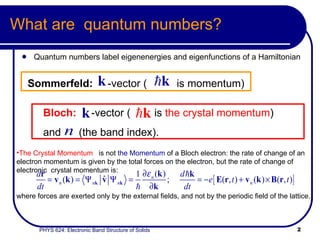
What are  quantum numbers? Quantum numbers label eigenenergies and eigenfunctions of a Hamiltonian Sommerfeld:   -vector (  is momentum) The Crystal Momentum   is not  the Momentum  of a Bloch electron: the rate of change of an electron momentum is given by the total forces on the electron, but the rate of change of electronic  crystal momentum is: where forces are exerted only by the external fields, and not by the periodic field of the lattice.  Bloch:   -vector (  is  the crystal momentum )  and  (the band index).
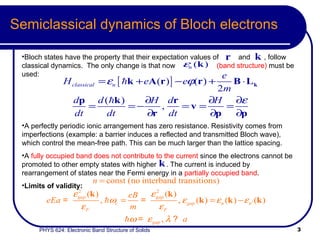
Semiclassical dynamics of Bloch electrons Bloch states have the property that their expectation values of  and  , follow classical dynamics.  The only change is that now  (band structure)  must be used:  A perfectly periodic ionic arrangement has zero resistance. Resistivity comes from imperfections (example: a barrier induces a reflected and transmitted Bloch wave), which control the mean-free path. This can be much larger than the lattice spacing.  A  fully occupied band does not contribute to the current  since the electrons cannot be promoted to other empty states with higher  . The current is induced by rearrangement of states near the Fermi energy in a  partially occupied band .   Limits of validity:
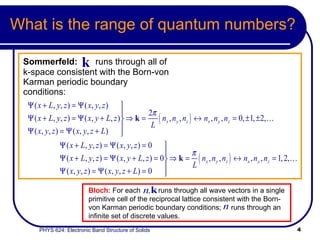
What is the range of quantum numbers? Sommerfeld:   runs through all of k-space consistent with the Born-von Karman periodic boundary conditions: Bloch:  For each  ,  runs through all wave vectors in a single primitive cell of the reciprocal lattice consistent with the Born-von Karman periodic boundary conditions;  runs through an infinite set of discrete values.
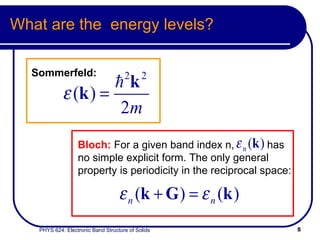
What are the  energy levels? Sommerfeld: Bloch:   For a given band index n,  has no simple explicit form. The only general property is periodicity in the reciprocal space:
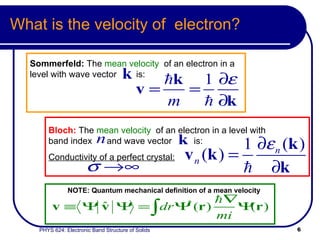
What is the velocity of  electron? Sommerfeld:  The  mean velocity   of an electron in a level with wave vector  is:  NOTE: Quantum mechanical definition of a mean velocity Bloch:   The  mean velocity   of an electron in a level with band index  and wave vector  is:  Conductivity of a perfect crystal:
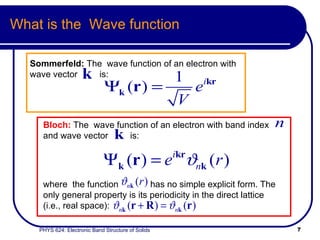
What is the  Wave function Sommerfeld:  The  wave function of an electron with wave vector  is:  Bloch:   The  wave function   of an electron with band index  and wave vector  is: where  the function  has no simple explicit form. The only general property is its periodicity in the direct lattice (i.e., real space):
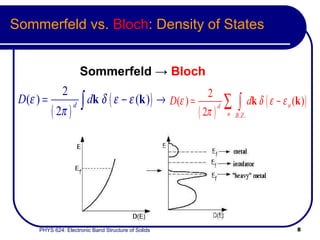
Sommerfeld vs.  Bloch : Density of States Sommerfeld  ->  Bloch
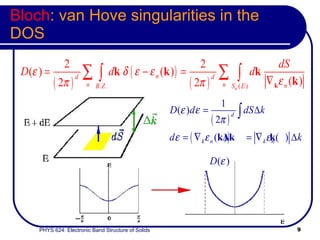
Bloch : van Hove singularities in the DOS
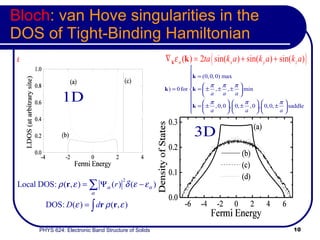
Bloch : van Hove singularities in the DOS of Tight-Binding Hamiltonian
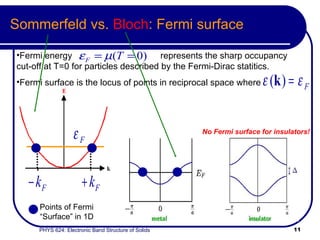
Sommerfeld vs.  Bloch : Fermi surface Fermi energy  represents the sharp occupancy cut-off at T=0 for particles described by the Fermi-Dirac statitics. Fermi surface is the locus of points in reciprocal space where  No Fermi surface for insulators! Points of Fermi “Surface” in 1D
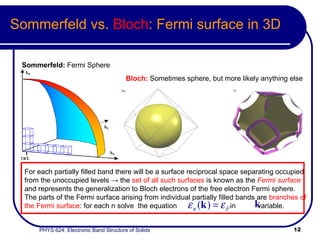
Sommerfeld vs.  Bloch : Fermi surface in 3D Sommerfeld:  Fermi Sphere Bloch:  Sometimes sphere, but more likely anything else For each partially filled band there will be a surface reciprocal space separating occupied from the unoccupied levels  -> the  set of all such surfaces  is known as the  Fermi surface  and represents the generalization to Bloch electrons of the free electron Fermi sphere. The parts of the Fermi surface arising from individual partially filled bands are  branches of the Fermi surface : for each n solve  the equation  in  variable.
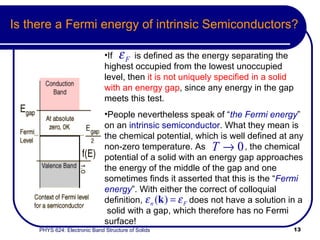
Is there a Fermi energy of intrinsic Semiconductors? If  is defined as the energy separating the highest occupied from the lowest unoccupied level, then  it is not uniquely specified in a solid with an energy gap , since any energy in the gap meets this test.  People nevertheless speak of “ the Fermi energy ” on an  intrinsic semiconductor . What they mean is the chemical potential, which is well defined at any non-zero temperature. As  , the chemical potential of a solid with an energy gap approaches the energy of the middle of the gap and one sometimes finds it asserted that this is the “ Fermi energy ”. With either the correct of colloquial definition,  does not have a solution in a  solid with a gap, which therefore has no Fermi surface!
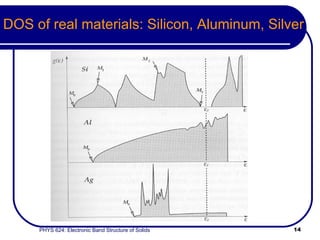
DOS of real materials: Silicon, Aluminum, Silver
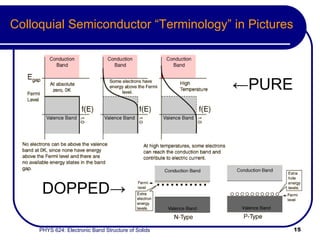
Colloquial Semiconductor “Terminology” in Pictures ← PURE DOPPED ->
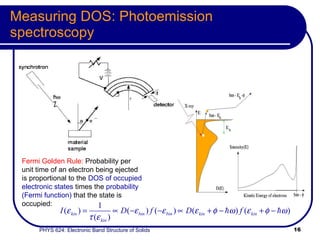
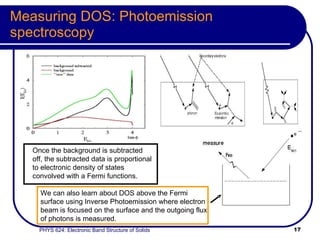
Measuring DOS: Photoemission spectroscopy Fermi Golden Rule:  Probability per unit time of an electron being ejected is proportional to the  DOS of occupied electronic states  times the  probability (Fermi function)  that the state is occupied:
Measuring DOS: Photoemission spectroscopy Once the background is subtracted off, the subtracted data is proportional to electronic density of states convolved with a Fermi functions. We can also learn about DOS above the Fermi surface using Inverse Photoemission where electron beam is focused on the surface and the outgoing flux of photons is measured.
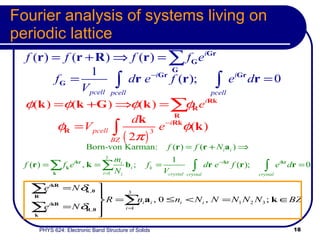
Fourier analysis of systems living on periodic lattice
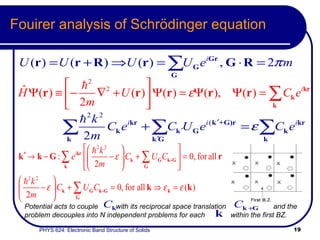
Fouirer analysis of Schr ö dinger equation Potential acts to couple  with its reciprocal space translation  and the problem decouples into N independent problems for each  within the first BZ.
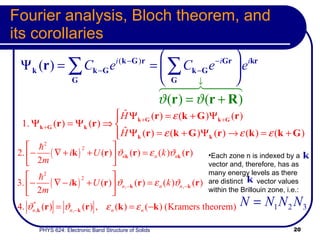
Fourier analysis, Bloch theorem, and its corollaries Each zone n is indexed by a  vector and, therefore, has as many energy levels as there are distinct  vector values within the Brillouin zone, i.e.:
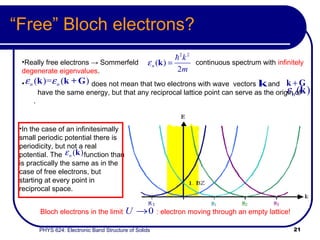
“ Free” Bloch electrons? Really free electrons  -> Sommerfeld  continuous spectrum with  infinitely degenerate eigenvalues .  does not mean that two electrons with wave  vectors  and  have the same energy, but that any reciprocal lattice point can serve as the origin of  .  In the case of an infinitesimally small periodic potential there is periodicity, but not a real potential. The  function than is practically the same as in the case of free electrons, but starting at every point in reciprocal space. Bloch electrons in the limit  : electron moving through an empty lattice!
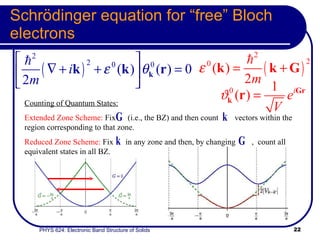
Schr ödinger equation for  “free” Bloch electrons Counting of Quantum States:   Extended Zone Scheme:  Fix  (i.e., the BZ) and then count  vectors within the region corresponding to that zone. Reduced Zone Scheme:  Fix  in any zone and then, by changing  ,  count all equivalent states in all BZ.
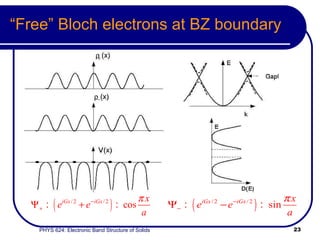
“ Free” Bloch electrons at BZ boundary
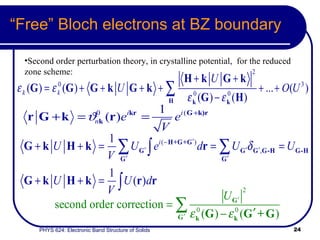
“ Free” Bloch electrons at BZ boundary Second order perturbation theory, in crystalline potential,  for the reduced zone scheme:
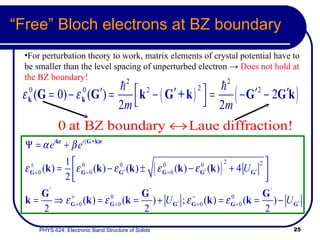
“ Free” Bloch electrons at BZ boundary For perturbation theory to work, matrix elements of crystal potential have to be smaller than the level spacing of unperturbed electron  ->  Does not hold at the BZ boundary!
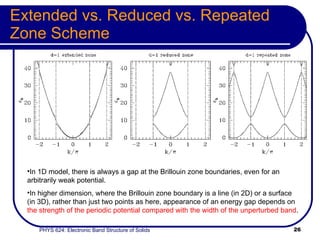
Extended vs. Reduced vs. Repeated Zone Scheme In 1D model, there is always a gap at the Brillouin zone boundaries, even for an arbitrarily weak potential.  In higher dimension, where the Brillouin zone boundary is a line (in 2D) or a surface (in 3D), rather than just two points as here, appearance of an energy gap depends on  the strength of the periodic potential compared with the width of the unperturbed band .
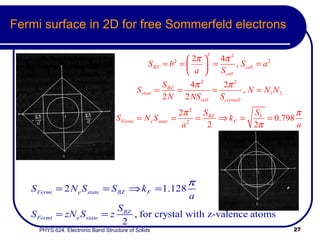
Fermi surface in 2D for free Sommerfeld electrons
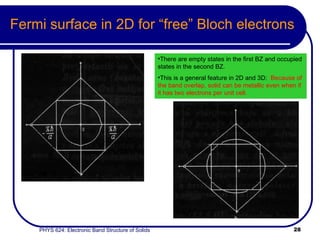
Fermi surface in 2D for “free” Bloch electrons There are empty states in the first BZ and occupied states in the second BZ.  This is a general feature in 2D and 3D:  Because of the band overlap, solid can be metallic even when if it has two electrons per unit cell.
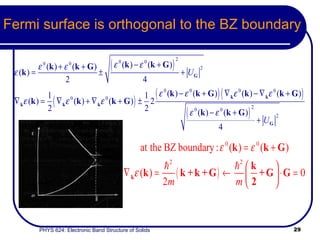
Fermi surface is orthogonal to the BZ boundary
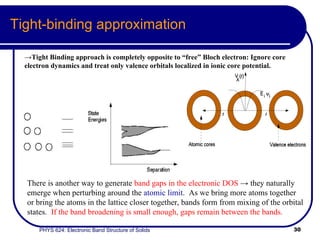
Tight-binding approximation -> Tight Binding approach is completely opposite to “free” Bloch electron: Ignore core electron dynamics and treat only valence orbitals localized in ionic core potential.  There is another way to generate  band gaps   in the electronic DOS  -> they naturally emerge when perturbing around the  atomic limit .  As we bring more atoms together or bring the atoms in the lattice closer together, bands form from mixing of the orbital states.  If the band broadening is small enough, gaps remain between the bands.
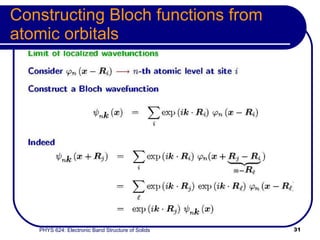
Constructing Bloch functions from atomic orbitals
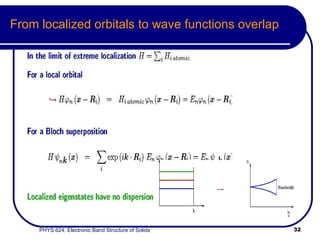
From localized orbitals to wave functions overlap
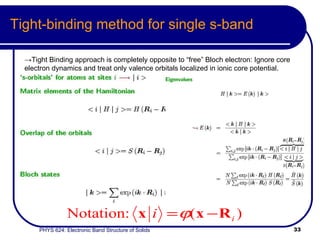
Tight-binding method for single s-band -> Tight Binding approach is completely opposite to “free” Bloch electron: Ignore core electron dynamics and treat only valence orbitals localized in ionic core potential.
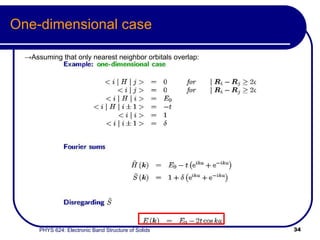
One-dimensional case -> Assuming that only nearest neighbor orbitals overlap:
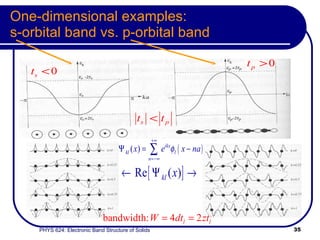
One-dimensional examples:  s-orbital band vs. p-orbital band
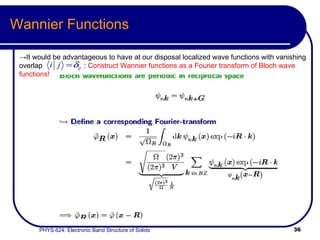
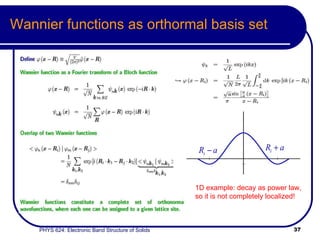
Wannier Functions -> It would be advantageous to have at our disposal localized wave functions with vanishing overlap  :  Construct Wannier functions as a Fourier transform of Bloch wave functions!
Wannier functions as orthormal basis set 1D example: decay as power law, so it is not completely localized!
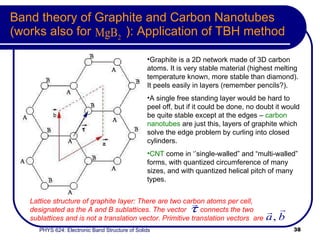
Band theory of Graphite and Carbon Nanotubes (works also for  ): Application of TBH method  Graphite is a 2D network made of 3D carbon atoms. It is very stable material (highest melting temperature known, more stable than diamond). It peels easily in layers (remember pencils?). A single free standing layer would be hard to peel off, but if it could be done, no doubt it would be quite stable except at the edges –  carbon nanotubes  are just this, layers of graphite which solve the edge problem by curling into closed cylinders. CNT  come in ‘’single-walled” and “multi-walled” forms, with quantized circumference of many sizes, and with quantized helical pitch of many types. Lattice structure of graphite layer: There are two carbon atoms per cell, designated as the A and B sublattices. The vector  connects the two sublattices and is not a translation vector. Primitive translation vectors  are   .
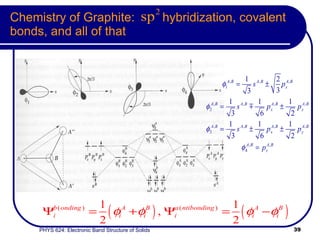
Chemistry of Graphite:  hybridization, covalent bonds, and all of that
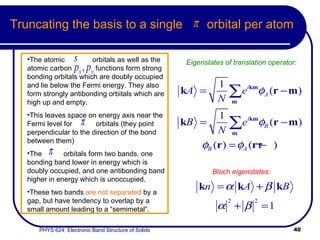
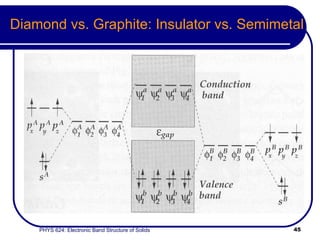
Truncating the basis to a single  orbital per atom The atomic  orbitals as well as the atomic carbon  functions form strong bonding orbitals which are doubly occupied and lie below the Fermi energy. They also form strongly antibonding orbitals which are high up and empty.  This leaves space on energy axis near the Fermi level for  orbitals (they point perpendicular to the direction of the bond between them) The  orbitals form two bands, one bonding band lower in energy which is doubly occupied, and one antibonding band higher in energy which is unoccupied.  These two bands  are not separated  by a gap, but have tendency to overlap by a small amount leading to a “semimetal”. Eigenstates of translation operator: Bloch eigenstates:
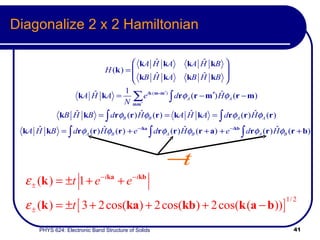
Diagonalize 2 x 2 Hamiltonian
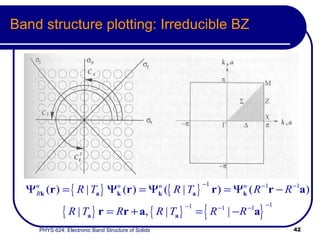
Band structure plotting: Irreducible BZ
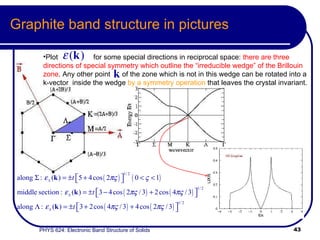
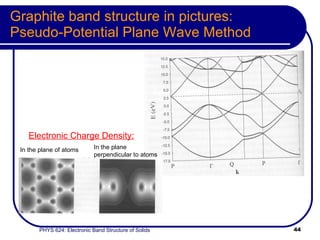
Graphite band structure in pictures Plot  for some special directions in reciprocal space:  there are three directions of special symmetry which outline the “irreducible wedge” of the Brillouin zone . Any other point  of the zone which is not in this wedge can be rotated into a  k-vector  inside the wedge  by a symmetry operation  that leaves the crystal invariant.
Graphite band structure in pictures:  Pseudo-Potential Plane Wave Method  Electronic Charge Density: In the plane of atoms In the plane perpendicular to atoms
Diamond vs. Graphite: Insulator vs. Semimetal
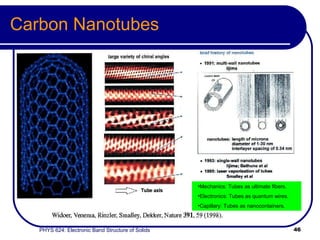
Carbon Nanotubes   Mechanics: Tubes as ultimate fibers. Electronics: Tubes as quantum wires. Capillary: Tubes as nanocontainers.
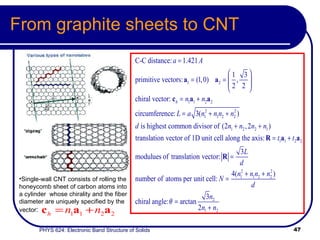
From graphite sheets to CNT   Single-wall CNT consists of rolling the honeycomb sheet of carbon atoms into  a cylinder  whose chirality and the fiber diameter are uniquely specified by the vector :
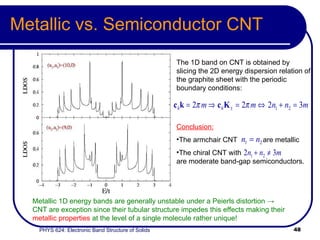
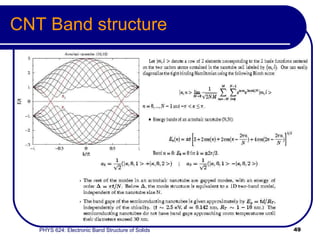
Metallic vs. Semiconductor CNT The 1D band on CNT is obtained by slicing the 2D energy dispersion relation of the graphite sheet with the periodic boundary conditions: Conclusion: The armchair CNT  are metallic  The chiral CNT with  are moderate band-gap semiconductors.  Metallic 1D energy bands are generally unstable under a Peierls distortion  ->  CNT are exception since their tubular structure impedes this effects making their  metallic properties  at the level of a single molecule rather unique!
CNT Band structure

Band structure(2)

  • 1.
    Electronic Band Structureof Solids Introduction to Solid State Physics http://www.physics.udel.edu/~bnikolic/teaching/phys624/phys624.html
  • 2.
    What are quantum numbers? Quantum numbers label eigenenergies and eigenfunctions of a Hamiltonian Sommerfeld: -vector ( is momentum) The Crystal Momentum is not the Momentum of a Bloch electron: the rate of change of an electron momentum is given by the total forces on the electron, but the rate of change of electronic crystal momentum is: where forces are exerted only by the external fields, and not by the periodic field of the lattice. Bloch: -vector ( is the crystal momentum ) and (the band index).
  • 3.
    Semiclassical dynamics ofBloch electrons Bloch states have the property that their expectation values of and , follow classical dynamics.  The only change is that now (band structure) must be used: A perfectly periodic ionic arrangement has zero resistance. Resistivity comes from imperfections (example: a barrier induces a reflected and transmitted Bloch wave), which control the mean-free path. This can be much larger than the lattice spacing. A fully occupied band does not contribute to the current since the electrons cannot be promoted to other empty states with higher . The current is induced by rearrangement of states near the Fermi energy in a partially occupied band . Limits of validity:
  • 4.
    What is therange of quantum numbers? Sommerfeld: runs through all of k-space consistent with the Born-von Karman periodic boundary conditions: Bloch: For each , runs through all wave vectors in a single primitive cell of the reciprocal lattice consistent with the Born-von Karman periodic boundary conditions; runs through an infinite set of discrete values.
  • 5.
    What are the energy levels? Sommerfeld: Bloch: For a given band index n, has no simple explicit form. The only general property is periodicity in the reciprocal space:
  • 6.
    What is thevelocity of electron? Sommerfeld: The mean velocity of an electron in a level with wave vector is: NOTE: Quantum mechanical definition of a mean velocity Bloch: The mean velocity of an electron in a level with band index and wave vector is: Conductivity of a perfect crystal:
  • 7.
    What is the Wave function Sommerfeld: The wave function of an electron with wave vector is: Bloch: The wave function of an electron with band index and wave vector is: where the function has no simple explicit form. The only general property is its periodicity in the direct lattice (i.e., real space):
  • 8.
    Sommerfeld vs. Bloch : Density of States Sommerfeld -> Bloch
  • 9.
    Bloch : vanHove singularities in the DOS
  • 10.
    Bloch : vanHove singularities in the DOS of Tight-Binding Hamiltonian
  • 11.
    Sommerfeld vs. Bloch : Fermi surface Fermi energy represents the sharp occupancy cut-off at T=0 for particles described by the Fermi-Dirac statitics. Fermi surface is the locus of points in reciprocal space where No Fermi surface for insulators! Points of Fermi “Surface” in 1D
  • 12.
    Sommerfeld vs. Bloch : Fermi surface in 3D Sommerfeld: Fermi Sphere Bloch: Sometimes sphere, but more likely anything else For each partially filled band there will be a surface reciprocal space separating occupied from the unoccupied levels -> the set of all such surfaces is known as the Fermi surface and represents the generalization to Bloch electrons of the free electron Fermi sphere. The parts of the Fermi surface arising from individual partially filled bands are branches of the Fermi surface : for each n solve the equation in variable.
  • 13.
    Is there aFermi energy of intrinsic Semiconductors? If is defined as the energy separating the highest occupied from the lowest unoccupied level, then it is not uniquely specified in a solid with an energy gap , since any energy in the gap meets this test. People nevertheless speak of “ the Fermi energy ” on an intrinsic semiconductor . What they mean is the chemical potential, which is well defined at any non-zero temperature. As , the chemical potential of a solid with an energy gap approaches the energy of the middle of the gap and one sometimes finds it asserted that this is the “ Fermi energy ”. With either the correct of colloquial definition, does not have a solution in a solid with a gap, which therefore has no Fermi surface!
  • 14.
    DOS of realmaterials: Silicon, Aluminum, Silver
  • 15.
    Colloquial Semiconductor “Terminology”in Pictures ← PURE DOPPED ->
  • 16.
    Measuring DOS: Photoemissionspectroscopy Fermi Golden Rule: Probability per unit time of an electron being ejected is proportional to the DOS of occupied electronic states times the probability (Fermi function) that the state is occupied:
  • 17.
    Measuring DOS: Photoemissionspectroscopy Once the background is subtracted off, the subtracted data is proportional to electronic density of states convolved with a Fermi functions. We can also learn about DOS above the Fermi surface using Inverse Photoemission where electron beam is focused on the surface and the outgoing flux of photons is measured.
  • 18.
    Fourier analysis ofsystems living on periodic lattice
  • 19.
    Fouirer analysis ofSchr ö dinger equation Potential acts to couple with its reciprocal space translation and the problem decouples into N independent problems for each within the first BZ.
  • 20.
    Fourier analysis, Blochtheorem, and its corollaries Each zone n is indexed by a vector and, therefore, has as many energy levels as there are distinct vector values within the Brillouin zone, i.e.:
  • 21.
    “ Free” Blochelectrons? Really free electrons -> Sommerfeld continuous spectrum with infinitely degenerate eigenvalues . does not mean that two electrons with wave vectors and have the same energy, but that any reciprocal lattice point can serve as the origin of . In the case of an infinitesimally small periodic potential there is periodicity, but not a real potential. The function than is practically the same as in the case of free electrons, but starting at every point in reciprocal space. Bloch electrons in the limit : electron moving through an empty lattice!
  • 22.
    Schr ödinger equationfor “free” Bloch electrons Counting of Quantum States: Extended Zone Scheme: Fix (i.e., the BZ) and then count vectors within the region corresponding to that zone. Reduced Zone Scheme: Fix in any zone and then, by changing , count all equivalent states in all BZ.
  • 23.
    “ Free” Blochelectrons at BZ boundary
  • 24.
    “ Free” Blochelectrons at BZ boundary Second order perturbation theory, in crystalline potential, for the reduced zone scheme:
  • 25.
    “ Free” Blochelectrons at BZ boundary For perturbation theory to work, matrix elements of crystal potential have to be smaller than the level spacing of unperturbed electron -> Does not hold at the BZ boundary!
  • 26.
    Extended vs. Reducedvs. Repeated Zone Scheme In 1D model, there is always a gap at the Brillouin zone boundaries, even for an arbitrarily weak potential. In higher dimension, where the Brillouin zone boundary is a line (in 2D) or a surface (in 3D), rather than just two points as here, appearance of an energy gap depends on the strength of the periodic potential compared with the width of the unperturbed band .
  • 27.
    Fermi surface in2D for free Sommerfeld electrons
  • 28.
    Fermi surface in2D for “free” Bloch electrons There are empty states in the first BZ and occupied states in the second BZ. This is a general feature in 2D and 3D: Because of the band overlap, solid can be metallic even when if it has two electrons per unit cell.
  • 29.
    Fermi surface isorthogonal to the BZ boundary
  • 30.
    Tight-binding approximation ->Tight Binding approach is completely opposite to “free” Bloch electron: Ignore core electron dynamics and treat only valence orbitals localized in ionic core potential. There is another way to generate band gaps in the electronic DOS -> they naturally emerge when perturbing around the atomic limit . As we bring more atoms together or bring the atoms in the lattice closer together, bands form from mixing of the orbital states. If the band broadening is small enough, gaps remain between the bands.
  • 31.
    Constructing Bloch functionsfrom atomic orbitals
  • 32.
    From localized orbitalsto wave functions overlap
  • 33.
    Tight-binding method forsingle s-band -> Tight Binding approach is completely opposite to “free” Bloch electron: Ignore core electron dynamics and treat only valence orbitals localized in ionic core potential.
  • 34.
    One-dimensional case ->Assuming that only nearest neighbor orbitals overlap:
  • 35.
    One-dimensional examples: s-orbital band vs. p-orbital band
  • 36.
    Wannier Functions ->It would be advantageous to have at our disposal localized wave functions with vanishing overlap : Construct Wannier functions as a Fourier transform of Bloch wave functions!
  • 37.
    Wannier functions asorthormal basis set 1D example: decay as power law, so it is not completely localized!
  • 38.
    Band theory ofGraphite and Carbon Nanotubes (works also for ): Application of TBH method Graphite is a 2D network made of 3D carbon atoms. It is very stable material (highest melting temperature known, more stable than diamond). It peels easily in layers (remember pencils?). A single free standing layer would be hard to peel off, but if it could be done, no doubt it would be quite stable except at the edges – carbon nanotubes are just this, layers of graphite which solve the edge problem by curling into closed cylinders. CNT come in ‘’single-walled” and “multi-walled” forms, with quantized circumference of many sizes, and with quantized helical pitch of many types. Lattice structure of graphite layer: There are two carbon atoms per cell, designated as the A and B sublattices. The vector connects the two sublattices and is not a translation vector. Primitive translation vectors are .
  • 39.
    Chemistry of Graphite: hybridization, covalent bonds, and all of that
  • 40.
    Truncating the basisto a single orbital per atom The atomic orbitals as well as the atomic carbon functions form strong bonding orbitals which are doubly occupied and lie below the Fermi energy. They also form strongly antibonding orbitals which are high up and empty. This leaves space on energy axis near the Fermi level for orbitals (they point perpendicular to the direction of the bond between them) The orbitals form two bands, one bonding band lower in energy which is doubly occupied, and one antibonding band higher in energy which is unoccupied. These two bands are not separated by a gap, but have tendency to overlap by a small amount leading to a “semimetal”. Eigenstates of translation operator: Bloch eigenstates:
  • 41.
    Diagonalize 2 x2 Hamiltonian
  • 42.
  • 43.
    Graphite band structurein pictures Plot for some special directions in reciprocal space: there are three directions of special symmetry which outline the “irreducible wedge” of the Brillouin zone . Any other point of the zone which is not in this wedge can be rotated into a k-vector inside the wedge by a symmetry operation that leaves the crystal invariant.
  • 44.
    Graphite band structurein pictures: Pseudo-Potential Plane Wave Method Electronic Charge Density: In the plane of atoms In the plane perpendicular to atoms
  • 45.
    Diamond vs. Graphite:Insulator vs. Semimetal
  • 46.
    Carbon Nanotubes Mechanics: Tubes as ultimate fibers. Electronics: Tubes as quantum wires. Capillary: Tubes as nanocontainers.
  • 47.
    From graphite sheetsto CNT Single-wall CNT consists of rolling the honeycomb sheet of carbon atoms into a cylinder whose chirality and the fiber diameter are uniquely specified by the vector :
  • 48.
    Metallic vs. SemiconductorCNT The 1D band on CNT is obtained by slicing the 2D energy dispersion relation of the graphite sheet with the periodic boundary conditions: Conclusion: The armchair CNT are metallic The chiral CNT with are moderate band-gap semiconductors. Metallic 1D energy bands are generally unstable under a Peierls distortion -> CNT are exception since their tubular structure impedes this effects making their metallic properties at the level of a single molecule rather unique!
  • 49.