CONCEPTS OF
CHROMATOGRAPHY
FINALYEAR B.PHARM 2021-22 SEMVII
PHARMACEUTICAL ANALYSIS YTIP UNIVERSITY OF MUMBAI
CONTENTS
• Introduction
• Basic terminologies - stationary phase, ● mobile phase, ● retention time, ● gradient
and isocratic elution, ● normal and reverse phase chromatography, ● planar
chromatography, ● retention factor, ● chromatogram, ● internal standard, ● reference
standard, ● working standard, ● tailing factor (symmetry factor), asymmetry factor, ●
resolution, ● signal to noise ratio, ● column chromatography, ● preparative
chromatography ● , adsorption chromatography and partition chromatography.
• Classification of chromatographic methods.
CONTENTS
• Quantitative analysis ( peak height , peak areas , calibration curve , internal standard and
area normalization )
• Optimization of column performance ( column efficiency & band broadening , shape of
peak- Gaussian , plate height , number of theoretical plates ,Van Deemter equation ,
capacity factor , selectivity factor , tailing factor , peak width & resolution )
CHROMATOGRAPHY
• Chromatography means color writing , it is used in many scientific fields , used in many
subjects and applied in all analytical fields .
• Chromatography is a method of analysis and separation technique of organic and
inorganic compound. It is used for large and small quantities so it is used quantitatively
and qualitatively and proved to be more effective from other means of separation and
identification
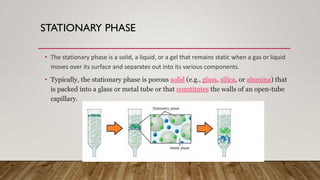
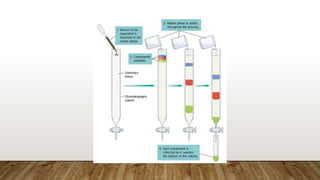
STATIONARY PHASE
• The stationary phase is a solid, a liquid, or a gel that remains static when a gas or liquid
moves over its surface and separates out into its various components.
• Typically, the stationary phase is porous solid (e.g., glass, silica, or alumina) that
is packed into a glass or metal tube or that constitutes the walls of an open-tube
capillary.
MOBILE PHASE
• The mobile phase in chromatography is the phase that is either liquid or
gas that is passed through a chromatographic system where the
components of the mixture are separated at different raters by adsorbing
them to the stationary phase.
• Substances used as mobile phases are selected for a chromatographic process
depending on the nature of the components to be separated and the type of
chromatography.
• Alcohol, water, acetic acid, acetone, or some gases are the commonly used
mobile phase in different chromatographic techniques.
DIFFERENCE BETWEEN MOBILE PHASE AND
STATIONARY PHASE
• The main difference between the mobile phase and stationary phase is that
the mobile phase is the solvent moving through the column, whereas
the stationary phase is the substance, which stays fixed inside the
column. Furthermore, the mobile phase can be either liquid or gas while the
stationary phase is a solid or liquid supported on a solid.
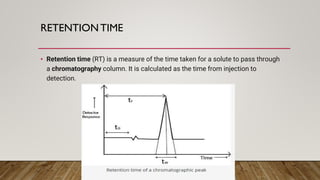
RETENTION TIME
• Retention time (RT) is a measure of the time taken for a solute to pass through
a chromatography column. It is calculated as the time from injection to
detection.
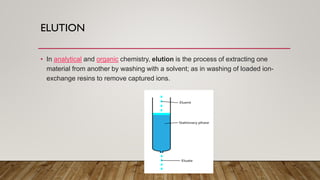
ELUTION
• In analytical and organic chemistry, elution is the process of extracting one
material from another by washing with a solvent; as in washing of loaded ion-
exchange resins to remove captured ions.
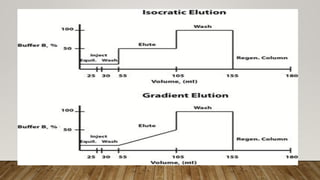
GRADIENT AND ISOCRATIC ELUTION
• Isocratic and gradient elution describe the properties of the mobile phase. The
key difference between isocratic and gradient elution is that isocratic
elution refers to the maintenance of a constant concentration in the mobile
phase whereas gradient elution refers to the maintenance of a varying
concentration in the mobile phase.
NORMAL PHASE CHROMATOGRAPHY
• Normal phase chromatography is one where in the stationary phase is polar in nature
and the mobile phase is non-polar in nature.
• In Normal Phase Liquid Chromatography, the stationary phase is more polar than the
mobile phase. There are a number of stationary phases available for normal-phase
chromatography. Silica is the most common of the non-bonded phases and can provide
very high selectivity for many applications.
I
REVERSE PHASE CHROMATOGRAPHY
• Reversed-phase chromatography is a technique using alkyl chains covalently
bonded to the stationary phase particles in order to create a hydrophobic
stationary phase, which has a stronger affinity for hydrophobic or less polar
compounds.
DIFFERENCE BETWEEN NORMAL AND REVERSE
PHASE CHROMATOGRAPHY
• The main difference between normal phase and reverse phase chromatography
is that normal phase chromatography has a very polar stationary phase and a
non-polar mobile phase whereas reverse phase chromatography has a non-polar
stationary phase and a polar mobile phase.
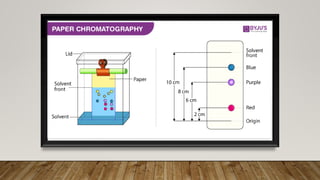
PLANER CHROMATOGRAPHY
• Planar chromatography is one branch of the discipline, defined by having the
stationary phase of the process take place on a plane.
• There are two main branches of planar chromatography: paper chromatography
and thin-layer chromatography (TLC). Although both practices follow very similar
principles and methods, they use different materials as beds or planes for the
stationary phase of the process.
RETENTION FACTOR
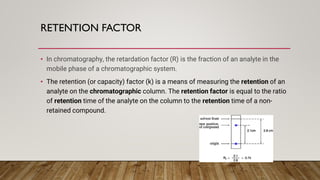
• In chromatography, the retardation factor (R) is the fraction of an analyte in the
mobile phase of a chromatographic system.
• The retention (or capacity) factor (k) is a means of measuring the retention of an
analyte on the chromatographic column. The retention factor is equal to the ratio
of retention time of the analyte on the column to the retention time of a non-
retained compound.
CHROMATOGRAM
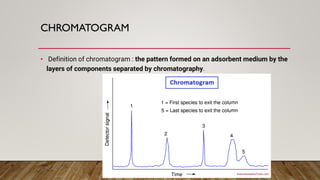
• Definition of chromatogram : the pattern formed on an adsorbent medium by the
layers of components separated by chromatography.
INTERNAL STANDARD
• In chromatography, internal standards are used to determine the concentration
of other analytes by calculating response factor. The internal standard selected
should be again similar to the analyte and have a similar retention time and
similar derivitization. It must be stable and must not interfere with the sample
components.
REFERENCE STANDARD
• A reference standard is a substance prepared for use as the standard in an assay,
identification, or purity test and should have a quality appropriate for its use. A
reference standard is a prerequisite to measuring potency.
TAILING FACTOR (SYMMETRY FACTOR)
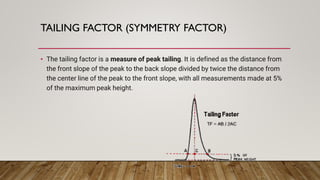
• The tailing factor is a measure of peak tailing. It is defined as the distance from
the front slope of the peak to the back slope divided by twice the distance from
the center line of the peak to the front slope, with all measurements made at 5%
of the maximum peak height.
ASYMMETRY FACTOR
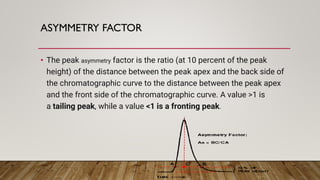
• The peak asymmetry factor is the ratio (at 10 percent of the peak
height) of the distance between the peak apex and the back side of
the chromatographic curve to the distance between the peak apex
and the front side of the chromatographic curve. A value >1 is
a tailing peak, while a value <1 is a fronting peak.
RESOLUTION
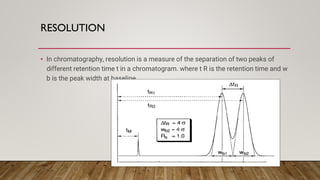
• In chromatography, resolution is a measure of the separation of two peaks of
different retention time t in a chromatogram. where t R is the retention time and w
b is the peak width at baseline.
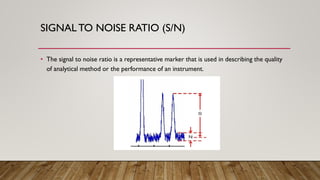
SIGNAL TO NOISE RATIO (S/N)
• The signal to noise ratio is a representative marker that is used in describing the quality
of analytical method or the performance of an instrument.
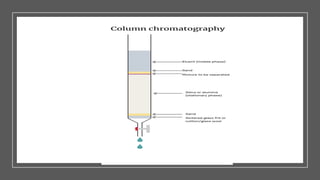
COLUMN CHROMATOGRAPHY
• Column chromatography is one of the most useful methods for the separation and purification of both
solids and liquids
• Column chromatography was developed by American chemist D.T. Day in 1900
• This is solid-liquid technique in which the stationary phase is a solid and mobile phase is liquid
• Principle –
• Principle is based on adsorption
• Components moves depending upon their relative affinities
• A component attracted more strongly by the mobile phase will move rapidly through the column,and
elute first and vice versa.
PREPARATIVE CHROMATOGRAPHY
• Preparative chromatography is a technique used for separating the ingredients of
complex mixtures. It is used in the pharmaceutical industry to purify molecules by
cleaning them of their impurities.
• How does it work?
• The active ingredient or the interim mixture, in its raw state, is placed on the
stationary phase of a chromatography column and mixed with solvents. Elution, i.e.
the separation process, takes place by gravity towards the bottom of the column.
At the end of the separation process, the purified sample is retrieved at the column
output.
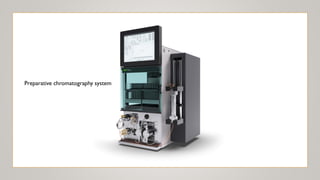
Preparative chromatography system
ADSORPTION CHROMATOGRAPHY
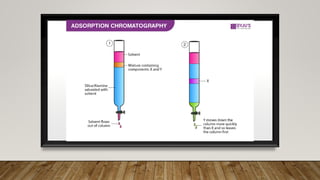
• Adsortion chromatography is probably one of the oldest types of chromatography .
• Adsorption chromatography is a process of separation of a components in a mixture
introduced into chromatography system based on the relative differences in adsorption
of components to the stationary phase present in the chromatography column.
• The adsorption chromatography applies to only solid-liquid or solid-gas chromatography.
Because the adsorption phenomenon is inherent property of solids and hence it is used
with only solid stationary phase chromatographies.
PARTITION CROMATOGRAPHY
• Partition chromatography definition states that it is a technique mainly used for the
separation of the components present in the mixture into two liquid phases that are the
original solvent and the solvent coating utilized in the columnn
• In partition chromatography, the separation of the components from the sample takes place
through the process of partition the components between two phases, where both the
phases are present in liquid form. In this procedure, the immiscible solid surface that is
covered with the liquid surface on the stationary phase is in the mobile phase.
• The stationary phase immobilizes the liquid surface which ultimately changes into a stationary
phase. The components are separated just after the mobile phase shifts from the stationary
phase. The separation is because of the differences in partition coefficients.
CLASSIFICATION OF CHROMATOGRAPHIC
METHODS
• This method can be classified in three ways:
1.Classification based on the physical state.
2.Classification based on the contact between the mobile phase and stationary
phase.
3.On the chemical or physical mechanism.
CLASSIFICATION BASED ON THE PHYSICAL STATE:
The first method based on the physical state of the mobile phase and the
stationary phase. They fall into four categories , Such as
• Gas-liquid
• gas-solid
• liquid-solid
• liquid-liquid
CLASSIFICATION BASED ON CONTACT BETWEEN
MOBILE PHASE AND STATIONARY PHASE:
This is a second method of classification :
• Liquid-solid chromatography (LSC)
• Liquid-Liquid chromatography (LLC)
• Gas-Solid chromatography (GSC)
• Gas-Liquid chromatography(GLC)
CLASSIFICATION BASED ON CHEMICAL OR PHYSICAL
MECHANISM:
The third method of classification that is based on the physical and chemical mechanism.
• Column chromato-graphy
• Ion – exchange chromatography
• Paper chromato-graphy
• Gas -liquid chromato-graphy
• Gas chromato-graphy
• Thin layer chroma-tography
• HPLC
QUANTITATIVE ANALYSIS
• Quantitative measurements using chromatographic analysis are based on
measurements of peak height or peak area of the peak from a sample with the
unknown concentration.
• Quantitative chromatography is used to determine the concentration of
analytes in a sample.
• Qualitative analysis fundamentally means to measure something by its quality rather than
quantity. Quantitative analysis is the opposite; to measure by quantity rather than quality.
• When we do quantitative analysis, we are exploring facts, measures, numbers and
percentages.
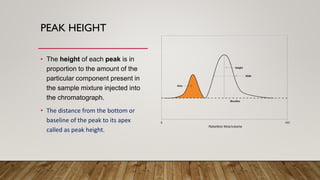
PEAK HEIGHT
• The height of each peak is in
proportion to the amount of the
particular component present in
the sample mixture injected into
the chromatograph.
• The distance from the bottom or
baseline of the peak to its apex
called as peak height.
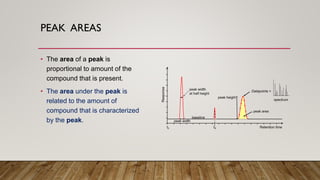
PEAK AREAS
• The area of a peak is
proportional to amount of the
compound that is present.
• The area under the peak is
related to the amount of
compound that is characterized
by the peak.
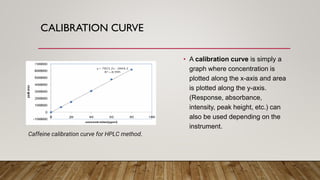
CALIBRATION CURVE
• A calibration curve is simply a
graph where concentration is
plotted along the x-axis and area
is plotted along the y-axis.
(Response, absorbance,
intensity, peak height, etc.) can
also be used depending on the
instrument.
Caffeine calibration curve for HPLC method.
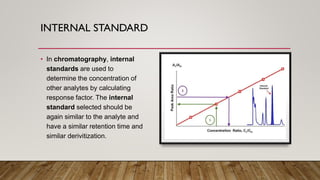
INTERNAL STANDARD
• In chromatography, internal
standards are used to
determine the concentration of
other analytes by calculating
response factor. The internal
standard selected should be
again similar to the analyte and
have a similar retention time and
similar derivitization.
AREA NORMALIZATION
• The %Area Normalization procedure reports the area of each peak in the
chromatogram as a. percentage of the total area of all peaks. %Area does not
require any standard and does not depend upon the amount of sample injected
within the limits of the detector.
• How do you calculate area normalization?
• When it comes to calculate the % impurity by area normalization one can do it
by taking the individual area of the impurity divided by the total area and multiply
that by 100 to get the % of impurity
OPTIMIZATION OF COLUMN PERFORMANCE
• Optimisation of chromatographic separations is achieved by varying the experimental conditions of
the run until the components of the mixture are separated cleanly in a reasonable amount of time.
• How do you improve column performance?
• Variables that may be adjusted to reduce peak broadening are those that lead to an improvement in column
efficiency. Making adjustments to increase the number of theoretical plates (N) or decreasing plate height (H) will
therefore reduce the tendency of peaks to broaden.
• In liquid chromatography, the easiest way to increase a solute's retention factor is to use a mobile phase that is a
weaker solvent. When the mobile phase has a lower solvent strength, solutes spend proportionally more time in the
stationary phase and take longer to elute.
COLUMN EFFICIENCY
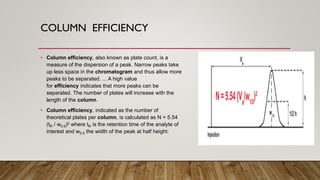
• Column efficiency, also known as plate count, is a
measure of the dispersion of a peak. Narrow peaks take
up less space in the chromatogram and thus allow more
peaks to be separated. ... A high value
for efficiency indicates that more peaks can be
separated. The number of plates will increase with the
length of the column.
• Column efficiency, indicated as the number of
theoretical plates per column, is calculated as N = 5.54
(tR / w0.5)2 where tR is the retention time of the analyte of
interest and w0.5 the width of the peak at half height.
BAND BROADENING
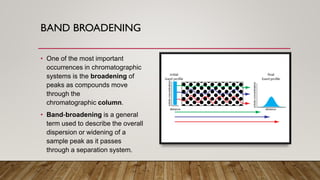
• One of the most important
occurrences in chromatographic
systems is the broadening of
peaks as compounds move
through the
chromatographic column.
• Band-broadening is a general
term used to describe the overall
dispersion or widening of a
sample peak as it passes
through a separation system.
SHAPE OF PEAK- GAUSSIAN
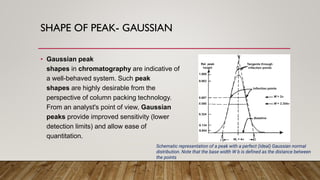
• Gaussian peak
shapes in chromatography are indicative of
a well-behaved system. Such peak
shapes are highly desirable from the
perspective of column packing technology.
From an analyst's point of view, Gaussian
peaks provide improved sensitivity (lower
detection limits) and allow ease of
quantitation.
Schematic representation of a peak with a perfect (ideal) Gaussian normal
distribution. Note that the base width W b is defined as the distance between
the points
PLATE HEIGHT (H)
• Theoretical plates represent a hypothetical division
of chromatographic columns, and each plate represents an equilibrated
partitioning of the solute between the stationary and mobile phases.
• The column length (L) divided by the plate number: H = L/N
• It is also called the Height Equivalent to One Theoretical Plate (HETP).
NUMBER OF THEORETICAL PLATES (N)
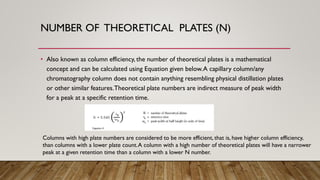
• Also known as column efficiency, the number of theoretical plates is a mathematical
concept and can be calculated using Equation given below.A capillary column/any
chromatography column does not contain anything resembling physical distillation plates
or other similar features.Theoretical plate numbers are indirect measure of peak width
for a peak at a specific retention time.
Columns with high plate numbers are considered to be more efficient, that is, have higher column efficiency,
than columns with a lower plate count.A column with a high number of theoretical plates will have a narrower
peak at a given retention time than a column with a lower N number.
VAN DEEMTER EQUATION
• The van Deemter equation is a theoretical treatment of the peak broadening within a chromatographic
column.
• The van Deemter equation is the basic interpretive equation of column efficiency, which provides an
insight into the factors that lead to broadening of a compound as it travels along the column.
• The mechanism of band broadening and how it can be linked to HETP was discussed in a 1956
paper entitled ‘Longitudinal diffusion and resistance to mass transfer as causes of nonideality
in chromatography’1.
• As a result of this work, it was found that the relationship between a column’s efficiency and the
mechanism behind band broadening could be described by an equation now known as the Van
Deemter equation. In a simplified form, the Van Deemter equation is :HETP = A + (B / u) + Cu
VAN DEEMTER EQUATION
• HETP = A + (B / u) + Cu
• Where:
• A Eddy diffusion
• B Longitudinal diffusion
• C Resistance to mass transfer
• u Average mobile phase velocity
CAPACITY FACTOR
• Capacity factor is an indication of how long a compound can be retained by the
stationary phase.
• It is calculated as, k = (Tr - To)/To, where Tr is the retention time of the target and
To is the unretained peak time.
• If Tr = To, then the sample is not retained by the stationary phase.
SELECTIVITY FACTOR
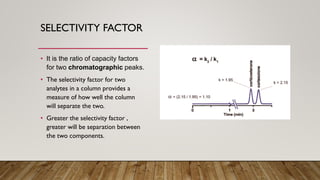
• It is the ratio of capacity factors
for two chromatographic peaks.
• The selectivity factor for two
analytes in a column provides a
measure of how well the column
will separate the two.
• Greater the selectivity factor ,
greater will be separation between
the two components.
TAILING FACTOR
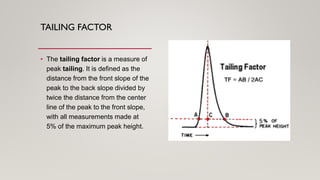
• The tailing factor is a measure of
peak tailing. It is defined as the
distance from the front slope of the
peak to the back slope divided by
twice the distance from the center
line of the peak to the front slope,
with all measurements made at
5% of the maximum peak height.
PEAK WIDTH
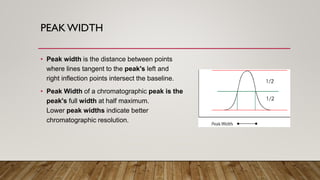
• Peak width is the distance between points
where lines tangent to the peak's left and
right inflection points intersect the baseline.
• Peak Width of a chromatographic peak is the
peak's full width at half maximum.
Lower peak widths indicate better
chromatographic resolution.
RESOLUTION (RS)
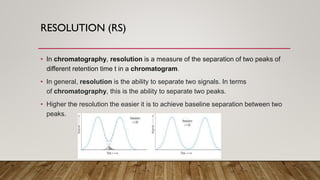
• In chromatography, resolution is a measure of the separation of two peaks of
different retention time t in a chromatogram.
• In general, resolution is the ability to separate two signals. In terms
of chromatography, this is the ability to separate two peaks.
• Higher the resolution the easier it is to achieve baseline separation between two
peaks.
THANKYOU
PREAPARED BY – ROHAN JAGDALE

Concepts of chromatography

  • 1.
    CONCEPTS OF CHROMATOGRAPHY FINALYEAR B.PHARM2021-22 SEMVII PHARMACEUTICAL ANALYSIS YTIP UNIVERSITY OF MUMBAI
  • 2.
    CONTENTS • Introduction • Basicterminologies - stationary phase, ● mobile phase, ● retention time, ● gradient and isocratic elution, ● normal and reverse phase chromatography, ● planar chromatography, ● retention factor, ● chromatogram, ● internal standard, ● reference standard, ● working standard, ● tailing factor (symmetry factor), asymmetry factor, ● resolution, ● signal to noise ratio, ● column chromatography, ● preparative chromatography ● , adsorption chromatography and partition chromatography. • Classification of chromatographic methods.
  • 3.
    CONTENTS • Quantitative analysis( peak height , peak areas , calibration curve , internal standard and area normalization ) • Optimization of column performance ( column efficiency & band broadening , shape of peak- Gaussian , plate height , number of theoretical plates ,Van Deemter equation , capacity factor , selectivity factor , tailing factor , peak width & resolution )
  • 4.
    CHROMATOGRAPHY • Chromatography meanscolor writing , it is used in many scientific fields , used in many subjects and applied in all analytical fields . • Chromatography is a method of analysis and separation technique of organic and inorganic compound. It is used for large and small quantities so it is used quantitatively and qualitatively and proved to be more effective from other means of separation and identification
  • 5.
    STATIONARY PHASE • Thestationary phase is a solid, a liquid, or a gel that remains static when a gas or liquid moves over its surface and separates out into its various components. • Typically, the stationary phase is porous solid (e.g., glass, silica, or alumina) that is packed into a glass or metal tube or that constitutes the walls of an open-tube capillary.
  • 6.
    MOBILE PHASE • Themobile phase in chromatography is the phase that is either liquid or gas that is passed through a chromatographic system where the components of the mixture are separated at different raters by adsorbing them to the stationary phase. • Substances used as mobile phases are selected for a chromatographic process depending on the nature of the components to be separated and the type of chromatography. • Alcohol, water, acetic acid, acetone, or some gases are the commonly used mobile phase in different chromatographic techniques.
  • 7.
    DIFFERENCE BETWEEN MOBILEPHASE AND STATIONARY PHASE • The main difference between the mobile phase and stationary phase is that the mobile phase is the solvent moving through the column, whereas the stationary phase is the substance, which stays fixed inside the column. Furthermore, the mobile phase can be either liquid or gas while the stationary phase is a solid or liquid supported on a solid.
  • 9.
    RETENTION TIME • Retentiontime (RT) is a measure of the time taken for a solute to pass through a chromatography column. It is calculated as the time from injection to detection.
  • 10.
    ELUTION • In analyticaland organic chemistry, elution is the process of extracting one material from another by washing with a solvent; as in washing of loaded ion- exchange resins to remove captured ions.
  • 11.
    GRADIENT AND ISOCRATICELUTION • Isocratic and gradient elution describe the properties of the mobile phase. The key difference between isocratic and gradient elution is that isocratic elution refers to the maintenance of a constant concentration in the mobile phase whereas gradient elution refers to the maintenance of a varying concentration in the mobile phase.
  • 13.
    NORMAL PHASE CHROMATOGRAPHY •Normal phase chromatography is one where in the stationary phase is polar in nature and the mobile phase is non-polar in nature. • In Normal Phase Liquid Chromatography, the stationary phase is more polar than the mobile phase. There are a number of stationary phases available for normal-phase chromatography. Silica is the most common of the non-bonded phases and can provide very high selectivity for many applications. I
  • 14.
    REVERSE PHASE CHROMATOGRAPHY •Reversed-phase chromatography is a technique using alkyl chains covalently bonded to the stationary phase particles in order to create a hydrophobic stationary phase, which has a stronger affinity for hydrophobic or less polar compounds.
  • 15.
    DIFFERENCE BETWEEN NORMALAND REVERSE PHASE CHROMATOGRAPHY • The main difference between normal phase and reverse phase chromatography is that normal phase chromatography has a very polar stationary phase and a non-polar mobile phase whereas reverse phase chromatography has a non-polar stationary phase and a polar mobile phase.
  • 16.
    PLANER CHROMATOGRAPHY • Planarchromatography is one branch of the discipline, defined by having the stationary phase of the process take place on a plane. • There are two main branches of planar chromatography: paper chromatography and thin-layer chromatography (TLC). Although both practices follow very similar principles and methods, they use different materials as beds or planes for the stationary phase of the process.
  • 17.
    RETENTION FACTOR • Inchromatography, the retardation factor (R) is the fraction of an analyte in the mobile phase of a chromatographic system. • The retention (or capacity) factor (k) is a means of measuring the retention of an analyte on the chromatographic column. The retention factor is equal to the ratio of retention time of the analyte on the column to the retention time of a non- retained compound.
  • 18.
    CHROMATOGRAM • Definition ofchromatogram : the pattern formed on an adsorbent medium by the layers of components separated by chromatography.
  • 19.
    INTERNAL STANDARD • Inchromatography, internal standards are used to determine the concentration of other analytes by calculating response factor. The internal standard selected should be again similar to the analyte and have a similar retention time and similar derivitization. It must be stable and must not interfere with the sample components.
  • 20.
    REFERENCE STANDARD • Areference standard is a substance prepared for use as the standard in an assay, identification, or purity test and should have a quality appropriate for its use. A reference standard is a prerequisite to measuring potency.
  • 21.
    TAILING FACTOR (SYMMETRYFACTOR) • The tailing factor is a measure of peak tailing. It is defined as the distance from the front slope of the peak to the back slope divided by twice the distance from the center line of the peak to the front slope, with all measurements made at 5% of the maximum peak height.
  • 22.
    ASYMMETRY FACTOR • Thepeak asymmetry factor is the ratio (at 10 percent of the peak height) of the distance between the peak apex and the back side of the chromatographic curve to the distance between the peak apex and the front side of the chromatographic curve. A value >1 is a tailing peak, while a value <1 is a fronting peak.
  • 23.
    RESOLUTION • In chromatography,resolution is a measure of the separation of two peaks of different retention time t in a chromatogram. where t R is the retention time and w b is the peak width at baseline.
  • 24.
    SIGNAL TO NOISERATIO (S/N) • The signal to noise ratio is a representative marker that is used in describing the quality of analytical method or the performance of an instrument.
  • 25.
    COLUMN CHROMATOGRAPHY • Columnchromatography is one of the most useful methods for the separation and purification of both solids and liquids • Column chromatography was developed by American chemist D.T. Day in 1900 • This is solid-liquid technique in which the stationary phase is a solid and mobile phase is liquid • Principle – • Principle is based on adsorption • Components moves depending upon their relative affinities • A component attracted more strongly by the mobile phase will move rapidly through the column,and elute first and vice versa.
  • 27.
    PREPARATIVE CHROMATOGRAPHY • Preparativechromatography is a technique used for separating the ingredients of complex mixtures. It is used in the pharmaceutical industry to purify molecules by cleaning them of their impurities. • How does it work? • The active ingredient or the interim mixture, in its raw state, is placed on the stationary phase of a chromatography column and mixed with solvents. Elution, i.e. the separation process, takes place by gravity towards the bottom of the column. At the end of the separation process, the purified sample is retrieved at the column output.
  • 28.
  • 29.
    ADSORPTION CHROMATOGRAPHY • Adsortionchromatography is probably one of the oldest types of chromatography . • Adsorption chromatography is a process of separation of a components in a mixture introduced into chromatography system based on the relative differences in adsorption of components to the stationary phase present in the chromatography column. • The adsorption chromatography applies to only solid-liquid or solid-gas chromatography. Because the adsorption phenomenon is inherent property of solids and hence it is used with only solid stationary phase chromatographies.
  • 31.
    PARTITION CROMATOGRAPHY • Partitionchromatography definition states that it is a technique mainly used for the separation of the components present in the mixture into two liquid phases that are the original solvent and the solvent coating utilized in the columnn • In partition chromatography, the separation of the components from the sample takes place through the process of partition the components between two phases, where both the phases are present in liquid form. In this procedure, the immiscible solid surface that is covered with the liquid surface on the stationary phase is in the mobile phase. • The stationary phase immobilizes the liquid surface which ultimately changes into a stationary phase. The components are separated just after the mobile phase shifts from the stationary phase. The separation is because of the differences in partition coefficients.
  • 33.
    CLASSIFICATION OF CHROMATOGRAPHIC METHODS •This method can be classified in three ways: 1.Classification based on the physical state. 2.Classification based on the contact between the mobile phase and stationary phase. 3.On the chemical or physical mechanism.
  • 34.
    CLASSIFICATION BASED ONTHE PHYSICAL STATE: The first method based on the physical state of the mobile phase and the stationary phase. They fall into four categories , Such as • Gas-liquid • gas-solid • liquid-solid • liquid-liquid
  • 35.
    CLASSIFICATION BASED ONCONTACT BETWEEN MOBILE PHASE AND STATIONARY PHASE: This is a second method of classification : • Liquid-solid chromatography (LSC) • Liquid-Liquid chromatography (LLC) • Gas-Solid chromatography (GSC) • Gas-Liquid chromatography(GLC)
  • 36.
    CLASSIFICATION BASED ONCHEMICAL OR PHYSICAL MECHANISM: The third method of classification that is based on the physical and chemical mechanism. • Column chromato-graphy • Ion – exchange chromatography • Paper chromato-graphy • Gas -liquid chromato-graphy • Gas chromato-graphy • Thin layer chroma-tography • HPLC
  • 37.
    QUANTITATIVE ANALYSIS • Quantitativemeasurements using chromatographic analysis are based on measurements of peak height or peak area of the peak from a sample with the unknown concentration. • Quantitative chromatography is used to determine the concentration of analytes in a sample. • Qualitative analysis fundamentally means to measure something by its quality rather than quantity. Quantitative analysis is the opposite; to measure by quantity rather than quality. • When we do quantitative analysis, we are exploring facts, measures, numbers and percentages.
  • 38.
    PEAK HEIGHT • Theheight of each peak is in proportion to the amount of the particular component present in the sample mixture injected into the chromatograph. • The distance from the bottom or baseline of the peak to its apex called as peak height.
  • 39.
    PEAK AREAS • Thearea of a peak is proportional to amount of the compound that is present. • The area under the peak is related to the amount of compound that is characterized by the peak.
  • 40.
    CALIBRATION CURVE • Acalibration curve is simply a graph where concentration is plotted along the x-axis and area is plotted along the y-axis. (Response, absorbance, intensity, peak height, etc.) can also be used depending on the instrument. Caffeine calibration curve for HPLC method.
  • 41.
    INTERNAL STANDARD • Inchromatography, internal standards are used to determine the concentration of other analytes by calculating response factor. The internal standard selected should be again similar to the analyte and have a similar retention time and similar derivitization.
  • 42.
    AREA NORMALIZATION • The%Area Normalization procedure reports the area of each peak in the chromatogram as a. percentage of the total area of all peaks. %Area does not require any standard and does not depend upon the amount of sample injected within the limits of the detector. • How do you calculate area normalization? • When it comes to calculate the % impurity by area normalization one can do it by taking the individual area of the impurity divided by the total area and multiply that by 100 to get the % of impurity
  • 43.
    OPTIMIZATION OF COLUMNPERFORMANCE • Optimisation of chromatographic separations is achieved by varying the experimental conditions of the run until the components of the mixture are separated cleanly in a reasonable amount of time. • How do you improve column performance? • Variables that may be adjusted to reduce peak broadening are those that lead to an improvement in column efficiency. Making adjustments to increase the number of theoretical plates (N) or decreasing plate height (H) will therefore reduce the tendency of peaks to broaden. • In liquid chromatography, the easiest way to increase a solute's retention factor is to use a mobile phase that is a weaker solvent. When the mobile phase has a lower solvent strength, solutes spend proportionally more time in the stationary phase and take longer to elute.
  • 44.
    COLUMN EFFICIENCY • Columnefficiency, also known as plate count, is a measure of the dispersion of a peak. Narrow peaks take up less space in the chromatogram and thus allow more peaks to be separated. ... A high value for efficiency indicates that more peaks can be separated. The number of plates will increase with the length of the column. • Column efficiency, indicated as the number of theoretical plates per column, is calculated as N = 5.54 (tR / w0.5)2 where tR is the retention time of the analyte of interest and w0.5 the width of the peak at half height.
  • 45.
    BAND BROADENING • Oneof the most important occurrences in chromatographic systems is the broadening of peaks as compounds move through the chromatographic column. • Band-broadening is a general term used to describe the overall dispersion or widening of a sample peak as it passes through a separation system.
  • 46.
    SHAPE OF PEAK-GAUSSIAN • Gaussian peak shapes in chromatography are indicative of a well-behaved system. Such peak shapes are highly desirable from the perspective of column packing technology. From an analyst's point of view, Gaussian peaks provide improved sensitivity (lower detection limits) and allow ease of quantitation. Schematic representation of a peak with a perfect (ideal) Gaussian normal distribution. Note that the base width W b is defined as the distance between the points
  • 47.
    PLATE HEIGHT (H) •Theoretical plates represent a hypothetical division of chromatographic columns, and each plate represents an equilibrated partitioning of the solute between the stationary and mobile phases. • The column length (L) divided by the plate number: H = L/N • It is also called the Height Equivalent to One Theoretical Plate (HETP).
  • 48.
    NUMBER OF THEORETICALPLATES (N) • Also known as column efficiency, the number of theoretical plates is a mathematical concept and can be calculated using Equation given below.A capillary column/any chromatography column does not contain anything resembling physical distillation plates or other similar features.Theoretical plate numbers are indirect measure of peak width for a peak at a specific retention time. Columns with high plate numbers are considered to be more efficient, that is, have higher column efficiency, than columns with a lower plate count.A column with a high number of theoretical plates will have a narrower peak at a given retention time than a column with a lower N number.
  • 49.
    VAN DEEMTER EQUATION •The van Deemter equation is a theoretical treatment of the peak broadening within a chromatographic column. • The van Deemter equation is the basic interpretive equation of column efficiency, which provides an insight into the factors that lead to broadening of a compound as it travels along the column. • The mechanism of band broadening and how it can be linked to HETP was discussed in a 1956 paper entitled ‘Longitudinal diffusion and resistance to mass transfer as causes of nonideality in chromatography’1. • As a result of this work, it was found that the relationship between a column’s efficiency and the mechanism behind band broadening could be described by an equation now known as the Van Deemter equation. In a simplified form, the Van Deemter equation is :HETP = A + (B / u) + Cu
  • 50.
    VAN DEEMTER EQUATION •HETP = A + (B / u) + Cu • Where: • A Eddy diffusion • B Longitudinal diffusion • C Resistance to mass transfer • u Average mobile phase velocity
  • 51.
    CAPACITY FACTOR • Capacityfactor is an indication of how long a compound can be retained by the stationary phase. • It is calculated as, k = (Tr - To)/To, where Tr is the retention time of the target and To is the unretained peak time. • If Tr = To, then the sample is not retained by the stationary phase.
  • 52.
    SELECTIVITY FACTOR • Itis the ratio of capacity factors for two chromatographic peaks. • The selectivity factor for two analytes in a column provides a measure of how well the column will separate the two. • Greater the selectivity factor , greater will be separation between the two components.
  • 53.
    TAILING FACTOR • Thetailing factor is a measure of peak tailing. It is defined as the distance from the front slope of the peak to the back slope divided by twice the distance from the center line of the peak to the front slope, with all measurements made at 5% of the maximum peak height.
  • 54.
    PEAK WIDTH • Peakwidth is the distance between points where lines tangent to the peak's left and right inflection points intersect the baseline. • Peak Width of a chromatographic peak is the peak's full width at half maximum. Lower peak widths indicate better chromatographic resolution.
  • 55.
    RESOLUTION (RS) • Inchromatography, resolution is a measure of the separation of two peaks of different retention time t in a chromatogram. • In general, resolution is the ability to separate two signals. In terms of chromatography, this is the ability to separate two peaks. • Higher the resolution the easier it is to achieve baseline separation between two peaks.
  • 56.