Presentation
On
Gas chromatography
By
Machhi Dhruvi Anilkumar
From
1st sem M. Pharm
(P’ceutical Quality Assurance)
Course name & Code:
Modern P’ceutical Analytical Techniques
MAT101T
Smt. B. N. B. Swaminarayan Pharmacy College, Salvav -Vapi
CONTENTS:-
•Introduction
•Types
•Principle
•Instrumentation
•Application
•Advantages
•Disadvantages 2
INTRODUCTION :-
• It is the process of separating components from the given
crude drug by using gaseous mobile phase.
• It involves a sample which is being vaporized & injected onto
the head of the chromatographic column. The sample is
transported through the column by the flow of inert gaseous
mobile phase. The column itself contains a liquid stationary
phase which is absorbed onto the surface of an inert solid.
3
TYPES :-
Gas
chromatography
Gas-liquid
chromatography
Gas-solid
chromatography
• Mobile phase is gas
• Stationary phase is solid
• Mobile phase is gas
• Stationary phase is liquid
retained on inert solid 4
PRINCIPLE :-
• In gas-solid chromatography, solid adsorbent is used as a stationary phase &
separation takes place through adsorption process
while in gas- liquid chromatography, the stationary phase consists of thin layer of
non-volatile liquid bound to solid support & separation takes place through the
process of partition.
• Gas-liquid chromatography is most commoly used technique.
• The sample which is to be separated is first converted into vapours & thus mixed
with gaseous mobile phase. Components of a sample that are more soluble in
stationary phase travels slower & the components that are less soluble in
stationary phase travels faster. The components are thus separated according to
their partition co-efficient.
5
INSTRUMENTATION :-
1.Carrier gas
2.Flow regulators
3.Sample introduction system
4.Column
5.Temperature control device
6.Detectors
7.Recorders
6
SCHEMATIC DIAGRAM :-
7
1.CARRIER GAS :-
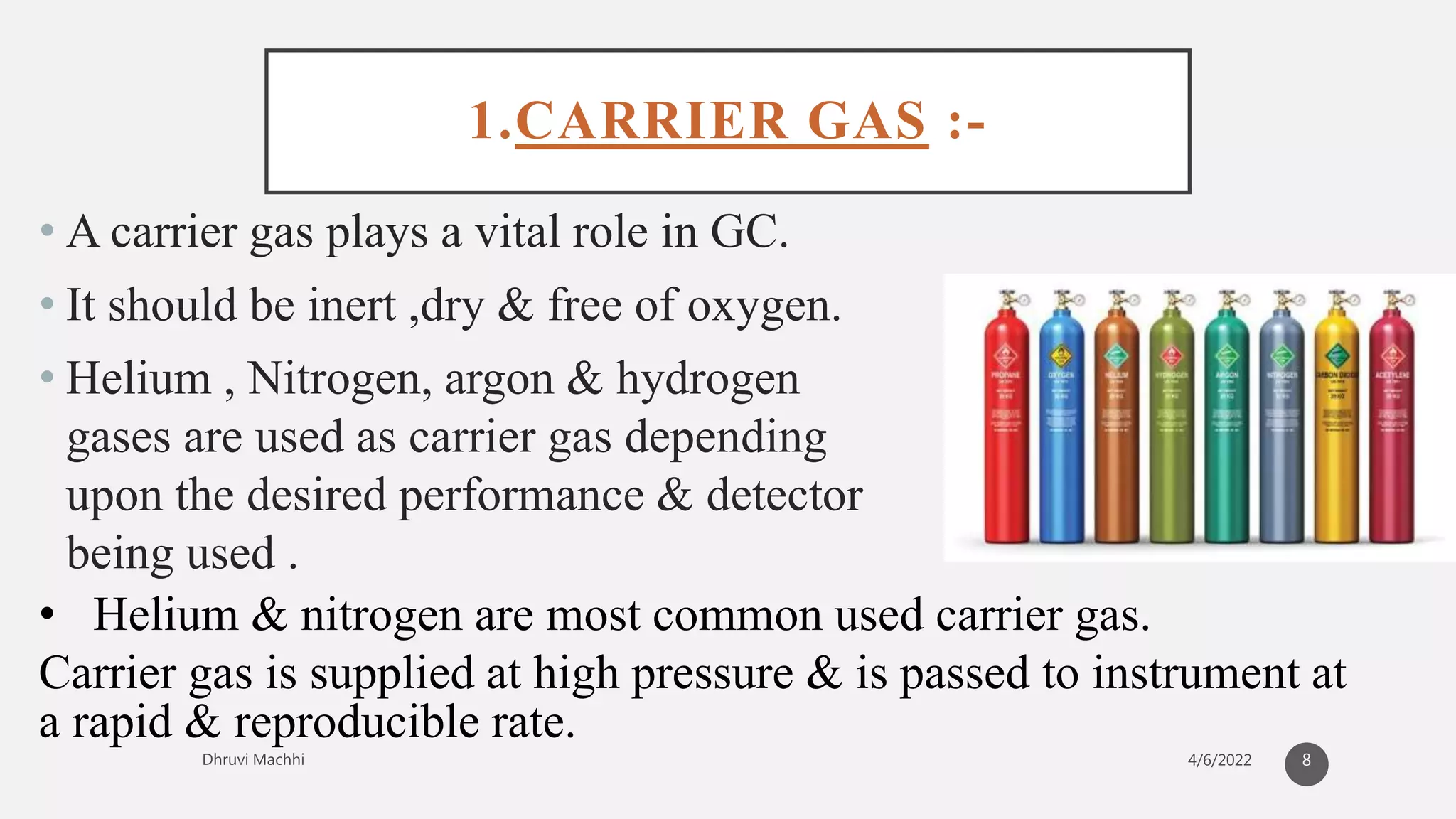
• A carrier gas plays a vital role in GC.
• It should be inert ,dry & free of oxygen.
• Helium , Nitrogen, argon & hydrogen
gases are used as carrier gas depending
upon the desired performance & detector
being used .
• Helium & nitrogen are most common used carrier gas.
Carrier gas is supplied at high pressure & is passed to instrument at
a rapid & reproducible rate.
8
2. FLOW REGULATORS :-
• As carrier gases are stored under high
pressure, flow regulators are used to
deliver the gas with uniform pressure as
well as flow rate.
• Inlet pressure: ranges from -10 to 50 psi
• Flow rate : 25-150 ml/min for packed
column & 2-25 ml/min for open tubular
column
9
3. SAMPLE
INTRODUCTION SYSTEM :-
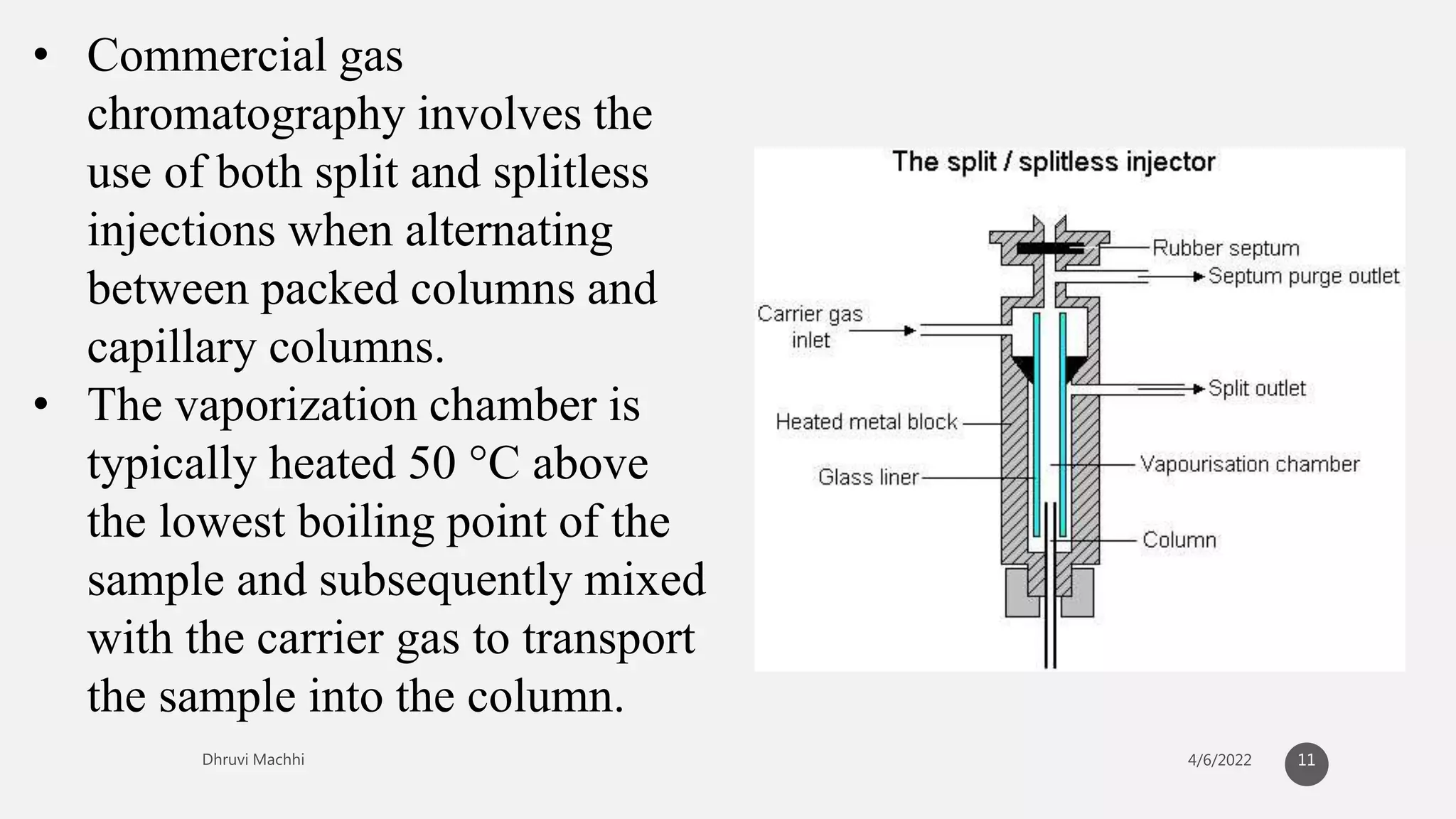
• A sample port is necessary for the
sample at the head of the column.
• A calibrated microsyringe is used to
transfer a volume of sample through a
rubber septum and thus into the
vaporization chamber.
• Most of the separations require only a
small fraction of the initial sample
volume and a sample splitter is used to
direct excess sample to waste.
10
• Commercial gas
chromatography involves the
use of both split and splitless
injections when alternating
between packed columns and
capillary columns.
• The vaporization chamber is
typically heated 50 °C above
the lowest boiling point of the
sample and subsequently mixed
with the carrier gas to transport
the sample into the column.
11
12
4. COLUMN :-
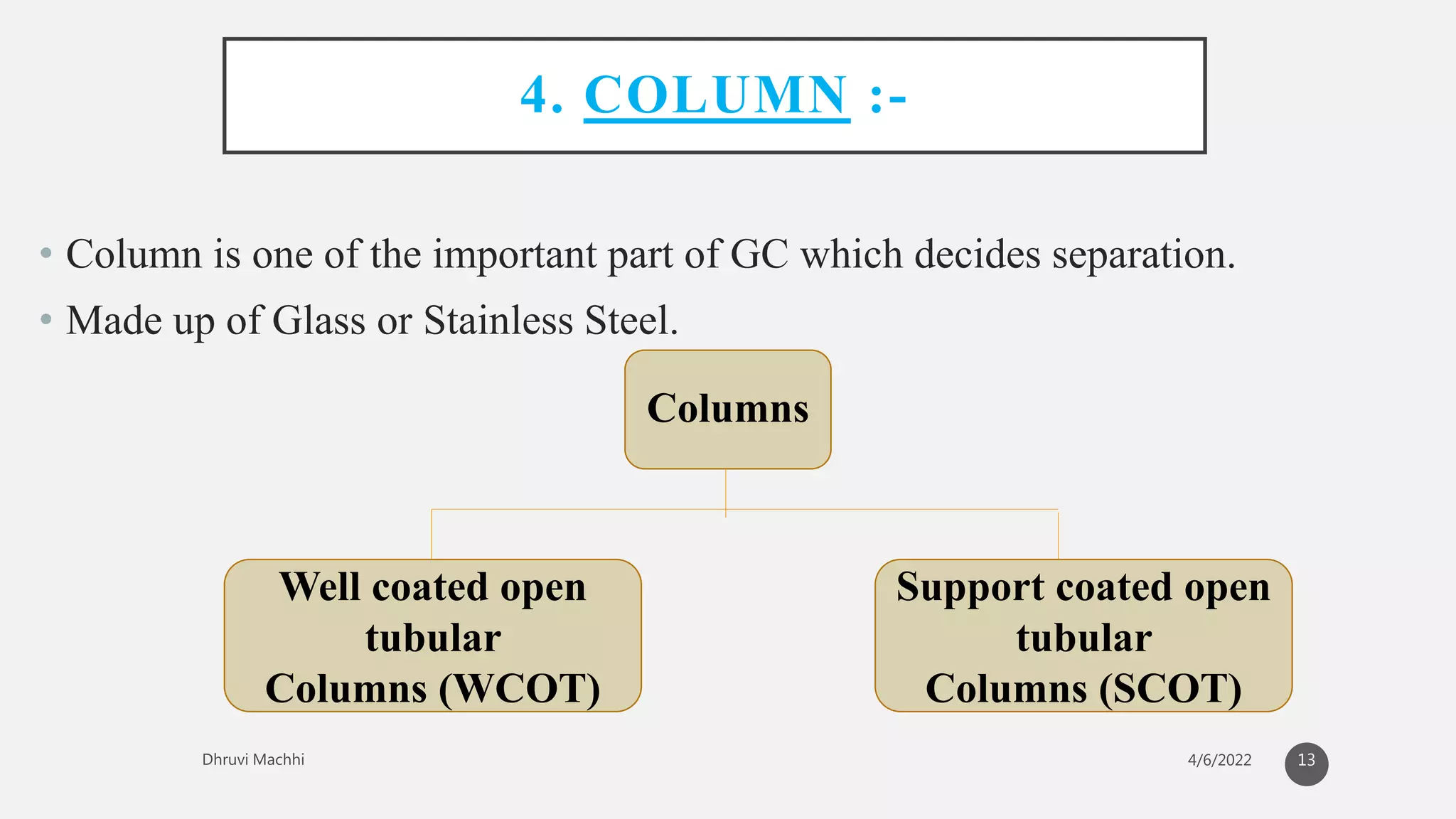
• Column is one of the important part of GC which decides separation.
• Made up of Glass or Stainless Steel.
Columns
Support coated open
tubular
Columns (SCOT)
Well coated open
tubular
Columns (WCOT)
13
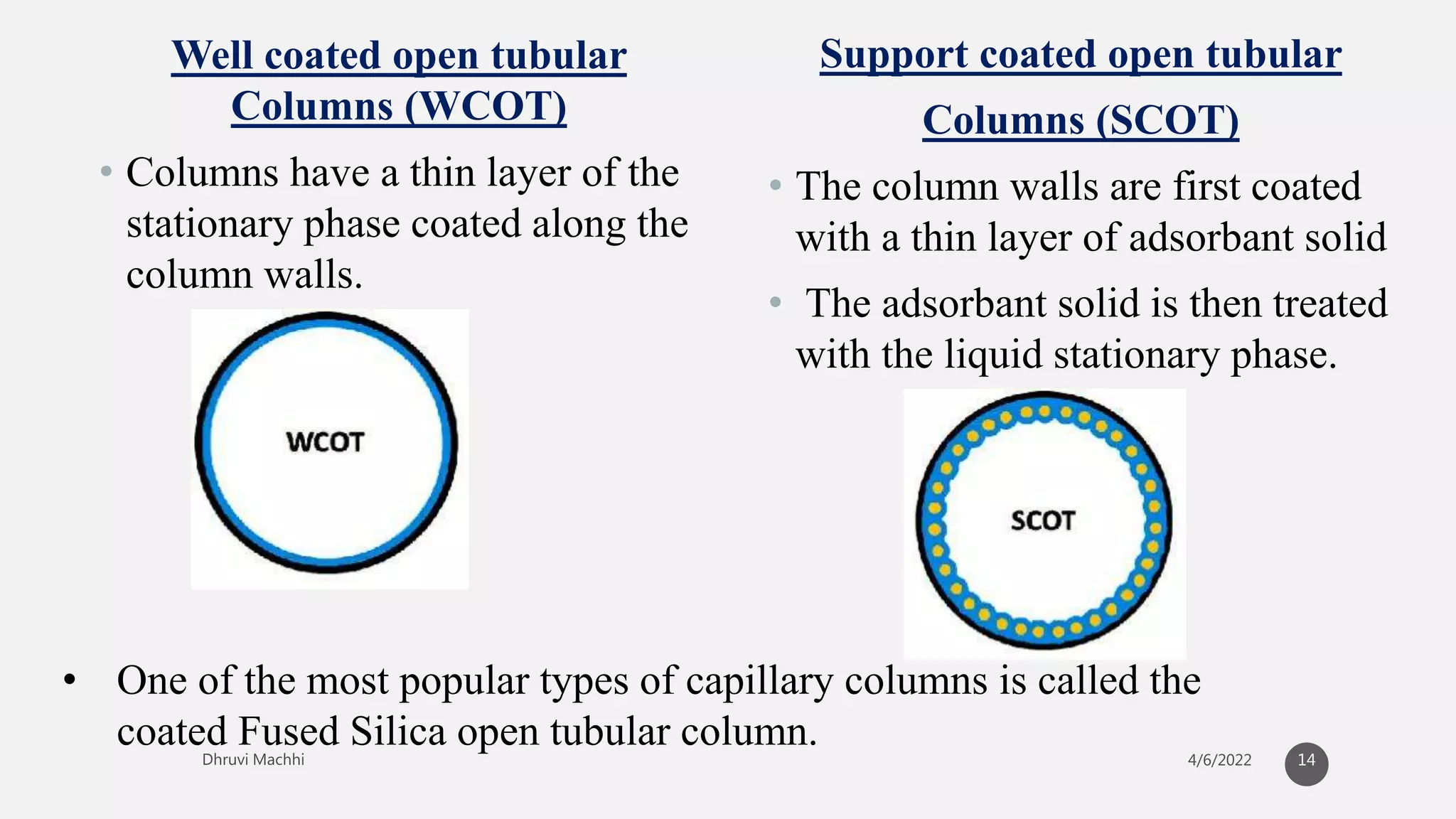
Well coated open tubular
Columns (WCOT)
• Columns have a thin layer of the
stationary phase coated along the
column walls.
Support coated open tubular
Columns (SCOT)
• The column walls are first coated
with a thin layer of adsorbant solid
• The adsorbant solid is then treated
with the liquid stationary phase.
• One of the most popular types of capillary columns is called the
coated Fused Silica open tubular column. 14
5. TEMPERATURE CONTROL
DEVICES :-
(1) Preheaters :-
• It is used in GC to convert the sample into vapour form & mix them with
the mobile phase or carrier gas.
• It is present along with injecting device.
15
(2) Column oven / Thermostatically controlled oven :-
• The oven are there to control the temperature of the column to conduct
precise work.
• The oven can be operated in two manners: isothermal programming &
temperature programming.
• In isothermal programming, the temperature of the column is held
constant throughout the whole separation & in temperature
programming method, the column temperature is either increased
continuously or in steps as the separation progresses.
16
Column oven
17
6. DETECTORS :-
• Detectors are most important part of GC &
considered as Heart of the apparatus.
Eluted solute along with the carrier gas exit from the column
& enter the detector
Detectors then produce electrical signals proportional to the
concentration of solute component
Signals are amplified & recorded as peaks at intervals on
chromatograph
18
Most common types of detectors used in GC are;
• Mass Spectrometer
• Flame ionization detector (FID)
• Electron capture detector (ECD)
• Thermal conductivity detector (TCD)
• Atomic emission detector (AED)
• Photo ioniztion detector (PID)
• Chemilumnescence detector
19
7. RECORDERS :-
• It is used to record the response obtained from detectors after
amplification.
• They record baseline & all peaks obtained with respect to time.
• These use special electronic circuits & amplify the signals so as
to display in an understandable graphical format that represents
several peaks of the constituents of the sample under analysis.
20
21
HOW GC WORKS?
Firstly vaporized sample is injected into the chromatographic column
Then sample moves through the column with the flow of inert gas
results in the separation of the components of sample
They are recorded as a sequence of peaks as they leave the column
Different components of the sample separated & eluted at different &
particular time i.e. retention time
22
APPLICATIONS :-
GC has wide range of applications in various fields .It has a
medicinal & pharmaceutical applications.
• It is used in food, beverage, flavor & fragrance analysis.
• It is also helpful in environmental analysis and monitoring.
• In forensics, it is used in detection of body fluids, for the testing of
fiber , blood alcohol, detection of poisons , pesticides & also to
detect explosives residues.
• It is also useful in Security and chemical warfare agent detection.
23
• Identification of hazardous compounds in waste damps.
• Quantification of drugs & their metabolites in blood & urine
for both pharmacological & forensic applications.
• Quantification of pollutants in drinking & waste water.
• Analysis of industrial products for quality control.
• Skin sample analysis.
• RNA isolation.
• In geochemical search.
24
ADVANTAGES :-
• The technique has strong separation power & even
complex mixture can be resolved into constituents
• The sensitivity of method is quite high. It is a micro
method & only few milligram of sample is sufficient
for analysis .
• It gives good precision & accuracy.
• The analysis is completed in short time.
25
DISADVANTAGES :-
• Limited to volatile compounds
• Only thermally stable compounds can be separated
• Sampe should be soluble but do not react with the
column
26
REFERENCES :-
1. Principles of Instrumental analysis- Doglas A. Skoog,
F. James Holler, 6th edition, page no. 788-815
2. Kaur, Gurleen, and Sahil Sharma. "Gas
Chromatography–A Brief Review”, International
journal of information and computing science,
volume 5, issue 7, july 2018, 125-131
3. Gas chromatography analytical chemistry by open
learning – Ian A. Fowlis ,2nd edition
27
Thank you
28

Gas chromatography

  • 1.
    Presentation On Gas chromatography By Machhi DhruviAnilkumar From 1st sem M. Pharm (P’ceutical Quality Assurance) Course name & Code: Modern P’ceutical Analytical Techniques MAT101T Smt. B. N. B. Swaminarayan Pharmacy College, Salvav -Vapi
  • 2.
  • 3.
    INTRODUCTION :- • Itis the process of separating components from the given crude drug by using gaseous mobile phase. • It involves a sample which is being vaporized & injected onto the head of the chromatographic column. The sample is transported through the column by the flow of inert gaseous mobile phase. The column itself contains a liquid stationary phase which is absorbed onto the surface of an inert solid. 3
  • 4.
    TYPES :- Gas chromatography Gas-liquid chromatography Gas-solid chromatography • Mobilephase is gas • Stationary phase is solid • Mobile phase is gas • Stationary phase is liquid retained on inert solid 4
  • 5.
    PRINCIPLE :- • Ingas-solid chromatography, solid adsorbent is used as a stationary phase & separation takes place through adsorption process while in gas- liquid chromatography, the stationary phase consists of thin layer of non-volatile liquid bound to solid support & separation takes place through the process of partition. • Gas-liquid chromatography is most commoly used technique. • The sample which is to be separated is first converted into vapours & thus mixed with gaseous mobile phase. Components of a sample that are more soluble in stationary phase travels slower & the components that are less soluble in stationary phase travels faster. The components are thus separated according to their partition co-efficient. 5
  • 6.
    INSTRUMENTATION :- 1.Carrier gas 2.Flowregulators 3.Sample introduction system 4.Column 5.Temperature control device 6.Detectors 7.Recorders 6
  • 7.
  • 8.
    1.CARRIER GAS :- •A carrier gas plays a vital role in GC. • It should be inert ,dry & free of oxygen. • Helium , Nitrogen, argon & hydrogen gases are used as carrier gas depending upon the desired performance & detector being used . • Helium & nitrogen are most common used carrier gas. Carrier gas is supplied at high pressure & is passed to instrument at a rapid & reproducible rate. 8
  • 9.
    2. FLOW REGULATORS:- • As carrier gases are stored under high pressure, flow regulators are used to deliver the gas with uniform pressure as well as flow rate. • Inlet pressure: ranges from -10 to 50 psi • Flow rate : 25-150 ml/min for packed column & 2-25 ml/min for open tubular column 9
  • 10.
    3. SAMPLE INTRODUCTION SYSTEM:- • A sample port is necessary for the sample at the head of the column. • A calibrated microsyringe is used to transfer a volume of sample through a rubber septum and thus into the vaporization chamber. • Most of the separations require only a small fraction of the initial sample volume and a sample splitter is used to direct excess sample to waste. 10
  • 11.
    • Commercial gas chromatographyinvolves the use of both split and splitless injections when alternating between packed columns and capillary columns. • The vaporization chamber is typically heated 50 °C above the lowest boiling point of the sample and subsequently mixed with the carrier gas to transport the sample into the column. 11
  • 12.
  • 13.
    4. COLUMN :- •Column is one of the important part of GC which decides separation. • Made up of Glass or Stainless Steel. Columns Support coated open tubular Columns (SCOT) Well coated open tubular Columns (WCOT) 13
  • 14.
    Well coated opentubular Columns (WCOT) • Columns have a thin layer of the stationary phase coated along the column walls. Support coated open tubular Columns (SCOT) • The column walls are first coated with a thin layer of adsorbant solid • The adsorbant solid is then treated with the liquid stationary phase. • One of the most popular types of capillary columns is called the coated Fused Silica open tubular column. 14
  • 15.
    5. TEMPERATURE CONTROL DEVICES:- (1) Preheaters :- • It is used in GC to convert the sample into vapour form & mix them with the mobile phase or carrier gas. • It is present along with injecting device. 15
  • 16.
    (2) Column oven/ Thermostatically controlled oven :- • The oven are there to control the temperature of the column to conduct precise work. • The oven can be operated in two manners: isothermal programming & temperature programming. • In isothermal programming, the temperature of the column is held constant throughout the whole separation & in temperature programming method, the column temperature is either increased continuously or in steps as the separation progresses. 16
  • 17.
  • 18.
    6. DETECTORS :- •Detectors are most important part of GC & considered as Heart of the apparatus. Eluted solute along with the carrier gas exit from the column & enter the detector Detectors then produce electrical signals proportional to the concentration of solute component Signals are amplified & recorded as peaks at intervals on chromatograph 18
  • 19.
    Most common typesof detectors used in GC are; • Mass Spectrometer • Flame ionization detector (FID) • Electron capture detector (ECD) • Thermal conductivity detector (TCD) • Atomic emission detector (AED) • Photo ioniztion detector (PID) • Chemilumnescence detector 19
  • 20.
    7. RECORDERS :- •It is used to record the response obtained from detectors after amplification. • They record baseline & all peaks obtained with respect to time. • These use special electronic circuits & amplify the signals so as to display in an understandable graphical format that represents several peaks of the constituents of the sample under analysis. 20
  • 21.
  • 22.
    HOW GC WORKS? Firstlyvaporized sample is injected into the chromatographic column Then sample moves through the column with the flow of inert gas results in the separation of the components of sample They are recorded as a sequence of peaks as they leave the column Different components of the sample separated & eluted at different & particular time i.e. retention time 22
  • 23.
    APPLICATIONS :- GC haswide range of applications in various fields .It has a medicinal & pharmaceutical applications. • It is used in food, beverage, flavor & fragrance analysis. • It is also helpful in environmental analysis and monitoring. • In forensics, it is used in detection of body fluids, for the testing of fiber , blood alcohol, detection of poisons , pesticides & also to detect explosives residues. • It is also useful in Security and chemical warfare agent detection. 23
  • 24.
    • Identification ofhazardous compounds in waste damps. • Quantification of drugs & their metabolites in blood & urine for both pharmacological & forensic applications. • Quantification of pollutants in drinking & waste water. • Analysis of industrial products for quality control. • Skin sample analysis. • RNA isolation. • In geochemical search. 24
  • 25.
    ADVANTAGES :- • Thetechnique has strong separation power & even complex mixture can be resolved into constituents • The sensitivity of method is quite high. It is a micro method & only few milligram of sample is sufficient for analysis . • It gives good precision & accuracy. • The analysis is completed in short time. 25
  • 26.
    DISADVANTAGES :- • Limitedto volatile compounds • Only thermally stable compounds can be separated • Sampe should be soluble but do not react with the column 26
  • 27.
    REFERENCES :- 1. Principlesof Instrumental analysis- Doglas A. Skoog, F. James Holler, 6th edition, page no. 788-815 2. Kaur, Gurleen, and Sahil Sharma. "Gas Chromatography–A Brief Review”, International journal of information and computing science, volume 5, issue 7, july 2018, 125-131 3. Gas chromatography analytical chemistry by open learning – Ian A. Fowlis ,2nd edition 27
  • 28.