FACTORS AFFECTING
FLUORESCENCE
INTENSITY
Name:-Md. Irfan Uddin
Roll:-1083
Reg no:-1086
Session:-Jan-2018
University of Science and Technology
Chittagong
Content
2
Introduction
Principle of
Fluorometry
Factors affecting
fluorescence
intensity
Conclusion
Introduction 3
FLUORESCENCE
FLUOROMETRY
Fluorescence is the emission of light by a substance that has absorbed
light or other electromagnetic radiation. In most cases, the emitted
light has a longer wavelength, and therefore lower energy, than the
absorbed radiation.
It is measurement of fluorescence intensity at a particular wavelength
with the help of a filter fluorimeter or a spectrofluorimeter.
4
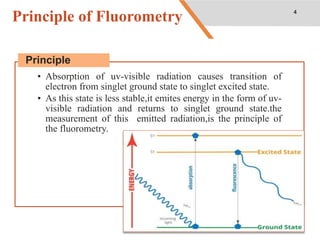
• Absorption of uv-visible radiation causes transition of
electron from singlet ground state to singlet excited state.
• As this state is less stable,it emites energy in the form of uv-
visible radiation and returns to singlet ground state.the
measurement of this emitted radiation,is the principle of
the fluorometry.
Principle
Principle of Fluorometry
Factors affecting fluorescence
intensity
5
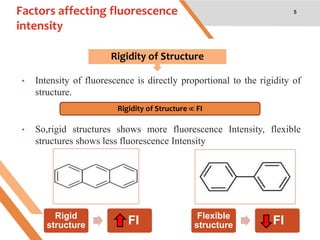
• Intensity of fluorescence is directly proportional to the rigidity of
structure.

• So,rigid structures shows more fluorescence Intensity, flexible
structures shows less fluorescence Intensity
Rigidity of Structure
Rigidity of Structure  FI
Rigid
structure FI Flexible
structure FI
Continued…
6
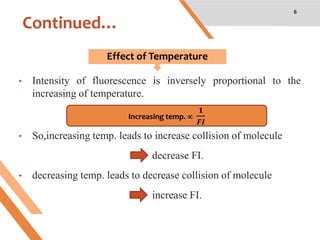
• Intensity of fluorescence is inversely proportional to the
increasing of temperature.
• So,increasing temp. leads to increase collision of molecule
decrease FI.
• decreasing temp. leads to decrease collision of molecule
increase FI.
Effect of Temperature
Increasing temp. 
𝟏
𝑭𝑰
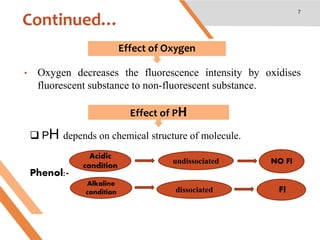
• Oxygen decreases the fluorescence intensity by oxidises
fluorescent substance to non-fluorescent substance.
Continued…
7
Effect of Oxygen
Effect of PH
 PH depends on chemical structure of molecule.
Phenol:-
Acidic
condition
undissociated NO FI
Alkaline
condition dissociated FI
Continued… 8
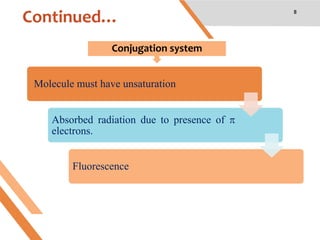
Conjugation system
Molecule must have unsaturation
Absorbed radiation due to presence of 
electrons.
Fluorescence
Continued… 9
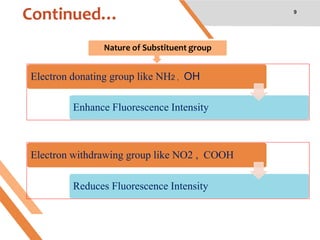
Nature of Substituent group
Electron donating group like NH2 , OH
Enhance Fluorescence Intensity
Electron withdrawing group like NO2 , COOH
Reduces Fluorescence Intensity
Continued…
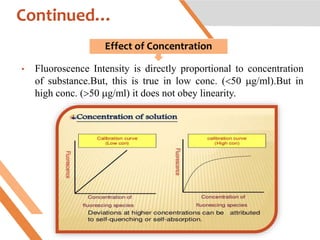
• Fluoroscence Intensity is directly proportional to concentration
of substance.But, this is true in low conc. (50 g/ml).But in
high conc. (50 g/ml) it does not obey linearity.
Effect of Concentration
Continued…
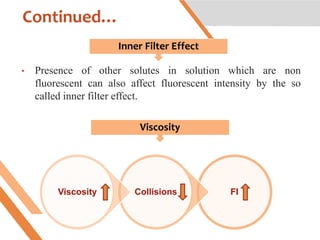
• Presence of other solutes in solution which are non
fluorescent can also affect fluorescent intensity by the so
called inner filter effect.
Inner Filter Effect
Viscosity
FI
Collisions
Viscosity
Conclusion
• Fluorometry is a quantitative analysis technique.
• Several factors affects the intensity of fluorescence among
them conc. Plays vital role.According to BEER’S law firstly
it shows linear curve that means direct proportional but after
certain conc. It shows deviation that times increasing conc.
Can’t increase the FI.
References
 Sharma Y R. Elementary organic spectroscopy. 16th ed . s chand
&company Ltd. New dellli 2007.
 Gurudeep R chatwalSham K .lnstrumental method chemical analysis . 5th
ed. Himalaya publishing house. Mumbai 2002 p .2.399-2.41 G.
 Ravi Sankar . Text boook Of pharmaceutical analysis .3'd ed. Rx publica
tion. 2006.
 http,//images.google.co.in/imghp?oe-üff-8&hI-en&tab-wi&q-fluorescence
 httpt//www.bertholdtech.com/ww/en pub/bioanalytik/biomethods/fluor.cfm
Factors affecting fluorescence intensity(pharmaceutical analysis)

Factors affecting fluorescence intensity(pharmaceutical analysis)

  • 1.
    FACTORS AFFECTING FLUORESCENCE INTENSITY Name:-Md. IrfanUddin Roll:-1083 Reg no:-1086 Session:-Jan-2018 University of Science and Technology Chittagong
  • 2.
  • 3.
    Introduction 3 FLUORESCENCE FLUOROMETRY Fluorescence isthe emission of light by a substance that has absorbed light or other electromagnetic radiation. In most cases, the emitted light has a longer wavelength, and therefore lower energy, than the absorbed radiation. It is measurement of fluorescence intensity at a particular wavelength with the help of a filter fluorimeter or a spectrofluorimeter.
  • 4.
    4 • Absorption ofuv-visible radiation causes transition of electron from singlet ground state to singlet excited state. • As this state is less stable,it emites energy in the form of uv- visible radiation and returns to singlet ground state.the measurement of this emitted radiation,is the principle of the fluorometry. Principle Principle of Fluorometry
  • 5.
    Factors affecting fluorescence intensity 5 •Intensity of fluorescence is directly proportional to the rigidity of structure.  • So,rigid structures shows more fluorescence Intensity, flexible structures shows less fluorescence Intensity Rigidity of Structure Rigidity of Structure  FI Rigid structure FI Flexible structure FI
  • 6.
    Continued… 6 • Intensity offluorescence is inversely proportional to the increasing of temperature. • So,increasing temp. leads to increase collision of molecule decrease FI. • decreasing temp. leads to decrease collision of molecule increase FI. Effect of Temperature Increasing temp.  𝟏 𝑭𝑰
  • 7.
    • Oxygen decreasesthe fluorescence intensity by oxidises fluorescent substance to non-fluorescent substance. Continued… 7 Effect of Oxygen Effect of PH  PH depends on chemical structure of molecule. Phenol:- Acidic condition undissociated NO FI Alkaline condition dissociated FI
  • 8.
    Continued… 8 Conjugation system Moleculemust have unsaturation Absorbed radiation due to presence of  electrons. Fluorescence
  • 9.
    Continued… 9 Nature ofSubstituent group Electron donating group like NH2 , OH Enhance Fluorescence Intensity Electron withdrawing group like NO2 , COOH Reduces Fluorescence Intensity
  • 10.
    Continued… • Fluoroscence Intensityis directly proportional to concentration of substance.But, this is true in low conc. (50 g/ml).But in high conc. (50 g/ml) it does not obey linearity. Effect of Concentration
  • 11.
    Continued… • Presence ofother solutes in solution which are non fluorescent can also affect fluorescent intensity by the so called inner filter effect. Inner Filter Effect Viscosity FI Collisions Viscosity
  • 12.
    Conclusion • Fluorometry isa quantitative analysis technique. • Several factors affects the intensity of fluorescence among them conc. Plays vital role.According to BEER’S law firstly it shows linear curve that means direct proportional but after certain conc. It shows deviation that times increasing conc. Can’t increase the FI.
  • 13.
    References  Sharma YR. Elementary organic spectroscopy. 16th ed . s chand &company Ltd. New dellli 2007.  Gurudeep R chatwalSham K .lnstrumental method chemical analysis . 5th ed. Himalaya publishing house. Mumbai 2002 p .2.399-2.41 G.  Ravi Sankar . Text boook Of pharmaceutical analysis .3'd ed. Rx publica tion. 2006.  http,//images.google.co.in/imghp?oe-üff-8&hI-en&tab-wi&q-fluorescence  httpt//www.bertholdtech.com/ww/en pub/bioanalytik/biomethods/fluor.cfm