
MAGNETIC MICROSPHERES


           Prepared By:
              Sonam M. Gandhi


                                1
DEFINITION:
                   Magnetic micro carriers are
supramolecular particles that are small enough to circulate
through capillaries without producing embolic occlusion
(<4µm) but are sufficiently susceptible (ferromagnetic) to
become captured in micro vessel and dragged into the
adjacent tissues by magnetic fields of 0.5 to 0.8 tesla (T).


                                                          2
Advantages:

1. Therapeutic responses in target organs occurs
   at only one tenth of free drug dose.

2. Controlled drug release within target tissues
   for intervals of 30 min to 30 hr .

3. Avoidance of acute drug toxicity directed
   against endothelium and normal parenchyma
   cells.

4. Adaptable to any part of the body.
                                                   3
Disadvantages:
1. Magnetic targeting is an expensive, technical approach and
    requires specialized manufacture and quality control system.

2. It needs specialized magnet for targeting, advanced techniques
   for monitoring and trained personnel to perform procedures.

3. Magnets must have relatively constant gradients, in order to
   avoid focal over-dosing with toxic drugs.

4. A large fraction of the magnetite which is entrapped in carriers
   is deposited permanently in target tissues.

5. Due to these limitations magnetic drug targeting is likely to be
   approved only for severe diseases.


                                                                   4
Concept of targeting magnetic microspheres:

Microspheres containing magnetic material (magnetite)
are injected into an artery that supplies to a given site.

As the microspheres would be selectively and
magnetically localized at the capillary level they have free
flow access through large arteries.
Thus the microspheres would serve as the time release
capsules systems sitting in the desired location.
A magnet of sufficient field strength is thus placed
externally over the target area to localize the microspheres
at the capillary bed in this region.

                                      www.themegallery.com   LOGO
            5
To localize microspheres in a fast moving arterial
system, greater field strength is required.

When the microspheres are first pushed against the
endothelial cells by the magnetic field, an endocytic
response was triggered with continuous magnetic influence
over certain period of time.

Microspheres migrated from endothelial cells into the
interstitial compartment and formed a depot for sustained
release over an extended period of time.


                                                      6
Important characteristics:
 In targeting using magnetic microspheres, the
  magnetite content of carrier and also magnitude of
  applied magnetic field is important.

 Particle size of drug carrier can affect the degree of
  drug entrapment.

 If a high magnetic content is incorporated, thus
  amount of magnetic fields needed is reduced but the
  space available for drug entrapment decreases.


                                                           7
 Drug incorporation and magnetite has to
  be delicately balanced.

 Optimum magnetite content would be
  between 20%-50% of drug weight in the
  drug carrier complex.


                                        8
Magnetite:
A ferromagnetic material when incorporated into
microspheres makes them magnetically responsive So that
they can be concentrated to the desired site by applying
some magnetic field.

Iron is strong ferromagnetic material but due to its local
tissue irritation and other toxic manifestation it cannot be
included into microspheres.

But such a problem is not seen when magnetite which is
chemically ferrous ferric oxide (Fe3o4) biologically
compatible and also its ultra fine particle size makes it
suitable material.
                                                         9
Super paramagnetic particles
under the influence of an external
magnetic field


 Super paramagnetic particles in
 absence of an external magnetic
 field, monodisperse particle        10
 distribution
Magnetic guidance:

Initially drugs were grafted on to the surface of
the magnetic particles, but it suffers from the
drawbacks like very low loading capacity and
irreversible particle aggregation under the
exposure of magnetic field.

Coating of the ferromagnetic particles with
albumin and other charged polymers decreases the
aggregation problem by making it reversible.

                                               11
PREPARATION OF MAGNETIC
MICROSPHERES
•Magnetically responsive microspheres can be
prepared by using albumin as a carrier of drug and
magnetite.
•Size of microspheres is kept between 1-2 µm, so
that they can be injected into blood vessels without
problem of thrombo -embolism.

Two methods are employed for the preparation
they are
1. Phase separation emulsion polymerization
2. Continuous solvent evaporation           12
CONTINUOUS SOLVENT EVAPORATION

      Solution in volatile organic solvent
        (polymer + drug + magnet)
               Auxillary Solution
                 Stirring
              Homogenization
            Stirring temp (22o-30o C)

           Magnetic Microsphere
         Separated by centrifugation

       Freeze drying and storage at 4o C     13
PHASE SEPARATION EMULSION POLYMERIZATION


     Aqueous solution              Vegetable oil
 (albumin+drug+magnetite)

                  Emulsification

                  Stabilization by
           Heat                        Cross linking agent
       ( 100-150C)
               Microsphere suspension
                 Separated from oil

             Freeze drying & storage at 4C                  14
Assembly used for separation of magnetic
microsphere from non magnetic materials
                                           15
Evaluation of drug release rate in vitro


1. Dialysis method

2. Continuous column elution method


                                           16
a. Dialysis methods:

Albumin microspheres were taken in a funnel, 3ml
of phosphate buffer of 7.3 pH was added.

The mouth of the funnel is covered with
cellophane paper and fastened with rubber band.

 Then funnel is inverted into a beaker containing
50 ml phosphate buffer. 2.5 ml of aliquots are
withdrawn every half an hour and replaced with
fresh buffer and estimated for drug release.      17
b.Continuous column elution methods:


Microspheres are immobilized on a column
containing a fixed weight of glass wool (3.5 gm) as a
support material and kept at 37oC. they are
subjected to a constant flow of 50 ml phosphate
buffer, fractions are collected at equal intervals and
amount of drug release is estimated by using UV
spectroscopy.


                                                  18
Characterization:
Carrier localization: gamma camera
imaging; high frequency ultrasound;
magnetic resonance technique


                                      19
SEM - scanning electron microscopy


                                     20
In vivo drug distribution: magnetic
resonance imaging


                                      21
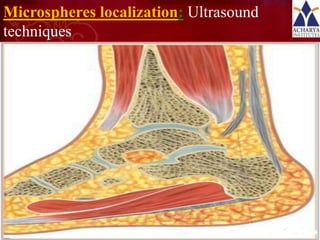
Microspheres localization: Ultrasound
techniques


                                        22
Particle size and shape: SEM


                               23

Magnetic microspheres

  • 1.
    MAGNETIC MICROSPHERES Prepared By: Sonam M. Gandhi 1
  • 2.
    DEFINITION: Magnetic micro carriers are supramolecular particles that are small enough to circulate through capillaries without producing embolic occlusion (<4µm) but are sufficiently susceptible (ferromagnetic) to become captured in micro vessel and dragged into the adjacent tissues by magnetic fields of 0.5 to 0.8 tesla (T). 2
  • 3.
    Advantages: 1. Therapeutic responsesin target organs occurs at only one tenth of free drug dose. 2. Controlled drug release within target tissues for intervals of 30 min to 30 hr . 3. Avoidance of acute drug toxicity directed against endothelium and normal parenchyma cells. 4. Adaptable to any part of the body. 3
  • 4.
    Disadvantages: 1. Magnetic targetingis an expensive, technical approach and requires specialized manufacture and quality control system. 2. It needs specialized magnet for targeting, advanced techniques for monitoring and trained personnel to perform procedures. 3. Magnets must have relatively constant gradients, in order to avoid focal over-dosing with toxic drugs. 4. A large fraction of the magnetite which is entrapped in carriers is deposited permanently in target tissues. 5. Due to these limitations magnetic drug targeting is likely to be approved only for severe diseases. 4
  • 5.
    Concept of targetingmagnetic microspheres: Microspheres containing magnetic material (magnetite) are injected into an artery that supplies to a given site. As the microspheres would be selectively and magnetically localized at the capillary level they have free flow access through large arteries. Thus the microspheres would serve as the time release capsules systems sitting in the desired location. A magnet of sufficient field strength is thus placed externally over the target area to localize the microspheres at the capillary bed in this region. www.themegallery.com LOGO 5
  • 6.
    To localize microspheresin a fast moving arterial system, greater field strength is required. When the microspheres are first pushed against the endothelial cells by the magnetic field, an endocytic response was triggered with continuous magnetic influence over certain period of time. Microspheres migrated from endothelial cells into the interstitial compartment and formed a depot for sustained release over an extended period of time. 6
  • 7.
    Important characteristics:  Intargeting using magnetic microspheres, the magnetite content of carrier and also magnitude of applied magnetic field is important.  Particle size of drug carrier can affect the degree of drug entrapment.  If a high magnetic content is incorporated, thus amount of magnetic fields needed is reduced but the space available for drug entrapment decreases. 7
  • 8.
     Drug incorporationand magnetite has to be delicately balanced.  Optimum magnetite content would be between 20%-50% of drug weight in the drug carrier complex. 8
  • 9.
    Magnetite: A ferromagnetic materialwhen incorporated into microspheres makes them magnetically responsive So that they can be concentrated to the desired site by applying some magnetic field. Iron is strong ferromagnetic material but due to its local tissue irritation and other toxic manifestation it cannot be included into microspheres. But such a problem is not seen when magnetite which is chemically ferrous ferric oxide (Fe3o4) biologically compatible and also its ultra fine particle size makes it suitable material. 9
  • 10.
    Super paramagnetic particles underthe influence of an external magnetic field Super paramagnetic particles in absence of an external magnetic field, monodisperse particle 10 distribution
  • 11.
    Magnetic guidance: Initially drugswere grafted on to the surface of the magnetic particles, but it suffers from the drawbacks like very low loading capacity and irreversible particle aggregation under the exposure of magnetic field. Coating of the ferromagnetic particles with albumin and other charged polymers decreases the aggregation problem by making it reversible. 11
  • 12.
    PREPARATION OF MAGNETIC MICROSPHERES •Magneticallyresponsive microspheres can be prepared by using albumin as a carrier of drug and magnetite. •Size of microspheres is kept between 1-2 µm, so that they can be injected into blood vessels without problem of thrombo -embolism. Two methods are employed for the preparation they are 1. Phase separation emulsion polymerization 2. Continuous solvent evaporation 12
  • 13.
    CONTINUOUS SOLVENT EVAPORATION Solution in volatile organic solvent (polymer + drug + magnet) Auxillary Solution Stirring Homogenization Stirring temp (22o-30o C) Magnetic Microsphere Separated by centrifugation Freeze drying and storage at 4o C 13
  • 14.
    PHASE SEPARATION EMULSIONPOLYMERIZATION Aqueous solution Vegetable oil (albumin+drug+magnetite) Emulsification Stabilization by Heat Cross linking agent ( 100-150C) Microsphere suspension Separated from oil Freeze drying & storage at 4C 14
  • 15.
    Assembly used forseparation of magnetic microsphere from non magnetic materials 15
  • 16.
    Evaluation of drugrelease rate in vitro 1. Dialysis method 2. Continuous column elution method 16
  • 17.
    a. Dialysis methods: Albuminmicrospheres were taken in a funnel, 3ml of phosphate buffer of 7.3 pH was added. The mouth of the funnel is covered with cellophane paper and fastened with rubber band.  Then funnel is inverted into a beaker containing 50 ml phosphate buffer. 2.5 ml of aliquots are withdrawn every half an hour and replaced with fresh buffer and estimated for drug release. 17
  • 18.
    b.Continuous column elutionmethods: Microspheres are immobilized on a column containing a fixed weight of glass wool (3.5 gm) as a support material and kept at 37oC. they are subjected to a constant flow of 50 ml phosphate buffer, fractions are collected at equal intervals and amount of drug release is estimated by using UV spectroscopy. 18
  • 19.
    Characterization: Carrier localization: gammacamera imaging; high frequency ultrasound; magnetic resonance technique 19
  • 20.
    SEM - scanningelectron microscopy 20
  • 21.
    In vivo drugdistribution: magnetic resonance imaging 21
  • 22.
  • 23.
    Particle size andshape: SEM 23