Chromatography Basic introduction and instrumentation
 
A  SEMINAR  ON Chromatography Introduction and Instrumentation GUIDED BY:  BY:  PATEL AKSHAY  J.D.Patel  M.PHARM- 1(ph’ceutics) (head of department)  ROLL NO-05 Department of Pharmaceutics NOOTAN PHARMACY COLLEGE,VISNAGAR
The  analyte  is the molecule which is to be purified or isolated during chromatography  Analytical chromatography  is used to determine the identity and concentration of molecules in a mixture  A  chromatogram  is the visual output of the chromatograph. Different peaks or patterns on the chromatograph correspond to different components of the separated mixture  A  chromatograph  takes a chemical mixture carried by liquid or gas and separates it into its component parts as a result of differential distributions of the  solutes  as they flow around or over the stationary phase  The  mobile phase  is the analyte and solvent mixture which travels through the stationary phase  Preparative chromatography  is used to purify larger quantities of a substance  The  retention time  is the characteristic time it takes for a particular molecule to pass through the system  The  stationary phase  is the substance which is fixed in place for the chromatography procedure and is the the phase to which  solvents  and the analyte travels through or binds to. Examples include the  silica  plate in  thin layer chromatography Chromatography terms
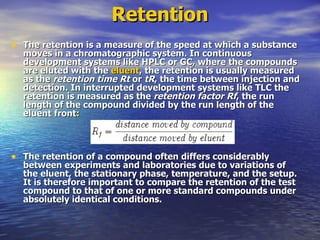
Retention The retention is a measure of the speed at which a substance moves in a chromatographic system. In continuous development systems like HPLC or GC, where the compounds are eluted with the  eluent , the retention is usually measured as the  retention time   Rt  or  tR , the time between injection and detection. In interrupted development systems like TLC the retention is measured as the  retention factor   Rf , the run length of the compound divided by the run length of the eluent front : The retention of a compound often differs considerably between experiments and laboratories due to variations of the eluent, the stationary phase, temperature, and the setup. It is therefore important to compare the retention of the test compound to that of one or more standard compounds under absolutely identical conditions.
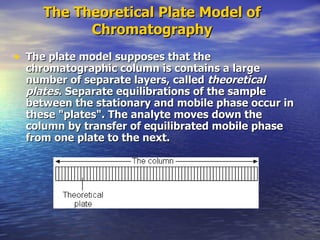
The Theoretical Plate Model of Chromatography The plate model supposes that the chromatographic column is contains a large number of separate layers, called  theoretical plates . Separate equilibrations of the sample between the stationary and mobile phase occur in these "plates". The analyte moves down the column by transfer of equilibrated mobile phase from one plate to the next.
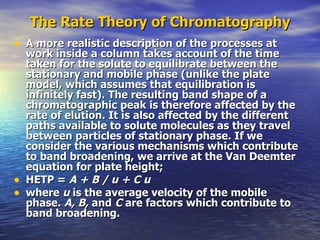
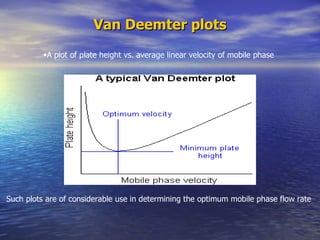
The Rate Theory of Chromatography A more realistic description of the processes at work inside a column takes account of the time taken for the solute to equilibrate between the stationary and mobile phase (unlike the plate model, which assumes that equilibration is infinitely fast). The resulting band shape of a chromatographic peak is therefore affected by the rate of elution. It is also affected by the different paths available to solute molecules as they travel between particles of stationary phase. If we consider the various mechanisms which contribute to band broadening, we arrive at the Van Deemter equation for plate height; HETP =  A + B / u + C u  where  u  is the average velocity of the mobile phase.  A, B,  and  C  are factors which contribute to band broadening.
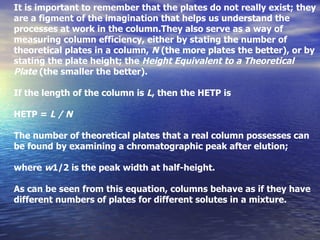
It is important to remember that the plates do not really exist; they are a figment of the imagination that helps us understand the processes at work in the column.They also serve as a way of measuring column efficiency, either by stating the number of theoretical plates in a column,  N  (the more plates the better), or by stating the plate height; the  Height Equivalent to a Theoretical Plate  (the smaller the better). If the length of the column is  L , then the HETP is HETP =  L / N The number of theoretical plates that a real column possesses can be found by examining a chromatographic peak after elution; where  w 1/2 is the peak width at half-height. As can be seen from this equation, columns behave as if they have different numbers of plates for different solutes in a mixture.
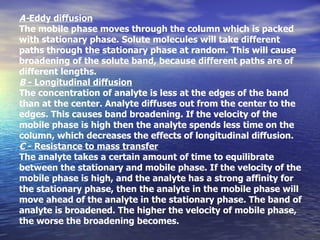
A- Eddy diffusion The mobile phase moves through the column which is packed with stationary phase. Solute molecules will take different paths through the stationary phase at random. This will cause broadening of the solute band, because different paths are of different lengths. B  - Longitudinal diffusion The concentration of analyte is less at the edges of the band than at the center. Analyte diffuses out from the center to the edges. This causes band broadening. If the velocity of the mobile phase is high then the analyte spends less time on the column, which decreases the effects of longitudinal diffusion. C  - Resistance to mass transfer The analyte takes a certain amount of time to equilibrate between the stationary and mobile phase. If the velocity of the mobile phase is high, and the analyte has a strong affinity for the stationary phase, then the analyte in the mobile phase will move ahead of the analyte in the stationary phase. The band of analyte is broadened. The higher the velocity of mobile phase, the worse the broadening becomes.
Van Deemter plots A plot of plate height vs. average linear velocity of mobile phase  Such plots are of considerable use in determining the optimum mobile phase flow rate
Resolution Although the selectivity factor, a, describes the separation of band centres, it does not take into account peak widths. Another measure of how well species have been separated is provided by measurement of the  resolution . The resolution of two species, A and B, is defined as Baseline resolution is achieved when  R  = 1.5
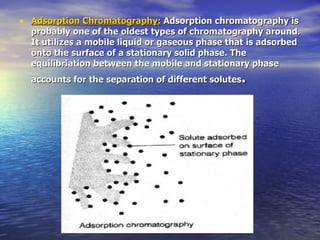
Adsorption Chromatography:   Adsorption chromatography is probably one of the oldest types of chromatography around. It utilizes a mobile liquid or gaseous phase that is adsorbed onto the surface of a stationary solid phase. The equilibriation between the mobile and stationary phase accounts for the separation of different solutes .
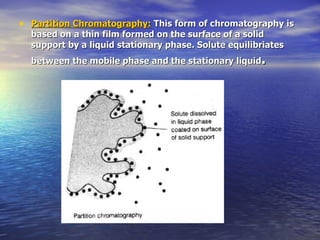
Partition Chromatography:  This form of chromatography is based on a thin film formed on the surface of a solid support by a liquid stationary phase. Solute equilibriates between the mobile phase and the stationary liquid .
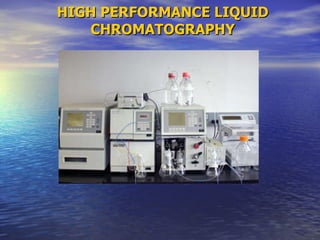
HIGH PERFORMANCE LIQUID CHROMATOGRAPHY
Only useful for volatile and thermally stable compounds.  Can’t be used for solid.  Difficulties encountered in LC :   Non availability of sensitive detectors. Speed of separation with conventional liquid chromatography. Difficulty of speed overcome by using high pressure. Limitations of GC :
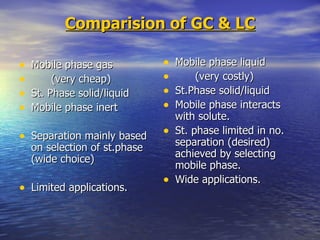
Comparision of GC & LC Mobile phase gas  (very cheap) St. Phase solid/liquid Mobile phase inert Separation mainly based on selection of st.phase (wide choice) Limited applications. Mobile phase liquid  (very costly) St.Phase solid/liquid Mobile phase interacts with solute. St. phase limited in no. separation (desired) achieved by selecting mobile phase. Wide applications.
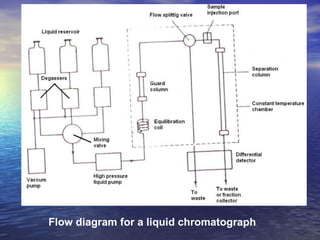
Flow diagram for a liquid chromatograph
Eluent Delivery System : Reservoirs (one or more )  Degassers Pumps
Function of Degassers :   Appreciable amount of gases dissolve at high pressure. When pressure released in column and detector bubbles may form. Degassing by heating distilling, vacuum pumping or purging inert gas with low solubility like He/Ar.
Requirements of Pump :   Pulseless flow upto 10 ml/min. High pressure upto 1000 psi or more. Suitability for gradient elution; Reciprocating pump Syringe pump Pneumatic pump
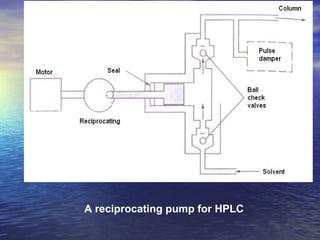
A reciprocating pump for HPLC
 
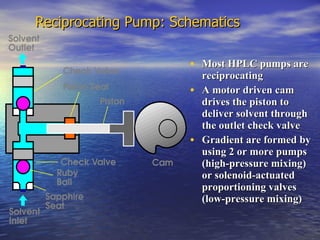
Reciprocating Pump: Schematics Most HPLC pumps are reciprocating  A motor driven cam  drives the piston to deliver solvent through the outlet check valve Gradient are formed by using 2 or more pumps (high-pressure mixing)  or solenoid-actuated proportioning valves (low-pressure mixing)
Reciprocating pump :   In 90% instrument used. To minimise pulsing pistons and cylinders operate in cycle.  Pressure drop caused by slowing of one is compensated by others. Advantages : Small volume Pressure upto 600 atm(10,000 psi) can be applied. Variable flow rate upto 10 ml/min. Suitable for gradient elution. Disadvantages : Not totally pulseless flow. Damping device required to have regular flow.
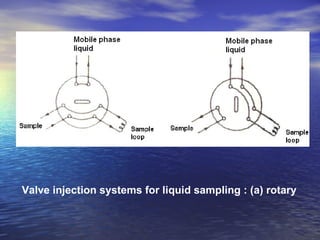
Valve injection systems for liquid sampling : (a) rotary
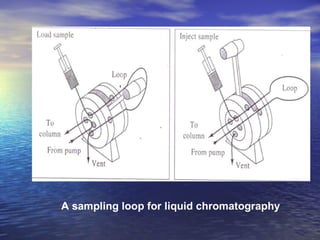
A sampling loop for liquid chromatography
Sample Inlet System : Syringe injection :  Problem of leaking and blow back of plunger.  Stop-flow Injection :  During injection, flow is stopped by a valve kept before injection port.  After injection over flow is started again.  Most widely used method is sampling valve method :   Rheodyne injector :  In one position sample fills loop (variable size) when mobile phase goes directly to column. Then lever is moved, when eluent carries sample from the loop along with it to the column.  Loops of different size 0.5µl to 500µL.
Columns :   Stainless steel. Length 30 cm. Internal diameter 5 mm. Particle size 5 µm. 40000 to 60000 plates/m. Smaller columns available.  Require less volume of eluent. This is important as mobile phase liquids costly. Such columns have limited sample capacity.  Temperature control not important. Many separations at room temperature. Sometimes temp. 30 – 1500C used accuracy ± 0.20C.
Guard column :   Short column containing similar st. phase as analyte column, but particle of bigger size filled so that no pressure drop. Two functions : (i) Remove impurity to protect analyte column which is  very costly. (ii) Presaturates mobile phase with st.phase liq. so that  in analyte column st.phase liq. Is not  carried away  with mobile phase liq.
Detectors :   No detector is as sensitive, versatile as detectors of GC like FID and TCD. Very few work on bulk property. Most of them respond to some physical property of solute that is different from eluent.
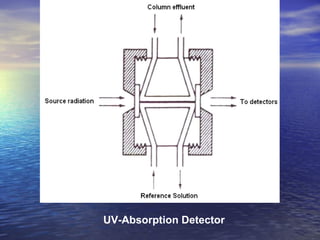
UV-Absorption Detector
UV – Absorption detector :   (i) Single wavelength (ii) Variable wavelength Principle :  Most of organic compound absorb UV radiation. If eluent is not absorbing then as soon as solute is eluted of Column and reach detector a signal obtained. For single wavelength source is Hg-vapour lamp that emits 254 nm wavelength. Radiation divided in two beams one passing through pure eluent other through column effluent. If solute eluted it will absorb radiation and detector will observe difference in intensity of two beams.
Volume of cell 1 to 10  µ L To have pathlength 2 to 10 mm. Diameter of tube very narrow. Advantages :   Sensitivity 10 -4 µ g/ml. Selective In sensitive to change in flowrate, temp. & comp. of  mobile phase Suitable for gradient elution. Limitation :   The eluent should not absorb UV radiation.
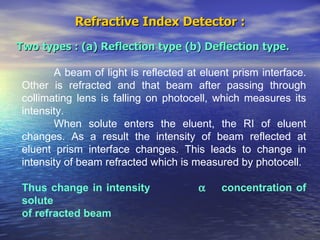
Refractive Index Detector
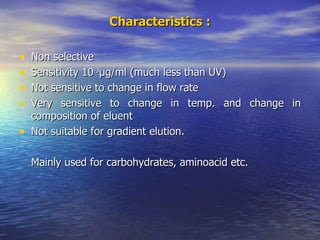
Refractive Index Detector : Two types : (a) Reflection type (b) Deflection type. A beam of light is reflected at eluent prism interface. Other is refracted and that beam after passing through collimating lens is falling on photocell, which measures its intensity.  When solute enters the eluent, the RI of eluent changes. As a result the intensity of beam reflected at eluent prism interface changes. This leads to change in intensity of beam refracted which is measured by photocell. Thus change in intensity     concentration of solute of refracted beam
Characteristics : Non selective Sensitivity 10 -3 µ g/ml (much less than UV) Not sensitive to change in flow rate Very sensitive to change in temp. and change in composition of eluent Not suitable for gradient elution. Mainly used for carbohydrates, aminoacid etc.
Fluorescence Detector :  Can only be used for sub. emitting fluorescence like plant pigments, vitamins, alkaloids, pharmaceuticals, flavoring agents etc.  Highly sensitive 10 -5 µ g/ml. Suitable for gradient elution. Non fluorescent compounds can be converted to  fluorescent derivatives. This can be done on column. Derivatisation column kept before or after analyte  column.
Stationary phases :   They can be either liquid or solid. If liquid is used it is coated on inert solid, but there are problems in it.  Hence, bonded phase supports prepared.
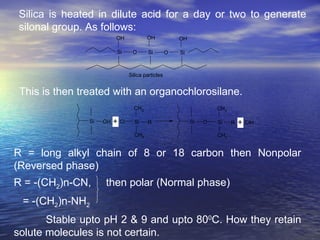
Silica is heated in dilute acid for a day or two to generate silonal group. As follows: This is then treated with an organochlorosilane.  R = long alkyl chain of 8 or 18 carbon then Nonpolar (Reversed phase) R = -(CH 2 )n-CN,  then polar (Normal phase) = -(CH 2 )n-NH 2 Stable upto pH 2 & 9 and upto 80 0 C. How they retain solute molecules is not certain.
Solid stationary phases : Commonly used are (1) Silica (2) Alumina (3) Polyamides. Silica is preferred as it can be obtained in different forms.  Porous microparticles Size 3 to 10  µ m Surface area 100-900 m 2 /gm Small particles (large area) are suitable to separate  solutes having narrow range of particles. Particles with bigger size and small surface area are  effective in separating solutes with wide range of  polarities.
Normal phase and Reversed phase Chromatography : Initially the stationary phase used to be polar and mobile phase used to be non-polar. This combination became popular as normal phase chromatography. Later the use of non-polar stationary phase and polar stationary phase started. This was reverse to the established combination and hence it is called reversed phase chromatography.
Points of comparision is given below : St. phase : Polar Mobile phase : Non polar On increasing polarity of mobile phase retention time decreases.  Non polar Polar On increasing polarity of mobile phase retention time increases.
Mobile phase liquids :  Criteria to select :   Low viscosity High polarity to avoid contamination with sample. High stability, should not react with solute/st.phase liq. Low volatility so that bubbles not formed. Immiscible with st. phase liq. If used in adsorbed form. Suitable for separation to be done. Compatibility with detector.
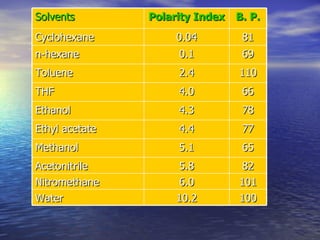
Solvents Polarity Index B. P. Cyclohexane 0.04 81 n-hexane 0.1 69 Toluene 2.4 110 THF 4.0 66 Ethanol 4.3 78 Ethyl acetate 4.4 77 Methanol 5.1 65 Acetonitrile 5.8 82 Nitromethane 6.0 101 Water 10.2 100
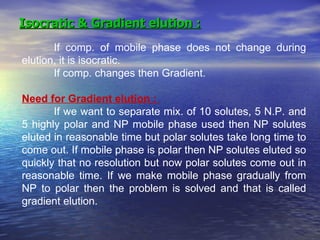
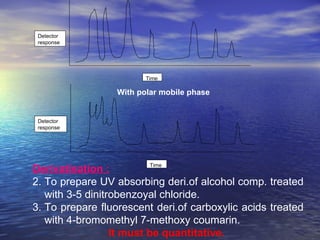
Isocratic & Gradient elution : If comp. of mobile phase does not change during elution, it is isocratic. If comp. changes then Gradient. Need for Gradient elution :  If we want to separate mix. of 10 solutes, 5 N.P. and 5 highly polar and NP mobile phase used then NP solutes eluted in reasonable time but polar solutes take long time to come out. If mobile phase is polar then NP solutes eluted so quickly that no resolution but now polar solutes come out in reasonable time. If we make mobile phase gradually from NP to polar then the problem is solved and that is called gradient elution.
With polar mobile phase Derivatisation : To prepare UV absorbing deri.of alcohol comp. treated with 3-5 dinitrobenzoyal chloride. To prepare fluorescent deri.of carboxylic acids treated with 4-bromomethyl 7-methoxy coumarin. It must be quantitative.   Detector response Time Detector response Time
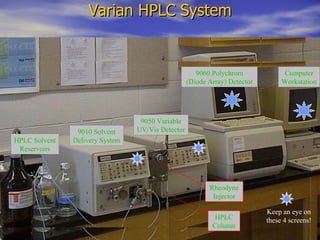
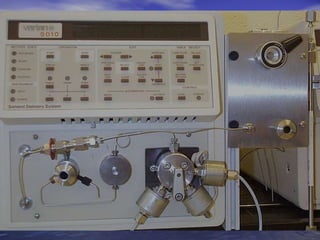
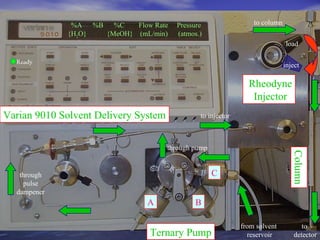
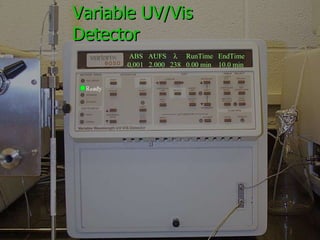
Varian HPLC System 9010 Solvent Delivery System 9050 Variable UV/Vis Detector HPLC Solvent Reservoirs HPLC Column Rheodyne Injector 9060 Polychrom (Diode Array) Detector Computer Workstation Keep an eye on these 4 screens!
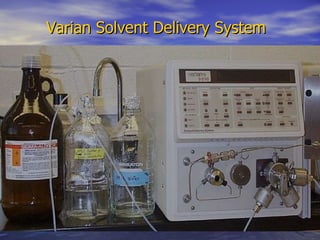
Varian Solvent Delivery System
 
Varian 9010 Solvent Delivery System Rheodyne Injector %A  %B  %C  Flow Rate  Pressure {H 2 O}   {MeOH}  (mL/min)  (atmos.) Ready Ternary Pump A C B from solvent  reservoir Column to detector to column through pulse dampener to injector through pump load inject
Variable UV/Vis Detector ABS  AUFS     RunTime  EndTime 0.001  2.000  238  0.00 min  10.0 min Ready
THANK  YOU

Chromatography introduction ppt by Akshay patel

  • 1.
  • 2.
  • 3.
    A SEMINAR ON Chromatography Introduction and Instrumentation GUIDED BY: BY: PATEL AKSHAY J.D.Patel M.PHARM- 1(ph’ceutics) (head of department) ROLL NO-05 Department of Pharmaceutics NOOTAN PHARMACY COLLEGE,VISNAGAR
  • 4.
    The analyte is the molecule which is to be purified or isolated during chromatography Analytical chromatography is used to determine the identity and concentration of molecules in a mixture A chromatogram is the visual output of the chromatograph. Different peaks or patterns on the chromatograph correspond to different components of the separated mixture A chromatograph takes a chemical mixture carried by liquid or gas and separates it into its component parts as a result of differential distributions of the solutes as they flow around or over the stationary phase The mobile phase is the analyte and solvent mixture which travels through the stationary phase Preparative chromatography is used to purify larger quantities of a substance The retention time is the characteristic time it takes for a particular molecule to pass through the system The stationary phase is the substance which is fixed in place for the chromatography procedure and is the the phase to which solvents and the analyte travels through or binds to. Examples include the silica plate in thin layer chromatography Chromatography terms
  • 5.
    Retention The retentionis a measure of the speed at which a substance moves in a chromatographic system. In continuous development systems like HPLC or GC, where the compounds are eluted with the eluent , the retention is usually measured as the retention time Rt or tR , the time between injection and detection. In interrupted development systems like TLC the retention is measured as the retention factor Rf , the run length of the compound divided by the run length of the eluent front : The retention of a compound often differs considerably between experiments and laboratories due to variations of the eluent, the stationary phase, temperature, and the setup. It is therefore important to compare the retention of the test compound to that of one or more standard compounds under absolutely identical conditions.
  • 6.
    The Theoretical PlateModel of Chromatography The plate model supposes that the chromatographic column is contains a large number of separate layers, called theoretical plates . Separate equilibrations of the sample between the stationary and mobile phase occur in these "plates". The analyte moves down the column by transfer of equilibrated mobile phase from one plate to the next.
  • 7.
    The Rate Theoryof Chromatography A more realistic description of the processes at work inside a column takes account of the time taken for the solute to equilibrate between the stationary and mobile phase (unlike the plate model, which assumes that equilibration is infinitely fast). The resulting band shape of a chromatographic peak is therefore affected by the rate of elution. It is also affected by the different paths available to solute molecules as they travel between particles of stationary phase. If we consider the various mechanisms which contribute to band broadening, we arrive at the Van Deemter equation for plate height; HETP = A + B / u + C u where u is the average velocity of the mobile phase. A, B, and C are factors which contribute to band broadening.
  • 8.
    It is importantto remember that the plates do not really exist; they are a figment of the imagination that helps us understand the processes at work in the column.They also serve as a way of measuring column efficiency, either by stating the number of theoretical plates in a column, N (the more plates the better), or by stating the plate height; the Height Equivalent to a Theoretical Plate (the smaller the better). If the length of the column is L , then the HETP is HETP = L / N The number of theoretical plates that a real column possesses can be found by examining a chromatographic peak after elution; where w 1/2 is the peak width at half-height. As can be seen from this equation, columns behave as if they have different numbers of plates for different solutes in a mixture.
  • 9.
    A- Eddy diffusionThe mobile phase moves through the column which is packed with stationary phase. Solute molecules will take different paths through the stationary phase at random. This will cause broadening of the solute band, because different paths are of different lengths. B - Longitudinal diffusion The concentration of analyte is less at the edges of the band than at the center. Analyte diffuses out from the center to the edges. This causes band broadening. If the velocity of the mobile phase is high then the analyte spends less time on the column, which decreases the effects of longitudinal diffusion. C - Resistance to mass transfer The analyte takes a certain amount of time to equilibrate between the stationary and mobile phase. If the velocity of the mobile phase is high, and the analyte has a strong affinity for the stationary phase, then the analyte in the mobile phase will move ahead of the analyte in the stationary phase. The band of analyte is broadened. The higher the velocity of mobile phase, the worse the broadening becomes.
  • 10.
    Van Deemter plotsA plot of plate height vs. average linear velocity of mobile phase Such plots are of considerable use in determining the optimum mobile phase flow rate
  • 11.
    Resolution Although theselectivity factor, a, describes the separation of band centres, it does not take into account peak widths. Another measure of how well species have been separated is provided by measurement of the resolution . The resolution of two species, A and B, is defined as Baseline resolution is achieved when R = 1.5
  • 12.
    Adsorption Chromatography: Adsorption chromatography is probably one of the oldest types of chromatography around. It utilizes a mobile liquid or gaseous phase that is adsorbed onto the surface of a stationary solid phase. The equilibriation between the mobile and stationary phase accounts for the separation of different solutes .
  • 13.
    Partition Chromatography: This form of chromatography is based on a thin film formed on the surface of a solid support by a liquid stationary phase. Solute equilibriates between the mobile phase and the stationary liquid .
  • 14.
  • 15.
    Only useful forvolatile and thermally stable compounds. Can’t be used for solid. Difficulties encountered in LC : Non availability of sensitive detectors. Speed of separation with conventional liquid chromatography. Difficulty of speed overcome by using high pressure. Limitations of GC :
  • 16.
    Comparision of GC& LC Mobile phase gas (very cheap) St. Phase solid/liquid Mobile phase inert Separation mainly based on selection of st.phase (wide choice) Limited applications. Mobile phase liquid (very costly) St.Phase solid/liquid Mobile phase interacts with solute. St. phase limited in no. separation (desired) achieved by selecting mobile phase. Wide applications.
  • 17.
    Flow diagram fora liquid chromatograph
  • 18.
    Eluent Delivery System: Reservoirs (one or more ) Degassers Pumps
  • 19.
    Function of Degassers: Appreciable amount of gases dissolve at high pressure. When pressure released in column and detector bubbles may form. Degassing by heating distilling, vacuum pumping or purging inert gas with low solubility like He/Ar.
  • 20.
    Requirements of Pump: Pulseless flow upto 10 ml/min. High pressure upto 1000 psi or more. Suitability for gradient elution; Reciprocating pump Syringe pump Pneumatic pump
  • 21.
  • 22.
  • 23.
    Reciprocating Pump: SchematicsMost HPLC pumps are reciprocating A motor driven cam drives the piston to deliver solvent through the outlet check valve Gradient are formed by using 2 or more pumps (high-pressure mixing) or solenoid-actuated proportioning valves (low-pressure mixing)
  • 24.
    Reciprocating pump : In 90% instrument used. To minimise pulsing pistons and cylinders operate in cycle. Pressure drop caused by slowing of one is compensated by others. Advantages : Small volume Pressure upto 600 atm(10,000 psi) can be applied. Variable flow rate upto 10 ml/min. Suitable for gradient elution. Disadvantages : Not totally pulseless flow. Damping device required to have regular flow.
  • 25.
    Valve injection systemsfor liquid sampling : (a) rotary
  • 26.
    A sampling loopfor liquid chromatography
  • 27.
    Sample Inlet System: Syringe injection : Problem of leaking and blow back of plunger. Stop-flow Injection : During injection, flow is stopped by a valve kept before injection port. After injection over flow is started again. Most widely used method is sampling valve method : Rheodyne injector : In one position sample fills loop (variable size) when mobile phase goes directly to column. Then lever is moved, when eluent carries sample from the loop along with it to the column. Loops of different size 0.5µl to 500µL.
  • 28.
    Columns : Stainless steel. Length 30 cm. Internal diameter 5 mm. Particle size 5 µm. 40000 to 60000 plates/m. Smaller columns available. Require less volume of eluent. This is important as mobile phase liquids costly. Such columns have limited sample capacity. Temperature control not important. Many separations at room temperature. Sometimes temp. 30 – 1500C used accuracy ± 0.20C.
  • 29.
    Guard column : Short column containing similar st. phase as analyte column, but particle of bigger size filled so that no pressure drop. Two functions : (i) Remove impurity to protect analyte column which is very costly. (ii) Presaturates mobile phase with st.phase liq. so that in analyte column st.phase liq. Is not carried away with mobile phase liq.
  • 30.
    Detectors : No detector is as sensitive, versatile as detectors of GC like FID and TCD. Very few work on bulk property. Most of them respond to some physical property of solute that is different from eluent.
  • 31.
  • 32.
    UV – Absorptiondetector : (i) Single wavelength (ii) Variable wavelength Principle : Most of organic compound absorb UV radiation. If eluent is not absorbing then as soon as solute is eluted of Column and reach detector a signal obtained. For single wavelength source is Hg-vapour lamp that emits 254 nm wavelength. Radiation divided in two beams one passing through pure eluent other through column effluent. If solute eluted it will absorb radiation and detector will observe difference in intensity of two beams.
  • 33.
    Volume of cell1 to 10 µ L To have pathlength 2 to 10 mm. Diameter of tube very narrow. Advantages : Sensitivity 10 -4 µ g/ml. Selective In sensitive to change in flowrate, temp. & comp. of mobile phase Suitable for gradient elution. Limitation : The eluent should not absorb UV radiation.
  • 34.
  • 35.
    Refractive Index Detector: Two types : (a) Reflection type (b) Deflection type. A beam of light is reflected at eluent prism interface. Other is refracted and that beam after passing through collimating lens is falling on photocell, which measures its intensity. When solute enters the eluent, the RI of eluent changes. As a result the intensity of beam reflected at eluent prism interface changes. This leads to change in intensity of beam refracted which is measured by photocell. Thus change in intensity  concentration of solute of refracted beam
  • 36.
    Characteristics : Nonselective Sensitivity 10 -3 µ g/ml (much less than UV) Not sensitive to change in flow rate Very sensitive to change in temp. and change in composition of eluent Not suitable for gradient elution. Mainly used for carbohydrates, aminoacid etc.
  • 37.
    Fluorescence Detector : Can only be used for sub. emitting fluorescence like plant pigments, vitamins, alkaloids, pharmaceuticals, flavoring agents etc. Highly sensitive 10 -5 µ g/ml. Suitable for gradient elution. Non fluorescent compounds can be converted to fluorescent derivatives. This can be done on column. Derivatisation column kept before or after analyte column.
  • 38.
    Stationary phases : They can be either liquid or solid. If liquid is used it is coated on inert solid, but there are problems in it. Hence, bonded phase supports prepared.
  • 39.
    Silica is heatedin dilute acid for a day or two to generate silonal group. As follows: This is then treated with an organochlorosilane. R = long alkyl chain of 8 or 18 carbon then Nonpolar (Reversed phase) R = -(CH 2 )n-CN, then polar (Normal phase) = -(CH 2 )n-NH 2 Stable upto pH 2 & 9 and upto 80 0 C. How they retain solute molecules is not certain.
  • 40.
    Solid stationary phases: Commonly used are (1) Silica (2) Alumina (3) Polyamides. Silica is preferred as it can be obtained in different forms. Porous microparticles Size 3 to 10 µ m Surface area 100-900 m 2 /gm Small particles (large area) are suitable to separate solutes having narrow range of particles. Particles with bigger size and small surface area are effective in separating solutes with wide range of polarities.
  • 41.
    Normal phase andReversed phase Chromatography : Initially the stationary phase used to be polar and mobile phase used to be non-polar. This combination became popular as normal phase chromatography. Later the use of non-polar stationary phase and polar stationary phase started. This was reverse to the established combination and hence it is called reversed phase chromatography.
  • 42.
    Points of comparisionis given below : St. phase : Polar Mobile phase : Non polar On increasing polarity of mobile phase retention time decreases. Non polar Polar On increasing polarity of mobile phase retention time increases.
  • 43.
    Mobile phase liquids: Criteria to select : Low viscosity High polarity to avoid contamination with sample. High stability, should not react with solute/st.phase liq. Low volatility so that bubbles not formed. Immiscible with st. phase liq. If used in adsorbed form. Suitable for separation to be done. Compatibility with detector.
  • 44.
    Solvents Polarity IndexB. P. Cyclohexane 0.04 81 n-hexane 0.1 69 Toluene 2.4 110 THF 4.0 66 Ethanol 4.3 78 Ethyl acetate 4.4 77 Methanol 5.1 65 Acetonitrile 5.8 82 Nitromethane 6.0 101 Water 10.2 100
  • 45.
    Isocratic & Gradientelution : If comp. of mobile phase does not change during elution, it is isocratic. If comp. changes then Gradient. Need for Gradient elution : If we want to separate mix. of 10 solutes, 5 N.P. and 5 highly polar and NP mobile phase used then NP solutes eluted in reasonable time but polar solutes take long time to come out. If mobile phase is polar then NP solutes eluted so quickly that no resolution but now polar solutes come out in reasonable time. If we make mobile phase gradually from NP to polar then the problem is solved and that is called gradient elution.
  • 46.
    With polar mobilephase Derivatisation : To prepare UV absorbing deri.of alcohol comp. treated with 3-5 dinitrobenzoyal chloride. To prepare fluorescent deri.of carboxylic acids treated with 4-bromomethyl 7-methoxy coumarin. It must be quantitative. Detector response Time Detector response Time
  • 47.
    Varian HPLC System9010 Solvent Delivery System 9050 Variable UV/Vis Detector HPLC Solvent Reservoirs HPLC Column Rheodyne Injector 9060 Polychrom (Diode Array) Detector Computer Workstation Keep an eye on these 4 screens!
  • 48.
  • 49.
  • 50.
    Varian 9010 SolventDelivery System Rheodyne Injector %A %B %C Flow Rate Pressure {H 2 O} {MeOH} (mL/min) (atmos.) Ready Ternary Pump A C B from solvent reservoir Column to detector to column through pulse dampener to injector through pump load inject
  • 51.
    Variable UV/Vis DetectorABS AUFS  RunTime EndTime 0.001 2.000 238 0.00 min 10.0 min Ready
  • 52.