FRAGMENTATION TECHNIQUES IN MASS
SPECTROSCOPY
Presented by:
Sk.Samiya,
1st year M-Pharm,(Pharmacology)
Hindu College of Pharmacy
Mass spectroscopy
Definition:
It is a powerful analytical technique useful for determination of
molecular weight of compound.
Principle:
 Initially in mass spectroscopy the sample must be converted into
vapourised or gaseous form then it undergo ionization to form a
molecular ion with the liberation of 1e-.
 This molecular ion normally undergoes fragmentation to form several
fragmented ions or daughter ions.
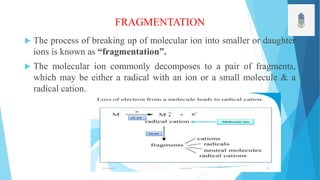
FRAGMENTATION
 The process of breaking up of molecular ion into smaller or daughter
ions is known as “fragmentation”.
 The molecular ion commonly decomposes to a pair of fragments,
which may be either a radical with an ion or a small molecule & a
radical cation.
Fragmentation process
 Bombardment of molecules by a electron beam with energy
between 10-15ev usually results in the ionization of molecules
by removal of one electron (molecular ion formation).
 When the energy of electron beam is increased between 50-7ev,
these molecular ions acquire a high excitation resulting in their
break down into various fragments.
General modes of fragmentation
Fragmentation of the molecular ion takes place in following mods:
 Simple cleavage
1. Homolytic cleavage
2. Heterolytic cleavage
3. Semi heterolytic cleavage
 Rearrangement reactions
1. Elimination reactions
2. Ortho reaction
3. Mc-lafferty rearrangement
Simple cleavage:
Transfer of electrons takes place
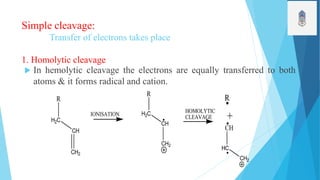
1. Homolytic cleavage
 In hemolytic cleavage the electrons are equally transferred to both
atoms & it forms radical and cation.
R
H2C
CH
CH2
R
H2C
CH
CH2
R
+
CH
HC
CH2
IONISATION
HOMOLYTIC
CLEAVAGE
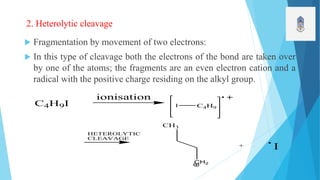
2. Heterolytic cleavage
 Fragmentation by movement of two electrons:
 In this type of cleavage both the electrons of the bond are taken over
by one of the atoms; the fragments are an even electron cation and a
radical with the positive charge residing on the alkyl group.
C4H9I
ionisation
CH3
CH2
+ I
C4H9I
HETEROLYTIC
CLEAVAGE
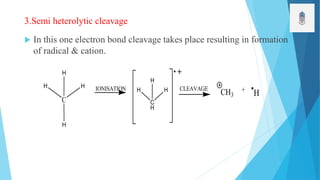
3.Semi heterolytic cleavage
 In this one electron bond cleavage takes place resulting in formation
of radical & cation.
C
H
H H
H
C
H
H H
H
CH3
+
H
IONISATION CLEAVAGE
Rearrangement reaction
 It involves the cleavage of bonds and formation of new bonds i.e., it
requires changes to at least two bonds.
 So the produced ions are not structural units of precursors.
 Generally rearrangement leads to loss of smaller molecules.
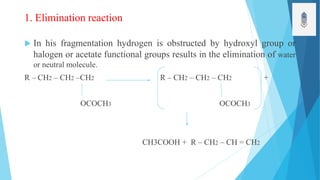
1. Elimination reaction
 In his fragmentation hydrogen is obstructed by hydroxyl group or
halogen or acetate functional groups results in the elimination of water
or neutral molecule.
R – CH2 – CH2 –CH2 R – CH2 – CH2 – CH2 +
OCOCH3 OCOCH3
CH3COOH + R – CH2 – CH = CH2
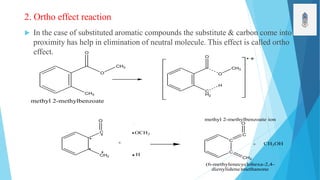
2. Ortho effect reaction
 In the case of substituted aromatic compounds the substitute & carbon come into
proximity has help in elimination of neutral molecule. This effect is called ortho
effect.
O
O
CH3
CH3
O
O
CH3
C
H2
C
O
CH2
+
OCH3
H
C
C
C
O
CH2
+ CH3OH
methyl 2-methylbenzoate
methyl 2-methylbenzoate ion
(6-methylenecyclohexa-2,4-
dienylidene)methanone
H
3. Mc-Lafferty rearrangement reaction
 The loss of an alkene fragment by cyclic rearrangement of a carbonyl
compounds ( like aldehyde, ketones, acids, esters, amines),
unsaturated compounds with γ-hydrogens undergo Mc-Lafferty
rearrangement.
Or
 It involves the migration of γ-hydrogen atom followed by cleavage
of β-bond then rearrangement leads to the elimination of neutral
molecule.
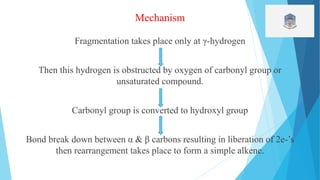
Mechanism
Fragmentation takes place only at γ-hydrogen
Then this hydrogen is obstructed by oxygen of carbonyl group or
unsaturated compound.
Carbonyl group is converted to hydroxyl group
Bond break down between α & β carbons resulting in liberation of 2e-’s
then rearrangement takes place to form a simple alkene.
H
H2C
C
H2
CH2
C
HO
butyraldehyde
H
H2C
C
H2
CH2
C
HO
H2C
C
H
CH
C
HHO
CH2
CH2
+
OH
C
CH2
H
O
C
CH3
H
H
H2C
C
H2
CH2
C
HO
IONISATION
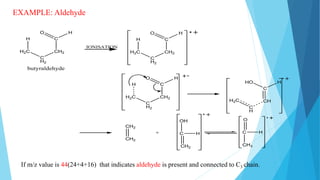
EXAMPLE: Aldehyde
If m/z value is 44(24+4+16) that indicates aldehyde is present and connected to C3 chain.
H
H2C
C
H2
CH2
C
CH3O
H
H2C
C
H2
CH2
C
CH3O
H2C
C
H
CH2
CH
CH3HO
CH2
CH2
+
CH2
C
CH3HO
CH3
C
CH3O
H
H2C
C
H2
CH2
C
CH3
O
pentan-2-one
ionisation
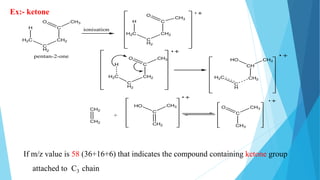
If m/z value is 58 (36+16+6) that indicates the compound containing ketone group
attached to C3 chain
Ex:- ketone
H
H2C
C
H2
CH2
C
NH2O
H
H2C
C
H2
CH2
C
NH2O
H2C
C
H
CH2
CH
NH2HO
CH2
CH2
+
CH2
C
NH2HO
CH3
C
NH2O
butyramide
H
H2C
C
H2
CH2
C
NH2O
ionisation
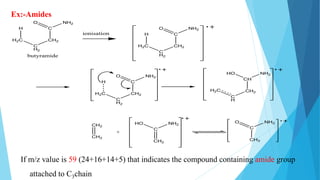
Ex:-Amides
If m/z value is 59 (24+16+14+5) that indicates the compound containing amide group
attached to C3chain
REFERENCES:
 Instrumental methods of chemical analysis- B.K Sharma,
 Instrumental methods of analysis By Chatwal,
 Principles of Instrumental analysis By Donglas Skoog
Fragmentation techniques

Fragmentation techniques

  • 1.
    FRAGMENTATION TECHNIQUES INMASS SPECTROSCOPY Presented by: Sk.Samiya, 1st year M-Pharm,(Pharmacology) Hindu College of Pharmacy
  • 2.
    Mass spectroscopy Definition: It isa powerful analytical technique useful for determination of molecular weight of compound. Principle:  Initially in mass spectroscopy the sample must be converted into vapourised or gaseous form then it undergo ionization to form a molecular ion with the liberation of 1e-.  This molecular ion normally undergoes fragmentation to form several fragmented ions or daughter ions.
  • 3.
    FRAGMENTATION  The processof breaking up of molecular ion into smaller or daughter ions is known as “fragmentation”.  The molecular ion commonly decomposes to a pair of fragments, which may be either a radical with an ion or a small molecule & a radical cation.
  • 4.
    Fragmentation process  Bombardmentof molecules by a electron beam with energy between 10-15ev usually results in the ionization of molecules by removal of one electron (molecular ion formation).  When the energy of electron beam is increased between 50-7ev, these molecular ions acquire a high excitation resulting in their break down into various fragments.
  • 5.
    General modes offragmentation Fragmentation of the molecular ion takes place in following mods:  Simple cleavage 1. Homolytic cleavage 2. Heterolytic cleavage 3. Semi heterolytic cleavage  Rearrangement reactions 1. Elimination reactions 2. Ortho reaction 3. Mc-lafferty rearrangement
  • 6.
    Simple cleavage: Transfer ofelectrons takes place 1. Homolytic cleavage  In hemolytic cleavage the electrons are equally transferred to both atoms & it forms radical and cation. R H2C CH CH2 R H2C CH CH2 R + CH HC CH2 IONISATION HOMOLYTIC CLEAVAGE
  • 7.
    2. Heterolytic cleavage Fragmentation by movement of two electrons:  In this type of cleavage both the electrons of the bond are taken over by one of the atoms; the fragments are an even electron cation and a radical with the positive charge residing on the alkyl group. C4H9I ionisation CH3 CH2 + I C4H9I HETEROLYTIC CLEAVAGE
  • 8.
    3.Semi heterolytic cleavage In this one electron bond cleavage takes place resulting in formation of radical & cation. C H H H H C H H H H CH3 + H IONISATION CLEAVAGE
  • 9.
    Rearrangement reaction  Itinvolves the cleavage of bonds and formation of new bonds i.e., it requires changes to at least two bonds.  So the produced ions are not structural units of precursors.  Generally rearrangement leads to loss of smaller molecules.
  • 10.
    1. Elimination reaction In his fragmentation hydrogen is obstructed by hydroxyl group or halogen or acetate functional groups results in the elimination of water or neutral molecule. R – CH2 – CH2 –CH2 R – CH2 – CH2 – CH2 + OCOCH3 OCOCH3 CH3COOH + R – CH2 – CH = CH2
  • 11.
    2. Ortho effectreaction  In the case of substituted aromatic compounds the substitute & carbon come into proximity has help in elimination of neutral molecule. This effect is called ortho effect. O O CH3 CH3 O O CH3 C H2 C O CH2 + OCH3 H C C C O CH2 + CH3OH methyl 2-methylbenzoate methyl 2-methylbenzoate ion (6-methylenecyclohexa-2,4- dienylidene)methanone H
  • 12.
    3. Mc-Lafferty rearrangementreaction  The loss of an alkene fragment by cyclic rearrangement of a carbonyl compounds ( like aldehyde, ketones, acids, esters, amines), unsaturated compounds with γ-hydrogens undergo Mc-Lafferty rearrangement. Or  It involves the migration of γ-hydrogen atom followed by cleavage of β-bond then rearrangement leads to the elimination of neutral molecule.
  • 13.
    Mechanism Fragmentation takes placeonly at γ-hydrogen Then this hydrogen is obstructed by oxygen of carbonyl group or unsaturated compound. Carbonyl group is converted to hydroxyl group Bond break down between α & β carbons resulting in liberation of 2e-’s then rearrangement takes place to form a simple alkene.
  • 14.
  • 15.
  • 16.
  • 17.
    REFERENCES:  Instrumental methodsof chemical analysis- B.K Sharma,  Instrumental methods of analysis By Chatwal,  Principles of Instrumental analysis By Donglas Skoog