A SEMINAR

             ON
ORAL CONTROLLED DRUG
   DELIVERY SYSTEM
           PRESENTED BY
          SONAM M. GANDHI
INTRODUCTION


    Oral controlled drug delivery system is
a delivery system that provides the
continuous oral delivery of drugs at
predictable and reproducible kinetics for a
determined delivery throughout the course
of GI transit.
Advantage
•   Reduce dosage frequency
•   Reduce fluctuation in circulating drug level
•   Increase patient compliance
•   Avoidance of night time dosing
•   More uniform effect
•   Reduction in GI irritation and dose related
    side effects
Disadvantage

•   Highly expansive
•   Often poor in vivo-in vitro correlation
•   Dose dumping
•   poor systemic availability
DESIGN AND FABRICATION OF
      ORAL STATEM
 Dissolution controlled release systems
 Diffusion controlled release system
     Dissolution & diffusion controlled
 release system
 Ion exchange resin drug complex
 pH dependant formulation
 Osmotic pressure controlled systems
 Hydrodynamic pressure controlled
 systems
DISSOLUTION CONTROLLED
           RELEASE SYSTEM


• Sustain release oral products employing
  dissolution as the rate limiting step are
  the principle involves in this system.
• To achieve this type of approach , the
  drug particles can be coated with
  material of varying thickness or by
  dispersing them in a polymeric matrix.
The common forms of dissolution controls formulation are
                    shown below


                      MEMBRANE


                        DRUGS

(a) Dissolution controls of drugs release depends on
    thickness & dissolution rate of the membrane coat


(b) Dissolution control of drugs release depends on polymer
     core erosion
•   Dissolution controlled drug release system can be
    divided in to two categories:

          (1) Encapsulation Dissolution control
          (2) Matrix Dissolution control


(1) Encapsulation Dissolution control:

    This method involves the coating of particles or
    granules of drug with slow dissolving materials
GRANULES COATED PRODUCT

• There are several ways to prepare a drug coated
  product.

• A common method is to coat the seeds with the
  drug followed by a coat of slow dissolving
  materials such as carbohydrate sugar and
  cellulose ,polyethylene glycol, polymeric
  material, and wax.
MICROENCAPSULATION

•   coacervation / phase separation techniques
•   Interfacial polymerization
•   Precipitation
•   Hot melt
•   Salting out
•    solvent evaporation
•   Electrostatic method.
(2) MATRIX DISSOLUTION CONTROL:

• It is also called as monoliths.

• The drug is dispersed in media such as bees wax,
  carnauba wax, caster oil etc which control drug
  dissolution by controlling the penetration of
  dissolution fluid in to matrix.

• This can be controlled by altering the porosity of the
  tablet matrix, the presence of hydrophobic
  additives, and the wettability of the tablet and
  particle surface.
DIFFUSION CONTROLLED RELEASE
              SYSTEM
• There are two type of the diffusion controlled
  release system :

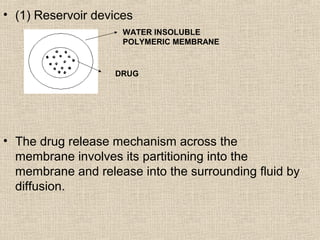
 (1) Reservoir devices

 (2) Matrix devices
• (1) Reservoir devices
                     WATER INSOLUBLE
                     POLYMERIC MEMBRANE


                   DRUG


• The drug release mechanism across the
  membrane involves its partitioning into the
  membrane and release into the surrounding fluid by
  diffusion.
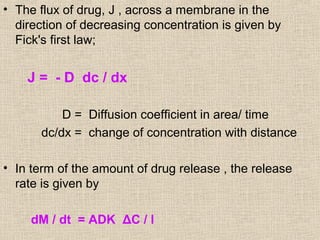
• The flux of drug, J , across a membrane in the
  direction of decreasing concentration is given by
  Fick's first law;


    J = - D dc / dx

           D = Diffusion coefficient in area/ time
       dc/dx = change of concentration with distance

• In term of the amount of drug release , the release
  rate is given by

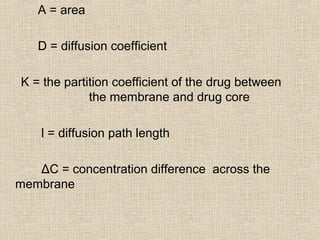
     dM / dt = ADK ΔC / l
A = area

   D = diffusion coefficient

K = the partition coefficient of the drug between
             the membrane and drug core

    l = diffusion path length

   ΔC = concentration difference across the
membrane
• (2) Matrix devices:


   Diffusion controls of drugs release by solid drugs dispersed in
   an insoluble matrix


• In this system, a solid drug is dispersed in an insoluble
  matrix.
• The rate of drug release is dependent on THE RATE
  OF DRUG DIFFUSION but not THE RATE OF SOLID
  Dissolution.
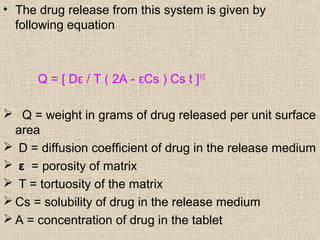
• The drug release from this system is given by
  following equation


      Q = [ Dε / T ( 2A - εCs ) Cs t ]1/2

 Q = weight in grams of drug released per unit surface
  area
 D = diffusion coefficient of drug in the release medium
 ε = porosity of matrix
 T = tortuosity of the matrix
 Cs = solubility of drug in the release medium
 A = concentration of drug in the tablet
DIFFUSION AND DISSOLUTION
         CONTROLLED SYSTEM
• The main feature of this system is that the drug
  core is enclosed with a partially soluble
  membrane.


                    drug


                     Partially Soluble membrane


              Pores produced by soluble portion of
              Polymer membrane
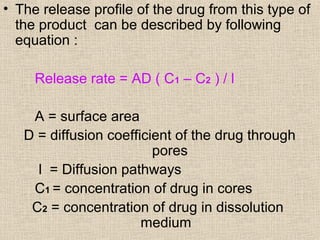
• The release profile of the drug from this type of
  the product can be described by following
  equation :

     Release rate = AD ( C1 – C2 ) / l

    A = surface area
   D = diffusion coefficient of the drug through
                         pores
     l = Diffusion pathways
    C1 = concentration of drug in cores
    C2 = concentration of drug in dissolution
                       medium
• The fraction of soluble polymer in the coat will be the
  dominant factor controlling drug release.

• Such a system has been demonstrated to provide a
  zero order release of Kcl from a tablet and doing the
  minimize gastrointestinal irritation effect of this
  compound.
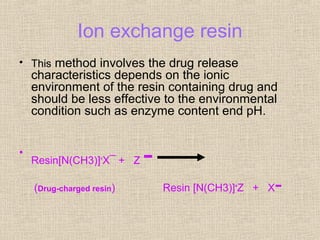
Ion exchange resin
• This method involves the drug release
    characteristics depends on the ionic
    environment of the resin containing drug and
    should be less effective to the environmental
    condition such as enzyme content end pH.


•
    Resin[N(CH3)]+X¯ + Z   -
    (Drug-charged resin)       Resin [N(CH3)]+Z + X   -
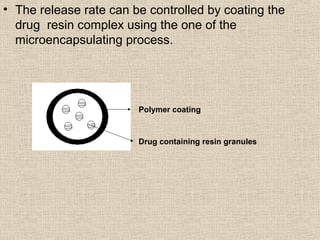
• The release rate can be controlled by coating the
  drug resin complex using the one of the
  microencapsulating process.


                        Polymer coating


                        Drug containing resin granules
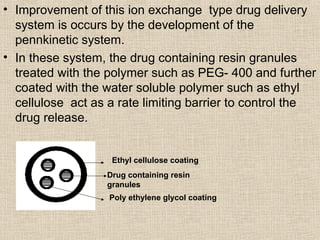
• Improvement of this ion exchange type drug delivery
  system is occurs by the development of the
  pennkinetic system.
• In these system, the drug containing resin granules
  treated with the polymer such as PEG- 400 and further
  coated with the water soluble polymer such as ethyl
  cellulose act as a rate limiting barrier to control the
  drug release.


                   Ethyl cellulose coating
                  Drug containing resin
                  granules
                   Poly ethylene glycol coating
pH – INDEPENDENT CONTROLLED
            RELEASE SYSTEM
• This system involves the granules are designed
  for the oral controlled release of acidic and basic
  drugs at the rate that is independent of the ph in
  the GI tract.
• They are prepared by mixing a basic or acidic
  drugs with one or more buffering agents
  ,granulating with excipients and finally coating
  with a GI fluid permeable film forming polymer.
• When the GI fluid permeates through the membrane ,
  the buffering agents adjust the suitable constant ph,
  there by constant rate of the drugs release occurs.
OSMOTICALLY CONTROLLED RELEASE
            SYSTEM
• In this type of drug delivery system, the osmotic pressure
  is the driving force that generates constant drug release.

                Osmotic delivery orifice


                            Semi permeable membrane

                             Osmotic core reservoir containing drug
• To regulate the flow of GI fluid for penetrstion
  through the semi permeable membrane, a layer of
  bioerodible polymer can be applied to the external
  surface of the semi permeable membrane

• Several other modification of osmotic pressure
  controlled drug delivery have been develop.

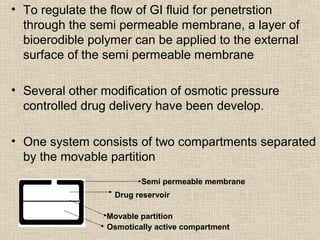
• One system consists of two compartments separated
  by the movable partition
                         Semi permeable membrane
                  Drug reservoir

                 Movable partition
                 Osmotically active compartment
• Another modified system is one in which delivery
  orifice is absents .In these system, the GI fluid is
  penetrate, hydraulic pressure is built up inside until
  the wall ruptures and the contents are release to
  the environments.
• Osmotic controlled release system requires
  osmotic pressure to be effective and is independent
  of its environments.
HYDRODYNAMICAL LY BALANCE
             SYSTEM
• This system is design to prolong GI residence
  time of drug in area of the GIT to minimized drug
  reaching its absorption site in the solution state.
• This type of the tablet or capsules having the
  less density compared to the GI fluid density.
• This type of tablet is prepared by granulating a
  mixture of drug, excipients, and hydrocolloids
  such as hydroxyethylcellulose, hydroxypropyle
  cellulose, and hydroxypropylmethylcellulose.
CLASSIFICATION OF HYDRODYNAMICALLY
           BALANCE SYSTEM


(1) Effervescent Floating Dosage Form

(2) Non effervescent Floating dosage
    Form
Effervescent Floating Dosage Form

•   These are matrix type of system prepared with
    swellable polymer such as methylcellulose,
    chitosan, and various effervescent compounds
    like sodium bicarbonate, tartaric acid, and citric
    acid.

•   These type of tablet comes in contact with the
    acidic gastric contents, Co2 is liberated and gets
    entrapped in swollen hydrocolloids, providing
    buoyancy to the dosage form.
Non effervescent Floating dosage Form

• This system is prepared from gel forming or swellable
    cellulose type of hydrocolloids, polysaccharides,
  and matrix forming polymer like acrylates.

• After the oral administration, this dosage forms sweiis
  in contact with gastric fluid and attain a bulk density of
  G.I.

• The air entrapped within the swollen matrix imparts
  buoyancy to dosage form.
• The formed swollen gel – like structure acts as a
  reservoir and allows sustained release of drug through
  the gelatinous mass.
Oral & dissolution controlled release system