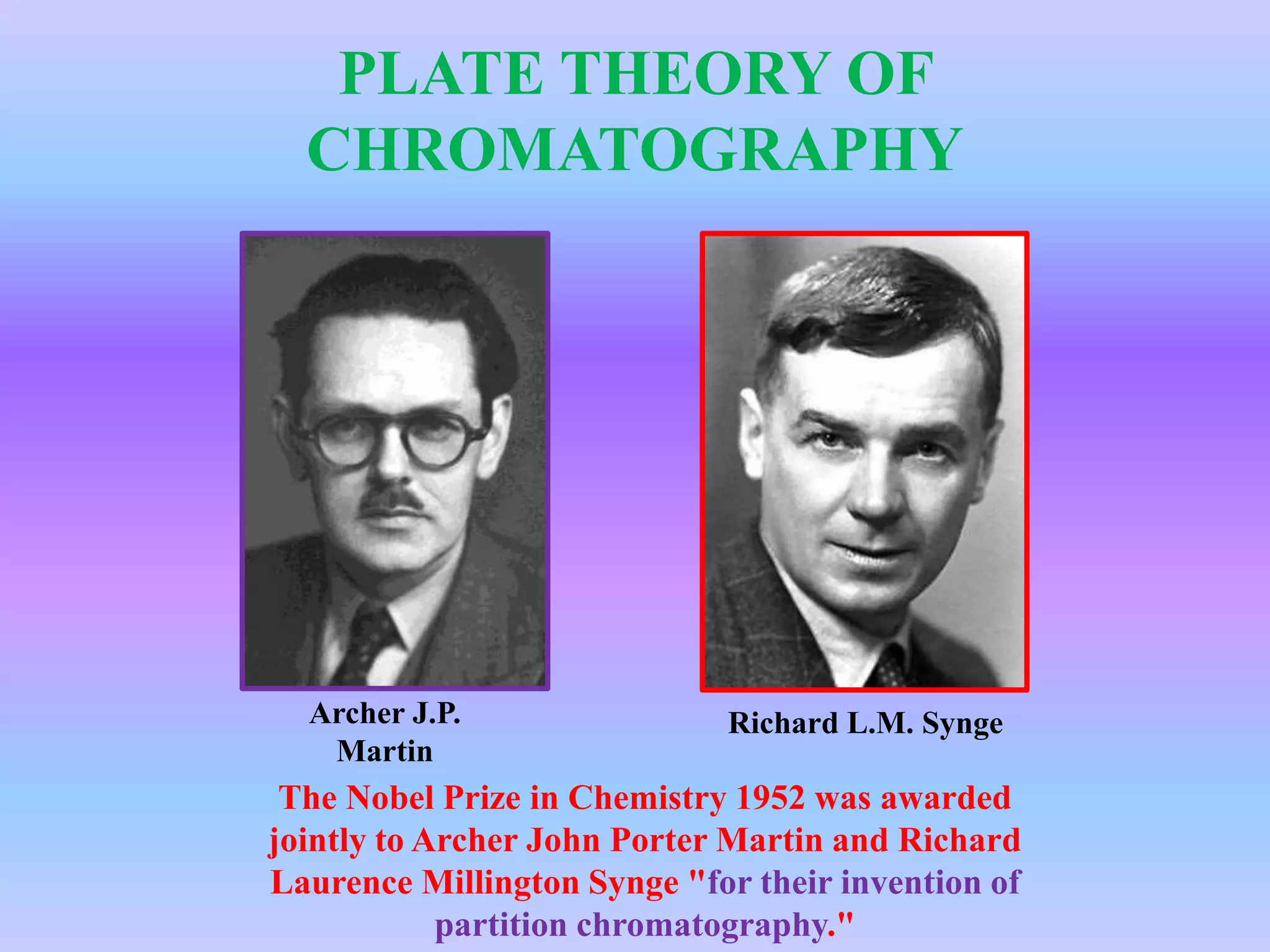
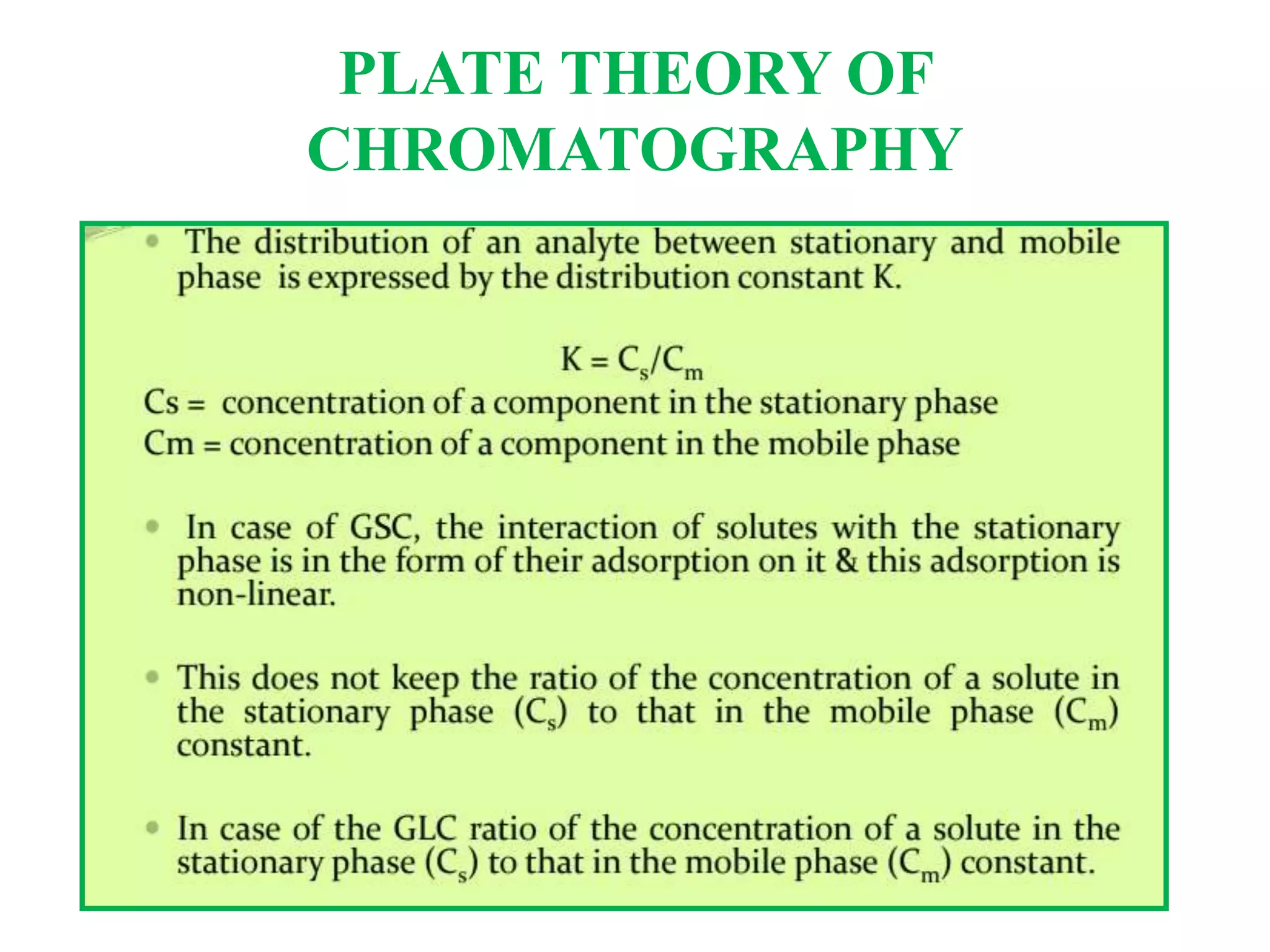
The Nobel Prize in Chemistry 1952 was awarded
jointly to Archer John Porter Martin and Richard
Laurence Millington Synge "for their invention of
partition chromatography."
Richard L.M. SyngeArcher J.P.
Martin
PLATE THEORY OF
CHROMATOGRAPHY
Nernst Distribution law:
“At constant temperature, a solute
distributes itself between two immiscible
solvents only in a particular ratio”
KD = [X]SolventA
[X]SolventBPartition
Coefficient
PLATE THEORY OF
CHROMATOGRAPHY
PLATE THEORY OF
CHROMATOGRAPHY
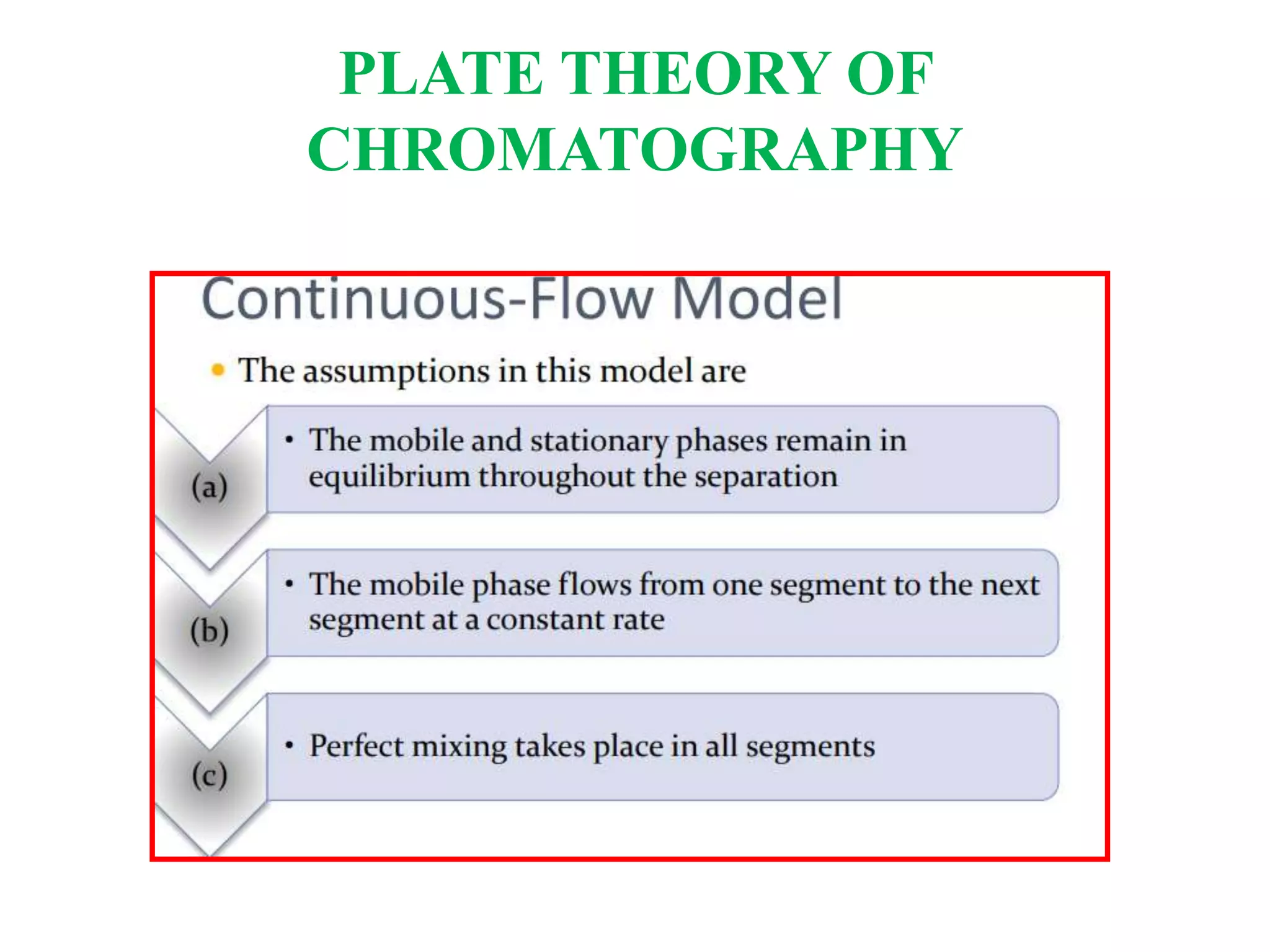
 The plate theory assumes that the solute, during its passage through the
column, is always in equilibrium with the mobile and stationary phases.
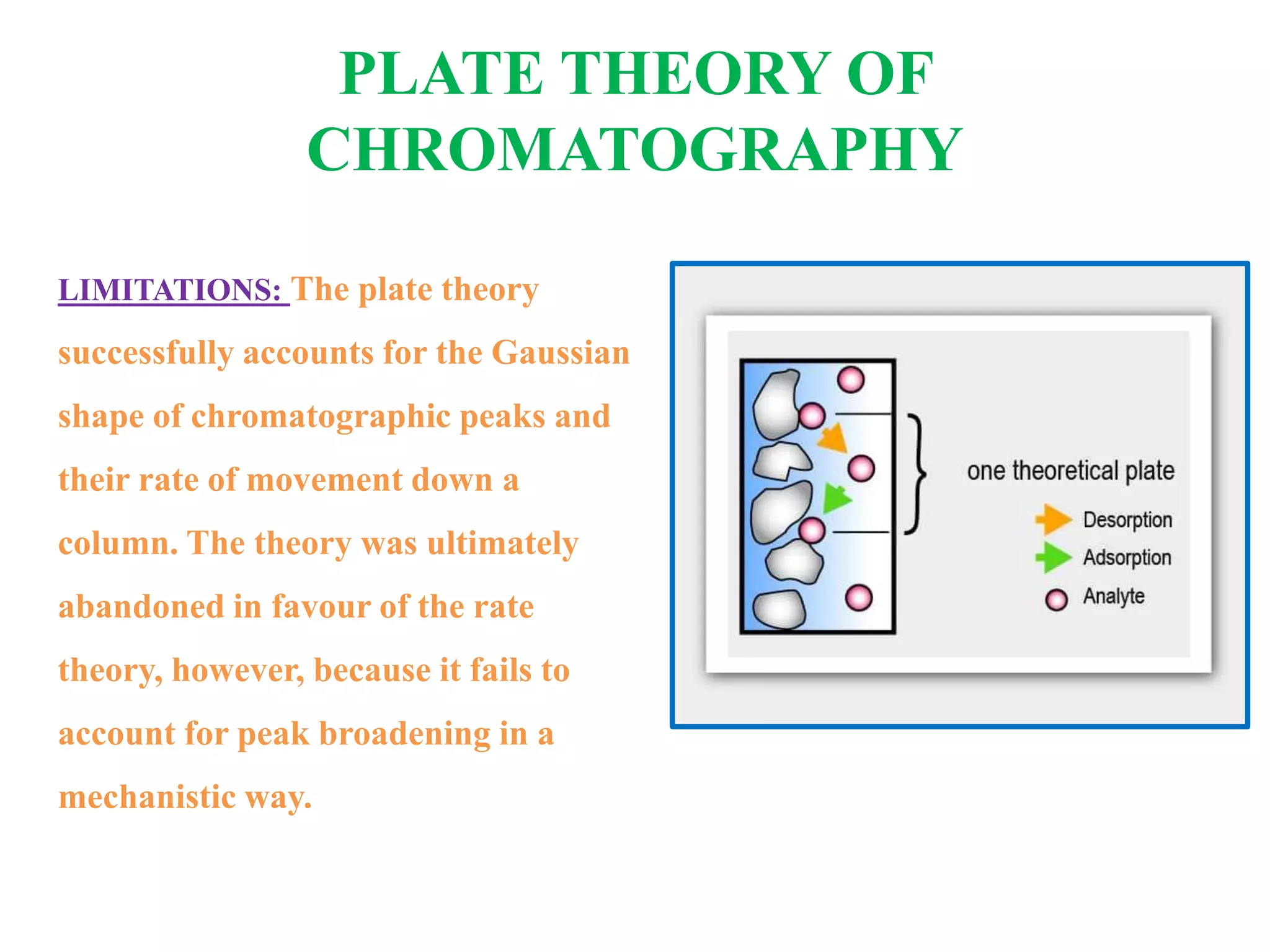
 The column is considered to be divided into a number of cells or plates.
Each plate is allotted a specific length and, thus, the solute will spend a
finite time in each plate.
 The size of the cell is chosen to provide sufficient residence time for the
solute to establish equilibrium with the two phases. Thus, the smaller the
plate, the faster will equilibrium and the more plates there will be in the
column.
 Consequently, the number of theoretical plates contained in a column
will be directly related to the equilibrium rate and, for this reason, has been
termed the column efficiency.
PLATE THEORY OF
CHROMATOGRAPHY
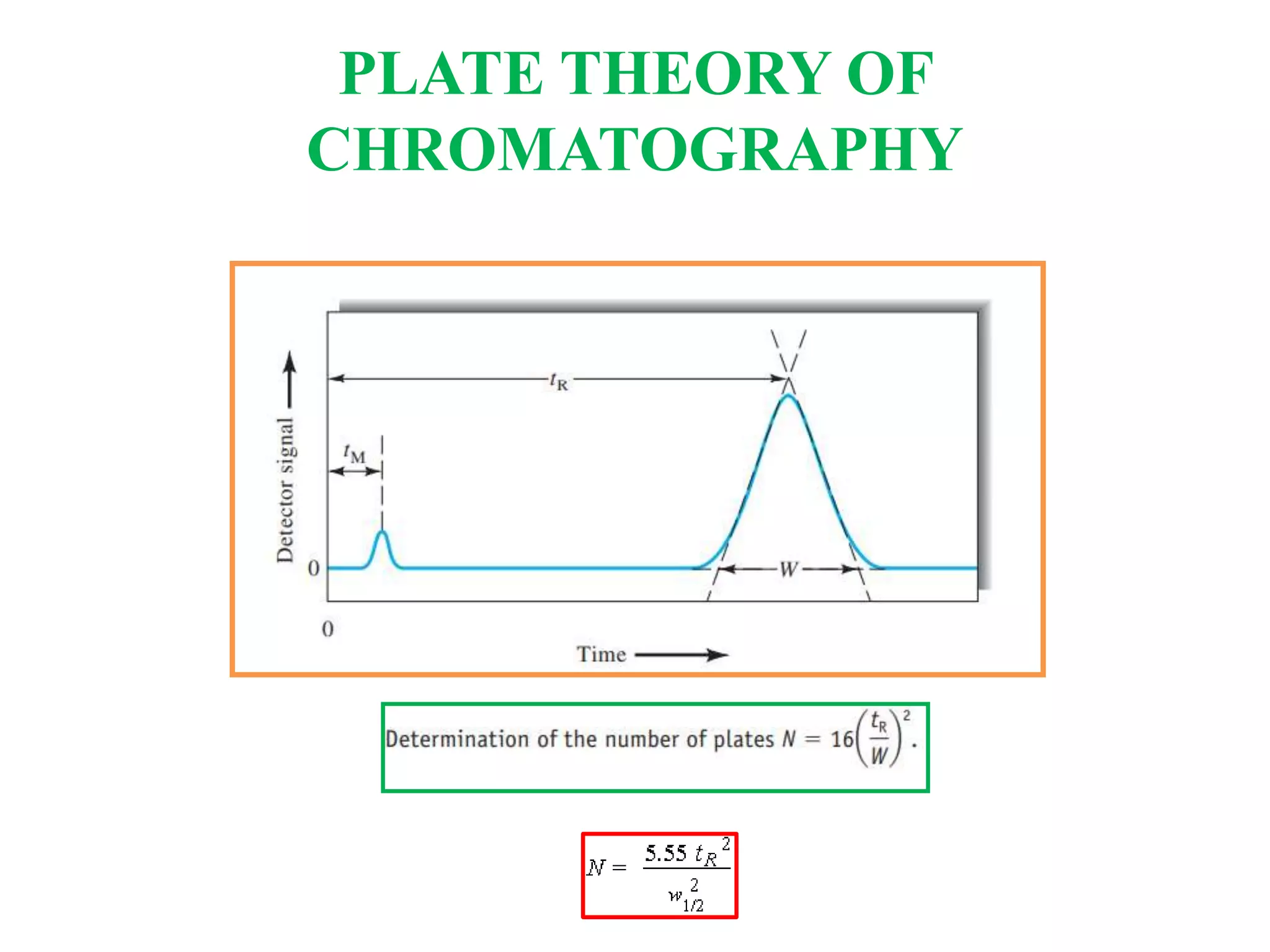
Plate height H and plate count, or number of
theoretical plates, N. The two are related by
the equation
Plate HeightPlate Count/
Number of Theoretical Plates
Length of
Column
The efficiency of chromatographic columns increases as the plate count N
becomes greater and as the plate height H becomes smaller
PLATE THEORY OF
CHROMATOGRAPHY
PLATE THEORY OF
CHROMATOGRAPHY
PLATE THEORY OF
CHROMATOGRAPHY
PLATE THEORY OF
CHROMATOGRAPHY
PLATE THEORY OF
CHROMATOGRAPHY
PLATE THEORY OF
CHROMATOGRAPHY
LIMITATIONS: The plate theory
successfully accounts for the Gaussian
shape of chromatographic peaks and
their rate of movement down a
column. The theory was ultimately
abandoned in favour of the rate
theory, however, because it fails to
account for peak broadening in a
mechanistic way.
PLATE THEORY OF
CHROMATOGRAPHY

Plate theory of Chromatography

  • 1.
    The Nobel Prizein Chemistry 1952 was awarded jointly to Archer John Porter Martin and Richard Laurence Millington Synge "for their invention of partition chromatography." Richard L.M. SyngeArcher J.P. Martin PLATE THEORY OF CHROMATOGRAPHY
  • 2.
    Nernst Distribution law: “Atconstant temperature, a solute distributes itself between two immiscible solvents only in a particular ratio” KD = [X]SolventA [X]SolventBPartition Coefficient PLATE THEORY OF CHROMATOGRAPHY
  • 3.
  • 4.
     The platetheory assumes that the solute, during its passage through the column, is always in equilibrium with the mobile and stationary phases.  The column is considered to be divided into a number of cells or plates. Each plate is allotted a specific length and, thus, the solute will spend a finite time in each plate.  The size of the cell is chosen to provide sufficient residence time for the solute to establish equilibrium with the two phases. Thus, the smaller the plate, the faster will equilibrium and the more plates there will be in the column.  Consequently, the number of theoretical plates contained in a column will be directly related to the equilibrium rate and, for this reason, has been termed the column efficiency. PLATE THEORY OF CHROMATOGRAPHY
  • 5.
    Plate height Hand plate count, or number of theoretical plates, N. The two are related by the equation Plate HeightPlate Count/ Number of Theoretical Plates Length of Column The efficiency of chromatographic columns increases as the plate count N becomes greater and as the plate height H becomes smaller PLATE THEORY OF CHROMATOGRAPHY
  • 6.
  • 7.
  • 8.
  • 9.
  • 10.
  • 11.
    LIMITATIONS: The platetheory successfully accounts for the Gaussian shape of chromatographic peaks and their rate of movement down a column. The theory was ultimately abandoned in favour of the rate theory, however, because it fails to account for peak broadening in a mechanistic way. PLATE THEORY OF CHROMATOGRAPHY