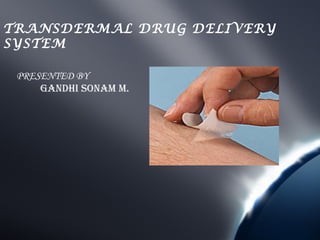
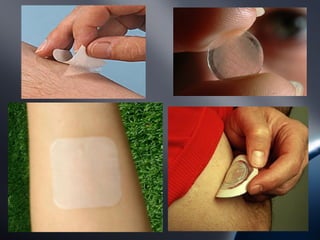




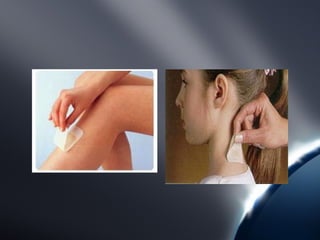

TRANSDERMAL DRUG DELIVERY
SYSTEM

 PRESENTED BY
     gandhi sonam m.
TRANSDERMAL DRUG DELIVERY
SYSTEM

DEFINITION:


       Transdermal      therapeutic   system   are   defined   as   self-
contained discrete dosage form which when applied to the intact
skin deliver the drugs, through the skin, at a controlled rate to the
systemic circulation.
                             OR
Transdermal drug delivery         systems (TDDS) are systems that
utilize skin as a site for continuous drug administration into the
systemic circulation
ADVANTAGES

Transdermal delivery can increase the therapeutic value of many
drugs by avoiding specification due to hepatic “First pass” effect,
formation of metabolites that causes side effects, short half life
necessitating frequent dosing etc.
Self administration is possible with these system.
The drug input can be terminated at any point of time by removing
transdermal patch.
Allows effective use of drugs with short biological half-life
Allow administration of drugs with narrow therapeutic window
Provides controlled plasma level of very potent drugs
Drug input can be promptly interrupted when toxicity occurs
DISADVANTAGES:

The barrier function of the skin changes from one site to another on the
same person or person to person and with age.


Drug that require high blood levels cannot be administered
Adhesive may not adhere well to all types of skin


Drug or drug formulation may cause skin irritation or sensitization


Uncomfortable to wear


May not be economical.
Skin as site for drug administration

   epidermis-
   Dermis
   Hypodermis
PERMEATION THROUGH SKIN
. mechanism of permeation can involve passage through the epidermis
The
itself (transepidermal absorption) or diffusion shunts.


TRANSEPIDRERMAL ABSORPTION
       It is now believe that the transdermal pathway is principally
responsible for diffusion across the skin. The main resistance encountered
along this pathway arises in the stratum corneum. Permeation by the
transepidermal route first involves partitioning into the        stratum
corneum. Diffusion then takes place across this tissue.
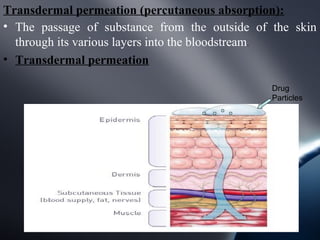
Transdermal permeation (percutaneous absorption):
• The passage of substance from the outside of the skin
  through its various layers into the bloodstream.
• Transdermal permeation

                                               Drug
                                               Particles
Kinetics of transdermal permeation

       Knowledge of skin permeation kinetics is vital to the successful
development    of   transdermal    therapeutic       systems.   Transdermal
permeation of a drug involves the following steps.


Sorption by stratum corneum,


Penetration of drug through viable epidermis,


Uptake of the drug by capillary network in the dermal papillary layer.
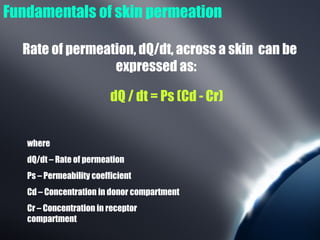
Fundamentals of skin permeation

  Rate of permeation, dQ/dt, across a skin can be
                 expressed as:

                          dQ / dt = Ps (Cd - Cr)


   where
   dQ/dt – Rate of permeation
   Ps – Permeability coefficient
   Cd – Concentration in donor compartment
   Cr – Concentration in receptor
   compartment
.
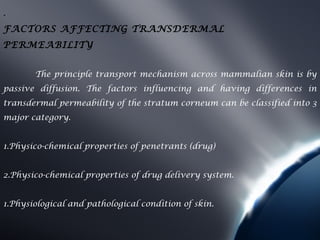
FACTORS AFFECTING TRANSDERMAL
PERMEABILITY


       The principle transport mechanism across mammalian skin is by
passive diffusion. The factors influencing and having differences in
transdermal permeability of the stratum corneum can be classified into 3
major category.


1.Physico-chemical properties of penetrants (drug)


2.Physico-chemical properties of drug delivery system.


1.Physiological and pathological condition of skin.
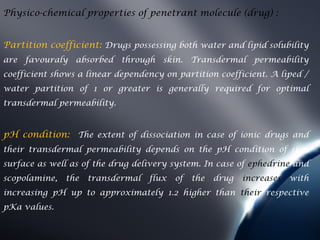
Physico-chemical properties of penetrant molecule (drug) :


Partition coefficient: Drugs possessing both water and lipid solubility
are favouraly absorbed through        skin. Transdermal permeability
coefficient shows a linear dependency on partition coefficient. A liped /
water partition of 1 or greater is generally required for optimal
transdermal permeability.


pH condition: The extent of dissociation in case of ionic drugs and
their transdermal permeability depends on the pH condition of skin
surface as well as of the drug delivery system. In case of ephedrine and
scopolamine,   the   transdermal   flux   of   the   drug   increases   with
increasing pH up to approximately 1.2 higher than their respective
pKa values.
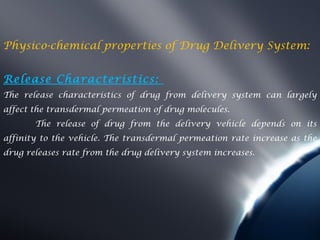
Physico-chemical properties of Drug Delivery System:


Release Characteristics:
The release characteristics of drug from delivery system can largely
affect the transdermal permeation of drug molecules.
       The release of drug from the delivery vehicle depends on its
affinity to the vehicle. The transdermal permeation rate increase as the
drug releases rate from the drug delivery system increases.
Composition of drug delivery system: (vehicle)
Composition may not affect the rate of drug release, but affect the
permeability of the stratum corneum by means of hydration, mixing
with skin lipids.
Eg: Salicylic acid and its methyesters, methyl salicylate is more lipophilic
then its parent acid and when applied to skin from fatty vehicle, they
methyl salicylate yielded a higher percutaneous absorption then salicylic
acid.


Incorporation of transdermal permeation:
Like     dymethyl       sulphoxide,     acetone,      propylene       glycol,
tetradihydrofurfuryl    alcohol,   dimethyl   sulphoxide   etc   in   typical
formulation increases drug permeation.
Physiological & pathological condition of skin:

Presence of hair follicle: Absorption is rapid where more hair follicles
present eg: scalp.


Thickness of stratum corneum: Absorption is low from region as foot and
palm.


Trauma: cut inflammation, rashes, mild burn where stratum corneum is
destroyed, promote drug absorption.


Hydration of skin: Soaking skin in H2O, plastic film, dressing promote
hydration of skin and drug absorption increase.


Age: Aged skin more prone to allergy and irritant effect, of topically
contacted drug infant particularly concerned.
Grooming: the frequency and vigor with which one bathes and
type of soap that is used also contributes variability in drug
absorption.


Chronic use of certain drug: long term use of keratolytics like
salicylic acid results in increased drug penetration.


Skin temperature: increase temperature increase absorption
because of increase vasodilatation of skin vessels eg: 10 fold
increase skin permeation of aspirin and glucostroids was noticed
when the environmental temperature increase from 10-51 C.
BASIC COMPONENTS OF TRANSDERMAL DRUG
DELIVERY SYSTEMS:


The components of transdermal devices include:
Polymer matrix or matrices
The drug
Permeation enhancers
Other excipients
Polymer matrix or matrices
The polymer controls the release of the drug from the device.
Ideal properties of polymers for transdermal drug delivery
system.
The polymer should be stable, non-reactive with the drug,
easily manufactured and fabricated into the desired product;
and inexpensive.
The polymer and its degradation products must be non-toxic
or non-antagonistic to the host.
The mechanical properties of the polymer should not
deteriorate excessively when large amounts of active agent
are incorporated into it.
Possible useful polymers for transdermal devices are:

Natural polymers:


Synthetic Elastomers:


Synthetic Polymers:
Drug
Desired properties of drug for transdermal drug delivery systems are

Physicochemical properties,biological properities

penetration enhancer are:
The material should be pharmacologically inert.
It   should    be non-toxic,        non-irritating       and    non-
allergenic.
The action should be immediate and the effect should
be suitable and predictable.
Upon removal of the material, the skin should immediately and
fully recover its normal barrier property.
The enhancer should not cause loss of body fluids, electrolytes or
other endogenous materials.
It should be compatible with all drugs and excipients.
The substance should be a good solvent for drugs.
The material should be cosmetically acceptable (good spread ability
and skin ‘feel’).
The chemical should formulate into all the variety of preparations
used topically.
It should be odourless, tasteless, colourless and inexpensive
Solvents:
       Water     is   well-recognized   in   the   dermatological   field   that
promotes the topical pharmacological effect of a number drugs (e.g.,
steroids). The mechanism of action is suggested to involve hydration of
keratin and intracellular lipids however, recent infrared and x-ray
experiments show that increasing the hydration of stratum corneum
does not increase lipid chain disorder or the interlamellar spacing.
Alcohol and ethanol, in particular, have been proposed as effective
permeation enhancers.


Examples:
Acetamide and derivatives, acetone, dimethyl acetamide, dimethyl
formamide, ethanol, ethanol / glycerol, polyethylene glycon, span-20,
tween-80, etc.
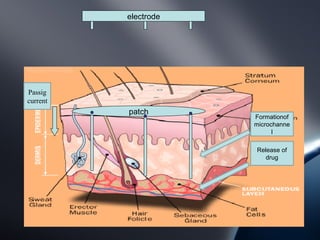
electrode


Passig
current
          patch
                      Formationof
                      microchanne
                            l

                      Release of
                         drug
Evaluation of TDDS
Evaluation of adhesive:
Pressure sensitive adhesives are evaluated for following
properties.


Peel adhesion properties:-


       Peel adhesion is the force required to remove an adhesive coating
from a test substrate. It is important in transdermal device because the
adhesive should not damage the skin on removal. peel adhesion
properties are affected by the molecules weight of the adhesive polymer,
the type and amount of additives, and polymer composition.
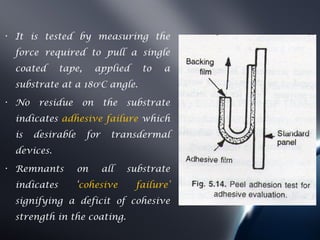
• It is tested by measuring the
  force required to pull a single
  coated      tape,        applied    to   a
  substrate at a 1800C angle.
• No    residue       on    the   substrate
  indicates adhesive failure which
  is   desirable      for     transdermal
  devices.
• Remnants         on       all   substrate
  indicates        ‘cohesive         failure’
  signifying a deficit of cohesive
  strength in the coating.
Shear Strength properties:
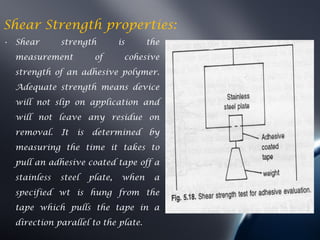
• Shear       strength           is      the
  measurement            of       cohesive
  strength of an adhesive polymer.
  Adequate strength means device
  will not slip on application and
  will not leave any residue on
  removal.    It   is   determined       by
  measuring the time it takes to
  pull an adhesive coated tape off a
  stainless   steel     plate,    when    a
  specified wt is hung from the
  tape which pulls the tape in a
  direction parallel to the plate.
In vitro drug release evaluation:
1.In   vitro permeation kinetics studies can be performed on hairless
mouse skin or human cadaver skin by using franz diffusion cell or two
reservoir diffusion cell.


2.In two reservoir diffusion cells, sink conditions can be maintained.


3.The permeation of nitroglycerins across human cadaver and hairless
mouse skin from different Transdermal Drug Delivery therapeutic
system was compared for their kinetics.


4.It was noted that the rates of skin permeation generated from the
excised skins of hairless mouse agree fairly with the date obtained from
human cadaver skin, suggesting that hairless mouse skin could be an
acceptable animal modes for human skin permeation kinetics studies.
Franz diffusion cell

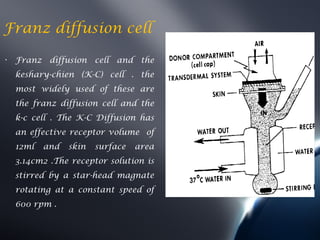
• Franz diffusion cell and the
  keshary-chien (K-C) cell . the
  most widely used of these are
  the franz diffusion cell and the
  k-c cell . The K-C Diffusion has
  an effective receptor volume of
  12ml   and   skin   surface   area
  3.14cm2 .The receptor solution is
  stirred by a star-head magnate
  rotating at a constant speed of
  600 rpm .
In-vivo evaluation:
AnimAl model:

In vivo animal models are preferred because considerable time and
resource are required to carry out studies in human. Some of the animal
are used to in vivo studies are mouse, rat, guinea pig, rabbit, hairless
mouse, hairless rat, hairless dog, cat, dog, miniature pig, pig, horse, goat,
squirrel, monkey. Etc.
Human model:
The final stage in the development of transdermal device involves the
collection of pharmacokinetic and pharmacodynamic data following
application of the device to human volunteers.
Determination of absorption following topical administration requires
the investigator to know the amount of radioactivity retained in the
body, or excreted by routs not monitored (assayed).
This necessitates measurement of elimination following parenteral
(ideally i.v.) administration of the compound


The percentage of dose absorbed transdermally is then calculated as
% dose absorbed =Total radioactivity excreted after topical administration
                   Total radioactivity excreted after I.v administration   .100
ConClusion

TDDS offers number of advantages to patient
TDDS offers scope for companies in terms of revenue
Importantly, newer advances in transdermal technology
including microporation provides a means for delivering
proteins and peptides
References
• B. Decadt and A.K. Siriwardena, "Radiofrequency Ablation of
  Liver Tumors: A Systematic Review," Lancet Oncol.5 (9),
  550–560 (2004).
• A. Hines-Peralta and S.N. Goldberg, "Review of
  Radiofrequency Ablation for Renal Cell Carcinoma," Clin.
  Cancer Res. 10 , 6328S–6334S (2004).
• S. Nahum Goldberg, "Radiofrequency Tumor Ablation:
  Principles and Techniques," Eur. J. Ultrasound 13 (2), 129–
  147 (2001).
• L. Solbiati et al., "Radiofrequency Thermal Ablation of
  Hepatic Metastases," Eur. J. Ultrasound, 13 (2), 149–158
  (2001).
• F.J. McGovern et al., "Radiofrequency Ablation of Renal Cell
  Carcinoma via Image Guided Needle Electrodes," J. Urol. 161
  (2), 599–600 (1999).
Thank you

Transdermal drug delivery systems

  • 1.
    TRANSDERMAL DRUG DELIVERY SYSTEM PRESENTED BY gandhi sonam m.
  • 2.
    TRANSDERMAL DRUG DELIVERY SYSTEM DEFINITION: Transdermal therapeutic system are defined as self- contained discrete dosage form which when applied to the intact skin deliver the drugs, through the skin, at a controlled rate to the systemic circulation. OR Transdermal drug delivery systems (TDDS) are systems that utilize skin as a site for continuous drug administration into the systemic circulation
  • 3.
    ADVANTAGES Transdermal delivery canincrease the therapeutic value of many drugs by avoiding specification due to hepatic “First pass” effect, formation of metabolites that causes side effects, short half life necessitating frequent dosing etc. Self administration is possible with these system. The drug input can be terminated at any point of time by removing transdermal patch. Allows effective use of drugs with short biological half-life Allow administration of drugs with narrow therapeutic window Provides controlled plasma level of very potent drugs Drug input can be promptly interrupted when toxicity occurs
  • 4.
    DISADVANTAGES: The barrier functionof the skin changes from one site to another on the same person or person to person and with age. Drug that require high blood levels cannot be administered Adhesive may not adhere well to all types of skin Drug or drug formulation may cause skin irritation or sensitization Uncomfortable to wear May not be economical.
  • 6.
    Skin as sitefor drug administration  epidermis-  Dermis  Hypodermis
  • 7.
    PERMEATION THROUGH SKIN .mechanism of permeation can involve passage through the epidermis The itself (transepidermal absorption) or diffusion shunts. TRANSEPIDRERMAL ABSORPTION It is now believe that the transdermal pathway is principally responsible for diffusion across the skin. The main resistance encountered along this pathway arises in the stratum corneum. Permeation by the transepidermal route first involves partitioning into the stratum corneum. Diffusion then takes place across this tissue.
  • 8.
    Transdermal permeation (percutaneousabsorption): • The passage of substance from the outside of the skin through its various layers into the bloodstream. • Transdermal permeation Drug Particles
  • 9.
    Kinetics of transdermalpermeation Knowledge of skin permeation kinetics is vital to the successful development of transdermal therapeutic systems. Transdermal permeation of a drug involves the following steps. Sorption by stratum corneum, Penetration of drug through viable epidermis, Uptake of the drug by capillary network in the dermal papillary layer.
  • 10.
    Fundamentals of skinpermeation Rate of permeation, dQ/dt, across a skin can be expressed as: dQ / dt = Ps (Cd - Cr) where dQ/dt – Rate of permeation Ps – Permeability coefficient Cd – Concentration in donor compartment Cr – Concentration in receptor compartment
  • 11.
    . FACTORS AFFECTING TRANSDERMAL PERMEABILITY The principle transport mechanism across mammalian skin is by passive diffusion. The factors influencing and having differences in transdermal permeability of the stratum corneum can be classified into 3 major category. 1.Physico-chemical properties of penetrants (drug) 2.Physico-chemical properties of drug delivery system. 1.Physiological and pathological condition of skin.
  • 12.
    Physico-chemical properties ofpenetrant molecule (drug) : Partition coefficient: Drugs possessing both water and lipid solubility are favouraly absorbed through skin. Transdermal permeability coefficient shows a linear dependency on partition coefficient. A liped / water partition of 1 or greater is generally required for optimal transdermal permeability. pH condition: The extent of dissociation in case of ionic drugs and their transdermal permeability depends on the pH condition of skin surface as well as of the drug delivery system. In case of ephedrine and scopolamine, the transdermal flux of the drug increases with increasing pH up to approximately 1.2 higher than their respective pKa values.
  • 13.
    Physico-chemical properties ofDrug Delivery System: Release Characteristics: The release characteristics of drug from delivery system can largely affect the transdermal permeation of drug molecules. The release of drug from the delivery vehicle depends on its affinity to the vehicle. The transdermal permeation rate increase as the drug releases rate from the drug delivery system increases.
  • 14.
    Composition of drugdelivery system: (vehicle) Composition may not affect the rate of drug release, but affect the permeability of the stratum corneum by means of hydration, mixing with skin lipids. Eg: Salicylic acid and its methyesters, methyl salicylate is more lipophilic then its parent acid and when applied to skin from fatty vehicle, they methyl salicylate yielded a higher percutaneous absorption then salicylic acid. Incorporation of transdermal permeation: Like dymethyl sulphoxide, acetone, propylene glycol, tetradihydrofurfuryl alcohol, dimethyl sulphoxide etc in typical formulation increases drug permeation.
  • 15.
    Physiological & pathologicalcondition of skin: Presence of hair follicle: Absorption is rapid where more hair follicles present eg: scalp. Thickness of stratum corneum: Absorption is low from region as foot and palm. Trauma: cut inflammation, rashes, mild burn where stratum corneum is destroyed, promote drug absorption. Hydration of skin: Soaking skin in H2O, plastic film, dressing promote hydration of skin and drug absorption increase. Age: Aged skin more prone to allergy and irritant effect, of topically contacted drug infant particularly concerned.
  • 16.
    Grooming: the frequencyand vigor with which one bathes and type of soap that is used also contributes variability in drug absorption. Chronic use of certain drug: long term use of keratolytics like salicylic acid results in increased drug penetration. Skin temperature: increase temperature increase absorption because of increase vasodilatation of skin vessels eg: 10 fold increase skin permeation of aspirin and glucostroids was noticed when the environmental temperature increase from 10-51 C.
  • 17.
    BASIC COMPONENTS OFTRANSDERMAL DRUG DELIVERY SYSTEMS: The components of transdermal devices include: Polymer matrix or matrices The drug Permeation enhancers Other excipients
  • 18.
    Polymer matrix ormatrices The polymer controls the release of the drug from the device. Ideal properties of polymers for transdermal drug delivery system. The polymer should be stable, non-reactive with the drug, easily manufactured and fabricated into the desired product; and inexpensive. The polymer and its degradation products must be non-toxic or non-antagonistic to the host. The mechanical properties of the polymer should not deteriorate excessively when large amounts of active agent are incorporated into it.
  • 19.
    Possible useful polymersfor transdermal devices are: Natural polymers: Synthetic Elastomers: Synthetic Polymers:
  • 20.
    Drug Desired properties ofdrug for transdermal drug delivery systems are Physicochemical properties,biological properities penetration enhancer are: The material should be pharmacologically inert. It should be non-toxic, non-irritating and non- allergenic. The action should be immediate and the effect should be suitable and predictable.
  • 21.
    Upon removal ofthe material, the skin should immediately and fully recover its normal barrier property. The enhancer should not cause loss of body fluids, electrolytes or other endogenous materials. It should be compatible with all drugs and excipients. The substance should be a good solvent for drugs. The material should be cosmetically acceptable (good spread ability and skin ‘feel’). The chemical should formulate into all the variety of preparations used topically. It should be odourless, tasteless, colourless and inexpensive
  • 22.
    Solvents: Water is well-recognized in the dermatological field that promotes the topical pharmacological effect of a number drugs (e.g., steroids). The mechanism of action is suggested to involve hydration of keratin and intracellular lipids however, recent infrared and x-ray experiments show that increasing the hydration of stratum corneum does not increase lipid chain disorder or the interlamellar spacing. Alcohol and ethanol, in particular, have been proposed as effective permeation enhancers. Examples: Acetamide and derivatives, acetone, dimethyl acetamide, dimethyl formamide, ethanol, ethanol / glycerol, polyethylene glycon, span-20, tween-80, etc.
  • 23.
    electrode Passig current patch Formationof microchanne l Release of drug
  • 24.
  • 25.
    Evaluation of adhesive: Pressuresensitive adhesives are evaluated for following properties. Peel adhesion properties:- Peel adhesion is the force required to remove an adhesive coating from a test substrate. It is important in transdermal device because the adhesive should not damage the skin on removal. peel adhesion properties are affected by the molecules weight of the adhesive polymer, the type and amount of additives, and polymer composition.
  • 26.
    • It istested by measuring the force required to pull a single coated tape, applied to a substrate at a 1800C angle. • No residue on the substrate indicates adhesive failure which is desirable for transdermal devices. • Remnants on all substrate indicates ‘cohesive failure’ signifying a deficit of cohesive strength in the coating.
  • 27.
    Shear Strength properties: •Shear strength is the measurement of cohesive strength of an adhesive polymer. Adequate strength means device will not slip on application and will not leave any residue on removal. It is determined by measuring the time it takes to pull an adhesive coated tape off a stainless steel plate, when a specified wt is hung from the tape which pulls the tape in a direction parallel to the plate.
  • 28.
    In vitro drugrelease evaluation: 1.In vitro permeation kinetics studies can be performed on hairless mouse skin or human cadaver skin by using franz diffusion cell or two reservoir diffusion cell. 2.In two reservoir diffusion cells, sink conditions can be maintained. 3.The permeation of nitroglycerins across human cadaver and hairless mouse skin from different Transdermal Drug Delivery therapeutic system was compared for their kinetics. 4.It was noted that the rates of skin permeation generated from the excised skins of hairless mouse agree fairly with the date obtained from human cadaver skin, suggesting that hairless mouse skin could be an acceptable animal modes for human skin permeation kinetics studies.
  • 29.
    Franz diffusion cell •Franz diffusion cell and the keshary-chien (K-C) cell . the most widely used of these are the franz diffusion cell and the k-c cell . The K-C Diffusion has an effective receptor volume of 12ml and skin surface area 3.14cm2 .The receptor solution is stirred by a star-head magnate rotating at a constant speed of 600 rpm .
  • 30.
    In-vivo evaluation: AnimAl model: Invivo animal models are preferred because considerable time and resource are required to carry out studies in human. Some of the animal are used to in vivo studies are mouse, rat, guinea pig, rabbit, hairless mouse, hairless rat, hairless dog, cat, dog, miniature pig, pig, horse, goat, squirrel, monkey. Etc.
  • 31.
    Human model: The finalstage in the development of transdermal device involves the collection of pharmacokinetic and pharmacodynamic data following application of the device to human volunteers. Determination of absorption following topical administration requires the investigator to know the amount of radioactivity retained in the body, or excreted by routs not monitored (assayed). This necessitates measurement of elimination following parenteral (ideally i.v.) administration of the compound The percentage of dose absorbed transdermally is then calculated as % dose absorbed =Total radioactivity excreted after topical administration Total radioactivity excreted after I.v administration .100
  • 32.
    ConClusion TDDS offers numberof advantages to patient TDDS offers scope for companies in terms of revenue Importantly, newer advances in transdermal technology including microporation provides a means for delivering proteins and peptides
  • 34.
    References • B. Decadtand A.K. Siriwardena, "Radiofrequency Ablation of Liver Tumors: A Systematic Review," Lancet Oncol.5 (9), 550–560 (2004). • A. Hines-Peralta and S.N. Goldberg, "Review of Radiofrequency Ablation for Renal Cell Carcinoma," Clin. Cancer Res. 10 , 6328S–6334S (2004). • S. Nahum Goldberg, "Radiofrequency Tumor Ablation: Principles and Techniques," Eur. J. Ultrasound 13 (2), 129– 147 (2001). • L. Solbiati et al., "Radiofrequency Thermal Ablation of Hepatic Metastases," Eur. J. Ultrasound, 13 (2), 149–158 (2001). • F.J. McGovern et al., "Radiofrequency Ablation of Renal Cell Carcinoma via Image Guided Needle Electrodes," J. Urol. 161 (2), 599–600 (1999).
  • 35.