1
Controlled release

• To achieve prolong therapeutic effect.
• Implies predictability in drug release kinetics.
• Deliver the drug at pre determined rate, locally
 or systematically.


                                                     2
Advantages
•   Improve patient convenience.
•   Reduction in fluctuation in steady state level.
•   Increase the safety margin of high potency drug.
•   Reduction in total health care cost.


                                                       3
Disadvantages
•   Decrease systemic availability.
•   Poor invitro – invivo correlation.
•   Increased risk of toxicity.
•   Retrieval of drug is difficult in case of toxicity ,
    poisoning or hyper sensitivity reaction.


                                                           4
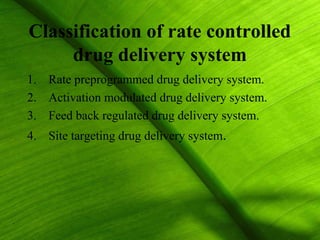
Classification of rate controlled
     drug delivery system
1. Rate preprogrammed drug delivery system.
2. Activation modulated drug delivery system.
3. Feed back regulated drug delivery system.
4. Site targeting drug delivery system.


                                                5
Rate preprogrammed drug
     delivery system


                          6
7
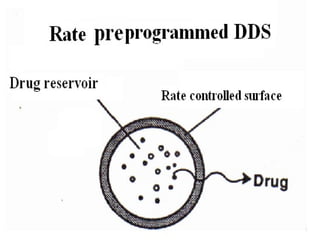
Rate programmed DDS
• The release of drug molecules from delivery system has
  been programmed at specific rate profile.

• It control molecular diffusion of drug molecules in or
  across barrier medium within or surrounding the delivery
  system.


                                                           8
These system can be further classified as
                     follow
1.   Polymer membrane permeation CDDS.
2.   Polymer matrix diffusion CDDS.
3.   Micro reservoir partition CDDS.


                                                 9
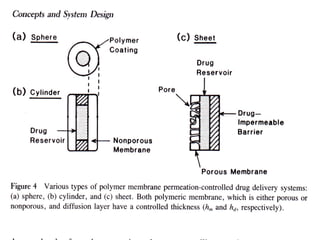
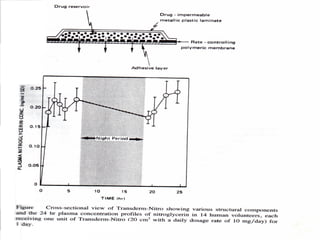
1. Polymer membrane permeation CDDS

• Drug formulation totally or partially encapsulated within
  drug reservoir compartment.
• Its drug release surface is covered by a rate controlling
  polymeric membrane.
• The encapsulation of drug formulation is carried out by
  spray coating, micro encapsulation or other technique.


                                                              10
11
12
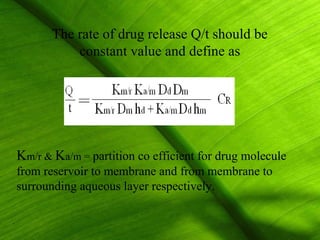
The rate of drug release Q/t should be
           constant value and define as


Km/r & Ka/m = partition co efficient for drug molecule
from reservoir to membrane and from membrane to
surrounding aqueous layer respectively.

                                                         13
Dd & Dm =Diffusion coefficient in the aqueous
            diffusion layer and in the rate
            controlling membrane respectively.
CR = drug concentration in reservoir compartment.


                                                    14
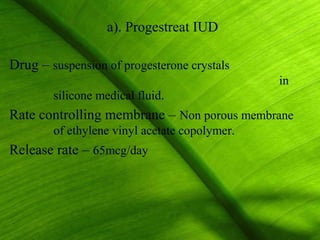
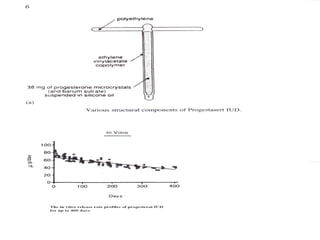
a). Progestreat IUD

Drug – suspension of progesterone crystals
                                               in
        silicone medical fluid.
Rate controlling membrane – Non porous membrane
        of ethylene vinyl acetate copolymer.
Release rate – 65mcg/day


                                                15
16
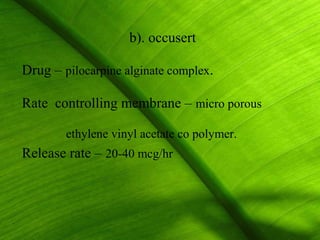
b). occusert

Drug – pilocarpine alginate complex.

Rate controlling membrane – micro porous

        ethylene vinyl acetate co polymer.
Release rate – 20-40 mcg/hr


                                             17
18
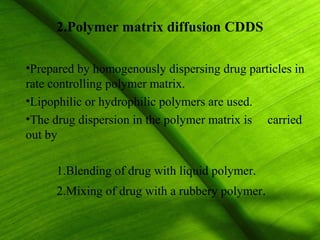
2.Polymer matrix diffusion CDDS

•Prepared by homogenously dispersing drug particles in
rate controlling polymer matrix.
•Lipophilic or hydrophilic polymers are used.
•The drug dispersion in the polymer matrix is carried
out by

     1.Blending of drug with liquid polymer.
     2.Mixing of drug with a rubbery polymer.

                                                  19
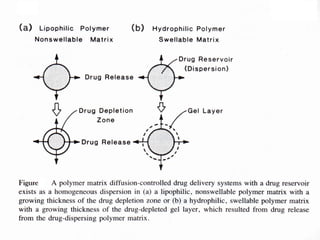
Drug release from polymer matrix carried out
       as a homogenous dispersion in


a). Lipophilic, nonswellable polymer matrix.
b). Hydrophilic, swellable polymer matrix.


                                               20
21
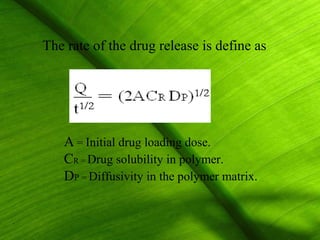
The rate of the drug release is define as


   A = Initial drug loading dose.
   CR = Drug solubility in polymer.
   DP = Diffusivity in the polymer matrix.


                                             22
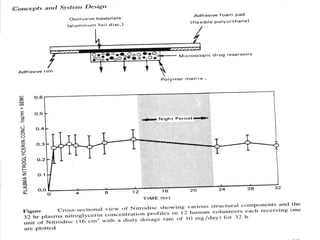
a). Nitro - Dur

•   Nitroglycerin containing matrix system.
•   It is fabricated by first heating in a aqueous solution
    of aqueous soluble polymer, glycerol and poly vinyl
    alcohol.
•   The temperature of solution is gradually lowered and
    nitroglycerin and lactose triturate are disperse just
    above the congealing temperature of solution.
•   The mixture is solidified in a mold at or below room
    temperature and than sliced to form a medicated
    polymer disc.
                                                       23
24
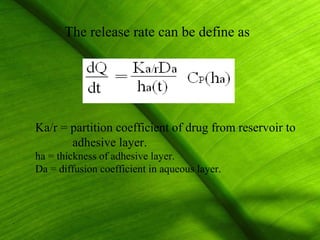
The release rate can be define as


Ka/r = partition coefficient of drug from reservoir to
       adhesive layer.
ha = thickness of adhesive layer.
Da = diffusion coefficient in aqueous layer.


                                                    25
26
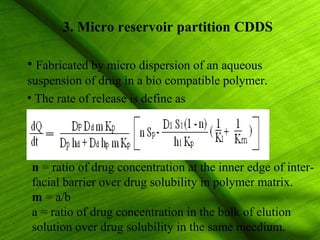
3. Micro reservoir partition CDDS

• Fabricated by micro dispersion of an aqueous
suspension of drug in a bio compatible polymer.
• The rate of release is define as


n = ratio of drug concentration at the inner edge of inter-
facial barrier over drug solubility in polymer matrix.
m = a/b
a = ratio of drug concentration in the bulk of elution
solution over drug solubility in the same mecdium. 27
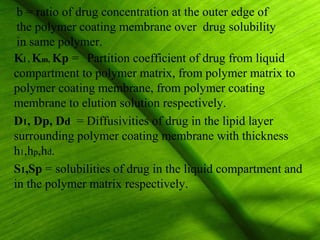
b = ratio of drug concentration at the outer edge of
 the polymer coating membrane over drug solubility
 in same polymer.
Kl , Km, Kp = Partition coefficient of drug from liquid
compartment to polymer matrix, from polymer matrix to
polymer coating membrane, from polymer coating
membrane to elution solution respectively.
D1, Dp, Dd = Diffusivities of drug in the lipid layer
surrounding polymer coating membrane with thickness
h1,hp,hd.
S1,Sp = solubilities of drug in the liquid compartment and
in the polymer matrix respectively.


                                                      28
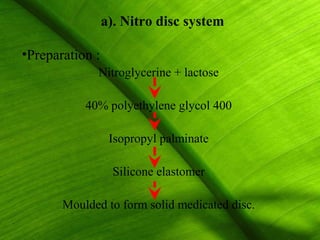
a). Nitro disc system

•Preparation :
             Nitroglycerine + lactose

           40% polyethylene glycol 400

                  Isopropyl palminate

                   Silicone elastomer

       Moulded to form solid medicated disc.
                                               29
30
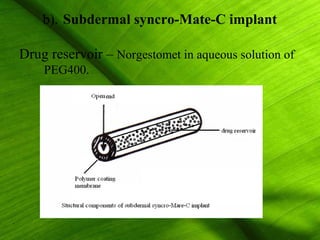
b). Subdermal syncro-Mate-C implant

Drug reservoir – Norgestomet in aqueous solution of
    PEG400.


                                                 31
Feedback regulated drug
    delivery system


                          32
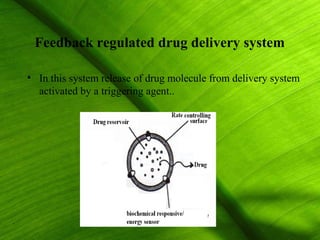
Feedback regulated drug delivery system

• In this system release of drug molecule from delivery system
  activated by a triggering agent..


                                                           33
Feedback regulated DDS is classified as follow

         1.Bioerosion regulated DDS.
         2.Bioresponsive DDS.
         3.Self regulated DDS.


                                                 34
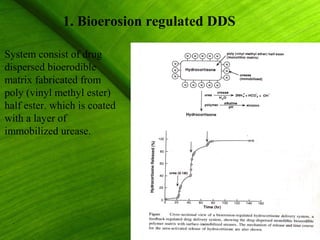
1. Bioerosion regulated DDS

System consist of drug
dispersed bioerodible
matrix fabricated from
poly (vinyl methyl ester)
half ester. which is coated
with a layer of
immobilized urease.


                                            35
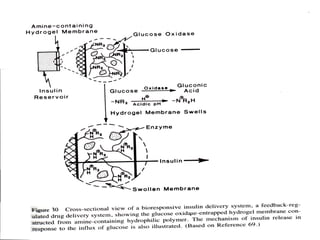
2. Bioresponsive DDS

In this system the drug reservoir is contained in a
device enclosed by a bio responsive polymeric
membrane whose drug permeability is controlled by
concentration of a bio chemical agent in the tissue
where the system is located.


                                                      36
37
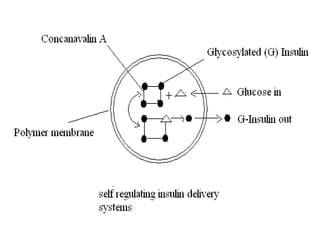
3. Self regulating DDS

• This system depend on a reversible and competitive binding
  mechanism to activate and to regulate the drug release.


                                                         38
39
References
• Biopharmaceutics And Pharmacokinetics
 - DM. Brahmankar, Sunil. B.Jaiswal.
• Novel drug delivery system
  Y.W.Chien
• Google.com


                                          40
41