Asad Rasheed
11-ARID-433
Type of Electron
Microscope
 Transmission Electron Microscope
 Scanning Electron Microscope
 Reflection Electron Microscope
 Low-Voltage Electron Microscope
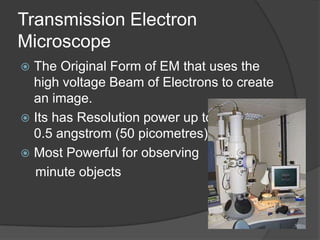
Transmission Electron
Microscope
 The Original Form of EM that uses the
high voltage Beam of Electrons to create
an image.
 Its has Resolution power up to
0.5 angstrom (50 picometres).
 Most Powerful for observing
minute objects
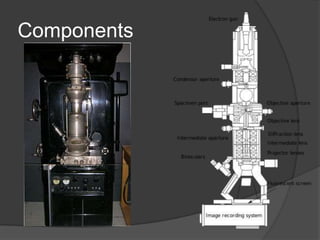
Components
Mechanism
 Electron Gun Produces Beam of 100 keV.
 Anode and Cathode accelerate Beam.
 Focusing occur by Electrostatic and
electromagnetic lenses
 Beam strikes the sample and pass through
it.
 After emerging out it carries information
about Sample and magnify it by objective
lens
 Information can be analyzed by Screen or
Film or CCD Cameras on LCD or monitor.
Advantages
 TEMs offer the most powerful
magnification, potentially over one million
times or more
 TEMs provide information on element and
compound structure
 Images are high-quality and detailed
 TEMs are able to yield information of
surface features, shape, size and structure
 They are easy to operate with proper
training
Limits of TEM
 Spherical Aberration.
 High Voltage can damage Sample.
 Sample should be xtremely thin upto 100
nm.
 Bio Samples are Dehydrated , chemically
fixed, embedded in polymer resin to
stabilize them.
 Staining is required to highlight in order to
achieve require image contrast.
 Thinning of sample should be done upto
100 nm
Scanning Electron Microscope
 SEM produces the image by scanning it
with focus beam of electron.
 Electrons interact with electrons in
sample and convey information in form
of signals to detectors. E.g. topography
& sample surface.
 SEM can achieve resolution better than
1 nanometer
 Raster image focusing is used
Mechanism
 When High energy Electrons strikes the
surface, it lose energy by diff.
mechanisms like heat, emission of low
energy secondary electrons and high
energy backscattered electrons.
 X-ray or light emerges from sample that
carries information on it.
Advantages
 Its basically used for biological samples
 It can scan the processes occurring on
surface and tells about topography and
composition.
 Enable us to view without thinning
dehydrating fixing the sample
 Can scan bulk samples upto 2-3 cm which
can not be examined by TEM.
 View obtained is in 3D.
 ESEM produce image of Wet, gas &
Vacuumed Samples and biological samples.
Reflection Electron Mcroscope
 Its is the fixation of Transmission and
Scanning Electron Microscope.
 Uses the Elastically Scattered Electrons
for focusing the electron beam into a
narrow spot which is scanned over the
sample in a raster.
 Raster is the rectangular pattern of
image capture and reconstruction in
television.
 TEM Sample forming processes are involved
like thinning.
 Highly contrasted mage is produces with
higher focusing
Difference
 Rastering of beam occurs by focusing on
rectangular area.
 In REM Focusing action occurs before the
beam strikes the sample but in TEM focusing
action occurs after the striking
 Also data is obtained in series image rather
in parallel image form.
Low-Voltage Electron
Mcroscope Microscope
 As the Name suggests that it uses low
voltage for scanning i.e. up to 5 KeV.
 Higher Contrasting focus and good quality
image are produces with good magnifying
power better then TEM.
 Pinpoint image are obtained on CCD
Camera.
 This type can be used as
TEM, SEM, STEM.
 No Staining Required
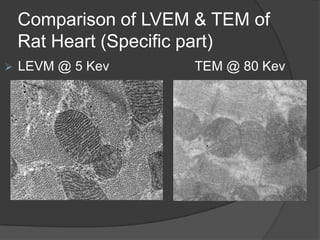
Comparison of LVEM & TEM of
Rat Heart (Specific part)
 LEVM @ 5 Kev TEM @ 80 Kev
Cont…
 Present low voltage electron
microscopes are capable of spatial
resolutions of about 2.5 nm in TEM
2.0 nm in STEM and 3.0 nm in SEM.
 Low voltage limits the maximum
thickness of samples
 It is about 100–200 nm in conventional
TEM.
 It decreases to around 20–65
nanometers for LVEM.
Thanks for being Patience

Types of electron microscope

  • 1.
  • 2.
    Type of Electron Microscope Transmission Electron Microscope  Scanning Electron Microscope  Reflection Electron Microscope  Low-Voltage Electron Microscope
  • 3.
    Transmission Electron Microscope  TheOriginal Form of EM that uses the high voltage Beam of Electrons to create an image.  Its has Resolution power up to 0.5 angstrom (50 picometres).  Most Powerful for observing minute objects
  • 4.
  • 5.
    Mechanism  Electron GunProduces Beam of 100 keV.  Anode and Cathode accelerate Beam.  Focusing occur by Electrostatic and electromagnetic lenses  Beam strikes the sample and pass through it.  After emerging out it carries information about Sample and magnify it by objective lens  Information can be analyzed by Screen or Film or CCD Cameras on LCD or monitor.
  • 6.
    Advantages  TEMs offerthe most powerful magnification, potentially over one million times or more  TEMs provide information on element and compound structure  Images are high-quality and detailed  TEMs are able to yield information of surface features, shape, size and structure  They are easy to operate with proper training
  • 7.
    Limits of TEM Spherical Aberration.  High Voltage can damage Sample.  Sample should be xtremely thin upto 100 nm.  Bio Samples are Dehydrated , chemically fixed, embedded in polymer resin to stabilize them.  Staining is required to highlight in order to achieve require image contrast.  Thinning of sample should be done upto 100 nm
  • 8.
    Scanning Electron Microscope SEM produces the image by scanning it with focus beam of electron.  Electrons interact with electrons in sample and convey information in form of signals to detectors. E.g. topography & sample surface.  SEM can achieve resolution better than 1 nanometer  Raster image focusing is used
  • 9.
    Mechanism  When Highenergy Electrons strikes the surface, it lose energy by diff. mechanisms like heat, emission of low energy secondary electrons and high energy backscattered electrons.  X-ray or light emerges from sample that carries information on it.
  • 10.
    Advantages  Its basicallyused for biological samples  It can scan the processes occurring on surface and tells about topography and composition.  Enable us to view without thinning dehydrating fixing the sample  Can scan bulk samples upto 2-3 cm which can not be examined by TEM.  View obtained is in 3D.  ESEM produce image of Wet, gas & Vacuumed Samples and biological samples.
  • 11.
    Reflection Electron Mcroscope Its is the fixation of Transmission and Scanning Electron Microscope.  Uses the Elastically Scattered Electrons for focusing the electron beam into a narrow spot which is scanned over the sample in a raster.  Raster is the rectangular pattern of image capture and reconstruction in television.
  • 12.
     TEM Sampleforming processes are involved like thinning.  Highly contrasted mage is produces with higher focusing Difference  Rastering of beam occurs by focusing on rectangular area.  In REM Focusing action occurs before the beam strikes the sample but in TEM focusing action occurs after the striking  Also data is obtained in series image rather in parallel image form.
  • 14.
    Low-Voltage Electron Mcroscope Microscope As the Name suggests that it uses low voltage for scanning i.e. up to 5 KeV.  Higher Contrasting focus and good quality image are produces with good magnifying power better then TEM.  Pinpoint image are obtained on CCD Camera.  This type can be used as TEM, SEM, STEM.  No Staining Required
  • 15.
    Comparison of LVEM& TEM of Rat Heart (Specific part)  LEVM @ 5 Kev TEM @ 80 Kev
  • 16.
    Cont…  Present lowvoltage electron microscopes are capable of spatial resolutions of about 2.5 nm in TEM 2.0 nm in STEM and 3.0 nm in SEM.  Low voltage limits the maximum thickness of samples  It is about 100–200 nm in conventional TEM.  It decreases to around 20–65 nanometers for LVEM.
  • 17.