
1
CLASSIFICATION

   Rate pre-programmed drug delivery systems

   Activation – modulated drug delivery systems

   Feedback- regulated drug delivery systems

   Site- targeting drug delivery systems


                                                   2
ACTIVATION MODULATED DDS
    Drug delivery is activated and controlled by physical,
     chemical or bio-chemical processes or facilitated by the
     energy supplied externally


Classification of activation modulated DDS
    Based on the nature of the process applied or the type
     of energy used


1.   Physical means
2.   Chemical means
3.   Biological means
                                                       3
DDS activated by physical means


a.   Osmotic pressure- activated DDS

b.   Hydrodynamic pressure activated DDS

c.   Vapour pressure activated DDS

d.   Mechanically activated DDS

e.   Magnetically activated DDS

f.   Sonophorosis activated DDS

g.   Iontophoresis activated DDS

h.   Hydration activated DDS


                                           4
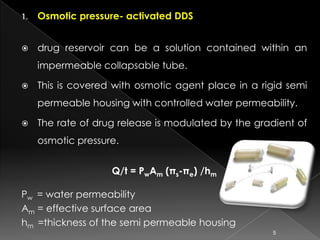
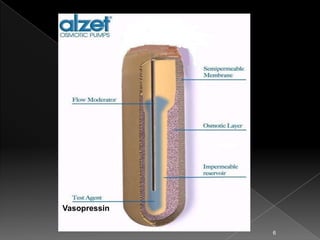
1.   Osmotic pressure- activated DDS


    drug reservoir can be a solution contained within an
     impermeable collapsable tube.

    This is covered with osmotic agent place in a rigid semi
     permeable housing with controlled water permeability.

    The rate of drug release is modulated by the gradient of
     osmotic pressure.


                    Q/t = PwAm (πs-πe) /hm

Pw = water permeability
Am = effective surface area
hm =thickness of the semi permeable housing
                                                     5
Vasopressin

              6
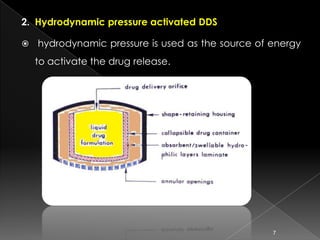
2. Hydrodynamic pressure activated DDS

   hydrodynamic pressure is used as the source of energy
    to activate the drug release.


                                                   7
Q/t = Pf Am/hm (θs – θe)


Pf = fluid permeability


Am = effective surface area


hm = thickness of the wall with annular openings


θs – θe = difference in hydrodynamic pressure between the
         DDS and the environment

                                                   8
3. Vapour pressure- activated drug delivery systems


   Drug inside infusion compartment is separated from
    pumping compartment by freely movable partition.

   Pumping compartment contains a fluorocarbon
    fluid that vaporizes at body temperature

   The vapour pressure created moves the partition
    upward, forcing the drug to be delivered.

   Eg: INFUSAID implants (heparin)


                                                      9
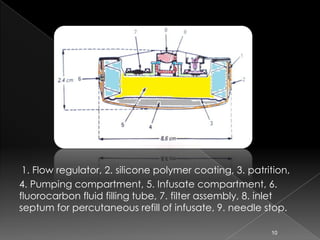
1. Flow regulator, 2. silicone polymer coating, 3. patrition,
4. Pumping compartment, 5. Infusate compartment, 6.
fluorocarbon fluid filling tube, 7. filter assembly, 8. inlet
septum for percutaneous refill of infusate, 9. needle stop.

                                                         10
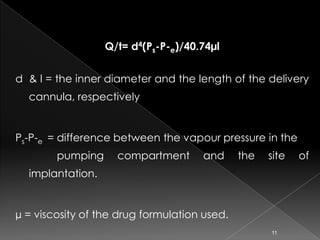
Q/t= d4(Ps-P-e)/40.74µl


d & l = the inner diameter and the length of the delivery
  cannula, respectively


Ps-P-e = difference between the vapour pressure in the
        pumping     compartment      and      the   site   of
  implantation.


µ = viscosity of the drug formulation used.
                                                    11
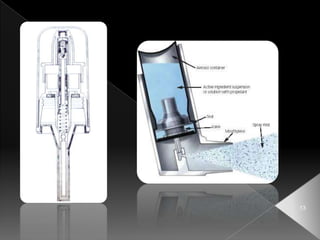
4. Mechanically activated drug delivery system

   Equipped with a mechanically activated pumping system

   A measured dose of drug formulation is reproducibly
    delivered

   The volume of solution delivered is controllable, as small as
    10-100µl

   Volume of solution delivered is independent of the force &
    duration of activation applied as well as the solution volume
    in the container.

   Example is the development of metered dose nebulizer for
    the intranasal administration of a precision dose of buserelin
    (LHRH).

                                                           12
13
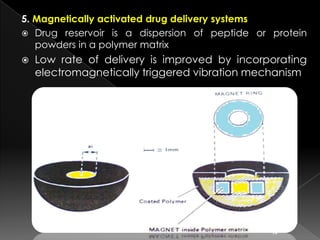
5. Magnetically activated drug delivery systems
 Drug reservoir is a dispersion of peptide or protein
   powders in a polymer matrix
   Low rate of delivery is improved by incorporating
    electromagnetically triggered vibration mechanism


                                               14
   Coating polymer can be a ethylene-vinyl acetate
    copolymer or silicon elastomers.

   These systems have been used to deliver protein drugs,
    such as bovine serum albumin

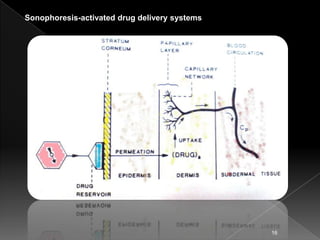
6. Sonophoresis-activated drug delivery systems

   Utilize ultrasonic energy to activate the delivery of the
    drugs from a polymeric drug delivery device

   can be fabricated from either a non degradable
    polymer, such as ethylene-vinyl acetate copolymer,

    a   bio   erodible    polymer      such   as   poly[bis(p-
    carboxyphenoxy)alkane anhydride].
                                                       15
Sonophoresis-activated drug delivery systems


                                               16
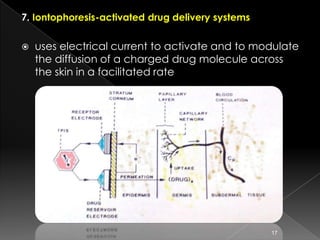
7. Iontophoresis-activated drug delivery systems

   uses electrical current to activate and to modulate
    the diffusion of a charged drug molecule across
    the skin in a facilitated rate


                                                   17
   skin permeation rate of a charged molecule i consist of 3
    components

                     Jiisp = Jp+Je+Jc
     Jp = passive skin permeation flux
     Je = electrical current driven permeation flux
     Jc = convection flow-driven skin permeation flux
   IONSYS - fentanyl iontophoretic transdermal system


   Example : development of an iontophoretic DDS of
    dexamethasone sodium phosphate
                                                         18
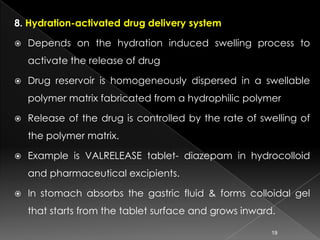
8. Hydration-activated drug delivery system

   Depends on the hydration induced swelling process to
    activate the release of drug

   Drug reservoir is homogeneously dispersed in a swellable
    polymer matrix fabricated from a hydrophilic polymer

   Release of the drug is controlled by the rate of swelling of
    the polymer matrix.

   Example is VALRELEASE tablet- diazepam in hydrocolloid
    and pharmaceutical excipients.

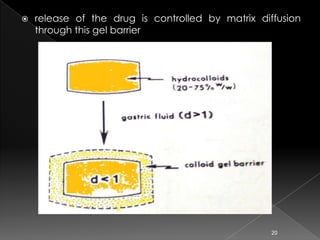
   In stomach absorbs the gastric fluid & forms colloidal gel
    that starts from the tablet surface and grows inward.

                                                        19
   release of the drug is controlled by matrix diffusion
    through this gel barrier


                                                   20
REFERENCES


   NOVEL DRUG DELIVERY SYSTEMS, 2nd edition, Yie W.
    Chien

   CONTROLLED DRUG DELIVERY- FUNDAMENTALS AND
    APPLICATIONS, 2nd edition,       edited by Joseph R.
    Robinson and Vincent H. L. Lee

   http://www.rxlist.com/ionsys-drug.htm


                                                  21
***Thank You!***
               22

Activation modulated drug delivery systems

  • 1.
  • 2.
    CLASSIFICATION  Rate pre-programmed drug delivery systems  Activation – modulated drug delivery systems  Feedback- regulated drug delivery systems  Site- targeting drug delivery systems 2
  • 3.
    ACTIVATION MODULATED DDS  Drug delivery is activated and controlled by physical, chemical or bio-chemical processes or facilitated by the energy supplied externally Classification of activation modulated DDS  Based on the nature of the process applied or the type of energy used 1. Physical means 2. Chemical means 3. Biological means 3
  • 4.
    DDS activated byphysical means a. Osmotic pressure- activated DDS b. Hydrodynamic pressure activated DDS c. Vapour pressure activated DDS d. Mechanically activated DDS e. Magnetically activated DDS f. Sonophorosis activated DDS g. Iontophoresis activated DDS h. Hydration activated DDS 4
  • 5.
    1. Osmotic pressure- activated DDS  drug reservoir can be a solution contained within an impermeable collapsable tube.  This is covered with osmotic agent place in a rigid semi permeable housing with controlled water permeability.  The rate of drug release is modulated by the gradient of osmotic pressure. Q/t = PwAm (πs-πe) /hm Pw = water permeability Am = effective surface area hm =thickness of the semi permeable housing 5
  • 6.
  • 7.
    2. Hydrodynamic pressureactivated DDS  hydrodynamic pressure is used as the source of energy to activate the drug release. 7
  • 8.
    Q/t = PfAm/hm (θs – θe) Pf = fluid permeability Am = effective surface area hm = thickness of the wall with annular openings θs – θe = difference in hydrodynamic pressure between the DDS and the environment 8
  • 9.
    3. Vapour pressure-activated drug delivery systems  Drug inside infusion compartment is separated from pumping compartment by freely movable partition.  Pumping compartment contains a fluorocarbon fluid that vaporizes at body temperature  The vapour pressure created moves the partition upward, forcing the drug to be delivered.  Eg: INFUSAID implants (heparin) 9
  • 10.
    1. Flow regulator,2. silicone polymer coating, 3. patrition, 4. Pumping compartment, 5. Infusate compartment, 6. fluorocarbon fluid filling tube, 7. filter assembly, 8. inlet septum for percutaneous refill of infusate, 9. needle stop. 10
  • 11.
    Q/t= d4(Ps-P-e)/40.74µl d &l = the inner diameter and the length of the delivery cannula, respectively Ps-P-e = difference between the vapour pressure in the pumping compartment and the site of implantation. µ = viscosity of the drug formulation used. 11
  • 12.
    4. Mechanically activateddrug delivery system  Equipped with a mechanically activated pumping system  A measured dose of drug formulation is reproducibly delivered  The volume of solution delivered is controllable, as small as 10-100µl  Volume of solution delivered is independent of the force & duration of activation applied as well as the solution volume in the container.  Example is the development of metered dose nebulizer for the intranasal administration of a precision dose of buserelin (LHRH). 12
  • 13.
  • 14.
    5. Magnetically activateddrug delivery systems  Drug reservoir is a dispersion of peptide or protein powders in a polymer matrix  Low rate of delivery is improved by incorporating electromagnetically triggered vibration mechanism 14
  • 15.
    Coating polymer can be a ethylene-vinyl acetate copolymer or silicon elastomers.  These systems have been used to deliver protein drugs, such as bovine serum albumin 6. Sonophoresis-activated drug delivery systems  Utilize ultrasonic energy to activate the delivery of the drugs from a polymeric drug delivery device  can be fabricated from either a non degradable polymer, such as ethylene-vinyl acetate copolymer, a bio erodible polymer such as poly[bis(p- carboxyphenoxy)alkane anhydride]. 15
  • 16.
  • 17.
    7. Iontophoresis-activated drugdelivery systems  uses electrical current to activate and to modulate the diffusion of a charged drug molecule across the skin in a facilitated rate 17
  • 18.
    skin permeation rate of a charged molecule i consist of 3 components Jiisp = Jp+Je+Jc Jp = passive skin permeation flux Je = electrical current driven permeation flux Jc = convection flow-driven skin permeation flux  IONSYS - fentanyl iontophoretic transdermal system  Example : development of an iontophoretic DDS of dexamethasone sodium phosphate 18
  • 19.
    8. Hydration-activated drugdelivery system  Depends on the hydration induced swelling process to activate the release of drug  Drug reservoir is homogeneously dispersed in a swellable polymer matrix fabricated from a hydrophilic polymer  Release of the drug is controlled by the rate of swelling of the polymer matrix.  Example is VALRELEASE tablet- diazepam in hydrocolloid and pharmaceutical excipients.  In stomach absorbs the gastric fluid & forms colloidal gel that starts from the tablet surface and grows inward. 19
  • 20.
    release of the drug is controlled by matrix diffusion through this gel barrier 20
  • 21.
    REFERENCES  NOVEL DRUG DELIVERY SYSTEMS, 2nd edition, Yie W. Chien  CONTROLLED DRUG DELIVERY- FUNDAMENTALS AND APPLICATIONS, 2nd edition, edited by Joseph R. Robinson and Vincent H. L. Lee  http://www.rxlist.com/ionsys-drug.htm 21
  • 22.