

biosensor
By: Imtiaz ur Rehman
4th Year MBBS
Khyber Medical College Peshawar
introduction
• – Any device that uses specific biochemical
reactions to detect chemical compounds in
biological samples.
• An enzyme electrode is a biosensor
• In 1916 Biosensor was used for the first time by detecting the
adsorption of invertase protein on activated charcoal.
definition
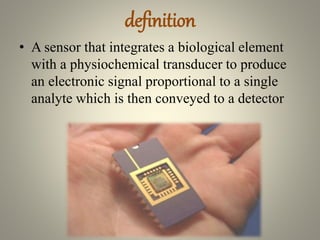
• A sensor that integrates a biological element
with a physiochemical transducer to produce
an electronic signal proportional to a single
analyte which is then conveyed to a detector
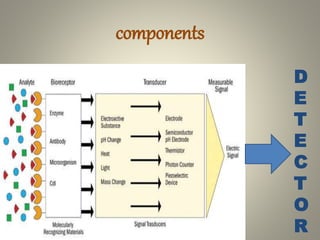
components
D
E
T
E
C
T
O
R
Characteristics of biosensor
1. LINEARITY Linearity of the sensor should
be high for the detection of
high substrate concentration.
2. SENSITIVITY Value of the electrode response
per substrate concentration.
3. SELECTIVITY Chemicals Interference must be
minimized for obtaining the
correct result.
4.RESPONSE TIME Time necessary for having 95%
of the response.
Types of Biosensors
1. Calorimetric Biosensor
2. Potentiometric Biosensor
3. Amperometric Biosensor
4. Optical Biosensor
5. Piezo-electric Biosensor
Applications of Biosensor
 Food Analysis
 Study of biomolecules and their interaction
 Drug Development
 Crime detection
 Medical diagnosis (both clinical and laboratory use)
 Environmental field monitoring
 Quality control
 Industrial Process Control
 Detection systems for biological warfare agents
 Manufacturing of pharmaceuticals and replacement
organs
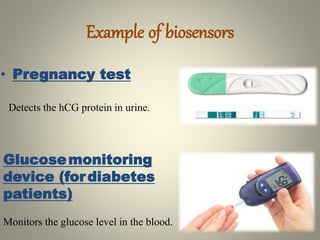
Example of biosensors
• Pregnancy test
Detects the hCG protein in urine.
Glucosemonitoring
device (fordiabetes
patients)
Monitors the glucose level in the blood.
Thanks......

Biosensor

  • 1.
    biosensor By: Imtiaz urRehman 4th Year MBBS Khyber Medical College Peshawar
  • 2.
    introduction • – Anydevice that uses specific biochemical reactions to detect chemical compounds in biological samples. • An enzyme electrode is a biosensor • In 1916 Biosensor was used for the first time by detecting the adsorption of invertase protein on activated charcoal.
  • 3.
    definition • A sensorthat integrates a biological element with a physiochemical transducer to produce an electronic signal proportional to a single analyte which is then conveyed to a detector
  • 4.
  • 5.
    Characteristics of biosensor 1.LINEARITY Linearity of the sensor should be high for the detection of high substrate concentration. 2. SENSITIVITY Value of the electrode response per substrate concentration. 3. SELECTIVITY Chemicals Interference must be minimized for obtaining the correct result. 4.RESPONSE TIME Time necessary for having 95% of the response.
  • 6.
    Types of Biosensors 1.Calorimetric Biosensor 2. Potentiometric Biosensor 3. Amperometric Biosensor 4. Optical Biosensor 5. Piezo-electric Biosensor
  • 7.
    Applications of Biosensor Food Analysis  Study of biomolecules and their interaction  Drug Development  Crime detection  Medical diagnosis (both clinical and laboratory use)  Environmental field monitoring  Quality control  Industrial Process Control  Detection systems for biological warfare agents  Manufacturing of pharmaceuticals and replacement organs
  • 8.
    Example of biosensors •Pregnancy test Detects the hCG protein in urine. Glucosemonitoring device (fordiabetes patients) Monitors the glucose level in the blood.
  • 9.