
UV-Vis Spectroscopy
Submitted by: Preeti choudhary
M.Sc.(Applied Physics)
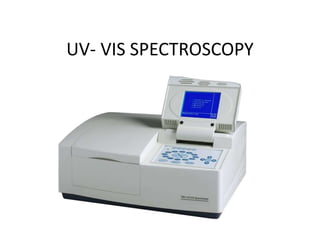
UV- VIS SPECTROSCOPY
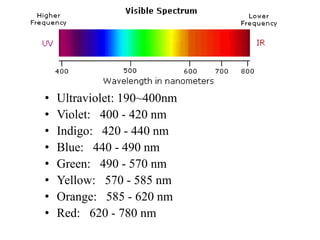
• Ultraviolet: 190~400nm
• Violet: 400 - 420 nm
• Indigo: 420 - 440 nm
• Blue: 440 - 490 nm
• Green: 490 - 570 nm
• Yellow: 570 - 585 nm
• Orange: 585 - 620 nm
• Red: 620 - 780 nm
Electronic Spectroscopy
• This is the earliest method of molecular
spectroscopy.
• A phenomenon of interaction of molecules with
ultraviolet and visible lights.
• Absorption of photon results in electronic
transition of a molecule, and electrons are
promoted from ground state to higher electronic
states.
Absorption and Emission
Emission
Absorption: A transition from a lower level to a higher level
with transfer of energy to an absorber, atom, molecule, or
solid.
Emission: A transition from a higher level to a lower level
Absorption
Terms describing UV absorptions
1. Chromophores: functional groups that give
electronic transitions.
2. Auxochromes: substituents with unshared pair e's like
OH, NH, SH ..., when attached to π chromophore they
generally move the absorption max. to longer λ.
3. Bathochromic shift: shift to longer λ, also called red
shift.
4. Hypsochromic shift: shift to shorter λ, also called blue
shift.
Absorbing species containing p , s, and
n electrons
• Absorption of ultraviolet and visible radiation
in organic molecules is restricted to certain
functional groups (chromophores) that contain
valence electrons of low excitation energy.
• UV-VIS spectroscopy is used to detect the
presence of chromophores like dienes,
aromatics, polyenes, and conjugated ketones,
etc
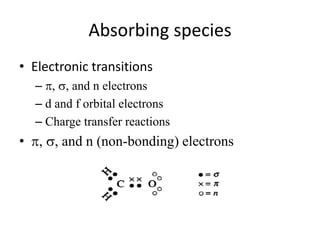
Absorbing species
• Electronic transitions
– p, s, and n electrons
– d and f orbital electrons
– Charge transfer reactions
• p, s, and n (non-bonding) electrons
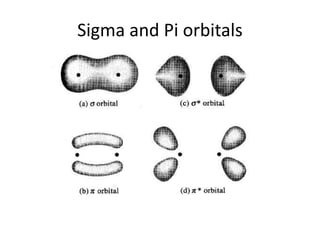
Sigma and Pi orbitals
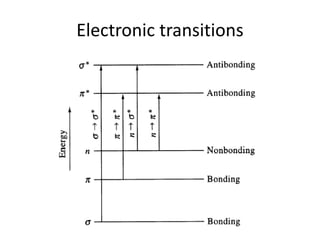
Electronic transitions
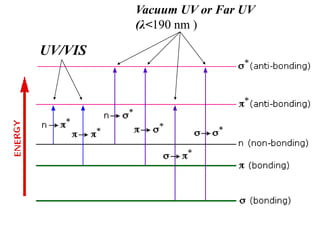
UV/VIS
Vacuum UV or Far UV
(λ<190 nm )
s  s Transitions
• An electron in a bonding s orbital is excited to
the corresponding antibonding orbital. The
energy required is large. For example, methane
(which has only C-H bonds, and can only
undergo s  s transitions) shows an
absorbance maximum at 125 nm.
• Absorption maxima due to s  s transitions
are not seen in typical UV-VIS spectra (200 -
700 nm)
n  s Transitions
• Saturated compounds containing atoms with
lone pairs (non-bonding electrons) are capable
of n  s transitions. These transitions
usually need less energy than s  s 
transitions. They can be initiated by light
whose wavelength is in the range 150 - 250 nm
• . The number of organic functional groups
with n  s peaks in the UV region is small.
n  p and p  p Transitions
• Most absorption spectroscopy of organic
compounds is based on transitions of n or p
electrons to the p excited state.
• These transitions fall in an experimentally
convenient region of the spectrum (200 - 700
nm). These transitions need an unsaturated
group in the molecule to provide the p
electrons.
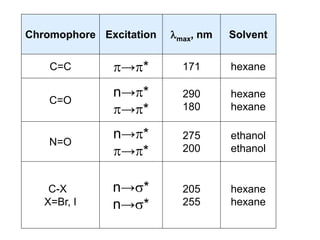
Chromophore Excitation lmax, nm Solvent
C=C p→p* 171 hexane
C=O
n→p*
p→p*
290
180
hexane
hexane
N=O
n→p*
p→p*
275
200
ethanol
ethanol
C-X
X=Br, I
n→s*
n→s*
205
255
hexane
hexane
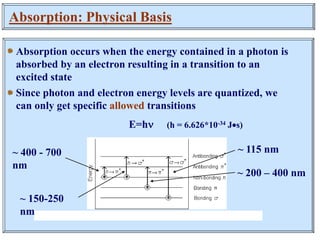
Absorption: Physical Basis
Absorption occurs when the energy contained in a photon is
absorbed by an electron resulting in a transition to an
excited state
Since photon and electron energy levels are quantized, we
can only get specific allowed transitions
~ 115 nm
~ 200 – 400 nm
~ 150-250
nm
~ 400 - 700
nm
E=h (h = 6.626*10-34 Js)
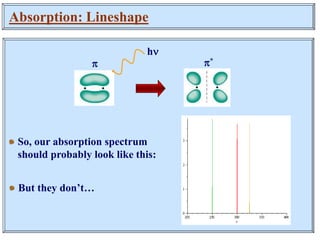
Absorption: Lineshape
p
h
p*
So, our absorption spectrum
should probably look like this:
But they don’t…
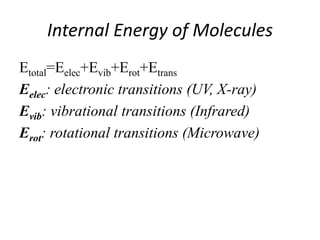
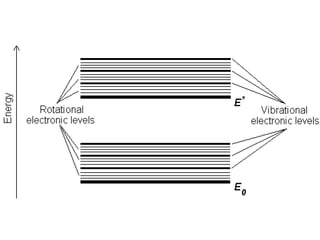
Internal Energy of Molecules
Etotal=Eelec+Evib+Erot+Etrans
Eelec: electronic transitions (UV, X-ray)
Evib: vibrational transitions (Infrared)
Erot: rotational transitions (Microwave)
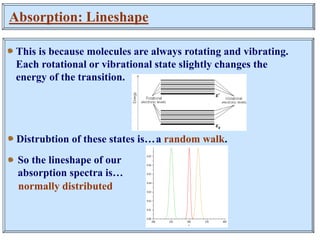
Absorption: Lineshape
This is because molecules are always rotating and vibrating.
Each rotational or vibrational state slightly changes the
energy of the transition.
Distrubtion of these states is…a random walk.
So the lineshape of our
absorption spectra is…
normally distributed
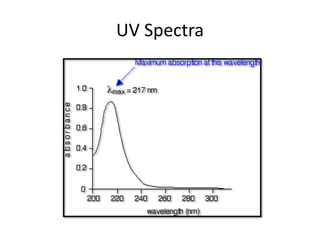
UV Spectra
Thank-You

UV-Vis Spectroscopy

  • 1.
    UV-Vis Spectroscopy Submitted by:Preeti choudhary M.Sc.(Applied Physics)
  • 2.
  • 3.
    • Ultraviolet: 190~400nm •Violet: 400 - 420 nm • Indigo: 420 - 440 nm • Blue: 440 - 490 nm • Green: 490 - 570 nm • Yellow: 570 - 585 nm • Orange: 585 - 620 nm • Red: 620 - 780 nm
  • 4.
    Electronic Spectroscopy • Thisis the earliest method of molecular spectroscopy. • A phenomenon of interaction of molecules with ultraviolet and visible lights. • Absorption of photon results in electronic transition of a molecule, and electrons are promoted from ground state to higher electronic states.
  • 5.
    Absorption and Emission Emission Absorption:A transition from a lower level to a higher level with transfer of energy to an absorber, atom, molecule, or solid. Emission: A transition from a higher level to a lower level Absorption
  • 6.
    Terms describing UVabsorptions 1. Chromophores: functional groups that give electronic transitions. 2. Auxochromes: substituents with unshared pair e's like OH, NH, SH ..., when attached to π chromophore they generally move the absorption max. to longer λ. 3. Bathochromic shift: shift to longer λ, also called red shift. 4. Hypsochromic shift: shift to shorter λ, also called blue shift.
  • 7.
    Absorbing species containingp , s, and n electrons • Absorption of ultraviolet and visible radiation in organic molecules is restricted to certain functional groups (chromophores) that contain valence electrons of low excitation energy. • UV-VIS spectroscopy is used to detect the presence of chromophores like dienes, aromatics, polyenes, and conjugated ketones, etc
  • 8.
    Absorbing species • Electronictransitions – p, s, and n electrons – d and f orbital electrons – Charge transfer reactions • p, s, and n (non-bonding) electrons
  • 9.
    Sigma and Piorbitals
  • 10.
  • 11.
    UV/VIS Vacuum UV orFar UV (λ<190 nm )
  • 12.
    s  sTransitions • An electron in a bonding s orbital is excited to the corresponding antibonding orbital. The energy required is large. For example, methane (which has only C-H bonds, and can only undergo s  s transitions) shows an absorbance maximum at 125 nm. • Absorption maxima due to s  s transitions are not seen in typical UV-VIS spectra (200 - 700 nm)
  • 13.
    n  sTransitions • Saturated compounds containing atoms with lone pairs (non-bonding electrons) are capable of n  s transitions. These transitions usually need less energy than s  s  transitions. They can be initiated by light whose wavelength is in the range 150 - 250 nm • . The number of organic functional groups with n  s peaks in the UV region is small.
  • 14.
    n  pand p  p Transitions • Most absorption spectroscopy of organic compounds is based on transitions of n or p electrons to the p excited state. • These transitions fall in an experimentally convenient region of the spectrum (200 - 700 nm). These transitions need an unsaturated group in the molecule to provide the p electrons.
  • 15.
    Chromophore Excitation lmax,nm Solvent C=C p→p* 171 hexane C=O n→p* p→p* 290 180 hexane hexane N=O n→p* p→p* 275 200 ethanol ethanol C-X X=Br, I n→s* n→s* 205 255 hexane hexane
  • 16.
    Absorption: Physical Basis Absorptionoccurs when the energy contained in a photon is absorbed by an electron resulting in a transition to an excited state Since photon and electron energy levels are quantized, we can only get specific allowed transitions ~ 115 nm ~ 200 – 400 nm ~ 150-250 nm ~ 400 - 700 nm E=h (h = 6.626*10-34 Js)
  • 17.
    Absorption: Lineshape p h p* So, ourabsorption spectrum should probably look like this: But they don’t…
  • 18.
    Internal Energy ofMolecules Etotal=Eelec+Evib+Erot+Etrans Eelec: electronic transitions (UV, X-ray) Evib: vibrational transitions (Infrared) Erot: rotational transitions (Microwave)
  • 19.
    Absorption: Lineshape This isbecause molecules are always rotating and vibrating. Each rotational or vibrational state slightly changes the energy of the transition. Distrubtion of these states is…a random walk. So the lineshape of our absorption spectra is… normally distributed
  • 21.
  • 22.