By
Dr. Harshali G. Wankhade
Assistant Professor
Department of Chemistry
Shri Shivaji Science College, Amravati
introduction
 Mossbauer spectroscopy also known as γ-ray spectroscopy.
 Introduced by Rudolf Mossbauer in 1958.
 He was awarded with Nobel prize for this discovery in 1961.
 Mossbauer spectroscopy relates to transitions between energy levels of
nuclei of atoms.
 Absorption of γ-rays depends upon the electron density around the nucleus.
 Number of peaks observed is related to the symmetry of the compound.
 Mossbauer spectroscopy is concerned with both excited and ground
state properties of the nucleus.
 Gases and non-viscous liquids do not exhibit Mossbauer effect because of
loss of recoil energy.
Basicprinciple of mossbauer spectroscopy
“ It is the study of γ-rays emission from excited nuclei and its subsequent
reabsorption by other nuclei ”
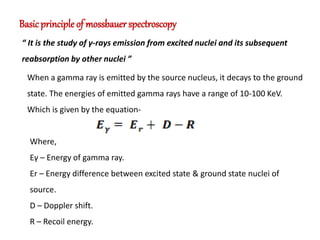
When a gamma ray is emitted by the source nucleus, it decays to the ground
state. The energies of emitted gamma rays have a range of 10-100 KeV.
Which is given by the equation-
Where,
Eγ – Energy of gamma ray.
Er – Energy difference between excited state & ground state nuclei of
source.
D – Doppler shift.
R – Recoil energy.
The source and sample nuclei used in Mossbauer spectroscopy is
same, but the reabsorption of emitted γ- ray were not taking place
at the same frequency, this is due to –
i] Nuclear recoil phenomenon.
ii] Doppler effect / Line width.
Nuclear recoil phenomenon
 When gamma ray photon of frequency 1018 C/sec is emitted from sample
nuclei, which is having relatively large momentum, so according to de-Broglie
relationship to conserve total momentum of sample nuclei it pushed
backwards (recoil effect / recoil phenomenon.)
 Due to recoil effect, the energy of γ- rays is slightly less than natural energy
of transition.
 increase kinetic energy of newly excited nuclei.
Hence emitted and absorbed gamma radiation differ by twice the kinetic
energy or recoil energy.
Line width/ doppler effect
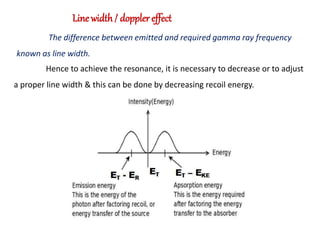
The difference between emitted and required gamma ray frequency
known as line width.
Hence to achieve the resonance, it is necessary to decrease or to adjust
a proper line width & this can be done by decreasing recoil energy.
Mossbauer effect
 It involves the resonant and recoil free emission and absorption of
gamma radiation by atomic nuclei bound in the solid.
 In the Mossbauer effect, a narrow resonance for nuclear gamma
emission and absorption results from the momentum of recoil being
delivered to a surrounding crystal lattice rather than to the emitting or
absorbing nucleus alone.
When this occurs, no gamma energy is lost to the kinetic energy of
recoiling nuclei at either the emitting or absorbing end of a gamma
transition: emission and absorption occur at the same energy, resulting
in strong, resonant absorption.
Instrumentation
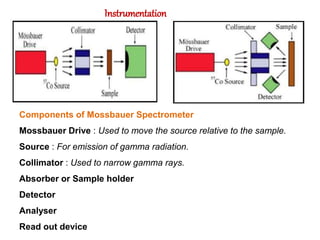
Components of Mossbauer Spectrometer
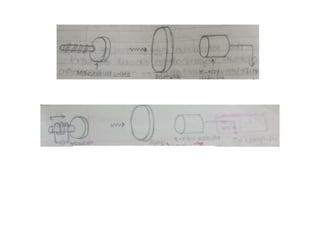
Mossbauer Drive : Used to move the source relative to the sample.
Source : For emission of gamma radiation.
Collimator : Used to narrow gamma rays.
Absorber or Sample holder
Detector
Analyser
Read out device
Source
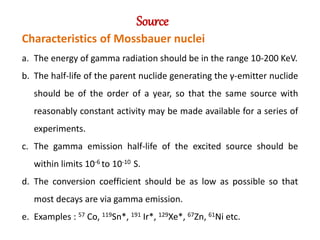
Characteristics of Mossbauer nuclei
a. The energy of gamma radiation should be in the range 10-200 KeV.
b. The half-life of the parent nuclide generating the γ-emitter nuclide
should be of the order of a year, so that the same source with
reasonably constant activity may be made available for a series of
experiments.
c. The gamma emission half-life of the excited source should be
within limits 10-6 to 10-10 S.
d. The conversion coefficient should be as low as possible so that
most decays are via gamma emission.
e. Examples : 57 Co, 119Sn*, 191 Ir*, 129Xe*, 67Zn, 61Ni etc.
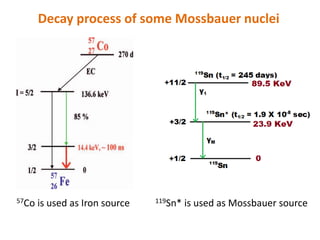
Decay process of some Mossbauer nuclei
57Co is used as Iron source 119Sn* is used as Mossbauer source
Absorber or sample holder
Characteristics of Absorber
a. It must be placed in crystal lattice to achieved recoilless resonance.
b. Absorber nuclide should be present in high isotopic abundance.
c. High sensitivity is needed for relevant isotopes sometimes used in
case of enriched samples.
detector
Common types of detector used in Mossbauer spectrometer
a. Scintillation Detector.
b. Proportional Detector.
c. Semiconductor Detector.
analyser
Analysis of mossbauer spectrum
Three important parameter are to be considered –
a. Nuclear isomer shift.
b. Nuclear quadrupole coupling.
c. Magnetic hyperfine interaction.
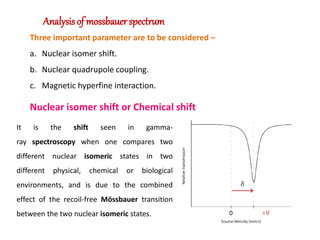
Nuclear isomer shift or Chemical shift
It is the shift seen in gamma-
ray spectroscopy when one compares two
different nuclear isomeric states in two
different physical, chemical or biological
environments, and is due to the combined
effect of the recoil-free Mössbauer transition
between the two nuclear isomeric states.
Nuclear Quadrupole Coupling
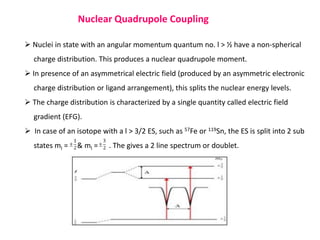
 Nuclei in state with an angular momentum quantum no. l > ½ have a non-spherical
charge distribution. This produces a nuclear quadrupole moment.
 In presence of an asymmetrical electric field (produced by an asymmetric electronic
charge distribution or ligand arrangement), this splits the nuclear energy levels.
 The charge distribution is characterized by a single quantity called electric field
gradient (EFG).
 In case of an isotope with a l > 3/2 ES, such as 57Fe or 119Sn, the ES is split into 2 sub
states ml = & ml = . The gives a 2 line spectrum or doublet.
Magnetic Field Effect
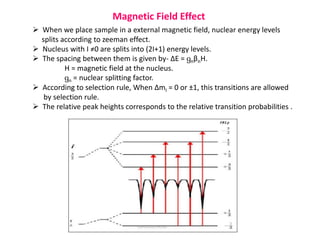
 When we place sample in a external magnetic field, nuclear energy levels
splits according to zeeman effect.
 Nucleus with I ≠0 are splits into (2I+1) energy levels.
 The spacing between them is given by- ΔE = ցnβnH.
H = magnetic field at the nucleus.
ցn = nuclear splitting factor.
 According to selection rule, When ΔmI = 0 or ±1, this transitions are allowed
by selection rule.
 The relative peak heights corresponds to the relative transition probabilities .
Applications of mossbauer spectroscopy
i. Chemical shift and electron density at nucleus.
ii. Isomeric shift and ionicity.
iii. Electronegativity and isomeric shift.
iv. Isomer shift and curie point.
v. Study of iron complex.
vi. Structure determination.
vii. Nature of chemical bond.
viii. Biochemical applications.

Mossbauer spectroscopy

  • 1.
    By Dr. Harshali G.Wankhade Assistant Professor Department of Chemistry Shri Shivaji Science College, Amravati
  • 2.
    introduction  Mossbauer spectroscopyalso known as γ-ray spectroscopy.  Introduced by Rudolf Mossbauer in 1958.  He was awarded with Nobel prize for this discovery in 1961.  Mossbauer spectroscopy relates to transitions between energy levels of nuclei of atoms.  Absorption of γ-rays depends upon the electron density around the nucleus.  Number of peaks observed is related to the symmetry of the compound.  Mossbauer spectroscopy is concerned with both excited and ground state properties of the nucleus.  Gases and non-viscous liquids do not exhibit Mossbauer effect because of loss of recoil energy.
  • 3.
    Basicprinciple of mossbauerspectroscopy “ It is the study of γ-rays emission from excited nuclei and its subsequent reabsorption by other nuclei ” When a gamma ray is emitted by the source nucleus, it decays to the ground state. The energies of emitted gamma rays have a range of 10-100 KeV. Which is given by the equation- Where, Eγ – Energy of gamma ray. Er – Energy difference between excited state & ground state nuclei of source. D – Doppler shift. R – Recoil energy.
  • 4.
    The source andsample nuclei used in Mossbauer spectroscopy is same, but the reabsorption of emitted γ- ray were not taking place at the same frequency, this is due to – i] Nuclear recoil phenomenon. ii] Doppler effect / Line width.
  • 5.
    Nuclear recoil phenomenon When gamma ray photon of frequency 1018 C/sec is emitted from sample nuclei, which is having relatively large momentum, so according to de-Broglie relationship to conserve total momentum of sample nuclei it pushed backwards (recoil effect / recoil phenomenon.)  Due to recoil effect, the energy of γ- rays is slightly less than natural energy of transition.  increase kinetic energy of newly excited nuclei. Hence emitted and absorbed gamma radiation differ by twice the kinetic energy or recoil energy.
  • 6.
    Line width/ dopplereffect The difference between emitted and required gamma ray frequency known as line width. Hence to achieve the resonance, it is necessary to decrease or to adjust a proper line width & this can be done by decreasing recoil energy.
  • 8.
    Mossbauer effect  Itinvolves the resonant and recoil free emission and absorption of gamma radiation by atomic nuclei bound in the solid.  In the Mossbauer effect, a narrow resonance for nuclear gamma emission and absorption results from the momentum of recoil being delivered to a surrounding crystal lattice rather than to the emitting or absorbing nucleus alone. When this occurs, no gamma energy is lost to the kinetic energy of recoiling nuclei at either the emitting or absorbing end of a gamma transition: emission and absorption occur at the same energy, resulting in strong, resonant absorption.
  • 9.
    Instrumentation Components of MossbauerSpectrometer Mossbauer Drive : Used to move the source relative to the sample. Source : For emission of gamma radiation. Collimator : Used to narrow gamma rays. Absorber or Sample holder Detector Analyser Read out device
  • 10.
    Source Characteristics of Mossbauernuclei a. The energy of gamma radiation should be in the range 10-200 KeV. b. The half-life of the parent nuclide generating the γ-emitter nuclide should be of the order of a year, so that the same source with reasonably constant activity may be made available for a series of experiments. c. The gamma emission half-life of the excited source should be within limits 10-6 to 10-10 S. d. The conversion coefficient should be as low as possible so that most decays are via gamma emission. e. Examples : 57 Co, 119Sn*, 191 Ir*, 129Xe*, 67Zn, 61Ni etc.
  • 11.
    Decay process ofsome Mossbauer nuclei 57Co is used as Iron source 119Sn* is used as Mossbauer source
  • 12.
    Absorber or sampleholder Characteristics of Absorber a. It must be placed in crystal lattice to achieved recoilless resonance. b. Absorber nuclide should be present in high isotopic abundance. c. High sensitivity is needed for relevant isotopes sometimes used in case of enriched samples. detector Common types of detector used in Mossbauer spectrometer a. Scintillation Detector. b. Proportional Detector. c. Semiconductor Detector. analyser
  • 13.
    Analysis of mossbauerspectrum Three important parameter are to be considered – a. Nuclear isomer shift. b. Nuclear quadrupole coupling. c. Magnetic hyperfine interaction. Nuclear isomer shift or Chemical shift It is the shift seen in gamma- ray spectroscopy when one compares two different nuclear isomeric states in two different physical, chemical or biological environments, and is due to the combined effect of the recoil-free Mössbauer transition between the two nuclear isomeric states.
  • 14.
    Nuclear Quadrupole Coupling Nuclei in state with an angular momentum quantum no. l > ½ have a non-spherical charge distribution. This produces a nuclear quadrupole moment.  In presence of an asymmetrical electric field (produced by an asymmetric electronic charge distribution or ligand arrangement), this splits the nuclear energy levels.  The charge distribution is characterized by a single quantity called electric field gradient (EFG).  In case of an isotope with a l > 3/2 ES, such as 57Fe or 119Sn, the ES is split into 2 sub states ml = & ml = . The gives a 2 line spectrum or doublet.
  • 15.
    Magnetic Field Effect When we place sample in a external magnetic field, nuclear energy levels splits according to zeeman effect.  Nucleus with I ≠0 are splits into (2I+1) energy levels.  The spacing between them is given by- ΔE = ցnβnH. H = magnetic field at the nucleus. ցn = nuclear splitting factor.  According to selection rule, When ΔmI = 0 or ±1, this transitions are allowed by selection rule.  The relative peak heights corresponds to the relative transition probabilities .
  • 16.
    Applications of mossbauerspectroscopy i. Chemical shift and electron density at nucleus. ii. Isomeric shift and ionicity. iii. Electronegativity and isomeric shift. iv. Isomer shift and curie point. v. Study of iron complex. vi. Structure determination. vii. Nature of chemical bond. viii. Biochemical applications.