Electron Spin
Resonance (ESR)
Spectroscopy
[Basic Concepts]
Prof. Harish Chopra,
Department of Chemistry,
SLIET, Longowal (Pb) INDIA
Introduction
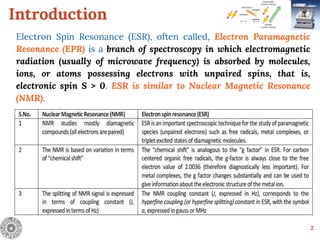
Electron Spin Resonance (ESR), often called, Electron Paramagnetic
Resonance (EPR) is a branch of spectroscopy in which electromagnetic
radiation (usually of microwave frequency) is absorbed by molecules,
ions, or atoms possessing electrons with unpaired spins, that is,
electronic spin S > 0. ESR is similar to Nuclear Magnetic Resonance
(NMR).
2
Introduction
ESR is a technique to give information on the electronic structure of
organic, inorganic, biological, solid state, and surface molecular species.
These include organic free radicals, bi-radicals, triplet excited states,
and most transition metal and rare earth species.
In most atoms and molecules electrons are paired. The paired electrons
do not give an ESR signal. Atoms and molecules with unpaired
electron give an ESR signal. Electrons and nuclei possess spin
angular momentum and an accompanying magnetic moment.
For nuclei, the magnetic dipole moment is proportional to the spin
angular momentum:
where gN is the nuclear g-value and μN is the nuclear magneton.
The quantity gNμN is generally referred to as the gyromagnetic ratio,
𝜸Ν, because it is the proportionality constant relating the
magnitude of a spin-angular momentum to the resulting
magnetic moment.
3
Theory
4
A magnetic moment is associated with the spinning charge and hence
an electron behaves like a magnet with its poles along the axis of
rotation. The electron circulates in atomic orbit, which also induces
some magnetic moment, and total magnetic moment associated with
the electron is equal to the vector sum of these two magnetic
moments. The ratio of the total magnetic moments to the spin
value for a given electron is constant for a particular environment
and is called as gyromagnetic ratio or spectroscopic splitting factor
or Lande’ g factor. As these ratios depend on the structure of the
material and differ for various atoms, environments and magnetic
fields which give a characteristic spectrum known as ESR spectra
and the technique as ESR spectroscopy.
ESR spectroscopy can be applied to study any species with a non-zero
total electron spin: S=1/2, 1, 3/2, 2,... . The principal aspect of
electron spin resonance which is of interest to chemists is that the
apparent electron spin energies are sensitive to paramagnetic nuclei
in the molecular environments, particularly hydrogen atoms.
Theory
5
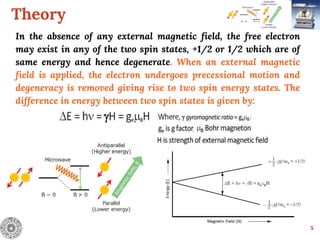
In the absence of any external magnetic field, the free electron
may exist in any of the two spin states, +1/2 or 1/2 which are of
same energy and hence degenerate. When an external magnetic
field is applied, the electron undergoes precessional motion and
degeneracy is removed giving rise to two spin energy states. The
difference in energy between two spin states is given by:
ESR Spectrometer
6
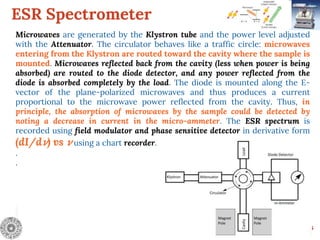
Microwaves are generated by the Klystron tube and the power level adjusted
with the Attenuator. The circulator behaves like a traffic circle: microwaves
entering from the Klystron are routed toward the cavity where the sample is
mounted. Microwaves reflected back from the cavity (less when power is being
absorbed) are routed to the diode detector, and any power reflected from the
diode is absorbed completely by the load. The diode is mounted along the E-
vector of the plane-polarized microwaves and thus produces a current
proportional to the microwave power reflected from the cavity. Thus, in
principle, the absorption of microwaves by the sample could be detected by
noting a decrease in current in the micro-ammeter. The ESR spectrum is
recorded using field modulator and phase sensitive detector in derivative form
(dI/d 𝜈) vs 𝜈 using a chart recorder.
.
.
ESR Spectrum
7
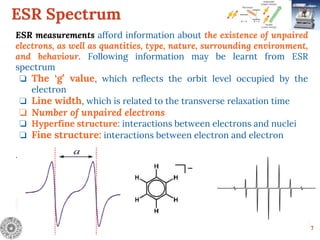
ESR measurements afford information about the existence of unpaired
electrons, as well as quantities, type, nature, surrounding environment,
and behaviour. Following information may be learnt from ESR
spectrum
❏ The ‘g’ value, which reflects the orbit level occupied by the
electron
❏ Line width, which is related to the transverse relaxation time
❏ Number of unpaired electrons
❏ Hyperfine structure: interactions between electrons and nuclei
❏ Fine structure: interactions between electron and electron
.
ESR Spectrum - Reference
8
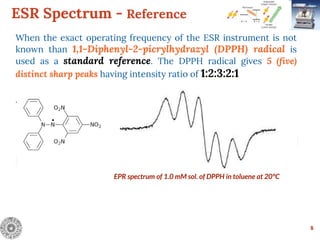
When the exact operating frequency of the ESR instrument is not
known than 1,1-Diphenyl-2-picrylhydrazyl (DPPH) radical is
used as a standard reference. The DPPH radical gives 5 (five)
distinct sharp peaks having intensity ratio of 1:2:3:2:1
.
EPR spectrum of 1.0 mM sol. of DPPH in toluene at 20°C
Hyperfine Splitting
9
Unpaired electrons are affected by the applied magnetic field and
the magnetic field generated by nuclei with spin which leads to
hyperfine splitting in ESR spectra. Nuclear hyperfine coupling
results in a multi-line ESR spectrum. The hyperfine splitting is
measured in Hz and represented by hyperfine coupling constant.
Different types of hyperfine splitting take place in ESR
spectrum depending upon the number of nuclei or non-
equivalent nuclei or delocalized nuclei etc.
ESR spectra are simpler to understand than NMR spectra in that
second-order effects normally do not alter the intensities of
components; on the other hand, ESR multiplets can be much
more complex when the electron interacts with several high-
spin nuclei.
Hyperfine Splitting - Examples
10
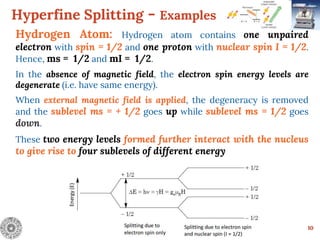
Hydrogen Atom: Hydrogen atom contains one unpaired
electron with spin = 1/2 and one proton with nuclear spin I = 1/2.
Hence, ms = 1/2 and mI = 1/2.
In the absence of magnetic field, the electron spin energy levels are
degenerate (i.e. have same energy).
When external magnetic field is applied, the degeneracy is removed
and the sublevel ms = + 1/2 goes up while sublevel ms = 1/2 goes
down.
These two energy levels formed further interact with the nucleus
to give rise to four sublevels of different energy
.
Hyperfine Splitting - Examples
11
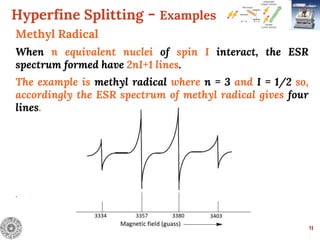
Methyl Radical
When n equivalent nuclei of spin I interact, the ESR
spectrum formed have 2nI+1 lines.
The example is methyl radical where n = 3 and I = 1/2 so,
accordingly the ESR spectrum of methyl radical gives four
lines.
.
Hyperfine Splitting - Examples
12
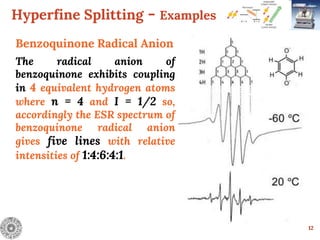
Benzoquinone Radical Anion
The radical anion of
benzoquinone exhibits coupling
in 4 equivalent hydrogen atoms
where n = 4 and I = 1/2 so,
accordingly the ESR spectrum of
benzoquinone radical anion
gives five lines with relative
intensities of 1:4:6:4:1.
Hyperfine Splitting - Examples
13
Benzene Radical Anion
The radical anion of benzene [C6H6]- has electrons
delocalized over all the six carbon atoms and exhibits
coupling in 6 equivalent hydrogen atoms where n = 6 and I
= 1/2 so, accordingly the ESR spectrum of benzene radical
anion gives seven lines with relative intensities of
1:6:15:20:15:6:1.
.
Hyperfine Splitting - Examples
14
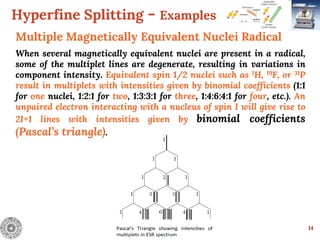
Multiple Magnetically Equivalent Nuclei Radical
When several magnetically equivalent nuclei are present in a radical,
some of the multiplet lines are degenerate, resulting in variations in
component intensity. Equivalent spin 1/2 nuclei such as 1H, 19F, or 31P
result in multiplets with intensities given by binomial coefficients (1:1
for one nuclei, 1:2:1 for two, 1:3:3:1 for three, 1:4:6:4:1 for four, etc.). An
unpaired electron interacting with a nucleus of spin I will give rise to
2I+1 lines with intensities given by binomial coefficients
(Pascal’s triangle).
.
Hyperfine Splitting - Examples
15
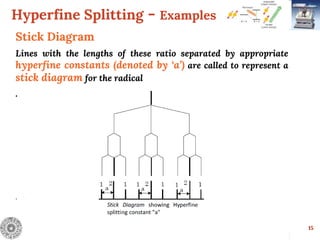
Stick Diagram
Lines with the lengths of these ratio separated by appropriate
hyperfine constants (denoted by ‘a’) are called to represent a
stick diagram for the radical
.
.
Hyperfine Splitting - Examples
16
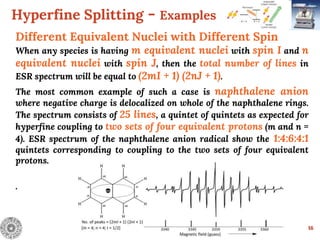
Different Equivalent Nuclei with Different Spin
When any species is having m equivalent nuclei with spin I and n
equivalent nuclei with spin J, then the total number of lines in
ESR spectrum will be equal to (2mI + 1) (2nJ + 1).
The most common example of such a case is naphthalene anion
where negative charge is delocalized on whole of the naphthalene rings.
The spectrum consists of 25 lines, a quintet of quintets as expected for
hyperfine coupling to two sets of four equivalent protons (m and n =
4). ESR spectrum of the naphthalene anion radical show the 1:4:6:4:1
quintets corresponding to coupling to the two sets of four equivalent
protons.
.
Hyperfine Splitting - Examples
17
Different Equivalent Nuclei with Different Spin
Anthracene radical anion
In anthracene radical anion, there are three sets of equivalent
protons. The set A and B consists of 4 equivalent protons
each whereas set C have 2 equivalent protons. Therefore, the
ESR spectrum of anthracene radical anion consists of 75 lines
[(4 + 1) (4 + 1) (2 + 1)]
.
.
Hyperfine Splitting - Examples
18
Different Equivalent Nuclei with Different Spin
Pyrazine radical anion
In pyrazine radical anion, the electrons delocalized over ring exhibit
coupling of
2 (two) equivalent Nitrogens (I=1) and 4 (four) equivalent hydrogens
(I=½). So, the total number of lines in ESR spectrum will be equal to
(2mI + 1) (2nJ + 1) i.e. [(2 x 2 + 1) (2 x 4 x 1/2 + 1)] = [ 5 x5] =
25 lines
.
Applications
19
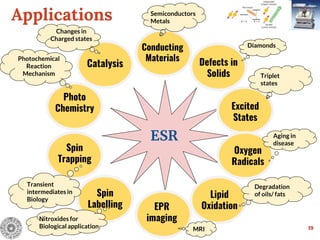
ESR
Catalysis
Conducting
Materials
Spin
Trapping
Photo
Chemistry
Spin
Labelling EPR
imaging
Defects in
Solids
Excited
States
Lipid
Oxidation
Oxygen
Radicals
Semiconductors
Metals
Diamonds
Triplet
states
Aging in
disease
Degradation
of oils/ fats
MRI
Nitroxides for
Biological application
Transient
intermediates in
Biology
Photochemical
Reaction
Mechanism
Changes in
Charged states
Applications - Details
20
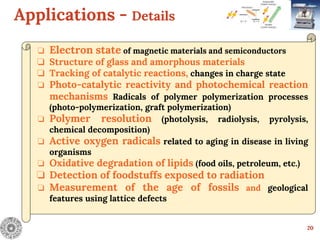
❏ Electron state of magnetic materials and semiconductors
❏ Structure of glass and amorphous materials
❏ Tracking of catalytic reactions, changes in charge state
❏ Photo-catalytic reactivity and photochemical reaction
mechanisms Radicals of polymer polymerization processes
(photo-polymerization, graft polymerization)
❏ Polymer resolution (photolysis, radiolysis, pyrolysis,
chemical decomposition)
❏ Active oxygen radicals related to aging in disease in living
organisms
❏ Oxidative degradation of lipids (food oils, petroleum, etc.)
❏ Detection of foodstuffs exposed to radiation
❏ Measurement of the age of fossils and geological
features using lattice defects
21
References
The some contents are taken from:
Chemistry For
Engineers
By
Harish Chopra
Anupama Parmar
[In addition, Internet sources have also been used]
Thank You !
22

Esr spectroscopy

  • 1.
    Electron Spin Resonance (ESR) Spectroscopy [BasicConcepts] Prof. Harish Chopra, Department of Chemistry, SLIET, Longowal (Pb) INDIA
  • 2.
    Introduction Electron Spin Resonance(ESR), often called, Electron Paramagnetic Resonance (EPR) is a branch of spectroscopy in which electromagnetic radiation (usually of microwave frequency) is absorbed by molecules, ions, or atoms possessing electrons with unpaired spins, that is, electronic spin S > 0. ESR is similar to Nuclear Magnetic Resonance (NMR). 2
  • 3.
    Introduction ESR is atechnique to give information on the electronic structure of organic, inorganic, biological, solid state, and surface molecular species. These include organic free radicals, bi-radicals, triplet excited states, and most transition metal and rare earth species. In most atoms and molecules electrons are paired. The paired electrons do not give an ESR signal. Atoms and molecules with unpaired electron give an ESR signal. Electrons and nuclei possess spin angular momentum and an accompanying magnetic moment. For nuclei, the magnetic dipole moment is proportional to the spin angular momentum: where gN is the nuclear g-value and μN is the nuclear magneton. The quantity gNμN is generally referred to as the gyromagnetic ratio, 𝜸Ν, because it is the proportionality constant relating the magnitude of a spin-angular momentum to the resulting magnetic moment. 3
  • 4.
    Theory 4 A magnetic momentis associated with the spinning charge and hence an electron behaves like a magnet with its poles along the axis of rotation. The electron circulates in atomic orbit, which also induces some magnetic moment, and total magnetic moment associated with the electron is equal to the vector sum of these two magnetic moments. The ratio of the total magnetic moments to the spin value for a given electron is constant for a particular environment and is called as gyromagnetic ratio or spectroscopic splitting factor or Lande’ g factor. As these ratios depend on the structure of the material and differ for various atoms, environments and magnetic fields which give a characteristic spectrum known as ESR spectra and the technique as ESR spectroscopy. ESR spectroscopy can be applied to study any species with a non-zero total electron spin: S=1/2, 1, 3/2, 2,... . The principal aspect of electron spin resonance which is of interest to chemists is that the apparent electron spin energies are sensitive to paramagnetic nuclei in the molecular environments, particularly hydrogen atoms.
  • 5.
    Theory 5 In the absenceof any external magnetic field, the free electron may exist in any of the two spin states, +1/2 or 1/2 which are of same energy and hence degenerate. When an external magnetic field is applied, the electron undergoes precessional motion and degeneracy is removed giving rise to two spin energy states. The difference in energy between two spin states is given by:
  • 6.
    ESR Spectrometer 6 Microwaves aregenerated by the Klystron tube and the power level adjusted with the Attenuator. The circulator behaves like a traffic circle: microwaves entering from the Klystron are routed toward the cavity where the sample is mounted. Microwaves reflected back from the cavity (less when power is being absorbed) are routed to the diode detector, and any power reflected from the diode is absorbed completely by the load. The diode is mounted along the E- vector of the plane-polarized microwaves and thus produces a current proportional to the microwave power reflected from the cavity. Thus, in principle, the absorption of microwaves by the sample could be detected by noting a decrease in current in the micro-ammeter. The ESR spectrum is recorded using field modulator and phase sensitive detector in derivative form (dI/d 𝜈) vs 𝜈 using a chart recorder. . .
  • 7.
    ESR Spectrum 7 ESR measurementsafford information about the existence of unpaired electrons, as well as quantities, type, nature, surrounding environment, and behaviour. Following information may be learnt from ESR spectrum ❏ The ‘g’ value, which reflects the orbit level occupied by the electron ❏ Line width, which is related to the transverse relaxation time ❏ Number of unpaired electrons ❏ Hyperfine structure: interactions between electrons and nuclei ❏ Fine structure: interactions between electron and electron .
  • 8.
    ESR Spectrum -Reference 8 When the exact operating frequency of the ESR instrument is not known than 1,1-Diphenyl-2-picrylhydrazyl (DPPH) radical is used as a standard reference. The DPPH radical gives 5 (five) distinct sharp peaks having intensity ratio of 1:2:3:2:1 . EPR spectrum of 1.0 mM sol. of DPPH in toluene at 20°C
  • 9.
    Hyperfine Splitting 9 Unpaired electronsare affected by the applied magnetic field and the magnetic field generated by nuclei with spin which leads to hyperfine splitting in ESR spectra. Nuclear hyperfine coupling results in a multi-line ESR spectrum. The hyperfine splitting is measured in Hz and represented by hyperfine coupling constant. Different types of hyperfine splitting take place in ESR spectrum depending upon the number of nuclei or non- equivalent nuclei or delocalized nuclei etc. ESR spectra are simpler to understand than NMR spectra in that second-order effects normally do not alter the intensities of components; on the other hand, ESR multiplets can be much more complex when the electron interacts with several high- spin nuclei.
  • 10.
    Hyperfine Splitting -Examples 10 Hydrogen Atom: Hydrogen atom contains one unpaired electron with spin = 1/2 and one proton with nuclear spin I = 1/2. Hence, ms = 1/2 and mI = 1/2. In the absence of magnetic field, the electron spin energy levels are degenerate (i.e. have same energy). When external magnetic field is applied, the degeneracy is removed and the sublevel ms = + 1/2 goes up while sublevel ms = 1/2 goes down. These two energy levels formed further interact with the nucleus to give rise to four sublevels of different energy .
  • 11.
    Hyperfine Splitting -Examples 11 Methyl Radical When n equivalent nuclei of spin I interact, the ESR spectrum formed have 2nI+1 lines. The example is methyl radical where n = 3 and I = 1/2 so, accordingly the ESR spectrum of methyl radical gives four lines. .
  • 12.
    Hyperfine Splitting -Examples 12 Benzoquinone Radical Anion The radical anion of benzoquinone exhibits coupling in 4 equivalent hydrogen atoms where n = 4 and I = 1/2 so, accordingly the ESR spectrum of benzoquinone radical anion gives five lines with relative intensities of 1:4:6:4:1.
  • 13.
    Hyperfine Splitting -Examples 13 Benzene Radical Anion The radical anion of benzene [C6H6]- has electrons delocalized over all the six carbon atoms and exhibits coupling in 6 equivalent hydrogen atoms where n = 6 and I = 1/2 so, accordingly the ESR spectrum of benzene radical anion gives seven lines with relative intensities of 1:6:15:20:15:6:1. .
  • 14.
    Hyperfine Splitting -Examples 14 Multiple Magnetically Equivalent Nuclei Radical When several magnetically equivalent nuclei are present in a radical, some of the multiplet lines are degenerate, resulting in variations in component intensity. Equivalent spin 1/2 nuclei such as 1H, 19F, or 31P result in multiplets with intensities given by binomial coefficients (1:1 for one nuclei, 1:2:1 for two, 1:3:3:1 for three, 1:4:6:4:1 for four, etc.). An unpaired electron interacting with a nucleus of spin I will give rise to 2I+1 lines with intensities given by binomial coefficients (Pascal’s triangle). .
  • 15.
    Hyperfine Splitting -Examples 15 Stick Diagram Lines with the lengths of these ratio separated by appropriate hyperfine constants (denoted by ‘a’) are called to represent a stick diagram for the radical . .
  • 16.
    Hyperfine Splitting -Examples 16 Different Equivalent Nuclei with Different Spin When any species is having m equivalent nuclei with spin I and n equivalent nuclei with spin J, then the total number of lines in ESR spectrum will be equal to (2mI + 1) (2nJ + 1). The most common example of such a case is naphthalene anion where negative charge is delocalized on whole of the naphthalene rings. The spectrum consists of 25 lines, a quintet of quintets as expected for hyperfine coupling to two sets of four equivalent protons (m and n = 4). ESR spectrum of the naphthalene anion radical show the 1:4:6:4:1 quintets corresponding to coupling to the two sets of four equivalent protons. .
  • 17.
    Hyperfine Splitting -Examples 17 Different Equivalent Nuclei with Different Spin Anthracene radical anion In anthracene radical anion, there are three sets of equivalent protons. The set A and B consists of 4 equivalent protons each whereas set C have 2 equivalent protons. Therefore, the ESR spectrum of anthracene radical anion consists of 75 lines [(4 + 1) (4 + 1) (2 + 1)] . .
  • 18.
    Hyperfine Splitting -Examples 18 Different Equivalent Nuclei with Different Spin Pyrazine radical anion In pyrazine radical anion, the electrons delocalized over ring exhibit coupling of 2 (two) equivalent Nitrogens (I=1) and 4 (four) equivalent hydrogens (I=½). So, the total number of lines in ESR spectrum will be equal to (2mI + 1) (2nJ + 1) i.e. [(2 x 2 + 1) (2 x 4 x 1/2 + 1)] = [ 5 x5] = 25 lines .
  • 19.
    Applications 19 ESR Catalysis Conducting Materials Spin Trapping Photo Chemistry Spin Labelling EPR imaging Defects in Solids Excited States Lipid Oxidation Oxygen Radicals Semiconductors Metals Diamonds Triplet states Agingin disease Degradation of oils/ fats MRI Nitroxides for Biological application Transient intermediates in Biology Photochemical Reaction Mechanism Changes in Charged states
  • 20.
    Applications - Details 20 ❏Electron state of magnetic materials and semiconductors ❏ Structure of glass and amorphous materials ❏ Tracking of catalytic reactions, changes in charge state ❏ Photo-catalytic reactivity and photochemical reaction mechanisms Radicals of polymer polymerization processes (photo-polymerization, graft polymerization) ❏ Polymer resolution (photolysis, radiolysis, pyrolysis, chemical decomposition) ❏ Active oxygen radicals related to aging in disease in living organisms ❏ Oxidative degradation of lipids (food oils, petroleum, etc.) ❏ Detection of foodstuffs exposed to radiation ❏ Measurement of the age of fossils and geological features using lattice defects
  • 21.
    21 References The some contentsare taken from: Chemistry For Engineers By Harish Chopra Anupama Parmar [In addition, Internet sources have also been used]
  • 22.