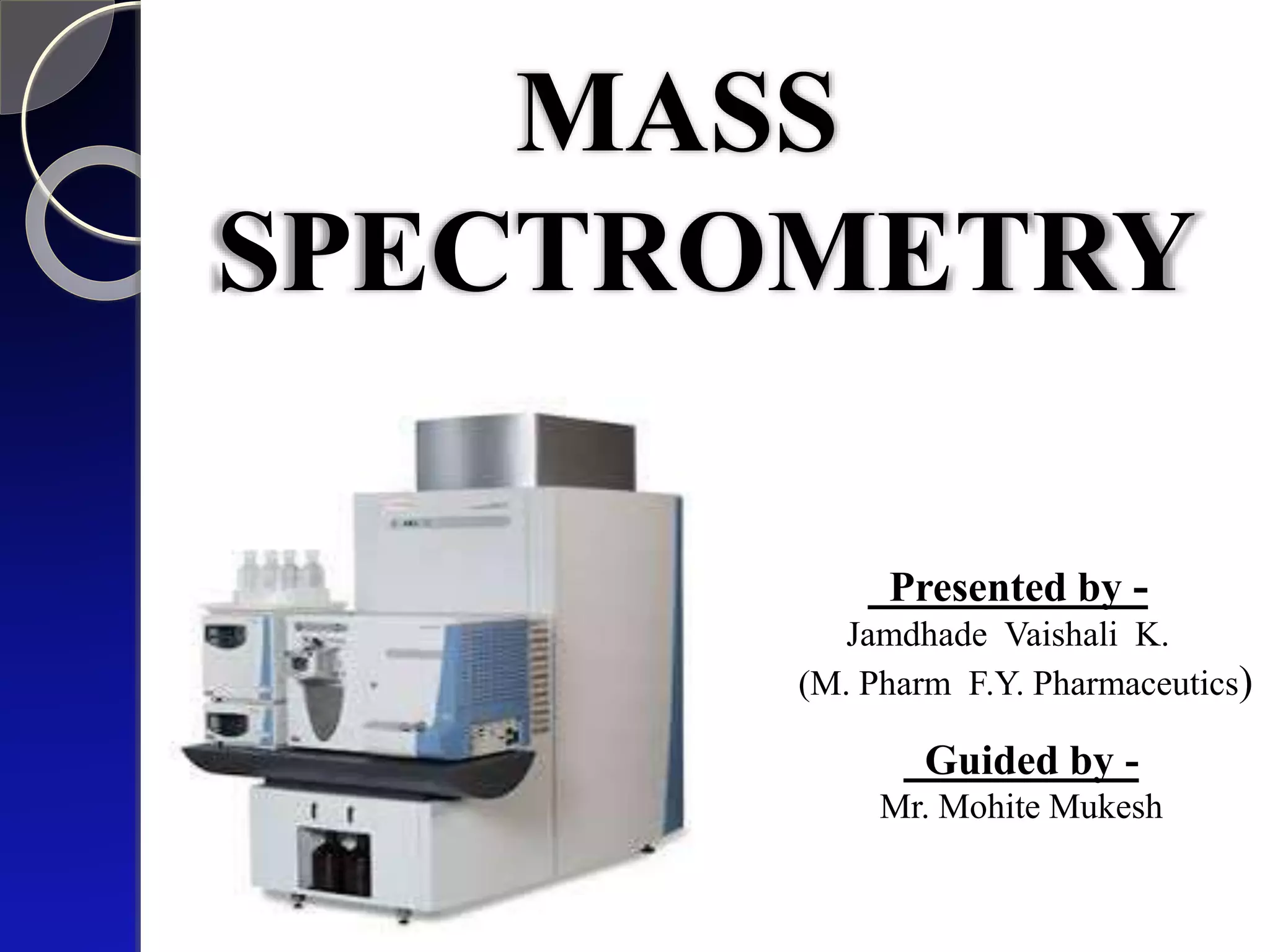
MASS
SPECTROMETRY
Presented by -
Jamdhade Vaishali K.
(M. Pharm F.Y. Pharmaceutics)
Guided by -
Mr. Mohite Mukesh
 Introduction
 Basic principle
 Fragmentation
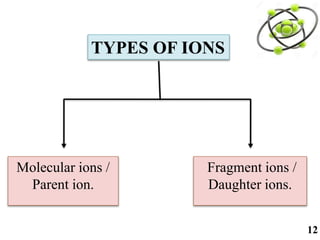
 Types of ions
 Fragmentation processes
CONTENT
1
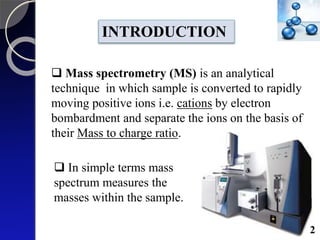
 Mass spectrometry (MS) is an analytical
technique in which sample is converted to rapidly
moving positive ions i.e. cations by electron
bombardment and separate the ions on the basis of
their Mass to charge ratio.
INTRODUCTION
 In simple terms mass
spectrum measures the
masses within the sample.
2
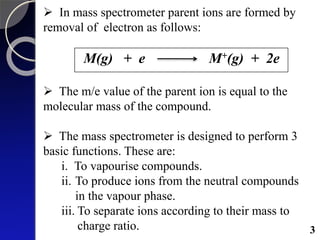
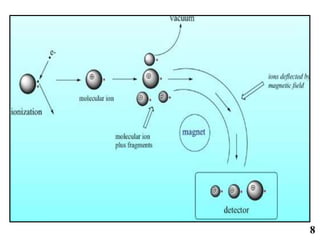
 In mass spectrometer parent ions are formed by
removal of electron as follows:
M(g) + e M+(g) + 2e
 The m/e value of the parent ion is equal to the
molecular mass of the compound.
 The mass spectrometer is designed to perform 3
basic functions. These are:
i. To vapourise compounds.
ii. To produce ions from the neutral compounds
in the vapour phase.
iii. To separate ions according to their mass to
charge ratio. 3
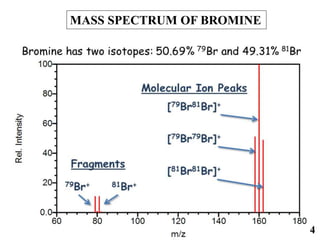
MASS SPECTRUM OF BROMINE
4
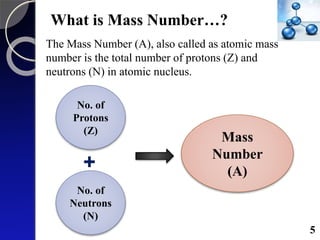
What is Mass Number…?
The Mass Number (A), also called as atomic mass
number is the total number of protons (Z) and
neutrons (N) in atomic nucleus.
Mass
Number
(A)
No. of
Neutrons
(N)
+
No. of
Protons
(Z)
5
6
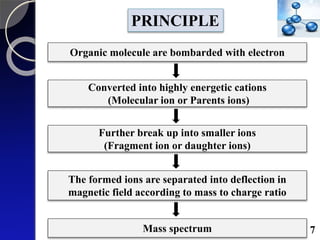
PRINCIPLE
Organic molecule are bombarded with electron
Converted into highly energetic cations
(Molecular ion or Parents ions)
Further break up into smaller ions
(Fragment ion or daughter ions)
The formed ions are separated into deflection in
magnetic field according to mass to charge ratio
Mass spectrum 7
8
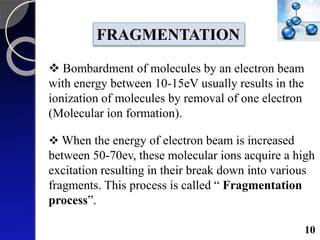
FRAGMENTATION
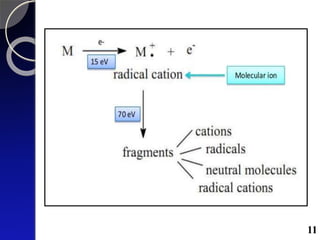
 Bombardment of molecules by an electron beam
with energy between 10-15eV usually results in the
ionization of molecules by removal of one electron
(Molecular ion formation).
 When the energy of electron beam is increased
between 50-70ev, these molecular ions acquire a high
excitation resulting in their break down into various
fragments. This process is called “ Fragmentation
process”.
10
11
12
Fragment ions /
Daughter ions.
TYPES OF IONS
Molecular ions /
Parent ion.
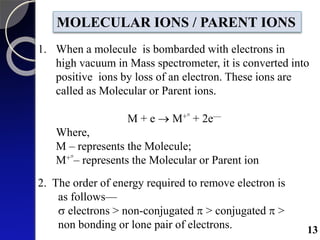
1. When a molecule is bombarded with electrons in
high vacuum in Mass spectrometer, it is converted into
positive ions by loss of an electron. These ions are
called as Molecular or Parent ions.
M + e  M+° + 2e—
Where,
M – represents the Molecule;
M+°– represents the Molecular or Parent ion
MOLECULAR IONS / PARENT IONS
2. The order of energy required to remove electron is
as follows—
 electrons > non-conjugated  > conjugated  >
non bonding or lone pair of electrons. 13
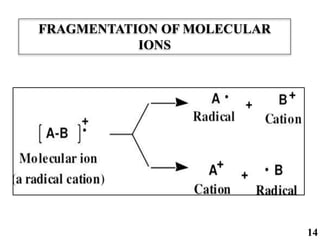
FRAGMENTATION OF MOLECULAR
IONS
14
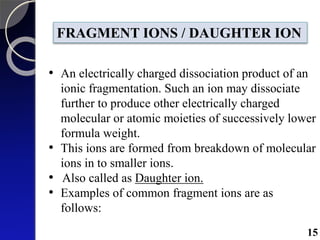
FRAGMENT IONS / DAUGHTER ION
• An electrically charged dissociation product of an
ionic fragmentation. Such an ion may dissociate
further to produce other electrically charged
molecular or atomic moieties of successively lower
formula weight.
• This ions are formed from breakdown of molecular
ions in to smaller ions.
• Also called as Daughter ion.
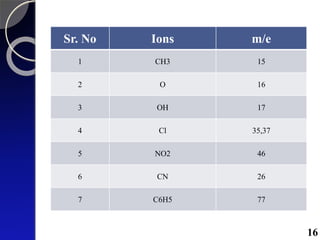
• Examples of common fragment ions are as
follows:
15
Sr. No Ions m/e
1 CH3 15
2 O 16
3 OH 17
4 Cl 35,37
5 NO2 46
6 CN 26
7 C6H5 77
16
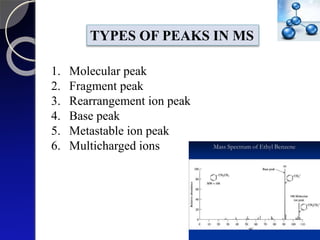
TYPES OF PEAKS IN MS
1. Molecular peak
2. Fragment peak
3. Rearrangement ion peak
4. Base peak
5. Metastable ion peak
6. Multicharged ions
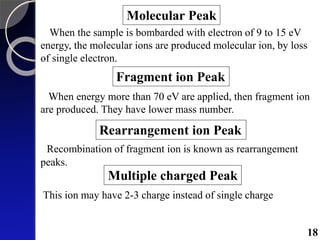
Molecular Peak
When the sample is bombarded with electron of 9 to 15 eV
energy, the molecular ions are produced molecular ion, by loss
of single electron.
Fragment ion Peak
When energy more than 70 eV are applied, then fragment ion
are produced. They have lower mass number.
Rearrangement ion Peak
Recombination of fragment ion is known as rearrangement
peaks.
Multiple charged Peak
This ion may have 2-3 charge instead of single charge
18
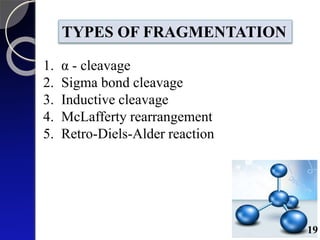
1. α - cleavage
2. Sigma bond cleavage
3. Inductive cleavage
4. McLafferty rearrangement
5. Retro-Diels-Alder reaction
TYPES OF FRAGMENTATION
19
20
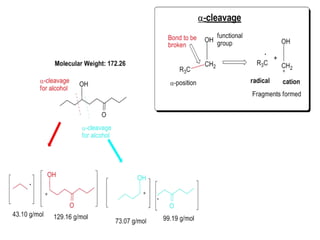
 Alpha fragmentation in MS is characteristic
fragmentation of molecular ion derived from
Carbonyl compound , in which the bond linking
the carbonyl carbon to atom shows alpha bond
breaks.
 It is expected pathway for following functional
groups - Ether
Alcohol
Halide
Amines
Carbonyl compound
α - Cleavage
Sigma Bond Cleavage
 The ionization of alkanes weakens the C-C bond,
ultimately resulting in the decomposition.
 As bond breaks, A charged, even electron species
(R+) and a neutral radical species (R•) are
generated.
 Highly substituted carbocations are more stable
than the nonsubstituted ones.
21
Inductive Cleavage
 This reaction results from the inductive effect of
the radical sites.
 This reaction is defined as a Heterolytic
Cleavage since a pair of electrons is transferred.
 The driving forces for such reaction are the
electronegativities of the radical sites:
halogens > O, S >> N, C.
 This reaction is less favored than radical-site
reactions.
22
McLafferty Rearrangement
 This involves migration of gamma- hydrogen
atom followed by the cleavage of β-bond.
 Elimination of neutral molecules from
aldehydes, ketone, amine, unsaturated
compounds, substituted aromatic compound etc
takes place.
 The rearrangement proceeds through a sterically
hindered 6 membered transation state.
23
24
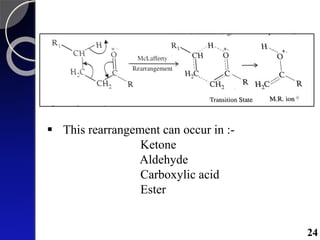
 This rearrangement can occur in :-
Ketone
Aldehyde
Carboxylic acid
Ester
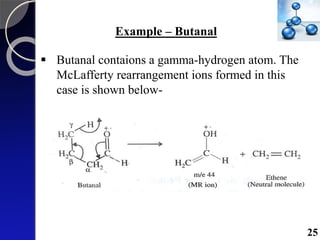
 Butanal contaions a gamma-hydrogen atom. The
McLafferty rearrangement ions formed in this
case is shown below-
25
Example – Butanal
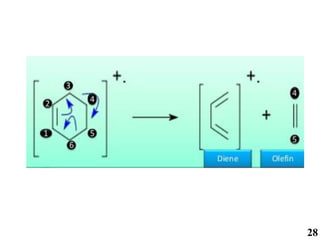
Retro-Diels -Alder Rearrangement
• This reaction occurs mainly in Cyclohexene and
its derivatives.
• In this first ionization occur and electrons from
double bond transfers to the adjacent carbon and
the electron from the bond between the 3-4 carbon
atom transfer to from a double bond that is
conjugate with the first one.
• This rearrangement cleave the molecule between
3 and 4, and 5 and 6 carbon atom.
• This rearrangement produces olefin and a diene.
26
28
THANK YOU

Mass spectrometry

  • 1.
    MASS SPECTROMETRY Presented by - JamdhadeVaishali K. (M. Pharm F.Y. Pharmaceutics) Guided by - Mr. Mohite Mukesh
  • 2.
     Introduction  Basicprinciple  Fragmentation  Types of ions  Fragmentation processes CONTENT 1
  • 3.
     Mass spectrometry(MS) is an analytical technique in which sample is converted to rapidly moving positive ions i.e. cations by electron bombardment and separate the ions on the basis of their Mass to charge ratio. INTRODUCTION  In simple terms mass spectrum measures the masses within the sample. 2
  • 4.
     In massspectrometer parent ions are formed by removal of electron as follows: M(g) + e M+(g) + 2e  The m/e value of the parent ion is equal to the molecular mass of the compound.  The mass spectrometer is designed to perform 3 basic functions. These are: i. To vapourise compounds. ii. To produce ions from the neutral compounds in the vapour phase. iii. To separate ions according to their mass to charge ratio. 3
  • 5.
  • 6.
    What is MassNumber…? The Mass Number (A), also called as atomic mass number is the total number of protons (Z) and neutrons (N) in atomic nucleus. Mass Number (A) No. of Neutrons (N) + No. of Protons (Z) 5
  • 7.
  • 8.
    PRINCIPLE Organic molecule arebombarded with electron Converted into highly energetic cations (Molecular ion or Parents ions) Further break up into smaller ions (Fragment ion or daughter ions) The formed ions are separated into deflection in magnetic field according to mass to charge ratio Mass spectrum 7
  • 9.
  • 10.
    FRAGMENTATION  Bombardment ofmolecules by an electron beam with energy between 10-15eV usually results in the ionization of molecules by removal of one electron (Molecular ion formation).  When the energy of electron beam is increased between 50-70ev, these molecular ions acquire a high excitation resulting in their break down into various fragments. This process is called “ Fragmentation process”. 10
  • 11.
  • 12.
    12 Fragment ions / Daughterions. TYPES OF IONS Molecular ions / Parent ion.
  • 13.
    1. When amolecule is bombarded with electrons in high vacuum in Mass spectrometer, it is converted into positive ions by loss of an electron. These ions are called as Molecular or Parent ions. M + e  M+° + 2e— Where, M – represents the Molecule; M+°– represents the Molecular or Parent ion MOLECULAR IONS / PARENT IONS 2. The order of energy required to remove electron is as follows—  electrons > non-conjugated  > conjugated  > non bonding or lone pair of electrons. 13
  • 14.
  • 15.
    FRAGMENT IONS /DAUGHTER ION • An electrically charged dissociation product of an ionic fragmentation. Such an ion may dissociate further to produce other electrically charged molecular or atomic moieties of successively lower formula weight. • This ions are formed from breakdown of molecular ions in to smaller ions. • Also called as Daughter ion. • Examples of common fragment ions are as follows: 15
  • 16.
    Sr. No Ionsm/e 1 CH3 15 2 O 16 3 OH 17 4 Cl 35,37 5 NO2 46 6 CN 26 7 C6H5 77 16
  • 17.
    TYPES OF PEAKSIN MS 1. Molecular peak 2. Fragment peak 3. Rearrangement ion peak 4. Base peak 5. Metastable ion peak 6. Multicharged ions
  • 18.
    Molecular Peak When thesample is bombarded with electron of 9 to 15 eV energy, the molecular ions are produced molecular ion, by loss of single electron. Fragment ion Peak When energy more than 70 eV are applied, then fragment ion are produced. They have lower mass number. Rearrangement ion Peak Recombination of fragment ion is known as rearrangement peaks. Multiple charged Peak This ion may have 2-3 charge instead of single charge 18
  • 19.
    1. α -cleavage 2. Sigma bond cleavage 3. Inductive cleavage 4. McLafferty rearrangement 5. Retro-Diels-Alder reaction TYPES OF FRAGMENTATION 19
  • 20.
    20  Alpha fragmentationin MS is characteristic fragmentation of molecular ion derived from Carbonyl compound , in which the bond linking the carbonyl carbon to atom shows alpha bond breaks.  It is expected pathway for following functional groups - Ether Alcohol Halide Amines Carbonyl compound α - Cleavage
  • 22.
    Sigma Bond Cleavage The ionization of alkanes weakens the C-C bond, ultimately resulting in the decomposition.  As bond breaks, A charged, even electron species (R+) and a neutral radical species (R•) are generated.  Highly substituted carbocations are more stable than the nonsubstituted ones. 21
  • 23.
    Inductive Cleavage  Thisreaction results from the inductive effect of the radical sites.  This reaction is defined as a Heterolytic Cleavage since a pair of electrons is transferred.  The driving forces for such reaction are the electronegativities of the radical sites: halogens > O, S >> N, C.  This reaction is less favored than radical-site reactions. 22
  • 24.
    McLafferty Rearrangement  Thisinvolves migration of gamma- hydrogen atom followed by the cleavage of β-bond.  Elimination of neutral molecules from aldehydes, ketone, amine, unsaturated compounds, substituted aromatic compound etc takes place.  The rearrangement proceeds through a sterically hindered 6 membered transation state. 23
  • 25.
    24  This rearrangementcan occur in :- Ketone Aldehyde Carboxylic acid Ester
  • 26.
     Butanal contaionsa gamma-hydrogen atom. The McLafferty rearrangement ions formed in this case is shown below- 25 Example – Butanal
  • 27.
    Retro-Diels -Alder Rearrangement •This reaction occurs mainly in Cyclohexene and its derivatives. • In this first ionization occur and electrons from double bond transfers to the adjacent carbon and the electron from the bond between the 3-4 carbon atom transfer to from a double bond that is conjugate with the first one. • This rearrangement cleave the molecule between 3 and 4, and 5 and 6 carbon atom. • This rearrangement produces olefin and a diene. 26
  • 28.
  • 29.