UV-Visible
spectroscopy
Presentation by: Prof. Samruddhi S. Khonde
Assistant Professor
P.R. Patil Institute of Pharmacy, Talegaon (S.P.)
UNIT I- IMA B Pharm Sem VII
2
Introduction
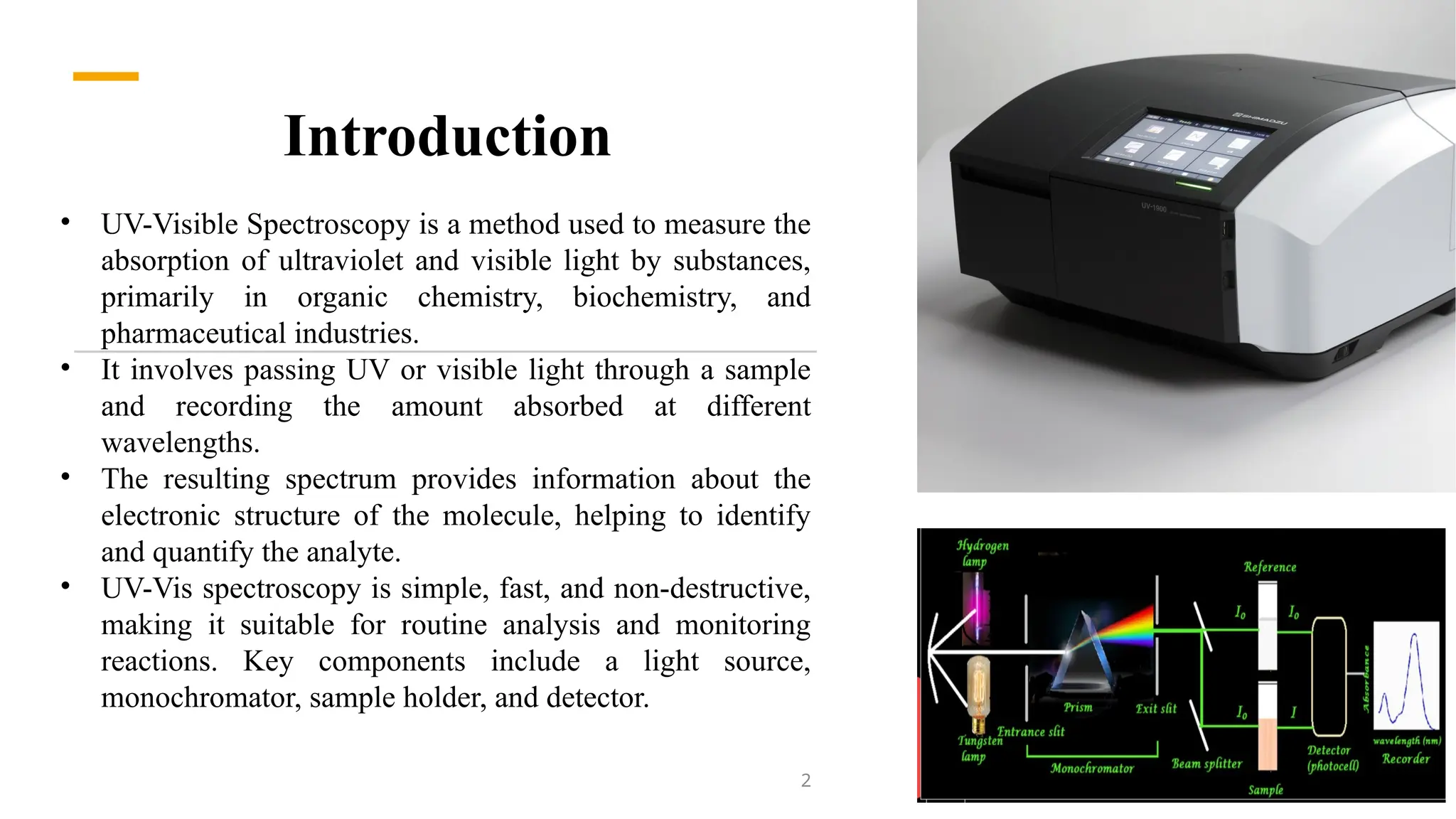
• UV-Visible Spectroscopy is a method used to measure the
absorption of ultraviolet and visible light by substances,
primarily in organic chemistry, biochemistry, and
pharmaceutical industries.
• It involves passing UV or visible light through a sample
and recording the amount absorbed at different
wavelengths.
• The resulting spectrum provides information about the
electronic structure of the molecule, helping to identify
and quantify the analyte.
• UV-Vis spectroscopy is simple, fast, and non-destructive,
making it suitable for routine analysis and monitoring
reactions. Key components include a light source,
monochromator, sample holder, and detector.
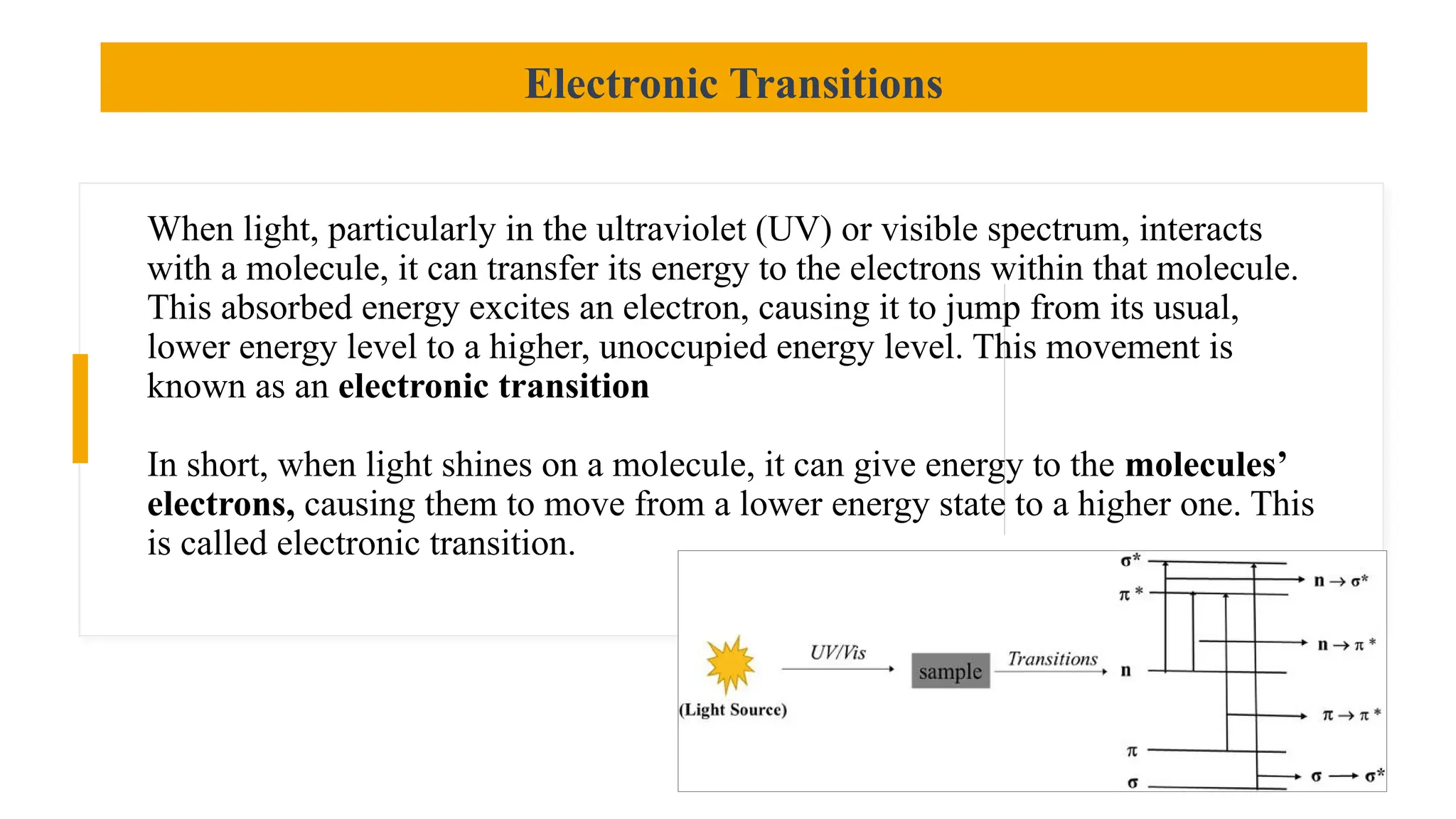
When light, particularly in the ultraviolet (UV) or visible spectrum, interacts
with a molecule, it can transfer its energy to the electrons within that molecule.
This absorbed energy excites an electron, causing it to jump from its usual,
lower energy level to a higher, unoccupied energy level. This movement is
known as an electronic transition
In short, when light shines on a molecule, it can give energy to the molecules’
electrons, causing them to move from a lower energy state to a higher one. This
is called electronic transition.
Electronic Transitions
• Molecules contain electrons that are not randomly distributed but occupy specific,
discrete energy levels. These levels can be visualized as steps on a ladder. Electrons
reside in the lowest available energy levels, known as the ground state.
Electron Energy
Levels:
• When a molecule is exposed to electromagnetic radiation (light), it can absorb photons. A
photon carries a specific amount of energy.
Light
Absorption:
• If the energy of an absorbed photon precisely matches the energy difference between an
electron's ground state level and a higher energy level (an excited state), the electron will
absorb that photon's energy.
Excitation:
• Upon absorbing this energy, the electron is promoted to the higher energy level. This is
the electronic transition.
Transition:
• Crucially, only specific wavelengths (colors) of light are absorbed because only specific
energy differences exist between the electron's energy levels within a given molecule.
This selective absorption is what allows us to identify and study molecules using
spectroscopy.
Specificity of
Absorption:
Steps of Electronic Transitions
5
Types of Electronic Transitions
9/4/20XX
• σ (sigma): Orbitals formed by head-on overlap of atomic
orbitals, typically found in single bonds.
• π (pi): Orbitals formed by the sideways overlap of atomic
orbitals, typically found in double and triple bonds.
• n (non-bonding): Lone pairs of electrons on atoms (like
oxygen, nitrogen, halogens) that are not involved in
bonding.
• * (asterisk): Denotes an antibonding orbital, which is a
higher energy orbital formed when bonding orbitals are
destabilized.
Fig: Types of Electronic Transition
Electronic transitions are categorized based on the type of orbital the electron originates from and the type
of orbital it moves to. The common notation uses Greek letters to denote orbital types:
Presentation Title 6
9/4/20XX
σ → σ* Transition:
Description: An electron
moves from a sigma (σ)
bonding orbital to an
antibonding sigma (σ*)
orbital.
• Energy
Requirement: These
transitions require the
highest amount of energy
because σ bonds are
strong, and the energy gap
between σ and σ* orbitals
is large.
• Observation: Typically
observed in the vacuum
UV region (wavelengths
below 200 nm), making
them less common in
standard UV-Vis
spectroscopy. They occur
in molecules with only
single bonds [2].
n → σ* Transition:
Description: An electron
moves from a non-
bonding (n) orbital (a lone
pair) to an antibonding
sigma (σ*) orbital.
• Energy
Requirement: These
transitions require less
energy than σ → σ*
transitions.
• Observation: Found in
molecules containing
atoms with lone pairs,
such as alcohols, ethers,
amines, and alkyl halides.
These transitions can
occur in the UV
region [2].
π → π* Transition:
Description: An electron
moves from a pi (π)
bonding orbital to an
antibonding pi (π*)
orbital.
• Energy
Requirement: These
transitions require less
energy than σ → σ*
transitions but generally
more than n → σ*
transitions.
• Observation: Common
in molecules with double
or triple bonds
(unsaturated systems) like
alkenes, alkynes, and
aromatic compounds.
These transitions are
frequently observed in the
UV-Vis spectrum and are
very important for
chromophore
identification [2].
n → π* Transition:
• Description: An electron
moves from a non-
bonding (n) orbital (a lone
pair) to an antibonding pi
(π*) orbital.
• Energy
Requirement: These
transitions typically
require the least amount
of energy among the
common types.
• Observation: Occur in
molecules that possess
both lone pairs and pi
bonds, such as carbonyl
compounds (aldehydes,
ketones), nitro
compounds, and imines.
These transitions are often
observed at longer
wavelengths (lower
energy) in the UV-Vis
spectrum compared to π
→ π* transitions [2].
Electronic Transitions
7
Chromophores:
The Light-Absorbing Units
A chromophore is a specific part of a molecule
that is responsible for absorbing light in the
ultraviolet (UV) and visible (Vis) regions of the
electromagnetic spectrum. It is the structural
feature within a molecule that contains the
electrons capable of undergoing electronic
transitions when exposed to light.
Chromophores generally contain pi bonds (π), such
as those found in double or triple bonds, or atoms
with lone pairs of electrons, known as non-bonding
electrons.
These electrons are easily excited to higher energy
antibonding orbitals, such as pi(π*) star or sigma
star (σ*) orbitals, during absorption of ultraviolet
or visible light.
Common types include:
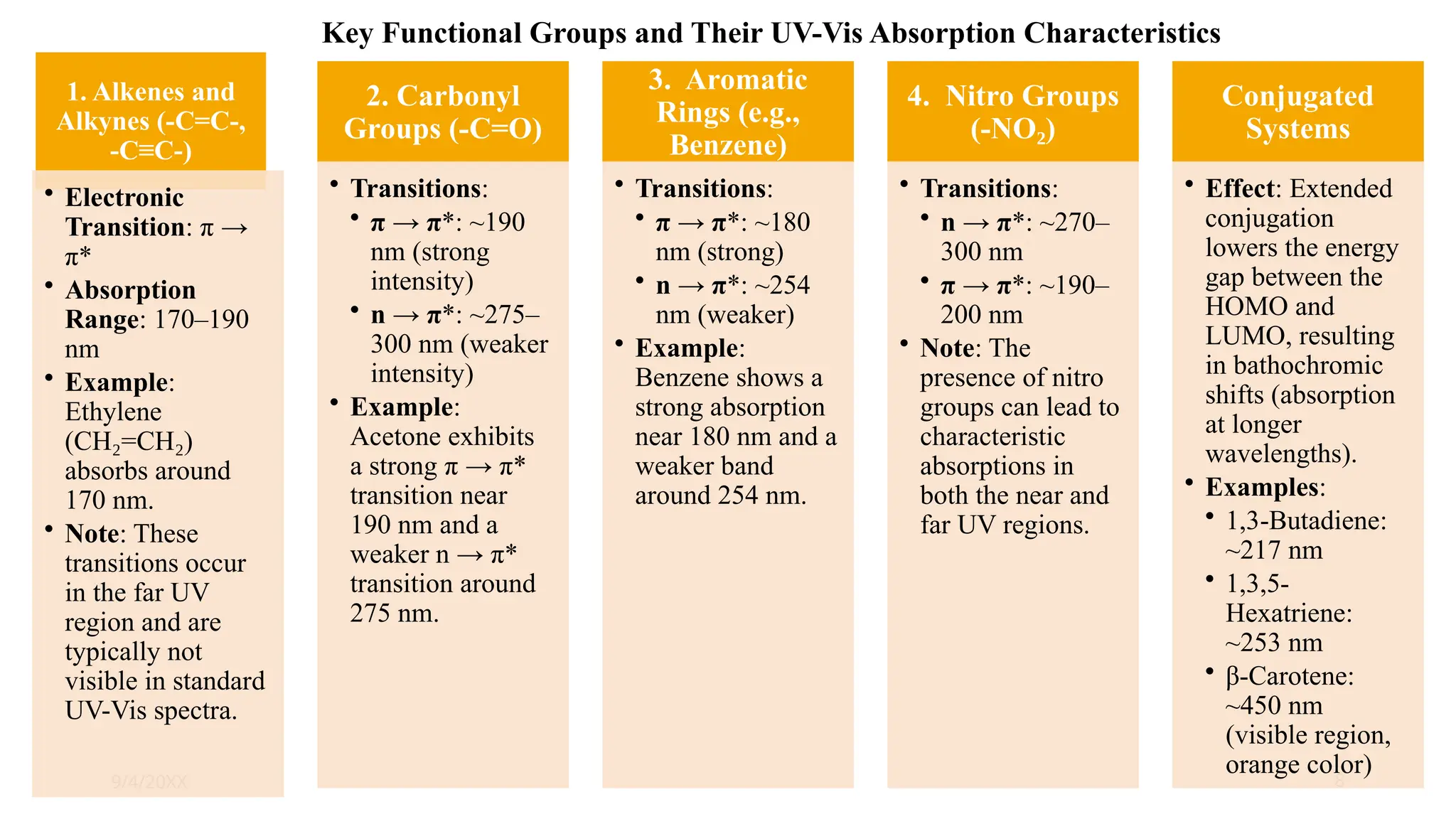
• Alkenes/Alkynes – e.g., ethylene absorbs in the far UV (170–
180 nm) via π → π* transition.
• Carbonyl Groups – e.g., aldehydes/ketones show strong π →
π* (180–200 nm) and weaker n → π* (270–300 nm) bands.
• Aromatic Rings – e.g., benzene absorbs at ~255 nm due to π
→ π* transition.
• Conjugated Systems – extended π systems lower the
HOMO–LUMO gap, causing bathochromic shifts and
stronger absorption (e.g., β-carotene absorbs in the visible
region, giving orange color).
The chromophore determines whether a molecule will absorb UV-Vis
light and which specific wavelengths it will absorb most strongly. This
is because the energy difference between the occupied and
unoccupied orbitals within the chromophore dictates the energy (and
thus wavelength) of the light absorbed
8
9/4/20XX
1. Alkenes and
Alkynes (-C=C-,
-C≡C-)
• Electronic
Transition: π →
π*
• Absorption
Range: 170–190
nm
• Example:
Ethylene
(CH =CH )
₂ ₂
absorbs around
170 nm.
• Note: These
transitions occur
in the far UV
region and are
typically not
visible in standard
UV-Vis spectra.
2. Carbonyl
Groups (-C=O)
• Transitions:
• π → π*: ~190
nm (strong
intensity)
• n → π*: ~275–
300 nm (weaker
intensity)
• Example:
Acetone exhibits
a strong π → π*
transition near
190 nm and a
weaker n → π*
transition around
275 nm.
3. Aromatic
Rings (e.g.,
Benzene)
• Transitions:
• π → π*: ~180
nm (strong)
• n → π*: ~254
nm (weaker)
• Example:
Benzene shows a
strong absorption
near 180 nm and a
weaker band
around 254 nm.
4. Nitro Groups
(-NO )
₂
• Transitions:
• n → π*: ~270–
300 nm
• π → π*: ~190–
200 nm
• Note: The
presence of nitro
groups can lead to
characteristic
absorptions in
both the near and
far UV regions.
Conjugated
Systems
• Effect: Extended
conjugation
lowers the energy
gap between the
HOMO and
LUMO, resulting
in bathochromic
shifts (absorption
at longer
wavelengths).
• Examples:
• 1,3-Butadiene:
~217 nm
• 1,3,5-
Hexatriene:
~253 nm
• β-Carotene:
~450 nm
(visible region,
orange color)
Key Functional Groups and Their UV-Vis Absorption Characteristics
Auxochrome:
The Light-Modifying Units
An Auxochrome is a functional group attached to a chromophore that
modifies the ability of the chromophore to absorb light, thereby
affecting the intensity and wavelength of absorption. It does not itself
cause absorption but influences the electronic environment of the
chromophore, enhancing or shifting the absorption spectrum.
• Auxochromes contain atoms or groups with lone pairs of
electrons, such as hydroxyl, amino, or alkoxy groups, which can
participate in resonance or conjugation with the chromophore .
• These groups can donate or withdraw electrons through resonance
or inductive effects, altering the electron density of the
chromophore and thus changing its absorption characteristics.
Auxochromes are crucial in color chemistry, as they help produce the
visible colors of dyes and pigments by shifting absorption to different
wavelengths
Common types include:
Typical auxochromes include:
Acidic types: –OH, –COOH, –SO H
₃
Basic types: –NH , –NHR, –NR
₂ ₂
They all contain lone pairs and act as
electron-donating (via resonance or
induction) to extend conjugation.
Auxochrome:
The Light-Modifying Units
Common types include:
• Hydroxyl group (-OH): When attached to a chromophore like an aromatic ring (e.g., in phenol), it donates electron density via
resonance, causing a bathochromic shift (to longer wavelengths) and an increase in absorption intensity (hyperchromic effect)
• Amino group (-NH2): Attached to a chromophore such as an aromatic ring (e.g., in aniline), it acts as a strong electron-donating group
through resonance, leading to a significant bathochromic shift and a hyperchromic effect, often producing visible color.
• Alkoxy group (-OR): Similar to the hydroxyl group, alkoxy groups donate electron density via resonance, resulting in bathochromic and
hyperchromic effects when they are part of a chromophoric system.
• Halogens (-X, where X = F, Cl, Br, I): These groups can donate electrons via resonance (due to lone pairs) while also withdrawing
electrons inductively. This typically results in a slight bathochromic shift and can cause either a hypochromic effect (decrease in
intensity) or a small bathochromic shift.
Changes in Light
Absorption: Spectral
Shifts
Spectral shifts
Spectral shifts refer to changes in the absorption characteristics of molecules when they
interact with light, particularly in the ultraviolet (UV) and visible regions of the
electromagnetic spectrum. These shifts can manifest as changes in the wavelength at which
maximum absorption occurs or in the intensity of absorption.
Understanding these phenomena is crucial for interpreting spectroscopic data and predicting how
structural modifications or environmental changes affect a molecule's interaction with light
common types of spectral shifts :
 Bathochromic Shift (Red Shift)
 Hypsochromic Shift (Blue Shift)
 Hyperchromic Effect
 Hypochromic Effect
9/4/20XX
Types of spectral shifts
9/4/20XX
Bathochromic shift : A bathochromic shift, also known as a red shift, occurs when the wavelength of
maximum absorption of a molecule shifts to a longer wavelength. This phenomenon is caused by a decrease
in the energy difference between the ground electronic state and the excited electronic state. Consequently,
the molecule requires less energy, corresponding to lower energy photons (longer wavelengths), to undergo
an electronic transition .
Common causes for a bathochromic shift include:
• Increased Conjugation: Extending the system of alternating double and single bonds (conjugated
systems) lowers the energy gap between the highest occupied molecular orbital (HOMO) and the lowest
unoccupied molecular orbital (LUMO).
“Extended π systems lower the HOMO–LUMO gap, causing bathochromic shifts".
• Attachment of Auxochromes: The presence of auxochromes, which are functional groups with lone pairs
of electrons (like -OH or -NH2), can donate electron density to the chromophore through resonance. This
donation increases electron delocalization and lowers the energy required for excitation.
• Solvent Effects: Changes in the polarity of the solvent can also influence the electronic states of a
molecule, sometimes leading to a bathochromic shift.
A bathochromic shift often results in the substance appearing more intensely colored or shifting its perceived
color towards the red end of the visible spectrum
Types of spectral shifts
9/4/20XX
Hypsochromic Shift (Blue Shift)
A hypsochromic shift, also known as a blue shift, occurs when the wavelength at which a molecule absorbs
most strongly moves toward a shorter wavelength. This change reflects an increase in the energy difference
between the molecule’s ground electronic state and its excited electronic state. As a result, the molecule
requires photons of higher energy—those with shorter wavelengths—to undergo its electronic transition.
Factors that can cause a hypsochromic shift include:
Decreased Conjugation: Shortening or breaking conjugated systems reduces
electron delocalization, thereby increasing the HOMO–LUMO gap and
requiring more energy for excitation.
Attachment of Electron-Withdrawing Groups: Certain groups can disrupt
the electronic system of the chromophore, leading to a hypsochromic shift.
Solvent Effects: Similar to bathochromic shifts, changes in solvent polarity
can also induce hypsochromic shifts.
A hypsochromic shift typically makes a substance appear less colored or
shifts its color towards the blue end of the spectrum.
Types of spectral shifts
9/4/20XX
Hyperchromic Effect
The hyperchromic effect is characterized by an increase in the intensity of absorption, meaning
the molar absorptivity of the molecule increases. This results in a taller peak in the absorption
spectrum, indicating a greater probability of the electronic transition occurring when the
molecule interacts with light.
Causes for a hyperchromic effect include:
• Attachment of Auxochromes: Auxochromes can enhance the transition probability by
increasing electron delocalization or altering the electronic distribution within the
chromophore.
• Increased Planarity: When a molecule becomes more planar, it often leads to better overlap
of atomic orbitals, facilitating electronic transitions and increasing absorption intensity.
• Changes in Molecular Environment: The surrounding medium can also influence the
probability of electronic transitions.
Types of spectral shifts
9/4/20XX
Hypochromic effect: A hypochromic effect is the opposite
of a hyperchromic effect, characterized by a decrease in the
intensity of absorption (a decrease in molar absorptivity.
This leads to a shorter peak in the absorption spectrum,
signifying a decreased probability of the electronic
transition.
Common causes for a hypochromic effect include:
• Disruption of Conjugation: If the conjugation within a
molecule is disrupted, for example, by twisting of the
molecule out of planarity due to steric hindrance, the
absorption intensity can decrease.
• Intermolecular Interactions: Aggregation or specific
interactions between molecules can sometimes lead to a
hypochromic effect by altering the electronic transitions.
Fig: Illustrative diagram showing Types of Spectral shifts in
Absorption
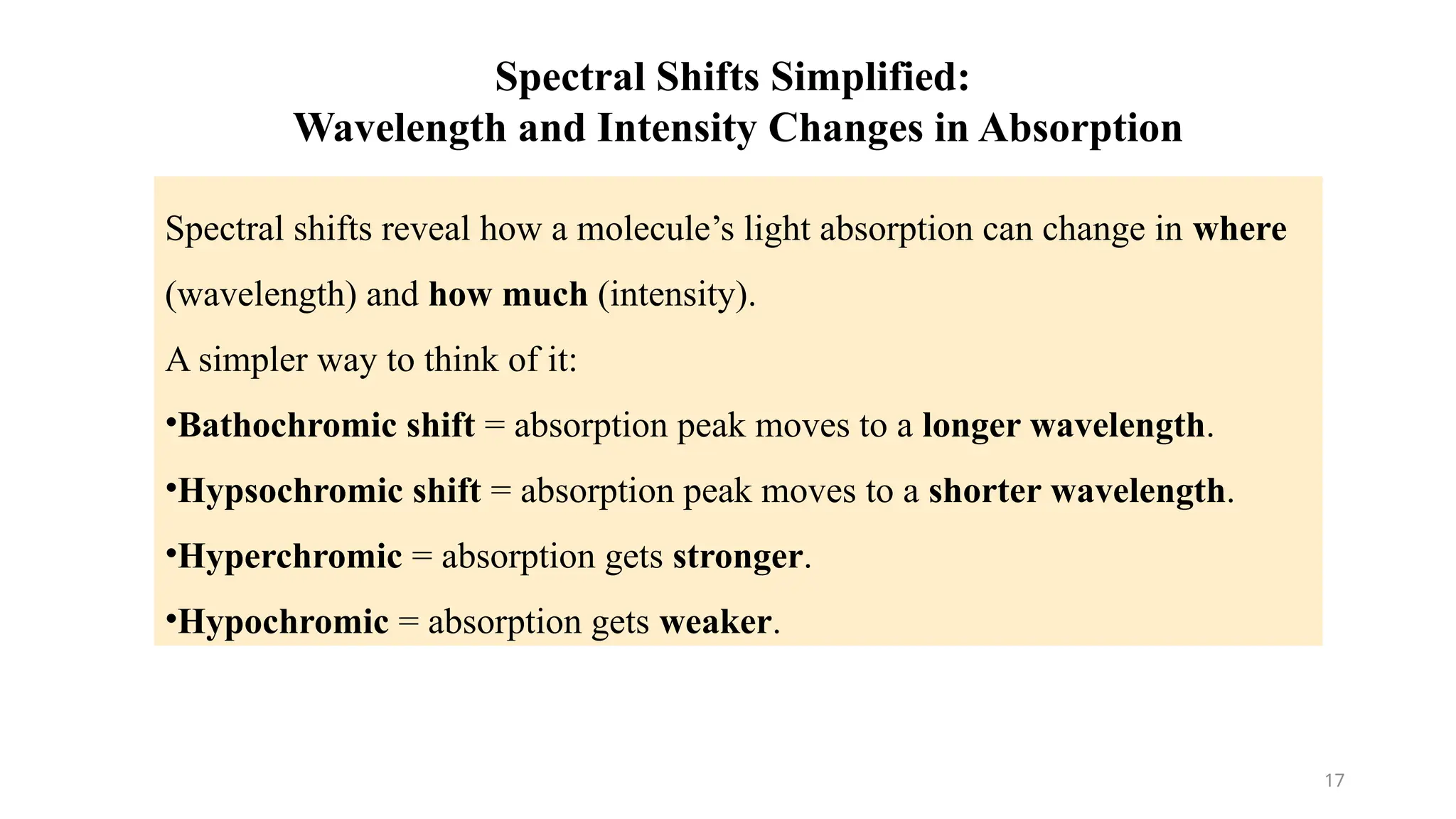
17
Spectral shifts reveal how a molecule’s light absorption can change in where
(wavelength) and how much (intensity).
A simpler way to think of it:
•Bathochromic shift = absorption peak moves to a longer wavelength.
•Hypsochromic shift = absorption peak moves to a shorter wavelength.
•Hyperchromic = absorption gets stronger.
•Hypochromic = absorption gets weaker.
Spectral Shifts Simplified:
Wavelength and Intensity Changes in Absorption
18
Solvent Effect on Absorption Spectra
The liquid a molecule is dissolved in, known as the solvent, can significantly affect how it interacts with light. Solvents
are not just passive containers; they actively interact with the molecules dissolved within them, and these interactions
can alter the energy levels of the molecule's electrons. This, in turn, changes the specific wavelengths of light the
molecule absorbs.
• Polar Solvents: These solvents, like water, alcohols (such as ethanol or methanol), or acetone, have an uneven
distribution of electrical charge. One part of the solvent molecule might be slightly positive, while another part is
slightly negative. This unevenness allows them to interact strongly with molecules that also have charges or uneven
charge distributions (like polar bonds or lone pairs of electrons).
• Non-Polar Solvents: These solvents, like hexane, benzene, or carbon tetrachloride, have a more even distribution of
electrical charge. They tend to interact more weakly with dissolved molecules, primarily through weaker forces.
Solvent Effect on Absorption Spectra
Changing Energy Levels
When a molecule absorbs light, its electrons jump to a
higher energy level. The amount of energy needed for
this jump depends on the molecule's internal energy
levels.
Solvents can affect these internal energy levels:
• Stabilizing Energy States: Polar solvents are
particularly good at interacting with and "stabilizing"
certain energy states of a molecule. This means they can
lower the energy of those states.
• Differential Stabilization: The key is that a polar
solvent might stabilize the molecule's normal, low-
energy state (the ground state) differently than it
stabilizes the molecule's higher-energy, excited state
(after it has absorbed light).
Shifting the Absorption
• If the solvent stabilizes the excited state more than
the ground state: This makes the energy jump from
the ground state to the excited state smaller. A
smaller energy jump means the molecule needs less
energy from light to get excited. Light with less
energy is found at longer wavelengths. So, the
absorption peak shifts to a longer wavelength (a "red
shift").
• If the solvent stabilizes the ground state more than
the excited state: This makes the energy
jump larger. A larger energy jump means the
molecule needs more energy from light to get
excited. Light with more energy is found at shorter
wavelengths. So, the absorption peak shifts to a
shorter wavelength (a "blue shift").
Beer-Lambert Law
• Beer’s Law, formulated by August Beer in 1825, states that the absorbance (A) of light by a
medium is directly proportional to the concentration (c) of the absorbing species. This means
that as the concentration increases, the absorbance also increases proportionally, assuming other
factors remain constant.
Represented as : A c
∝
• Lambert’s Law, established by Johann Heinrich Lambert, states
that the absorbance of a medium is directly proportional to the path
length (l)—the distance that light travels through the medium. This
means that as the path length increases, the absorbance increases
proportionally.
Represented as : A l
∝
Beer-Lambert Law
• The Beer–Lambert Law, also known as the Beer-Lambert-Bouguer Law, combines the
principles of Beer's Law and Lambert's Law. It states that the absorbance of a solution is
directly proportional to the concentration of the absorbing species and the path length the
light travels through the solution.
• The law can be expressed mathematically as: A=εcl,
Variables:
• A: Absorbance (dimensionless)
• ε: Molar absorptivity or extinction coefficient (characteristic for each substance at a given wavelength)
expressed in units of liters per mole per centimeter (L mol ¹ cm ¹). It quantifies how strongly a chemical
⁻ ⁻
species absorbs light at a given wavelength.
• c: Concentration of the solution
• l: Path length of the light through the sample (e.g., cuvette width)
The absorbance is often defined in terms of incident (I0) and transmitted (I) light intensities: A=log10​
(I0 /I​
​
)
22
THANK YOU
Topic Key Point (Simple Explanation)
Electronic Transition Electrons jump to higher energy with light.
Chromophore Part of molecule causing color/absorption.
Auxochrome Changes/shifts chromophore’s absorption.
Spectral Shifts Absorption moves to different wavelengths (colors).
Solvent Effect Solvent can change where and how much sample absorbs.
Beer-Lambert Law Absorbance = constant × concentration × path length.
Summary Table:
Law Relationship Proportional to
Beer’s Law A c
∝ Concentration
Lamberts Law A l
∝ Path length
Beer’s and Lambert’s Law A=εcl
Both concentration and
path length

UV-Visible spectroscopy..pptx UV-Visible Spectroscopy – Electronic Transitions, Chromophores & Auxochromes, Spectral Shifts, Solvent Effects, and Beer–Lambert’s Law

  • 1.
    UV-Visible spectroscopy Presentation by: Prof.Samruddhi S. Khonde Assistant Professor P.R. Patil Institute of Pharmacy, Talegaon (S.P.) UNIT I- IMA B Pharm Sem VII
  • 2.
    2 Introduction • UV-Visible Spectroscopyis a method used to measure the absorption of ultraviolet and visible light by substances, primarily in organic chemistry, biochemistry, and pharmaceutical industries. • It involves passing UV or visible light through a sample and recording the amount absorbed at different wavelengths. • The resulting spectrum provides information about the electronic structure of the molecule, helping to identify and quantify the analyte. • UV-Vis spectroscopy is simple, fast, and non-destructive, making it suitable for routine analysis and monitoring reactions. Key components include a light source, monochromator, sample holder, and detector.
  • 3.
    When light, particularlyin the ultraviolet (UV) or visible spectrum, interacts with a molecule, it can transfer its energy to the electrons within that molecule. This absorbed energy excites an electron, causing it to jump from its usual, lower energy level to a higher, unoccupied energy level. This movement is known as an electronic transition In short, when light shines on a molecule, it can give energy to the molecules’ electrons, causing them to move from a lower energy state to a higher one. This is called electronic transition. Electronic Transitions
  • 4.
    • Molecules containelectrons that are not randomly distributed but occupy specific, discrete energy levels. These levels can be visualized as steps on a ladder. Electrons reside in the lowest available energy levels, known as the ground state. Electron Energy Levels: • When a molecule is exposed to electromagnetic radiation (light), it can absorb photons. A photon carries a specific amount of energy. Light Absorption: • If the energy of an absorbed photon precisely matches the energy difference between an electron's ground state level and a higher energy level (an excited state), the electron will absorb that photon's energy. Excitation: • Upon absorbing this energy, the electron is promoted to the higher energy level. This is the electronic transition. Transition: • Crucially, only specific wavelengths (colors) of light are absorbed because only specific energy differences exist between the electron's energy levels within a given molecule. This selective absorption is what allows us to identify and study molecules using spectroscopy. Specificity of Absorption: Steps of Electronic Transitions
  • 5.
    5 Types of ElectronicTransitions 9/4/20XX • σ (sigma): Orbitals formed by head-on overlap of atomic orbitals, typically found in single bonds. • π (pi): Orbitals formed by the sideways overlap of atomic orbitals, typically found in double and triple bonds. • n (non-bonding): Lone pairs of electrons on atoms (like oxygen, nitrogen, halogens) that are not involved in bonding. • * (asterisk): Denotes an antibonding orbital, which is a higher energy orbital formed when bonding orbitals are destabilized. Fig: Types of Electronic Transition Electronic transitions are categorized based on the type of orbital the electron originates from and the type of orbital it moves to. The common notation uses Greek letters to denote orbital types:
  • 6.
    Presentation Title 6 9/4/20XX σ→ σ* Transition: Description: An electron moves from a sigma (σ) bonding orbital to an antibonding sigma (σ*) orbital. • Energy Requirement: These transitions require the highest amount of energy because σ bonds are strong, and the energy gap between σ and σ* orbitals is large. • Observation: Typically observed in the vacuum UV region (wavelengths below 200 nm), making them less common in standard UV-Vis spectroscopy. They occur in molecules with only single bonds [2]. n → σ* Transition: Description: An electron moves from a non- bonding (n) orbital (a lone pair) to an antibonding sigma (σ*) orbital. • Energy Requirement: These transitions require less energy than σ → σ* transitions. • Observation: Found in molecules containing atoms with lone pairs, such as alcohols, ethers, amines, and alkyl halides. These transitions can occur in the UV region [2]. π → π* Transition: Description: An electron moves from a pi (π) bonding orbital to an antibonding pi (π*) orbital. • Energy Requirement: These transitions require less energy than σ → σ* transitions but generally more than n → σ* transitions. • Observation: Common in molecules with double or triple bonds (unsaturated systems) like alkenes, alkynes, and aromatic compounds. These transitions are frequently observed in the UV-Vis spectrum and are very important for chromophore identification [2]. n → π* Transition: • Description: An electron moves from a non- bonding (n) orbital (a lone pair) to an antibonding pi (π*) orbital. • Energy Requirement: These transitions typically require the least amount of energy among the common types. • Observation: Occur in molecules that possess both lone pairs and pi bonds, such as carbonyl compounds (aldehydes, ketones), nitro compounds, and imines. These transitions are often observed at longer wavelengths (lower energy) in the UV-Vis spectrum compared to π → π* transitions [2]. Electronic Transitions
  • 7.
    7 Chromophores: The Light-Absorbing Units Achromophore is a specific part of a molecule that is responsible for absorbing light in the ultraviolet (UV) and visible (Vis) regions of the electromagnetic spectrum. It is the structural feature within a molecule that contains the electrons capable of undergoing electronic transitions when exposed to light. Chromophores generally contain pi bonds (π), such as those found in double or triple bonds, or atoms with lone pairs of electrons, known as non-bonding electrons. These electrons are easily excited to higher energy antibonding orbitals, such as pi(π*) star or sigma star (σ*) orbitals, during absorption of ultraviolet or visible light. Common types include: • Alkenes/Alkynes – e.g., ethylene absorbs in the far UV (170– 180 nm) via π → π* transition. • Carbonyl Groups – e.g., aldehydes/ketones show strong π → π* (180–200 nm) and weaker n → π* (270–300 nm) bands. • Aromatic Rings – e.g., benzene absorbs at ~255 nm due to π → π* transition. • Conjugated Systems – extended π systems lower the HOMO–LUMO gap, causing bathochromic shifts and stronger absorption (e.g., β-carotene absorbs in the visible region, giving orange color). The chromophore determines whether a molecule will absorb UV-Vis light and which specific wavelengths it will absorb most strongly. This is because the energy difference between the occupied and unoccupied orbitals within the chromophore dictates the energy (and thus wavelength) of the light absorbed
  • 8.
    8 9/4/20XX 1. Alkenes and Alkynes(-C=C-, -C≡C-) • Electronic Transition: π → π* • Absorption Range: 170–190 nm • Example: Ethylene (CH =CH ) ₂ ₂ absorbs around 170 nm. • Note: These transitions occur in the far UV region and are typically not visible in standard UV-Vis spectra. 2. Carbonyl Groups (-C=O) • Transitions: • π → π*: ~190 nm (strong intensity) • n → π*: ~275– 300 nm (weaker intensity) • Example: Acetone exhibits a strong π → π* transition near 190 nm and a weaker n → π* transition around 275 nm. 3. Aromatic Rings (e.g., Benzene) • Transitions: • π → π*: ~180 nm (strong) • n → π*: ~254 nm (weaker) • Example: Benzene shows a strong absorption near 180 nm and a weaker band around 254 nm. 4. Nitro Groups (-NO ) ₂ • Transitions: • n → π*: ~270– 300 nm • π → π*: ~190– 200 nm • Note: The presence of nitro groups can lead to characteristic absorptions in both the near and far UV regions. Conjugated Systems • Effect: Extended conjugation lowers the energy gap between the HOMO and LUMO, resulting in bathochromic shifts (absorption at longer wavelengths). • Examples: • 1,3-Butadiene: ~217 nm • 1,3,5- Hexatriene: ~253 nm • β-Carotene: ~450 nm (visible region, orange color) Key Functional Groups and Their UV-Vis Absorption Characteristics
  • 9.
    Auxochrome: The Light-Modifying Units AnAuxochrome is a functional group attached to a chromophore that modifies the ability of the chromophore to absorb light, thereby affecting the intensity and wavelength of absorption. It does not itself cause absorption but influences the electronic environment of the chromophore, enhancing or shifting the absorption spectrum. • Auxochromes contain atoms or groups with lone pairs of electrons, such as hydroxyl, amino, or alkoxy groups, which can participate in resonance or conjugation with the chromophore . • These groups can donate or withdraw electrons through resonance or inductive effects, altering the electron density of the chromophore and thus changing its absorption characteristics. Auxochromes are crucial in color chemistry, as they help produce the visible colors of dyes and pigments by shifting absorption to different wavelengths Common types include: Typical auxochromes include: Acidic types: –OH, –COOH, –SO H ₃ Basic types: –NH , –NHR, –NR ₂ ₂ They all contain lone pairs and act as electron-donating (via resonance or induction) to extend conjugation.
  • 10.
    Auxochrome: The Light-Modifying Units Commontypes include: • Hydroxyl group (-OH): When attached to a chromophore like an aromatic ring (e.g., in phenol), it donates electron density via resonance, causing a bathochromic shift (to longer wavelengths) and an increase in absorption intensity (hyperchromic effect) • Amino group (-NH2): Attached to a chromophore such as an aromatic ring (e.g., in aniline), it acts as a strong electron-donating group through resonance, leading to a significant bathochromic shift and a hyperchromic effect, often producing visible color. • Alkoxy group (-OR): Similar to the hydroxyl group, alkoxy groups donate electron density via resonance, resulting in bathochromic and hyperchromic effects when they are part of a chromophoric system. • Halogens (-X, where X = F, Cl, Br, I): These groups can donate electrons via resonance (due to lone pairs) while also withdrawing electrons inductively. This typically results in a slight bathochromic shift and can cause either a hypochromic effect (decrease in intensity) or a small bathochromic shift.
  • 11.
  • 12.
    Spectral shifts Spectral shiftsrefer to changes in the absorption characteristics of molecules when they interact with light, particularly in the ultraviolet (UV) and visible regions of the electromagnetic spectrum. These shifts can manifest as changes in the wavelength at which maximum absorption occurs or in the intensity of absorption. Understanding these phenomena is crucial for interpreting spectroscopic data and predicting how structural modifications or environmental changes affect a molecule's interaction with light common types of spectral shifts :  Bathochromic Shift (Red Shift)  Hypsochromic Shift (Blue Shift)  Hyperchromic Effect  Hypochromic Effect 9/4/20XX
  • 13.
    Types of spectralshifts 9/4/20XX Bathochromic shift : A bathochromic shift, also known as a red shift, occurs when the wavelength of maximum absorption of a molecule shifts to a longer wavelength. This phenomenon is caused by a decrease in the energy difference between the ground electronic state and the excited electronic state. Consequently, the molecule requires less energy, corresponding to lower energy photons (longer wavelengths), to undergo an electronic transition . Common causes for a bathochromic shift include: • Increased Conjugation: Extending the system of alternating double and single bonds (conjugated systems) lowers the energy gap between the highest occupied molecular orbital (HOMO) and the lowest unoccupied molecular orbital (LUMO). “Extended π systems lower the HOMO–LUMO gap, causing bathochromic shifts". • Attachment of Auxochromes: The presence of auxochromes, which are functional groups with lone pairs of electrons (like -OH or -NH2), can donate electron density to the chromophore through resonance. This donation increases electron delocalization and lowers the energy required for excitation. • Solvent Effects: Changes in the polarity of the solvent can also influence the electronic states of a molecule, sometimes leading to a bathochromic shift. A bathochromic shift often results in the substance appearing more intensely colored or shifting its perceived color towards the red end of the visible spectrum
  • 14.
    Types of spectralshifts 9/4/20XX Hypsochromic Shift (Blue Shift) A hypsochromic shift, also known as a blue shift, occurs when the wavelength at which a molecule absorbs most strongly moves toward a shorter wavelength. This change reflects an increase in the energy difference between the molecule’s ground electronic state and its excited electronic state. As a result, the molecule requires photons of higher energy—those with shorter wavelengths—to undergo its electronic transition. Factors that can cause a hypsochromic shift include: Decreased Conjugation: Shortening or breaking conjugated systems reduces electron delocalization, thereby increasing the HOMO–LUMO gap and requiring more energy for excitation. Attachment of Electron-Withdrawing Groups: Certain groups can disrupt the electronic system of the chromophore, leading to a hypsochromic shift. Solvent Effects: Similar to bathochromic shifts, changes in solvent polarity can also induce hypsochromic shifts. A hypsochromic shift typically makes a substance appear less colored or shifts its color towards the blue end of the spectrum.
  • 15.
    Types of spectralshifts 9/4/20XX Hyperchromic Effect The hyperchromic effect is characterized by an increase in the intensity of absorption, meaning the molar absorptivity of the molecule increases. This results in a taller peak in the absorption spectrum, indicating a greater probability of the electronic transition occurring when the molecule interacts with light. Causes for a hyperchromic effect include: • Attachment of Auxochromes: Auxochromes can enhance the transition probability by increasing electron delocalization or altering the electronic distribution within the chromophore. • Increased Planarity: When a molecule becomes more planar, it often leads to better overlap of atomic orbitals, facilitating electronic transitions and increasing absorption intensity. • Changes in Molecular Environment: The surrounding medium can also influence the probability of electronic transitions.
  • 16.
    Types of spectralshifts 9/4/20XX Hypochromic effect: A hypochromic effect is the opposite of a hyperchromic effect, characterized by a decrease in the intensity of absorption (a decrease in molar absorptivity. This leads to a shorter peak in the absorption spectrum, signifying a decreased probability of the electronic transition. Common causes for a hypochromic effect include: • Disruption of Conjugation: If the conjugation within a molecule is disrupted, for example, by twisting of the molecule out of planarity due to steric hindrance, the absorption intensity can decrease. • Intermolecular Interactions: Aggregation or specific interactions between molecules can sometimes lead to a hypochromic effect by altering the electronic transitions. Fig: Illustrative diagram showing Types of Spectral shifts in Absorption
  • 17.
    17 Spectral shifts revealhow a molecule’s light absorption can change in where (wavelength) and how much (intensity). A simpler way to think of it: •Bathochromic shift = absorption peak moves to a longer wavelength. •Hypsochromic shift = absorption peak moves to a shorter wavelength. •Hyperchromic = absorption gets stronger. •Hypochromic = absorption gets weaker. Spectral Shifts Simplified: Wavelength and Intensity Changes in Absorption
  • 18.
    18 Solvent Effect onAbsorption Spectra The liquid a molecule is dissolved in, known as the solvent, can significantly affect how it interacts with light. Solvents are not just passive containers; they actively interact with the molecules dissolved within them, and these interactions can alter the energy levels of the molecule's electrons. This, in turn, changes the specific wavelengths of light the molecule absorbs. • Polar Solvents: These solvents, like water, alcohols (such as ethanol or methanol), or acetone, have an uneven distribution of electrical charge. One part of the solvent molecule might be slightly positive, while another part is slightly negative. This unevenness allows them to interact strongly with molecules that also have charges or uneven charge distributions (like polar bonds or lone pairs of electrons). • Non-Polar Solvents: These solvents, like hexane, benzene, or carbon tetrachloride, have a more even distribution of electrical charge. They tend to interact more weakly with dissolved molecules, primarily through weaker forces.
  • 19.
    Solvent Effect onAbsorption Spectra Changing Energy Levels When a molecule absorbs light, its electrons jump to a higher energy level. The amount of energy needed for this jump depends on the molecule's internal energy levels. Solvents can affect these internal energy levels: • Stabilizing Energy States: Polar solvents are particularly good at interacting with and "stabilizing" certain energy states of a molecule. This means they can lower the energy of those states. • Differential Stabilization: The key is that a polar solvent might stabilize the molecule's normal, low- energy state (the ground state) differently than it stabilizes the molecule's higher-energy, excited state (after it has absorbed light). Shifting the Absorption • If the solvent stabilizes the excited state more than the ground state: This makes the energy jump from the ground state to the excited state smaller. A smaller energy jump means the molecule needs less energy from light to get excited. Light with less energy is found at longer wavelengths. So, the absorption peak shifts to a longer wavelength (a "red shift"). • If the solvent stabilizes the ground state more than the excited state: This makes the energy jump larger. A larger energy jump means the molecule needs more energy from light to get excited. Light with more energy is found at shorter wavelengths. So, the absorption peak shifts to a shorter wavelength (a "blue shift").
  • 20.
    Beer-Lambert Law • Beer’sLaw, formulated by August Beer in 1825, states that the absorbance (A) of light by a medium is directly proportional to the concentration (c) of the absorbing species. This means that as the concentration increases, the absorbance also increases proportionally, assuming other factors remain constant. Represented as : A c ∝ • Lambert’s Law, established by Johann Heinrich Lambert, states that the absorbance of a medium is directly proportional to the path length (l)—the distance that light travels through the medium. This means that as the path length increases, the absorbance increases proportionally. Represented as : A l ∝
  • 21.
    Beer-Lambert Law • TheBeer–Lambert Law, also known as the Beer-Lambert-Bouguer Law, combines the principles of Beer's Law and Lambert's Law. It states that the absorbance of a solution is directly proportional to the concentration of the absorbing species and the path length the light travels through the solution. • The law can be expressed mathematically as: A=εcl, Variables: • A: Absorbance (dimensionless) • ε: Molar absorptivity or extinction coefficient (characteristic for each substance at a given wavelength) expressed in units of liters per mole per centimeter (L mol ¹ cm ¹). It quantifies how strongly a chemical ⁻ ⁻ species absorbs light at a given wavelength. • c: Concentration of the solution • l: Path length of the light through the sample (e.g., cuvette width) The absorbance is often defined in terms of incident (I0) and transmitted (I) light intensities: A=log10​ (I0 /I​ ​ )
  • 22.
    22 THANK YOU Topic KeyPoint (Simple Explanation) Electronic Transition Electrons jump to higher energy with light. Chromophore Part of molecule causing color/absorption. Auxochrome Changes/shifts chromophore’s absorption. Spectral Shifts Absorption moves to different wavelengths (colors). Solvent Effect Solvent can change where and how much sample absorbs. Beer-Lambert Law Absorbance = constant × concentration × path length. Summary Table: Law Relationship Proportional to Beer’s Law A c ∝ Concentration Lamberts Law A l ∝ Path length Beer’s and Lambert’s Law A=εcl Both concentration and path length

Editor's Notes

  • #1  ID=d924773e-9a16-4d6d-9803-8cb819e99682 Recipe=text_billboard Type=TextOnly Variant=0 FamilyID=AccentBoxWalbaum_Zero