3. UV / Visible Spectroscopy
Kanhaya lal kumawat
M.tech.
Ict (UDCT), Mumbai
Advance Characterization Techniques
Spectroscopy
It is the branch of science that deals with the study of
interaction of electromagnetic radiation with matter.
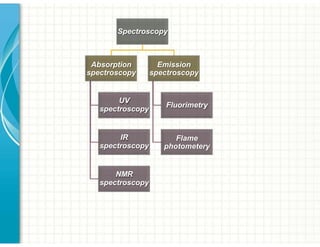
Spectroscopy
Absorption
spectroscopy
UV
spectroscopy
IR
spectroscopy
NMR
spectroscopy
Emission
spectroscopy
Fluorimetry
Flame
photometery
UV / VISIBLE SPECTROSCOPY
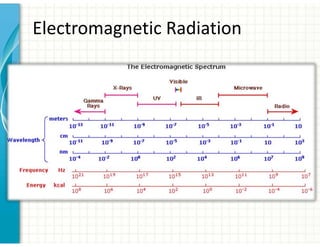
Electromagnetic Radiation
Electromagnetic radiation consist of discrete packages of energy
which are called as photons.
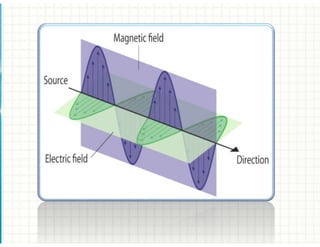
A photon consists of an oscillating electric field (E) & an
oscillating magnetic field (M) which are perpendicular to each
other.
Electromagnetic Radiation
• Frequency (ν):
– It is defined as the number of times electrical field
radiation oscillates in one second.
– The unit for frequency is Hertz (Hz).
1 Hz = 1 cycle per second
• Wavelength (λ):
– It is the distance between two nearest parts of the
wave in the same phase i.e. distance between two
nearest crest or troughs.
Electromagnetic Radiation
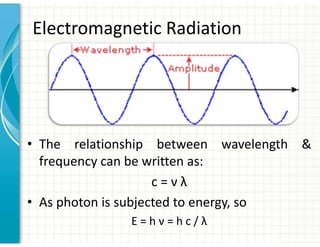
• The relationship between wavelength &
frequency can be written as:
c = ν λ
• As photon is subjected to energy, so
E = h ν = h c / λ
Electromagnetic Radiation
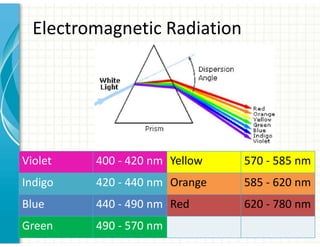
Violet 400 - 420 nm Yellow 570 - 585 nm
Indigo 420 - 440 nm Orange 585 - 620 nm
Blue 440 - 490 nm Red 620 - 780 nm
Green 490 - 570 nm
Interaction of EMR
with Matter
Interaction of EMR with matter
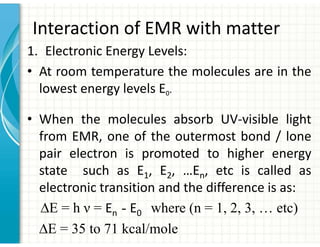
1. Electronic Energy Levels:
• At room temperature the molecules are in the
lowest energy levels E0.
• When the molecules absorb UV-visible light
from EMR, one of the outermost bond / lone
pair electron is promoted to higher energy
state such as E1, E2, …En, etc is called as
electronic transition and the difference is as:
∆E = h ν = En - E0 where (n = 1, 2, 3, … etc)
∆E = 35 to 71 kcal/mole
Interaction of EMR with matter
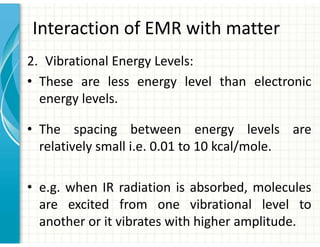
2. Vibrational Energy Levels:
• These are less energy level than electronic
energy levels.
• The spacing between energy levels are
relatively small i.e. 0.01 to 10 kcal/mole.
• e.g. when IR radiation is absorbed, molecules
are excited from one vibrational level to
another or it vibrates with higher amplitude.
Interaction of EMR with matter
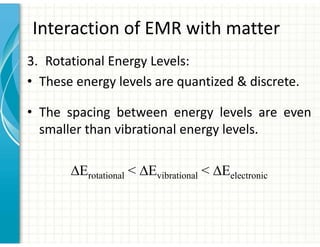
3. Rotational Energy Levels:
• These energy levels are quantized & discrete.
• The spacing between energy levels are even
smaller than vibrational energy levels.
∆Erotational < ∆Evibrational < ∆Eelectronic
Principles of
Spectroscopy
Lambert’s Law
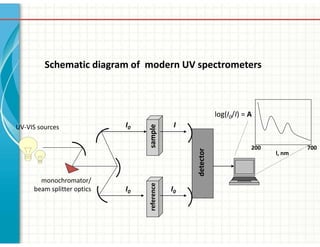
Schematic diagram of modern UV spectrometers
sample
reference
detector
I0
I0 I0
I
log(I0/I) = A
200 700
l, nm
monochromator/
beam splitter optics
UV-VIS sources
Lambert’s Law
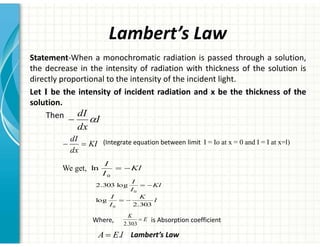
Statement-When a monochromatic radiation is passed through a solution,
the decrease in the intensity of radiation with thickness of the solution is
directly proportional to the intensity of the incident light.
Let I be the intensity of incident radiation and x be the thickness of the
solution.
Then I
dx
dI
D

KI
dx
dI
 (Integrate equation between limit I = Io at x = 0 and I = I at x=l)
Kl
I
I

0
ln
We get,
Kl
I
I

0
log
303
.
2
l
K
I
I
303
.
2
log
0

Lambert’s Law
l
E
A .
Where, is Absorption coefficient
E
K
303
.
2
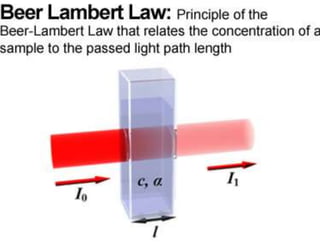
Beer Lambert’s Law
Beer Lambert’s Law
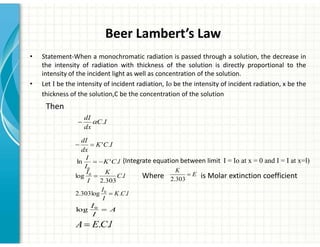
• Statement-When a monochromatic radiation is passed through a solution, the decrease in
the intensity of radiation with thickness of the solution is directly proportional to the
intensity of the incident light as well as concentration of the solution.
• Let I be the intensity of incident radiation, Io be the intensity of incident radiation, x be the
thickness of the solution,C be the concentration of the solution
Then
I
C
dx
dI
.
D

I
C
K
dx
dI
.
'

(Integrate equation between limit I = Io at x = 0 and I = I at x=l)
l
C
K
I
I
.
'
ln
0

l
C
E
A .
.
l
C
K
I
I
.
.
log
303
.
2 0
l
C
K
I
I
.
303
.
2
log 0
A
I
I0
log
Where is Molar extinction coefficient
E
K
303
.
2
Continue
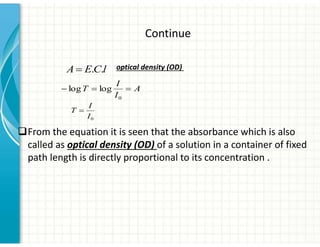
0
I
I
T
A
I
I
T

0
log
log
l
C
E
A .
.
‰From the equation it is seen that the absorbance which is also
called as optical density (OD) of a solution in a container of fixed
path length is directly proportional to its concentration .
optical density (OD)
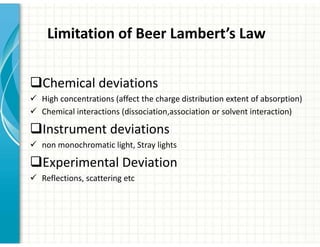
‰Chemical deviations
9 High concentrations (affect the charge distribution extent of absorption)
9 Chemical interactions (dissociation,association or solvent interaction)
‰Instrument deviations
9 non monochromatic light, Stray lights
‰Experimental Deviation
9 Reflections, scattering etc
Limitation of Beer Lambert’s Law
PRINCIPLES OF
UV - VISIBLE
SPECTROSCOPY
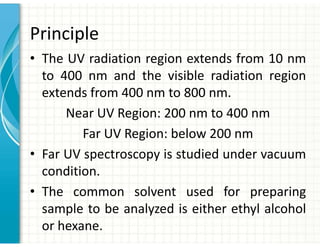
Principle
• The UV radiation region extends from 10 nm
to 400 nm and the visible radiation region
extends from 400 nm to 800 nm.
Near UV Region: 200 nm to 400 nm
Far UV Region: below 200 nm
• Far UV spectroscopy is studied under vacuum
condition.
• The common solvent used for preparing
sample to be analyzed is either ethyl alcohol
or hexane.
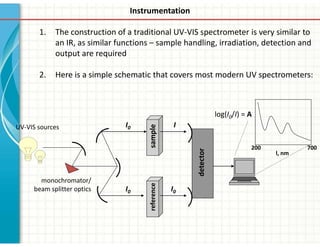
Instrumentation
1. The construction of a traditional UV-VIS spectrometer is very similar to
an IR, as similar functions – sample handling, irradiation, detection and
output are required
2. Here is a simple schematic that covers most modern UV spectrometers:
sample
reference
detector
I0
I0 I0
I
log(I0/I) = A
200 700
l, nm
monochromator/
beam splitter optics
UV-VIS sources
Light Source:
‰Deuterium lamp for UV range
‰Tungsten/halogen for visible range
Combined sources used to cover a range (200-800 nm)
Cuvettes:
‰ Glass or plastic – visible
‰ Quartz – visible, UV
‰ Acrylic – visible, UV
Solvents  Solutions
• Solvents should not absorb UV-radiation within same range as the substance.
• (A strong absorbing solvent allows very little amount of light to pass through the sample)
• Non-polar solvents-
• no solute-solvent interactions so “fine structure”
• Polar solvents-
• solute-solvent interactions through H-bonding “no fine structure”
Solvatochromic effect
(Solvatochromism)
change in absorption spectra (λmax, intensity, and shape)
‰ Positive solvatochromism
9 corresponds to a bathochromic shift (or red shift) with increasing solvent polarity.
‰ Negative solvatochromism
9 corresponds to a Hypsochromic Shift (Blue Shift) with increasing solvent polarity.
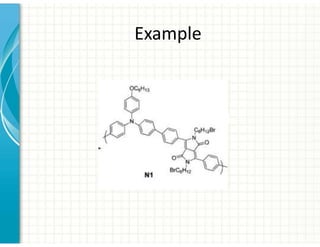
Example
•
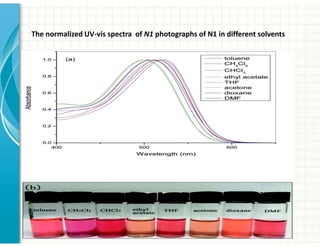
The normalized UV-vis spectra of N1 photographs of N1 in different solvents
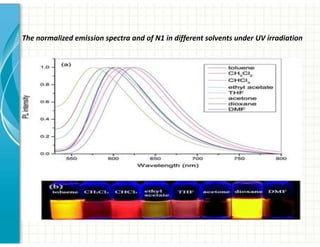
The normalized emission spectra and of N1 in different solvents under UV irradiation
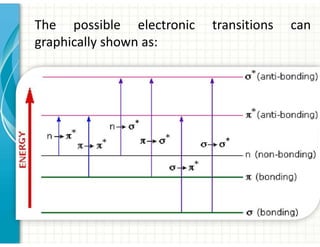
The possible electronic transitions can
graphically shown as:
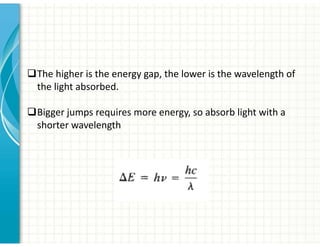
‰The higher is the energy gap, the lower is the wavelength of
the light absorbed.
‰Bigger jumps requires more energy, so absorb light with a
shorter wavelength
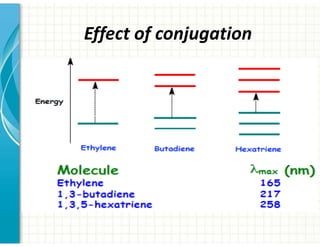
Effect of conjugation
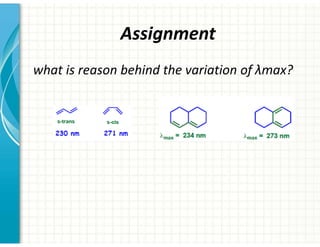
Assignment
what is reason behind the variation of λmax?
Assignment
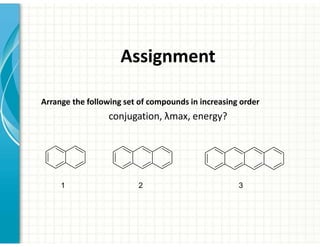
Arrange the following set of compounds in increasing order
conjugation, λmax, energy?
Electronic
Transitions
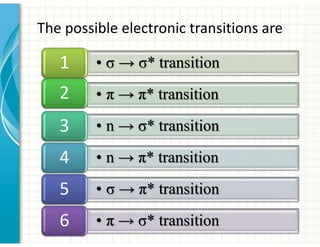
• σ → σ* transition
1
• π → π* transition
2
• n → σ* transition
3
• n → π* transition
4
• σ → π* transition
5
• π → σ* transition
6
The possible electronic transitions are
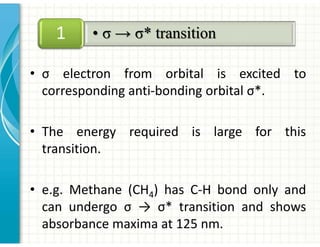
• σ electron from orbital is excited to
corresponding anti-bonding orbital σ*.
• The energy required is large for this
transition.
• e.g. Methane (CH4) has C-H bond only and
can undergo σ → σ* transition and shows
absorbance maxima at 125 nm.
• σ → σ* transition
1
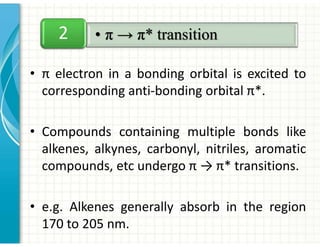
• π electron in a bonding orbital is excited to
corresponding anti-bonding orbital π*.
• Compounds containing multiple bonds like
alkenes, alkynes, carbonyl, nitriles, aromatic
compounds, etc undergo π → π* transitions.
• e.g. Alkenes generally absorb in the region
170 to 205 nm.
• π → π* transition
2
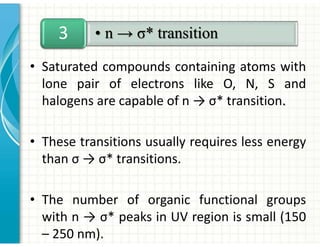
• Saturated compounds containing atoms with
lone pair of electrons like O, N, S and
halogens are capable of n → σ* transition.
• These transitions usually requires less energy
than σ → σ* transitions.
• The number of organic functional groups
with n → σ* peaks in UV region is small (150
– 250 nm).
• n → σ* transition
3
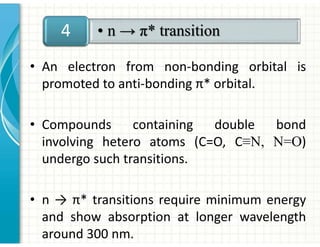
• An electron from non-bonding orbital is
promoted to anti-bonding π* orbital.
• Compounds containing double bond
involving hetero atoms (C=O, C≡N, N=O)
undergo such transitions.
• n → π* transitions require minimum energy
and show absorption at longer wavelength
around 300 nm.
• n → π* transition
4
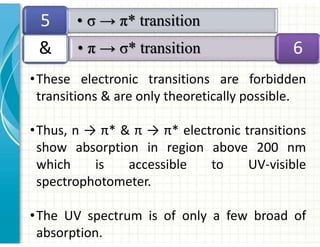
•These electronic transitions are forbidden
transitions  are only theoretically possible.
•Thus, n → π*  π → π* electronic transitions
show absorption in region above 200 nm
which is accessible to UV-visible
spectrophotometer.
•The UV spectrum is of only a few broad of
absorption.
• σ → π* transition
5
• π → σ* transition 6
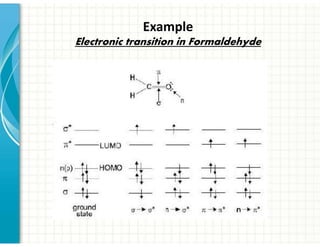
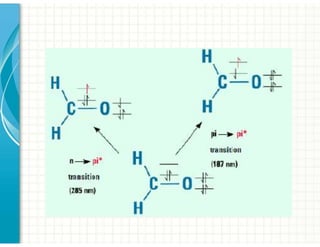
Example
Electronic transition in Formaldehyde
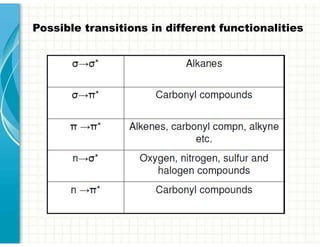
Possible transitions in different functionalities
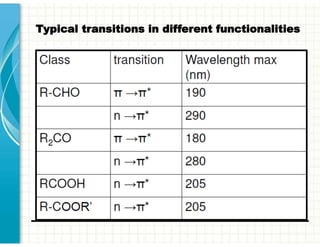
Typical transitions in different functionalities
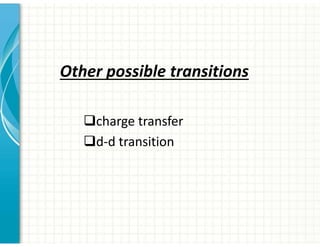
Other possible transitions
‰charge transfer
‰d-d transition
Terms used
in
UV / Visible
Spectroscopy
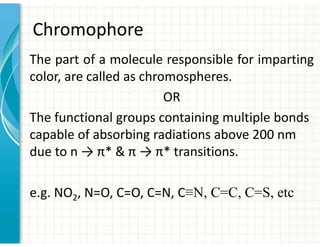
Chromophore
The part of a molecule responsible for imparting
color, are called as chromospheres.
OR
The functional groups containing multiple bonds
capable of absorbing radiations above 200 nm
due to n → π*  π → π* transitions.
e.g. NO2, N=O, C=O, C=N, C≡N, C=C, C=S, etc
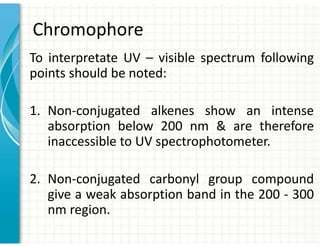
Chromophore
To interpretate UV – visible spectrum following
points should be noted:
1. Non-conjugated alkenes show an intense
absorption below 200 nm  are therefore
inaccessible to UV spectrophotometer.
2. Non-conjugated carbonyl group compound
give a weak absorption band in the 200 - 300
nm region.
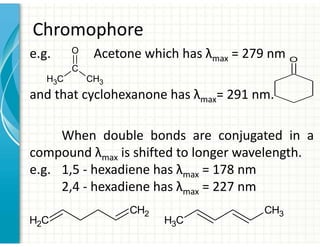
Chromophore
e.g. Acetone which has λmax = 279 nm
and that cyclohexanone has λmax= 291 nm.
When double bonds are conjugated in a
compound λmax is shifted to longer wavelength.
e.g. 1,5 - hexadiene has λmax = 178 nm
2,4 - hexadiene has λmax = 227 nm
C
H3
C
CH3
O
O
C
H2
CH2
C
H3
CH3
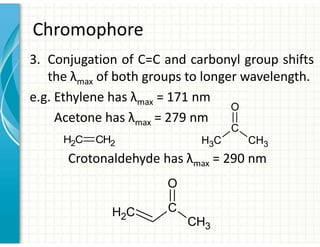
Chromophore
3. Conjugation of C=C and carbonyl group shifts
the λmax of both groups to longer wavelength.
e.g. Ethylene has λmax = 171 nm
Acetone has λmax = 279 nm
Crotonaldehyde has λmax = 290 nm
C
H3
C
CH3
O
C
H2 CH2
C
CH3
O
C
H2
Auxochrome
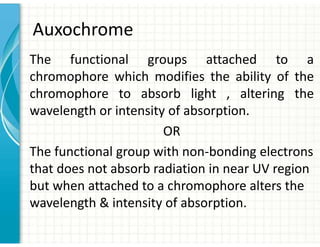
The functional groups attached to a
chromophore which modifies the ability of the
chromophore to absorb light , altering the
wavelength or intensity of absorption.
OR
The functional group with non-bonding electrons
that does not absorb radiation in near UV region
but when attached to a chromophore alters the
wavelength  intensity of absorption.
Auxochrome
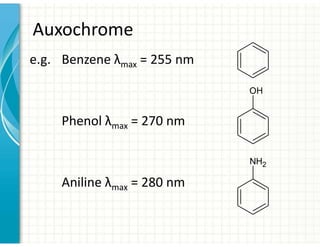
e.g. Benzene λmax = 255 nm
Phenol λmax = 270 nm
Aniline λmax = 280 nm
OH
NH2
Absorption
 Intensity
Shifts
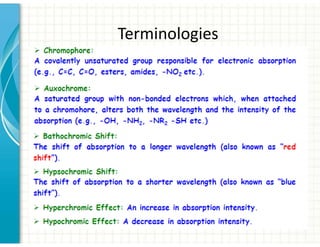
Terminologies
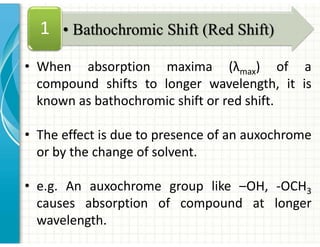
• When absorption maxima (λmax) of a
compound shifts to longer wavelength, it is
known as bathochromic shift or red shift.
• The effect is due to presence of an auxochrome
or by the change of solvent.
• e.g. An auxochrome group like –OH, -OCH3
causes absorption of compound at longer
wavelength.
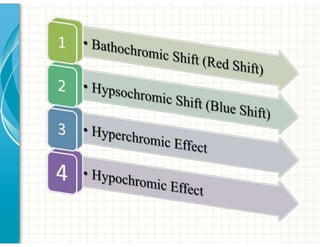
• Bathochromic Shift (Red Shift)
1
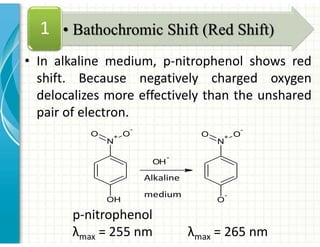
• In alkaline medium, p-nitrophenol shows red
shift. Because negatively charged oxygen
delocalizes more effectively than the unshared
pair of electron.
p-nitrophenol
λmax = 255 nm λmax = 265 nm
• Bathochromic Shift (Red Shift)
1
OH
N
+ O
-
O
OH
-
Alkaline
medium
O
-
N
+ O
-
O
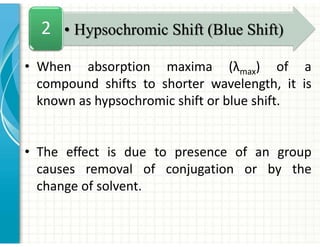
• When absorption maxima (λmax) of a
compound shifts to shorter wavelength, it is
known as hypsochromic shift or blue shift.
• The effect is due to presence of an group
causes removal of conjugation or by the
change of solvent.
• Hypsochromic Shift (Blue Shift)
2
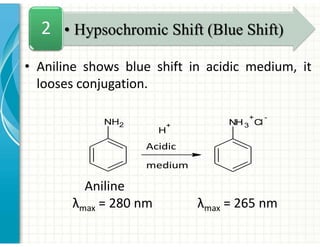
• Aniline shows blue shift in acidic medium, it
looses conjugation.
Aniline
λmax = 280 nm λmax = 265 nm
• Hypsochromic Shift (Blue Shift)
2
NH2
H
+
Acidic
medium
NH3
+
Cl
-
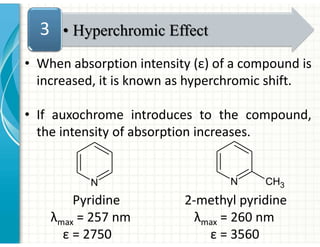
• When absorption intensity (ε) of a compound is
increased, it is known as hyperchromic shift.
• If auxochrome introduces to the compound,
the intensity of absorption increases.
Pyridine 2-methyl pyridine
λmax = 257 nm λmax = 260 nm
ε = 2750 ε = 3560
• Hyperchromic Effect
3
N N CH3
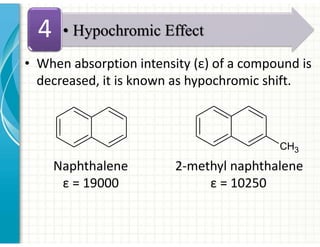
• When absorption intensity (ε) of a compound is
decreased, it is known as hypochromic shift.
Naphthalene 2-methyl naphthalene
ε = 19000 ε = 10250
CH3
• Hypochromic Effect
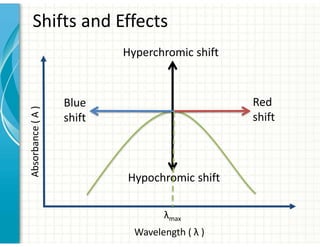
4
Wavelength ( λ )
Absorbance
(
A
)
Shifts and Effects
Hyperchromic shift
Hypochromic shift
Red
shift
Blue
shift
λmax
Woodward–Fieser Rules
‰ In 1941, Woodward proposed a set of rules to predict λmax values for the lowest
energy transition called Woodward–Fieser Rules
‰Applications
™ To predict λmax values of generally Dienes, Enones, Aromatics
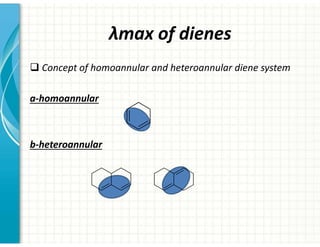
λmax of dienes
‰ Concept of homoannular and heteroannular diene system
a-homoannular
b-heteroannular
Woodward–Fieser Rules for
1.Dienes
‰ Base value for heteroannular diene (unsubstituted, conjugated) - 214 nm
‰ Base value for homoannular diene (unsubstituted, conjugated) - 253nm
‰ Increments for
9 Each extra double bonds in conjugation + 30 nm
9 Exocyclic double bond (effect is two fold if the bond is exocyclic to two
rings) + 5 nm
‰ Substituent effect:
9 Simple alkyl substituents(ring residue) + 5 nm
9 Halogen (-Cl, -Br) + 5 nm
9 OR (R=Alkyl) + 6 nm
9 SR (R=Alkyl) + 30 nm
9 NR2 (R=Alkyl) + 60 nm
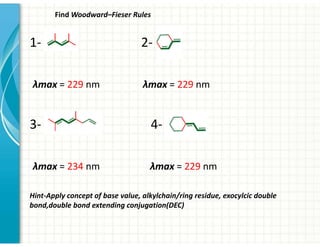
Find Woodward–Fieser Rules
1- 2-
λmax = 229 nm λmax = 229 nm
3- 4-
λmax = 234 nm λmax = 229 nm
Hint-Apply concept of base value, alkylchain/ring residue, exocylcic double
bond,double bond extending conjugation(DEC)
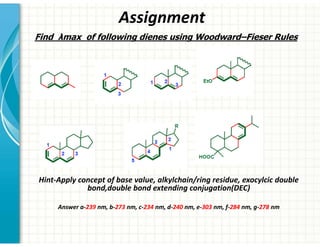
Assignment
Find λmax of following dienes using Woodward–Fieser Rules
Hint-Apply concept of base value, alkylchain/ring residue, exocylcic double
bond,double bond extending conjugation(DEC)
Answer a-239 nm, b-273 nm, c-234 nm, d-240 nm, e-303 nm, f-284 nm, g-278 nm
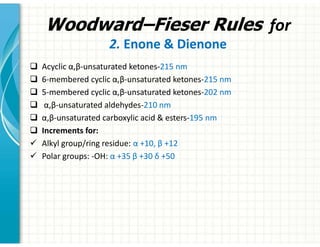
Woodward–Fieser Rules for
2. Enone  Dienone
‰ Acyclic α,β-unsaturated ketones-215 nm
‰ 6-membered cyclic α,β-unsaturated ketones-215 nm
‰ 5-membered cyclic α,β-unsaturated ketones-202 nm
‰ α,β-unsaturated aldehydes-210 nm
‰ α,β-unsaturated carboxylic acid  esters-195 nm
‰ Increments for:
9 Alkyl group/ring residue: α +10, β +12
9 Polar groups: -OH: α +35 β +30 δ +50
Find λmax of following dienes using Woodward–Fieser Rules
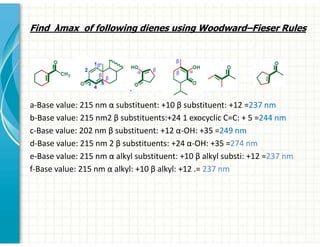
a-Base value: 215 nm α substituent: +10 β substituent: +12 =237 nm
b-Base value: 215 nm2 β substituents:+24 1 exocyclic C=C: + 5 =244 nm
c-Base value: 202 nm β substituent: +12 α-OH: +35 =249 nm
d-Base value: 215 nm 2 β substituents: +24 α-OH: +35 =274 nm
e-Base value: 215 nm α alkyl substituent: +10 β alkyl substi: +12 =237 nm
f-Base value: 215 nm α alkyl: +10 β alkyl: +12 .= 237 nm
Limitations
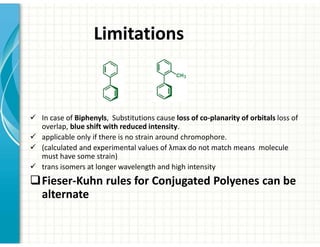
9 In case of Biphenyls, Substitutions cause loss of co-planarity of orbitals loss of
overlap, blue shift with reduced intensity.
9 applicable only if there is no strain around chromophore.
9 (calculated and experimental values of λmax do not match means molecule
must have some strain)
9 trans isomers at longer wavelength and high intensity
‰Fieser-Kuhn rules for Conjugated Polyenes can be
alternate
Thanku for your kind patience

1.-uv-visible (1) edicion dios.pdf sssss

  • 1.
    3. UV /Visible Spectroscopy Kanhaya lal kumawat M.tech. Ict (UDCT), Mumbai Advance Characterization Techniques
  • 2.
    Spectroscopy It is thebranch of science that deals with the study of interaction of electromagnetic radiation with matter.
  • 3.
  • 4.
    UV / VISIBLESPECTROSCOPY
  • 5.
    Electromagnetic Radiation Electromagnetic radiationconsist of discrete packages of energy which are called as photons. A photon consists of an oscillating electric field (E) & an oscillating magnetic field (M) which are perpendicular to each other.
  • 7.
    Electromagnetic Radiation • Frequency(ν): – It is defined as the number of times electrical field radiation oscillates in one second. – The unit for frequency is Hertz (Hz). 1 Hz = 1 cycle per second • Wavelength (λ): – It is the distance between two nearest parts of the wave in the same phase i.e. distance between two nearest crest or troughs.
  • 8.
    Electromagnetic Radiation • Therelationship between wavelength & frequency can be written as: c = ν λ • As photon is subjected to energy, so E = h ν = h c / λ
  • 9.
  • 10.
    Electromagnetic Radiation Violet 400- 420 nm Yellow 570 - 585 nm Indigo 420 - 440 nm Orange 585 - 620 nm Blue 440 - 490 nm Red 620 - 780 nm Green 490 - 570 nm
  • 11.
  • 12.
    Interaction of EMRwith matter 1. Electronic Energy Levels: • At room temperature the molecules are in the lowest energy levels E0. • When the molecules absorb UV-visible light from EMR, one of the outermost bond / lone pair electron is promoted to higher energy state such as E1, E2, …En, etc is called as electronic transition and the difference is as: ∆E = h ν = En - E0 where (n = 1, 2, 3, … etc) ∆E = 35 to 71 kcal/mole
  • 13.
    Interaction of EMRwith matter 2. Vibrational Energy Levels: • These are less energy level than electronic energy levels. • The spacing between energy levels are relatively small i.e. 0.01 to 10 kcal/mole. • e.g. when IR radiation is absorbed, molecules are excited from one vibrational level to another or it vibrates with higher amplitude.
  • 14.
    Interaction of EMRwith matter 3. Rotational Energy Levels: • These energy levels are quantized & discrete. • The spacing between energy levels are even smaller than vibrational energy levels. ∆Erotational < ∆Evibrational < ∆Eelectronic
  • 15.
  • 16.
  • 17.
    Schematic diagram ofmodern UV spectrometers sample reference detector I0 I0 I0 I log(I0/I) = A 200 700 l, nm monochromator/ beam splitter optics UV-VIS sources
  • 18.
    Lambert’s Law Statement-When amonochromatic radiation is passed through a solution, the decrease in the intensity of radiation with thickness of the solution is directly proportional to the intensity of the incident light. Let I be the intensity of incident radiation and x be the thickness of the solution. Then I dx dI D KI dx dI (Integrate equation between limit I = Io at x = 0 and I = I at x=l) Kl I I 0 ln We get, Kl I I 0 log 303 . 2 l K I I 303 . 2 log 0 Lambert’s Law l E A . Where, is Absorption coefficient E K 303 . 2
  • 19.
  • 21.
    Beer Lambert’s Law •Statement-When a monochromatic radiation is passed through a solution, the decrease in the intensity of radiation with thickness of the solution is directly proportional to the intensity of the incident light as well as concentration of the solution. • Let I be the intensity of incident radiation, Io be the intensity of incident radiation, x be the thickness of the solution,C be the concentration of the solution Then I C dx dI . D I C K dx dI . ' (Integrate equation between limit I = Io at x = 0 and I = I at x=l) l C K I I . ' ln 0 l C E A . . l C K I I . . log 303 . 2 0 l C K I I . 303 . 2 log 0 A I I0 log Where is Molar extinction coefficient E K 303 . 2
  • 22.
    Continue 0 I I T A I I T 0 log log l C E A . . ‰From theequation it is seen that the absorbance which is also called as optical density (OD) of a solution in a container of fixed path length is directly proportional to its concentration . optical density (OD)
  • 23.
    ‰Chemical deviations 9 Highconcentrations (affect the charge distribution extent of absorption) 9 Chemical interactions (dissociation,association or solvent interaction) ‰Instrument deviations 9 non monochromatic light, Stray lights ‰Experimental Deviation 9 Reflections, scattering etc Limitation of Beer Lambert’s Law
  • 24.
    PRINCIPLES OF UV -VISIBLE SPECTROSCOPY
  • 25.
    Principle • The UVradiation region extends from 10 nm to 400 nm and the visible radiation region extends from 400 nm to 800 nm. Near UV Region: 200 nm to 400 nm Far UV Region: below 200 nm • Far UV spectroscopy is studied under vacuum condition. • The common solvent used for preparing sample to be analyzed is either ethyl alcohol or hexane.
  • 26.
    Instrumentation 1. The constructionof a traditional UV-VIS spectrometer is very similar to an IR, as similar functions – sample handling, irradiation, detection and output are required 2. Here is a simple schematic that covers most modern UV spectrometers: sample reference detector I0 I0 I0 I log(I0/I) = A 200 700 l, nm monochromator/ beam splitter optics UV-VIS sources
  • 27.
    Light Source: ‰Deuterium lampfor UV range ‰Tungsten/halogen for visible range Combined sources used to cover a range (200-800 nm)
  • 28.
    Cuvettes: ‰ Glass orplastic – visible ‰ Quartz – visible, UV ‰ Acrylic – visible, UV
  • 29.
    Solvents Solutions •Solvents should not absorb UV-radiation within same range as the substance. • (A strong absorbing solvent allows very little amount of light to pass through the sample) • Non-polar solvents- • no solute-solvent interactions so “fine structure” • Polar solvents- • solute-solvent interactions through H-bonding “no fine structure”
  • 30.
    Solvatochromic effect (Solvatochromism) change inabsorption spectra (λmax, intensity, and shape) ‰ Positive solvatochromism 9 corresponds to a bathochromic shift (or red shift) with increasing solvent polarity. ‰ Negative solvatochromism 9 corresponds to a Hypsochromic Shift (Blue Shift) with increasing solvent polarity.
  • 31.
  • 32.
    • The normalized UV-visspectra of N1 photographs of N1 in different solvents
  • 33.
    The normalized emissionspectra and of N1 in different solvents under UV irradiation
  • 34.
    The possible electronictransitions can graphically shown as:
  • 35.
    ‰The higher isthe energy gap, the lower is the wavelength of the light absorbed. ‰Bigger jumps requires more energy, so absorb light with a shorter wavelength
  • 36.
  • 37.
    Assignment what is reasonbehind the variation of λmax?
  • 38.
    Assignment Arrange the followingset of compounds in increasing order conjugation, λmax, energy?
  • 39.
  • 40.
    • σ →σ* transition 1 • π → π* transition 2 • n → σ* transition 3 • n → π* transition 4 • σ → π* transition 5 • π → σ* transition 6 The possible electronic transitions are
  • 41.
    • σ electronfrom orbital is excited to corresponding anti-bonding orbital σ*. • The energy required is large for this transition. • e.g. Methane (CH4) has C-H bond only and can undergo σ → σ* transition and shows absorbance maxima at 125 nm. • σ → σ* transition 1
  • 42.
    • π electronin a bonding orbital is excited to corresponding anti-bonding orbital π*. • Compounds containing multiple bonds like alkenes, alkynes, carbonyl, nitriles, aromatic compounds, etc undergo π → π* transitions. • e.g. Alkenes generally absorb in the region 170 to 205 nm. • π → π* transition 2
  • 43.
    • Saturated compoundscontaining atoms with lone pair of electrons like O, N, S and halogens are capable of n → σ* transition. • These transitions usually requires less energy than σ → σ* transitions. • The number of organic functional groups with n → σ* peaks in UV region is small (150 – 250 nm). • n → σ* transition 3
  • 44.
    • An electronfrom non-bonding orbital is promoted to anti-bonding π* orbital. • Compounds containing double bond involving hetero atoms (C=O, C≡N, N=O) undergo such transitions. • n → π* transitions require minimum energy and show absorption at longer wavelength around 300 nm. • n → π* transition 4
  • 45.
    •These electronic transitionsare forbidden transitions are only theoretically possible. •Thus, n → π* π → π* electronic transitions show absorption in region above 200 nm which is accessible to UV-visible spectrophotometer. •The UV spectrum is of only a few broad of absorption. • σ → π* transition 5 • π → σ* transition 6
  • 46.
  • 48.
    Possible transitions indifferent functionalities
  • 49.
    Typical transitions indifferent functionalities
  • 50.
    Other possible transitions ‰chargetransfer ‰d-d transition
  • 51.
    Terms used in UV /Visible Spectroscopy
  • 52.
    Chromophore The part ofa molecule responsible for imparting color, are called as chromospheres. OR The functional groups containing multiple bonds capable of absorbing radiations above 200 nm due to n → π* π → π* transitions. e.g. NO2, N=O, C=O, C=N, C≡N, C=C, C=S, etc
  • 53.
    Chromophore To interpretate UV– visible spectrum following points should be noted: 1. Non-conjugated alkenes show an intense absorption below 200 nm are therefore inaccessible to UV spectrophotometer. 2. Non-conjugated carbonyl group compound give a weak absorption band in the 200 - 300 nm region.
  • 54.
    Chromophore e.g. Acetone whichhas λmax = 279 nm and that cyclohexanone has λmax= 291 nm. When double bonds are conjugated in a compound λmax is shifted to longer wavelength. e.g. 1,5 - hexadiene has λmax = 178 nm 2,4 - hexadiene has λmax = 227 nm C H3 C CH3 O O C H2 CH2 C H3 CH3
  • 55.
    Chromophore 3. Conjugation ofC=C and carbonyl group shifts the λmax of both groups to longer wavelength. e.g. Ethylene has λmax = 171 nm Acetone has λmax = 279 nm Crotonaldehyde has λmax = 290 nm C H3 C CH3 O C H2 CH2 C CH3 O C H2
  • 56.
    Auxochrome The functional groupsattached to a chromophore which modifies the ability of the chromophore to absorb light , altering the wavelength or intensity of absorption. OR The functional group with non-bonding electrons that does not absorb radiation in near UV region but when attached to a chromophore alters the wavelength intensity of absorption.
  • 57.
    Auxochrome e.g. Benzene λmax= 255 nm Phenol λmax = 270 nm Aniline λmax = 280 nm OH NH2
  • 58.
  • 60.
  • 61.
    • When absorptionmaxima (λmax) of a compound shifts to longer wavelength, it is known as bathochromic shift or red shift. • The effect is due to presence of an auxochrome or by the change of solvent. • e.g. An auxochrome group like –OH, -OCH3 causes absorption of compound at longer wavelength. • Bathochromic Shift (Red Shift) 1
  • 62.
    • In alkalinemedium, p-nitrophenol shows red shift. Because negatively charged oxygen delocalizes more effectively than the unshared pair of electron. p-nitrophenol λmax = 255 nm λmax = 265 nm • Bathochromic Shift (Red Shift) 1 OH N + O - O OH - Alkaline medium O - N + O - O
  • 63.
    • When absorptionmaxima (λmax) of a compound shifts to shorter wavelength, it is known as hypsochromic shift or blue shift. • The effect is due to presence of an group causes removal of conjugation or by the change of solvent. • Hypsochromic Shift (Blue Shift) 2
  • 64.
    • Aniline showsblue shift in acidic medium, it looses conjugation. Aniline λmax = 280 nm λmax = 265 nm • Hypsochromic Shift (Blue Shift) 2 NH2 H + Acidic medium NH3 + Cl -
  • 65.
    • When absorptionintensity (ε) of a compound is increased, it is known as hyperchromic shift. • If auxochrome introduces to the compound, the intensity of absorption increases. Pyridine 2-methyl pyridine λmax = 257 nm λmax = 260 nm ε = 2750 ε = 3560 • Hyperchromic Effect 3 N N CH3
  • 66.
    • When absorptionintensity (ε) of a compound is decreased, it is known as hypochromic shift. Naphthalene 2-methyl naphthalene ε = 19000 ε = 10250 CH3 • Hypochromic Effect 4
  • 67.
    Wavelength ( λ) Absorbance ( A ) Shifts and Effects Hyperchromic shift Hypochromic shift Red shift Blue shift λmax
  • 68.
    Woodward–Fieser Rules ‰ In1941, Woodward proposed a set of rules to predict λmax values for the lowest energy transition called Woodward–Fieser Rules ‰Applications ™ To predict λmax values of generally Dienes, Enones, Aromatics
  • 69.
    λmax of dienes ‰Concept of homoannular and heteroannular diene system a-homoannular b-heteroannular
  • 70.
    Woodward–Fieser Rules for 1.Dienes ‰Base value for heteroannular diene (unsubstituted, conjugated) - 214 nm ‰ Base value for homoannular diene (unsubstituted, conjugated) - 253nm ‰ Increments for 9 Each extra double bonds in conjugation + 30 nm 9 Exocyclic double bond (effect is two fold if the bond is exocyclic to two rings) + 5 nm ‰ Substituent effect: 9 Simple alkyl substituents(ring residue) + 5 nm 9 Halogen (-Cl, -Br) + 5 nm 9 OR (R=Alkyl) + 6 nm 9 SR (R=Alkyl) + 30 nm 9 NR2 (R=Alkyl) + 60 nm
  • 71.
    Find Woodward–Fieser Rules 1-2- λmax = 229 nm λmax = 229 nm 3- 4- λmax = 234 nm λmax = 229 nm Hint-Apply concept of base value, alkylchain/ring residue, exocylcic double bond,double bond extending conjugation(DEC)
  • 72.
    Assignment Find λmax offollowing dienes using Woodward–Fieser Rules Hint-Apply concept of base value, alkylchain/ring residue, exocylcic double bond,double bond extending conjugation(DEC) Answer a-239 nm, b-273 nm, c-234 nm, d-240 nm, e-303 nm, f-284 nm, g-278 nm
  • 73.
    Woodward–Fieser Rules for 2.Enone Dienone ‰ Acyclic α,β-unsaturated ketones-215 nm ‰ 6-membered cyclic α,β-unsaturated ketones-215 nm ‰ 5-membered cyclic α,β-unsaturated ketones-202 nm ‰ α,β-unsaturated aldehydes-210 nm ‰ α,β-unsaturated carboxylic acid esters-195 nm ‰ Increments for: 9 Alkyl group/ring residue: α +10, β +12 9 Polar groups: -OH: α +35 β +30 δ +50
  • 74.
    Find λmax offollowing dienes using Woodward–Fieser Rules a-Base value: 215 nm α substituent: +10 β substituent: +12 =237 nm b-Base value: 215 nm2 β substituents:+24 1 exocyclic C=C: + 5 =244 nm c-Base value: 202 nm β substituent: +12 α-OH: +35 =249 nm d-Base value: 215 nm 2 β substituents: +24 α-OH: +35 =274 nm e-Base value: 215 nm α alkyl substituent: +10 β alkyl substi: +12 =237 nm f-Base value: 215 nm α alkyl: +10 β alkyl: +12 .= 237 nm
  • 75.
    Limitations 9 In caseof Biphenyls, Substitutions cause loss of co-planarity of orbitals loss of overlap, blue shift with reduced intensity. 9 applicable only if there is no strain around chromophore. 9 (calculated and experimental values of λmax do not match means molecule must have some strain) 9 trans isomers at longer wavelength and high intensity ‰Fieser-Kuhn rules for Conjugated Polyenes can be alternate
  • 76.
    Thanku for yourkind patience