Vibrational spectroscopy
Prof David Lidzey
University of Sheffield
Vibrational Spectroscopy
• A key experimental technique use to probe the vibrational
modes (normal modes) of a material.
• Raman spectroscopy is commonly used in chemistry to provide
a fingerprint by which molecules can be identified.
• Can be used to explore relative composition of a material (i.e.
relative concentration of a known compound in solution).
• Widely used in industry and quality assurance.
• Key technique in condensed matter research.
Simple harmonic motion
Atoms connected via chemical bonds are equivalent to masses
connected by springs. We can describe these using Hooke’s
law (Q is a displacement of an atom away from eqn position)
From Newton’s second law
Where m is the reduced mass
Thus
Find a general solution
where
F = -kQ
F = m
d2
Q
dt2
m
d2
Q
dt2
+kQ = 0
Q(t)= Acos(wvibt)
wvib =
k
m
Insert potential into time independent Schrodinger equation:
To find quantized solutions
V(x) =
1
2
kx2
k =
d2
V
dx2
æ
è
ç
ö
ø
÷
From classical to quantum
V(x) = V(0) + x
dV
dx
æ
è
ç
ö
ø
÷+
1
2
x2 d2
V
dx2
æ
è
ç
ö
ø
÷ +
1
3!
x3 d3
V
dx3
æ
è
ç
ö
ø
÷ + ...
If two nuclei are slightly displaced from equilibrium positions (x = R - Re),
can express their potential energy in a Taylor series:
Not interested in absolute potential, so set V(0) = 0.
At equilibrium, dV/dx = 0 (a potential minimum). Providing displacement is small, third
order term can be neglected. We can therefore write:
EY(x) = -
2
2m
Ñ2
+V(x)
é
ë
ê
ù
û
úY(x)
En = wvib (n+
1
2
)
This creates a ladder of vibrational modes
This is well-known case of a harmonic oscillator.
The energy of a quantum-mechanical harmonic
oscillator is quantized and limited to the
values.
Selection rules dictate that harmonic
Oscillator transitions are only allowed for
Dn = ± 1
En = (n+
1
2
) wvib
0
1
2
3
4
5
6
7
8
Displacement (x)
Energy
Potential energy V
wvib
V(x) =
1
2
kx2
Molecules have many different vibrational modes
O C O
O C O
Asymmetric stretch mode
O
C
O
Bending mode
CO O
Symmetric stretch mode
(100)
(010)
(020)
(030)
(001)
Symmetric
stretch
mode
Bending
mode
Asymmetric
stretch
mode
171 meV
82 meV
290 meV
Example: CO2
Mode frequency dependent on mass of
Atoms, bond stiffness and type of
vibration involved (stretching, rocking,
breathing etc)
Light-molecule interactions
During the interaction between light and a molecule, the incident wave induces a
dipole P, given by
Where a is the polarizability of the molecule, and E is the strength of the EM wave.
(Polarisability is the tendency of an electron cloud to be distorted by a field)
The EM field of an incident wave at angular frequency wo can be expressed using.
So the time-dependent induced dipole moment is
P =aE
E = E0 cos(w0t)
P =aE0 cos(w0t)
When a molecular bond undergoes vibration at its characteristic frequency
wvib, the atoms undergo a displacement dQ around their equilibrium position
Q0
For small displacements, we can express the change in the polarisability
using a Taylor series.
Here, a0 is the polarizability at the equilibrium position. Substituting, we have
dQ =Q0 cos(wvibt)
Q0
Q0+dQ
a =a0 +
¶a
¶Q
dQ+...
a =a0 +
¶a
¶Q
Q0 cos(wvibt)
From our expression for P, we then find
Using the trig identity
It is easy to show
This tells us that dipole moments are created at 3 different frequencies:
P =a0E0 cos(w0t)+
¶a
¶Q
Q0E0 cos(w0t)cos(wvibt)
cos(a)cos(b) =
1
2
cos(a-b)+cos(a+b)[ ]
P =a0E0 cos(w0t)+
¶a
¶Q
Q0E0
2
cos((w0 -wvib )t)+cos((w0 +wvib )t)[ ]
w0 w0 +wvibw0 -wvib
Results in a processes called Raman scattering
• Raman-spectroscopy is a form of inelastic
light-scattering.
• Photon interacts with a molecule in its ground
vibronic state or an excited vibronic state.
• Molecule makes a brief transition to a virtual
energy state.
• (Virtual state is an ‘imaginary’ intermediate
state. Lifetime of such states dictated by
uncertainty principle)
• The “scattered” (emitted) photon can be of
lower energy (Stokes shifted) than the
incoming photon, leaving the molecule in an
excited vibrational state.
Ground state
0
1
2
3
4
Virtual state
hn hn '
Anti-stokes scattering.
• Can also have a transition from a
vibrationally excited state to the
virtual state.
• The molecule will then return to its
ground-state, with the scattered
photon carrying away more energy
than the incident photon.
• This is called anti-Stokes scattering.
• Raman scattering should not be
confused with the emission of
fluorescence.
Ground state
0
1
2
3
4
Virtual state
hn hn '
Raman ‘selection rules’.
A necessity for Raman scattering is that
i.e., as the bond vibrates, there is a change in its polarizability. Why does this
happen?
At max compression, electrons ‘feel’ effects of other nucleus, and are less
purturbed by EM field. At max elongation, electrons feel less interaction with
other atom, and are more perturbed by the EM field. We thus have a change
in polarisability as a function of displacement.
¶a
¶Q
¹ 0
Q0-DQ
Q0 Q0+DQ
Max compression Equilibrium Max elongation
Raman spectroscopy: practicalities
Raman signal is often orders of magnitude
weaker than elastic scattering, so we need
A laser and rejection of stray light.
Use an ‘edge filter’ to reject the
Laser light.
Raman scattered cross section given
By
Where
and
Can use shorter wavelengths (higher frequencies), but this can excite fluorescence
that often swamps the weak Raman signal.
Spectroscopists most often express wavenumber of vibrational mode in units of
cm-1 (which is a unit of energy). Typically goes from 200 to 4000 cm-1.
s µ(n0 -nvib )
n0 =1/ l0
nvib = 2pwvib /c
nvib
nvib
Example: acetone
394 492 532
789
899
1068
1220
1353
1427 1711
1746
(C=O stretch)
(CC2 symmetric stretch)
(CH3 deformation)
(CH3
rock)
(identification based on Harris et al, Journal of molecular spectroscopy, 43 (1972) 117)
Example: silicon
Raman map of silicon, showing strain
Around a laser drilled hole.
Kishan Dholakia and colleagues:
University of St. Andrews
Raman used in
chemical analysis
Quality assurance and
Substance identification
Detecting counterfeits
Mapping drug dispersion
in pharmaceuticals
Coupling electronic and vibronic transitions
• We have seen that we can directly measure
the vibrational modes of a material using
Raman spectroscopy.
• Molecules typically vibrate as the make
transitions between electronic states.
• So how does the vibration of a bond affect the
fluorescence of a molecule?
Molecular transitions
The ground state and the excited states
of molecules can be represented by
harmonic oscillators with quantized
vibrational modes.
Electronic transitions are allowed between
these modes.
Mass of an electron is very different from
the nuclei. Thus electronic transitions occur
in a stationary nuclear framework (Franck
Condon Principle).
We plot electronic transitions as vertical
lines, representing the same nuclear
distribution in ground and excited states.
Nuclear Displacement
Energy
hn
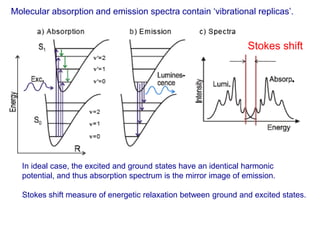
Molecular absorption and emission spectra contain ‘vibrational replicas’.
In ideal case, the excited and ground states have an identical harmonic
potential, and thus absorption spectrum is the mirror image of emission.
Stokes shift measure of energetic relaxation between ground and excited states.
Stokes shift
Example: Absorption and PL of diphenyl anthracene
DE ~162 meV
(~1309 cm-1)
Probably a C-C
Stretch mode.
DE
The effects of disorder
See strongly broadened transitions
caused by inhomogeneous broadening.
Polymers can be very disordered materials
F8BT
S0 S1 S1 S0S0 S2
Vibrational spectroscopy
• In many molecular systems, the harmonic potential results in
quantized vibrational modes.
• Raman spectroscopy allows you to identify and characterize
these vibrational modes.
• We can see fingerprinits of certain vibrational modes when we
measure absorption and fluorescence emission.
• Raman spectroscopy is highly useful in materials research and
is widely used as a routine characterization technique.

Vibrational Spectrroscopy

  • 1.
    Vibrational spectroscopy Prof DavidLidzey University of Sheffield
  • 2.
    Vibrational Spectroscopy • Akey experimental technique use to probe the vibrational modes (normal modes) of a material. • Raman spectroscopy is commonly used in chemistry to provide a fingerprint by which molecules can be identified. • Can be used to explore relative composition of a material (i.e. relative concentration of a known compound in solution). • Widely used in industry and quality assurance. • Key technique in condensed matter research.
  • 3.
    Simple harmonic motion Atomsconnected via chemical bonds are equivalent to masses connected by springs. We can describe these using Hooke’s law (Q is a displacement of an atom away from eqn position) From Newton’s second law Where m is the reduced mass Thus Find a general solution where F = -kQ F = m d2 Q dt2 m d2 Q dt2 +kQ = 0 Q(t)= Acos(wvibt) wvib = k m
  • 4.
    Insert potential intotime independent Schrodinger equation: To find quantized solutions V(x) = 1 2 kx2 k = d2 V dx2 æ è ç ö ø ÷ From classical to quantum V(x) = V(0) + x dV dx æ è ç ö ø ÷+ 1 2 x2 d2 V dx2 æ è ç ö ø ÷ + 1 3! x3 d3 V dx3 æ è ç ö ø ÷ + ... If two nuclei are slightly displaced from equilibrium positions (x = R - Re), can express their potential energy in a Taylor series: Not interested in absolute potential, so set V(0) = 0. At equilibrium, dV/dx = 0 (a potential minimum). Providing displacement is small, third order term can be neglected. We can therefore write: EY(x) = - 2 2m Ñ2 +V(x) é ë ê ù û úY(x) En = wvib (n+ 1 2 )
  • 5.
    This creates aladder of vibrational modes This is well-known case of a harmonic oscillator. The energy of a quantum-mechanical harmonic oscillator is quantized and limited to the values. Selection rules dictate that harmonic Oscillator transitions are only allowed for Dn = ± 1 En = (n+ 1 2 ) wvib 0 1 2 3 4 5 6 7 8 Displacement (x) Energy Potential energy V wvib V(x) = 1 2 kx2
  • 6.
    Molecules have manydifferent vibrational modes O C O O C O Asymmetric stretch mode O C O Bending mode CO O Symmetric stretch mode (100) (010) (020) (030) (001) Symmetric stretch mode Bending mode Asymmetric stretch mode 171 meV 82 meV 290 meV Example: CO2 Mode frequency dependent on mass of Atoms, bond stiffness and type of vibration involved (stretching, rocking, breathing etc)
  • 7.
    Light-molecule interactions During theinteraction between light and a molecule, the incident wave induces a dipole P, given by Where a is the polarizability of the molecule, and E is the strength of the EM wave. (Polarisability is the tendency of an electron cloud to be distorted by a field) The EM field of an incident wave at angular frequency wo can be expressed using. So the time-dependent induced dipole moment is P =aE E = E0 cos(w0t) P =aE0 cos(w0t)
  • 8.
    When a molecularbond undergoes vibration at its characteristic frequency wvib, the atoms undergo a displacement dQ around their equilibrium position Q0 For small displacements, we can express the change in the polarisability using a Taylor series. Here, a0 is the polarizability at the equilibrium position. Substituting, we have dQ =Q0 cos(wvibt) Q0 Q0+dQ a =a0 + ¶a ¶Q dQ+... a =a0 + ¶a ¶Q Q0 cos(wvibt)
  • 9.
    From our expressionfor P, we then find Using the trig identity It is easy to show This tells us that dipole moments are created at 3 different frequencies: P =a0E0 cos(w0t)+ ¶a ¶Q Q0E0 cos(w0t)cos(wvibt) cos(a)cos(b) = 1 2 cos(a-b)+cos(a+b)[ ] P =a0E0 cos(w0t)+ ¶a ¶Q Q0E0 2 cos((w0 -wvib )t)+cos((w0 +wvib )t)[ ] w0 w0 +wvibw0 -wvib
  • 10.
    Results in aprocesses called Raman scattering • Raman-spectroscopy is a form of inelastic light-scattering. • Photon interacts with a molecule in its ground vibronic state or an excited vibronic state. • Molecule makes a brief transition to a virtual energy state. • (Virtual state is an ‘imaginary’ intermediate state. Lifetime of such states dictated by uncertainty principle) • The “scattered” (emitted) photon can be of lower energy (Stokes shifted) than the incoming photon, leaving the molecule in an excited vibrational state. Ground state 0 1 2 3 4 Virtual state hn hn '
  • 11.
    Anti-stokes scattering. • Canalso have a transition from a vibrationally excited state to the virtual state. • The molecule will then return to its ground-state, with the scattered photon carrying away more energy than the incident photon. • This is called anti-Stokes scattering. • Raman scattering should not be confused with the emission of fluorescence. Ground state 0 1 2 3 4 Virtual state hn hn '
  • 12.
    Raman ‘selection rules’. Anecessity for Raman scattering is that i.e., as the bond vibrates, there is a change in its polarizability. Why does this happen? At max compression, electrons ‘feel’ effects of other nucleus, and are less purturbed by EM field. At max elongation, electrons feel less interaction with other atom, and are more perturbed by the EM field. We thus have a change in polarisability as a function of displacement. ¶a ¶Q ¹ 0 Q0-DQ Q0 Q0+DQ Max compression Equilibrium Max elongation
  • 13.
    Raman spectroscopy: practicalities Ramansignal is often orders of magnitude weaker than elastic scattering, so we need A laser and rejection of stray light. Use an ‘edge filter’ to reject the Laser light. Raman scattered cross section given By Where and Can use shorter wavelengths (higher frequencies), but this can excite fluorescence that often swamps the weak Raman signal. Spectroscopists most often express wavenumber of vibrational mode in units of cm-1 (which is a unit of energy). Typically goes from 200 to 4000 cm-1. s µ(n0 -nvib ) n0 =1/ l0 nvib = 2pwvib /c nvib nvib
  • 14.
    Example: acetone 394 492532 789 899 1068 1220 1353 1427 1711 1746 (C=O stretch) (CC2 symmetric stretch) (CH3 deformation) (CH3 rock) (identification based on Harris et al, Journal of molecular spectroscopy, 43 (1972) 117)
  • 15.
    Example: silicon Raman mapof silicon, showing strain Around a laser drilled hole.
  • 16.
    Kishan Dholakia andcolleagues: University of St. Andrews Raman used in chemical analysis Quality assurance and Substance identification Detecting counterfeits Mapping drug dispersion in pharmaceuticals
  • 17.
    Coupling electronic andvibronic transitions • We have seen that we can directly measure the vibrational modes of a material using Raman spectroscopy. • Molecules typically vibrate as the make transitions between electronic states. • So how does the vibration of a bond affect the fluorescence of a molecule?
  • 18.
    Molecular transitions The groundstate and the excited states of molecules can be represented by harmonic oscillators with quantized vibrational modes. Electronic transitions are allowed between these modes. Mass of an electron is very different from the nuclei. Thus electronic transitions occur in a stationary nuclear framework (Franck Condon Principle). We plot electronic transitions as vertical lines, representing the same nuclear distribution in ground and excited states. Nuclear Displacement Energy hn
  • 19.
    Molecular absorption andemission spectra contain ‘vibrational replicas’. In ideal case, the excited and ground states have an identical harmonic potential, and thus absorption spectrum is the mirror image of emission. Stokes shift measure of energetic relaxation between ground and excited states. Stokes shift
  • 20.
    Example: Absorption andPL of diphenyl anthracene DE ~162 meV (~1309 cm-1) Probably a C-C Stretch mode. DE
  • 21.
    The effects ofdisorder See strongly broadened transitions caused by inhomogeneous broadening. Polymers can be very disordered materials F8BT S0 S1 S1 S0S0 S2
  • 22.
    Vibrational spectroscopy • Inmany molecular systems, the harmonic potential results in quantized vibrational modes. • Raman spectroscopy allows you to identify and characterize these vibrational modes. • We can see fingerprinits of certain vibrational modes when we measure absorption and fluorescence emission. • Raman spectroscopy is highly useful in materials research and is widely used as a routine characterization technique.