MOSSBAUER SPECTROSCOPY:
Basic principle, recoil energy & Doppler shift.
Instrumentation: sources & absorber, motion devices, detection,
reference substances & calibration.
Isomer shift, quadrupole interaction, magnetic interaction,
electronegativity & chemical shift.
 INTRODUCTION:
• Discovered by the German physicist Rudolf Mossbauer in 1958
• also known as the Nuclear Gamma Resonance Spectroscopy
• based on the resonance fluorescence of γ- radiations (Mossbauer effect).
• Elements used are 57Fe, 119Sn, 121Sb, 129I, etc.
• has found wide application in elucidating the nature of chemical bond in
inorganic solid state chemistry & biological science, for instance, bonding in
haemoglobin & oxyhaemoglobin.
 BASIC PRINCIPLE:
• involves recoil-less emission & absorption of γ-rays by nuclei
• atoms in source emitting γ-rays must be of same isotope as atoms in sample
absorbing them.
 RECOIL EFFECT:
• Whenever a high energy particle is released from a body at rest, the releasing body feels a back-kick,
ie., it is pushed backward (Just like gun). This is called recoil effect.
• So the energy of γ-rays is slightly less than natural energy of transition.
• Similarly for a nucleus at rest to absorb γ-ray, the energy of γ-ray should be slightly less than natural
energy.
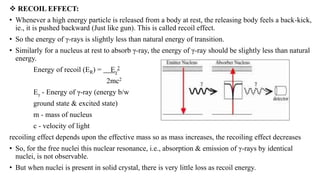
Energy of recoil (ER) = Eγ
2
2mc2
Eγ - Energy of γ-ray (energy b/w
ground state & excited state)
m - mass of nucleus
c - velocity of light
recoiling effect depends upon the effective mass so as mass increases, the recoiling effect decreases
• So, for the free nuclei this nuclear resonance, i.e., absorption & emission of γ-rays by identical
nuclei, is not observable.
• But when nuclei is present in solid crystal, there is very little loss as recoil energy.
• If the emitting & absorbing nuclei were in identical chemical environment then the transition
energies would be equal & nuclei resonance.
• But if chemical environment is diff., it will cause the shift in nuclear energy less. To bring the nuclei
in resonance the energy of γ- rays is slightly changed by Doppler effect.
 MOSSBAUER EFFECT:
• It involves the resonant & recoil-free emission & absorption of gamma radiation by atomic nuclei
bound in a solid.
• In the Mossbauer effect, a narrow resonance for nuclear gamma emission & absorption results from
the momentum of recoil being delivered to a surrounding crystal lattice rather than to the emitting or
absorbing nucleus alone.
• When this occurs, no gamma energy is lost to the kinetic energy of recoiling nuclei at either the
emitting or absorbing end of a gamma transition: emission & absorption occur at the same energy,
resulting in strong, resonant absorption.
It is should be noted that Mossbauer effect cannot be observed in liqs & gases because the recoil
energy cannot be dissipated in these states in matter.
 DOPPLER EFFECT:
• Doppler effect (or Doppler shift) is the change in frequency or wavelength of a
wave in relation to an observer who is moving relative to the wave source.
• A common eg is the change of pitch heard when a vehicle sounding a horn
approaches & recedes from an observer.
• Compared to the emitted frequency, the received frequency is higher during the
approach, identical at the instant of passing by & lower during the recession.
INSTRUMENTATION
• Mossbauer drive or Absorber:
used to move the source relative to sample
• Source:
57Co source for γ-ray emission
generally kept at RT
• Collimator:
used to narrow the γ-rays
• Sample:
 contains the sample to be analysed
 must be in solid phase & in crystalline structure
 usually requires a large amount of sample
 applied as a thin layer on sample holder & irradiated
 Selecting a sample:
 Excited state should be of relatively low energy
 small change of energy b/w ground & excited state
 too large a change of energy results in no resonant emission
 relatively long lasting life of excited state
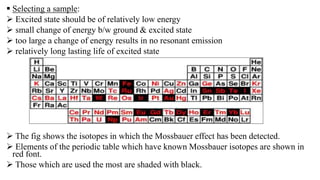
 The fig shows the isotopes in which the Mossbauer effect has been detected.
 Elements of the periodic table which have known Mossbauer isotopes are shown in
red font.
 Those which are used the most are shaded with black.
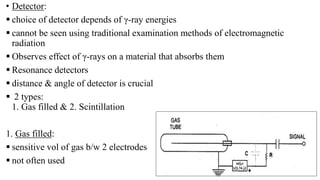
• Detector:
 choice of detector depends of γ-ray energies
 cannot be seen using traditional examination methods of electromagnetic
radiation
 Observes effect of γ-rays on a material that absorbs them
 Resonance detectors
 distance & angle of detector is crucial
 2 types:
1. Gas filled & 2. Scintillation
1. Gas filled:
 sensitive vol of gas b/w 2 electrodes
 not often used
2. Scintillation:
 sensitive material is luminescent material
 γ-rays interact with luminescent material
 γ-rays are detected by an optical detector
 usually used detector
 3 quantities called hyperfine interactions are studied:
1) Isomer (chemical) shift
2) Quadrupole splitting
3) Magnetic splitting (Nuclear Zeeman splitting / Magnetic hyperfine splitting)
1) Isomer (chemical) shift:
• Arises due to the non-zero vol of the nucleus & the electron charge density due to
s- electrons within it.
• This leads to a monopole (Coulomb) interaction, altering the nuclear energy
levels.
• Any difference in s-electron environment b/w the source & absorber thus produces
a shift in the resonance energy of the transition.
• This shifts the whole spectrum +vely or –vely depending upon the s-electron
density & sets the centroid of the spectrum.
• As the shift cannot be measured directly, it is quoted relative to a known absorber.
e.g., 57Fe Mossbauer spectra will often be quoted relative to alpha-iron at RT.
• It is useful for determining valency states, ligand bonding states, electron shielding
& electron drawing power of electronegative grps. e.g., electron configurations for
Fe+2 & Fe+3 are 3d6 & 3d5 resp. Ferrous ions have less s-electrons at the nucleus
due to greater screening of the d-electrons. Thus ferrous ions have larger +ve
isomer shifts than ferric ions.
2) Quadrupole splitting:
• Nuclei in states with an angular momentum quantum no. l > ½ have a non-spherical
charge distribution. This produces a nuclear quadrupole moment.
• In presence of an asymmetrical electric field (produced by an asymmetric electronic
charge distribution or ligand arrangement), this splits the nuclear energy levels.
• The charge distribution is characterized by a single quantity called Electric Field
Gradient (EFG)
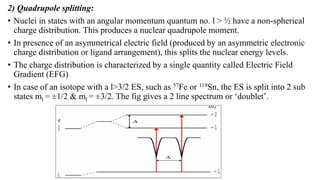
• In case of an isotope with a l>3/2 ES, such as 57Fe or 119Sn, the ES is split into 2 sub
states ml = ±1/2 & ml = ±3/2. The fig gives a 2 line spectrum or ‘doublet’.
3) Magnetic splitting:
• In presence of magnetic field (MF), the nuclear spin moment experiences a dipolar
interact with the MF, i.e., Zeeman splitting.
• There are many sources of MFs that can be experienced by the nucleus.
• Total effective MF at the nucleus, Beff is given by,
Beff = (Bcontact + Borbital + Bdipolar) + Bapplied
The first 3 terms being due to the atom’s own
partially filled electron shells.
Bconstant is due to spin on those electrons polarizing the
spin density at the nucleus,
Borbital is due to orbital moment on those electrons,
Bdipolar is dipolar field due to spin of those electrons.
• This MF splits nuclear levels with a spin of l into
(2l+1) sub states.
• This is shown in the fig for 57Fe.
• These interactions, Isomer shift, Quadrupole splitting & Magnetic
splitting, alone or in combination are the primary characteristics of
many Mossbauer spectra.
• Mossbauer spectroscopy is useful analytical tool for studying a variety
of systems & phenomena.
BIBLIOGRAPHY:
www.google.com
 www.rsc.org
 www.wikipedia.org
 www.slideshare.net
Mossbauer Spectroscopy

Mossbauer Spectroscopy

  • 1.
    MOSSBAUER SPECTROSCOPY: Basic principle,recoil energy & Doppler shift. Instrumentation: sources & absorber, motion devices, detection, reference substances & calibration. Isomer shift, quadrupole interaction, magnetic interaction, electronegativity & chemical shift.
  • 2.
     INTRODUCTION: • Discoveredby the German physicist Rudolf Mossbauer in 1958 • also known as the Nuclear Gamma Resonance Spectroscopy • based on the resonance fluorescence of γ- radiations (Mossbauer effect). • Elements used are 57Fe, 119Sn, 121Sb, 129I, etc. • has found wide application in elucidating the nature of chemical bond in inorganic solid state chemistry & biological science, for instance, bonding in haemoglobin & oxyhaemoglobin.  BASIC PRINCIPLE: • involves recoil-less emission & absorption of γ-rays by nuclei • atoms in source emitting γ-rays must be of same isotope as atoms in sample absorbing them.
  • 3.
     RECOIL EFFECT: •Whenever a high energy particle is released from a body at rest, the releasing body feels a back-kick, ie., it is pushed backward (Just like gun). This is called recoil effect. • So the energy of γ-rays is slightly less than natural energy of transition. • Similarly for a nucleus at rest to absorb γ-ray, the energy of γ-ray should be slightly less than natural energy. Energy of recoil (ER) = Eγ 2 2mc2 Eγ - Energy of γ-ray (energy b/w ground state & excited state) m - mass of nucleus c - velocity of light recoiling effect depends upon the effective mass so as mass increases, the recoiling effect decreases • So, for the free nuclei this nuclear resonance, i.e., absorption & emission of γ-rays by identical nuclei, is not observable. • But when nuclei is present in solid crystal, there is very little loss as recoil energy.
  • 4.
    • If theemitting & absorbing nuclei were in identical chemical environment then the transition energies would be equal & nuclei resonance. • But if chemical environment is diff., it will cause the shift in nuclear energy less. To bring the nuclei in resonance the energy of γ- rays is slightly changed by Doppler effect.  MOSSBAUER EFFECT: • It involves the resonant & recoil-free emission & absorption of gamma radiation by atomic nuclei bound in a solid. • In the Mossbauer effect, a narrow resonance for nuclear gamma emission & absorption results from the momentum of recoil being delivered to a surrounding crystal lattice rather than to the emitting or absorbing nucleus alone. • When this occurs, no gamma energy is lost to the kinetic energy of recoiling nuclei at either the emitting or absorbing end of a gamma transition: emission & absorption occur at the same energy, resulting in strong, resonant absorption. It is should be noted that Mossbauer effect cannot be observed in liqs & gases because the recoil energy cannot be dissipated in these states in matter.
  • 5.
     DOPPLER EFFECT: •Doppler effect (or Doppler shift) is the change in frequency or wavelength of a wave in relation to an observer who is moving relative to the wave source. • A common eg is the change of pitch heard when a vehicle sounding a horn approaches & recedes from an observer. • Compared to the emitted frequency, the received frequency is higher during the approach, identical at the instant of passing by & lower during the recession.
  • 6.
    INSTRUMENTATION • Mossbauer driveor Absorber: used to move the source relative to sample • Source: 57Co source for γ-ray emission generally kept at RT • Collimator: used to narrow the γ-rays • Sample:  contains the sample to be analysed  must be in solid phase & in crystalline structure  usually requires a large amount of sample  applied as a thin layer on sample holder & irradiated
  • 7.
     Selecting asample:  Excited state should be of relatively low energy  small change of energy b/w ground & excited state  too large a change of energy results in no resonant emission  relatively long lasting life of excited state  The fig shows the isotopes in which the Mossbauer effect has been detected.  Elements of the periodic table which have known Mossbauer isotopes are shown in red font.  Those which are used the most are shaded with black.
  • 8.
    • Detector:  choiceof detector depends of γ-ray energies  cannot be seen using traditional examination methods of electromagnetic radiation  Observes effect of γ-rays on a material that absorbs them  Resonance detectors  distance & angle of detector is crucial  2 types: 1. Gas filled & 2. Scintillation 1. Gas filled:  sensitive vol of gas b/w 2 electrodes  not often used
  • 9.
    2. Scintillation:  sensitivematerial is luminescent material  γ-rays interact with luminescent material  γ-rays are detected by an optical detector  usually used detector  3 quantities called hyperfine interactions are studied: 1) Isomer (chemical) shift 2) Quadrupole splitting 3) Magnetic splitting (Nuclear Zeeman splitting / Magnetic hyperfine splitting)
  • 10.
    1) Isomer (chemical)shift: • Arises due to the non-zero vol of the nucleus & the electron charge density due to s- electrons within it. • This leads to a monopole (Coulomb) interaction, altering the nuclear energy levels. • Any difference in s-electron environment b/w the source & absorber thus produces a shift in the resonance energy of the transition. • This shifts the whole spectrum +vely or –vely depending upon the s-electron density & sets the centroid of the spectrum. • As the shift cannot be measured directly, it is quoted relative to a known absorber. e.g., 57Fe Mossbauer spectra will often be quoted relative to alpha-iron at RT. • It is useful for determining valency states, ligand bonding states, electron shielding & electron drawing power of electronegative grps. e.g., electron configurations for Fe+2 & Fe+3 are 3d6 & 3d5 resp. Ferrous ions have less s-electrons at the nucleus due to greater screening of the d-electrons. Thus ferrous ions have larger +ve isomer shifts than ferric ions.
  • 11.
    2) Quadrupole splitting: •Nuclei in states with an angular momentum quantum no. l > ½ have a non-spherical charge distribution. This produces a nuclear quadrupole moment. • In presence of an asymmetrical electric field (produced by an asymmetric electronic charge distribution or ligand arrangement), this splits the nuclear energy levels. • The charge distribution is characterized by a single quantity called Electric Field Gradient (EFG) • In case of an isotope with a l>3/2 ES, such as 57Fe or 119Sn, the ES is split into 2 sub states ml = ±1/2 & ml = ±3/2. The fig gives a 2 line spectrum or ‘doublet’.
  • 12.
    3) Magnetic splitting: •In presence of magnetic field (MF), the nuclear spin moment experiences a dipolar interact with the MF, i.e., Zeeman splitting. • There are many sources of MFs that can be experienced by the nucleus. • Total effective MF at the nucleus, Beff is given by, Beff = (Bcontact + Borbital + Bdipolar) + Bapplied The first 3 terms being due to the atom’s own partially filled electron shells. Bconstant is due to spin on those electrons polarizing the spin density at the nucleus, Borbital is due to orbital moment on those electrons, Bdipolar is dipolar field due to spin of those electrons. • This MF splits nuclear levels with a spin of l into (2l+1) sub states. • This is shown in the fig for 57Fe.
  • 13.
    • These interactions,Isomer shift, Quadrupole splitting & Magnetic splitting, alone or in combination are the primary characteristics of many Mossbauer spectra. • Mossbauer spectroscopy is useful analytical tool for studying a variety of systems & phenomena.
  • 14.