Unit 7 - Digestion
The alimentary canal
Learning Outcomes
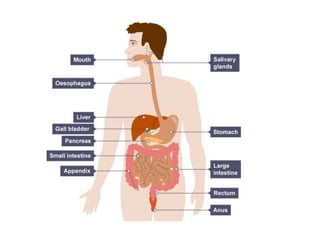
• identify the gross structure of the alimentary
canal and associated organs (mouth,
oesophagus, stomach, small intestine:
duodenum and ileum, large intestine: colon
and rectum, anus, pancreas, liver)
• define ingestion, digestion, absorption,
assimilation and egestion
• https://www.youtube.com/watch?v=bFczvJp0
bpU
• Digestion introduction
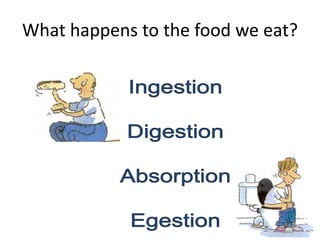
What happens to the food we eat?
The alimentary canal
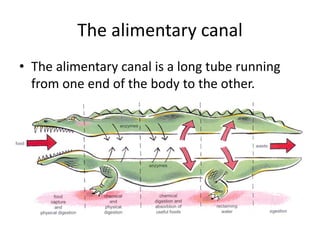
• The alimentary canal is a long tube running
from one end of the body to the other.
Types of digestion
• Mechanical digestion:
– Large pieces of food are broken up by the teeth and
by movement in the alimentary canal.
• Chemical digestion
– The large insoluble molecules are then broken up in to
small soluble ones.
– It involves a chemical change from one type to
another.
– Enzymes are used in this process.
Coursebook
• Page 80 questions
What happens to the food we eat?
• Ingestion
– Intake of food into the mouth
• Digestion
– Breaking down large, insoluble food molecules
into smaller soluble ones using enzymes
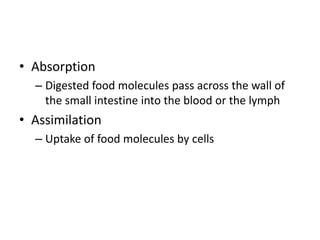
• Absorption
– Digested food molecules pass across the wall of
the small intestine into the blood or the lymph
• Assimilation
– Uptake of food molecules by cells
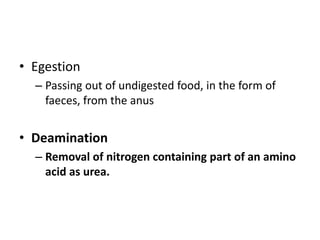
• Egestion
– Passing out of undigested food, in the form of
faeces, from the anus
• Deamination
– Removal of nitrogen containing part of an amino
acid as urea.
Ingestion
• Definition: the taking in of substances through
the mouth.
• Teeth are important to this part of digestion.
• WHY?
Teeth
• Food is broken down into smaller pieces in the
mouth by chewing. This is an example
of mechanical digestion. The teeth cut and
crush food, and the pieces are mixed
with saliva to form a ball of food called a
bolus.
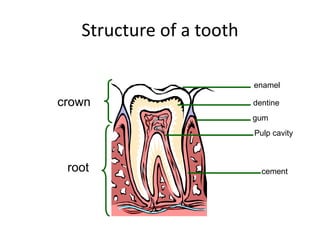
Structure of a tooth
crown
root
enamel
dentine
gum
Pulp cavity
cement
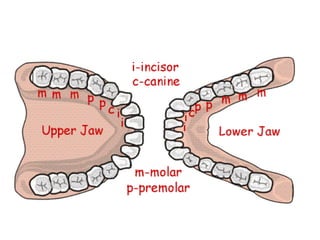
Types of teeth
• There are different types of human teeth, with
a different structure and function:
• incisor – for biting and cutting
• canine – for holding and cutting
• premolar and molar - crushing and chewing
• Page 81 – figure 7.13 – types of teeth
Teeth problems
• Dental decay
– Tooth decay:
• Caused by bacteria. They form a sticky film over your
teeth called plaque.
• It is easy to remove at first but if it is left it will harden
and become tartar, which cannot be removed by
brushing.
– Gum Disease:
• Caused by bacteria. The gums swell and may bleed.
• The disease may spread to the root of the tooth.
• The tooth will become loose and will need removing.
How can you avoid dental decay?
Tooth decay can be prevented by:
• avoiding foods with a high sugar content
• using toothpaste and drinking water containing fluoride
• regular, effective brushing to prevent the build-up
of plaque (a sticky layer on the teeth)
Fluoride compounds may be added to toothpaste and public
water supplies. Fluoride reduces tooth decay by:
• reducing the ability of bacteria on plaque to produce acid
• helping to replace calcium ions and phosphate ions lost by
tooth enamel because of acid attack
Coursebook
• Page 82 Questions
Worksheet
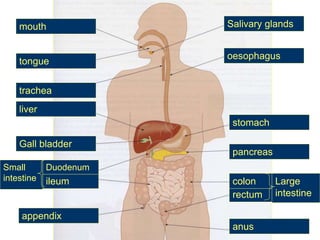
• Worksheet 7.3 label alimentary canal
Salivary glands
stomach
trachea
tongue
mouth
anus
rectum
colon
pancreas
Large
intestine
appendix
Small
intestine ileum
Duodenum
Gall bladder
liver
oesophagus
Digestion in the mouth and
oesophagus
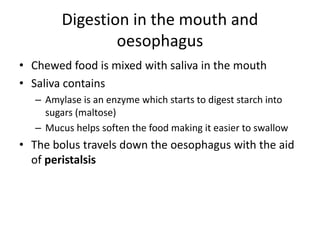
• Chewed food is mixed with saliva in the mouth
• Saliva contains
– Amylase is an enzyme which starts to digest starch into
sugars (maltose)
– Mucus helps soften the food making it easier to swallow
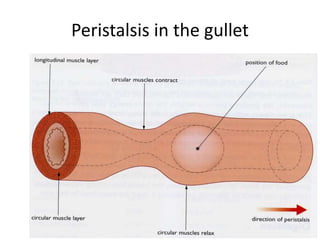
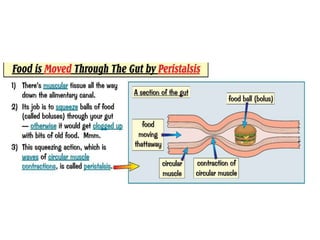
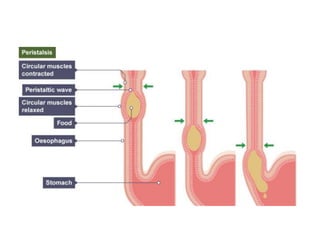
• The bolus travels down the oesophagus with the aid
of peristalsis
Peristalsis in the gullet
Digestion
Digestion is the breakdown of large, insoluble
food molecules into small, water-soluble
molecules using mechanical and chemical
processes.
Mechanical digestion includes:
• chewing in the mouth
• churning in the stomach
Chemical digestion involves enzymes. These are
proteins that function as biological catalysts.
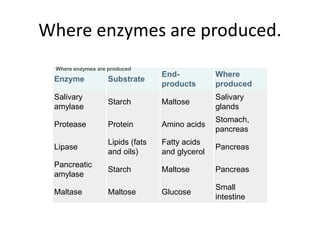
Where enzymes are produced.
Enzyme Substrate
End-
products
Where
produced
Salivary
amylase
Starch Maltose
Salivary
glands
Protease Protein Amino acids
Stomach,
pancreas
Lipase
Lipids (fats
and oils)
Fatty acids
and glycerol
Pancreas
Pancreatic
amylase
Starch Maltose Pancreas
Maltase Maltose Glucose
Small
intestine
Where enzymes are produced
Where digestion happens
• Proteases catalyse the breakdown of proteins
into amino acids in the stomach and small
intestine
• Lipases catalyse the breakdown of fats and oils
into fatty acids and glycerol in the small intestine
• Amylase catalyses the breakdown of starch into
maltose in the mouth and small intestine
• Maltase catalyses the breakdown
of maltose into glucose in the small intestine
Bile
Bile is secreted into the small intestine where it
has two effects:
• it neutralises the acid - providing the alkaline
conditions needed in the small intestine
• it emulsifies fats - providing a larger surface
area over which the lipase enzymes can work
Absorption
• Once the molecules have been broken down,
they are now small enough to pass through the
wall of the small intestine and into the blood.
• The small intestine is the region where digested
food is absorbed. Most absorption happens in
the ileum. This is the longest part of the small
intestine and is between 2-4 metres long. The
small intestine has a large internal surface area
for absorption to happen quickly and efficiently.
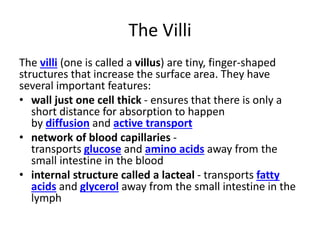
The Villi
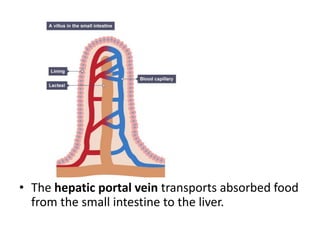
The villi (one is called a villus) are tiny, finger-shaped
structures that increase the surface area. They have
several important features:
• wall just one cell thick - ensures that there is only a
short distance for absorption to happen
by diffusion and active transport
• network of blood capillaries -
transports glucose and amino acids away from the
small intestine in the blood
• internal structure called a lacteal - transports fatty
acids and glycerol away from the small intestine in the
lymph
• The hepatic portal vein transports absorbed food
from the small intestine to the liver.
Assimilation
Assimilation is the movement of digested food
molecules into the cells of the body where they
are used. For example:
• glucose is used in respiration to provide
energy
• amino acids are used to build new proteins
The role of the Liver
• The liver is important in assimilation. For
example, it converts glucose into glycogen (a
complex carbohydrate used for storage) and
amino acids into proteins.
• The liver is involved in the process of
deamination. This is the removal of the
nitrogen-containing part of amino acids, to
form urea, followed by the release of
energy from the remainder of the amino acid.
Egestion
The small intestine absorbs most of the water in the contents of the gut. By
the time the contents reach the end of the small intestine, most of the
digested food has also been absorbed.
The remaining material consists of:
• water
• bacteria (living and dead)
• cells from the lining of the gut
• indigestible substances - such as cellulose from plant cell walls
The colon is the first part of the large intestine. It absorbs most of the
remaining water. This leaves semi-solid waste material calledfaeces. The
faeces are stored in the rectum, the last part of the large
intestine. Egestion happens when these faeces pass out of the body through
the anus.
Coursebook
• Page 89 questions
Group Task
Your assignment:
• Create a brochure or small booklet that will serve as a
“travel guide” of the gastrointestinal tract.
• Your guide should include the following components:
– A hand-drawn picture of all 8 “locations” in the digestive tract.
– A physical description of each location.
– A creative explanation of interesting features, tour options,
restaurants, etc., that can be visited at each stop.
• The emphasis on this assignment will be placed on
creativity. The goal is that you understand each part of the
digestive tract well enough to create analogies between it
and a real-life location that is known for tourism.
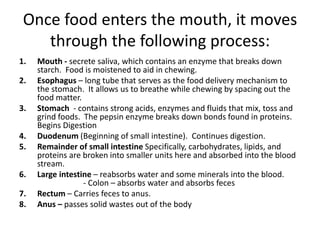
Once food enters the mouth, it moves
through the following process:
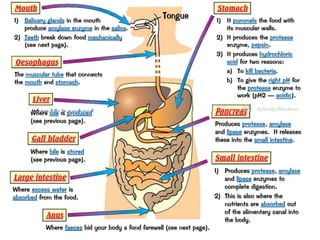
1. Mouth - secrete saliva, which contains an enzyme that breaks down
starch. Food is moistened to aid in chewing.
2. Esophagus – long tube that serves as the food delivery mechanism to
the stomach. It allows us to breathe while chewing by spacing out the
food matter.
3. Stomach - contains strong acids, enzymes and fluids that mix, toss and
grind foods. The pepsin enzyme breaks down bonds found in proteins.
Begins Digestion
4. Duodenum (Beginning of small intestine). Continues digestion.
5. Remainder of small intestine Specifically, carbohydrates, lipids, and
proteins are broken into smaller units here and absorbed into the blood
stream.
6. Large intestine – reabsorbs water and some minerals into the blood.
- Colon – absorbs water and absorbs feces
7. Rectum – Carries feces to anus.
8. Anus – passes solid wastes out of the body
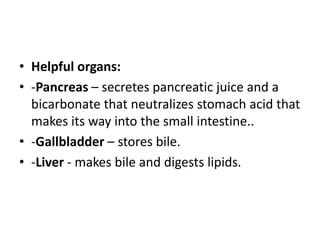
• Helpful organs:
• -Pancreas – secretes pancreatic juice and a
bicarbonate that neutralizes stomach acid that
makes its way into the small intestine..
• -Gallbladder – stores bile.
• -Liver - makes bile and digests lipids.

Unit 7 digestion

  • 1.
    Unit 7 -Digestion The alimentary canal
  • 2.
    Learning Outcomes • identifythe gross structure of the alimentary canal and associated organs (mouth, oesophagus, stomach, small intestine: duodenum and ileum, large intestine: colon and rectum, anus, pancreas, liver) • define ingestion, digestion, absorption, assimilation and egestion
  • 3.
  • 4.
    What happens tothe food we eat?
  • 5.
    The alimentary canal •The alimentary canal is a long tube running from one end of the body to the other.
  • 6.
    Types of digestion •Mechanical digestion: – Large pieces of food are broken up by the teeth and by movement in the alimentary canal. • Chemical digestion – The large insoluble molecules are then broken up in to small soluble ones. – It involves a chemical change from one type to another. – Enzymes are used in this process.
  • 7.
  • 8.
    What happens tothe food we eat? • Ingestion – Intake of food into the mouth • Digestion – Breaking down large, insoluble food molecules into smaller soluble ones using enzymes
  • 9.
    • Absorption – Digestedfood molecules pass across the wall of the small intestine into the blood or the lymph • Assimilation – Uptake of food molecules by cells
  • 10.
    • Egestion – Passingout of undigested food, in the form of faeces, from the anus • Deamination – Removal of nitrogen containing part of an amino acid as urea.
  • 12.
    Ingestion • Definition: thetaking in of substances through the mouth. • Teeth are important to this part of digestion. • WHY?
  • 13.
    Teeth • Food isbroken down into smaller pieces in the mouth by chewing. This is an example of mechanical digestion. The teeth cut and crush food, and the pieces are mixed with saliva to form a ball of food called a bolus.
  • 14.
    Structure of atooth crown root enamel dentine gum Pulp cavity cement
  • 15.
    Types of teeth •There are different types of human teeth, with a different structure and function: • incisor – for biting and cutting • canine – for holding and cutting • premolar and molar - crushing and chewing • Page 81 – figure 7.13 – types of teeth
  • 17.
    Teeth problems • Dentaldecay – Tooth decay: • Caused by bacteria. They form a sticky film over your teeth called plaque. • It is easy to remove at first but if it is left it will harden and become tartar, which cannot be removed by brushing. – Gum Disease: • Caused by bacteria. The gums swell and may bleed. • The disease may spread to the root of the tooth. • The tooth will become loose and will need removing.
  • 18.
    How can youavoid dental decay? Tooth decay can be prevented by: • avoiding foods with a high sugar content • using toothpaste and drinking water containing fluoride • regular, effective brushing to prevent the build-up of plaque (a sticky layer on the teeth) Fluoride compounds may be added to toothpaste and public water supplies. Fluoride reduces tooth decay by: • reducing the ability of bacteria on plaque to produce acid • helping to replace calcium ions and phosphate ions lost by tooth enamel because of acid attack
  • 19.
  • 20.
    Worksheet • Worksheet 7.3label alimentary canal
  • 21.
  • 23.
    Digestion in themouth and oesophagus • Chewed food is mixed with saliva in the mouth • Saliva contains – Amylase is an enzyme which starts to digest starch into sugars (maltose) – Mucus helps soften the food making it easier to swallow • The bolus travels down the oesophagus with the aid of peristalsis
  • 24.
  • 27.
    Digestion Digestion is thebreakdown of large, insoluble food molecules into small, water-soluble molecules using mechanical and chemical processes. Mechanical digestion includes: • chewing in the mouth • churning in the stomach Chemical digestion involves enzymes. These are proteins that function as biological catalysts.
  • 28.
    Where enzymes areproduced. Enzyme Substrate End- products Where produced Salivary amylase Starch Maltose Salivary glands Protease Protein Amino acids Stomach, pancreas Lipase Lipids (fats and oils) Fatty acids and glycerol Pancreas Pancreatic amylase Starch Maltose Pancreas Maltase Maltose Glucose Small intestine Where enzymes are produced
  • 29.
    Where digestion happens •Proteases catalyse the breakdown of proteins into amino acids in the stomach and small intestine • Lipases catalyse the breakdown of fats and oils into fatty acids and glycerol in the small intestine • Amylase catalyses the breakdown of starch into maltose in the mouth and small intestine • Maltase catalyses the breakdown of maltose into glucose in the small intestine
  • 32.
    Bile Bile is secretedinto the small intestine where it has two effects: • it neutralises the acid - providing the alkaline conditions needed in the small intestine • it emulsifies fats - providing a larger surface area over which the lipase enzymes can work
  • 33.
    Absorption • Once themolecules have been broken down, they are now small enough to pass through the wall of the small intestine and into the blood. • The small intestine is the region where digested food is absorbed. Most absorption happens in the ileum. This is the longest part of the small intestine and is between 2-4 metres long. The small intestine has a large internal surface area for absorption to happen quickly and efficiently.
  • 34.
    The Villi The villi(one is called a villus) are tiny, finger-shaped structures that increase the surface area. They have several important features: • wall just one cell thick - ensures that there is only a short distance for absorption to happen by diffusion and active transport • network of blood capillaries - transports glucose and amino acids away from the small intestine in the blood • internal structure called a lacteal - transports fatty acids and glycerol away from the small intestine in the lymph
  • 35.
    • The hepaticportal vein transports absorbed food from the small intestine to the liver.
  • 36.
    Assimilation Assimilation is themovement of digested food molecules into the cells of the body where they are used. For example: • glucose is used in respiration to provide energy • amino acids are used to build new proteins
  • 37.
    The role ofthe Liver • The liver is important in assimilation. For example, it converts glucose into glycogen (a complex carbohydrate used for storage) and amino acids into proteins. • The liver is involved in the process of deamination. This is the removal of the nitrogen-containing part of amino acids, to form urea, followed by the release of energy from the remainder of the amino acid.
  • 38.
    Egestion The small intestineabsorbs most of the water in the contents of the gut. By the time the contents reach the end of the small intestine, most of the digested food has also been absorbed. The remaining material consists of: • water • bacteria (living and dead) • cells from the lining of the gut • indigestible substances - such as cellulose from plant cell walls The colon is the first part of the large intestine. It absorbs most of the remaining water. This leaves semi-solid waste material calledfaeces. The faeces are stored in the rectum, the last part of the large intestine. Egestion happens when these faeces pass out of the body through the anus.
  • 39.
  • 40.
    Group Task Your assignment: •Create a brochure or small booklet that will serve as a “travel guide” of the gastrointestinal tract. • Your guide should include the following components: – A hand-drawn picture of all 8 “locations” in the digestive tract. – A physical description of each location. – A creative explanation of interesting features, tour options, restaurants, etc., that can be visited at each stop. • The emphasis on this assignment will be placed on creativity. The goal is that you understand each part of the digestive tract well enough to create analogies between it and a real-life location that is known for tourism.
  • 41.
    Once food entersthe mouth, it moves through the following process: 1. Mouth - secrete saliva, which contains an enzyme that breaks down starch. Food is moistened to aid in chewing. 2. Esophagus – long tube that serves as the food delivery mechanism to the stomach. It allows us to breathe while chewing by spacing out the food matter. 3. Stomach - contains strong acids, enzymes and fluids that mix, toss and grind foods. The pepsin enzyme breaks down bonds found in proteins. Begins Digestion 4. Duodenum (Beginning of small intestine). Continues digestion. 5. Remainder of small intestine Specifically, carbohydrates, lipids, and proteins are broken into smaller units here and absorbed into the blood stream. 6. Large intestine – reabsorbs water and some minerals into the blood. - Colon – absorbs water and absorbs feces 7. Rectum – Carries feces to anus. 8. Anus – passes solid wastes out of the body
  • 42.
    • Helpful organs: •-Pancreas – secretes pancreatic juice and a bicarbonate that neutralizes stomach acid that makes its way into the small intestine.. • -Gallbladder – stores bile. • -Liver - makes bile and digests lipids.