WEEK 4
SCIENCE | GRADE 7
MATATAG CURRICULUM
Quarter 1
QUARTER 1 WEEK 4
Learners learn that there are
specific processes for
planning, conducting, and
recording scientific
investigations
Content Standards Performance Standards
By the end of the Quarter, learners recognize that
scientists use models to describe the particle model of
matter.
• They use diagrams and illustrations to explain the
motion and arrangement of particles during
changes of state.
• They demonstrate an understanding of the role of
solute and solvent in solutions and the factors that
affect solubility.
• They demonstrate skills to plan and conduct a
scientific investigation making accurate
measurements and using standard units
The learners follow the appropriate steps
of a scientific investigation which include:
a. Aim or problem,
b. Materials and equipment,
c. Method or procedures,
d. Results including data, and
e. Conclusions.
Learning Competencies Content
Designing a Scientific
Investigation
QUARTER 1 WEEK 4
• Scientific literacy and Scientific
Qualities
• Innovation and Technology
• Ethical Considerations
• Health and wellbeing
• Environmental Sustainability
Integration
QUARTER 1 WEEK 4
DAY 1
SCIENCE | GRADE 7
SCIENTIFIC INVESTIGATION
Quarter 1 | Week 4 | Day 1
ACTIVATING
PRIOR
KNOWLEDGE
SCIENCE | GRADE 7
Quarter 1 | Week 4 | Day 1
Short Review
What are the different
phases of matter?
Activating Prior
Knowledge
Short Review
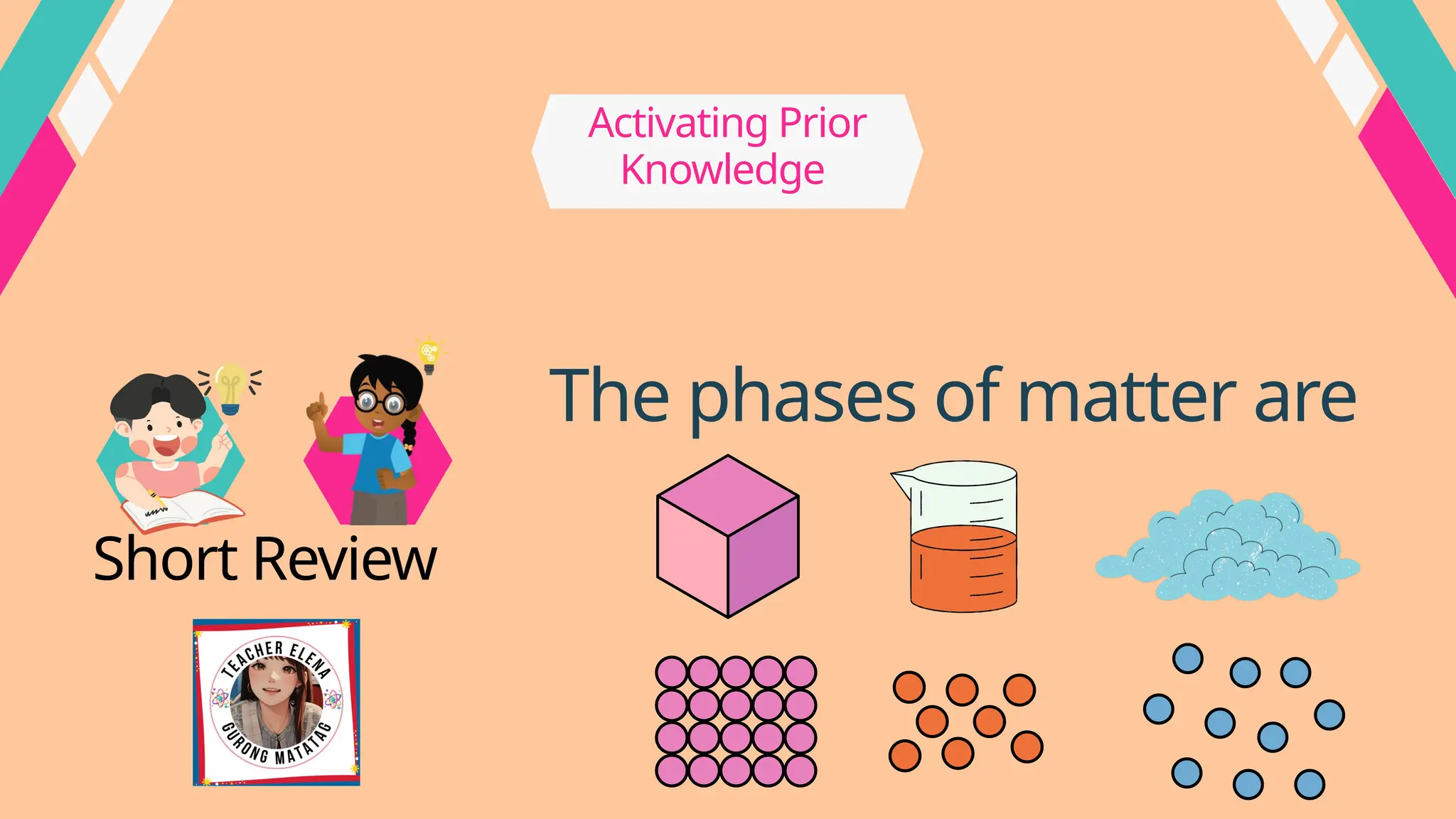
The phases of matter are
Activating Prior
Knowledge
ESTABLISHING
Lesson Purpose
SCIENCE | GRADE 7
Week 4 Day 1
Lesson Purpose
Roleplaying: Superhero scientists
"Today, we'll transform into
scientists ourselves and learn a
superpower: designing our own
experiments!"
UNLOCKING
CONTENT
VOCABULARY
SCIENCE | GRADE 7
Quarter 1 | Week 4 | Day 1
Scientific Investigation
A step-by-step process scientists use
to answer questions about the world.
.
Unlocking Content Vocabulary
Scientific Investigation
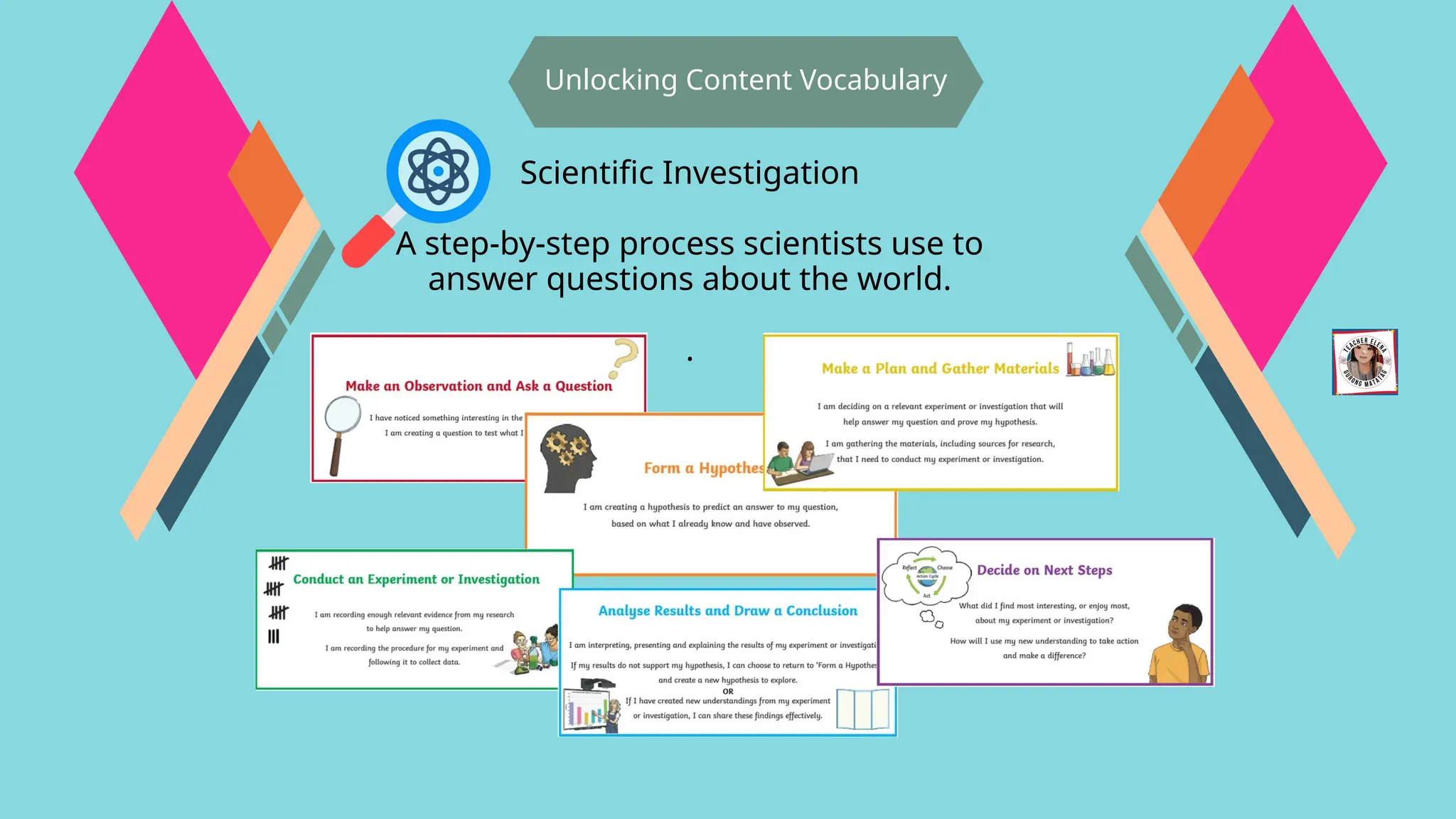
A step-by-step process scientists use to
answer questions about the world.
.
Unlocking Content Vocabulary
Aim/Problem
The question you want to
answer through your
experiment.
Unlocking Content Vocabulary
Aim/Problem
The question you want to
answer through your
experiment.
Unlocking Content Vocabulary
Materials & Equipment
The tools and supplies you
need to conduct your
experiment.
Unlocking Content Vocabulary
Method/Procedure
The detailed plan outlining
exactly what you will do, step-by-
step, to test your question (like a
recipe for an experiment!).
Unlocking Content Vocabulary
Data
The information you collect
during your experiment
(observations,
measurements).
Unlocking Content Vocabulary
Results
The findings of your
experiment, presented
using tables, charts, or
graphs.
Unlocking Content Vocabulary
Conclusion
Your explanation of what
your results mean and how
they answer your initial
question.
DEVELOPING AND
Deepening
Understanding
SCIENCE | GRADE 7
Quarter 1 | Week 4 | Day 1
Steps of a
Scientific
Investigation
SCIENCE | GRADE 7
MATATAG CURRICULUM
Quarter 1 | Week 4 | Day 1
Explicitation
"What do you think scientists do
when they want to learn
something
new?" or "How do scientists figure
out the answers to their
questions?"
Explicitation
When scientists want to figure out
the answer to their question, they
follow certain steps.
What are these steps?
Explicitation
AIM OR
PROBLEM
SCIENCE | GRADE 7
Quarter 1 | Week 4 | Day 1
a. Aim or Problem
This is the heart of your
investigation. It's the
question you want to
answer through your
experiment.
a. Aim or Problem
A good aim is:
Clear and Specific: It should be a
focused question about what
you want to investigate. Don't try
to answer too many things at
once.
a. Aim or Problem
A good aim is:
Answerable through an
Experiment: The question should
be something you can test by
collecting data.
a. Aim or Problem
A good aim is:
Measurable: You should be able
to measure or observe
something to find an answer.
MATERIALS
AND
EQUIPMENT
SCIENCE | GRADE 7
Quarter 1 | Week 4 | Day 1
This is the list of tools and
supplies you need to
conduct your experiment.
b. Materials and Equipment
Consider these points:
Adequacy: You should have
everything needed to carry
out your procedures
effectively.
b. Materials and Equipment
Consider these points:
Safety: Choose materials that
are safe to use and handle.
b. Materials and Equipment
Consider these points:
Availability: Ensure the
materials are readily available
or easily
obtainable.
b. Materials and Equipment
METHOD
OR
PROCEDURES
SCIENCE | GRADE 7
Quarter 1 | Week 4 | Day 1
c. Method or Procedures
This is the detailed step-by-step
plan for conducting your
experiment. It outlines exactly
what you will do to test your aim.
c. Method or Procedures
A good method should be:
Clear and Concise: Write specific
instructions that are easy to
understand and follow, even by
someone else.
c. Method or Procedures
A good method should be:
Sequential: List the steps in
the order they will be
performed.
c. Method or Procedures
A good method should be:
Repeatable: The method should
be written in a way that allows
others to repeat your
experiment and get similar
results.
RESULTS
INCLUDING
DATA
SCIENCE | GRADE 7
Quarter 1 | Week 4 | Day 1
d. Results including Data
This section documents the
findings of your experiment. It
includes all the information you
collected during the
investigation.
d. Results including Data
Data can be presented in various
ways:
Observations: Detailed descriptions
of what you saw, smelled, heard, etc.,
during the experiment.
d. Results including Data
Data can be presented in various
ways:
Tables and Charts: Organized
presentations of your data for
easier analysis.
d. Results including Data
Data can be presented in various
ways:
Graphs: Visual representations of
your data to identify trends or
relationships.
CONCLUSIONS
SCIENCE | GRADE 7
Quarter 1 | Week 4 | Day 1
e. Conclusions
This is where you
interpret your results
and answer your initial
question (aim).
e. Conclusions
A good conclusion should be
Based on Evidence: It should
be derived directly from the
data you collected during the
experiment.
e. Conclusions
A good conclusion should be
Explanatory: Explain what your
findings mean in relation to
your
aim.
e. Conclusions
A good conclusion should be
Supports or Rejects: State whether
your data supports or rejects your
initial hypothesis (if one was
formulated).
Worked Example
Worked
Example
Now, it’s your turn to investigate
and be a scientist!
Worked Example
Worked
Example
Are you ready?
ACTIVITY 1.
THE SCIENTIFIC
INVESTIGATION (15
MINUTES)
SCIENTIFIC PROBLEM
Read the scenario and pose scientific solutions.
Discuss with a partner or in small groups then
report back to the class.
TASK:
SCENARIO 1
IT'S PLANTING TIME, AND EVERYONE IN
YOUR CLASS IS EXCITED TO PLANT SEEDS IN
THEIR GARDENS! YOU NOTICE THAT SOME
STUDENTS SOAK THEIR SEEDS IN WATER
BEFORE PLANTING, WHILE OTHERS PLANT
THEM DRY. YOU WONDER, "DOES SOAKING
SEEDS IN WATER BEFORE PLANTING AFFECT
HOW QUICKLY THEY SPROUT?"
I. AIM OR
PROBLEM
What question are you trying to answer with your
experiment? (Write your aim or problem in a clear
and answerable sentence.)
Aim or Problem:
_____________________________________________________
_____________________________________________________
_____________________________________________________
________________
I. AIM OR
PROBLEM
Possible answer
Aim or problem:
Does soaking seeds in water
before planting affect how quickly
they sprout?
II. MATERIALS AND
EQUIPMENT:
What tools and supplies will you need
to conduct this experiment? Make a list
of all the materials and equipment
you'll use.
(Think about safety and what's readily
available in your classroom or at
home.)
II. MATERIALS AND
EQUIPMENT:
List of tools and supplies:
• Seeds ( e.g, beans, peas, or
any other fast-germinating
seeds)
• Water
• Two sets of planting pots or
garden space
II. MATERIALS AND
EQUIPMENT:
• Soil
• Measuring cup
• Labels or markers
• Notebook and pen for recording
observations
• Ruler (for measuring sprout length)
• Timer or calendar for tracking days
III. METHOD OR
PROCEDURES:
How will you conduct your experiment? Write
down the proposed step-by-step instructions
(procedure) for testing your aim.
(Remember, your procedure should be clear and
easy for someone else to follow and repeat.)
Procedures:
_______________________________
_______________________________
_______________________________
III. METHOD OR
PROCEDURES:
1. Preparation:
• Gather all the materials.
• Label one set of pots as ‘soaked” and the
other as “dry”.
2. Soaking Seeds:
• Place half of the seeds in a bowl of water
and let them soak for 24 hours.
• Keep the other half of the seeds dry.
III. METHOD OR
PROCEDURES:
3. Planting:
• Fill all pots with the same amount of soil.
• Plant the soaked seeds in the pots labeled
“soaked” and the dry seeds in the pots labeled
“dry’. Ensure that the seeds are planted at the
same depth and spacing.
4. Watering:
• Water all pots equally immediately after
planting and maintain consistent watering
throughout the experiment.
III. METHOD OR
PROCEDURES:
5. Observation:
• Check the pots daily for signs of
sprouting.
• Record the day when the first
sprout appears in each pot.
• Measure and record the height of
the sprouts daily once they appear.
IV.RESULTS INCLUDING DATA:
Imagine you conducted your experiment. What
kind of information would you record during your
experiment?
(Think about observations and measurements you
might make. How will you organize your data?)
Information to be recorded during the
experiment:
_____________________________________________________
_____________________________________________________
__________________________________
IV. RESULTS
During the experiment, you would record
the following information:
• The day each seed first sprouts.
• The height of each sprout is measured
daily.
• Any other observations, such as the
health of the plants or differences in
growth patterns.
V. CONCLUSIONS:
Based on the data you collected, what can you
conclude about the effect of soaking seeds on
germination?
(Did your findings support or reject your initial
idea? Explain your reasoning.)
_____________________________________________________
_____________________________________________________
__________________________________
V. CONCLUSION AND SYNTHESIS
After experimenting, you might find that
the seeds that were soaked in water before
planting sprouted faster than the dry
seeds.
For example, if the soaked seeds sprouted
on average in 3 days while the dry seeds
took 5 days, you could conclude that
soaking seeds in water before planting
does indeed affect how quickly they
sprout.
CONCLUSION
Soaking seeds in water before
planting accelerates the
sprouting process compared to
planting dry seeds.
SYNTHESIS
This information can be useful for
gardeners who want to ensure faster
germination of their seeds. By
soaking seeds, they can potentially
shorten the time it takes for their
plants to begin growing, leading to a
more efficient and productive
gardening process.
DIAGRAM
Title: Effect of Soaking Seeds on
Sprouting Time
SOAKED SEEDS DRY SEEDS
Day 1
Day 2
Day 3
DAY 2
SCIENCE | GRADE 7
MATATAG CURRICULUM
Quarter 1 | Week 4 | Day 2
Recall
What are the key steps of a
scientific investigation?
Recall
Key Steps of a Scientific Investigation
• Aim/Problem
• Materials & Equipment
• Method/Procedures
• Results & Data
Conclusions
Explicitation
"Method"
What comes to mind when
you hear the word method?
A method is like a recipe -
it tells you exactly what to
do to answer your
question (aim).
It follows a step-by-step
process.
Explicitation
Hypothesis and
Variables
SCIENCE | GRADE 7
Quarter 1 | Week 4 | Day 2
Introducing Hypothesis and Variables
Hypothesis is an educated
guess or a prediction
about the outcome of an
experiment based on your
observations and prior
knowledge.
Introducing Hypothesis and Variables
Example:
Hypothesis:
Plants placed in a sunny location will
grow taller than plants placed in the
shade.
Three
main types of
variables
SCIENCE | GRADE 7
Quarter 1 | Week 4 | Day 2
Independent Variable
This is the factor you deliberately
change or manipulate in your
experiment to see its effect on
something else. (In our example, the
independent variable is the amount of
sunlight)
Dependent Variable
This is the factor that you measure or
observe in response to the changes
made in the independent variable. (In
our example, the dependent variable is
plant growth)
Controlled Variables
These are factors that you keep the
same throughout the experiment to
ensure a fair test. (In our example, we
want to control the amount of water
both plants receive, pot size, etc.)
Worked
Example
SCIENCE | GRADE 7
Quarter 1 | Week 4 | Day 2
Worked Example
Scenario:
You've noticed that some brands of paper
towels seem to be more absorbent than
others. You wonder, "Do different brands of
paper towels absorb the same amount of
water?"
• Formulate a Hypothesis from the given scenario.
• Identify the following:
Independent Variables:
Dependent Variables:
Controlled Variables:
Method:
• Step 1:
• Step 2:
• Step 3:
• Step 4:
• Step 5:
Worked Example
Sample
Response
SCIENCE | GRADE 7
Quarter 1 | Week 4 | Day 2
Sample Response
Hypothesis: Brand A paper
towel will absorb more
water than Brand
B paper towel.
Sample Response
Independent Variable:
Brand of paper towel
(Brand A vs. Brand B)
Sample Response
Dependent Variable:
Amount of water absorbed
(measured in milliliters)
Sample Response
Controlled Variables:
Size of paper towel pieces (use
the same size for both brands)
Sample Response
Controlled Variables:
Amount of water used in each
trial
Sample Response
Controlled Variables:
Type of container used to hold
the water
Sample Response
Method
Step 1: Gather two identical glasses or
containers, two different brands of
paper towel (Brand A and Brand B), a
ruler, a marker, and a measuring cup.
Sample Response
Method
Step 2: Mark a line at 10 ml on
each glass or container
(controlled variable).
Sample Response
Method
Step 3: Pour 10 ml of water
into one of the containers
(controlled variable).
Sample Response
Method
Step 4: Tear off two same-sized pieces
of paper towel from Brand A
(independent variable). Fold them
together if needed for absorbency.
Sample Response
Method
Step 5: Place the Brand A paper
towels in the water for 5 seconds. Then,
carefully remove the paper towels and
squeeze out any excess water back into
the container for 10 seconds.
Sample Response
Method
Step 6: Measure the remaining water level
in the container using the ruler. Record the
amount of water absorbed by Brand A
(dependent variable) in milliliters. Repeat
steps 3-6 using two same sized pieces of
Brand B paper towel (independent
variable).
Sample Response
Method
Step 7: Repeat steps 3-6 two more times for
each brand of paper towel (total of 3 trials
per brand) to ensure accuracy. Calculate the
average amount of water absorbed by each
brand.
Sample Response
Method
Results: Imagine you conducted
this experiment and found that
Brand A paper towels absorbed an
average of 8 ml of water, while
Brand B paper
Lesson Activity
Lesson
Activity
Do the next activity
Activity 2. Designing a Scientific
Investigation
Lesson Activity
By group
Refer to the worksheet given by the
teacher
Listen as the teacher explains the
activity
Lesson Activity
By group
Refer to the worksheet given by the
teacher
Listen as the teacher explains the
activity
Lesson Activity
Presentation
The presentation will be held tomorrow.
Please think of the best way to present
your output. You can write it the manila
paper clearly and visibly.
DAY 3
SCIENCE | GRADE 7
MATATAG CURRICULUM
Quarter 1 | Week 4 | Day 3
Day 3
OUTPUT PRESENTATION
DAY!
ARE YOU READY?
EACH GROUP WILL HAVE
5 -MIN. PRESENTATION.
DAY 4
SCIENCE | GRADE 7
MATATAG CURRICULUM
Quarter 1 | Week 4 |
Day 3
Making
Generalizations
SCIENCE | GRADE 7
MATATAG CURRICULUM
Quarter 1 | Week 4 |
Day 4
Learners’ Takeaways
Today we learned about
designing scientific
investigations.
What surprised you the most
about this process?
Learners’ Takeaways
Think about the scientific
investigation you designed today.
What was the most challenging part,
and how did you overcome it?
Learners’ Takeaways
Why is it important to have a
clear and detailed method
(procedure) when designing
an experiment?
FORMATIVE
ASSESSMENT
SCIENCE | GRADE 7
Quarter 1 | Week 4
Exit Ticket
Do the following:
• Write down a scientific question you are
curious about.
• What materials would you need to
investigate this question?
• Describe two or three steps you would take
to test your question.
Group Discussion
Within your group share your chosen
scientific questions and your initial ideas
for procedures.
You have to discuss the following:
Group Discussion
• Is the question clear and answerable
through an experiment?
• Are the materials listed appropriate and
sufficient for the investigation?
• Do the proposed steps provide a clear and
sequential plan for testing the question?
Variable Identification
After you refine your procedure,
consider the variables in your
investigation.
Please identify:
Variable Identification
• The independent variable (the factor
they will change)
• The dependent variable (the factor
they will measure or observe)
• At least two controlled variables
(factors they will keep the same)
WEEK 4
SCIENCE | GRADE 7
MATATAG CURRICULUM
Quarter 1
Formative Assessment
3. Variable Identification:
• The independent variable (the factor
they will change)
• The dependent variable (the factor
they will measure or observe)
• At least two controlled variables
(factors they will keep the same)

Science 7 - Quarter 1 Full Week 4 (1).pptx

  • 1.
    WEEK 4 SCIENCE |GRADE 7 MATATAG CURRICULUM Quarter 1
  • 2.
    QUARTER 1 WEEK4 Learners learn that there are specific processes for planning, conducting, and recording scientific investigations Content Standards Performance Standards By the end of the Quarter, learners recognize that scientists use models to describe the particle model of matter. • They use diagrams and illustrations to explain the motion and arrangement of particles during changes of state. • They demonstrate an understanding of the role of solute and solvent in solutions and the factors that affect solubility. • They demonstrate skills to plan and conduct a scientific investigation making accurate measurements and using standard units
  • 3.
    The learners followthe appropriate steps of a scientific investigation which include: a. Aim or problem, b. Materials and equipment, c. Method or procedures, d. Results including data, and e. Conclusions. Learning Competencies Content Designing a Scientific Investigation QUARTER 1 WEEK 4
  • 4.
    • Scientific literacyand Scientific Qualities • Innovation and Technology • Ethical Considerations • Health and wellbeing • Environmental Sustainability Integration QUARTER 1 WEEK 4
  • 5.
    DAY 1 SCIENCE |GRADE 7 SCIENTIFIC INVESTIGATION Quarter 1 | Week 4 | Day 1
  • 6.
    ACTIVATING PRIOR KNOWLEDGE SCIENCE | GRADE7 Quarter 1 | Week 4 | Day 1
  • 7.
    Short Review What arethe different phases of matter? Activating Prior Knowledge
  • 8.
    Short Review The phasesof matter are Activating Prior Knowledge
  • 9.
  • 10.
    Lesson Purpose Roleplaying: Superheroscientists "Today, we'll transform into scientists ourselves and learn a superpower: designing our own experiments!"
  • 11.
  • 12.
    Scientific Investigation A step-by-stepprocess scientists use to answer questions about the world. . Unlocking Content Vocabulary
  • 13.
    Unlocking Content Vocabulary ScientificInvestigation A step-by-step process scientists use to answer questions about the world. .
  • 14.
    Unlocking Content Vocabulary Aim/Problem Thequestion you want to answer through your experiment.
  • 15.
    Unlocking Content Vocabulary Aim/Problem Thequestion you want to answer through your experiment.
  • 16.
    Unlocking Content Vocabulary Materials& Equipment The tools and supplies you need to conduct your experiment.
  • 17.
    Unlocking Content Vocabulary Method/Procedure Thedetailed plan outlining exactly what you will do, step-by- step, to test your question (like a recipe for an experiment!).
  • 18.
    Unlocking Content Vocabulary Data Theinformation you collect during your experiment (observations, measurements).
  • 19.
    Unlocking Content Vocabulary Results Thefindings of your experiment, presented using tables, charts, or graphs.
  • 20.
    Unlocking Content Vocabulary Conclusion Yourexplanation of what your results mean and how they answer your initial question.
  • 21.
    DEVELOPING AND Deepening Understanding SCIENCE |GRADE 7 Quarter 1 | Week 4 | Day 1
  • 22.
    Steps of a Scientific Investigation SCIENCE| GRADE 7 MATATAG CURRICULUM Quarter 1 | Week 4 | Day 1
  • 23.
  • 24.
    "What do youthink scientists do when they want to learn something new?" or "How do scientists figure out the answers to their questions?" Explicitation
  • 25.
    When scientists wantto figure out the answer to their question, they follow certain steps. What are these steps? Explicitation
  • 26.
    AIM OR PROBLEM SCIENCE |GRADE 7 Quarter 1 | Week 4 | Day 1
  • 27.
    a. Aim orProblem This is the heart of your investigation. It's the question you want to answer through your experiment.
  • 28.
    a. Aim orProblem A good aim is: Clear and Specific: It should be a focused question about what you want to investigate. Don't try to answer too many things at once.
  • 29.
    a. Aim orProblem A good aim is: Answerable through an Experiment: The question should be something you can test by collecting data.
  • 30.
    a. Aim orProblem A good aim is: Measurable: You should be able to measure or observe something to find an answer.
  • 31.
    MATERIALS AND EQUIPMENT SCIENCE | GRADE7 Quarter 1 | Week 4 | Day 1
  • 32.
    This is thelist of tools and supplies you need to conduct your experiment. b. Materials and Equipment
  • 33.
    Consider these points: Adequacy:You should have everything needed to carry out your procedures effectively. b. Materials and Equipment
  • 34.
    Consider these points: Safety:Choose materials that are safe to use and handle. b. Materials and Equipment
  • 35.
    Consider these points: Availability:Ensure the materials are readily available or easily obtainable. b. Materials and Equipment
  • 36.
    METHOD OR PROCEDURES SCIENCE | GRADE7 Quarter 1 | Week 4 | Day 1
  • 37.
    c. Method orProcedures This is the detailed step-by-step plan for conducting your experiment. It outlines exactly what you will do to test your aim.
  • 38.
    c. Method orProcedures A good method should be: Clear and Concise: Write specific instructions that are easy to understand and follow, even by someone else.
  • 39.
    c. Method orProcedures A good method should be: Sequential: List the steps in the order they will be performed.
  • 40.
    c. Method orProcedures A good method should be: Repeatable: The method should be written in a way that allows others to repeat your experiment and get similar results.
  • 41.
    RESULTS INCLUDING DATA SCIENCE | GRADE7 Quarter 1 | Week 4 | Day 1
  • 42.
    d. Results includingData This section documents the findings of your experiment. It includes all the information you collected during the investigation.
  • 43.
    d. Results includingData Data can be presented in various ways: Observations: Detailed descriptions of what you saw, smelled, heard, etc., during the experiment.
  • 44.
    d. Results includingData Data can be presented in various ways: Tables and Charts: Organized presentations of your data for easier analysis.
  • 45.
    d. Results includingData Data can be presented in various ways: Graphs: Visual representations of your data to identify trends or relationships.
  • 46.
    CONCLUSIONS SCIENCE | GRADE7 Quarter 1 | Week 4 | Day 1
  • 47.
    e. Conclusions This iswhere you interpret your results and answer your initial question (aim).
  • 48.
    e. Conclusions A goodconclusion should be Based on Evidence: It should be derived directly from the data you collected during the experiment.
  • 49.
    e. Conclusions A goodconclusion should be Explanatory: Explain what your findings mean in relation to your aim.
  • 50.
    e. Conclusions A goodconclusion should be Supports or Rejects: State whether your data supports or rejects your initial hypothesis (if one was formulated).
  • 51.
    Worked Example Worked Example Now, it’syour turn to investigate and be a scientist!
  • 52.
  • 53.
  • 54.
    SCIENTIFIC PROBLEM Read thescenario and pose scientific solutions. Discuss with a partner or in small groups then report back to the class. TASK:
  • 55.
    SCENARIO 1 IT'S PLANTINGTIME, AND EVERYONE IN YOUR CLASS IS EXCITED TO PLANT SEEDS IN THEIR GARDENS! YOU NOTICE THAT SOME STUDENTS SOAK THEIR SEEDS IN WATER BEFORE PLANTING, WHILE OTHERS PLANT THEM DRY. YOU WONDER, "DOES SOAKING SEEDS IN WATER BEFORE PLANTING AFFECT HOW QUICKLY THEY SPROUT?"
  • 56.
    I. AIM OR PROBLEM Whatquestion are you trying to answer with your experiment? (Write your aim or problem in a clear and answerable sentence.) Aim or Problem: _____________________________________________________ _____________________________________________________ _____________________________________________________ ________________
  • 57.
    I. AIM OR PROBLEM Possibleanswer Aim or problem: Does soaking seeds in water before planting affect how quickly they sprout?
  • 58.
    II. MATERIALS AND EQUIPMENT: Whattools and supplies will you need to conduct this experiment? Make a list of all the materials and equipment you'll use. (Think about safety and what's readily available in your classroom or at home.)
  • 59.
    II. MATERIALS AND EQUIPMENT: Listof tools and supplies: • Seeds ( e.g, beans, peas, or any other fast-germinating seeds) • Water • Two sets of planting pots or garden space
  • 60.
    II. MATERIALS AND EQUIPMENT: •Soil • Measuring cup • Labels or markers • Notebook and pen for recording observations • Ruler (for measuring sprout length) • Timer or calendar for tracking days
  • 61.
    III. METHOD OR PROCEDURES: Howwill you conduct your experiment? Write down the proposed step-by-step instructions (procedure) for testing your aim. (Remember, your procedure should be clear and easy for someone else to follow and repeat.) Procedures: _______________________________ _______________________________ _______________________________
  • 62.
    III. METHOD OR PROCEDURES: 1.Preparation: • Gather all the materials. • Label one set of pots as ‘soaked” and the other as “dry”. 2. Soaking Seeds: • Place half of the seeds in a bowl of water and let them soak for 24 hours. • Keep the other half of the seeds dry.
  • 63.
    III. METHOD OR PROCEDURES: 3.Planting: • Fill all pots with the same amount of soil. • Plant the soaked seeds in the pots labeled “soaked” and the dry seeds in the pots labeled “dry’. Ensure that the seeds are planted at the same depth and spacing. 4. Watering: • Water all pots equally immediately after planting and maintain consistent watering throughout the experiment.
  • 64.
    III. METHOD OR PROCEDURES: 5.Observation: • Check the pots daily for signs of sprouting. • Record the day when the first sprout appears in each pot. • Measure and record the height of the sprouts daily once they appear.
  • 65.
    IV.RESULTS INCLUDING DATA: Imagineyou conducted your experiment. What kind of information would you record during your experiment? (Think about observations and measurements you might make. How will you organize your data?) Information to be recorded during the experiment: _____________________________________________________ _____________________________________________________ __________________________________
  • 66.
    IV. RESULTS During theexperiment, you would record the following information: • The day each seed first sprouts. • The height of each sprout is measured daily. • Any other observations, such as the health of the plants or differences in growth patterns.
  • 67.
    V. CONCLUSIONS: Based onthe data you collected, what can you conclude about the effect of soaking seeds on germination? (Did your findings support or reject your initial idea? Explain your reasoning.) _____________________________________________________ _____________________________________________________ __________________________________
  • 68.
    V. CONCLUSION ANDSYNTHESIS After experimenting, you might find that the seeds that were soaked in water before planting sprouted faster than the dry seeds. For example, if the soaked seeds sprouted on average in 3 days while the dry seeds took 5 days, you could conclude that soaking seeds in water before planting does indeed affect how quickly they sprout.
  • 69.
    CONCLUSION Soaking seeds inwater before planting accelerates the sprouting process compared to planting dry seeds.
  • 70.
    SYNTHESIS This information canbe useful for gardeners who want to ensure faster germination of their seeds. By soaking seeds, they can potentially shorten the time it takes for their plants to begin growing, leading to a more efficient and productive gardening process.
  • 71.
    DIAGRAM Title: Effect ofSoaking Seeds on Sprouting Time SOAKED SEEDS DRY SEEDS Day 1 Day 2 Day 3
  • 73.
    DAY 2 SCIENCE |GRADE 7 MATATAG CURRICULUM Quarter 1 | Week 4 | Day 2
  • 74.
    Recall What are thekey steps of a scientific investigation?
  • 75.
    Recall Key Steps ofa Scientific Investigation • Aim/Problem • Materials & Equipment • Method/Procedures • Results & Data Conclusions
  • 76.
    Explicitation "Method" What comes tomind when you hear the word method?
  • 77.
    A method islike a recipe - it tells you exactly what to do to answer your question (aim). It follows a step-by-step process. Explicitation
  • 78.
    Hypothesis and Variables SCIENCE |GRADE 7 Quarter 1 | Week 4 | Day 2
  • 79.
    Introducing Hypothesis andVariables Hypothesis is an educated guess or a prediction about the outcome of an experiment based on your observations and prior knowledge.
  • 80.
    Introducing Hypothesis andVariables Example: Hypothesis: Plants placed in a sunny location will grow taller than plants placed in the shade.
  • 81.
    Three main types of variables SCIENCE| GRADE 7 Quarter 1 | Week 4 | Day 2
  • 82.
    Independent Variable This isthe factor you deliberately change or manipulate in your experiment to see its effect on something else. (In our example, the independent variable is the amount of sunlight)
  • 83.
    Dependent Variable This isthe factor that you measure or observe in response to the changes made in the independent variable. (In our example, the dependent variable is plant growth)
  • 84.
    Controlled Variables These arefactors that you keep the same throughout the experiment to ensure a fair test. (In our example, we want to control the amount of water both plants receive, pot size, etc.)
  • 85.
    Worked Example SCIENCE | GRADE7 Quarter 1 | Week 4 | Day 2
  • 86.
    Worked Example Scenario: You've noticedthat some brands of paper towels seem to be more absorbent than others. You wonder, "Do different brands of paper towels absorb the same amount of water?"
  • 87.
    • Formulate aHypothesis from the given scenario. • Identify the following: Independent Variables: Dependent Variables: Controlled Variables: Method: • Step 1: • Step 2: • Step 3: • Step 4: • Step 5: Worked Example
  • 88.
    Sample Response SCIENCE | GRADE7 Quarter 1 | Week 4 | Day 2
  • 89.
    Sample Response Hypothesis: BrandA paper towel will absorb more water than Brand B paper towel.
  • 90.
    Sample Response Independent Variable: Brandof paper towel (Brand A vs. Brand B)
  • 91.
    Sample Response Dependent Variable: Amountof water absorbed (measured in milliliters)
  • 92.
    Sample Response Controlled Variables: Sizeof paper towel pieces (use the same size for both brands)
  • 93.
  • 94.
    Sample Response Controlled Variables: Typeof container used to hold the water
  • 95.
    Sample Response Method Step 1:Gather two identical glasses or containers, two different brands of paper towel (Brand A and Brand B), a ruler, a marker, and a measuring cup.
  • 96.
    Sample Response Method Step 2:Mark a line at 10 ml on each glass or container (controlled variable).
  • 97.
    Sample Response Method Step 3:Pour 10 ml of water into one of the containers (controlled variable).
  • 98.
    Sample Response Method Step 4:Tear off two same-sized pieces of paper towel from Brand A (independent variable). Fold them together if needed for absorbency.
  • 99.
    Sample Response Method Step 5:Place the Brand A paper towels in the water for 5 seconds. Then, carefully remove the paper towels and squeeze out any excess water back into the container for 10 seconds.
  • 100.
    Sample Response Method Step 6:Measure the remaining water level in the container using the ruler. Record the amount of water absorbed by Brand A (dependent variable) in milliliters. Repeat steps 3-6 using two same sized pieces of Brand B paper towel (independent variable).
  • 101.
    Sample Response Method Step 7:Repeat steps 3-6 two more times for each brand of paper towel (total of 3 trials per brand) to ensure accuracy. Calculate the average amount of water absorbed by each brand.
  • 102.
    Sample Response Method Results: Imagineyou conducted this experiment and found that Brand A paper towels absorbed an average of 8 ml of water, while Brand B paper
  • 103.
    Lesson Activity Lesson Activity Do thenext activity Activity 2. Designing a Scientific Investigation
  • 104.
    Lesson Activity By group Referto the worksheet given by the teacher Listen as the teacher explains the activity
  • 105.
    Lesson Activity By group Referto the worksheet given by the teacher Listen as the teacher explains the activity
  • 106.
    Lesson Activity Presentation The presentationwill be held tomorrow. Please think of the best way to present your output. You can write it the manila paper clearly and visibly.
  • 107.
    DAY 3 SCIENCE |GRADE 7 MATATAG CURRICULUM Quarter 1 | Week 4 | Day 3
  • 108.
    Day 3 OUTPUT PRESENTATION DAY! AREYOU READY? EACH GROUP WILL HAVE 5 -MIN. PRESENTATION.
  • 109.
    DAY 4 SCIENCE |GRADE 7 MATATAG CURRICULUM Quarter 1 | Week 4 | Day 3
  • 110.
    Making Generalizations SCIENCE | GRADE7 MATATAG CURRICULUM Quarter 1 | Week 4 | Day 4
  • 111.
    Learners’ Takeaways Today welearned about designing scientific investigations. What surprised you the most about this process?
  • 112.
    Learners’ Takeaways Think aboutthe scientific investigation you designed today. What was the most challenging part, and how did you overcome it?
  • 113.
    Learners’ Takeaways Why isit important to have a clear and detailed method (procedure) when designing an experiment?
  • 114.
  • 115.
    Exit Ticket Do thefollowing: • Write down a scientific question you are curious about. • What materials would you need to investigate this question? • Describe two or three steps you would take to test your question.
  • 116.
    Group Discussion Within yourgroup share your chosen scientific questions and your initial ideas for procedures. You have to discuss the following:
  • 117.
    Group Discussion • Isthe question clear and answerable through an experiment? • Are the materials listed appropriate and sufficient for the investigation? • Do the proposed steps provide a clear and sequential plan for testing the question?
  • 118.
    Variable Identification After yourefine your procedure, consider the variables in your investigation. Please identify:
  • 119.
    Variable Identification • Theindependent variable (the factor they will change) • The dependent variable (the factor they will measure or observe) • At least two controlled variables (factors they will keep the same)
  • 120.
    WEEK 4 SCIENCE |GRADE 7 MATATAG CURRICULUM Quarter 1
  • 121.
    Formative Assessment 3. VariableIdentification: • The independent variable (the factor they will change) • The dependent variable (the factor they will measure or observe) • At least two controlled variables (factors they will keep the same)