Respiration and Gas
Exchange
Respiration
• Why do organisms need energy?
• Muscle contraction. Why?
• Making protein molecules. How?
• Cell division. Why?
• Active transport. What?
- movement of molecules and ions in or out of a cell, across a
membrane, from lower concentration to higher against concentration
gradient.
• Nerve impulses. Why?
• Internal heat. Why?
How do we get this energy?
• Food is ingested (eaten)
• Food is digested (broken down into smaller molecules)
• Molecules absorbed (from intestines into the blood)
• Blood transports nutrients to the body
• Cells take up the nutrients as needed
What is the main nutrient for energy?
GLUCOSE
C6H12O6
How does our body make use of glucose?
A series of metabolic reactions (respiration) break down the glucose to
release its chemical energy
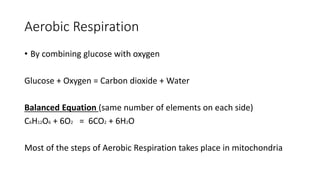
Aerobic Respiration
• By combining glucose with oxygen
Glucose + Oxygen = Carbon dioxide + Water
Balanced Equation (same number of elements on each side)
C6H12O6 + 6O2 = 6CO2 + 6H2O
Most of the steps of Aerobic Respiration takes place in mitochondria
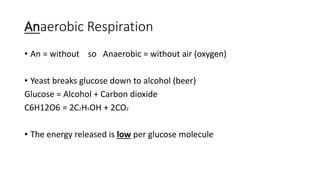
Anaerobic Respiration
• An = without so Anaerobic = without air (oxygen)
• Yeast breaks glucose down to alcohol (beer)
Glucose = Alcohol + Carbon dioxide
C6H12O6 = 2C2H5OH + 2CO2
• The energy released is low per glucose molecule
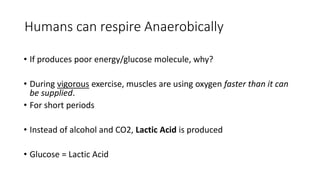
Humans can respire Anaerobically
• If produces poor energy/glucose molecule, why?
• During vigorous exercise, muscles are using oxygen faster than it can
be supplied.
• For short periods
• Instead of alcohol and CO2, Lactic Acid is produced
• Glucose = Lactic Acid
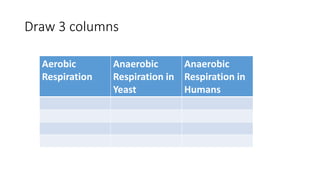
Draw 3 columns
Aerobic
Respiration
Anaerobic
Respiration in
Yeast
Anaerobic
Respiration in
Humans
Mini Test

Resp intro

  • 1.
  • 2.
    Respiration • Why doorganisms need energy? • Muscle contraction. Why? • Making protein molecules. How? • Cell division. Why? • Active transport. What? - movement of molecules and ions in or out of a cell, across a membrane, from lower concentration to higher against concentration gradient. • Nerve impulses. Why? • Internal heat. Why?
  • 3.
    How do weget this energy? • Food is ingested (eaten) • Food is digested (broken down into smaller molecules) • Molecules absorbed (from intestines into the blood) • Blood transports nutrients to the body • Cells take up the nutrients as needed
  • 4.
    What is themain nutrient for energy? GLUCOSE C6H12O6 How does our body make use of glucose? A series of metabolic reactions (respiration) break down the glucose to release its chemical energy
  • 5.
    Aerobic Respiration • Bycombining glucose with oxygen Glucose + Oxygen = Carbon dioxide + Water Balanced Equation (same number of elements on each side) C6H12O6 + 6O2 = 6CO2 + 6H2O Most of the steps of Aerobic Respiration takes place in mitochondria
  • 6.
    Anaerobic Respiration • An= without so Anaerobic = without air (oxygen) • Yeast breaks glucose down to alcohol (beer) Glucose = Alcohol + Carbon dioxide C6H12O6 = 2C2H5OH + 2CO2 • The energy released is low per glucose molecule
  • 7.
    Humans can respireAnaerobically • If produces poor energy/glucose molecule, why? • During vigorous exercise, muscles are using oxygen faster than it can be supplied. • For short periods • Instead of alcohol and CO2, Lactic Acid is produced • Glucose = Lactic Acid
  • 8.
    Draw 3 columns Aerobic Respiration Anaerobic Respirationin Yeast Anaerobic Respiration in Humans
  • 9.