Co-ordination
Part 2
Sense Organs
• Parts of the body that detect stimuli (receptors)
Definition: groups of receptor cells responding to specific stimuli: light,
sound, touch, temp. and chemicals.
• Eye – vision
• Ear – hearing and balance
• Nose – smell
• Tongue – taste
• Skin – touch, temperature and pain
Eye
• Eye is a sense organ.
• Rod and cone cells in the retina are receptors. Sensitive to light.
• Protected by a bony socket in the skull (orbit). Completely surrounded by
bone except for the front.
• Conjunctiva – a thin, transparent membrane, to protect
Tear glands keep this membrane moist and contain an enzyme lysozyme to
kill bacteria.
Blinking spreads the fluid across the eye
Eye (cont.)
• Eyelids, eyebrows and eyelashes help stop dirt/dust landing on the
eye.
• Sclera protects inside part of the eye.
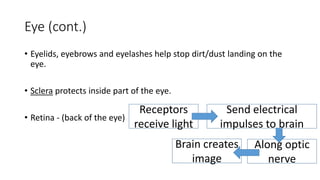
• Retina - (back of the eye)
Receptors
receive light
Send electrical
impulses to brain
Along optic
nerve
Brain creates
image
Retina (cont.)
• Fovea – tightly packed with receptor cells which focus an image when
we look straight at an object
• Blind spot – part of retina where the optic nerve leaves (NO
RECEPTORS), light falling on this area won't send impulses to the brain
(we can't see)
• Chloroid – absorbs the light passed through the retina
Rod and Cone receptors
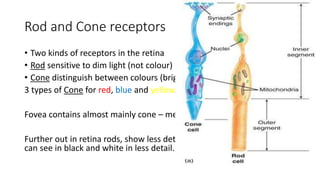
• Two kinds of receptors in the retina
• Rod sensitive to dim light (not colour)
• Cone distinguish between colours (bright light)
3 types of Cone for red, blue and yellow.
Fovea contains almost mainly cone – meaning we can focus an image
Further out in retina rods, show less detailed images. In darkness we
can see in black and white in less detail.
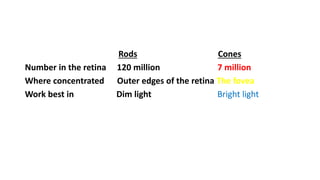
Rods Cones
Number in the retina 120 million 7 million
Where concentrated Outer edges of the retina The fovea
Work best in Dim light Bright light
Iris
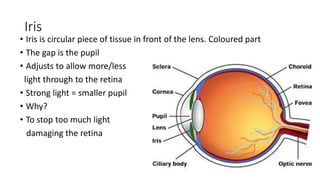
• Iris is circular piece of tissue in front of the lens. Coloured part
• The gap is the pupil
• Adjusts to allow more/less
light through to the retina
• Strong light = smaller pupil
• Why?
• To stop too much light
damaging the retina
How does iris adjust size?
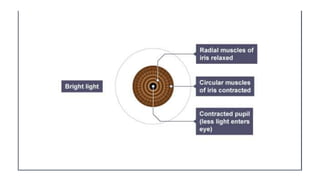
• Iris contains muscles
• Circular muscles around the pupil contract – makes pupil smaller (constrict)
• Radial muscles around the edge contract – makes pupil larger (dilate)
• Iris reflex
• Reflex action – we don't need to think about this action. Our brains do it
automatically
• What are the advantages of this reflex action?
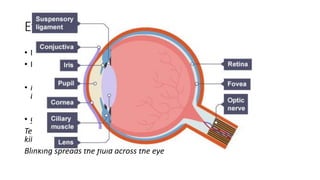
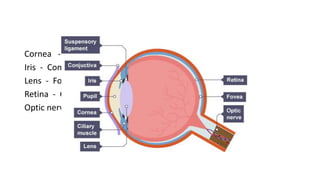
Cornea - Refracts light - bends it as it enters the eye
Iris - Controls how much light enters the pupil
Lens - Focuses light onto the retina
Retina - Contains the light receptors
Optic nerve - Carries impulses between the eye and the brain
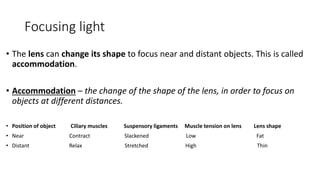
Focusing light
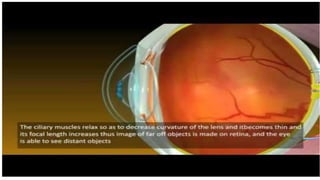
• The lens can change its shape to focus near and distant objects. This is called
accommodation.
• Accommodation – the change of the shape of the lens, in order to focus on
objects at different distances.
• Position of object Ciliary muscles Suspensory ligaments Muscle tension on lens Lens shape
• Near Contract Slackened Low Fat
• Distant Relax Stretched High Thin
Coordination2

Coordination2

  • 1.
  • 2.
    Sense Organs • Partsof the body that detect stimuli (receptors) Definition: groups of receptor cells responding to specific stimuli: light, sound, touch, temp. and chemicals. • Eye – vision • Ear – hearing and balance • Nose – smell • Tongue – taste • Skin – touch, temperature and pain
  • 3.
    Eye • Eye isa sense organ. • Rod and cone cells in the retina are receptors. Sensitive to light. • Protected by a bony socket in the skull (orbit). Completely surrounded by bone except for the front. • Conjunctiva – a thin, transparent membrane, to protect Tear glands keep this membrane moist and contain an enzyme lysozyme to kill bacteria. Blinking spreads the fluid across the eye
  • 4.
    Eye (cont.) • Eyelids,eyebrows and eyelashes help stop dirt/dust landing on the eye. • Sclera protects inside part of the eye. • Retina - (back of the eye) Receptors receive light Send electrical impulses to brain Along optic nerve Brain creates image
  • 5.
    Retina (cont.) • Fovea– tightly packed with receptor cells which focus an image when we look straight at an object • Blind spot – part of retina where the optic nerve leaves (NO RECEPTORS), light falling on this area won't send impulses to the brain (we can't see) • Chloroid – absorbs the light passed through the retina
  • 6.
    Rod and Conereceptors • Two kinds of receptors in the retina • Rod sensitive to dim light (not colour) • Cone distinguish between colours (bright light) 3 types of Cone for red, blue and yellow. Fovea contains almost mainly cone – meaning we can focus an image Further out in retina rods, show less detailed images. In darkness we can see in black and white in less detail.
  • 7.
    Rods Cones Number inthe retina 120 million 7 million Where concentrated Outer edges of the retina The fovea Work best in Dim light Bright light
  • 8.
    Iris • Iris iscircular piece of tissue in front of the lens. Coloured part • The gap is the pupil • Adjusts to allow more/less light through to the retina • Strong light = smaller pupil • Why? • To stop too much light damaging the retina
  • 9.
    How does irisadjust size? • Iris contains muscles • Circular muscles around the pupil contract – makes pupil smaller (constrict) • Radial muscles around the edge contract – makes pupil larger (dilate) • Iris reflex • Reflex action – we don't need to think about this action. Our brains do it automatically • What are the advantages of this reflex action?
  • 11.
    Cornea - Refractslight - bends it as it enters the eye Iris - Controls how much light enters the pupil Lens - Focuses light onto the retina Retina - Contains the light receptors Optic nerve - Carries impulses between the eye and the brain
  • 13.
    Focusing light • Thelens can change its shape to focus near and distant objects. This is called accommodation. • Accommodation – the change of the shape of the lens, in order to focus on objects at different distances. • Position of object Ciliary muscles Suspensory ligaments Muscle tension on lens Lens shape • Near Contract Slackened Low Fat • Distant Relax Stretched High Thin