Parts of the Cell
Go to
Section:
Animal Cell
Nucleus
Nucleolu
s
Cell Membrane
Cytoplasm
Cell Organelles and Function
1. Nucleus
– Nickname: “The Control Center”
– Function: holds the DNA
– Parts:
• Chromatin: strands that contain genetic
material
• Nucleolus: dark spot in the middle of the
nucleus that helps make ribosomes
– Plant and animal cells
Go to
Section:
Animal Cell
Nucleus
Nucleolus Ribosomes
Cell Membrane
Cytoplasm
Cell Organelles and Function
2. Ribosomes
– Function: makes proteins
– Found in all cells
– Located: Cytoplasm
Go to
Section:
Animal Cell
Nucleus
Nucleolus
Rough
Endoplasmic
Reticulum
Smooth
Endoplasmic
Reticulum
Cell Membrane
Cytoplasm
Ribosomes
Cell Organelles and Function
3. Endoplasmic Reticulum (ER)
– Nickname: “freeway”
– Function: The internal delivery system of
the cell
– Located: Cytoplasm
– Plant and animal cells
Section 7-2
Figure 7-5 Plant and Animal Cells
Go to
Section:
Animal Cell
Nucleus
Nucleolus
Rough Endoplasmic
Reticulum
Smooth Endoplasmic
Reticulum
Ribosomes
Golgi Complex
Cell Membrane
Cytoplasm
Cell Organelles and Function
4. Golgi Complex
– Nickname: The shippers
– Function: packages, modifies, and
transports materials to different location
inside/outside of the cell
– Appearance: stack of pancakes
– Located: Cytoplasm
– Plant and animal cells
Section 7-2
Figure 7-5 Plant and Animal Cells
Go to
Section:
Animal Cell
Nucleus
Nucleolus
Rough Endoplasmic
Reticulum
Smooth Endoplasmic
Reticulum
Ribosomes
Golgi Bodies
Cell Membrane
Cytoplasm
Cell Organelles and Function
5. Lysosomes: circular, but bigger than
ribosomes)
– Nickname: “Clean-up Crews” (think Lysol)
– Function: to break down food into particles
the rest of the cell can use and to destroy
old cells
– Located: Cytoplasm
– Plant and animal cells
Section 7-2
Figure 7-5 Plant and Animal Cells
Animal Cell
Nucleus
Nucleolus
Rough Endoplasmic
Reticulum
Smooth Endoplasmic
Reticulum
Ribosomes
Golgi Bodies
Mitochondria
Cell Membrane
Cytoplasm
Cell Organelles and Function
6. Mitochondria
– Nickname: “The Powerhouse”
– Function: makes energy
• Breaks down food to make ATP
– ATP: is the major fuel for all cell activities that
require energy
– Located: Cytoplasm
– Plant and animal cells
Section 7-2
Figure 7-5 Plant and Animal Cells
Go to
Section:
Plant Cell
Cell Membrane
Vacuol
e
Cell Organelles and Function
7. Vacuoles
– Function:
• Plant Cells
– Very large
– stores water
– This is what makes lettuce crisp
» When there is no water, the plant wilts
• Animal Cells
– Smaller than in plant cells
– Stores/releases waste products
– used in cellular digestion
– Located: Cytoplasm
Section 7-2
Figure 7-5 Plant and Animal Cells
Go to
Section:
Plant Cell
Cell Membrane
Vacuole
Chloroplasts
Cell Organelles and Function
8. Chloroplasts
– Function: traps energy from the sun to
produce food for the plant cell
– Located: Cytoplasm
– Green in color because of chlorophyll,
which is a green pigment
– Plant cells ONLY
Looking inside Chloroplasts
Section 7-2
Figure 7-5 Plant and Animal Cells
Go to
Section:
Plant Cell
Cell Membrane
Vacuole
Chloroplasts
Cell
Wall
Cell Organelles and Function
9. Cell Wall
– Function: provides support and protection to
the cell membrane
– Located: Found outside the cell membrane
in plant cells only
Plant Cell
Cell Membrane
Vacuole
Chloroplasts
Cell Wall
Nucleolus
Nucleus
Rough ER
Smooth ER
Golgi Bodies
Mitochondria
Ribosomes
Cytoplasm
Cell Organelles and Function
10. Cell Membrane
– Functions:
• separates the inside of the cell from its
environment
• Controls what substances enter and leave the
cell (think door)
– Oxygen, carbon dioxide, wastes, food, etc…
– Located:
• In plant cells, it is to the inside of the cell wall
• In animal cells, it is the outermost part of the cell
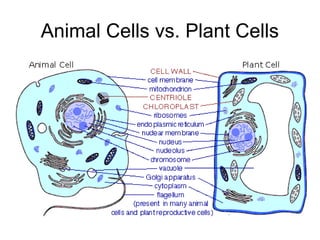
Animal Cells vs. Plant Cells

Parts of the Cell

  • 1.
  • 2.
  • 3.
    Cell Organelles andFunction 1. Nucleus – Nickname: “The Control Center” – Function: holds the DNA – Parts: • Chromatin: strands that contain genetic material • Nucleolus: dark spot in the middle of the nucleus that helps make ribosomes – Plant and animal cells
  • 4.
    Go to Section: Animal Cell Nucleus NucleolusRibosomes Cell Membrane Cytoplasm
  • 5.
    Cell Organelles andFunction 2. Ribosomes – Function: makes proteins – Found in all cells – Located: Cytoplasm
  • 6.
  • 7.
    Cell Organelles andFunction 3. Endoplasmic Reticulum (ER) – Nickname: “freeway” – Function: The internal delivery system of the cell – Located: Cytoplasm – Plant and animal cells
  • 8.
    Section 7-2 Figure 7-5Plant and Animal Cells Go to Section: Animal Cell Nucleus Nucleolus Rough Endoplasmic Reticulum Smooth Endoplasmic Reticulum Ribosomes Golgi Complex Cell Membrane Cytoplasm
  • 9.
    Cell Organelles andFunction 4. Golgi Complex – Nickname: The shippers – Function: packages, modifies, and transports materials to different location inside/outside of the cell – Appearance: stack of pancakes – Located: Cytoplasm – Plant and animal cells
  • 10.
    Section 7-2 Figure 7-5Plant and Animal Cells Go to Section: Animal Cell Nucleus Nucleolus Rough Endoplasmic Reticulum Smooth Endoplasmic Reticulum Ribosomes Golgi Bodies Cell Membrane Cytoplasm
  • 11.
    Cell Organelles andFunction 5. Lysosomes: circular, but bigger than ribosomes) – Nickname: “Clean-up Crews” (think Lysol) – Function: to break down food into particles the rest of the cell can use and to destroy old cells – Located: Cytoplasm – Plant and animal cells
  • 12.
    Section 7-2 Figure 7-5Plant and Animal Cells Animal Cell Nucleus Nucleolus Rough Endoplasmic Reticulum Smooth Endoplasmic Reticulum Ribosomes Golgi Bodies Mitochondria Cell Membrane Cytoplasm
  • 13.
    Cell Organelles andFunction 6. Mitochondria – Nickname: “The Powerhouse” – Function: makes energy • Breaks down food to make ATP – ATP: is the major fuel for all cell activities that require energy – Located: Cytoplasm – Plant and animal cells
  • 15.
    Section 7-2 Figure 7-5Plant and Animal Cells Go to Section: Plant Cell Cell Membrane Vacuol e
  • 16.
    Cell Organelles andFunction 7. Vacuoles – Function: • Plant Cells – Very large – stores water – This is what makes lettuce crisp » When there is no water, the plant wilts • Animal Cells – Smaller than in plant cells – Stores/releases waste products – used in cellular digestion – Located: Cytoplasm
  • 17.
    Section 7-2 Figure 7-5Plant and Animal Cells Go to Section: Plant Cell Cell Membrane Vacuole Chloroplasts
  • 18.
    Cell Organelles andFunction 8. Chloroplasts – Function: traps energy from the sun to produce food for the plant cell – Located: Cytoplasm – Green in color because of chlorophyll, which is a green pigment – Plant cells ONLY
  • 19.
  • 20.
    Section 7-2 Figure 7-5Plant and Animal Cells Go to Section: Plant Cell Cell Membrane Vacuole Chloroplasts Cell Wall
  • 21.
    Cell Organelles andFunction 9. Cell Wall – Function: provides support and protection to the cell membrane – Located: Found outside the cell membrane in plant cells only
  • 22.
    Plant Cell Cell Membrane Vacuole Chloroplasts CellWall Nucleolus Nucleus Rough ER Smooth ER Golgi Bodies Mitochondria Ribosomes Cytoplasm
  • 23.
    Cell Organelles andFunction 10. Cell Membrane – Functions: • separates the inside of the cell from its environment • Controls what substances enter and leave the cell (think door) – Oxygen, carbon dioxide, wastes, food, etc… – Located: • In plant cells, it is to the inside of the cell wall • In animal cells, it is the outermost part of the cell
  • 24.
    Animal Cells vs.Plant Cells