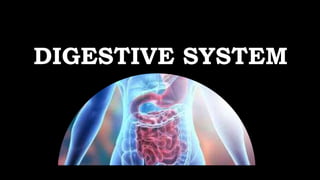
DIGESTIVE SYSTEM
The food that we eat plays a central role in
the survival of species. It provides the
energy that enables us to carry out the
many activities that we do each day such as
breathing, walking, studying and cooking.
Food also provides the substances needed
for growth and repair of body parts.
The cells in the body need food for energy
used for growth and repair. Food
must be broken down into a form that these
microscopic cells can use. The body
changes food into a usable form by means of
a group of organs referred to as the
digestive system.
The function of the digestive system is
digestion, the breakdown of organic
compounds into their simple forms for use
by the cells. Digestion is the chief
function of the digestive system. It breaks
down food mechanically and chemically.
Mechanical digestion- starts in the mouth
where food is chewed and broken down into
smaller pieces for easier digestion.
Chemical digestion- also starts in the mouth
and is carried out by enzymes.
Enzymes- molecules that speed up chemical
reaction. Ex. Amylase, an enzyme present in
the saliva that breaks down carbohydrates,
which are large complex molecules into
simpler ones that can be used by the body.
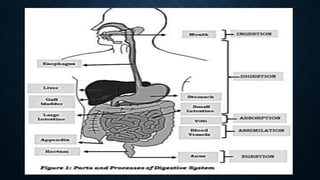
The process of digestion
1. INGESTION is the first process that
happens in digestive system. It is the
journey of taking in food or any
substance into the body through the
mouth. The journey of food starts when
a bit of food enters your mouth.
2. DIGESTION is the second process
involved in digestive system. It is the
process that involves break down of large
food molecules into smaller molecules for
easy absorption of the cells. Both chemical
and mechanical digestions begin
immediately in the mouth
While the food is in the mouth, the teeth cut,
crush, and break it apart into tiny pieces while
the tongue helps mix food with saliva secreted
by the salivary glands forming into a moist ball
called bolus so it can be easily swallowed. This
process is known as mastication or chewing
considered as a mechanical digestion, which is
the initial stage of digestion.
The saliva contains salivary amylase, the
enzyme that breaks down starch into smaller
carbohydrate. Then, the bolus passes from the
mouth to the esophagus - a tube that attaches
the mouth to the stomach.
A series of wave-like muscle contractions
known as peristalsis push and transport
foods and liquids in small sections to the
stomach.
The stomach is a J-shaped, bag-like muscular organ
that can hold approximately one liter of fluid and
food. The primary function of the stomach is to store
food, which turns to chyme after being acted on by
the stomach acid. Chyme is a semifluid material
formed from bolus that is acted upon by the gastric
juices secreted by the stomach. The walls of the
stomach have special cells that secrete gastric juices
like hydrochloric acid and pepsin that begin the
chemical breakdown of proteins.
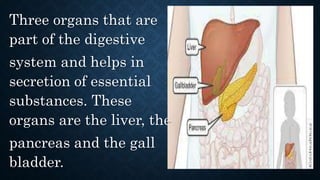
Three organs that are
part of the digestive
system and helps in
secretion of essential
substances. These
organs are the liver, the
pancreas and the gall
bladder.
The liver produces bile, a green fluid that turns
large fat droplets into smaller ones and stores them
in the gall bladder. When necessary, bile gets into
the small
intestine and helps in the digestion of fat. The
pancreas makes three different kinds of enzymes
namely amylase, peptidase, and lipase released
through a pancreatic duct that aid in the digestion of
all three organic compounds such as carbohydrates,
proteins, and fats respectively.
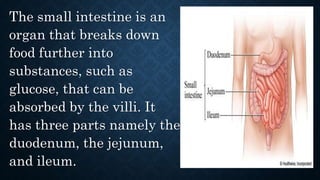
The small intestine is an
organ that breaks down
food further into
substances, such as
glucose, that can be
absorbed by the villi. It
has three parts namely the
duodenum, the jejunum,
and ileum.
The duodenum is the first and shortest part of
the small intestine that starts at the lower end
of the stomach and extends for about 20 cm to
25 cm in length. Basically, it is in charge for the
continuous breaking-down process as it
partially receives the chyme from the stomach,
it resumes chemical digestion of food, and
prepares for absorption through the villi.
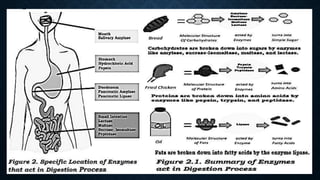
Organic compounds such as carbohydrates, proteins,
and fats are specifically broken down with the aid of
different enzymes. Carbohydrates are broken down
into sugars by enzymes like amylase, maltase and
lactase. Proteins are broken down into amino acids
by enzymes like trypsin and peptidase. Fats are
broken down into fatty acids by the enzyme lipase.
After about four hours, the stomach pushes food into
the small intestines.
The production and release of enzymes and acids in
the digestive system is called secretion. It aids in the
breaking down of complex food molecules into their
chemical building blocks.
The jejunum is the second part of the small intestine
that is 2.5 cm in length. Its wall works for
absorption through enterocytes or columnar cells of
small nutrient particles which have been previously
digested by the enzymes in the duodenum.
3. Absorption is the third process that
happens in the digestive system. It occurs
mostly in the small intestine where several
digestive juices, pancreatic juice, and bile aid
in the chemical digestion of food. Absorption
is the process of passing the soluble food
molecules in the wall of the small intestine
through the villi.
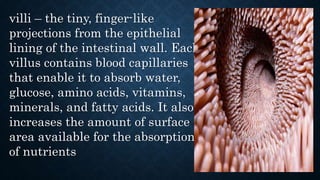
villi – the tiny, finger-like
projections from the epithelial
lining of the intestinal wall. Each
villus contains blood capillaries
that enable it to absorb water,
glucose, amino acids, vitamins,
minerals, and fatty acids. It also
increases the amount of surface
area available for the absorption
of nutrients
4. Assimilation is the fourth process that occurs in
the
digestive system. It is the movement of digested food
nutrients into the blood vessels of the small
intestine
through diffusion and use of nutrients into the body
cells through the microvilli – microscopic cellular
membrane projections that serves to expand the
surface area for diffusion and also to lessen any
The third part of the small intestine is the
ileum which is about 3.5 meters in length.
Its main function is the assimilation
(absorption) of B12 and the re-assimilation
(reabsorption) of conjugated bile salts.
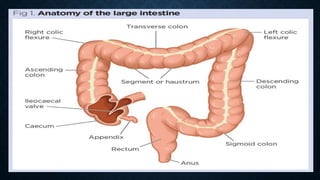
The Large intestine is divided into caecum,
ascending colon, transverse colon, descending
colon, and sigmoid colon. This is where
reabsorption of liquid, electrolytes and some
vitamins from the undigested food takes place.
It secretes mucus to aid in the formation of
feces and maintains alkaline conditions. This is
the last segment of the gastrointestinal tract
that completes absorption and compacts waste.
E. Egestion is the last process that occurs in
the digestive system. It is the release
of undigested food collected in the rectum
called feces and pushed out of the body
through the anus by defecation.
1. When does ingestion begin?
2. What happens to food when it is in your:
a. mouth ________________________________________________
b. stomach ______________________________________________
c. small intestine ________________________________________
3. How are nutrients from the food you eat absorbed after
digestion?
4. Why are villus and microvilli important in the human
digestive system?
5. What happens to the undigested food in the large intestine?
Activity 6. Share It!
1. When food, drink or any substances enters
into the mouth.
2. When food is in the mouth, stomach and
small intestine it will undergo mechanical and
chemical digestion that breaks down large
insoluble food molecules into smaller water-
soluble food molecules for easy absorption of
the cells.
3. Absorption of nutrients passed the
soluble food molecules in the lining of the
small intestine through the villi.
4. The villi and microvilli are important
because it increases the surface area for
absorption of nutrients from the food that
we ate.
5. The undigested food stored in the rectum
called feces are pushed out of the body
through the anus by defecation.

Science Grade 8- The Digestive System.pptx

  • 1.
  • 2.
    The food thatwe eat plays a central role in the survival of species. It provides the energy that enables us to carry out the many activities that we do each day such as breathing, walking, studying and cooking. Food also provides the substances needed for growth and repair of body parts.
  • 3.
    The cells inthe body need food for energy used for growth and repair. Food must be broken down into a form that these microscopic cells can use. The body changes food into a usable form by means of a group of organs referred to as the digestive system.
  • 4.
    The function ofthe digestive system is digestion, the breakdown of organic compounds into their simple forms for use by the cells. Digestion is the chief function of the digestive system. It breaks down food mechanically and chemically.
  • 5.
    Mechanical digestion- startsin the mouth where food is chewed and broken down into smaller pieces for easier digestion. Chemical digestion- also starts in the mouth and is carried out by enzymes.
  • 6.
    Enzymes- molecules thatspeed up chemical reaction. Ex. Amylase, an enzyme present in the saliva that breaks down carbohydrates, which are large complex molecules into simpler ones that can be used by the body.
  • 8.
    The process ofdigestion 1. INGESTION is the first process that happens in digestive system. It is the journey of taking in food or any substance into the body through the mouth. The journey of food starts when a bit of food enters your mouth.
  • 9.
    2. DIGESTION isthe second process involved in digestive system. It is the process that involves break down of large food molecules into smaller molecules for easy absorption of the cells. Both chemical and mechanical digestions begin immediately in the mouth
  • 10.
    While the foodis in the mouth, the teeth cut, crush, and break it apart into tiny pieces while the tongue helps mix food with saliva secreted by the salivary glands forming into a moist ball called bolus so it can be easily swallowed. This process is known as mastication or chewing considered as a mechanical digestion, which is the initial stage of digestion.
  • 11.
    The saliva containssalivary amylase, the enzyme that breaks down starch into smaller carbohydrate. Then, the bolus passes from the mouth to the esophagus - a tube that attaches the mouth to the stomach. A series of wave-like muscle contractions known as peristalsis push and transport foods and liquids in small sections to the stomach.
  • 12.
    The stomach isa J-shaped, bag-like muscular organ that can hold approximately one liter of fluid and food. The primary function of the stomach is to store food, which turns to chyme after being acted on by the stomach acid. Chyme is a semifluid material formed from bolus that is acted upon by the gastric juices secreted by the stomach. The walls of the stomach have special cells that secrete gastric juices like hydrochloric acid and pepsin that begin the chemical breakdown of proteins.
  • 13.
    Three organs thatare part of the digestive system and helps in secretion of essential substances. These organs are the liver, the pancreas and the gall bladder.
  • 14.
    The liver producesbile, a green fluid that turns large fat droplets into smaller ones and stores them in the gall bladder. When necessary, bile gets into the small intestine and helps in the digestion of fat. The pancreas makes three different kinds of enzymes namely amylase, peptidase, and lipase released through a pancreatic duct that aid in the digestion of all three organic compounds such as carbohydrates, proteins, and fats respectively.
  • 15.
    The small intestineis an organ that breaks down food further into substances, such as glucose, that can be absorbed by the villi. It has three parts namely the duodenum, the jejunum, and ileum.
  • 16.
    The duodenum isthe first and shortest part of the small intestine that starts at the lower end of the stomach and extends for about 20 cm to 25 cm in length. Basically, it is in charge for the continuous breaking-down process as it partially receives the chyme from the stomach, it resumes chemical digestion of food, and prepares for absorption through the villi.
  • 18.
    Organic compounds suchas carbohydrates, proteins, and fats are specifically broken down with the aid of different enzymes. Carbohydrates are broken down into sugars by enzymes like amylase, maltase and lactase. Proteins are broken down into amino acids by enzymes like trypsin and peptidase. Fats are broken down into fatty acids by the enzyme lipase. After about four hours, the stomach pushes food into the small intestines.
  • 19.
    The production andrelease of enzymes and acids in the digestive system is called secretion. It aids in the breaking down of complex food molecules into their chemical building blocks. The jejunum is the second part of the small intestine that is 2.5 cm in length. Its wall works for absorption through enterocytes or columnar cells of small nutrient particles which have been previously digested by the enzymes in the duodenum.
  • 20.
    3. Absorption isthe third process that happens in the digestive system. It occurs mostly in the small intestine where several digestive juices, pancreatic juice, and bile aid in the chemical digestion of food. Absorption is the process of passing the soluble food molecules in the wall of the small intestine through the villi.
  • 21.
    villi – thetiny, finger-like projections from the epithelial lining of the intestinal wall. Each villus contains blood capillaries that enable it to absorb water, glucose, amino acids, vitamins, minerals, and fatty acids. It also increases the amount of surface area available for the absorption of nutrients
  • 22.
    4. Assimilation isthe fourth process that occurs in the digestive system. It is the movement of digested food nutrients into the blood vessels of the small intestine through diffusion and use of nutrients into the body cells through the microvilli – microscopic cellular membrane projections that serves to expand the surface area for diffusion and also to lessen any
  • 23.
    The third partof the small intestine is the ileum which is about 3.5 meters in length. Its main function is the assimilation (absorption) of B12 and the re-assimilation (reabsorption) of conjugated bile salts.
  • 24.
    The Large intestineis divided into caecum, ascending colon, transverse colon, descending colon, and sigmoid colon. This is where reabsorption of liquid, electrolytes and some vitamins from the undigested food takes place. It secretes mucus to aid in the formation of feces and maintains alkaline conditions. This is the last segment of the gastrointestinal tract that completes absorption and compacts waste.
  • 26.
    E. Egestion isthe last process that occurs in the digestive system. It is the release of undigested food collected in the rectum called feces and pushed out of the body through the anus by defecation.
  • 29.
    1. When doesingestion begin? 2. What happens to food when it is in your: a. mouth ________________________________________________ b. stomach ______________________________________________ c. small intestine ________________________________________ 3. How are nutrients from the food you eat absorbed after digestion? 4. Why are villus and microvilli important in the human digestive system? 5. What happens to the undigested food in the large intestine?
  • 30.
    Activity 6. ShareIt! 1. When food, drink or any substances enters into the mouth. 2. When food is in the mouth, stomach and small intestine it will undergo mechanical and chemical digestion that breaks down large insoluble food molecules into smaller water- soluble food molecules for easy absorption of the cells.
  • 31.
    3. Absorption ofnutrients passed the soluble food molecules in the lining of the small intestine through the villi. 4. The villi and microvilli are important because it increases the surface area for absorption of nutrients from the food that we ate.
  • 32.
    5. The undigestedfood stored in the rectum called feces are pushed out of the body through the anus by defecation.