THE DIGESTIVE SYSTEM
© PDST Home Economics
 Without food, water and oxygen, human beings could
not survive.
 The digestive system is a set of organs which change
what we eat into substances that can be used in the
body.
 These substances can be used for energy, growth and
repair.
THE DIGESTIVE SYSTEM
 The alimentary canal is a tube that runs from the
mouth to the anus
 It is composed of the mouth, oesophagus, stomach,
small intestine and the large intestine
 As food passes through the alimentary canal it is
changed and the nourishment is taken into the blood
 Waste passes out the end of the canal
 Certain organs and glands add juices to the canal at
various points
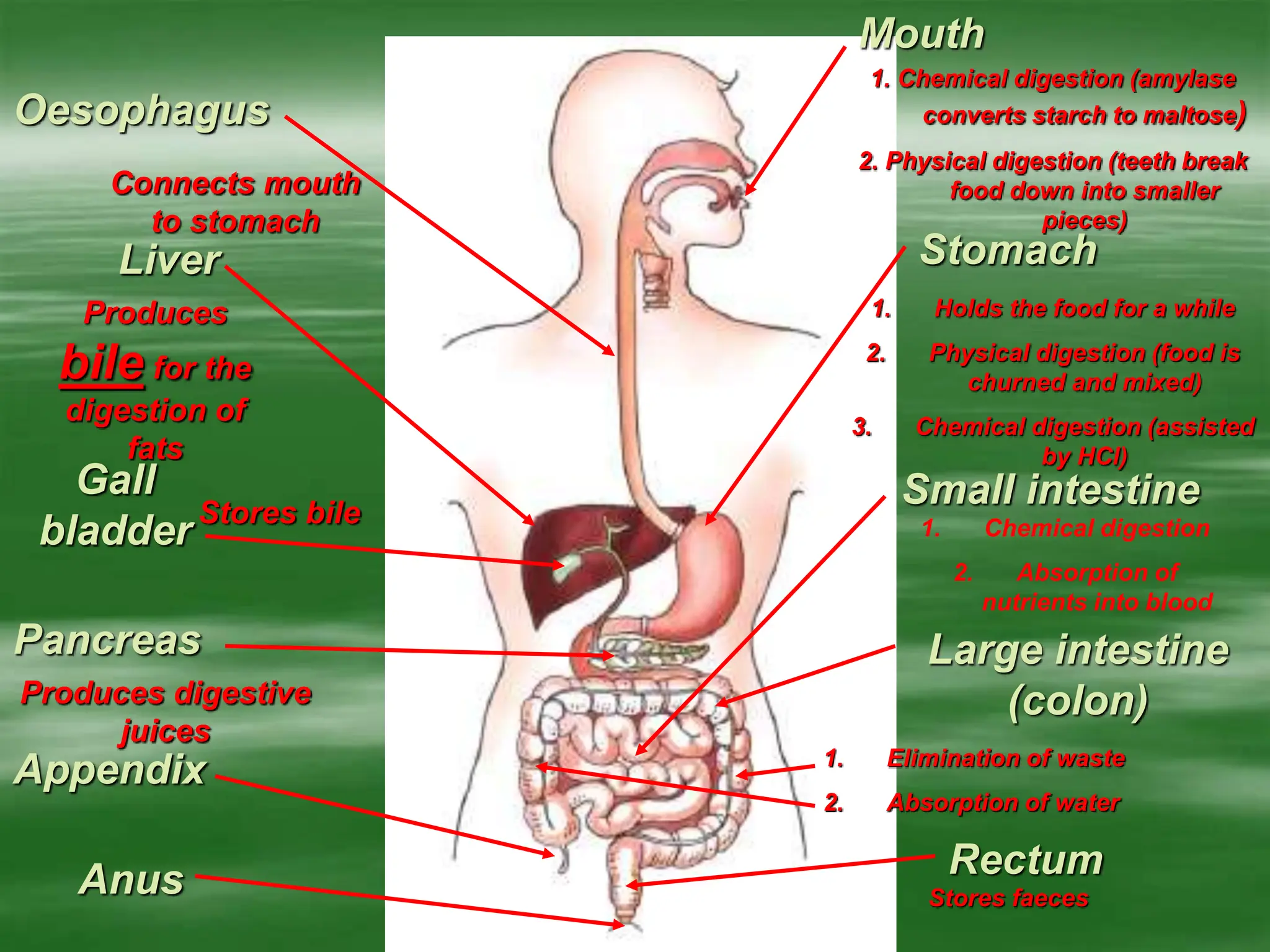
Mouth
1. Chemical digestion (amylase
converts starch to maltose)
2. Physical digestion (teeth break
food down into smaller
pieces)
Oesophagus
Connects mouth
to stomach
Stomach
Liver
Produces
bile for the
digestion of
fats
Gall
bladder
Stores bile
1. Holds the food for a while
2. Physical digestion (food is
churned and mixed)
3. Chemical digestion (assisted
by HCl)
Pancreas
Produces digestive
juices
Small intestine
1. Chemical digestion
2. Absorption of
nutrients into blood
Appendix
Large intestine
(colon)
1. Elimination of waste
2. Absorption of water
Rectum
Stores faeces
Anus
Food can be broken down (digested) in one of two
ways:
1. Physical Digestion
This is where large pieces of food are broken down
into smaller pieces of the same food
2. Chemical Digestion
This is where food is broken down into a different
substance that can easily pass into the blood
Mouth
 The food is broken down by the teeth and mixed with
saliva.
 Saliva is excreted by three pairs of glands:
• The parotid gland (below the ear)
• The submandibular (under the tongue)
• The sublingual (under the tongue)
 Saliva contains water, mucus and the enzyme salivary
amylase.
Functions of Saliva
 It lubricates food with mucus, making it easier to
swallow.
 It contains the enzyme salivary amylase, which acts on
cooked starch turning some of it into maltose.
 It keeps the mouth and teeth clean.
 The ball of food that leaves the mouth is known as a
bolus.
Functions of the Tongue
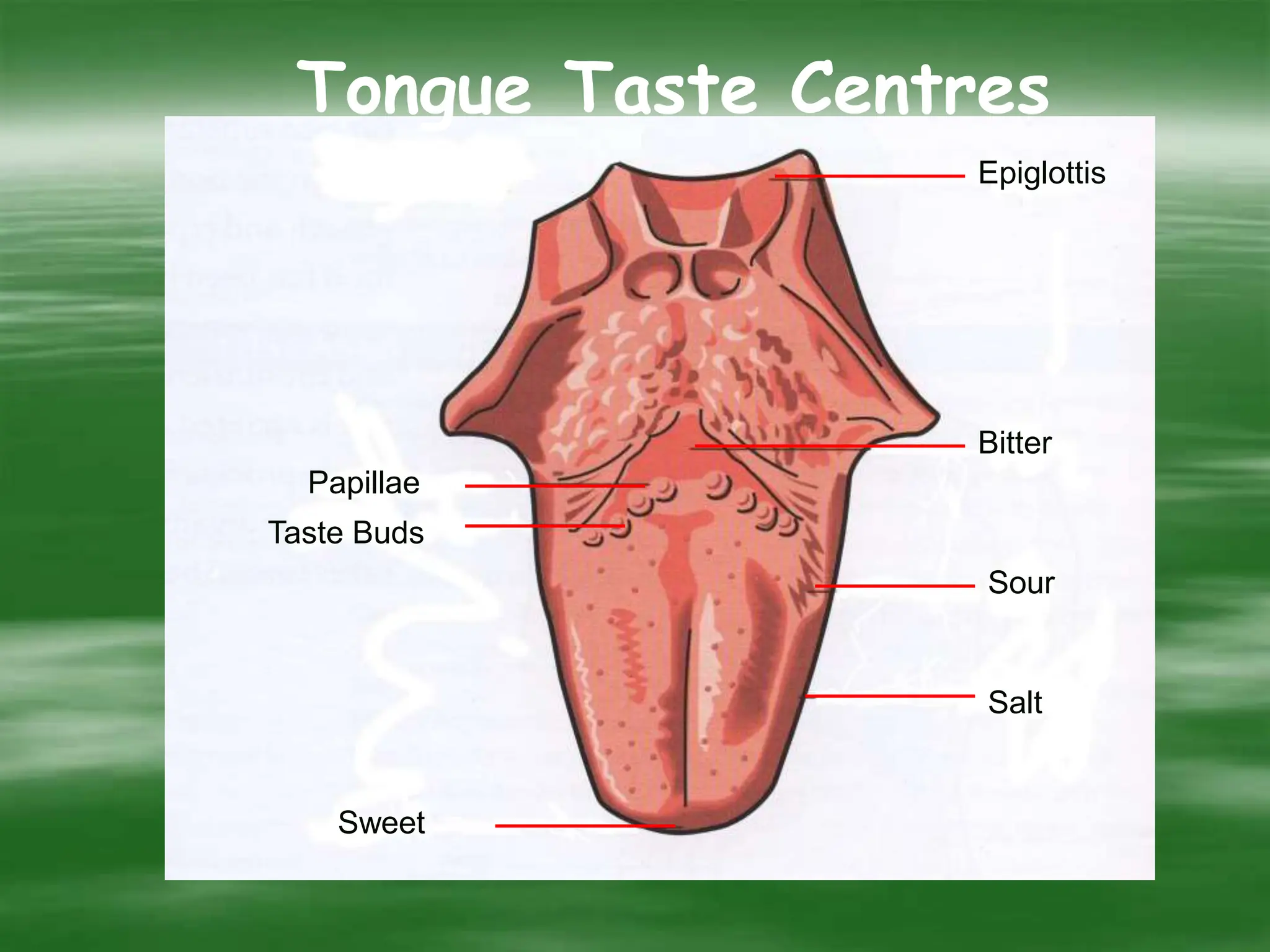
 Taste: it is covered with thousands of taste buds.
These are sensitive to salt, sweet, sour and bitter
chemicals in food and drink.
They help us enjoy food and drink and warn us when
food, drink are off or inedible.
 Chewing: the tongue aids chewing by moving the food
around the mouth, pushing it between the teeth and
covering it with saliva, which contains enzymes that
start the digestive process.
The food is turned into a partially digested mass known
as a bolus.
 Swallowing: when the food is ready to travel to the
stomach, the tongue pushes it to the back of the mouth.
Tongue Taste Centres
Epiglottis
Bitter
Sour
Salt
Sweet
Taste Buds
Papillae
Oesophagus
 The food passes into the pharynx (a muscular tube
behind the mouth) and down the oesophagus.
 The epiglottis a small flap of cartilage blocks the
entrance to the larynx, this stops the food going down
the wrong way and prevents choking.
Structure of the Oesophagus
& Functions
 It is a muscular tube.
 It leads from the pharynx to the stomach.
Function
 To carry chewed food from the pharynx to the
stomach.
 Food moves along it by a muscular contraction known as
peristalsis.
 The muscle fibres contract and relax which acts like a
wave on the tube, pushing the bolus forward.
 It’s lining secretes mucus to lubricate the passage of
food.
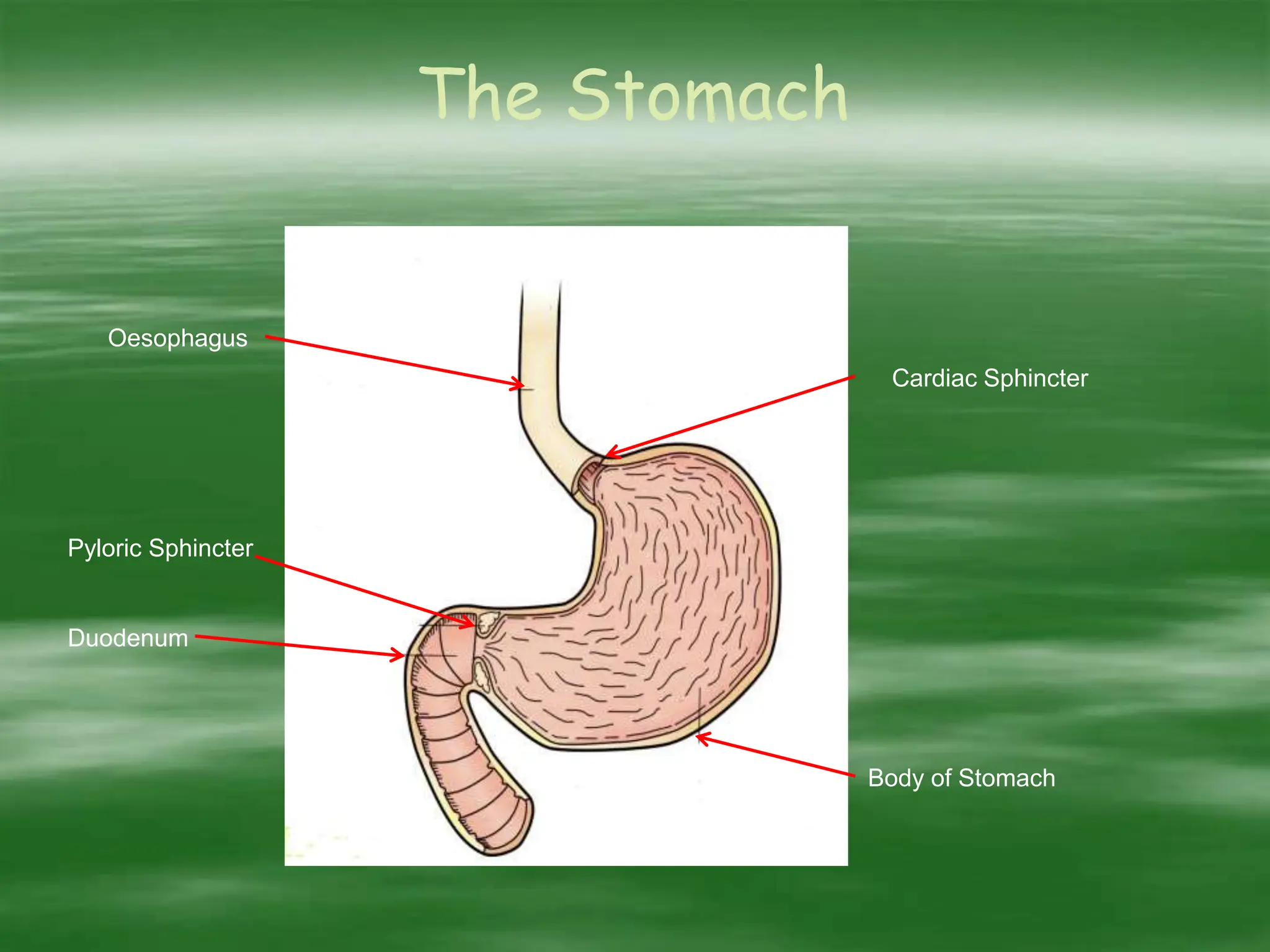
The Stomach
Oesophagus
Pyloric Sphincter
Duodenum
Body of Stomach
Cardiac Sphincter
Stomach Structure
 It is a J-shaped, elastic organ.
 Food enters it from the oesophagus through the cardiac
sphincter.
 The cardiac sphincter, is a valve that stops back flow of
the stomach`s contents.
 Food leaves the stomach through the pyloric sphincter
into the duodenum (first part of the small intestine).
 The walls of the stomach is made up of layers of
muscle.
 It has an inner mucous membrane.
 This membrane has lots of folds.
 When the stomach is full these folds stretch out,
enabling it to expand, then they contract when the
stomach empties.
Functions of The Stomach
 It digests protein through the action of enzymes.
 It churns food with the gastric juices.
 It helps lubricate the food by producing mucus.
 It absorbs alcohol.
 It kills bacteria by producing hydrochloric acid.
Gastric Juices
 Hydrochloric acid neutralises bacteria and activates
pepsin.
 Rennin is an enzyme that curdles milk protein in infants.
 Pepsin is an enzyme that breaks down proteins into
peptones.
Structure of the Small Intestine
 It is seven metres long.
 It is divided into three parts:
The duodenum
The jejunum
The ileum
 The walls has four layers:
A muscular layer
A layer containing blood vessels, lymph vessels, and
nerves.
A submucous layer,
A mucous layer.
 The inner wall is covered in villi, tiny hair like
projections which increase the surface area for
absorption.
 Each villi contain blood vessels and lymph vessels.
Functions of The Small Intestine
Digestion
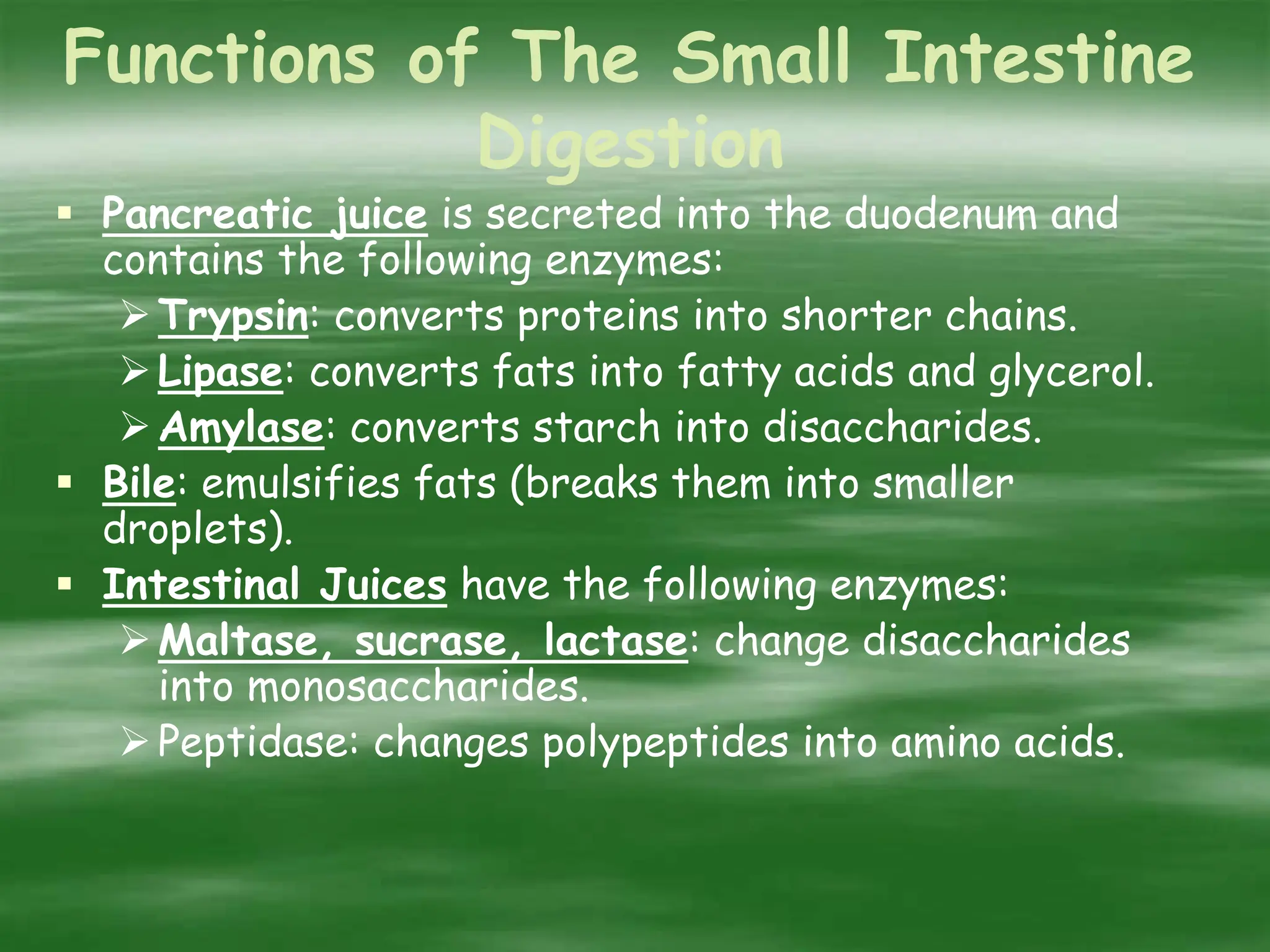
 Pancreatic juice is secreted into the duodenum and
contains the following enzymes:
Trypsin: converts proteins into shorter chains.
Lipase: converts fats into fatty acids and glycerol.
Amylase: converts starch into disaccharides.
 Bile: emulsifies fats (breaks them into smaller
droplets).
 Intestinal Juices have the following enzymes:
Maltase, sucrase, lactase: change disaccharides
into monosaccharides.
Peptidase: changes polypeptides into amino acids.
Absorption
 Digested food is absorbed through the villi walls.
Fats, fatty acids and glycerol are passed into the
lymph system.
Amino acids and sugars pass along the portal vein to
the liver.
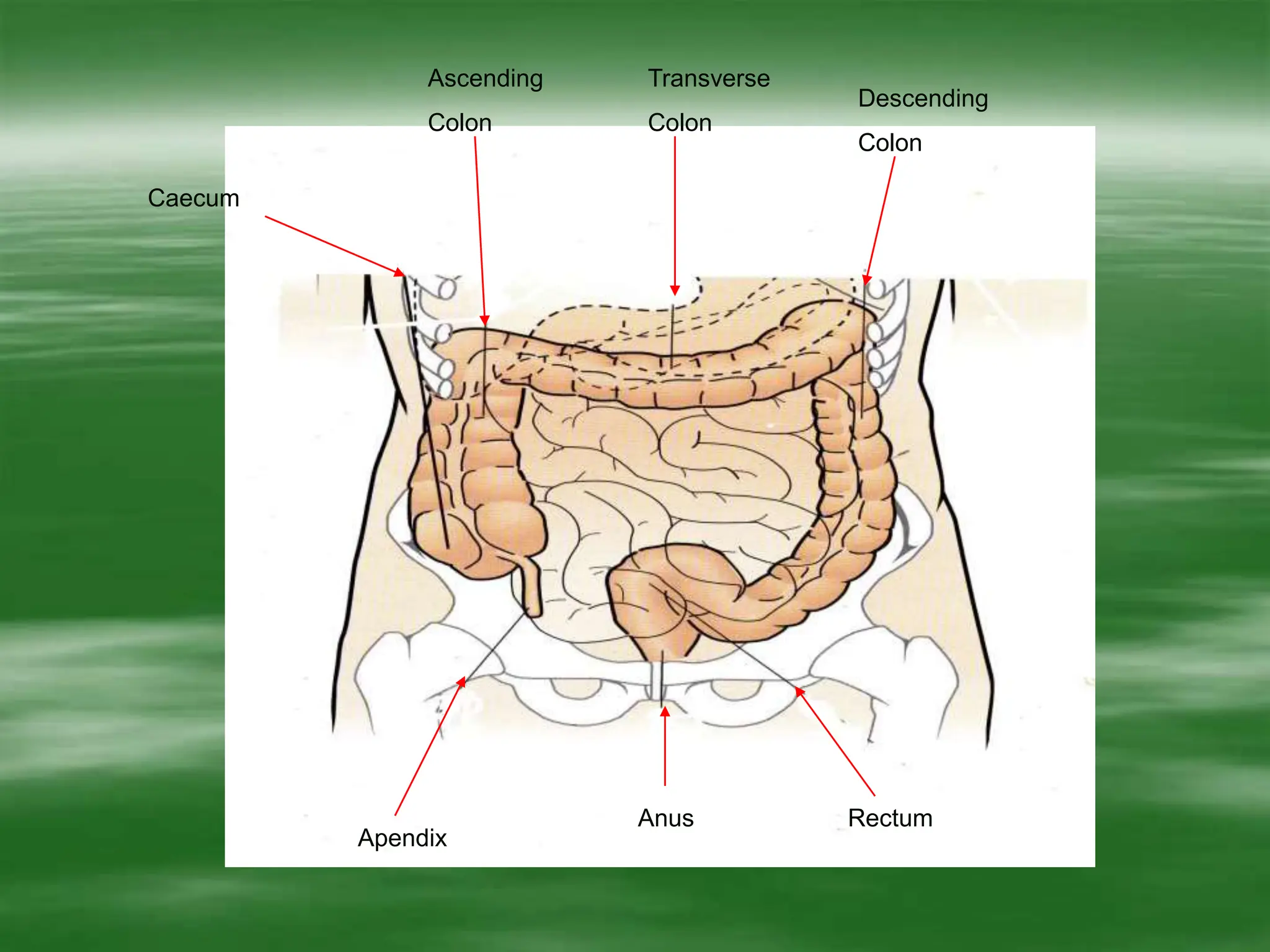
Caecum
Transverse
Colon
Descending
Colon
Ascending
Colon
Rectum
Anus
Apendix
What is the Large Intestine
 It deals with waste.
 It is about 1.5m long.
 It consists of the following:
 The caecum: a small pouch; the ileum empties its
contents into the caecum through the ileo-caecal valve.
 The colon: ascending, transverse, descending colon.
 The appendix: narrow tube attached to the caecum.
 The rectum.
 The anus
Functions
 Whatever remains of the food, is passed into the large
intestine
 To reabsorb water and vitamins left in digestive waste.
 It secretes mucus to help the movement of faeces.
 Short term storage of faeces in the rectum.
 Many bacteria live in the large intestine, they are
harmless in the colon and may be useful e.g. produce
Vitamin K.
 Defecation: peristalsis pushes waste along the colon and
then it is passed out of the body.
ENZYMES
 An enzyme is a biological catalyst
 A catalyst speeds up chemical reactions
 Enzymes speed up biological reactions
 All chemical reactions that take place in living systems
require the action of an enzyme
ENZYMES
 Digestive enzymes break food down into smaller, more
soluble substances
 This allows the food to be absorbed into the blood
ENZYMES
 An example of a digestive enzyme is
amylase
 Amylase is present in saliva
 Amylase chemically breaks down starch
ENZYMES
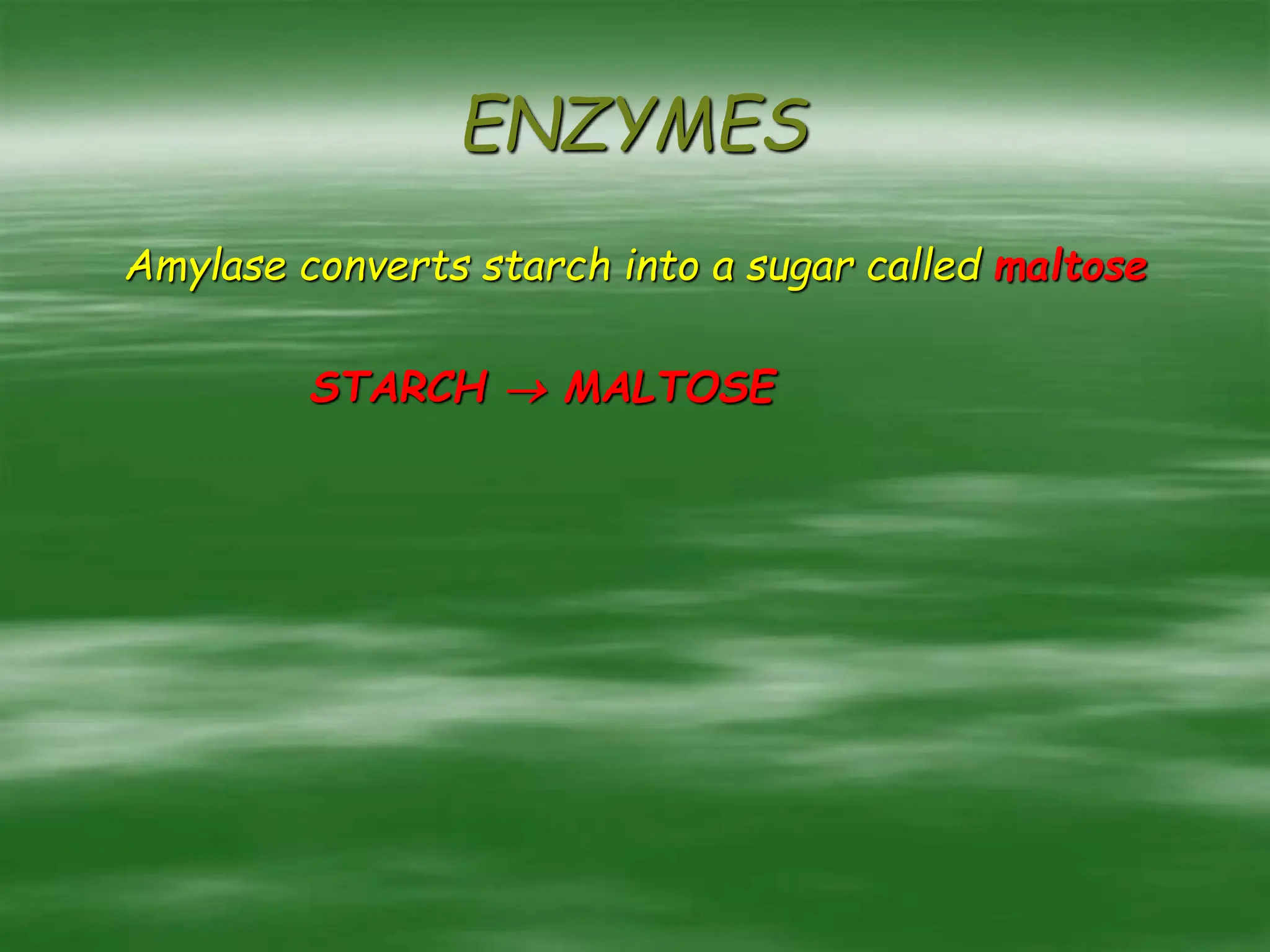
Amylase converts starch into a sugar called maltose
STARCH  MALTOSE
ENZYMES
STARCH
AMYLASE
MALTOSE
ENZYMES
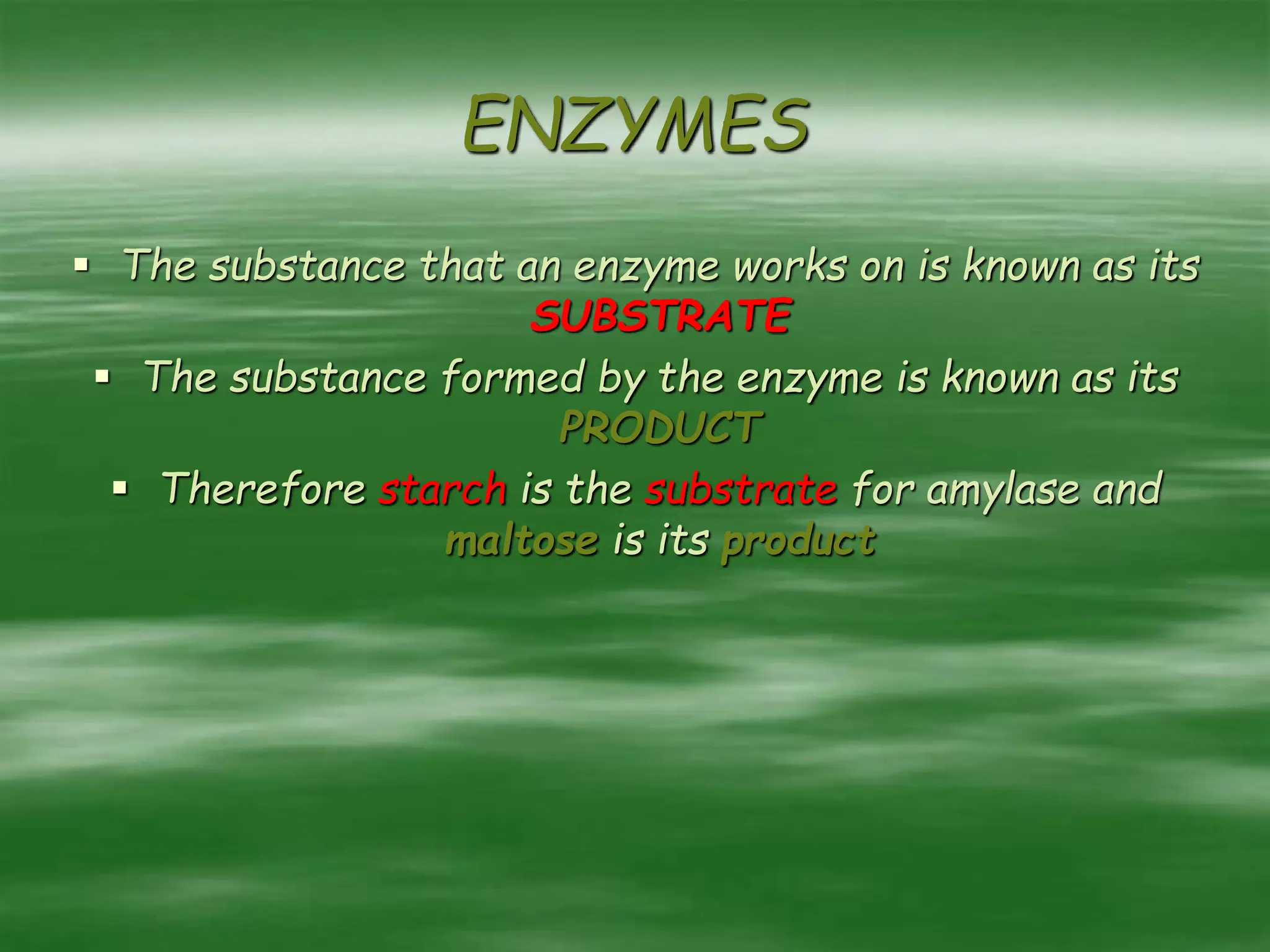
 The substance that an enzyme works on is known as its
SUBSTRATE
 The substance formed by the enzyme is known as its
PRODUCT
 Therefore starch is the substrate for amylase and
maltose is its product
STAGES OF NUTRITION
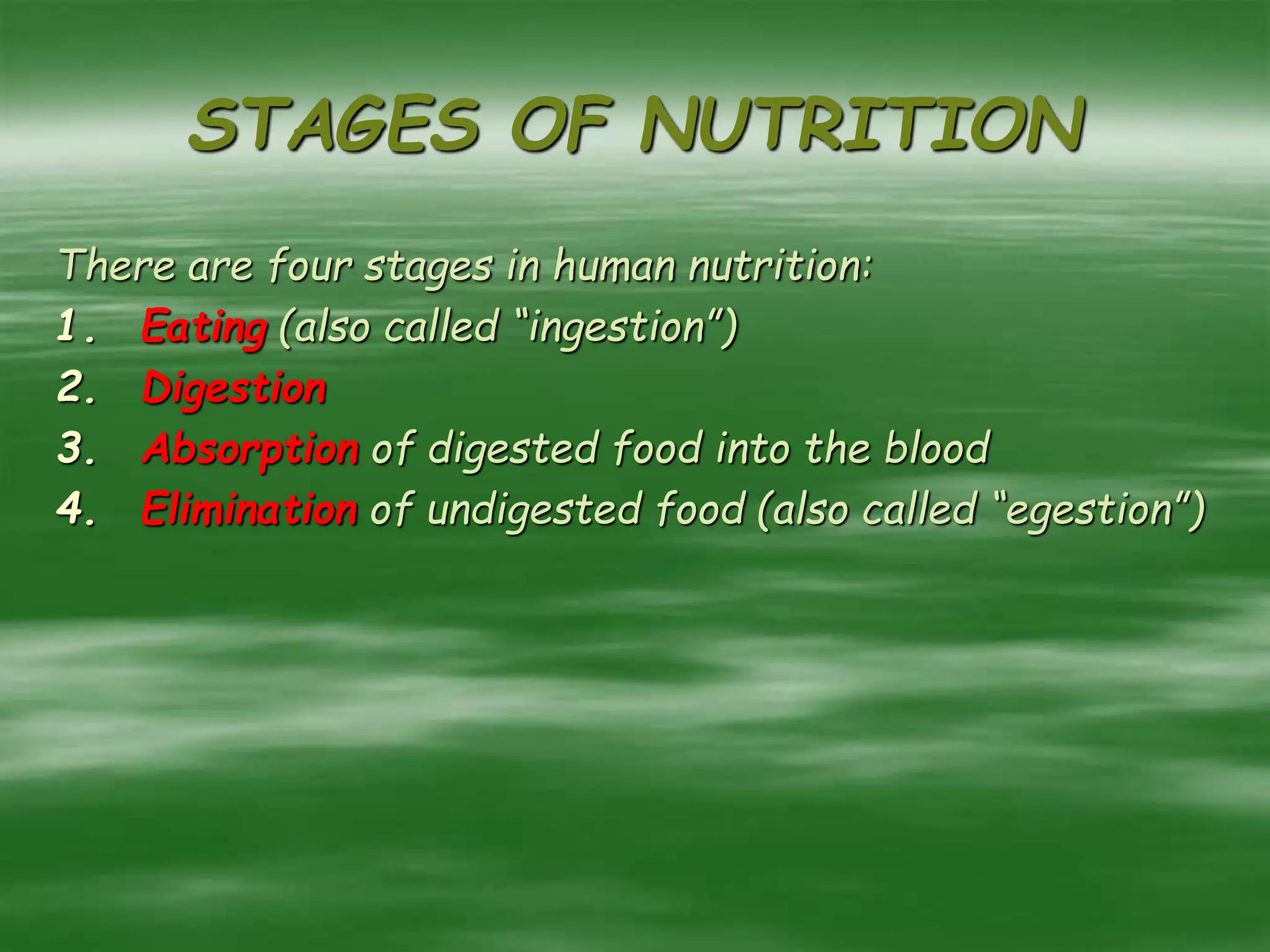
There are four stages in human nutrition:
1. Eating (also called “ingestion”)
2. Digestion
3. Absorption of digested food into the blood
4. Elimination of undigested food (also called “egestion”)
STAGES OF NUTRITION
 Digestion changes food into a form that can enter the
blood
 Physical (mechanical) digestion breaks food down into
smaller pieces
 Chemical digestion breaks food down into different,
more soluble substances
 The contents of the alimentary canal are pushed
along by a rhythmic pulsing of the muscles of the
intestines
 This is known as peristalsis
TEETH
 An adult human has 32 teeth, 16 in either jaw
 The shape and size of the tooth varies with the job it
has to do
 There are four different types of tooth
TEETH
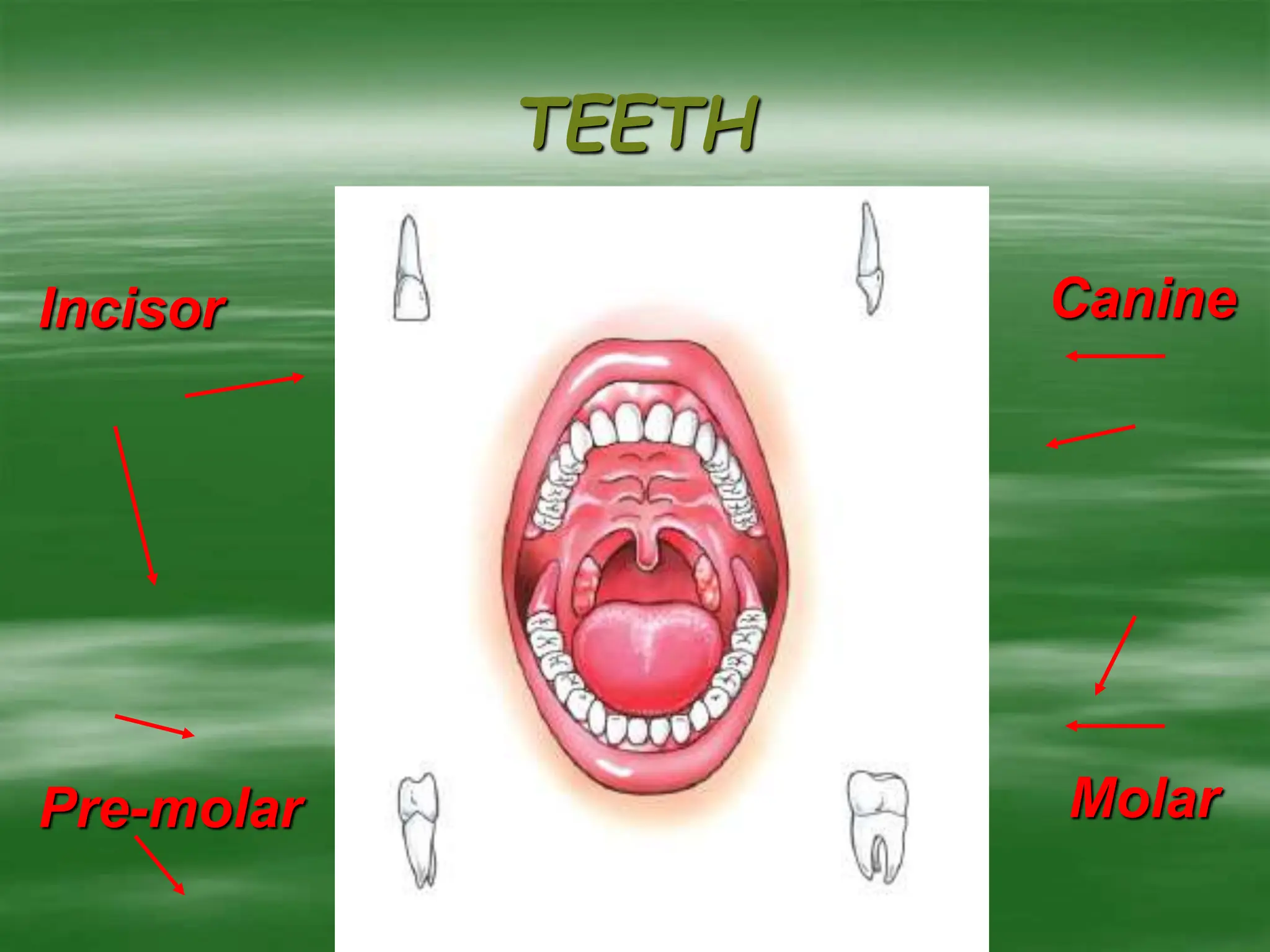
Incisors
These cut and bite food
Canines
These grasp and tear food
Pre-molars
These grind and chew food
Molars
These also grind and chew food
TEETH
Incisor
Pre-molar
Canine
Molar
TEETH
 The type of teeth that an animal has depends on what it
eats
 A herbivore eats plant material and has very large
incisors and molars
 A carnivore eats other animals and needs very large
canines
 An omnivore (e.g. humans) eats all kinds of food and
needs and use all of the types of tooth equally

Digestive System- and role of Saliva .ppt

  • 1.
    THE DIGESTIVE SYSTEM ©PDST Home Economics
  • 2.
     Without food,water and oxygen, human beings could not survive.  The digestive system is a set of organs which change what we eat into substances that can be used in the body.  These substances can be used for energy, growth and repair.
  • 3.
    THE DIGESTIVE SYSTEM The alimentary canal is a tube that runs from the mouth to the anus  It is composed of the mouth, oesophagus, stomach, small intestine and the large intestine  As food passes through the alimentary canal it is changed and the nourishment is taken into the blood  Waste passes out the end of the canal  Certain organs and glands add juices to the canal at various points
  • 4.
    Mouth 1. Chemical digestion(amylase converts starch to maltose) 2. Physical digestion (teeth break food down into smaller pieces) Oesophagus Connects mouth to stomach Stomach Liver Produces bile for the digestion of fats Gall bladder Stores bile 1. Holds the food for a while 2. Physical digestion (food is churned and mixed) 3. Chemical digestion (assisted by HCl) Pancreas Produces digestive juices Small intestine 1. Chemical digestion 2. Absorption of nutrients into blood Appendix Large intestine (colon) 1. Elimination of waste 2. Absorption of water Rectum Stores faeces Anus
  • 5.
    Food can bebroken down (digested) in one of two ways: 1. Physical Digestion This is where large pieces of food are broken down into smaller pieces of the same food 2. Chemical Digestion This is where food is broken down into a different substance that can easily pass into the blood
  • 6.
    Mouth  The foodis broken down by the teeth and mixed with saliva.  Saliva is excreted by three pairs of glands: • The parotid gland (below the ear) • The submandibular (under the tongue) • The sublingual (under the tongue)  Saliva contains water, mucus and the enzyme salivary amylase.
  • 7.
    Functions of Saliva It lubricates food with mucus, making it easier to swallow.  It contains the enzyme salivary amylase, which acts on cooked starch turning some of it into maltose.  It keeps the mouth and teeth clean.  The ball of food that leaves the mouth is known as a bolus.
  • 8.
    Functions of theTongue  Taste: it is covered with thousands of taste buds. These are sensitive to salt, sweet, sour and bitter chemicals in food and drink. They help us enjoy food and drink and warn us when food, drink are off or inedible.  Chewing: the tongue aids chewing by moving the food around the mouth, pushing it between the teeth and covering it with saliva, which contains enzymes that start the digestive process. The food is turned into a partially digested mass known as a bolus.  Swallowing: when the food is ready to travel to the stomach, the tongue pushes it to the back of the mouth.
  • 9.
  • 10.
    Oesophagus  The foodpasses into the pharynx (a muscular tube behind the mouth) and down the oesophagus.  The epiglottis a small flap of cartilage blocks the entrance to the larynx, this stops the food going down the wrong way and prevents choking.
  • 11.
    Structure of theOesophagus & Functions  It is a muscular tube.  It leads from the pharynx to the stomach. Function  To carry chewed food from the pharynx to the stomach.  Food moves along it by a muscular contraction known as peristalsis.  The muscle fibres contract and relax which acts like a wave on the tube, pushing the bolus forward.  It’s lining secretes mucus to lubricate the passage of food.
  • 12.
  • 13.
    Stomach Structure  Itis a J-shaped, elastic organ.  Food enters it from the oesophagus through the cardiac sphincter.  The cardiac sphincter, is a valve that stops back flow of the stomach`s contents.  Food leaves the stomach through the pyloric sphincter into the duodenum (first part of the small intestine).
  • 14.
     The wallsof the stomach is made up of layers of muscle.  It has an inner mucous membrane.  This membrane has lots of folds.  When the stomach is full these folds stretch out, enabling it to expand, then they contract when the stomach empties.
  • 15.
    Functions of TheStomach  It digests protein through the action of enzymes.  It churns food with the gastric juices.  It helps lubricate the food by producing mucus.  It absorbs alcohol.  It kills bacteria by producing hydrochloric acid.
  • 16.
    Gastric Juices  Hydrochloricacid neutralises bacteria and activates pepsin.  Rennin is an enzyme that curdles milk protein in infants.  Pepsin is an enzyme that breaks down proteins into peptones.
  • 17.
    Structure of theSmall Intestine  It is seven metres long.  It is divided into three parts: The duodenum The jejunum The ileum  The walls has four layers: A muscular layer A layer containing blood vessels, lymph vessels, and nerves. A submucous layer, A mucous layer.
  • 18.
     The innerwall is covered in villi, tiny hair like projections which increase the surface area for absorption.  Each villi contain blood vessels and lymph vessels.
  • 19.
    Functions of TheSmall Intestine Digestion  Pancreatic juice is secreted into the duodenum and contains the following enzymes: Trypsin: converts proteins into shorter chains. Lipase: converts fats into fatty acids and glycerol. Amylase: converts starch into disaccharides.  Bile: emulsifies fats (breaks them into smaller droplets).  Intestinal Juices have the following enzymes: Maltase, sucrase, lactase: change disaccharides into monosaccharides. Peptidase: changes polypeptides into amino acids.
  • 20.
    Absorption  Digested foodis absorbed through the villi walls. Fats, fatty acids and glycerol are passed into the lymph system. Amino acids and sugars pass along the portal vein to the liver.
  • 21.
  • 22.
    What is theLarge Intestine  It deals with waste.  It is about 1.5m long.  It consists of the following:  The caecum: a small pouch; the ileum empties its contents into the caecum through the ileo-caecal valve.  The colon: ascending, transverse, descending colon.  The appendix: narrow tube attached to the caecum.  The rectum.  The anus
  • 23.
    Functions  Whatever remainsof the food, is passed into the large intestine  To reabsorb water and vitamins left in digestive waste.  It secretes mucus to help the movement of faeces.  Short term storage of faeces in the rectum.  Many bacteria live in the large intestine, they are harmless in the colon and may be useful e.g. produce Vitamin K.  Defecation: peristalsis pushes waste along the colon and then it is passed out of the body.
  • 24.
    ENZYMES  An enzymeis a biological catalyst  A catalyst speeds up chemical reactions  Enzymes speed up biological reactions  All chemical reactions that take place in living systems require the action of an enzyme
  • 25.
    ENZYMES  Digestive enzymesbreak food down into smaller, more soluble substances  This allows the food to be absorbed into the blood
  • 26.
    ENZYMES  An exampleof a digestive enzyme is amylase  Amylase is present in saliva  Amylase chemically breaks down starch
  • 27.
    ENZYMES Amylase converts starchinto a sugar called maltose STARCH  MALTOSE
  • 28.
  • 29.
    ENZYMES  The substancethat an enzyme works on is known as its SUBSTRATE  The substance formed by the enzyme is known as its PRODUCT  Therefore starch is the substrate for amylase and maltose is its product
  • 30.
    STAGES OF NUTRITION Thereare four stages in human nutrition: 1. Eating (also called “ingestion”) 2. Digestion 3. Absorption of digested food into the blood 4. Elimination of undigested food (also called “egestion”)
  • 31.
    STAGES OF NUTRITION Digestion changes food into a form that can enter the blood  Physical (mechanical) digestion breaks food down into smaller pieces  Chemical digestion breaks food down into different, more soluble substances
  • 32.
     The contentsof the alimentary canal are pushed along by a rhythmic pulsing of the muscles of the intestines  This is known as peristalsis
  • 33.
    TEETH  An adulthuman has 32 teeth, 16 in either jaw  The shape and size of the tooth varies with the job it has to do  There are four different types of tooth
  • 34.
    TEETH Incisors These cut andbite food Canines These grasp and tear food Pre-molars These grind and chew food Molars These also grind and chew food
  • 35.
  • 36.
    TEETH  The typeof teeth that an animal has depends on what it eats  A herbivore eats plant material and has very large incisors and molars  A carnivore eats other animals and needs very large canines  An omnivore (e.g. humans) eats all kinds of food and needs and use all of the types of tooth equally