HOMEOSTASIS
WHAT HOMEOSTASIS IS AND WHY IT IS
IMPORTANT
• Homeostasis – the maintenance of a constant internal environment
Although the outside environment is always changing (think weather),
The cells inside almost always the same all the time.
Temp., amount of water, glucose concentration
WHAT HOMEOSTASIS IS AND WHY IT IS
IMPORTANT
Why is Homeostasis important?
Temp.
To help cells work efficiently. 37 degrees helps enzymes work at the optimum rate.
Water.
Cells are not damaged by absorbing/losing too much water by osmosis.
Glucose.
Constant glucose conc. Means always enough fuel for energy.
WHAT HOMEOSTASIS IS AND WHY IT IS
IMPORTANT
Mammals and Birds = Endothermic – able to internally regulate body temp.
They are able to maintain the internal temperature themselves, independent of outside
environment.
Opposite
Reptiles, fish, invertebrates and amphibians = Ectothermic – unable to regulate body
temp.
The organisms body temp. varies with the environment.
THE ADVANTAGES OF CONTROLLING BODY
TEMPERATURE
Advantages of Endothermic
Enzymes can always work very efficiently. Metabolism can occur even when cold
outside.
Can be active (can move) in cold weather.
However,
Endothermic animals need to eat much more than Ectothermic.
Needs to gain energy, from respiration
THE STRUCTURE OF THE SKIN
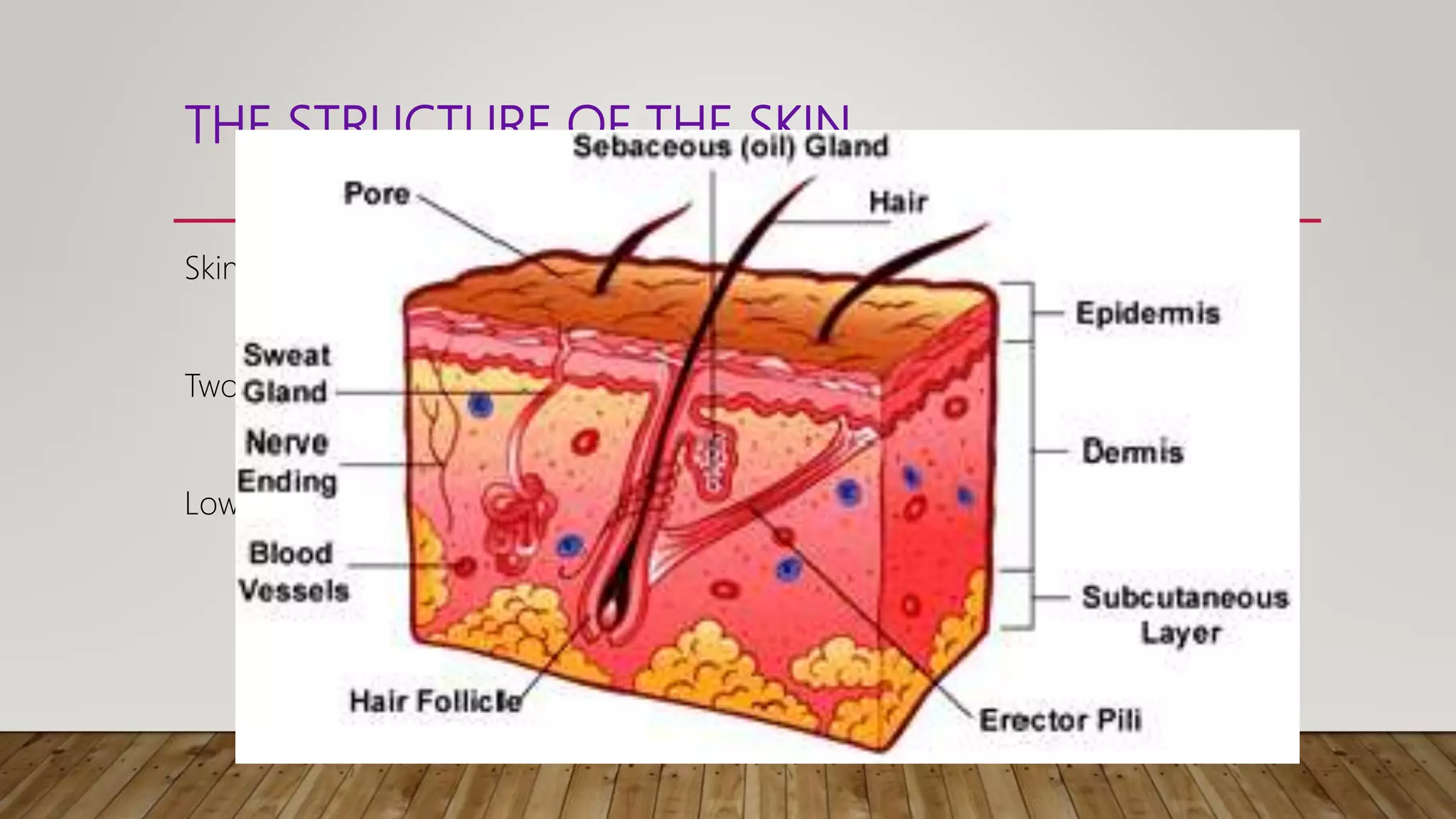
Skin is obviously important for temp. regulation.
Two layers. Top layer is EPIDERMIS
Lower layer is DERMIS
THE STRUCTURE OF THE SKIN
Epidermis - Cells at the base of the epidermis divide (mitosis).
These new cells move towards surface = die and fill up with keratin (protein)
(top layer of skin is made up of dead cells = Cornified Layer)
This Cornified Layer protects living cells below. How? Because it is Hard and
Waterproof.
Constantly sheading and being replaced. (Soles of feet thicker....WHY?)
THE STRUCTURE OF THE SKIN
Some epidermis cells contain a pigment call Melanin (dark brown)
Melanin absorbs harmful ultraviolet rays, to stop damage to living cells below.
Hair follicles are formed by the epidermis folding inwards. Hair is made of Keratin
THE STRUCTURE OF THE SKIN
DERMIS
Most of Dermis is formed by connective tissue (separates/connects different
organs/tissues, not clearly defined shape – containing few cells, collagen and elastic
tissues)
As people get older the fibres lose their elasticity
THE STRUCTURE OF THE SKIN
DERMIS. Sweat glands are contained in the dermis. Secrete Sweat (mostly water, with
salts and urea dissolved in it)
From sweat gland – through sweat duct – out through sweat pores.
Sweating helps with temp. regulation.
THE STRUCTURE OF THE SKIN
DERMIS. Also in Dermis: -
Blood vessels and nerve endings (sensitive to touch/pain/pressure/temp.)
Detect changes in environment
Below Dermis is Fat Layer of Adipose Tissue
Adipose – contains oil which acts as insulation against heat loss and acts as energy
storage.
THE STRUCTURE OF THE SKIN
Summary of Skin Structure
Epidermis - New cells form by mitosis.
New cells move to surface and die forming Cornified Layer. Protects living cells below.
Contains Melanin to protect from UV rays
Hair follicles form when epidermis folds inwards
Dermis – Formed from connective tissue.
Contains Sweat Glands, blood vessels and nerve endings.
Adipose Tissue – Fatty tissue containing oil.
Insulates against the cold. Energy storage.

Homeostasis

  • 1.
  • 2.
    WHAT HOMEOSTASIS ISAND WHY IT IS IMPORTANT • Homeostasis – the maintenance of a constant internal environment Although the outside environment is always changing (think weather), The cells inside almost always the same all the time. Temp., amount of water, glucose concentration
  • 3.
    WHAT HOMEOSTASIS ISAND WHY IT IS IMPORTANT Why is Homeostasis important? Temp. To help cells work efficiently. 37 degrees helps enzymes work at the optimum rate. Water. Cells are not damaged by absorbing/losing too much water by osmosis. Glucose. Constant glucose conc. Means always enough fuel for energy.
  • 4.
    WHAT HOMEOSTASIS ISAND WHY IT IS IMPORTANT Mammals and Birds = Endothermic – able to internally regulate body temp. They are able to maintain the internal temperature themselves, independent of outside environment. Opposite Reptiles, fish, invertebrates and amphibians = Ectothermic – unable to regulate body temp. The organisms body temp. varies with the environment.
  • 5.
    THE ADVANTAGES OFCONTROLLING BODY TEMPERATURE Advantages of Endothermic Enzymes can always work very efficiently. Metabolism can occur even when cold outside. Can be active (can move) in cold weather. However, Endothermic animals need to eat much more than Ectothermic. Needs to gain energy, from respiration
  • 6.
    THE STRUCTURE OFTHE SKIN Skin is obviously important for temp. regulation. Two layers. Top layer is EPIDERMIS Lower layer is DERMIS
  • 7.
    THE STRUCTURE OFTHE SKIN Epidermis - Cells at the base of the epidermis divide (mitosis). These new cells move towards surface = die and fill up with keratin (protein) (top layer of skin is made up of dead cells = Cornified Layer) This Cornified Layer protects living cells below. How? Because it is Hard and Waterproof. Constantly sheading and being replaced. (Soles of feet thicker....WHY?)
  • 8.
    THE STRUCTURE OFTHE SKIN Some epidermis cells contain a pigment call Melanin (dark brown) Melanin absorbs harmful ultraviolet rays, to stop damage to living cells below. Hair follicles are formed by the epidermis folding inwards. Hair is made of Keratin
  • 9.
    THE STRUCTURE OFTHE SKIN DERMIS Most of Dermis is formed by connective tissue (separates/connects different organs/tissues, not clearly defined shape – containing few cells, collagen and elastic tissues) As people get older the fibres lose their elasticity
  • 10.
    THE STRUCTURE OFTHE SKIN DERMIS. Sweat glands are contained in the dermis. Secrete Sweat (mostly water, with salts and urea dissolved in it) From sweat gland – through sweat duct – out through sweat pores. Sweating helps with temp. regulation.
  • 11.
    THE STRUCTURE OFTHE SKIN DERMIS. Also in Dermis: - Blood vessels and nerve endings (sensitive to touch/pain/pressure/temp.) Detect changes in environment Below Dermis is Fat Layer of Adipose Tissue Adipose – contains oil which acts as insulation against heat loss and acts as energy storage.
  • 12.
    THE STRUCTURE OFTHE SKIN Summary of Skin Structure Epidermis - New cells form by mitosis. New cells move to surface and die forming Cornified Layer. Protects living cells below. Contains Melanin to protect from UV rays Hair follicles form when epidermis folds inwards Dermis – Formed from connective tissue. Contains Sweat Glands, blood vessels and nerve endings. Adipose Tissue – Fatty tissue containing oil. Insulates against the cold. Energy storage.