DNA
UNIT 4 Biological Molecules
Starter – Food tests
• A student carried out tests on two foods.
– Starch test:
• Food A went brown
• Food B went black
– Benedict’s reagent:
• Food A went orange-red
• Food B went blue
• What do the results tell you about Food A and
Food B?
Learning Objectives
• Describe the structure of DNA
What is DNA?
• DNA stands for deoxyribonucleic acid.
• It is the chemical that makes up our genes &
chromosomes.
• It is inherited (passed down from your
ancestors) and is responsible for giving us
many of our characteristics.
The structure of DNA
• DNA is made of 2 long strands.
• Each strand has a series of bases
along it.
• The bases are held together by
bonds forming crosslinks
• The two strands twist together
to make a spiral called a double
helix. (see Figure 4.14 on page
47)
DNA base pairing
• There are 4 bases:
– Adenine A
– Cytosine C
– Guanine G
– Thymine T
For iGCSE you only need to
know the letters!!!
DNA Base Pairing
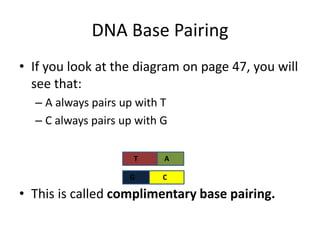
• If you look at the diagram on page 47, you will
see that:
– A always pairs up with T
– C always pairs up with G
• This is called complimentary base pairing.
T A
G C
Base pairing
• Base-pairing means you will always find equal
amounts of A and T in a DNA sample – as well
as equal amounts of G and C.
– For example:
• If a DNA sample contains 30% A
• There will be 30% T
• How much C will there be in this sample?
• How much G?
What does the sequence of bases do?
• The sequence provides a code that is used to
determine the kinds of proteins that are made
in our cells.
• This will determine how our cells, tissues and
organs develop.
• It will determine all kinds of this such as
personal characteristics (hair colour, eye
colour, blood group).
End of chapter questions
• Coursebook page 48

Lesson 20 unit 4 - dna

  • 1.
  • 2.
    Starter – Foodtests • A student carried out tests on two foods. – Starch test: • Food A went brown • Food B went black – Benedict’s reagent: • Food A went orange-red • Food B went blue • What do the results tell you about Food A and Food B?
  • 3.
  • 4.
    What is DNA? •DNA stands for deoxyribonucleic acid. • It is the chemical that makes up our genes & chromosomes. • It is inherited (passed down from your ancestors) and is responsible for giving us many of our characteristics.
  • 5.
    The structure ofDNA • DNA is made of 2 long strands. • Each strand has a series of bases along it. • The bases are held together by bonds forming crosslinks • The two strands twist together to make a spiral called a double helix. (see Figure 4.14 on page 47)
  • 6.
    DNA base pairing •There are 4 bases: – Adenine A – Cytosine C – Guanine G – Thymine T For iGCSE you only need to know the letters!!!
  • 7.
    DNA Base Pairing •If you look at the diagram on page 47, you will see that: – A always pairs up with T – C always pairs up with G • This is called complimentary base pairing. T A G C
  • 8.
    Base pairing • Base-pairingmeans you will always find equal amounts of A and T in a DNA sample – as well as equal amounts of G and C. – For example: • If a DNA sample contains 30% A • There will be 30% T • How much C will there be in this sample? • How much G?
  • 9.
    What does thesequence of bases do? • The sequence provides a code that is used to determine the kinds of proteins that are made in our cells. • This will determine how our cells, tissues and organs develop. • It will determine all kinds of this such as personal characteristics (hair colour, eye colour, blood group).
  • 11.
    End of chapterquestions • Coursebook page 48