Unit 6 – Plant Nutrition
Learning objectives
• Define photosynthesis.
• Write the word equation and chemical
equation for photosynthesis.
• Describe the effects of varying factors on
photosynthesis.
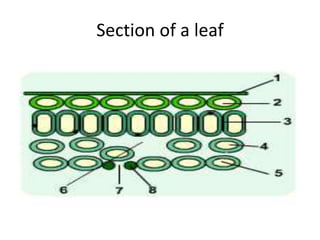
Section of a leaf
Key
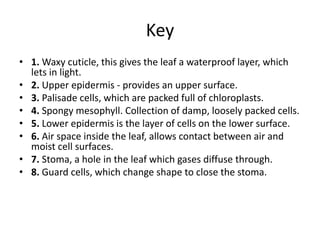
• 1. Waxy cuticle, this gives the leaf a waterproof layer, which
lets in light.
• 2. Upper epidermis - provides an upper surface.
• 3. Palisade cells, which are packed full of chloroplasts.
• 4. Spongy mesophyll. Collection of damp, loosely packed cells.
• 5. Lower epidermis is the layer of cells on the lower surface.
• 6. Air space inside the leaf, allows contact between air and
moist cell surfaces.
• 7. Stoma, a hole in the leaf which gases diffuse through.
• 8. Guard cells, which change shape to close the stoma.
Photosynthesis video
• Video
• https://www.youtube.com/watch?v=HkyDoUR
zU4c
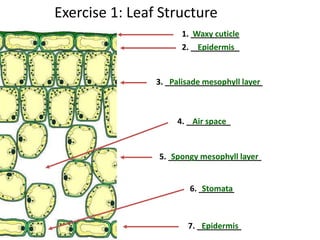
Exercise 1: Leaf Structure
1. ___________
2. ___________
3. ______________________
5. _____________________
7. __________
6. ________
4. __________
Waxy cuticle
Epidermis
Palisade mesophyll layer
Spongy mesophyll layer
Epidermis
Stomata
Air space
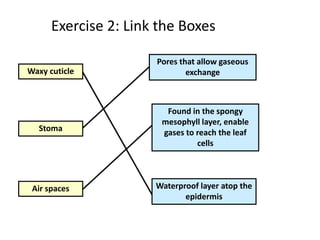
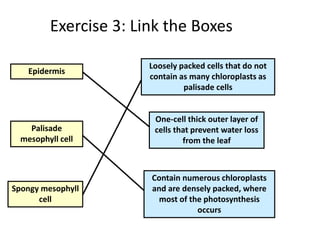
Exercise 2: Link the Boxes
Waxy cuticle
Stoma
Air spaces Waterproof layer atop the
epidermis
Pores that allow gaseous
exchange
Found in the spongy
mesophyll layer, enable
gases to reach the leaf
cells
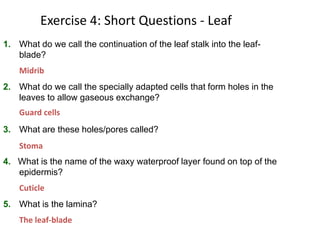
Exercise 3: Link the Boxes
Epidermis
Palisade
mesophyll cell
Spongy mesophyll
cell
Contain numerous chloroplasts
and are densely packed, where
most of the photosynthesis
occurs
Loosely packed cells that do not
contain as many chloroplasts as
palisade cells
One-cell thick outer layer of
cells that prevent water loss
from the leaf
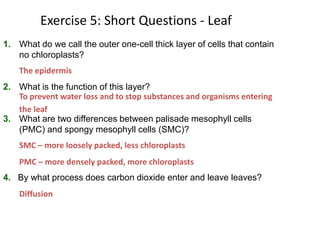
Exercise 4: Short Questions - Leaf
1. What do we call the continuation of the leaf stalk into the leaf-
blade?
2. What do we call the specially adapted cells that form holes in the
leaves to allow gaseous exchange?
3. What are these holes/pores called?
4. What is the name of the waxy waterproof layer found on top of the
epidermis?
5. What is the lamina?
Midrib
Guard cells
Stoma
Cuticle
The leaf-blade
Exercise 5: Short Questions - Leaf
1. What do we call the outer one-cell thick layer of cells that contain
no chloroplasts?
2. What is the function of this layer?
3. What are two differences between palisade mesophyll cells
(PMC) and spongy mesophyll cells (SMC)?
4. By what process does carbon dioxide enter and leave leaves?
The epidermis
To prevent water loss and to stop substances and organisms entering
the leaf
SMC – more loosely packed, less chloroplasts
Diffusion
PMC – more densely packed, more chloroplasts
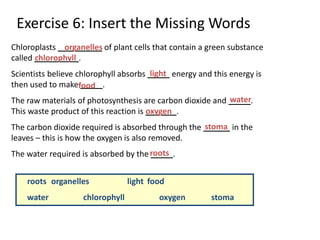
Exercise 6: Insert the Missing Words
Chloroplasts __________ of plant cells that contain a green substance
called __________.
Scientists believe chlorophyll absorbs _____ energy and this energy is
then used to make _____.
The raw materials of photosynthesis are carbon dioxide and _____.
This waste product of this reaction is _______.
The carbon dioxide required is absorbed through the ______ in the
leaves – this is how the oxygen is also removed.
The water required is absorbed by the _____.
roots organelles light food
water chlorophyll oxygen stoma
organelles
chlorophyll
light
food
water
oxygen
stoma
roots
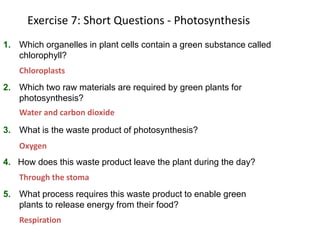
Exercise 7: Short Questions - Photosynthesis
1. Which organelles in plant cells contain a green substance called
chlorophyll?
2. Which two raw materials are required by green plants for
photosynthesis?
3. What is the waste product of photosynthesis?
4. How does this waste product leave the plant during the day?
5. What process requires this waste product to enable green
plants to release energy from their food?
Chloroplasts
Water and carbon dioxide
Oxygen
Through the stoma
Respiration
Exercise 8: Short Questions – Plant Nutrition
1. What do we call the process whereby green plants make
glucose using light energy and the raw materials carbon dioxide
and water?
2. During the night many green plants perform another process
whereby they release the energy from their food they have
made. What do we call this process?
3. The sugar glucose, the product of photosynthesis, is changed to
starch when it is being stored by the plant. Why?
4. What is the chemical formula of glucose?
Photosynthesis
Respiration
Glucose is soluble in water, starch is insoluble in water. By
storing the food starch it means it is easier for the plant to keep
the food in the required place
C6H12O6
Exercise 9: Short Questions – Plant Nutrition
1. What is the word equation for photosynthesis?
2. What is the chemical equation for photosynthesis?
3. Name the arrowed organelle.
4. Which substance does this organelle
contain that allows green plants to
absorb the Sun’s light energy for the
process of photosynthesis?
6H2O + 6CO2  C6H12O6 + 6O2
Chloroplast
Chlorophyll
Types of nutrition
• Green plants make their own food.
• They take inorganic substances from the air
and soil. (carbon dioxide, water and minerals)
• Plants use these substances to make complex
materials. (Carbohydrates, lipids, proteins,
vitamins)
• Substances made by living things are organic.
What is photosynthesis?
• Photosynthesis is the fundamental process by
which plants manufacture carbohydrates
from raw materials using energy from light.
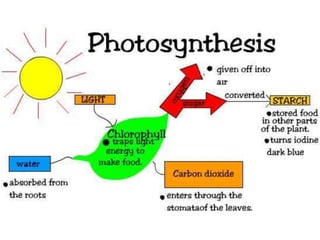
• Plants use water from the soil, carbon dioxide
from the air and energy from sunlight to make
carbohydrates & oxygen.
• Photo = Light synthesis = manufacture
Word equation
• Plants use the green dye (or pigment) called chlorophyll to pick up
the energy from the sunlight.
• Plants make sugar and use some of it for energy to keep them alive
(respiration) but they also use some for growth and repair by
making fats and proteins.
• However, it is not always sunny so plants need to be able to store
some of the sugar they make, so they convert it to a storage
carbohydrate.
The role of chlorophyll
• Chorophyll is kept inside the chloroplasts of
plant cells.
• The green pigment traps sunlight energy.
• The cholrophyll molecule then releases the
energy to make carbon dioxide combine to
water.
Limiting Factors on photosynthesis
• Video
Factors effecting Photosynthesis
Lesson 23   unit 6 – plant nutrition

Lesson 23 unit 6 – plant nutrition

  • 1.
    Unit 6 –Plant Nutrition
  • 2.
    Learning objectives • Definephotosynthesis. • Write the word equation and chemical equation for photosynthesis. • Describe the effects of varying factors on photosynthesis.
  • 3.
  • 4.
    Key • 1. Waxycuticle, this gives the leaf a waterproof layer, which lets in light. • 2. Upper epidermis - provides an upper surface. • 3. Palisade cells, which are packed full of chloroplasts. • 4. Spongy mesophyll. Collection of damp, loosely packed cells. • 5. Lower epidermis is the layer of cells on the lower surface. • 6. Air space inside the leaf, allows contact between air and moist cell surfaces. • 7. Stoma, a hole in the leaf which gases diffuse through. • 8. Guard cells, which change shape to close the stoma.
  • 5.
    Photosynthesis video • Video •https://www.youtube.com/watch?v=HkyDoUR zU4c
  • 6.
    Exercise 1: LeafStructure 1. ___________ 2. ___________ 3. ______________________ 5. _____________________ 7. __________ 6. ________ 4. __________ Waxy cuticle Epidermis Palisade mesophyll layer Spongy mesophyll layer Epidermis Stomata Air space
  • 7.
    Exercise 2: Linkthe Boxes Waxy cuticle Stoma Air spaces Waterproof layer atop the epidermis Pores that allow gaseous exchange Found in the spongy mesophyll layer, enable gases to reach the leaf cells
  • 8.
    Exercise 3: Linkthe Boxes Epidermis Palisade mesophyll cell Spongy mesophyll cell Contain numerous chloroplasts and are densely packed, where most of the photosynthesis occurs Loosely packed cells that do not contain as many chloroplasts as palisade cells One-cell thick outer layer of cells that prevent water loss from the leaf
  • 9.
    Exercise 4: ShortQuestions - Leaf 1. What do we call the continuation of the leaf stalk into the leaf- blade? 2. What do we call the specially adapted cells that form holes in the leaves to allow gaseous exchange? 3. What are these holes/pores called? 4. What is the name of the waxy waterproof layer found on top of the epidermis? 5. What is the lamina? Midrib Guard cells Stoma Cuticle The leaf-blade
  • 10.
    Exercise 5: ShortQuestions - Leaf 1. What do we call the outer one-cell thick layer of cells that contain no chloroplasts? 2. What is the function of this layer? 3. What are two differences between palisade mesophyll cells (PMC) and spongy mesophyll cells (SMC)? 4. By what process does carbon dioxide enter and leave leaves? The epidermis To prevent water loss and to stop substances and organisms entering the leaf SMC – more loosely packed, less chloroplasts Diffusion PMC – more densely packed, more chloroplasts
  • 11.
    Exercise 6: Insertthe Missing Words Chloroplasts __________ of plant cells that contain a green substance called __________. Scientists believe chlorophyll absorbs _____ energy and this energy is then used to make _____. The raw materials of photosynthesis are carbon dioxide and _____. This waste product of this reaction is _______. The carbon dioxide required is absorbed through the ______ in the leaves – this is how the oxygen is also removed. The water required is absorbed by the _____. roots organelles light food water chlorophyll oxygen stoma organelles chlorophyll light food water oxygen stoma roots
  • 12.
    Exercise 7: ShortQuestions - Photosynthesis 1. Which organelles in plant cells contain a green substance called chlorophyll? 2. Which two raw materials are required by green plants for photosynthesis? 3. What is the waste product of photosynthesis? 4. How does this waste product leave the plant during the day? 5. What process requires this waste product to enable green plants to release energy from their food? Chloroplasts Water and carbon dioxide Oxygen Through the stoma Respiration
  • 13.
    Exercise 8: ShortQuestions – Plant Nutrition 1. What do we call the process whereby green plants make glucose using light energy and the raw materials carbon dioxide and water? 2. During the night many green plants perform another process whereby they release the energy from their food they have made. What do we call this process? 3. The sugar glucose, the product of photosynthesis, is changed to starch when it is being stored by the plant. Why? 4. What is the chemical formula of glucose? Photosynthesis Respiration Glucose is soluble in water, starch is insoluble in water. By storing the food starch it means it is easier for the plant to keep the food in the required place C6H12O6
  • 14.
    Exercise 9: ShortQuestions – Plant Nutrition 1. What is the word equation for photosynthesis? 2. What is the chemical equation for photosynthesis? 3. Name the arrowed organelle. 4. Which substance does this organelle contain that allows green plants to absorb the Sun’s light energy for the process of photosynthesis? 6H2O + 6CO2  C6H12O6 + 6O2 Chloroplast Chlorophyll
  • 15.
    Types of nutrition •Green plants make their own food. • They take inorganic substances from the air and soil. (carbon dioxide, water and minerals) • Plants use these substances to make complex materials. (Carbohydrates, lipids, proteins, vitamins) • Substances made by living things are organic.
  • 16.
    What is photosynthesis? •Photosynthesis is the fundamental process by which plants manufacture carbohydrates from raw materials using energy from light. • Plants use water from the soil, carbon dioxide from the air and energy from sunlight to make carbohydrates & oxygen. • Photo = Light synthesis = manufacture
  • 18.
    Word equation • Plantsuse the green dye (or pigment) called chlorophyll to pick up the energy from the sunlight. • Plants make sugar and use some of it for energy to keep them alive (respiration) but they also use some for growth and repair by making fats and proteins. • However, it is not always sunny so plants need to be able to store some of the sugar they make, so they convert it to a storage carbohydrate.
  • 20.
    The role ofchlorophyll • Chorophyll is kept inside the chloroplasts of plant cells. • The green pigment traps sunlight energy. • The cholrophyll molecule then releases the energy to make carbon dioxide combine to water.
  • 21.
    Limiting Factors onphotosynthesis • Video
  • 22.