ERIES D.
ISIDERIO
Capiz State
University-LHS
Roxas City, Capiz,
Philippines
DIGESTIVE
SYSTEM
(MAMMAL AND
BIRDS)
WHAT IS
DIGESTIVE
SYSTEM?
 In order to survive, animals must
feed by ingesting solid or liquid food
matter obtained from other
organisms, such as plants or other
animals.
 Digestive System - The organs
and glands in the body that
are responsible for digestion.
 The intake of food from these
sources (plants or other animals) and
the processes that convert food
substances into living matter are
known as nutrition.
 Specifically, this mode of feeding
found in animals is known as
holozoic nutrition.
It involves the taking
in of food.
INGESTION/
FEEDING
 The process of mechanical and
chemical breakdown whereby
large food molecules are broken
down into soluble and diffusible
molecules that can be absorbed by
the body cells.
DIGESTION
Breakdown of food by
chewing and the action of
muscles (churning) within
the stomach.
MECHANICAL
digestion
 Breakdown of food by enzymes
produced at various stages of
the digestive tract
CHEMICAL
digestion
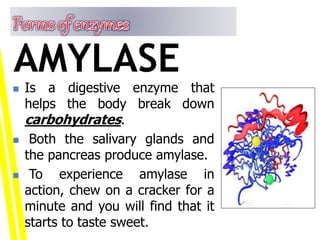
 Is a digestive enzyme that
helps the body break down
carbohydrates.
 Both the salivary glands and
the pancreas produce amylase.
 To experience amylase in
action, chew on a cracker for a
minute and you will find that it
starts to taste sweet.
AMYLASE
 Is an enzyme that break
down proteins, which are
found throughout the
body, including trace
amounts in the saliva.
 Changes in kallikrein
enzymes have also been
linked to certain cancers.
KALLIKREIN
 Is an enzyme that breaks
down fatty acids.
 Lingual lipase is very
important for infants
because it helps them digest
the fats in milk, making
digestion much easier for
their immature systems.
LIPASE
the process whereby
digested food materials are
taken into the body cells.
ABSORPTION
The conversion of absorbed
food into the substance of
the body.
ASSIMILATION
The elimination of food
waste materials from
the body.
EGESTION
THE HUMAN
DIGESTIVE
TRACT
 The human digestive tract is a
long, coiled, muscular tube that
stretches from the mouth to the
anus.
 From mouth to the anus, the
human food tube or the
digestive tract is about nine
meters long.
The Human
digestive tract
9 meters
How Digestion
is done?
 Food processing begins in the mouth.
 The bite food is then swallowed and is moved
through the pharynx into the esophagus.
 Then, food is mechanically and enzymatically
digested in the stomach.
 Most enzymatic digestion takes place in the
small intestine
 The large intestine then eliminates wastes
leading to the opening for the elimination of
wastes called anus.
SPECIALIZED REGIONS WHERE DIGESTION TAKES PLACE
MOUTH
PHARYNX
ESOPHAGUS
STOMACH
SMALL INTESTINE
LARGE INTESTINE
ANUS
 The intake of food starts
from the mouth, which
leads into the mouth cavity.
 Around the sides and front
of the cavity are the upper
and lower jaws. The upper
jaw is fixed, while the
lower is movable.
MOUTH
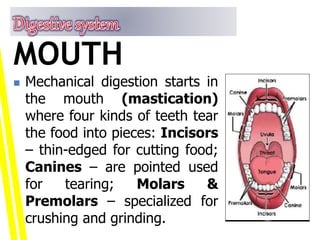
 Mechanical digestion starts in
the mouth (mastication)
where four kinds of teeth tear
the food into pieces: Incisors
– thin-edged for cutting food;
Canines – are pointed used
for tearing; Molars &
Premolars – specialized for
crushing and grinding.
MOUTH
 There are three pairs of
salivary glands (parotid,
submandibular and sublingual)
that open into the mouth cavity
via ducts that release a
secretion called saliva.
 The mucin in saliva helps to
soften the food, while chewing
helps to break down the food
into smaller pieces.
MOUTH
 The pharynx is a
common passage of
both air and food.
 It is the part of the
gut between mouth
and esophagus.
PHARYNX
PHARYNX
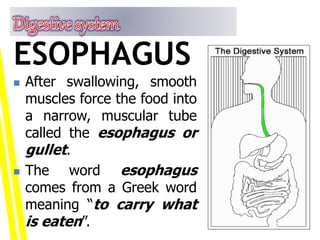
 After swallowing, smooth
muscles force the food into
a narrow, muscular tube
called the esophagus or
gullet.
 The word esophagus
comes from a Greek word
meaning “to carry what
is eaten”.
ESOPHAGUS
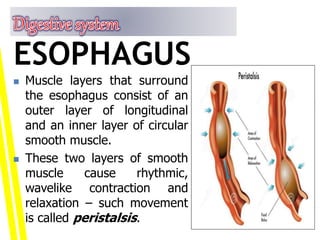
 Muscle layers that surround
the esophagus consist of an
outer layer of longitudinal
and an inner layer of circular
smooth muscle.
 These two layers of smooth
muscle cause rhythmic,
wavelike contraction and
relaxation – such movement
is called peristalsis.
ESOPHAGUS
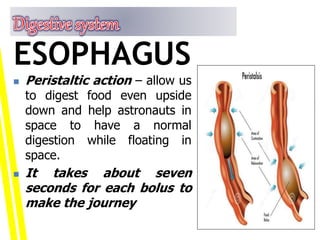
 Peristaltic action – allow us
to digest food even upside
down and help astronauts in
space to have a normal
digestion while floating in
space.
 It takes about seven
seconds for each bolus to
make the journey
ESOPHAGUS
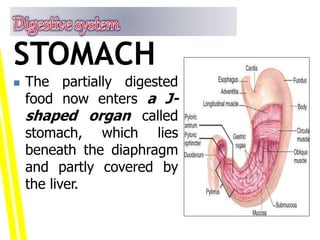
 The partially digested
food now enters a J-
shaped organ called
stomach, which lies
beneath the diaphragm
and partly covered by
the liver.
STOMACH
 When empty, the stomach is collapsed and
shaped almost like a hot dog. Once food
enters, the folds of stomach wall called
rugae smooths out and expands to more
than a liter.
 The stomach lining bears numerous pits
lined with gastric glands which release
strong gastric juices. Such gland was
stimulated by the foods in the stomach.
STOMACH
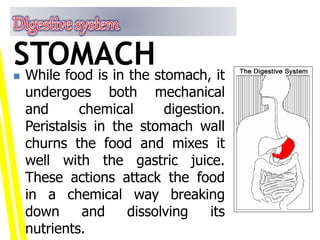
 While food is in the stomach, it
undergoes both mechanical
and chemical digestion.
Peristalsis in the stomach wall
churns the food and mixes it
well with the gastric juice.
These actions attack the food
in a chemical way breaking
down and dissolving its
nutrients.
STOMACH
 Gastric juice is a solution of hydrochloric
acid and the pepsin. It provides a slightly
acidic medium suitable for the action of the
gastric enzyme, such as pepsin breaks some
of the complex proteins and also kills germs
and certain potential parasites.
 Food found in the stomach is called chyme.
 The food normally remains in the
stomach for about three to six hours.
STOMACH
 Digestion is completed in the small
intestine and nutrients are
absorbed through its wall (villi).
 The small intestine is about 5 to 6
meters (about 17ft.) in length and
has three regions: duodenum,
jejunum and ileum
SMALL INTESTINE
SMALL INTESTINE
 The majority of chemical digestion
occurs in the first of three sections of
the small intestine known as the
duodenum.
 This section also contains an opening
from the bile duct and pancreatic duct
through which bile and pancreatic
enzymes enter the small intestine.
SMALL INTESTINE
 Undigested food passes through
the large intestine. Although
shorter in length than small
intestine, it is called large because
of its diameter.
 The large intestine is 1.3m (about
4ft.) in length.
LARGE INTESTINE
 The main function of the large
intestine is to absorb water and
minerals salts from the undigested
food material.
 After about 18 or 24 hours in the large
intestine, most of the water that is
contained in undigested food is
absorbed.
LARGE INTESTINE
 Materials that are not absorbed in the large
intestine form a solid waste known as
feces.
 Feces, which is made up of dead bacteria
and some fat protein is temporarily stored in
the rectum.
 When the rectum contracts, the feces is
expelled through an opening called anus.
LARGE INTESTINE
Associated
Organs in
Digestion
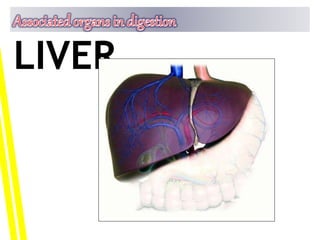
 The liver is a large accessory organ of
the digestive system that is constantly
producing a fluid known as bile.
 Bile contains bile salts that emulsifies
fats which means it breaks them into
smaller droplets so they can be
digested. Bile is temporarily stored in
the gallbladder.
LIVER
LIVER
 Is a soft triangular
gland lying between
the small intestine and
the stomach. The
pancreas produces
pancreatic juice, which
is a mixture of digestive
enzymes.
PANCREAS
 These enzymes move into the small
intestine at the same time the bile does and
help to break down proteins, starches and
fats.
 The pancreas also secrets the hormone
insulin, which plays an important role in the
control of the blood sugar level in the body
and utilization of carbohydrates.
PANCREAS

Digestive system

  • 1.
  • 2.
  • 3.
  • 4.
     In orderto survive, animals must feed by ingesting solid or liquid food matter obtained from other organisms, such as plants or other animals.  Digestive System - The organs and glands in the body that are responsible for digestion.
  • 5.
     The intakeof food from these sources (plants or other animals) and the processes that convert food substances into living matter are known as nutrition.  Specifically, this mode of feeding found in animals is known as holozoic nutrition.
  • 6.
    It involves thetaking in of food. INGESTION/ FEEDING
  • 7.
     The processof mechanical and chemical breakdown whereby large food molecules are broken down into soluble and diffusible molecules that can be absorbed by the body cells. DIGESTION
  • 8.
    Breakdown of foodby chewing and the action of muscles (churning) within the stomach. MECHANICAL digestion
  • 9.
     Breakdown offood by enzymes produced at various stages of the digestive tract CHEMICAL digestion
  • 10.
     Is adigestive enzyme that helps the body break down carbohydrates.  Both the salivary glands and the pancreas produce amylase.  To experience amylase in action, chew on a cracker for a minute and you will find that it starts to taste sweet. AMYLASE
  • 11.
     Is anenzyme that break down proteins, which are found throughout the body, including trace amounts in the saliva.  Changes in kallikrein enzymes have also been linked to certain cancers. KALLIKREIN
  • 12.
     Is anenzyme that breaks down fatty acids.  Lingual lipase is very important for infants because it helps them digest the fats in milk, making digestion much easier for their immature systems. LIPASE
  • 13.
    the process whereby digestedfood materials are taken into the body cells. ABSORPTION
  • 14.
    The conversion ofabsorbed food into the substance of the body. ASSIMILATION
  • 15.
    The elimination offood waste materials from the body. EGESTION
  • 16.
  • 17.
     The humandigestive tract is a long, coiled, muscular tube that stretches from the mouth to the anus.  From mouth to the anus, the human food tube or the digestive tract is about nine meters long. The Human digestive tract 9 meters
  • 18.
  • 19.
     Food processingbegins in the mouth.  The bite food is then swallowed and is moved through the pharynx into the esophagus.  Then, food is mechanically and enzymatically digested in the stomach.  Most enzymatic digestion takes place in the small intestine  The large intestine then eliminates wastes leading to the opening for the elimination of wastes called anus.
  • 20.
    SPECIALIZED REGIONS WHEREDIGESTION TAKES PLACE MOUTH PHARYNX ESOPHAGUS STOMACH SMALL INTESTINE LARGE INTESTINE ANUS
  • 21.
     The intakeof food starts from the mouth, which leads into the mouth cavity.  Around the sides and front of the cavity are the upper and lower jaws. The upper jaw is fixed, while the lower is movable. MOUTH
  • 22.
     Mechanical digestionstarts in the mouth (mastication) where four kinds of teeth tear the food into pieces: Incisors – thin-edged for cutting food; Canines – are pointed used for tearing; Molars & Premolars – specialized for crushing and grinding. MOUTH
  • 23.
     There arethree pairs of salivary glands (parotid, submandibular and sublingual) that open into the mouth cavity via ducts that release a secretion called saliva.  The mucin in saliva helps to soften the food, while chewing helps to break down the food into smaller pieces. MOUTH
  • 24.
     The pharynxis a common passage of both air and food.  It is the part of the gut between mouth and esophagus. PHARYNX
  • 25.
  • 26.
     After swallowing,smooth muscles force the food into a narrow, muscular tube called the esophagus or gullet.  The word esophagus comes from a Greek word meaning “to carry what is eaten”. ESOPHAGUS
  • 27.
     Muscle layersthat surround the esophagus consist of an outer layer of longitudinal and an inner layer of circular smooth muscle.  These two layers of smooth muscle cause rhythmic, wavelike contraction and relaxation – such movement is called peristalsis. ESOPHAGUS
  • 28.
     Peristaltic action– allow us to digest food even upside down and help astronauts in space to have a normal digestion while floating in space.  It takes about seven seconds for each bolus to make the journey ESOPHAGUS
  • 29.
     The partiallydigested food now enters a J- shaped organ called stomach, which lies beneath the diaphragm and partly covered by the liver. STOMACH
  • 30.
     When empty,the stomach is collapsed and shaped almost like a hot dog. Once food enters, the folds of stomach wall called rugae smooths out and expands to more than a liter.  The stomach lining bears numerous pits lined with gastric glands which release strong gastric juices. Such gland was stimulated by the foods in the stomach. STOMACH
  • 31.
     While foodis in the stomach, it undergoes both mechanical and chemical digestion. Peristalsis in the stomach wall churns the food and mixes it well with the gastric juice. These actions attack the food in a chemical way breaking down and dissolving its nutrients. STOMACH
  • 32.
     Gastric juiceis a solution of hydrochloric acid and the pepsin. It provides a slightly acidic medium suitable for the action of the gastric enzyme, such as pepsin breaks some of the complex proteins and also kills germs and certain potential parasites.  Food found in the stomach is called chyme.  The food normally remains in the stomach for about three to six hours. STOMACH
  • 33.
     Digestion iscompleted in the small intestine and nutrients are absorbed through its wall (villi).  The small intestine is about 5 to 6 meters (about 17ft.) in length and has three regions: duodenum, jejunum and ileum SMALL INTESTINE
  • 34.
  • 35.
     The majorityof chemical digestion occurs in the first of three sections of the small intestine known as the duodenum.  This section also contains an opening from the bile duct and pancreatic duct through which bile and pancreatic enzymes enter the small intestine. SMALL INTESTINE
  • 36.
     Undigested foodpasses through the large intestine. Although shorter in length than small intestine, it is called large because of its diameter.  The large intestine is 1.3m (about 4ft.) in length. LARGE INTESTINE
  • 38.
     The mainfunction of the large intestine is to absorb water and minerals salts from the undigested food material.  After about 18 or 24 hours in the large intestine, most of the water that is contained in undigested food is absorbed. LARGE INTESTINE
  • 39.
     Materials thatare not absorbed in the large intestine form a solid waste known as feces.  Feces, which is made up of dead bacteria and some fat protein is temporarily stored in the rectum.  When the rectum contracts, the feces is expelled through an opening called anus. LARGE INTESTINE
  • 40.
  • 41.
     The liveris a large accessory organ of the digestive system that is constantly producing a fluid known as bile.  Bile contains bile salts that emulsifies fats which means it breaks them into smaller droplets so they can be digested. Bile is temporarily stored in the gallbladder. LIVER
  • 42.
  • 43.
     Is asoft triangular gland lying between the small intestine and the stomach. The pancreas produces pancreatic juice, which is a mixture of digestive enzymes. PANCREAS
  • 44.
     These enzymesmove into the small intestine at the same time the bile does and help to break down proteins, starches and fats.  The pancreas also secrets the hormone insulin, which plays an important role in the control of the blood sugar level in the body and utilization of carbohydrates. PANCREAS