Coordination and Response
Keywords
• Stimuli – are changes in the environment (Stimulus)
• (eg. You touch something hot) (eg. A bright light) (eg. A strong smell)
• These stimuli are sensed by receptors – cells able to detect changes in
the environment
• The body responds using effectors – muscles – contract
glands - smell
Receptors to Effectors
• Messages passed via nerves – Nervous System. This is the fastest method
• Or Endocrine System, via hormones
Coordination - The method in which receptors pick up a stimuli and pass it
on to the effectors
• Why is good (fast) coordination essential between receptors and effectors?
• Hunting – catching prey Avoiding predators
Nervous System
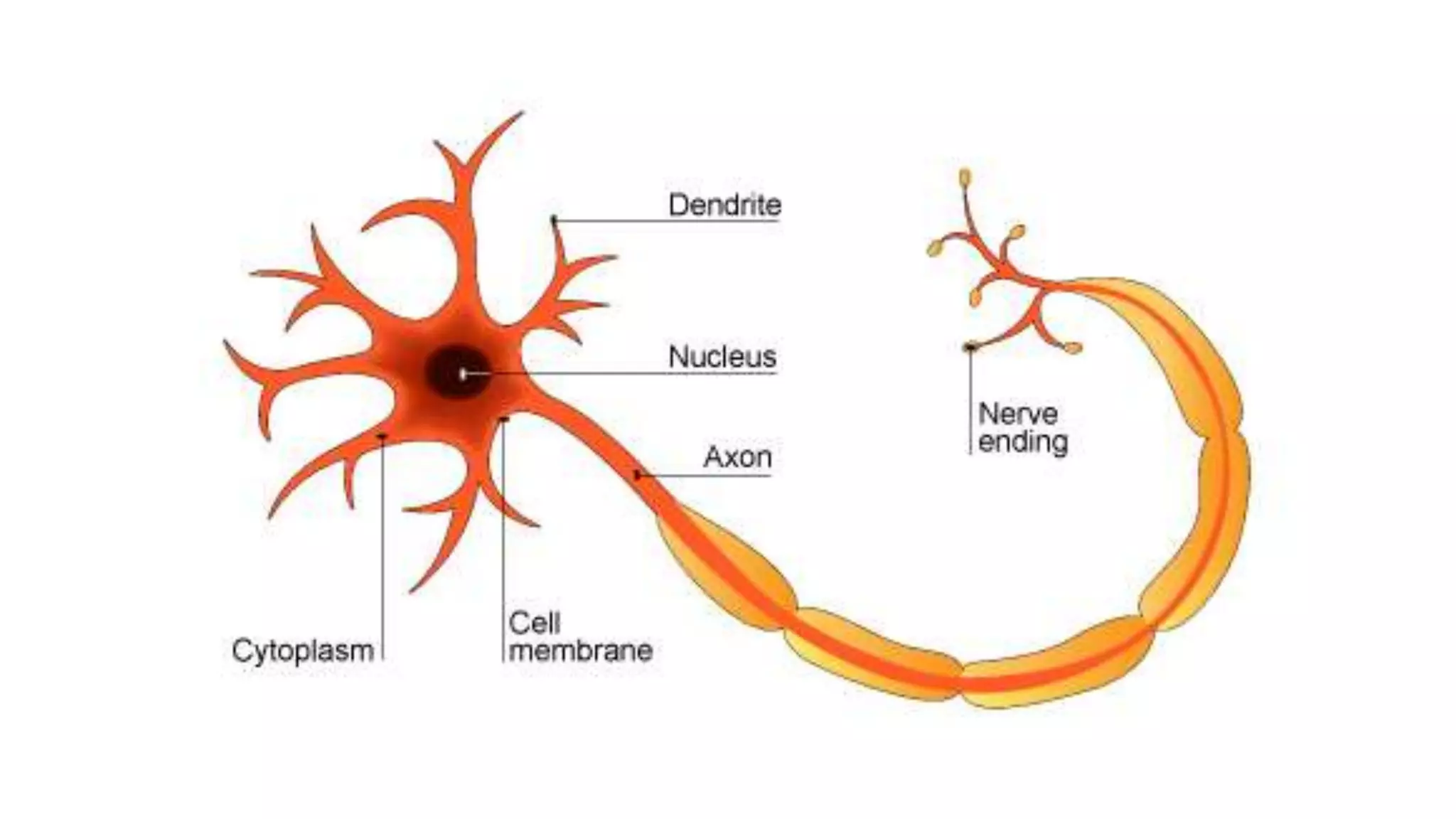
Made up of special cells Neurones,
like ordinary cells - nucleus/cytoplasm/cell membrane
BUT
Special adaptations to carry messages quickly
Axons – a long nerve fibre that transports impulses (signals)
Dendrites – shorter, pick up impulses from other nerve cells
The axons have myelin, a layer of fat and protein = insulates the nerve fibres
to send electrical impulses faster
Central Nervous System
• Brain and the spinal cord = coordinates the messages
• Nerves and receptors around the body
Peripheral Nervous System
Receptor
detects stimulus
Click to add text
Electrical
impulse to
brain/spinal
cord
Brain/spinal
cord receives
impulse
Sends impulse on
along nerve fibres
to appropriate
effector
Reflex Arc
• The arrangement of neurones along which an impulse passes during
reflex action.
• Refex action = a fast, automatic response to a stimulus
• Volunary action = actions we think about,eg eating, bathing, walking,
studying
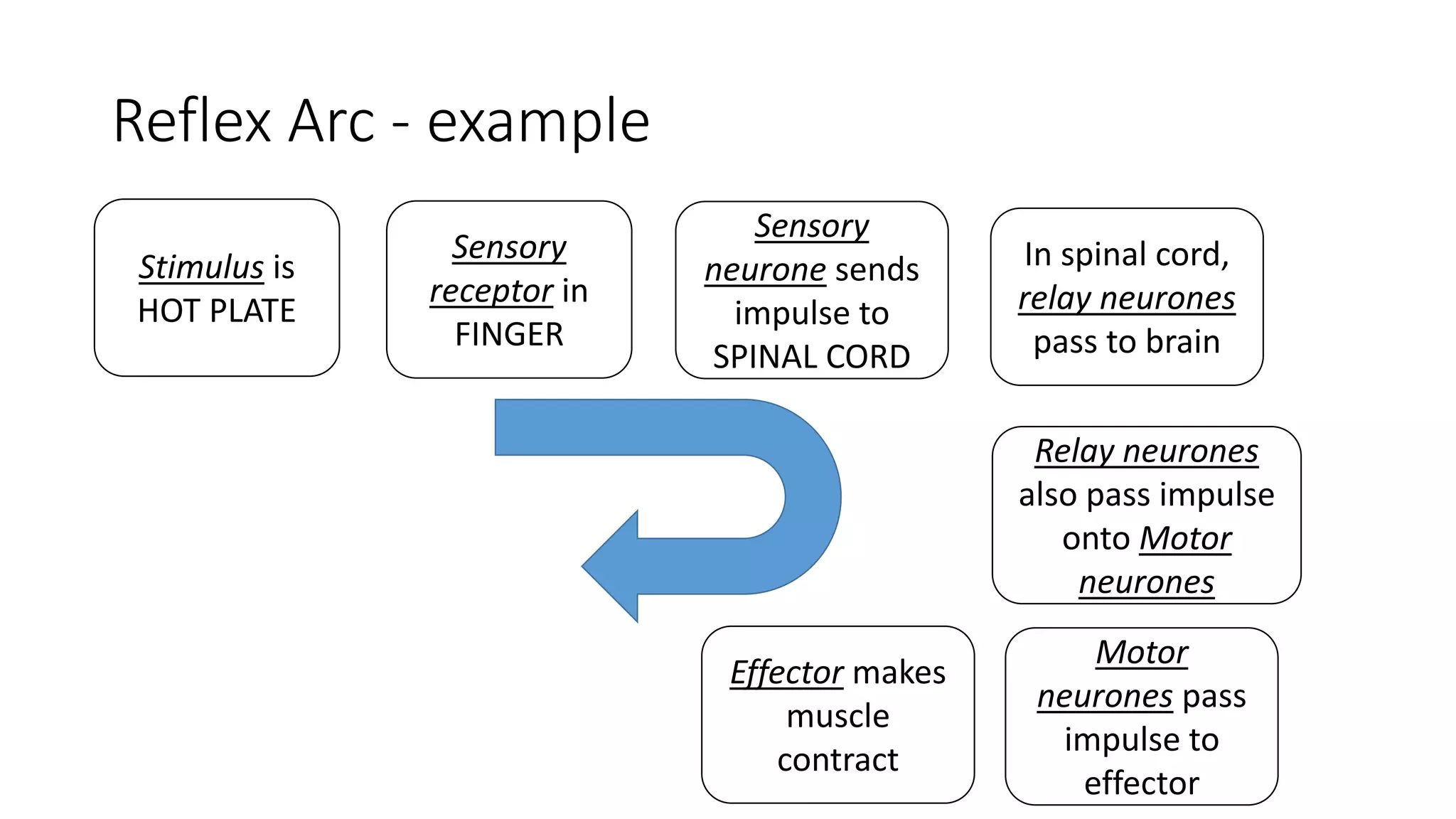
Reflex Arc - example
Sensory
receptor in
FINGER
Stimulus is
HOT PLATE
Sensory
neurone sends
impulse to
SPINAL CORD
In spinal cord,
relay neurones
pass to brain
Relay neurones
also pass impulse
onto Motor
neurones
Motor
neurones pass
impulse to
effector
Effector makes
muscle
contract
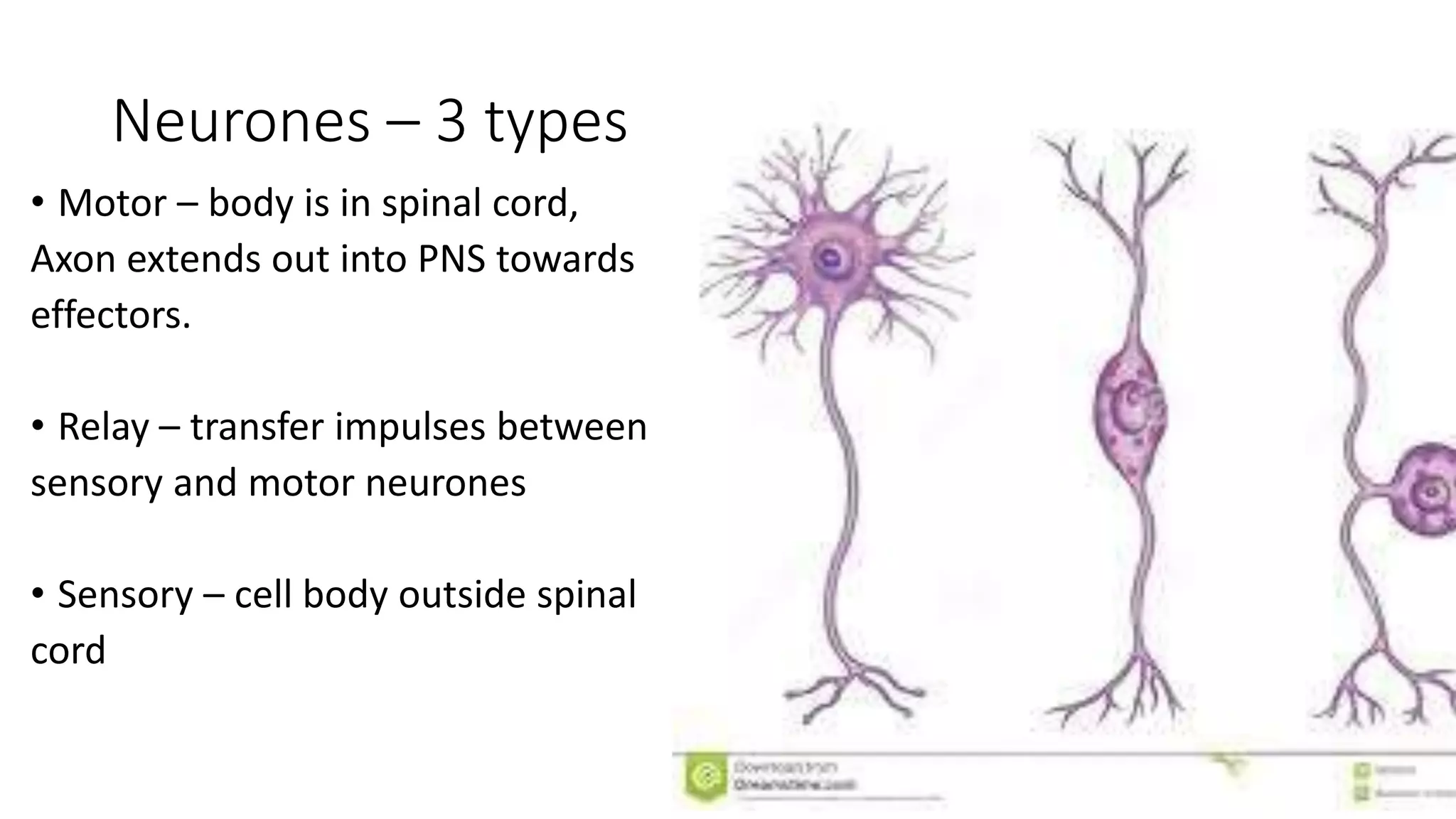
Neurones – 3 types
• Motor – body is in spinal cord,
Axon extends out into PNS towards
effectors.
• Relay – transfer impulses between
sensory and motor neurones
• Sensory – cell body outside spinal
cord
Synapses
• Gap between neurones – Synaptic Cleft
• Synapse = synaptic cleft +
ends of the two neurones
Vesicles contain neurotransmitters
• Impulse arrives along axon of sensory neurone
• Neurotransmitter is released and diffuses across synaptic cleft
• Neurotransmitters attach to receptor molecules in relay neurone
(shapes of neurotransmitters and receptor match)
• This binding triggers a nerve impulse in the relay neurone
• Crosses the relay neurone, and a similar process occurs to pass onto motor
neurone
• NOTE – neurotransmitters only on one side of each neurone, "on way flow"
Experiment
• Collect data
• 3 variables
• Visual
• Auditory
• Tactile
• Over Christmas, present this data in appropriate graph form and
research why one is faster/slower
Hypothesis.
• Reaction time is affected by different stimuli
• Complete this sentence.....
• "I think reaction time will be fastest from a ___________ stimulus."
• Write how you tested this hypothesis.
• Bullet points are fine for the method. Ensure method is concise and
clear for somebody to repeat your experiment.
• Graphs
Method.
Results.
Conclusion.
• What do the results show?
• Did they match your Hypothesis?
• Do some research and try to explain why one you gained these results
Reaction
(cm)
Stimulus

Coordination(1)

  • 1.
  • 2.
    Keywords • Stimuli –are changes in the environment (Stimulus) • (eg. You touch something hot) (eg. A bright light) (eg. A strong smell) • These stimuli are sensed by receptors – cells able to detect changes in the environment • The body responds using effectors – muscles – contract glands - smell
  • 3.
    Receptors to Effectors •Messages passed via nerves – Nervous System. This is the fastest method • Or Endocrine System, via hormones Coordination - The method in which receptors pick up a stimuli and pass it on to the effectors • Why is good (fast) coordination essential between receptors and effectors? • Hunting – catching prey Avoiding predators
  • 4.
    Nervous System Made upof special cells Neurones, like ordinary cells - nucleus/cytoplasm/cell membrane BUT Special adaptations to carry messages quickly Axons – a long nerve fibre that transports impulses (signals) Dendrites – shorter, pick up impulses from other nerve cells The axons have myelin, a layer of fat and protein = insulates the nerve fibres to send electrical impulses faster
  • 5.
    Central Nervous System •Brain and the spinal cord = coordinates the messages • Nerves and receptors around the body Peripheral Nervous System Receptor detects stimulus Click to add text Electrical impulse to brain/spinal cord Brain/spinal cord receives impulse Sends impulse on along nerve fibres to appropriate effector
  • 6.
    Reflex Arc • Thearrangement of neurones along which an impulse passes during reflex action. • Refex action = a fast, automatic response to a stimulus • Volunary action = actions we think about,eg eating, bathing, walking, studying
  • 7.
    Reflex Arc -example Sensory receptor in FINGER Stimulus is HOT PLATE Sensory neurone sends impulse to SPINAL CORD In spinal cord, relay neurones pass to brain Relay neurones also pass impulse onto Motor neurones Motor neurones pass impulse to effector Effector makes muscle contract
  • 8.
    Neurones – 3types • Motor – body is in spinal cord, Axon extends out into PNS towards effectors. • Relay – transfer impulses between sensory and motor neurones • Sensory – cell body outside spinal cord
  • 9.
    Synapses • Gap betweenneurones – Synaptic Cleft • Synapse = synaptic cleft + ends of the two neurones Vesicles contain neurotransmitters
  • 10.
    • Impulse arrivesalong axon of sensory neurone • Neurotransmitter is released and diffuses across synaptic cleft • Neurotransmitters attach to receptor molecules in relay neurone (shapes of neurotransmitters and receptor match) • This binding triggers a nerve impulse in the relay neurone • Crosses the relay neurone, and a similar process occurs to pass onto motor neurone • NOTE – neurotransmitters only on one side of each neurone, "on way flow"
  • 11.
    Experiment • Collect data •3 variables • Visual • Auditory • Tactile • Over Christmas, present this data in appropriate graph form and research why one is faster/slower
  • 12.
    Hypothesis. • Reaction timeis affected by different stimuli • Complete this sentence..... • "I think reaction time will be fastest from a ___________ stimulus." • Write how you tested this hypothesis. • Bullet points are fine for the method. Ensure method is concise and clear for somebody to repeat your experiment. • Graphs Method. Results.
  • 13.
    Conclusion. • What dothe results show? • Did they match your Hypothesis? • Do some research and try to explain why one you gained these results Reaction (cm) Stimulus