STRUCTURE AND FUNCTION:
CIRCULATORY SYSTEM
Journey Into a Man’s
Heart
K W H L
What do I
know?
What do I
want to find
out?
How can I
find out
what I want
to learn?
What did I
learn?
[at the end of
the lesson]
Skills I
expect to use
What makes your heart
beats fast?
What do you know about your Heart?
How do you take care of your Heart?
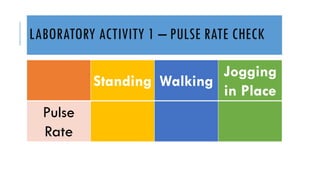
LABORATORY ACTIVITY 1 – PULSE RATE CHECK
Standing Walking
Jogging
in Place
Pulse
Rate
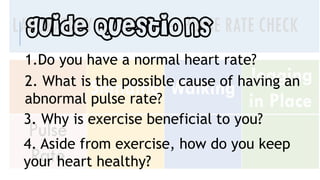
Guide Questions
1.Do you have a normal heart rate?
2. What is the possible cause of having an
abnormal pulse rate?
3. Why is exercise beneficial to you?
4. Aside from exercise, how do you keep
your heart healthy?
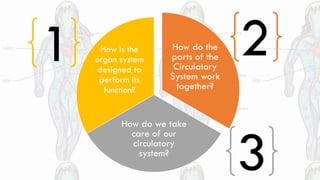
How do the
parts of the
Circulatory
System work
together?
How do we take
care of our
circulatory
system?
How is the
organ system
designed to
perform its
function?
1 2
3
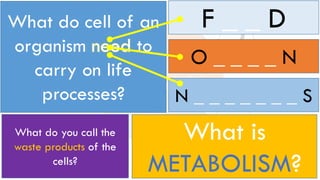
What do cell of an
organism need to
carry on life
processes?
What is
METABOLISM?
What do you call the
waste products of the
cells?
F _ _ D
O _ _ _ _ N
N _ _ _ _ _ _ _ S
Life
Circulatory
System
Body’s
transport
System
What is
CIRCULATION?
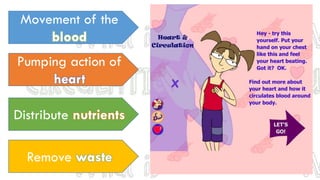
Movement of the
blood
Pumping action of
heart
Distribute nutrients
Remove waste
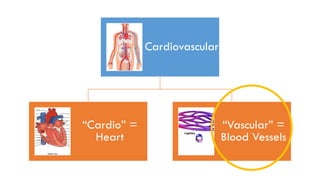
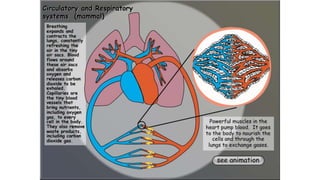
Cardiovascular
“Cardio” =
Heart
“Vascular” =
Blood Vessels
What is the function of
BLOOD VESSELS?
What are the
three types of
BLOOD VESSELS?
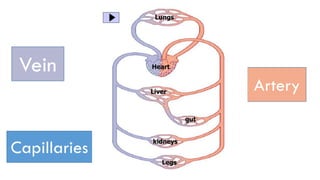
Capillaries
Vein
Artery
Which blood vessel carry blood away from the
heart?
Which blood vessel brings blood back to the
heart?
Which blood vessel carry blood from
small artery to a small vein?
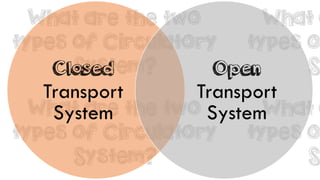
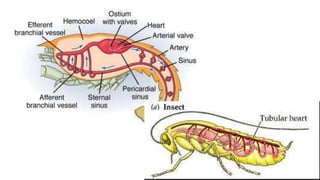
Closed
Transport
System
Open
Transport
System
WHAT IS THE DIFFERENCE?
Closed
- Vertebrates and few
invertebrates
- Have heart and blood vessels
- Does not fill body cavities
- Blood kept in blood vessels
- Heart pumps blood
Open
- Invertebrates
- Do not have true heart or
capillaries
- Blood is pumped in hemocoel
[cavity]
- Blood + interstitial fluid =
hemolymph
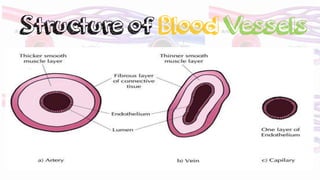
Structure of Blood Vessels
[1] [2] [3]
THE HEART
The most
“hardworking”
organ
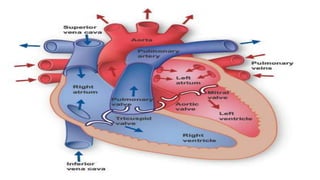
What are the four chambers of the heart?
What are the four valves of the heart?
What are the five large blood vessels
connected to the heart?
BLOOD
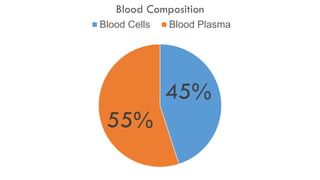
45%
55%
Blood Composition
Blood Cells Blood Plasma
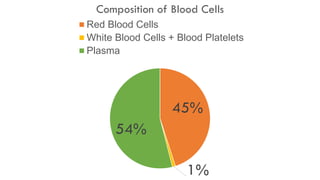
45%
1%
54%
Composition of Blood Cells
Red Blood Cells
White Blood Cells + Blood Platelets
Plasma
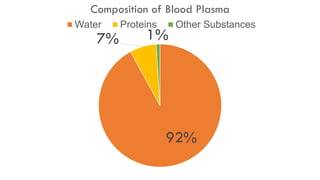
92%
7% 1%
Composition of Blood Plasma
Water Proteins Other Substances
RED BLOOD CELLS [ERYTHROCYTES]
[biconcave] [no nucleus]
[unable to repair]
[120 days  body]
[10 days  blood]
[Hemoglobin  red] [carry O2]
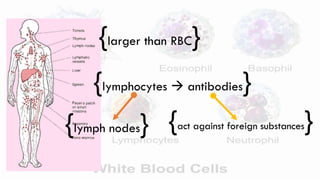
WHITE BLOOD CELLS [LEUKOCYTES]
{larger than RBC}
{lymphocytes  antibodies}
{lymph nodes} {act against foreign substances}
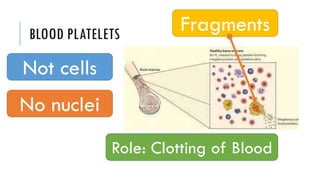
BLOOD PLATELETS
Not cells
No nuclei
Fragments
Role: Clotting of Blood
Are you a
humanitarian?
Are you willing
to donate blood?
3-2-1
3 Things That You Remember
2 Things That You Don’t Understand
1 Thing That You Want to Share

Lesson 1 Circulatory System - Grade 9

Editor's Notes

  • #5 Reflection
  • #9 Food, Oxygen, and some other substances The sum total of the chemical changes that go on within the cells of an organism – metabolism.
  • #10 Cycle is involved in sustaining life. Inside one’s body is a cycle that keeps a person alive – CIRCULATORY SYSTEM
  • #11 Circulatory is also known as the body’s transport system. Circulation – movement of blood through the vessels of the body. It is induced by the pumping action of the heart. It serves to distribute nutrients and oxygen to all parts of the body and remove waste products as well.
  • #12 Circulation – movement of blood through the vessels of the body. It is induced by the pumping action of the heart. It serves to distribute nutrients and oxygen to all parts of the body and remove waste products as well.
  • #14 Parts of Circulatory System Animation
  • #15 Blood vessels – responsible for the transportation of blood Blood vessels – arteries, veins, and capillaries
  • #16 Blood system animation
  • #17 Artery, vein, capillaries
  • #18 circulation - blood vessels animation
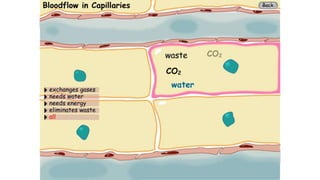
  • #19 Blood flow in capillaries animation
  • #21 open and close transport system animation
  • #25 1 – innermost epithelial cells 2 – middle layer of smooth muscles 3 – outermost layer of tough connective tissues
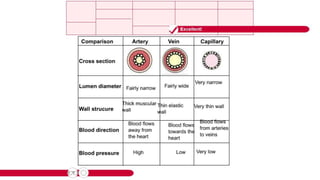
  • #26 Comparison - Blood Vessels animation Blood pressure in artery high – blood goes to other parts of the body
  • #29 Structure of the heart animation
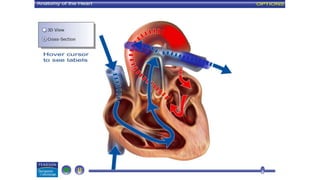
  • #30 Anatomy of the heart animation
  • #36 Blood cells animation
  • #37 RBC  mostly destroyed in liver and spleen Hemoglobin  protein with strong attraction to O2
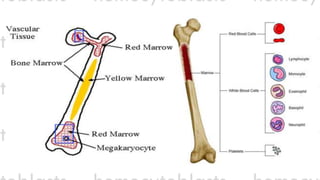
  • #38 RBC – made in red marrow RBC,WBC, and platelets – formed from a special connective tissue called hemocytoblasts.
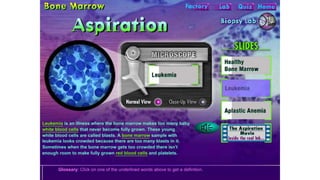
  • #39 Bone Marrow Factory animation
  • #41 WBC  made in lymph nodes
  • #42 Fragments from large cells called MEGAKARYOCYTES
  • #43 Blood Clot animation
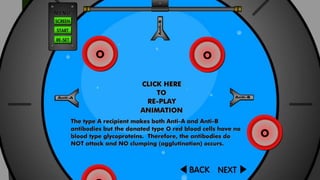
  • #44 Blood Type animation Type O – universal donor Type AB – universal acceptor