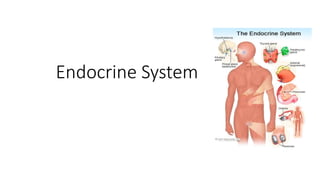
Endocrine System
• Messages can be sent using the nervous system – electrical impulses
• Or the Endocrine system – using chemicals
• Chemicals called hormones – a chemical substance produced by a
gland, carried by the blood, which alters the activity of one or more
target organs and is then destroyed by the liver
Important Endocrine
Glands
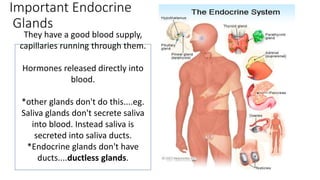
They have a good blood supply,
capillaries running through them.
Hormones released directly into
blood.
*other glands don't do this....eg.
Saliva glands don't secrete saliva
into blood. Instead saliva is
secreted into saliva ducts.
*Endocrine glands don't have
ducts....ductless glands.
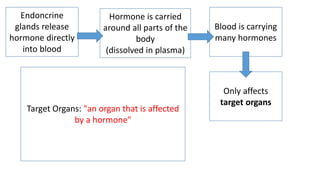
Endoncrine
glands release
hormone directly
into blood
Hormone is carried
around all parts of the
body
(dissolved in plasma)
Blood is carrying
many hormones
Only affects
target organs
Target Organs: "an organ that is affected
by a hormone"
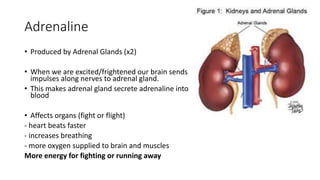
Adrenaline
• Produced by Adrenal Glands (x2)
• When we are excited/frightened our brain sends
impulses along nerves to adrenal gland.
• This makes adrenal gland secrete adrenaline into
blood
• Affects organs (fight or flight)
- heart beats faster
- increases breathing
- more oxygen supplied to brain and muscles
More energy for fighting or running away
Other effects of Adrenaline
• Blood vessels in skin and digestive system contract
(pale and ' butterflies in stomach' )
• Reason: to provide as much blood as possible for the brain
• Pupils in the eye widen. To allow more light in. Why?
• Liver releases glucose into the blood. To release more energy from it
(respiration)
COORDINATION
AND RESPONSE IN
PLANTS
• Plants often respond to stimuli by growing towards or away from the
stimulus.
• Changing their direction of growth
• Away = negative response / Towards = positive response
• Tropism = growth response by a plant
• Gravitropism = a response in which plants grow towards or away from
gravity
• Phototropism = a response in which plants grow towards or away from
the direction of the light
• Shoots usually grow towards the light.
• Roots usually don't respond to light (some grow away)
• Shoots usually grow away from the pull of gravity
• Roots usually grow towards it
• Reasons: shoots need light so must grow towards it – more light,
better photosynthesis
• Roots need to grow into the soil to anchor the plant and absorb
water/minerals
Plant Hormones
• Plants don't have complex sense organs (like mammals)
• Receptor is in tip of shoot. See Experiment
Auxin
• A plant hormone that causes plant cells to elongate
• Produced in the tip of the shoot. Cells on the shady side grow faster
than cells on the bright side. Causes bending towards light.
• Even light causes shoot to grow straight upwards.
Auxin affected by Gravity
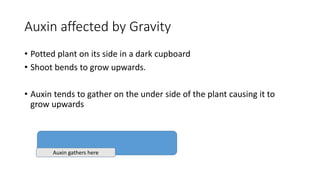
• Potted plant on its side in a dark cupboard
• Shoot bends to grow upwards.
• Auxin tends to gather on the under side of the plant causing it to
grow upwards
Auxin gathers here
Auxin has opposite effect in roots
Etiolation
• Plants grow in darkness.
• Auxin spread evenly around tip...causes plant to grow rapidly upwards
• Results in very tall thin plant.
• However: chloroplasts don't develop properly in darkness.
• So, plant is yellow and weak. With leaves spaced apart.
• If plant then receives light, will begin to develop chloroplast and grow
normally.
• If continued darkness, plant will die because it cannot photosynthesise.
Weedkillers
• Often made from synthetic Auxin
• Selective weedkillers. Meaning it causes weeds to grow very fast and
die, but doesn't affect grass

Endocrine system

  • 1.
  • 2.
    • Messages canbe sent using the nervous system – electrical impulses • Or the Endocrine system – using chemicals • Chemicals called hormones – a chemical substance produced by a gland, carried by the blood, which alters the activity of one or more target organs and is then destroyed by the liver
  • 3.
    Important Endocrine Glands They havea good blood supply, capillaries running through them. Hormones released directly into blood. *other glands don't do this....eg. Saliva glands don't secrete saliva into blood. Instead saliva is secreted into saliva ducts. *Endocrine glands don't have ducts....ductless glands.
  • 4.
    Endoncrine glands release hormone directly intoblood Hormone is carried around all parts of the body (dissolved in plasma) Blood is carrying many hormones Only affects target organs Target Organs: "an organ that is affected by a hormone"
  • 5.
    Adrenaline • Produced byAdrenal Glands (x2) • When we are excited/frightened our brain sends impulses along nerves to adrenal gland. • This makes adrenal gland secrete adrenaline into blood • Affects organs (fight or flight) - heart beats faster - increases breathing - more oxygen supplied to brain and muscles More energy for fighting or running away
  • 6.
    Other effects ofAdrenaline • Blood vessels in skin and digestive system contract (pale and ' butterflies in stomach' ) • Reason: to provide as much blood as possible for the brain • Pupils in the eye widen. To allow more light in. Why? • Liver releases glucose into the blood. To release more energy from it (respiration)
  • 7.
  • 8.
    • Plants oftenrespond to stimuli by growing towards or away from the stimulus. • Changing their direction of growth • Away = negative response / Towards = positive response • Tropism = growth response by a plant • Gravitropism = a response in which plants grow towards or away from gravity • Phototropism = a response in which plants grow towards or away from the direction of the light
  • 9.
    • Shoots usuallygrow towards the light. • Roots usually don't respond to light (some grow away) • Shoots usually grow away from the pull of gravity • Roots usually grow towards it • Reasons: shoots need light so must grow towards it – more light, better photosynthesis • Roots need to grow into the soil to anchor the plant and absorb water/minerals
  • 10.
    Plant Hormones • Plantsdon't have complex sense organs (like mammals) • Receptor is in tip of shoot. See Experiment
  • 11.
    Auxin • A planthormone that causes plant cells to elongate • Produced in the tip of the shoot. Cells on the shady side grow faster than cells on the bright side. Causes bending towards light. • Even light causes shoot to grow straight upwards.
  • 12.
    Auxin affected byGravity • Potted plant on its side in a dark cupboard • Shoot bends to grow upwards. • Auxin tends to gather on the under side of the plant causing it to grow upwards Auxin gathers here
  • 13.
    Auxin has oppositeeffect in roots
  • 14.
    Etiolation • Plants growin darkness. • Auxin spread evenly around tip...causes plant to grow rapidly upwards • Results in very tall thin plant. • However: chloroplasts don't develop properly in darkness. • So, plant is yellow and weak. With leaves spaced apart. • If plant then receives light, will begin to develop chloroplast and grow normally. • If continued darkness, plant will die because it cannot photosynthesise.
  • 15.
    Weedkillers • Often madefrom synthetic Auxin • Selective weedkillers. Meaning it causes weeds to grow very fast and die, but doesn't affect grass