The Digestive SystemThe Digestive System
Made by - Amogh JalanMade by - Amogh Jalan
DigestionDigestion
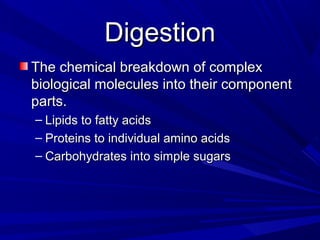
The chemical breakdown of complexThe chemical breakdown of complex
biological molecules into their componentbiological molecules into their component
parts.parts.
– Lipids to fatty acidsLipids to fatty acids
– Proteins to individual amino acidsProteins to individual amino acids
– Carbohydrates into simple sugarsCarbohydrates into simple sugars
FunctionFunction
Produces various chemicals toProduces various chemicals to
break down the food.break down the food.
Filters out harmful substances.Filters out harmful substances.
Gets rid of solid wastes.Gets rid of solid wastes.
DigestionDigestion
MechanicalMechanical
–Changes the physical form of foodChanges the physical form of food
ChewChew
TearTear
GrindGrind
MashMash
MixMix
DigestionDigestion
ChemicalChemical
– Changes the chemical composition of foodChanges the chemical composition of food
with the aid of digestive enzymeswith the aid of digestive enzymes
CarbohydrateCarbohydrate
ProteinProtein
LipidLipid
– Digestive enzymes are special proteins thatDigestive enzymes are special proteins that
help break up large molecules of food intohelp break up large molecules of food into
very tiny molecules that can be absorbed andvery tiny molecules that can be absorbed and
used by the cells in the form of nutrition.used by the cells in the form of nutrition.
Phases of DigestionPhases of Digestion
IngestionIngestion
MovementMovement
DigestionDigestion
AbsorptionAbsorption
Further digestionFurther digestion
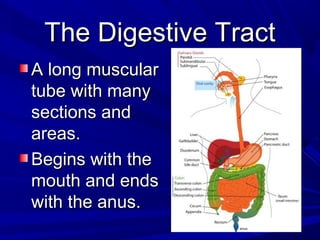
The Digestive TractThe Digestive Tract
A long muscularA long muscular
tube with manytube with many
sections andsections and
areas.areas.
Begins with theBegins with the
mouth and endsmouth and ends
with the anus.with the anus.
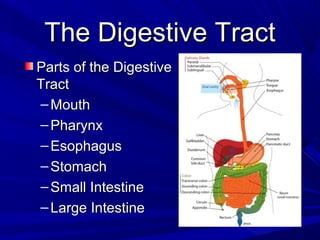
The Digestive TractThe Digestive Tract
Parts of the DigestiveParts of the Digestive
TractTract
– MouthMouth
– PharynxPharynx
– EsophagusEsophagus
– StomachStomach
– Small IntestineSmall Intestine
– Large IntestineLarge Intestine
Accessory PartsAccessory Parts
Organs that are not in the digestive tractOrgans that are not in the digestive tract
but helps in the digestionbut helps in the digestion
– TeethTeeth
– TongueTongue
– Salivary glandsSalivary glands
– LiverLiver
– Gall bladderGall bladder
– PancreasPancreas
MouthMouth
Functions:Functions:
– Food enters in the mouth or oralFood enters in the mouth or oral
cavitycavity
– TastingTasting
– Mechanical breakdown of foodMechanical breakdown of food
– Secretion of salivary glandsSecretion of salivary glands
(salivary amylase)(salivary amylase)
MouthMouth
Structures in the mouth that aids digestion:Structures in the mouth that aids digestion:
Teeth – cut, tear, crush and grind food.Teeth – cut, tear, crush and grind food.
Salivary glands – produce and secreteSalivary glands – produce and secrete
saliva into the oral cavity.saliva into the oral cavity.
– Parotid (beneath the cheeks)Parotid (beneath the cheeks)
– Submaxillary (below the jaw bone)Submaxillary (below the jaw bone)
– Sublingual (below the tongue)Sublingual (below the tongue)
–– saliva moistens thesaliva moistens the
food and contains enzymes (food and contains enzymes (ptyalinptyalin oror
salivarysalivary amylaseamylase) that begins digestion) that begins digestion
of starch into smaller polysaccharides.of starch into smaller polysaccharides.
MouthMouth
TongueTongue
– Mixes and rolls food into tinyMixes and rolls food into tiny
mashed up bitsmashed up bits ((BolusBolus))
– Pushes the bolus toward thePushes the bolus toward the
pharynx and into the esophaguspharynx and into the esophagus
when swallowing.when swallowing.
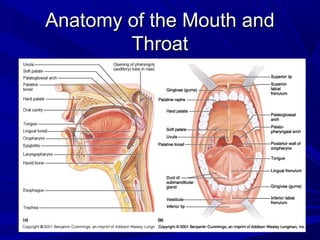
Anatomy of the Mouth andAnatomy of the Mouth and
ThroatThroat
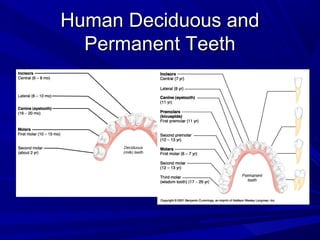
Human Deciduous andHuman Deciduous and
Permanent TeethPermanent Teeth
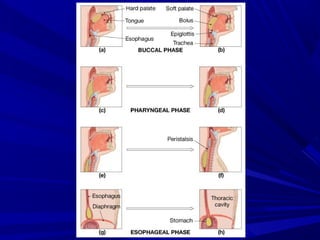
Mechanism of SwallowingMechanism of Swallowing
Swallowing is a coordinated activity of theSwallowing is a coordinated activity of the
tongue, soft palate, pharynx and esophagus.tongue, soft palate, pharynx and esophagus.
PhasesPhases
– Food is pushed into theFood is pushed into the pharynxpharynx by theby the
tongue. (voluntary)tongue. (voluntary)
– Tongue blocks the mouthTongue blocks the mouth
– Soft palate closes off the noseSoft palate closes off the nose
– Larynx (Adam’s Apple) rises so theLarynx (Adam’s Apple) rises so the
EpiglottisEpiglottis (a flap of tissue) can close the(a flap of tissue) can close the
opening of the trachea.opening of the trachea.
EsophagusEsophagus
A straight muscular tube that is about 10 inchesA straight muscular tube that is about 10 inches
(25 cm) long which connects the mouth with the(25 cm) long which connects the mouth with the
stomachstomach
Food takes about 4 to 8 seconds as it passesFood takes about 4 to 8 seconds as it passes
through to the stomach.through to the stomach.
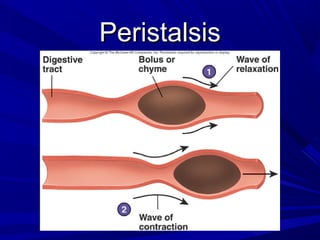
Its walls contain smooth muscles that contractsIts walls contain smooth muscles that contracts
in wavy motion (in wavy motion (PeristalsisPeristalsis).).
Peristalsis propels food and liquid slowlyPeristalsis propels food and liquid slowly
down the esophagus into the stomach.down the esophagus into the stomach.
Cardiac Sphincter (ring-like valve) relaxes toCardiac Sphincter (ring-like valve) relaxes to
allow food into the stomach.allow food into the stomach.
PeristalsisPeristalsis
StomachStomach
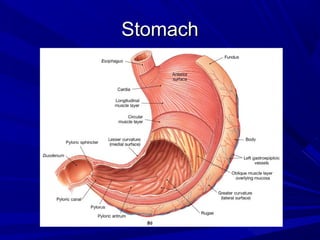
J-shaped muscular sacJ-shaped muscular sac
Has inner folds (Has inner folds (rugaerugae) that increases the) that increases the
surface area of the stomach.surface area of the stomach.
Churns and grinds together the bolus intoChurns and grinds together the bolus into
smaller pieces.smaller pieces.
Food is mixed with gastric juicesFood is mixed with gastric juices
(hydrochloric acid and enzymes) secreted(hydrochloric acid and enzymes) secreted
by the stomach walls.by the stomach walls.
HCL helps break down food and killsHCL helps break down food and kills
bacteria that came along with the food.bacteria that came along with the food.
StomachStomach
StomachStomach
PepsinPepsin – major enzyme; converts– major enzyme; converts
proteins into peptides in the presence ofproteins into peptides in the presence of
HCL.HCL.
MucusMucus – lubricates food and protects the– lubricates food and protects the
gastric lining from strong digestive juices.gastric lining from strong digestive juices.
Converts the bolus into a liquidConverts the bolus into a liquid
((chymechyme)) after 4 hrs of mechanical andafter 4 hrs of mechanical and
chemical digestionchemical digestion
Chyme passes through theChyme passes through the pyloricpyloric
sphinctersphincter into the small intestine.into the small intestine.
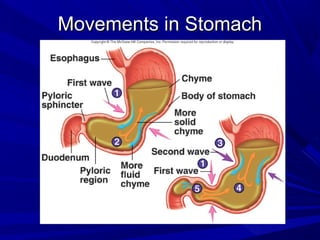
Movements in StomachMovements in Stomach
Small IntestineSmall Intestine
Long (20 ft), coiled tube beneath theLong (20 ft), coiled tube beneath the
stomach.stomach.
Has three parts:Has three parts:
Duodenum – upper part; about 10 in; connected toDuodenum – upper part; about 10 in; connected to
the stomach.the stomach.
–– where the digestive juices from thewhere the digestive juices from the
pancreas and the liver combine with chymepancreas and the liver combine with chyme
making it thin and watery.making it thin and watery.
Jejunum – about 8 ftJejunum – about 8 ft
Ileum – about 12 ftIleum – about 12 ft
Small IntestineSmall Intestine
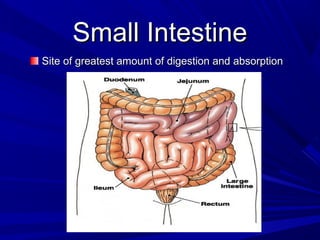
Site of greatest amount of digestion and absorptionSite of greatest amount of digestion and absorption
Small IntestineSmall Intestine
Takes about 4 – 8 hrs to complete its journey.Takes about 4 – 8 hrs to complete its journey.
Mucosa (inner wall) – secretes several enzymesMucosa (inner wall) – secretes several enzymes
that acts on the food.that acts on the food.
Where the pancreatic enzymes are emptied into.Where the pancreatic enzymes are emptied into.
Digested nutrients are absorbed throughDigested nutrients are absorbed through
intestinal walls.intestinal walls.
Absorbed materials cross the mucosa into theAbsorbed materials cross the mucosa into the
blood then other parts of the body for storage orblood then other parts of the body for storage or
further chemical change.further chemical change.
Small IntestineSmall Intestine
Has folded inner walls covered withHas folded inner walls covered with
fingerlike projections (fingerlike projections (villivilli; sing. – villus); sing. – villus)
Each villus has tinier projections calledEach villus has tinier projections called
microvillimicrovilli that absorbs digested food.that absorbs digested food.
Villi and microvilli increases the surfaceVilli and microvilli increases the surface
area of the small intestine for greaterarea of the small intestine for greater
absorption.absorption.
Peristalsis moves the undigested food toPeristalsis moves the undigested food to
the large intestine.the large intestine.
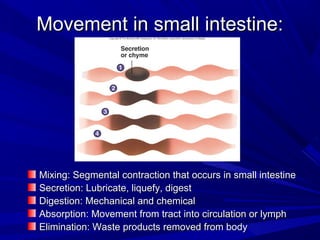
Movement in small intestine:Movement in small intestine:
Mixing: Segmental contraction that occurs in small intestineMixing: Segmental contraction that occurs in small intestine
Secretion: Lubricate, liquefy, digestSecretion: Lubricate, liquefy, digest
Digestion: Mechanical and chemicalDigestion: Mechanical and chemical
Absorption: Movement from tract into circulation or lymphAbsorption: Movement from tract into circulation or lymph
Elimination: Waste products removed from bodyElimination: Waste products removed from body
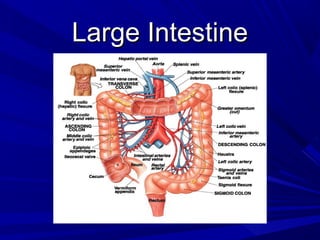
Large IntestineLarge Intestine
a.k.a. Colona.k.a. Colon
larger diameter, but shorter (5 ft)larger diameter, but shorter (5 ft)
Water is absorbed from theWater is absorbed from the
undigested food making the wasteundigested food making the waste
harder until it becomes solid.harder until it becomes solid.
Waste stays for 10 – 12 hours.Waste stays for 10 – 12 hours.
Large IntestineLarge Intestine
Waste is pushed into the expandedWaste is pushed into the expanded
portion (rectum) of the large intestine.portion (rectum) of the large intestine.
Solid waste stays in the rectum until itSolid waste stays in the rectum until it
is excreted through the anus asis excreted through the anus as
feces.feces.
Appendix hangs on the right side ofAppendix hangs on the right side of
the large intestine.the large intestine.
Accessory OrgansAccessory Organs
Produce or store enzymes that helps inProduce or store enzymes that helps in
digestion.digestion.
LiverLiver
– Largest gland of the bodyLargest gland of the body
– Stores vitamins A,D,E,KStores vitamins A,D,E,K
– Stores sugar and glycogenStores sugar and glycogen
– ProducesProduces bilebile (watery, greenish(watery, greenish
substance)substance)
– Secretes bile to the gall bladder via theSecretes bile to the gall bladder via the
hepatic duct and cystic duct.hepatic duct and cystic duct.
Accessory OrgansAccessory Organs
Gall bladderGall bladder
– Stores bile in between mealsStores bile in between meals
– Secretes bile to the duodenum throughSecretes bile to the duodenum through
the bile duct during mealtime.the bile duct during mealtime.
Bile contains bile salts, pigments,Bile contains bile salts, pigments,
cholesterol and phospholipids.cholesterol and phospholipids.
Bile is an emulsifier NOT an enzyme.Bile is an emulsifier NOT an enzyme.
Emulsifier – dissolves fat into theEmulsifier – dissolves fat into the
watery contents of the intestine.watery contents of the intestine.
Accessory OrgansAccessory Organs
PancreasPancreas
– Produces a juice that containsProduces a juice that contains
enzymes (enzymes (amylase and insulinamylase and insulin) to) to
break down carbohydrates, fatsbreak down carbohydrates, fats
and protein.and protein.
– Secretes the juice into theSecretes the juice into the
duodenum through the pancreaticduodenum through the pancreatic
duct.duct.
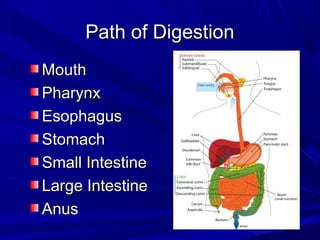
Path of DigestionPath of Digestion
MouthMouth
PharynxPharynx
EsophagusEsophagus
StomachStomach
Small IntestineSmall Intestine
Large IntestineLarge Intestine
AnusAnus
The Excretory SystemThe Excretory System
Gets rid of wastes and otherGets rid of wastes and other
substances that the body doesn’tsubstances that the body doesn’t
need.need.
Two Types of WastesTwo Types of Wastes
Solid Waste – from the Digestive SystemSolid Waste – from the Digestive System
in the form of feces.in the form of feces.
Metabolic Wastes – produced by chemicalMetabolic Wastes – produced by chemical
reactions like respiration, hydrolysis,reactions like respiration, hydrolysis,
synthesis and neutralization.synthesis and neutralization.
– WaterWater
– Carbon DioxideCarbon Dioxide
– SaltsSalts
– UreaUrea
Removal of WastesRemoval of Wastes
EgestionEgestion
– removal of digestive waste.removal of digestive waste.
ExcretionExcretion
– removal of metabolic waste.removal of metabolic waste.
Organs of ExcretionOrgans of Excretion
SkinSkin
–Allows water, salt and urea toAllows water, salt and urea to
diffuse from the blood (capillaries)diffuse from the blood (capillaries)
into the sweat glands.into the sweat glands.
–Releases sweat from the sweatReleases sweat from the sweat
glands through the sweat ducts outglands through the sweat ducts out
to the skin pores.to the skin pores.
Organs of ExcretionOrgans of Excretion
LungsLungs
– Excretes the waste product ofExcretes the waste product of
respiration during exhalation.respiration during exhalation.
– Carbon Dioxide and WaterCarbon Dioxide and Water
Vapor.Vapor.
Organs of ExcretionOrgans of Excretion
LiverLiver
–Part of the digestive, circulatory andPart of the digestive, circulatory and
excretory systems.excretory systems.
–Removes excess amino acids fromRemoves excess amino acids from
the body.the body.
–Breaks down the amino acidsBreaks down the amino acids
throughthrough deaminationdeamination to form theto form the
urea which is excreted in the urine.urea which is excreted in the urine.
Organs of ExcretionOrgans of Excretion
KidneysKidneys
– Major excretory organs of the bodyMajor excretory organs of the body
which removes most of the bodywhich removes most of the body
wastes.wastes.
– Purify blood by filtering out water, salts,Purify blood by filtering out water, salts,
digested food particles and urea in thedigested food particles and urea in the
form of urine.form of urine.
– Urine passes out through the urinaryUrine passes out through the urinary
tract.tract.
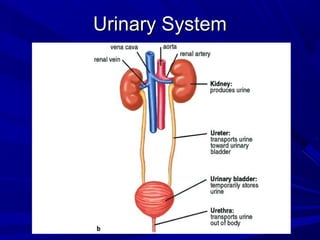
Urinary SystemUrinary System
Excretion of UrineExcretion of Urine
KidneyKidney
Ureter – a tube that transports urine to theUreter – a tube that transports urine to the
urinary bladder.urinary bladder.
Urinary Bladder – a sac of tissue that hasUrinary Bladder – a sac of tissue that has
the ability to expand as it fills with urine.the ability to expand as it fills with urine.
Urethra – a tube at the bottom of theUrethra – a tube at the bottom of the
bladder where urine passes out of thebladder where urine passes out of the
body.body.
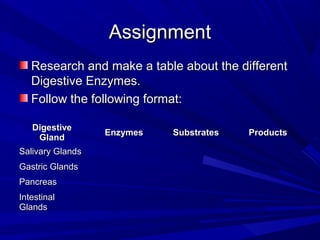
AssignmentAssignment
Research and make a table about the differentResearch and make a table about the different
Digestive Enzymes.Digestive Enzymes.
Follow the following format:Follow the following format:
DigestiveDigestive
GlandGland
EnzymesEnzymes SubstratesSubstrates ProductsProducts
Salivary GlandsSalivary Glands
Gastric GlandsGastric Glands
PancreasPancreas
IntestinalIntestinal
GlandsGlands

The digestive-system-powerpoint-1227698045024899-8

  • 1.
    The Digestive SystemTheDigestive System Made by - Amogh JalanMade by - Amogh Jalan
  • 2.
    DigestionDigestion The chemical breakdownof complexThe chemical breakdown of complex biological molecules into their componentbiological molecules into their component parts.parts. – Lipids to fatty acidsLipids to fatty acids – Proteins to individual amino acidsProteins to individual amino acids – Carbohydrates into simple sugarsCarbohydrates into simple sugars
  • 3.
    FunctionFunction Produces various chemicalstoProduces various chemicals to break down the food.break down the food. Filters out harmful substances.Filters out harmful substances. Gets rid of solid wastes.Gets rid of solid wastes.
  • 4.
    DigestionDigestion MechanicalMechanical –Changes the physicalform of foodChanges the physical form of food ChewChew TearTear GrindGrind MashMash MixMix
  • 5.
    DigestionDigestion ChemicalChemical – Changes thechemical composition of foodChanges the chemical composition of food with the aid of digestive enzymeswith the aid of digestive enzymes CarbohydrateCarbohydrate ProteinProtein LipidLipid – Digestive enzymes are special proteins thatDigestive enzymes are special proteins that help break up large molecules of food intohelp break up large molecules of food into very tiny molecules that can be absorbed andvery tiny molecules that can be absorbed and used by the cells in the form of nutrition.used by the cells in the form of nutrition.
  • 6.
    Phases of DigestionPhasesof Digestion IngestionIngestion MovementMovement DigestionDigestion AbsorptionAbsorption Further digestionFurther digestion
  • 7.
    The Digestive TractTheDigestive Tract A long muscularA long muscular tube with manytube with many sections andsections and areas.areas. Begins with theBegins with the mouth and endsmouth and ends with the anus.with the anus.
  • 8.
    The Digestive TractTheDigestive Tract Parts of the DigestiveParts of the Digestive TractTract – MouthMouth – PharynxPharynx – EsophagusEsophagus – StomachStomach – Small IntestineSmall Intestine – Large IntestineLarge Intestine
  • 9.
    Accessory PartsAccessory Parts Organsthat are not in the digestive tractOrgans that are not in the digestive tract but helps in the digestionbut helps in the digestion – TeethTeeth – TongueTongue – Salivary glandsSalivary glands – LiverLiver – Gall bladderGall bladder – PancreasPancreas
  • 10.
    MouthMouth Functions:Functions: – Food entersin the mouth or oralFood enters in the mouth or oral cavitycavity – TastingTasting – Mechanical breakdown of foodMechanical breakdown of food – Secretion of salivary glandsSecretion of salivary glands (salivary amylase)(salivary amylase)
  • 11.
    MouthMouth Structures in themouth that aids digestion:Structures in the mouth that aids digestion: Teeth – cut, tear, crush and grind food.Teeth – cut, tear, crush and grind food. Salivary glands – produce and secreteSalivary glands – produce and secrete saliva into the oral cavity.saliva into the oral cavity. – Parotid (beneath the cheeks)Parotid (beneath the cheeks) – Submaxillary (below the jaw bone)Submaxillary (below the jaw bone) – Sublingual (below the tongue)Sublingual (below the tongue) –– saliva moistens thesaliva moistens the food and contains enzymes (food and contains enzymes (ptyalinptyalin oror salivarysalivary amylaseamylase) that begins digestion) that begins digestion of starch into smaller polysaccharides.of starch into smaller polysaccharides.
  • 12.
    MouthMouth TongueTongue – Mixes androlls food into tinyMixes and rolls food into tiny mashed up bitsmashed up bits ((BolusBolus)) – Pushes the bolus toward thePushes the bolus toward the pharynx and into the esophaguspharynx and into the esophagus when swallowing.when swallowing.
  • 13.
    Anatomy of theMouth andAnatomy of the Mouth and ThroatThroat
  • 14.
    Human Deciduous andHumanDeciduous and Permanent TeethPermanent Teeth
  • 15.
    Mechanism of SwallowingMechanismof Swallowing Swallowing is a coordinated activity of theSwallowing is a coordinated activity of the tongue, soft palate, pharynx and esophagus.tongue, soft palate, pharynx and esophagus. PhasesPhases – Food is pushed into theFood is pushed into the pharynxpharynx by theby the tongue. (voluntary)tongue. (voluntary) – Tongue blocks the mouthTongue blocks the mouth – Soft palate closes off the noseSoft palate closes off the nose – Larynx (Adam’s Apple) rises so theLarynx (Adam’s Apple) rises so the EpiglottisEpiglottis (a flap of tissue) can close the(a flap of tissue) can close the opening of the trachea.opening of the trachea.
  • 17.
    EsophagusEsophagus A straight musculartube that is about 10 inchesA straight muscular tube that is about 10 inches (25 cm) long which connects the mouth with the(25 cm) long which connects the mouth with the stomachstomach Food takes about 4 to 8 seconds as it passesFood takes about 4 to 8 seconds as it passes through to the stomach.through to the stomach. Its walls contain smooth muscles that contractsIts walls contain smooth muscles that contracts in wavy motion (in wavy motion (PeristalsisPeristalsis).). Peristalsis propels food and liquid slowlyPeristalsis propels food and liquid slowly down the esophagus into the stomach.down the esophagus into the stomach. Cardiac Sphincter (ring-like valve) relaxes toCardiac Sphincter (ring-like valve) relaxes to allow food into the stomach.allow food into the stomach.
  • 18.
  • 19.
    StomachStomach J-shaped muscular sacJ-shapedmuscular sac Has inner folds (Has inner folds (rugaerugae) that increases the) that increases the surface area of the stomach.surface area of the stomach. Churns and grinds together the bolus intoChurns and grinds together the bolus into smaller pieces.smaller pieces. Food is mixed with gastric juicesFood is mixed with gastric juices (hydrochloric acid and enzymes) secreted(hydrochloric acid and enzymes) secreted by the stomach walls.by the stomach walls. HCL helps break down food and killsHCL helps break down food and kills bacteria that came along with the food.bacteria that came along with the food.
  • 20.
  • 21.
    StomachStomach PepsinPepsin – majorenzyme; converts– major enzyme; converts proteins into peptides in the presence ofproteins into peptides in the presence of HCL.HCL. MucusMucus – lubricates food and protects the– lubricates food and protects the gastric lining from strong digestive juices.gastric lining from strong digestive juices. Converts the bolus into a liquidConverts the bolus into a liquid ((chymechyme)) after 4 hrs of mechanical andafter 4 hrs of mechanical and chemical digestionchemical digestion Chyme passes through theChyme passes through the pyloricpyloric sphinctersphincter into the small intestine.into the small intestine.
  • 22.
  • 23.
    Small IntestineSmall Intestine Long(20 ft), coiled tube beneath theLong (20 ft), coiled tube beneath the stomach.stomach. Has three parts:Has three parts: Duodenum – upper part; about 10 in; connected toDuodenum – upper part; about 10 in; connected to the stomach.the stomach. –– where the digestive juices from thewhere the digestive juices from the pancreas and the liver combine with chymepancreas and the liver combine with chyme making it thin and watery.making it thin and watery. Jejunum – about 8 ftJejunum – about 8 ft Ileum – about 12 ftIleum – about 12 ft
  • 24.
    Small IntestineSmall Intestine Siteof greatest amount of digestion and absorptionSite of greatest amount of digestion and absorption
  • 25.
    Small IntestineSmall Intestine Takesabout 4 – 8 hrs to complete its journey.Takes about 4 – 8 hrs to complete its journey. Mucosa (inner wall) – secretes several enzymesMucosa (inner wall) – secretes several enzymes that acts on the food.that acts on the food. Where the pancreatic enzymes are emptied into.Where the pancreatic enzymes are emptied into. Digested nutrients are absorbed throughDigested nutrients are absorbed through intestinal walls.intestinal walls. Absorbed materials cross the mucosa into theAbsorbed materials cross the mucosa into the blood then other parts of the body for storage orblood then other parts of the body for storage or further chemical change.further chemical change.
  • 26.
    Small IntestineSmall Intestine Hasfolded inner walls covered withHas folded inner walls covered with fingerlike projections (fingerlike projections (villivilli; sing. – villus); sing. – villus) Each villus has tinier projections calledEach villus has tinier projections called microvillimicrovilli that absorbs digested food.that absorbs digested food. Villi and microvilli increases the surfaceVilli and microvilli increases the surface area of the small intestine for greaterarea of the small intestine for greater absorption.absorption. Peristalsis moves the undigested food toPeristalsis moves the undigested food to the large intestine.the large intestine.
  • 27.
    Movement in smallintestine:Movement in small intestine: Mixing: Segmental contraction that occurs in small intestineMixing: Segmental contraction that occurs in small intestine Secretion: Lubricate, liquefy, digestSecretion: Lubricate, liquefy, digest Digestion: Mechanical and chemicalDigestion: Mechanical and chemical Absorption: Movement from tract into circulation or lymphAbsorption: Movement from tract into circulation or lymph Elimination: Waste products removed from bodyElimination: Waste products removed from body
  • 28.
    Large IntestineLarge Intestine a.k.a.Colona.k.a. Colon larger diameter, but shorter (5 ft)larger diameter, but shorter (5 ft) Water is absorbed from theWater is absorbed from the undigested food making the wasteundigested food making the waste harder until it becomes solid.harder until it becomes solid. Waste stays for 10 – 12 hours.Waste stays for 10 – 12 hours.
  • 29.
  • 30.
    Large IntestineLarge Intestine Wasteis pushed into the expandedWaste is pushed into the expanded portion (rectum) of the large intestine.portion (rectum) of the large intestine. Solid waste stays in the rectum until itSolid waste stays in the rectum until it is excreted through the anus asis excreted through the anus as feces.feces. Appendix hangs on the right side ofAppendix hangs on the right side of the large intestine.the large intestine.
  • 31.
    Accessory OrgansAccessory Organs Produceor store enzymes that helps inProduce or store enzymes that helps in digestion.digestion. LiverLiver – Largest gland of the bodyLargest gland of the body – Stores vitamins A,D,E,KStores vitamins A,D,E,K – Stores sugar and glycogenStores sugar and glycogen – ProducesProduces bilebile (watery, greenish(watery, greenish substance)substance) – Secretes bile to the gall bladder via theSecretes bile to the gall bladder via the hepatic duct and cystic duct.hepatic duct and cystic duct.
  • 32.
    Accessory OrgansAccessory Organs GallbladderGall bladder – Stores bile in between mealsStores bile in between meals – Secretes bile to the duodenum throughSecretes bile to the duodenum through the bile duct during mealtime.the bile duct during mealtime. Bile contains bile salts, pigments,Bile contains bile salts, pigments, cholesterol and phospholipids.cholesterol and phospholipids. Bile is an emulsifier NOT an enzyme.Bile is an emulsifier NOT an enzyme. Emulsifier – dissolves fat into theEmulsifier – dissolves fat into the watery contents of the intestine.watery contents of the intestine.
  • 33.
    Accessory OrgansAccessory Organs PancreasPancreas –Produces a juice that containsProduces a juice that contains enzymes (enzymes (amylase and insulinamylase and insulin) to) to break down carbohydrates, fatsbreak down carbohydrates, fats and protein.and protein. – Secretes the juice into theSecretes the juice into the duodenum through the pancreaticduodenum through the pancreatic duct.duct.
  • 34.
    Path of DigestionPathof Digestion MouthMouth PharynxPharynx EsophagusEsophagus StomachStomach Small IntestineSmall Intestine Large IntestineLarge Intestine AnusAnus
  • 35.
    The Excretory SystemTheExcretory System Gets rid of wastes and otherGets rid of wastes and other substances that the body doesn’tsubstances that the body doesn’t need.need.
  • 36.
    Two Types ofWastesTwo Types of Wastes Solid Waste – from the Digestive SystemSolid Waste – from the Digestive System in the form of feces.in the form of feces. Metabolic Wastes – produced by chemicalMetabolic Wastes – produced by chemical reactions like respiration, hydrolysis,reactions like respiration, hydrolysis, synthesis and neutralization.synthesis and neutralization. – WaterWater – Carbon DioxideCarbon Dioxide – SaltsSalts – UreaUrea
  • 37.
    Removal of WastesRemovalof Wastes EgestionEgestion – removal of digestive waste.removal of digestive waste. ExcretionExcretion – removal of metabolic waste.removal of metabolic waste.
  • 38.
    Organs of ExcretionOrgansof Excretion SkinSkin –Allows water, salt and urea toAllows water, salt and urea to diffuse from the blood (capillaries)diffuse from the blood (capillaries) into the sweat glands.into the sweat glands. –Releases sweat from the sweatReleases sweat from the sweat glands through the sweat ducts outglands through the sweat ducts out to the skin pores.to the skin pores.
  • 39.
    Organs of ExcretionOrgansof Excretion LungsLungs – Excretes the waste product ofExcretes the waste product of respiration during exhalation.respiration during exhalation. – Carbon Dioxide and WaterCarbon Dioxide and Water Vapor.Vapor.
  • 40.
    Organs of ExcretionOrgansof Excretion LiverLiver –Part of the digestive, circulatory andPart of the digestive, circulatory and excretory systems.excretory systems. –Removes excess amino acids fromRemoves excess amino acids from the body.the body. –Breaks down the amino acidsBreaks down the amino acids throughthrough deaminationdeamination to form theto form the urea which is excreted in the urine.urea which is excreted in the urine.
  • 41.
    Organs of ExcretionOrgansof Excretion KidneysKidneys – Major excretory organs of the bodyMajor excretory organs of the body which removes most of the bodywhich removes most of the body wastes.wastes. – Purify blood by filtering out water, salts,Purify blood by filtering out water, salts, digested food particles and urea in thedigested food particles and urea in the form of urine.form of urine. – Urine passes out through the urinaryUrine passes out through the urinary tract.tract.
  • 42.
  • 43.
    Excretion of UrineExcretionof Urine KidneyKidney Ureter – a tube that transports urine to theUreter – a tube that transports urine to the urinary bladder.urinary bladder. Urinary Bladder – a sac of tissue that hasUrinary Bladder – a sac of tissue that has the ability to expand as it fills with urine.the ability to expand as it fills with urine. Urethra – a tube at the bottom of theUrethra – a tube at the bottom of the bladder where urine passes out of thebladder where urine passes out of the body.body.
  • 44.
    AssignmentAssignment Research and makea table about the differentResearch and make a table about the different Digestive Enzymes.Digestive Enzymes. Follow the following format:Follow the following format: DigestiveDigestive GlandGland EnzymesEnzymes SubstratesSubstrates ProductsProducts Salivary GlandsSalivary Glands Gastric GlandsGastric Glands PancreasPancreas IntestinalIntestinal GlandsGlands