

1
Measuring and Promoting Urban
     Resilience: A new UN-Habitat
              Programme

                       Ansa Masaud
      Human Settlements Officer, Risk Reduction and
      Reconstruction Branch, UN-Habitat, HQ, Nairobi
              IDRC Conference, Davos 2012


2
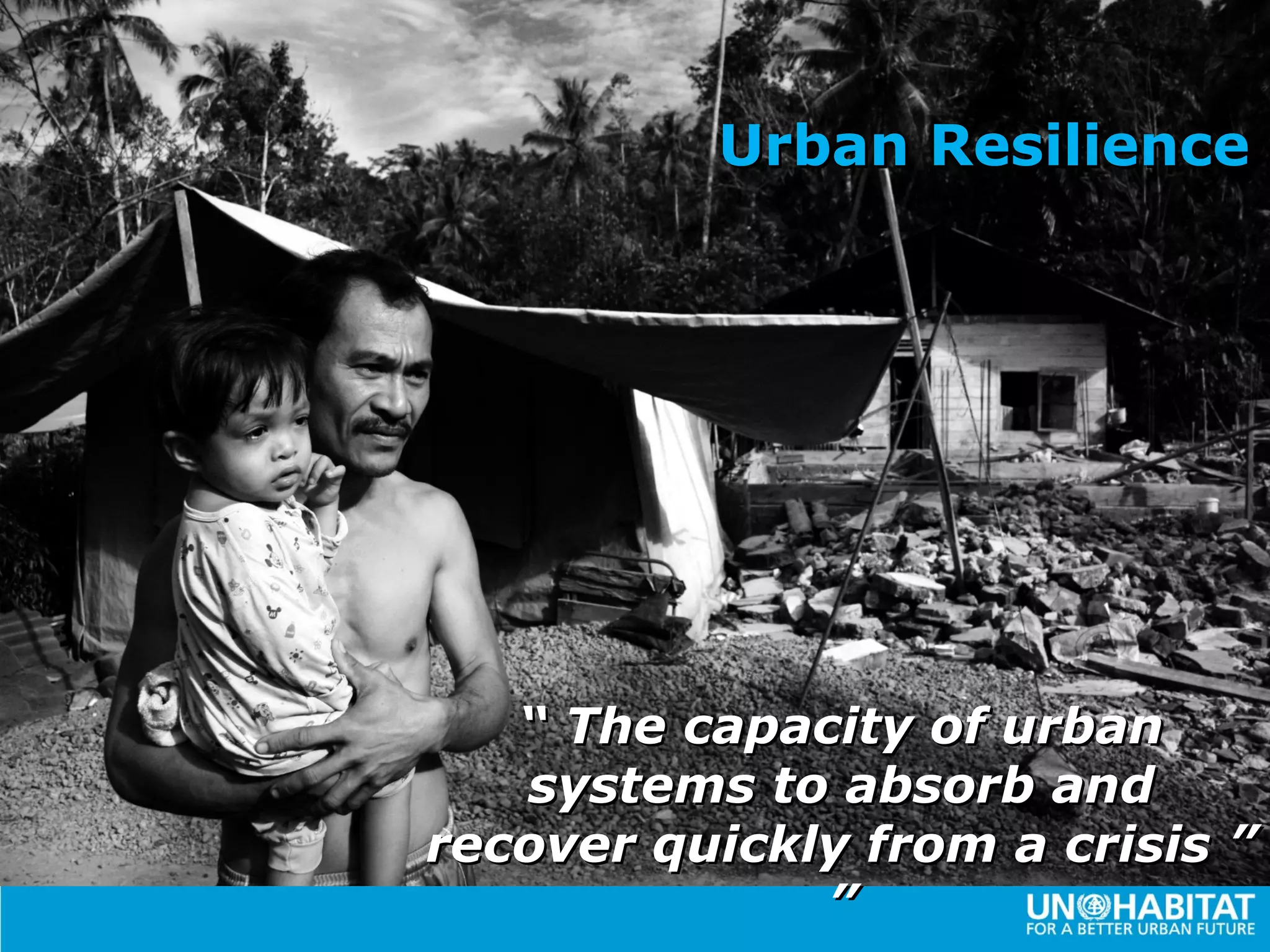
Urban Resilience


   “ The capacity of urban
   systems to absorb and
recover quickly from a crisis ”
              ”
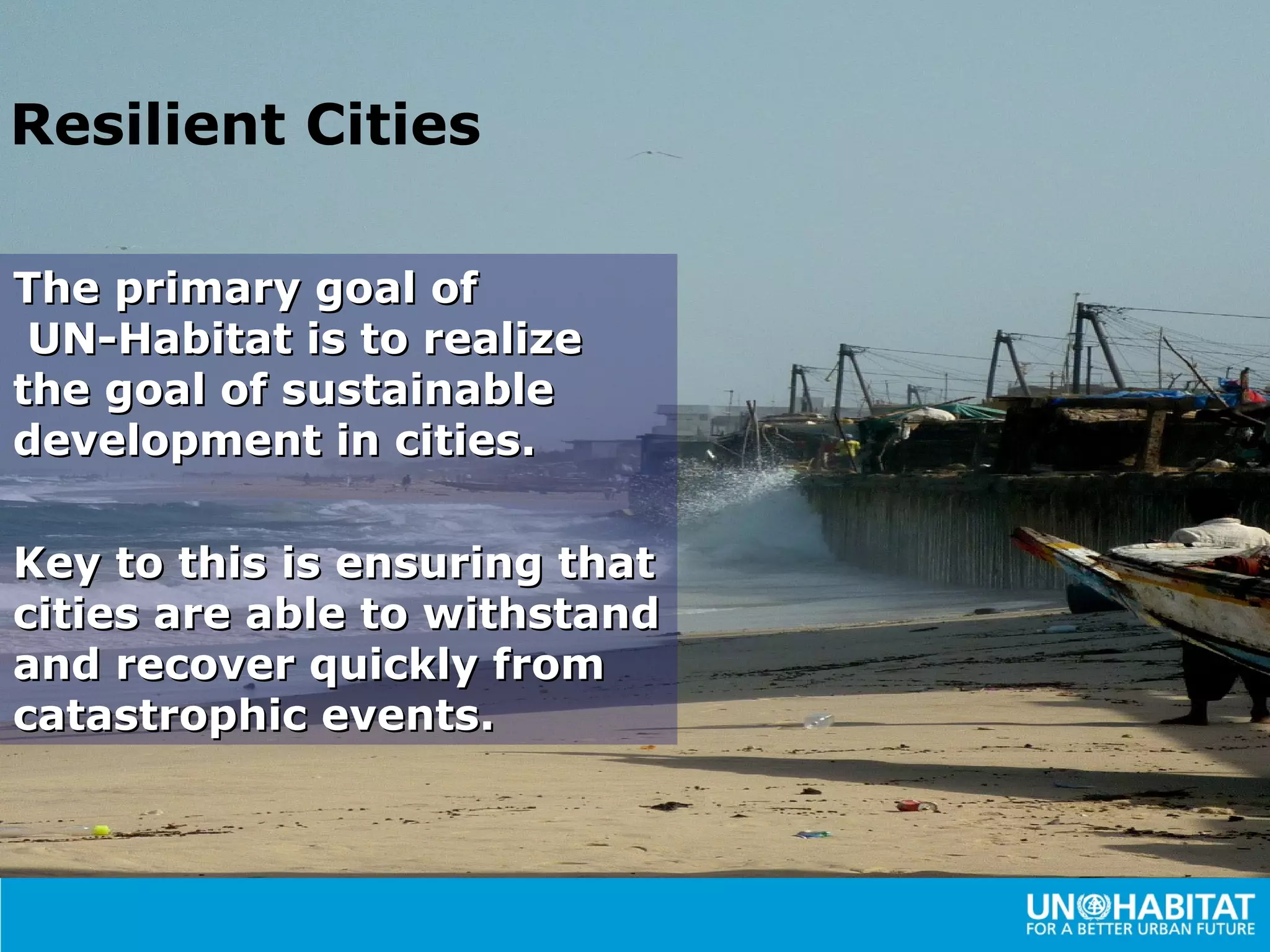
Resilient Cities

The primary goal of
 UN-Habitat is to realize
the goal of sustainable
development in cities.

Key to this is ensuring that
cities are able to withstand
and recover quickly from
catastrophic events.
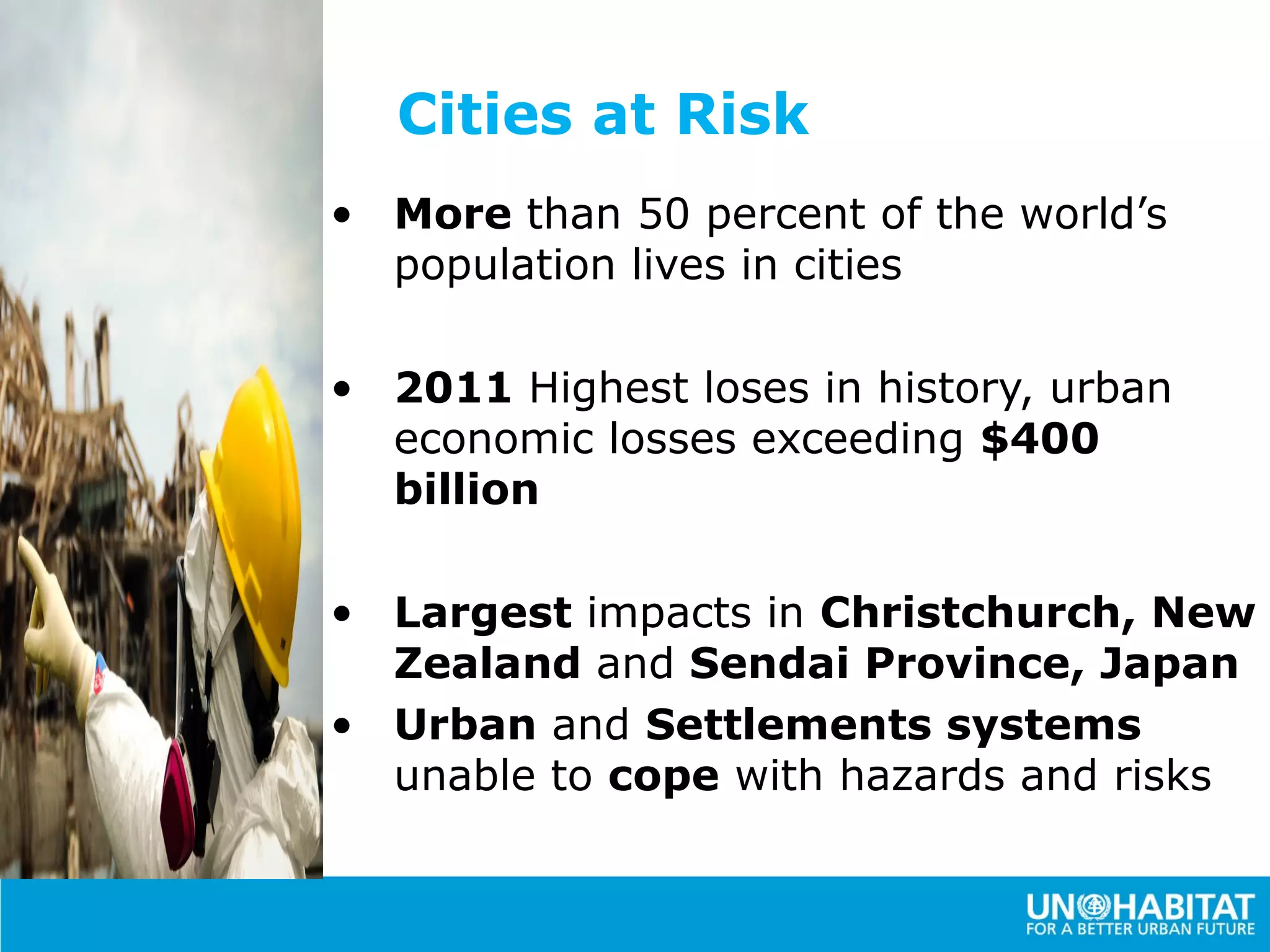
Cities at Risk
• More than 50 percent of the world’s
  population lives in cities

• 2011 Highest loses in history, urban
  economic losses exceeding $400
  billion

• Largest impacts in Christchurch, New
  Zealand and Sendai Province, Japan
• Urban and Settlements systems
  unable to cope with hazards and risks
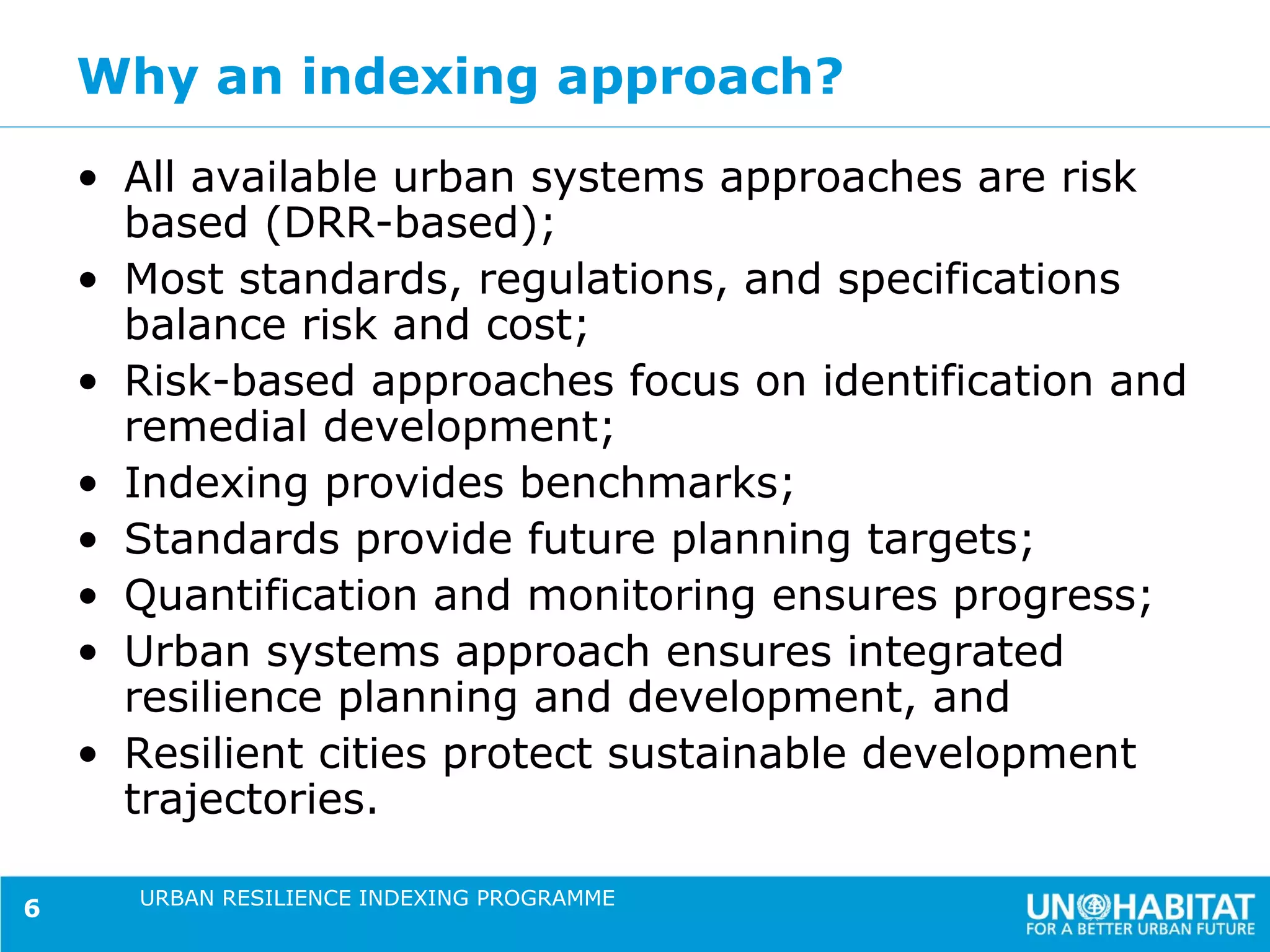
Why an indexing approach?
    • All available urban systems approaches are risk
      based (DRR-based);
    • Most standards, regulations, and specifications
      balance risk and cost;
    • Risk-based approaches focus on identification and
      remedial development;
    • Indexing provides benchmarks;
    • Standards provide future planning targets;
    • Quantification and monitoring ensures progress;
    • Urban systems approach ensures integrated
      resilience planning and development, and
    • Resilient cities protect sustainable development
      trajectories.

      URBAN RESILIENCE INDEXING PROGRAMME
6
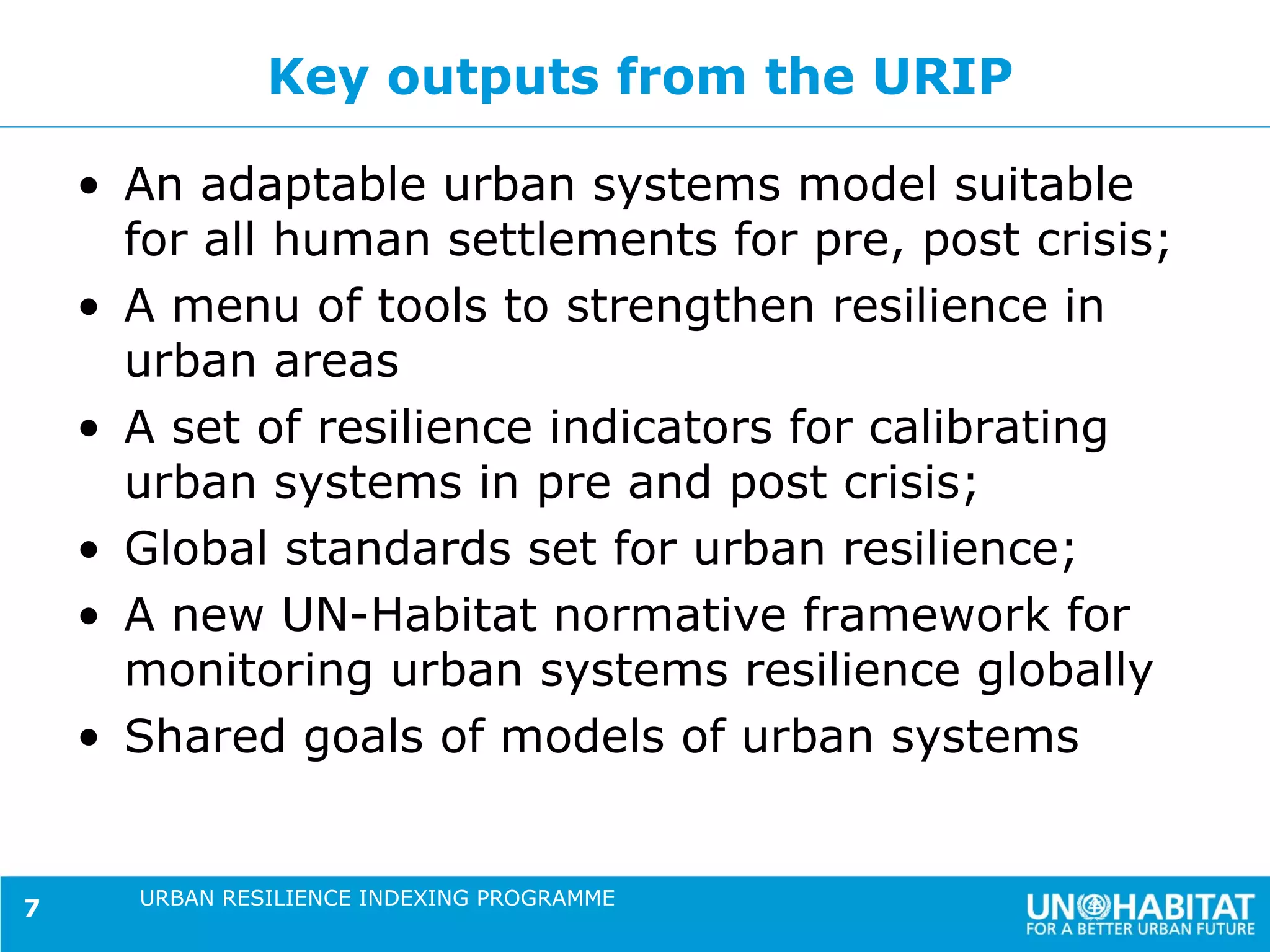
Key outputs from the URIP

    • An adaptable urban systems model suitable
      for all human settlements for pre, post crisis;
    • A menu of tools to strengthen resilience in
      urban areas
    • A set of resilience indicators for calibrating
      urban systems in pre and post crisis;
    • Global standards set for urban resilience;
    • A new UN-Habitat normative framework for
      monitoring urban systems resilience globally
    • Shared goals of models of urban systems


      URBAN RESILIENCE INDEXING PROGRAMME
7
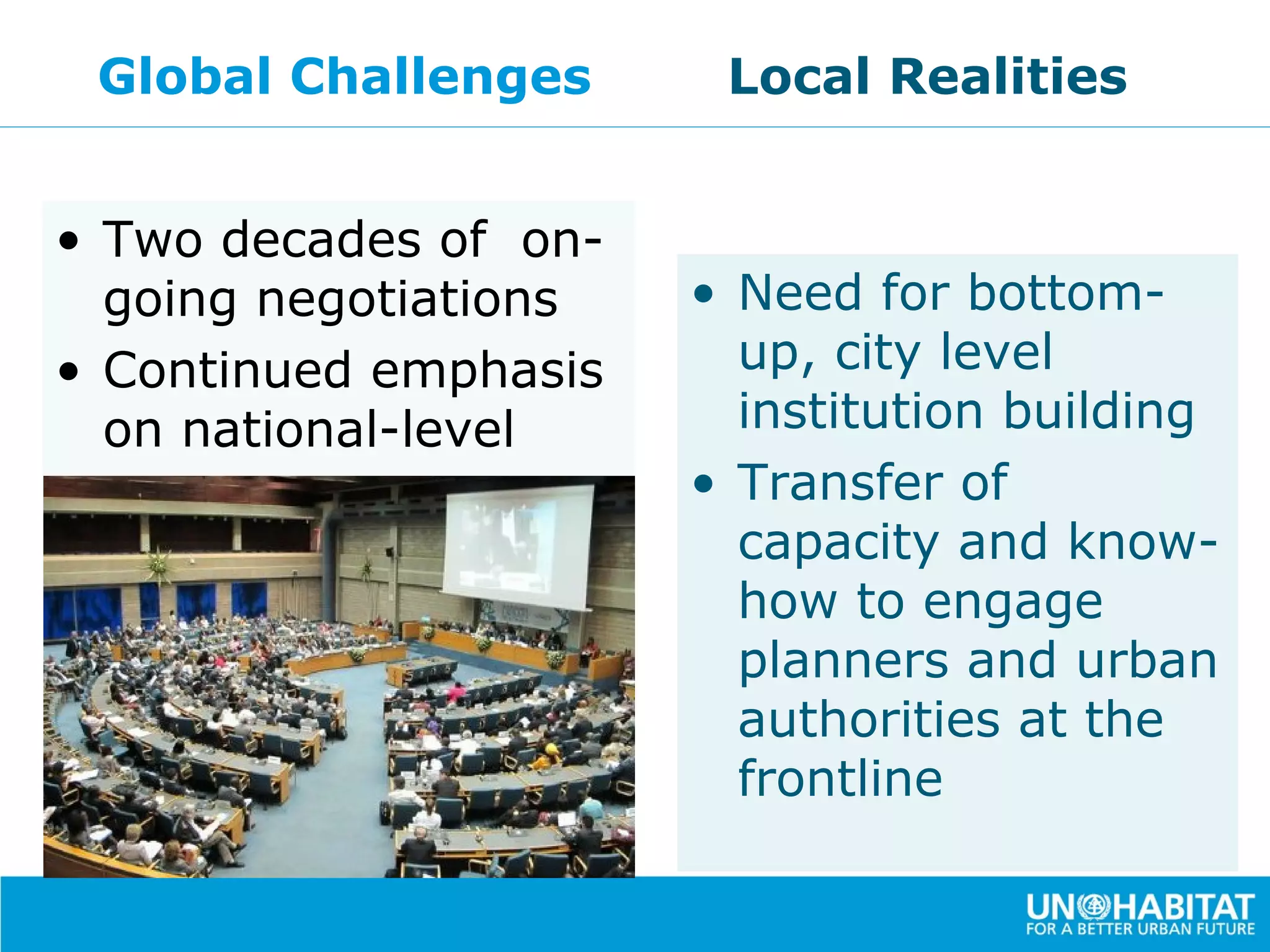
Global Challenges      Local Realities


• Two decades of on-
  going negotiations   • Need for bottom-
• Continued emphasis     up, city level
  on national-level      institution building
  concerns.            • Transfer of
                         capacity and know-
                         how to engage
                         planners and urban
                         authorities at the
                         frontline
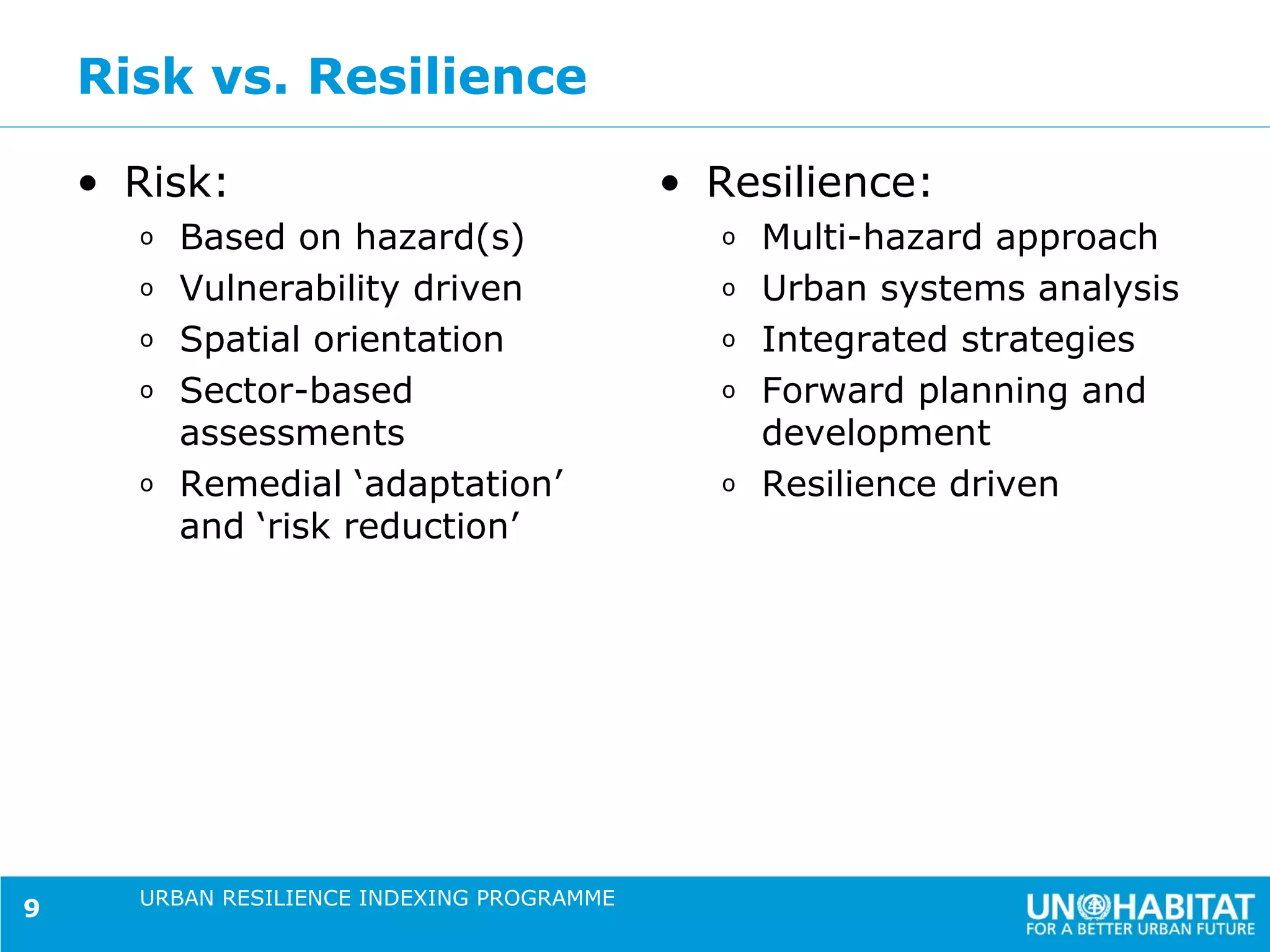
Risk vs. Resilience

    • Risk:                                 • Resilience:
      o   Based on hazard(s)                  o   Multi-hazard approach
      o   Vulnerability driven                o   Urban systems analysis
      o   Spatial orientation                 o   Integrated strategies
      o   Sector-based                        o   Forward planning and
          assessments                             development
      o   Remedial ‘adaptation’               o   Resilience driven
          and ‘risk reduction’


      URBAN RESILIENCE INDEXING PROGRAMME
9
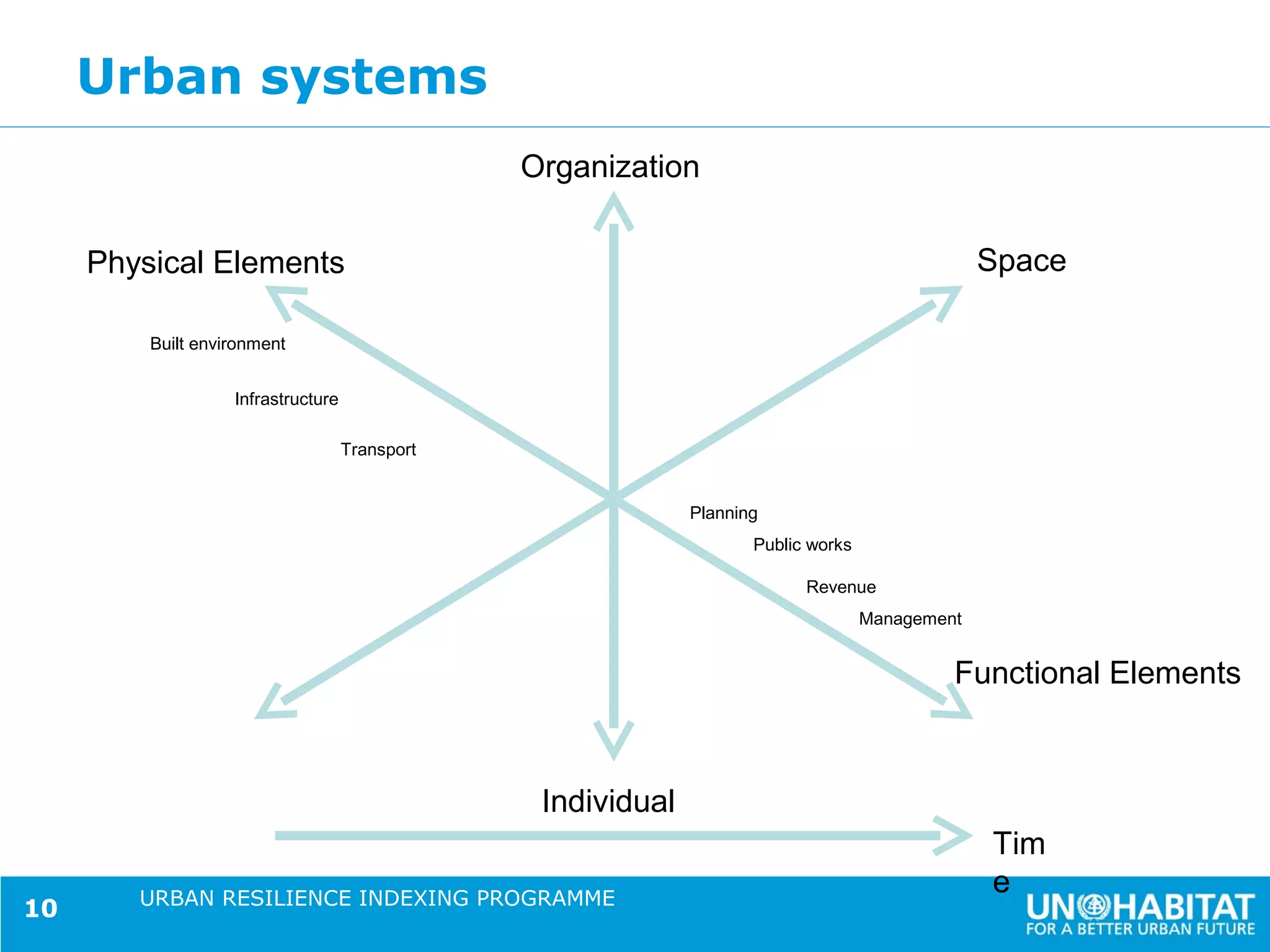
Urban systems
                                                Organization


     Physical Elements                                                                           Space

         Built environment


                   Infrastructure

                                    Transport


                                                              Planning
                                                                     Public works

                                                                           Revenue
                                                                                    Management


                                                                                             Functional Elements


                                                 Individual
                                                                                                 Tim
        URBAN RESILIENCE INDEXING PROGRAMME
                                                                                                 e
10
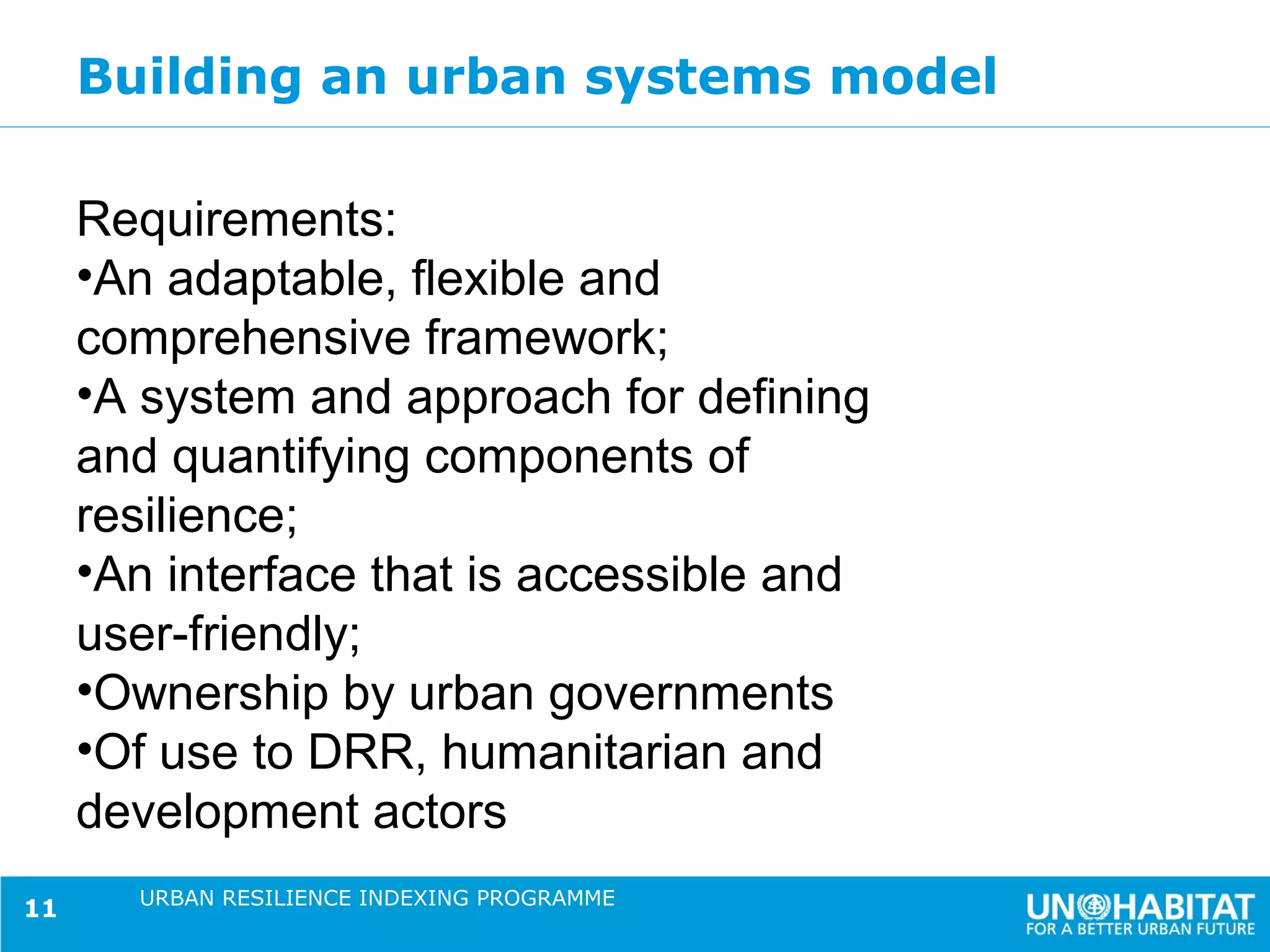
Building an urban systems model

     Requirements:
     •An adaptable, flexible and
     comprehensive framework;
     •A system and approach for defining
     and quantifying components of
     resilience;
     •An interface that is accessible and
     user-friendly;
     •Ownership by urban governments
     •Of use to DRR, humanitarian and
     development actors
       URBAN RESILIENCE INDEXING PROGRAMME
11
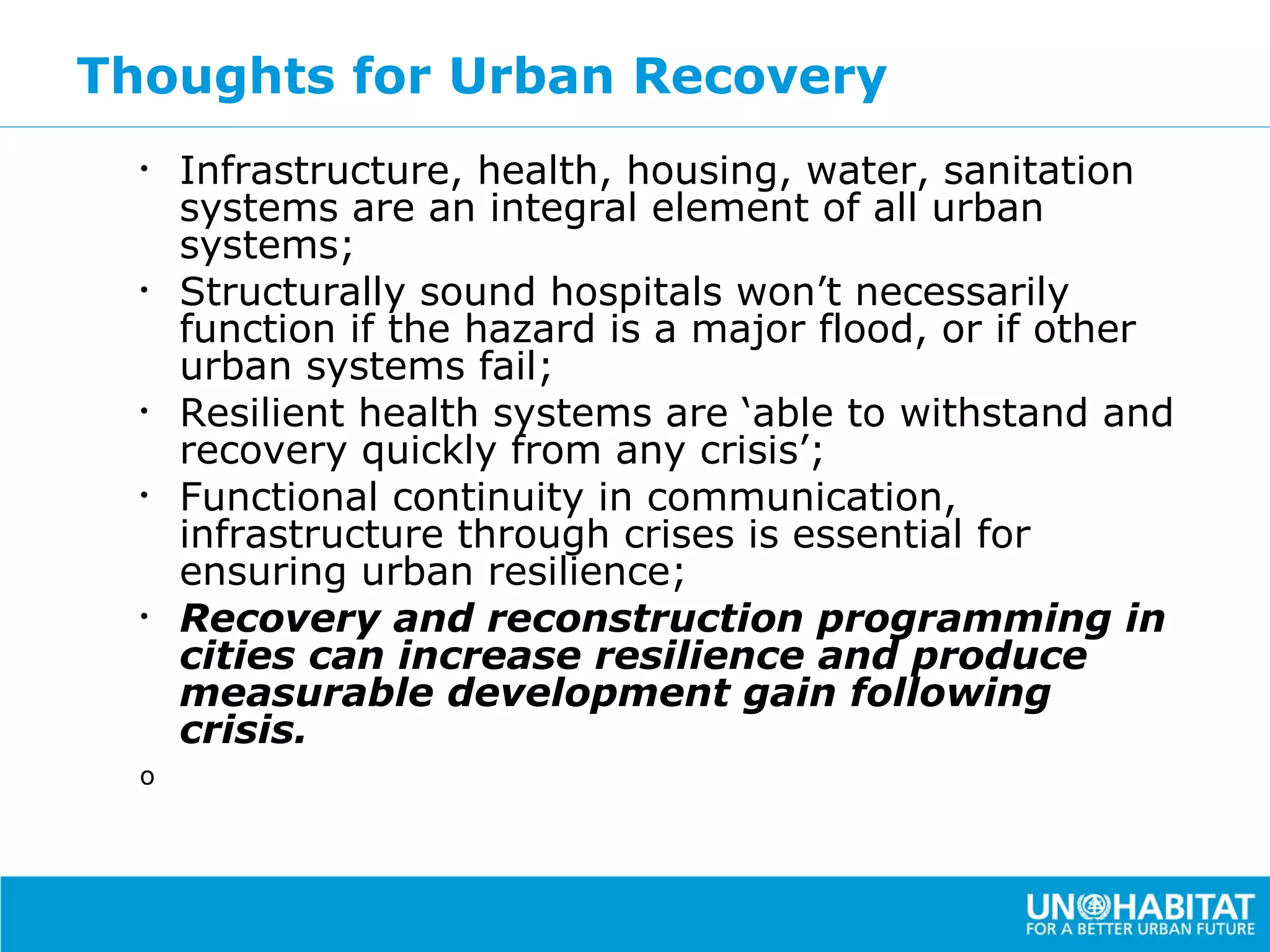
Thoughts for Urban Recovery
  •   Infrastructure, health, housing, water, sanitation
      systems are an integral element of all urban
      systems;
  •   Structurally sound hospitals won’t necessarily
      function if the hazard is a major flood, or if other
      urban systems fail;
  •   Resilient health systems are ‘able to withstand and
      recovery quickly from any crisis’;
  •   Functional continuity in communication,
      infrastructure through crises is essential for
      ensuring urban resilience;
  •   Recovery and reconstruction programming in
      cities can increase resilience and produce
      measurable development gain following
      crisis.
  o
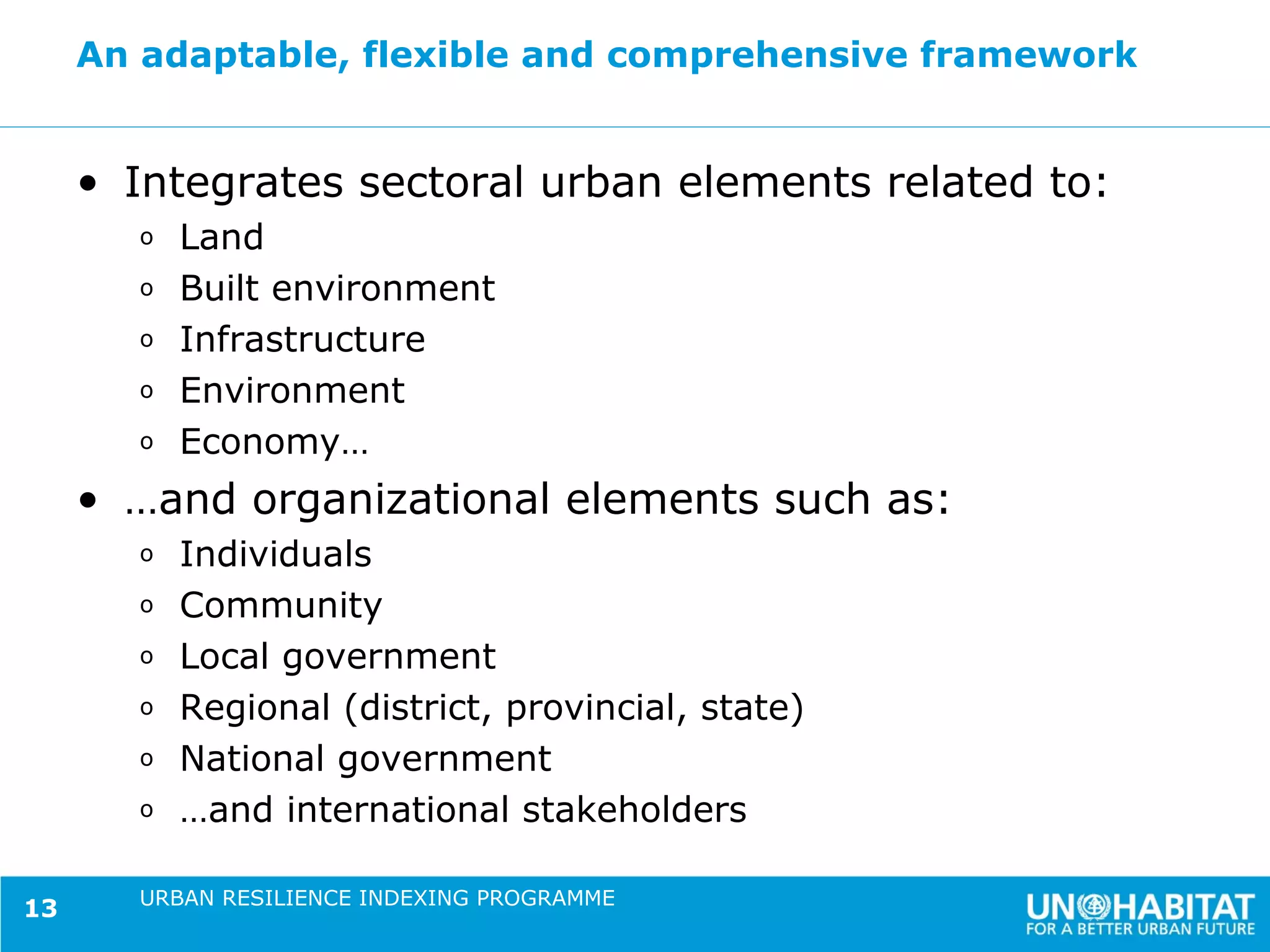
An adaptable, flexible and comprehensive framework


     • Integrates sectoral urban elements related to:
       o   Land
       o   Built environment
       o   Infrastructure
       o   Environment
       o   Economy…
     • …and organizational elements such as:
       o   Individuals
       o   Community
       o   Local government
       o   Regional (district, provincial, state)
       o   National government
       o   …and international stakeholders

       URBAN RESILIENCE INDEXING PROGRAMME
13
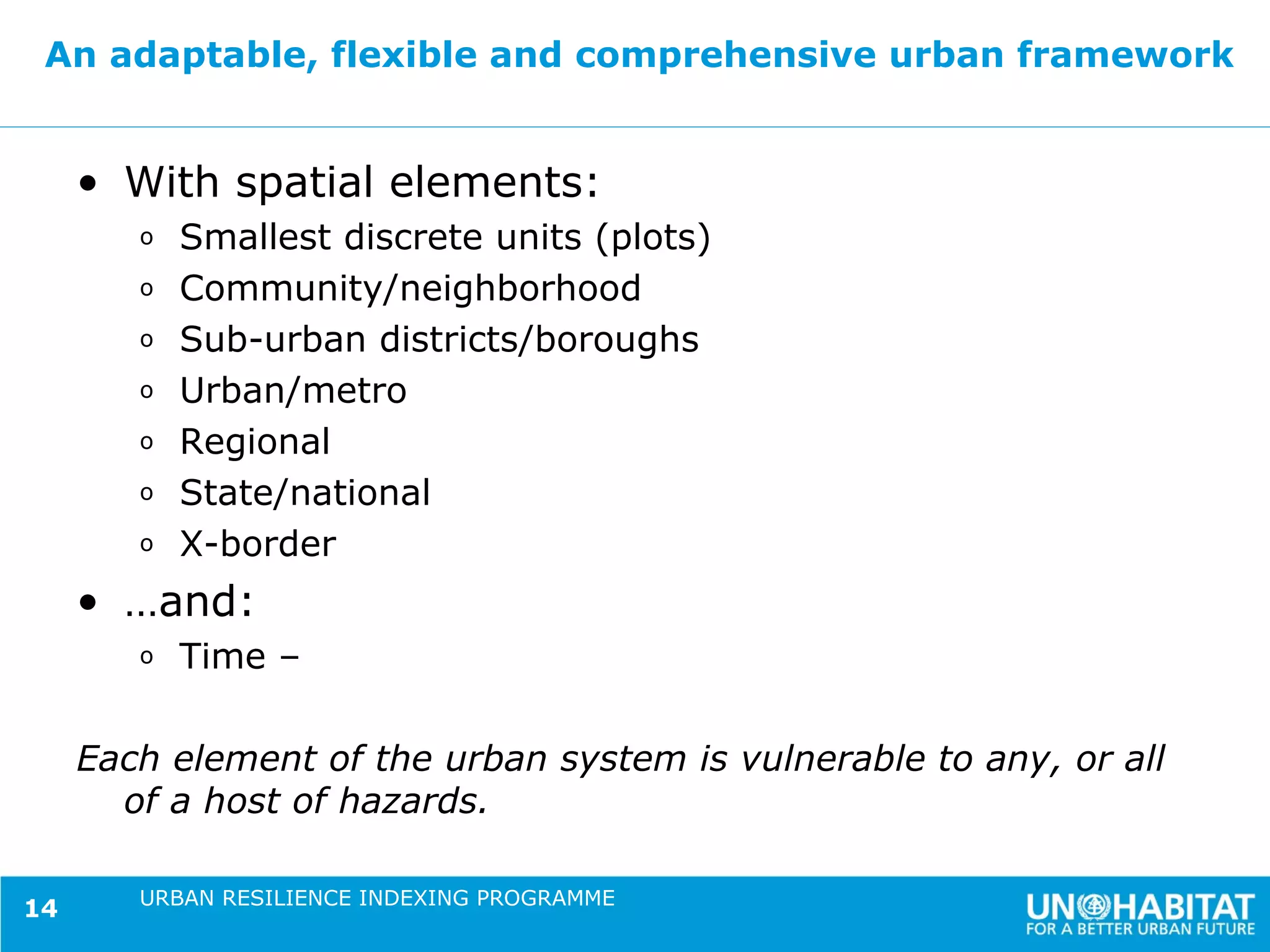
An adaptable, flexible and comprehensive urban framework


     • With spatial elements:
        o   Smallest discrete units (plots)
        o   Community/neighborhood
        o   Sub-urban districts/boroughs
        o   Urban/metro
        o   Regional
        o   State/national
        o   X-border
     • …and:
        o   Time –

     Each element of the urban system is vulnerable to any, or all
       of a host of hazards.

        URBAN RESILIENCE INDEXING PROGRAMME
14
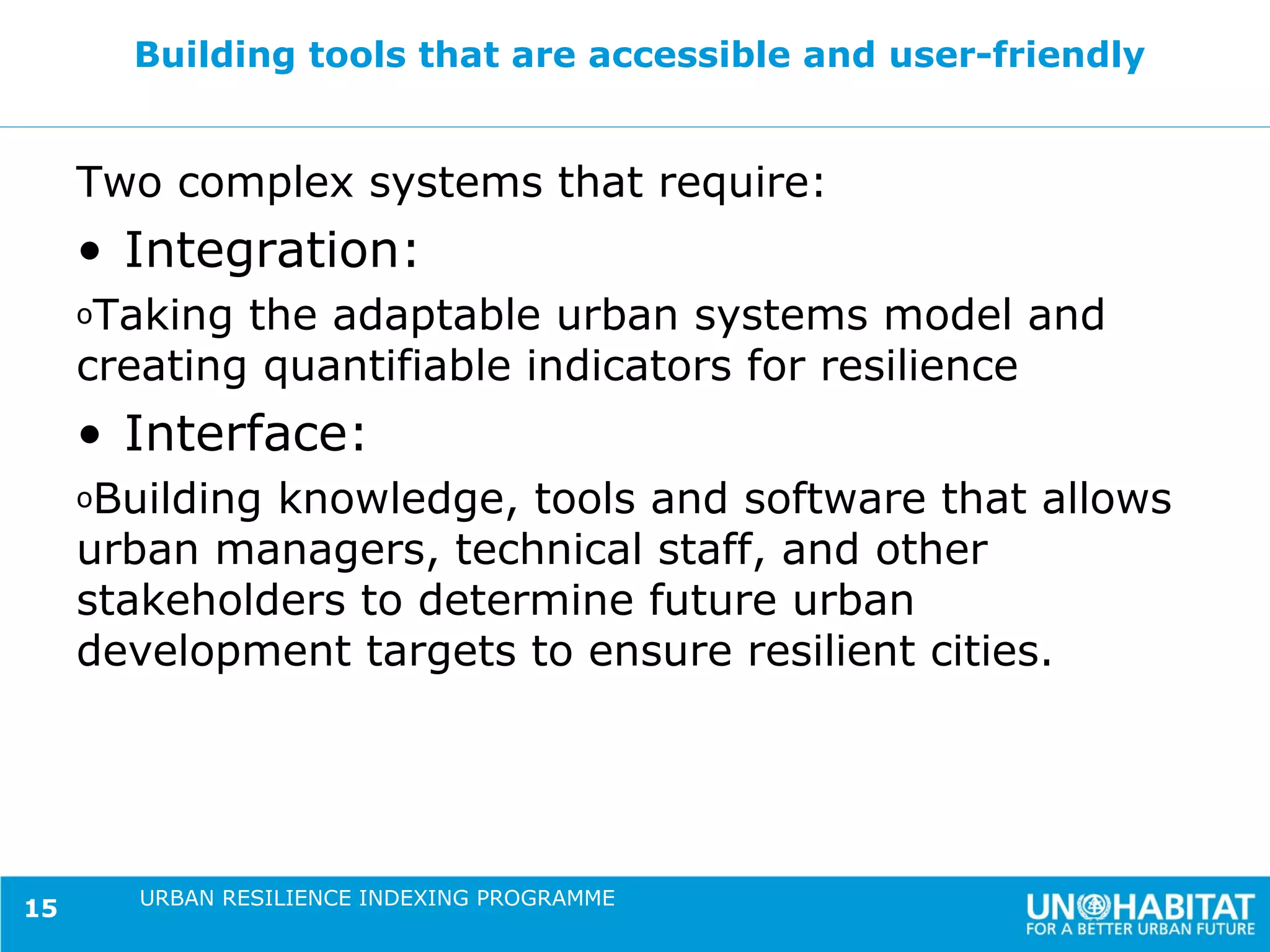
Building tools that are accessible and user-friendly


     Two complex systems that require:
     • Integration:
     oTaking the adaptable urban systems model and
     creating quantifiable indicators for resilience
     • Interface:
     oBuildingknowledge, tools and software that allows
     urban managers, technical staff, and other
     stakeholders to determine future urban
     development targets to ensure resilient cities.


        URBAN RESILIENCE INDEXING PROGRAMME
15
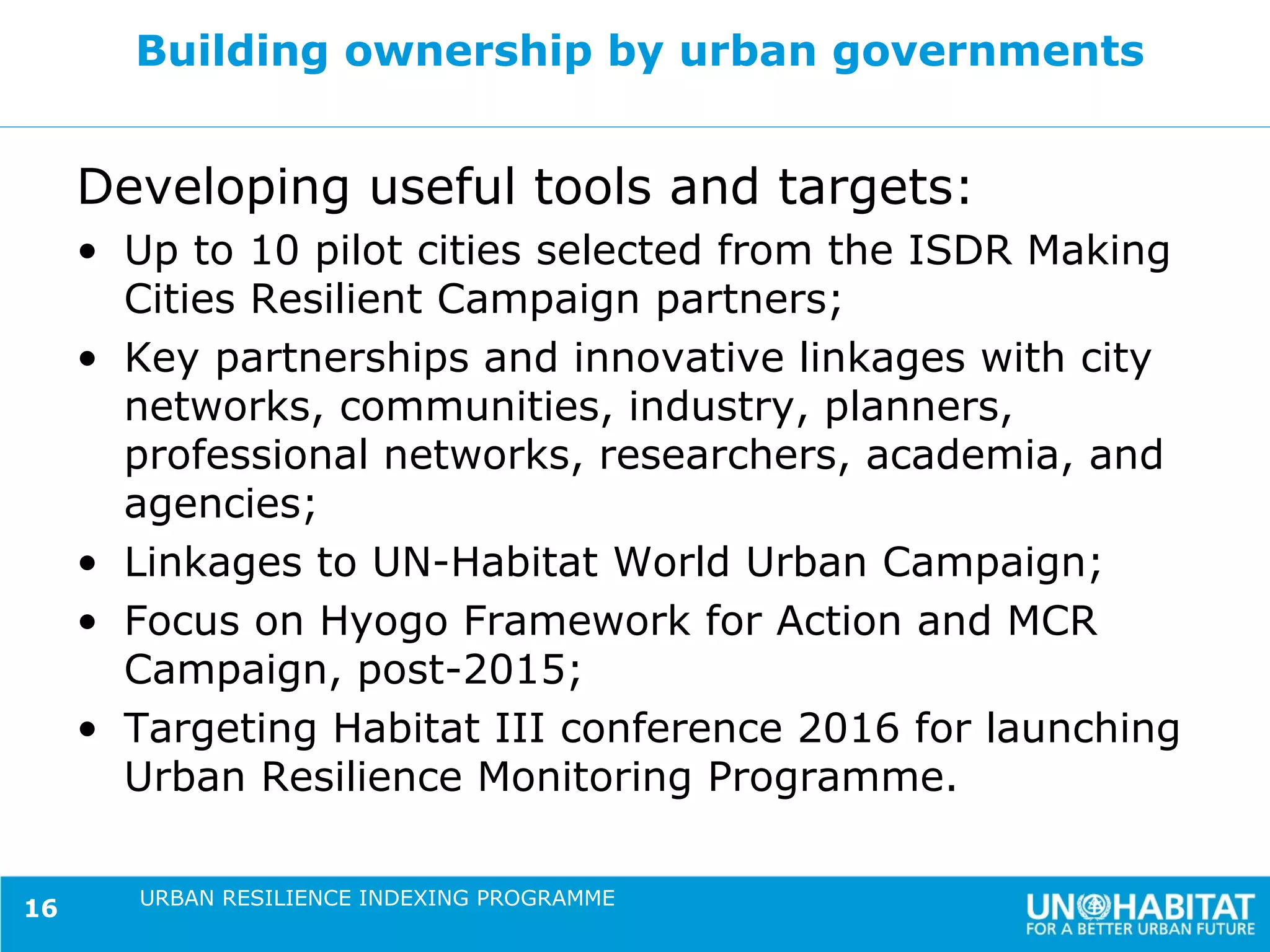
Building ownership by urban governments


     Developing useful tools and targets:
     • Up to 10 pilot cities selected from the ISDR Making
       Cities Resilient Campaign partners;
     • Key partnerships and innovative linkages with city
       networks, communities, industry, planners,
       professional networks, researchers, academia, and
       agencies;
     • Linkages to UN-Habitat World Urban Campaign;
     • Focus on Hyogo Framework for Action and MCR
       Campaign, post-2015;
     • Targeting Habitat III conference 2016 for launching
       Urban Resilience Monitoring Programme.

        URBAN RESILIENCE INDEXING PROGRAMME
16
THANK YOU
     For comments and feedback:
     Ansa.masaud@unhabitat.org

17

Understanding and Measuring Urban Resilience: A new UN-Habitat's initiative

  • 1.
  • 2.
    Measuring and PromotingUrban Resilience: A new UN-Habitat Programme Ansa Masaud Human Settlements Officer, Risk Reduction and Reconstruction Branch, UN-Habitat, HQ, Nairobi IDRC Conference, Davos 2012 2
  • 3.
    Urban Resilience “ The capacity of urban systems to absorb and recover quickly from a crisis ” ”
  • 4.
    Resilient Cities The primarygoal of UN-Habitat is to realize the goal of sustainable development in cities. Key to this is ensuring that cities are able to withstand and recover quickly from catastrophic events.
  • 5.
    Cities at Risk •More than 50 percent of the world’s population lives in cities • 2011 Highest loses in history, urban economic losses exceeding $400 billion • Largest impacts in Christchurch, New Zealand and Sendai Province, Japan • Urban and Settlements systems unable to cope with hazards and risks
  • 6.
    Why an indexingapproach? • All available urban systems approaches are risk based (DRR-based); • Most standards, regulations, and specifications balance risk and cost; • Risk-based approaches focus on identification and remedial development; • Indexing provides benchmarks; • Standards provide future planning targets; • Quantification and monitoring ensures progress; • Urban systems approach ensures integrated resilience planning and development, and • Resilient cities protect sustainable development trajectories. URBAN RESILIENCE INDEXING PROGRAMME 6
  • 7.
    Key outputs fromthe URIP • An adaptable urban systems model suitable for all human settlements for pre, post crisis; • A menu of tools to strengthen resilience in urban areas • A set of resilience indicators for calibrating urban systems in pre and post crisis; • Global standards set for urban resilience; • A new UN-Habitat normative framework for monitoring urban systems resilience globally • Shared goals of models of urban systems URBAN RESILIENCE INDEXING PROGRAMME 7
  • 8.
    Global Challenges Local Realities • Two decades of on- going negotiations • Need for bottom- • Continued emphasis up, city level on national-level institution building concerns. • Transfer of capacity and know- how to engage planners and urban authorities at the frontline
  • 9.
    Risk vs. Resilience • Risk: • Resilience: o Based on hazard(s) o Multi-hazard approach o Vulnerability driven o Urban systems analysis o Spatial orientation o Integrated strategies o Sector-based o Forward planning and assessments development o Remedial ‘adaptation’ o Resilience driven and ‘risk reduction’ URBAN RESILIENCE INDEXING PROGRAMME 9
  • 10.
    Urban systems Organization Physical Elements Space Built environment Infrastructure Transport Planning Public works Revenue Management Functional Elements Individual Tim URBAN RESILIENCE INDEXING PROGRAMME e 10
  • 11.
    Building an urbansystems model Requirements: •An adaptable, flexible and comprehensive framework; •A system and approach for defining and quantifying components of resilience; •An interface that is accessible and user-friendly; •Ownership by urban governments •Of use to DRR, humanitarian and development actors URBAN RESILIENCE INDEXING PROGRAMME 11
  • 12.
    Thoughts for UrbanRecovery • Infrastructure, health, housing, water, sanitation systems are an integral element of all urban systems; • Structurally sound hospitals won’t necessarily function if the hazard is a major flood, or if other urban systems fail; • Resilient health systems are ‘able to withstand and recovery quickly from any crisis’; • Functional continuity in communication, infrastructure through crises is essential for ensuring urban resilience; • Recovery and reconstruction programming in cities can increase resilience and produce measurable development gain following crisis. o
  • 13.
    An adaptable, flexibleand comprehensive framework • Integrates sectoral urban elements related to: o Land o Built environment o Infrastructure o Environment o Economy… • …and organizational elements such as: o Individuals o Community o Local government o Regional (district, provincial, state) o National government o …and international stakeholders URBAN RESILIENCE INDEXING PROGRAMME 13
  • 14.
    An adaptable, flexibleand comprehensive urban framework • With spatial elements: o Smallest discrete units (plots) o Community/neighborhood o Sub-urban districts/boroughs o Urban/metro o Regional o State/national o X-border • …and: o Time – Each element of the urban system is vulnerable to any, or all of a host of hazards. URBAN RESILIENCE INDEXING PROGRAMME 14
  • 15.
    Building tools thatare accessible and user-friendly Two complex systems that require: • Integration: oTaking the adaptable urban systems model and creating quantifiable indicators for resilience • Interface: oBuildingknowledge, tools and software that allows urban managers, technical staff, and other stakeholders to determine future urban development targets to ensure resilient cities. URBAN RESILIENCE INDEXING PROGRAMME 15
  • 16.
    Building ownership byurban governments Developing useful tools and targets: • Up to 10 pilot cities selected from the ISDR Making Cities Resilient Campaign partners; • Key partnerships and innovative linkages with city networks, communities, industry, planners, professional networks, researchers, academia, and agencies; • Linkages to UN-Habitat World Urban Campaign; • Focus on Hyogo Framework for Action and MCR Campaign, post-2015; • Targeting Habitat III conference 2016 for launching Urban Resilience Monitoring Programme. URBAN RESILIENCE INDEXING PROGRAMME 16
  • 17.
    THANK YOU For comments and feedback: Ansa.masaud@unhabitat.org 17