Beyond Sustainability: Designing our Cities for Resiliency in the face of Global Warming, Peak Oil, and Unsustainable Population Growthby Craig Applegath, FRAICCOHOS EVAMY integratedesign
Introduction
Introduction
Introduction
Today’s Presentation Agenda:The Un-holy trinity of Climate Change, Peak Oil and Unsustainable Population GrowthResilience Planning and Designing for ResilienceResilient Design Principles
Resilient Planning and Design Strategieswww.ResilientCity.orgNext StepsIntroduction
A LOOK AT THE NUMBERSIn 1960 there were 4 Category 5 events – world-wide
In 2008 there were 40 Category 5 Weather related natural disasters
Meteorological and climatologically events have nearly doubled since 1980
In 2008 Economic loses from these disasters was $200 Bil  (the most expensive year ever recorded)Source: Wikipedia CommonsHurricane Ike in the Gulf of Mexico, 2008Near Galveston, TexasIntroduction
Source: WorldWatch Institute Source: Source: WorldWatch Institute Introduction
+ Peak Oil             and+ Population GrowthIntroduction
Peak Oil
Billons of Barrels per YearSource: Kelly Doran When will oil peak?Peak Oil
DEMANDSUPPLYPRICEMillion Barrels/DaySource: theoildrum.comWhat happens when oil peaks?Peak Oil
Introduction
Peak Oil:  Key ImpactsMuch higher cost of oil and all fuels“Cars take the off-ramp”Much greater need for pubic mass transitRe-localization of agriculture / food productionRe-localization of manufacturingTransformation and/or death of suburbsPeak Oil
Population GrowthPopulation
Key MetricsCurrent Population = 6.78 Billion (US Census May 2009) Growth rate per year = 80.2 Million (2008)Projected by 2050 = 9.0 Billion ?Growth rate  in 2008 =  1.1 %Population
Source: Wikipedia CommonsPOPULATION GROWTH RATEPopulation
Source: Wikipedia CommonsPOPULATION GROWTH – (IN ABSOLUTE NUMBERS)Past and projected population growth on different continents. The vertical axis is logarithmic and its scale is millions of people.Population
Population:  Key ImpactsGreater use of oil / fossil fuel, and therefore…Greater production of CO2 / Greenhouse GasesGreater demands on all resources, and therefore…Resource shortages, and therefore… migrating populations, and therefore…Significant in-migration to cities across the world…Population
“So…what can we do about this?  Is there anything we can do as architects, planners, landscape architects and engineers that will make a difference?”
Antonio Gomez-PalacioEarle ArneyCraig ApplegathPeter HowardBrian WatkinsonLyle ScottResilientCity Discussion Group
PEAK OILFOOD STRESSCOST OF OIL$PUSH UP $ CO2 CLIMATE CHANGEPOPULATION GROWTHSTRESSCO2 The Un-holy Trinity
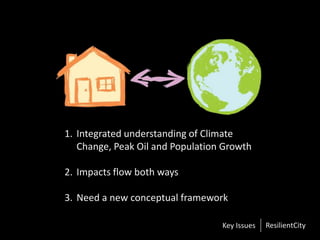
Integrated understanding of Climate Change, Peak Oil and Population GrowthImpacts flow both ways Need a new conceptual frameworkKey Issues
Resilience!Resilience
Resilience:“1. (Of a substance etc.) recoiling; springing back; resuming its original shape after bending, stretching, compression, etc.” 2. (of a person) readily recovering from a shock, depression etc. Source: The Canadian Oxford English Dictionary, page 1227Resilience
Resilience:“Resilience is the capacity of a system to absorb disturbance and reorganize while undergoing change, so as to still remain essentially the same function, structure, identity, and feedbacks.” Source: B. Walker et al, ‘Resilience, Adaptability and Transformability in Social-ecological Systems’, Ecology and Society 9 (2) p. 5Resilience
Resilient to What?Environmental stresses of Climate ChangeTransformation of our economy by Peak OilEconomic and social pressures of population migrationResilience
Achieving Resilience:Principles+StrategiesResilience
Resilient Planning and Design Principles:Carbon neutralityRedundancy of SystemsDiversity of SystemsDurabilityLocal Self-SufficiencyResponsiveness and ConnectednessResilientCity Principles
Resilient City Planning Strategies:Transform CirculationReduce Energy Requirements of Existing FabricRe-localize key functionsIncrease Density / Decrease Height / Mixed UseResilientCity Planning Strategies
Resilient Building Design Strategies:Reduce Energy and Carbon Input Requirements Re-localize Key Processes and MaterialsDesign for Flexibility and Re-use Design for DurabilityDesign for Integration with EnvironmentPlanning and Design
Tools for further developing strategies and good exemplars?
www.ResilientCity.orgResilientCity.org Website
HOME PAGEResilientCity.org Website
ResilientCity.org Goals:1.	Raise Awareness2.	Shift thinking : sustainability >>> resilience3.  Provide Resources  to develop solutions
RESOURCESResilientCity.org Website
ESSENTIAL WEB LINKSResilientCity.org Website
ESSENTIAL BOOKSResilientCity.org Website
ResilientCity BLOGResilientCity.org Website
DESIGN COMPETITIONResilientCity.org Website
Mike Haggerty, Brooklyn, NYScenario 4: Densify an Urban Neighbourhood and Re-localize Food
Scenario 4: Densify an Urban Neighbourhood and Re-localize Food
Robert Shepherd, San Francisco, CAScenario 4: Densify an Urban Neighbourhood and Re-localize Food
Scenario 4: Densify an Urban Neighbourhood and Re-localize Food
Scenario 2: Design a High Density Urban Block
Scenario 1: Reclad an Existing Urban Building
“OK…But what do we do about this when we get back to the office?”
Five Suggestions:Stop thinking only about the impact we are having on the environment; and… Start also thinking about how we will deal with the impacts of environment as it starts to push back!Start looking over the horizon to the time when the economics of Peak Oil will change how our cities function – creating an urgent need for re-localization of food and manufacturing.Start thinking about how our cities will deal with the huge in-migrations of environmental refugees.Take advantage of our ResilientCity.org resources, and please share your ideas with us!
“The dogmas of the quiet past are inadequate to the stormy present. The occasion is piled high with difficulty, and we must rise with the occasion. As our case is new, so we must think anew and act anew.” Abraham Lincoln
For more information about the planning and design of resilient cities:www.ResilientCity.orgResilientCity.org Website
Thank you!Craig ApplegathCOHOS EVAMY integratedesign
Scenario 4: Densify an Urban Neighbourhood and Re-localize Food

Resilient City

Editor's Notes

  • #2 Welcome. If I remember correctly it is coming up to about 8 years ago now that a few of us that were Part of the RAIC’s Sustainable Design Committee and when it came its conclusion we decided to form Sustainable Buildings Canada. So speaking today is a great pleasure. This presentation is an incomplete story – or should I say a story in the making – about how we as architects and urban designers are going to come to terms with Climate Change and Peak Oil in the context of continued and unsustainable global population growth.
  • #3 Before I put up the standard agenda slide, I would like to start my presentation by telling you where the idea for the notion of creating Resilient Cities came from. About 7 years ago, back in 2002 I had been on a speaking tour talking about how to create more environmentally responsible and sustainable healthcare facilities.While I was speaking at the CleanMed Conference in 2002 in Chicago, one of the attendees at my presentation asked me the following question at the end of my presentation:He said “I can buy the idea of trying to plan and design our healthcare facilities to be more energy efficient, and have a lower impact on the environment, but shouldn’t we also be planning for the inevitable future consequences of Global Warming – with its increased number of storms, population migrations, massive agri-failure, water shortages, and economic decline….!”What a shockingly obvious, and over-the-horizon-looking question. More importantly, what an important question! And yet, if I can be so bold, what a politically incorrect question!
  • #4 Typically most sustainable design discussions are about what we as architects, interior designers, and urban designers can do to reduce our carbon foot print, and create more sustainable cities and buildings. Indeed! All of our focus for the past 10 years has been on our impact on the world … on the kinds of effects our profligate use of energy and its massive production of carbon will have on the environment ….as if the environment was “out there” and somehow separate from us.
  • #5 In fact, diminishing our impact on the environment through green building has become a mature industry in the past decade. One has only to think about how much these organization have changed the way the design and building industry thinks to realize that we are now well past the early adopter phase in this industry.