A Systems Approach to
Urban Resilience …
Professor Chris Rogers
University of Birmingham
November 2021
… and Sustainable, Liveable, Adaptable and (Truly) Smart Cities
Resilience Through Innovation
Critical Local Transport and
Utility Infrastructure
What is the Purpose of Cities?
• A place to trade (especially food) … originally
• A place of safety, with a source of clean water … originally
• A large agglomeration of people … and now
... a place to live, work and play
... an amalgam of residential, commercial, retail, industry, leisure, transport,
open spaces, green spaces
... a place of business, busyness and peaceful solitude
... a place for dynamic 24 hour city living
... a place for biodiversity to flourish – trees, birds, bats
… a complex system-of-systems
• Civil engineers support all this by facilitating movement (people, resources, goods, ideas)
… we need infrastructure systems
… designed to be synergistic with all urban systems
The Core Design Criteria for Cities?
We have many aspirations (needs) for cities
 Sustainability – ensuring we meet the needs of people today without
compromising the ability of future generations to meet their own needs
 Resilience – ensuring that our engineering interventions continue to function,
and deliver their benefits, no matter how the future develops
 Liveability – putting people at the centre of our thinking … embracing our
responsibility of looking after people’s health and wellbeing … and for this we
need planetary wellbeing
 Adaptability – making sure that, wherever possible, our systems are able to
respond to contextual change
 Smart – delivering all of the above
The Core Design Criteria for Cities?
We have many aspirations (needs) for cities
 Sustainability – ensuring we meet the needs of people today without
compromising the ability of future generations to meet their own needs
 Resilience – ensuring that our engineering interventions continue to function,
and deliver their benefits, no matter how the future develops
 Liveability – putting people at the centre of our thinking … embracing our
responsibility of looking after people’s health and wellbeing … and for this we
need planetary wellbeing
 Adaptability – making sure that, wherever possible, our systems are able to
respond to contextual change
 Smart – delivering all of the above
… so we minimise climate change
… so we respond to climate change
… this is part of the response
Transformational infrastructure and urban systems for a
changing world
Enabling infrastructure and urban systems to adapt to the challenges of
climate change, changing patterns of use, societal expectations and
emergent technologies
UKCRIC Missions
Infrastructure and urban systems for one planet living
Empowering society to thrive within the capacity of the planet through
responsible consumption, resource efficiency and sustainable growth
Ownership, governance and business models for infrastructure
and urban systems
Coping with greater system interdependencies, changing patterns of use
and new, disruptive technologies whilst at the same time delivering social justice
and affordability
UKCRIC Missions
Infrastructure and urban systems as drivers of equity, inclusion
and social justice
Forging healthy, happy and productive lives for all through urban design,
planning, policy and infrastructure
Enabling Beneficial Change to Happen
• First – Compile a rigorous Evidence Base
• Second – Make the (comprehensive, transparent) Case for Change
• Third – Create the Alternative Business Models needed to implement change
… balance all positive consequences against all negative
consequences
• Fourth – align All Forms of Governance to deliver on the business models
… formal: legislation, regulations, codes & standards, taxation
… informal: attitudes, behaviours, societal norms, practice norms
An ‘Engineering Cities’ Methodology
• Bring together all who need to be part of the conversation
… all relevant disciplines, professions, sectors, communities of interest
• Create the brief by identifying and synthesising the aspirations of all stakeholders
… and national and global priorities
• Diagnose rigorously the problems
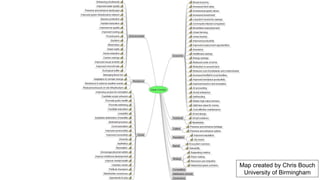
• Map the system of interest in relation to all other urban systems
… and establish the interdependencies and the (unique) context
Map created by Chris Bouch
University of Birmingham
An ‘Engineering Cities’ Methodology
• Bring together all who need to be part of the conversation
… all relevant disciplines, professions, sectors, communities of interest
• Create the brief by identifying and synthesising the aspirations of all stakeholders
… and national and global priorities
• Diagnose rigorously the problems
• Map the system of interest in relation to all other urban systems
… and establish the interdependencies and the (unique) context
• Establish the baseline performance of the system in its context
• Apply ingenuity to solve of the problems, yielding a number of alternative solutions
• Assess the impacts of the intervention using system maps and assessment frameworks
• Conduct futures analysis – are the interventions vulnerable to future contextual change?
An ‘Engineering Cities’ Methodology
Here lies the uncertainty and (political) fear of reaction to the investment decision
• Public reaction – is the intervention justifiable?
• Professional reaction – is the evidence base robust?
• Political reaction – is the decision to approve the intervention defensible?
• Personal reaction – am I confident in making the judgement?
… will the intervention be effective if implemented now?
… will the inconvenience (disruption) be worth it?
… will the intervention be effective in the future?
… will there be any “Ah, what if …?” questions I won’t be able to deal with?
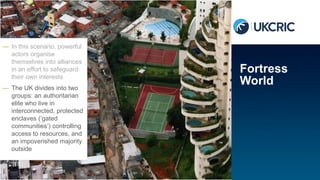
— In this scenario, powerful
actors organise
themselves into alliances
in an effort to safeguard
their own interests
— The UK divides into two
groups: an authoritarian
elite who live in
interconnected, protected
enclaves (‘gated
communities’) controlling
access to resources, and
an impoverished majority
outside
Fortress
World
— In this scenario, current
demographic, economic,
environmental, and technological
trends unfold without major
surprise, with convergence toward
today’s structures
— Competitive, open markets drive
UK development. The self-
correcting logic of the market is
expected to cope with problems as
they arise
— Sustainability issues are addressed
more through rhetoric than action
— Materialism and individualism
spread as core human values,
whereas social and environmental
concerns are secondary
Market
Forces
Photo by lyzadanger, via Flickr
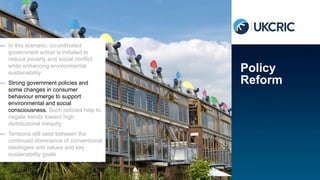
— In this scenario, co-ordinated
government action is initiated to
reduce poverty and social conflict
while enhancing environmental
sustainability
— Strong government policies and
some changes in consumer
behaviour emerge to support
environmental and social
consciousness. Such policies help to
negate trends toward high
distributional inequity.
— Tensions still exist between the
continued dominance of conventional
ideologies and values and key
sustainability goals
Policy
Reform
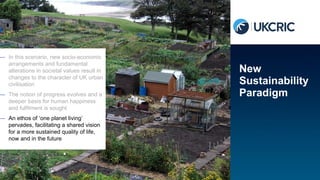
— In this scenario, new socio-economic
arrangements and fundamental
alterations in societal values result in
changes to the character of UK urban
civilisation
— The notion of progress evolves and a
deeper basis for human happiness
and fulfilment is sought
— An ethos of ‘one planet living’
pervades, facilitating a shared vision
for a more sustained quality of life,
now and in the future
New
Sustainability
Paradigm
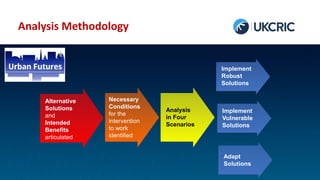
Analysis Methodology
Analysis
in Four
Scenarios
Alternative
Solutions
and
Intended
Benefits
articulated
Necessary
Conditions
for the
intervention
to work
identified
Implement
Robust
Solutions
Implement
Vulnerable
Solutions
Adapt
Solutions
An ‘Engineering Cities’ Methodology
• Develop a suite of alternative ‘business models’
… associated with different design options
… offering different portfolios of outcomes / benefits
• Understand all of the dimensions of governance (formal and informal) relevant to the
intervention and its context
… and recommend changes where necessary so that the business models work
• Influence policy by drawing on research findings
• Influence practice by implementing the tools and case studies
• Engage the public so that they understand the problems and proposed solution
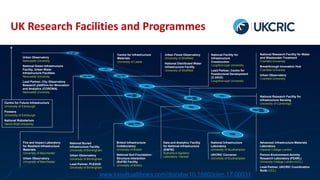
UK Research Facilities and Programmes
National Buried
Infrastructure Facility
University of Birmingham
Urban Observatory
University of Birmingham
Lead Partner, PLEXUS
University of Birmingham
Fire and Impact Laboratory
for Resilient Infrastructure
Materials
University of Manchester
Urban Observatory
University of Manchester
Bristol Infrastructure
Collaboratory
University of Bristol
National Soil-Foundation-
Structure Interaction
(SoFSI) Facility
University of Bristol
Data and Analytics Facility
for National Infrastructure
(DAFNI)
Rutherford Appleton
Laboratory, Harwell
National Infrastructure
Laboratory
University of Southampton
UKCRIC Convenor
University of Southampton
Advanced Infrastructure Materials
Laboratory
Imperial College London
Person-Environment-Activity
Research Laboratory (PEARL)
University College London (UCL)
Lead Partner, UKCRIC Coordination
Node (UCL)
National Research Facility for Water
and Wastewater Treatment
Cranfield University
Breakthrough Innovation Hub
Cranfield University
Urban Observatory
Cranfield University
National Research Facility for
Infrastructure Sensing
University of Cambridge
National Facility for
Infrastructure
Construction
Loughborough University
Lead Partner, Centre for
Postdoctoral Development
(C-DICE)
Loughborough University
Urban Flows Observatory
University of Sheffield
National Distributed Water
Infrastructure Facility
University of Sheffield
Centre for Infrastructure
Materials
University of Leeds
Urban Observatory
Newcastle University
National Green Infrastructure
Facility, Urban Water
Infrastructure Facilities
Newcastle University
Lead Partner, City Observatory
Research platfOrm for iNnovation
and Analytics (CORONA)
Newcastle University
Centre for Future Infrastructure
University of Edinburgh
Flowave
University of Edinburgh
National Robotarium
Heriot-Watt University
www.icevirtuallibrary.com/doi/abs/10.1680/jcien.17.00031

Christopher Rogers

  • 1.
    A Systems Approachto Urban Resilience … Professor Chris Rogers University of Birmingham November 2021
  • 2.
    … and Sustainable,Liveable, Adaptable and (Truly) Smart Cities Resilience Through Innovation Critical Local Transport and Utility Infrastructure
  • 3.
    What is thePurpose of Cities? • A place to trade (especially food) … originally • A place of safety, with a source of clean water … originally • A large agglomeration of people … and now ... a place to live, work and play ... an amalgam of residential, commercial, retail, industry, leisure, transport, open spaces, green spaces ... a place of business, busyness and peaceful solitude ... a place for dynamic 24 hour city living ... a place for biodiversity to flourish – trees, birds, bats … a complex system-of-systems • Civil engineers support all this by facilitating movement (people, resources, goods, ideas) … we need infrastructure systems … designed to be synergistic with all urban systems
  • 4.
    The Core DesignCriteria for Cities? We have many aspirations (needs) for cities  Sustainability – ensuring we meet the needs of people today without compromising the ability of future generations to meet their own needs  Resilience – ensuring that our engineering interventions continue to function, and deliver their benefits, no matter how the future develops  Liveability – putting people at the centre of our thinking … embracing our responsibility of looking after people’s health and wellbeing … and for this we need planetary wellbeing  Adaptability – making sure that, wherever possible, our systems are able to respond to contextual change  Smart – delivering all of the above
  • 5.
    The Core DesignCriteria for Cities? We have many aspirations (needs) for cities  Sustainability – ensuring we meet the needs of people today without compromising the ability of future generations to meet their own needs  Resilience – ensuring that our engineering interventions continue to function, and deliver their benefits, no matter how the future develops  Liveability – putting people at the centre of our thinking … embracing our responsibility of looking after people’s health and wellbeing … and for this we need planetary wellbeing  Adaptability – making sure that, wherever possible, our systems are able to respond to contextual change  Smart – delivering all of the above … so we minimise climate change … so we respond to climate change … this is part of the response
  • 6.
    Transformational infrastructure andurban systems for a changing world Enabling infrastructure and urban systems to adapt to the challenges of climate change, changing patterns of use, societal expectations and emergent technologies UKCRIC Missions Infrastructure and urban systems for one planet living Empowering society to thrive within the capacity of the planet through responsible consumption, resource efficiency and sustainable growth
  • 7.
    Ownership, governance andbusiness models for infrastructure and urban systems Coping with greater system interdependencies, changing patterns of use and new, disruptive technologies whilst at the same time delivering social justice and affordability UKCRIC Missions Infrastructure and urban systems as drivers of equity, inclusion and social justice Forging healthy, happy and productive lives for all through urban design, planning, policy and infrastructure
  • 8.
    Enabling Beneficial Changeto Happen • First – Compile a rigorous Evidence Base • Second – Make the (comprehensive, transparent) Case for Change • Third – Create the Alternative Business Models needed to implement change … balance all positive consequences against all negative consequences • Fourth – align All Forms of Governance to deliver on the business models … formal: legislation, regulations, codes & standards, taxation … informal: attitudes, behaviours, societal norms, practice norms
  • 9.
    An ‘Engineering Cities’Methodology • Bring together all who need to be part of the conversation … all relevant disciplines, professions, sectors, communities of interest • Create the brief by identifying and synthesising the aspirations of all stakeholders … and national and global priorities • Diagnose rigorously the problems • Map the system of interest in relation to all other urban systems … and establish the interdependencies and the (unique) context
  • 10.
    Map created byChris Bouch University of Birmingham
  • 11.
    An ‘Engineering Cities’Methodology • Bring together all who need to be part of the conversation … all relevant disciplines, professions, sectors, communities of interest • Create the brief by identifying and synthesising the aspirations of all stakeholders … and national and global priorities • Diagnose rigorously the problems • Map the system of interest in relation to all other urban systems … and establish the interdependencies and the (unique) context • Establish the baseline performance of the system in its context • Apply ingenuity to solve of the problems, yielding a number of alternative solutions • Assess the impacts of the intervention using system maps and assessment frameworks • Conduct futures analysis – are the interventions vulnerable to future contextual change?
  • 12.
    An ‘Engineering Cities’Methodology Here lies the uncertainty and (political) fear of reaction to the investment decision • Public reaction – is the intervention justifiable? • Professional reaction – is the evidence base robust? • Political reaction – is the decision to approve the intervention defensible? • Personal reaction – am I confident in making the judgement? … will the intervention be effective if implemented now? … will the inconvenience (disruption) be worth it? … will the intervention be effective in the future? … will there be any “Ah, what if …?” questions I won’t be able to deal with?
  • 13.
    — In thisscenario, powerful actors organise themselves into alliances in an effort to safeguard their own interests — The UK divides into two groups: an authoritarian elite who live in interconnected, protected enclaves (‘gated communities’) controlling access to resources, and an impoverished majority outside Fortress World
  • 14.
    — In thisscenario, current demographic, economic, environmental, and technological trends unfold without major surprise, with convergence toward today’s structures — Competitive, open markets drive UK development. The self- correcting logic of the market is expected to cope with problems as they arise — Sustainability issues are addressed more through rhetoric than action — Materialism and individualism spread as core human values, whereas social and environmental concerns are secondary Market Forces Photo by lyzadanger, via Flickr
  • 15.
    — In thisscenario, co-ordinated government action is initiated to reduce poverty and social conflict while enhancing environmental sustainability — Strong government policies and some changes in consumer behaviour emerge to support environmental and social consciousness. Such policies help to negate trends toward high distributional inequity. — Tensions still exist between the continued dominance of conventional ideologies and values and key sustainability goals Policy Reform
  • 16.
    — In thisscenario, new socio-economic arrangements and fundamental alterations in societal values result in changes to the character of UK urban civilisation — The notion of progress evolves and a deeper basis for human happiness and fulfilment is sought — An ethos of ‘one planet living’ pervades, facilitating a shared vision for a more sustained quality of life, now and in the future New Sustainability Paradigm
  • 17.
    Analysis Methodology Analysis in Four Scenarios Alternative Solutions and Intended Benefits articulated Necessary Conditions forthe intervention to work identified Implement Robust Solutions Implement Vulnerable Solutions Adapt Solutions
  • 18.
    An ‘Engineering Cities’Methodology • Develop a suite of alternative ‘business models’ … associated with different design options … offering different portfolios of outcomes / benefits • Understand all of the dimensions of governance (formal and informal) relevant to the intervention and its context … and recommend changes where necessary so that the business models work • Influence policy by drawing on research findings • Influence practice by implementing the tools and case studies • Engage the public so that they understand the problems and proposed solution
  • 20.
    UK Research Facilitiesand Programmes National Buried Infrastructure Facility University of Birmingham Urban Observatory University of Birmingham Lead Partner, PLEXUS University of Birmingham Fire and Impact Laboratory for Resilient Infrastructure Materials University of Manchester Urban Observatory University of Manchester Bristol Infrastructure Collaboratory University of Bristol National Soil-Foundation- Structure Interaction (SoFSI) Facility University of Bristol Data and Analytics Facility for National Infrastructure (DAFNI) Rutherford Appleton Laboratory, Harwell National Infrastructure Laboratory University of Southampton UKCRIC Convenor University of Southampton Advanced Infrastructure Materials Laboratory Imperial College London Person-Environment-Activity Research Laboratory (PEARL) University College London (UCL) Lead Partner, UKCRIC Coordination Node (UCL) National Research Facility for Water and Wastewater Treatment Cranfield University Breakthrough Innovation Hub Cranfield University Urban Observatory Cranfield University National Research Facility for Infrastructure Sensing University of Cambridge National Facility for Infrastructure Construction Loughborough University Lead Partner, Centre for Postdoctoral Development (C-DICE) Loughborough University Urban Flows Observatory University of Sheffield National Distributed Water Infrastructure Facility University of Sheffield Centre for Infrastructure Materials University of Leeds Urban Observatory Newcastle University National Green Infrastructure Facility, Urban Water Infrastructure Facilities Newcastle University Lead Partner, City Observatory Research platfOrm for iNnovation and Analytics (CORONA) Newcastle University Centre for Future Infrastructure University of Edinburgh Flowave University of Edinburgh National Robotarium Heriot-Watt University www.icevirtuallibrary.com/doi/abs/10.1680/jcien.17.00031