URBAN PLANNING
Sustainable development
Halima A Othman , Architect Engineer , Urban Planner , Assistant lecturer, University of Zakho , Petroleum Department
Definition
History
Theory
Aspects
Practice
Impacts
Halima A Othman , Architect Engineer , Urban Planner , Assistant lecturer, University of Zakho , Petroleum Department
By whom ??????
For whom ??????
Where ?????
When ?????
What for ?????
Halima A Othman , Architect Engineer , Urban Planner , Assistant lecturer, University of Zakho , Petroleum Department
Which process ?????
Which scale ??????
How long duration??????
Halima A Othman , Architect Engineer , Urban Planner , Assistant lecturer, University of Zakho , Petroleum Department
Urban Planning:- design and regulation of the uses of space
that focus on the physical form, economic functions, and social
impacts of the urban environment and on the location of
different activities within it.
involving goal setting, data collection and analysis, forecasting,
design, strategic thinking, and public consultation.
Three actors have main role in urban planning
• The decision-makers
• The technicians
• The users
DEFINITION
Halima A Othman , Architect Engineer , Urban Planner , Assistant lecturer, University of Zakho , Petroleum Department
The first recorded description of urban planning
is described in the Epic of Gilgamesh, Designed
cities were characteristic of the Minoan,
Mesopotamian, Harrapan, and Egyptian
civilizations of the third millennium BC.
HISTORY
Halima A Othman , Architect Engineer , Urban Planner , Assistant lecturer, University of Zakho , Petroleum Department
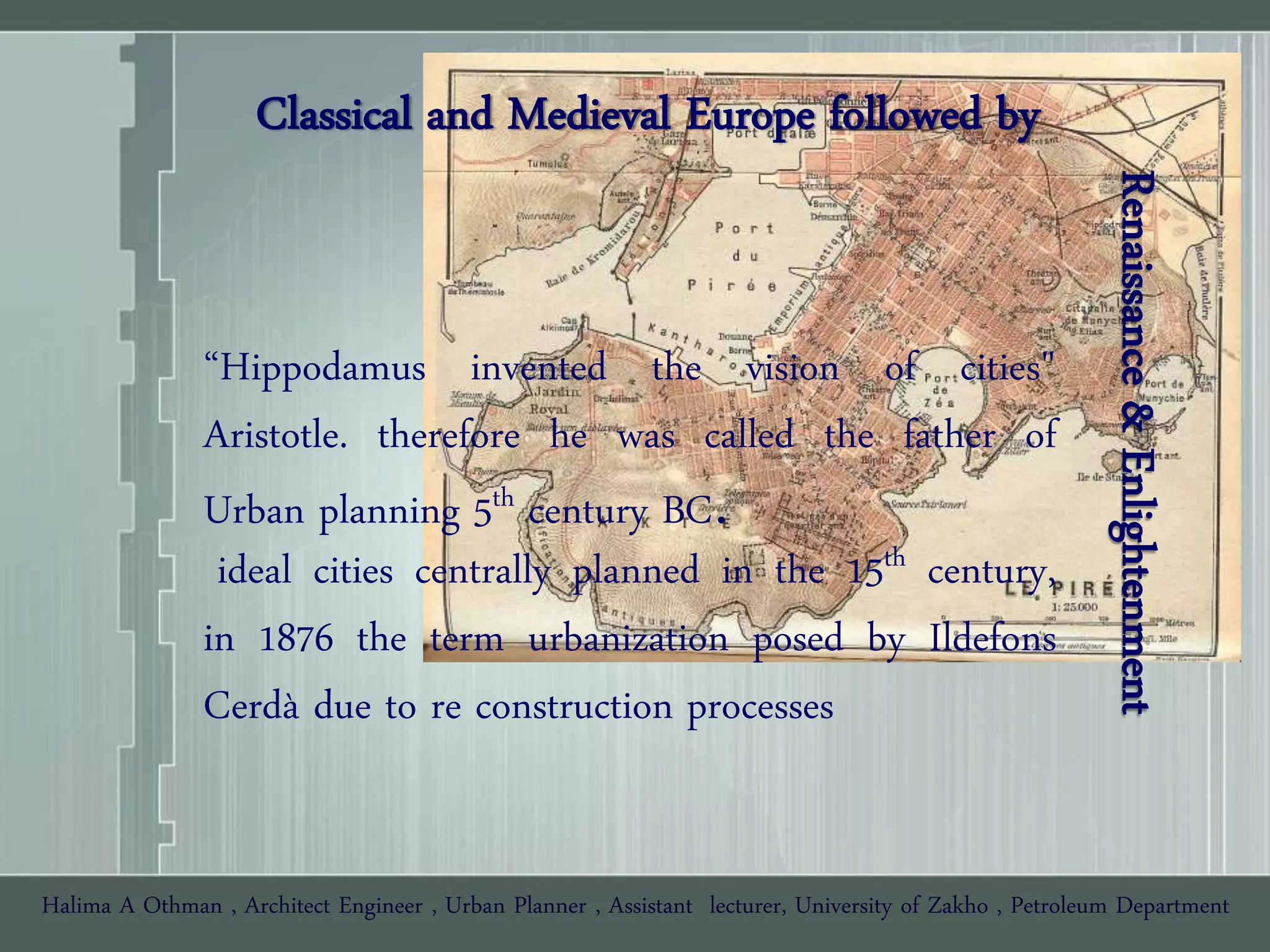
“Hippodamus invented the vision of cities"
Aristotle. therefore he was called the father of
Urban planning 5th century BC.
ideal cities centrally planned in the 15th century,
in 1876 the term urbanization posed by Ildefons
Cerdà due to re construction processes
Classical and Medieval Europe followed by
Renaissance&Enlightenment
Halima A Othman , Architect Engineer , Urban Planner , Assistant lecturer, University of Zakho , Petroleum Department
Planning and architecture went through a paradigm shift at
the turn of the 20th century.
The industrialized cities of the 19th century had grown at a
tremendous rate, with the pace and style of building largely
dictated by private business concerns.
The evils of urban life for the working poor were becoming
increasingly evident as a matter for public concern
Modern urban planning
Halima A Othman , Architect Engineer , Urban Planner , Assistant lecturer, University of Zakho , Petroleum Department
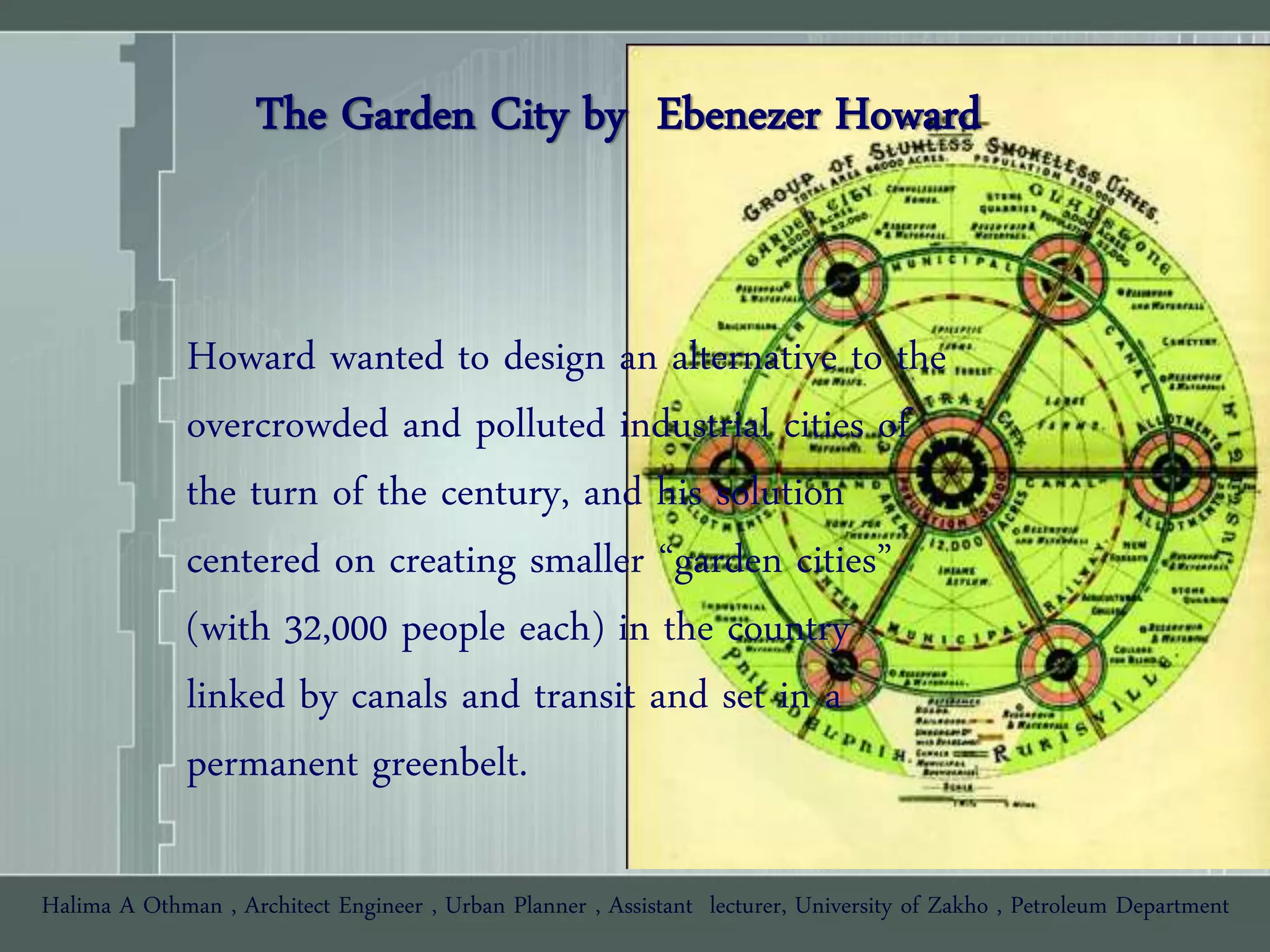
Howard wanted to design an alternative to the
overcrowded and polluted industrial cities of
the turn of the century, and his solution
centered on creating smaller “garden cities”
(with 32,000 people each) in the country
linked by canals and transit and set in a
permanent greenbelt.
The Garden City by Ebenezer Howard
Halima A Othman , Architect Engineer , Urban Planner , Assistant lecturer, University of Zakho , Petroleum Department
Le Corbusier’s envisioned building up, not
out. His plan, also known as “Towers in
the Park,” proposed exactly that: numerous
high-rise buildings each surrounded by
green space.”)
Modernism, Le Corbusier’s Radiant City
Halima A Othman , Architect Engineer , Urban Planner , Assistant lecturer, University of Zakho , Petroleum Department
The Street Grid, By Frank Lloyd Wright
The simple, rational street grid has been a
default choice of planners for industrial
centuries, By Frank Lloyd Wright in 1950s
Halima A Othman , Architect Engineer , Urban Planner , Assistant lecturer, University of Zakho , Petroleum Department
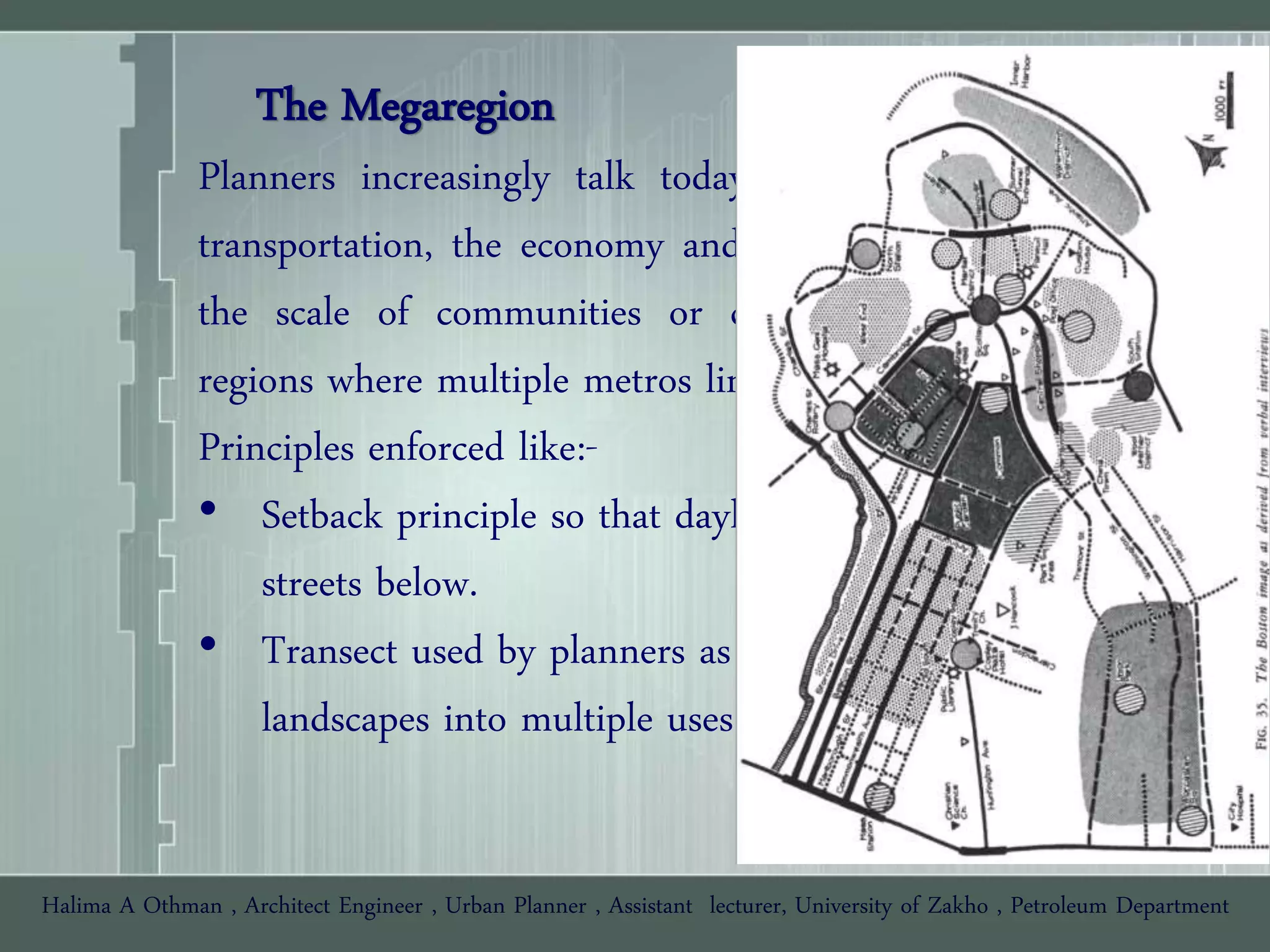
Planners increasingly talk today about issues involving
transportation, the economy and the environment not at
the scale of communities or cities, but within whole
regions where multiple metros link together.
Principles enforced like:-
• Setback principle so that daylight would still reach the
streets below.
• Transect used by planners as a visual tool to divide
landscapes into multiple uses
The Megaregion
Halima A Othman , Architect Engineer , Urban Planner , Assistant lecturer, University of Zakho , Petroleum Department
Reaction , New Urbanism
By the late 1960s and early 1970s, many planners felt that modernism's
clean lines and lack of human scale sapped vitality from the
community, blaming them for high crime rates and social problem.
Various current movements in urban design seek to create sustainable
urban environments with long-lasting structures, buildings and a great
livability for its inhabitants. The most clearly defined form of walkable
urbanism is known as the Charter of New Urbanism. reducing sprawl
and supporting sustainable transport. Mixing instead of separating uses
Creating Sustainable Places of lasting economic, social, cultural, and
environmental value and The public participation
Halima A Othman , Architect Engineer , Urban Planner , Assistant lecturer, University of Zakho , Petroleum Department
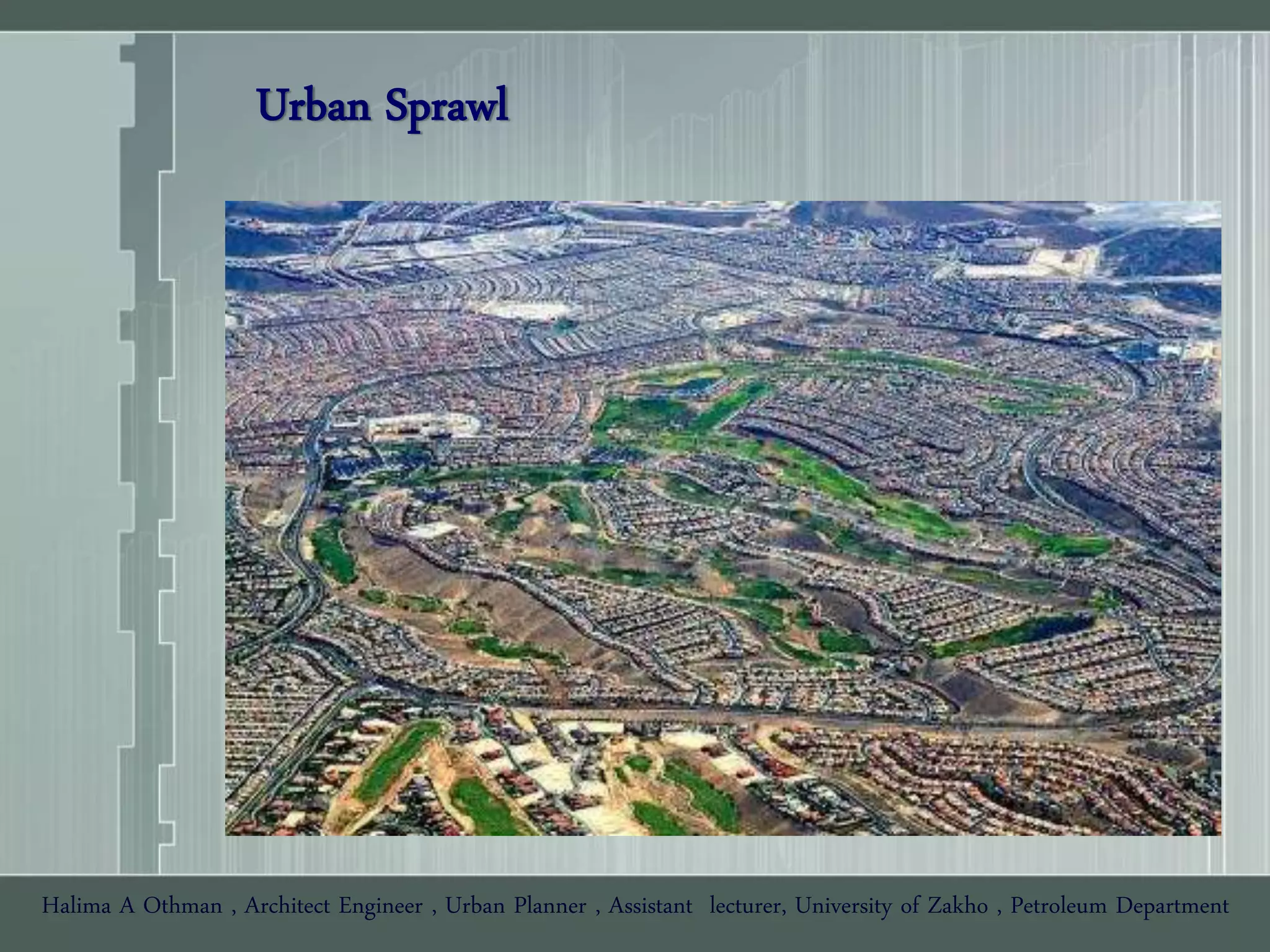
Urban Sprawl
Halima A Othman , Architect Engineer , Urban Planner , Assistant lecturer, University of Zakho , Petroleum Department
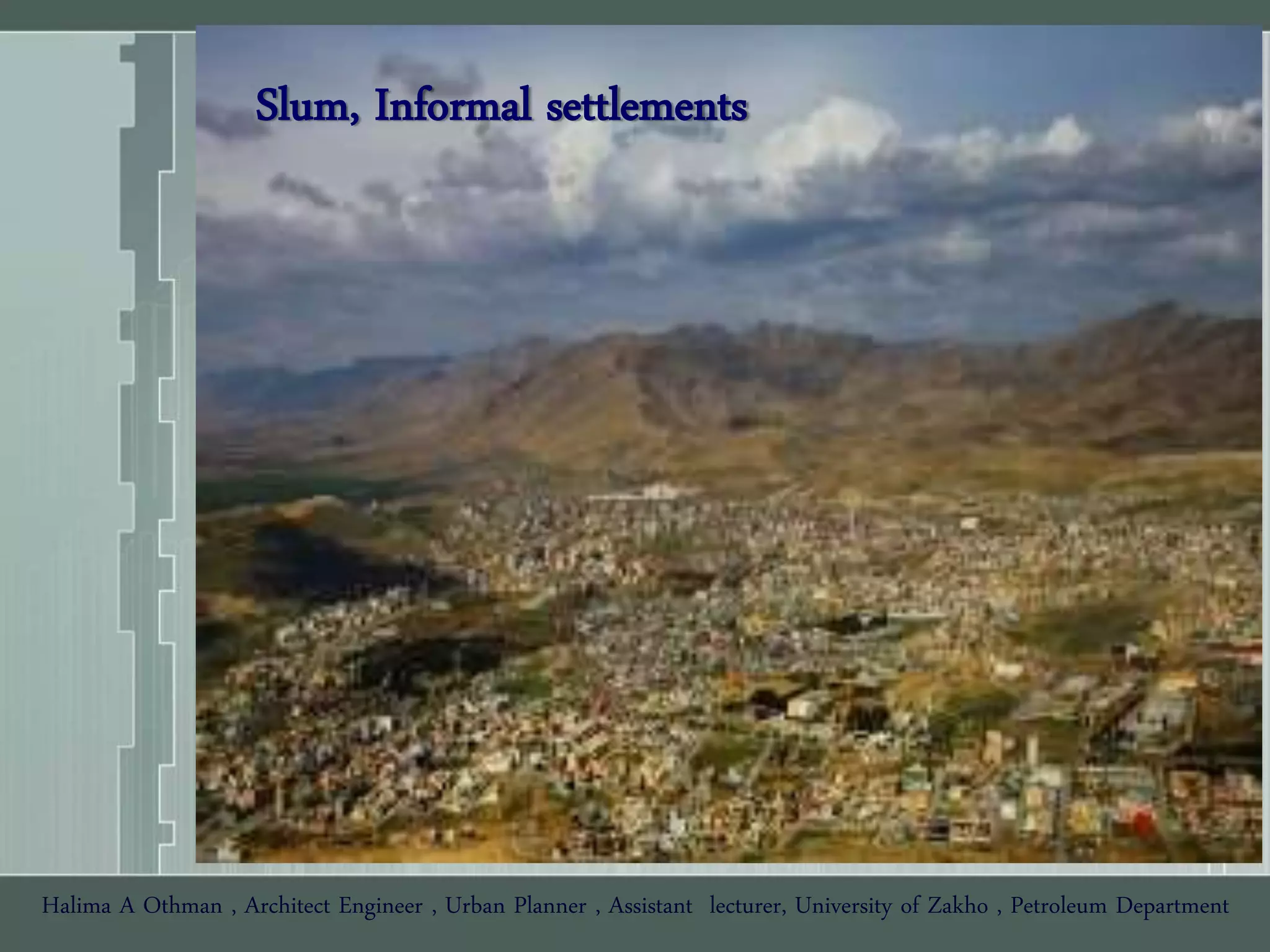
Slum, Informal settlements
Halima A Othman , Architect Engineer , Urban Planner , Assistant lecturer, University of Zakho , Petroleum Department
Climate change , The Hockey Stick
“The idea that there’s a connection between the shape of cities and the patterns of settlement and their
climate impact is so powerful.” by climate scientist Michael Mann
Halima A Othman , Architect Engineer , Urban Planner , Assistant lecturer, University of Zakho , Petroleum Department
Planners argue that modern lifestyles use too many natural
resources, polluting or destroying ecosystems, increasing
social inequality, creating urban heat islands, and causing
climate change. Many urban planners, therefore, advocate
sustainable cities
The term sustainable development came to represent an
ideal outcome in the sum of urban planning goals.
Sustainability refers to “development that meets the needs of
the present without compromising the ability of future
generations to meet their own needs.”
Halima A Othman , Architect Engineer , Urban Planner , Assistant lecturer, University of Zakho , Petroleum Department
SUSTAINABLE DEVELOPMENT
1. Compact
2. Efficient land use and recourses
3. Less automobile use, Better access
4. Less pollution & Less waste
5. Restoration of Ecosystem
6. Good housing and living environments
7. Healthy social ecology
8. Sustainable economy
9. Community participation, Involvement
10. Preservation of local culture & Wisdom
Halima A Othman , Architect Engineer , Urban Planner , Assistant lecturer, University of Zakho , Petroleum Department
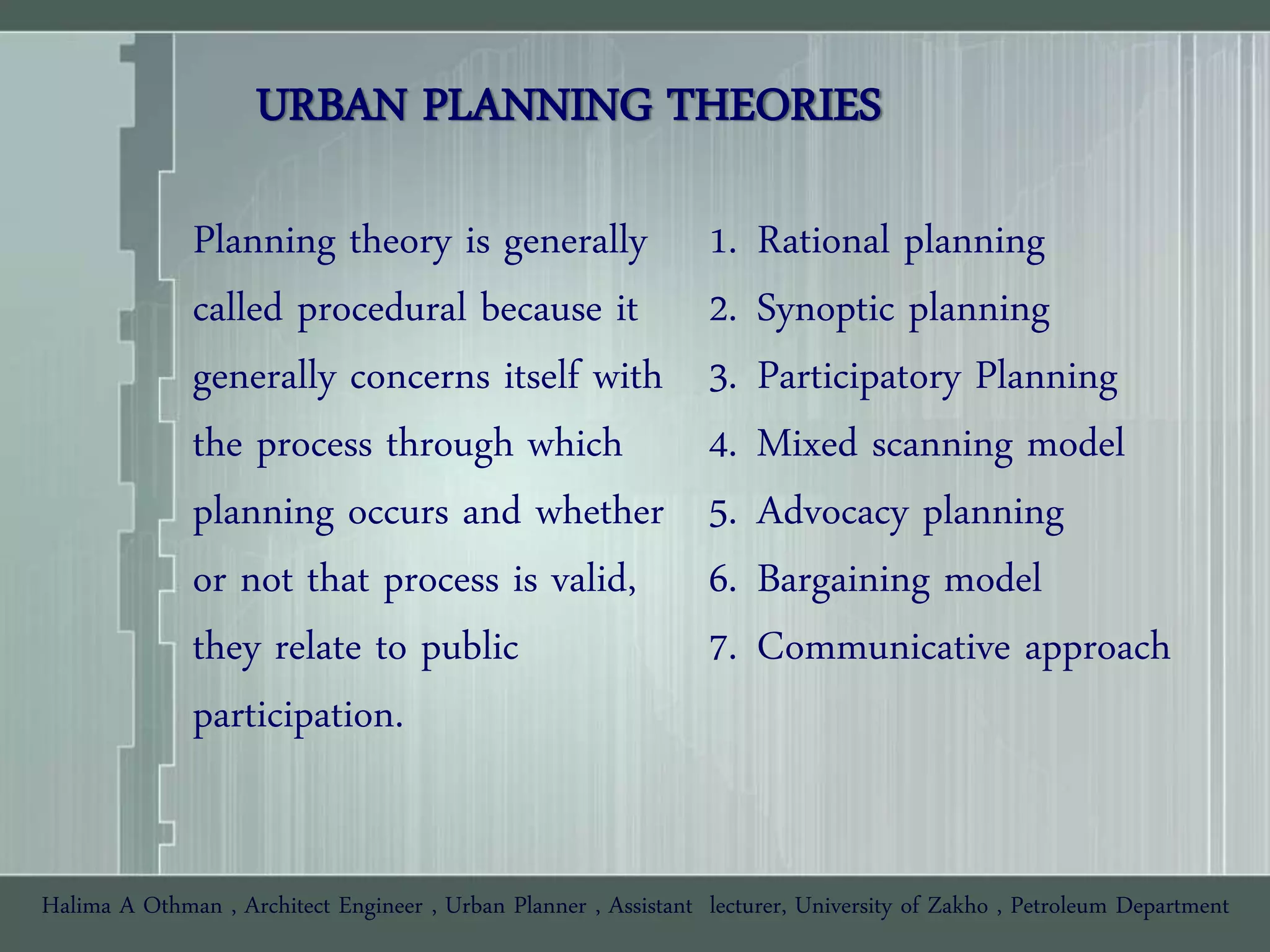
Planning theory is generally
called procedural because it
generally concerns itself with
the process through which
planning occurs and whether
or not that process is valid,
they relate to public
participation.
1. Rational planning
2. Synoptic planning
3. Participatory Planning
4. Mixed scanning model
5. Advocacy planning
6. Bargaining model
7. Communicative approach
URBAN PLANNING THEORIES
Halima A Othman , Architect Engineer , Urban Planner , Assistant lecturer, University of Zakho , Petroleum Department
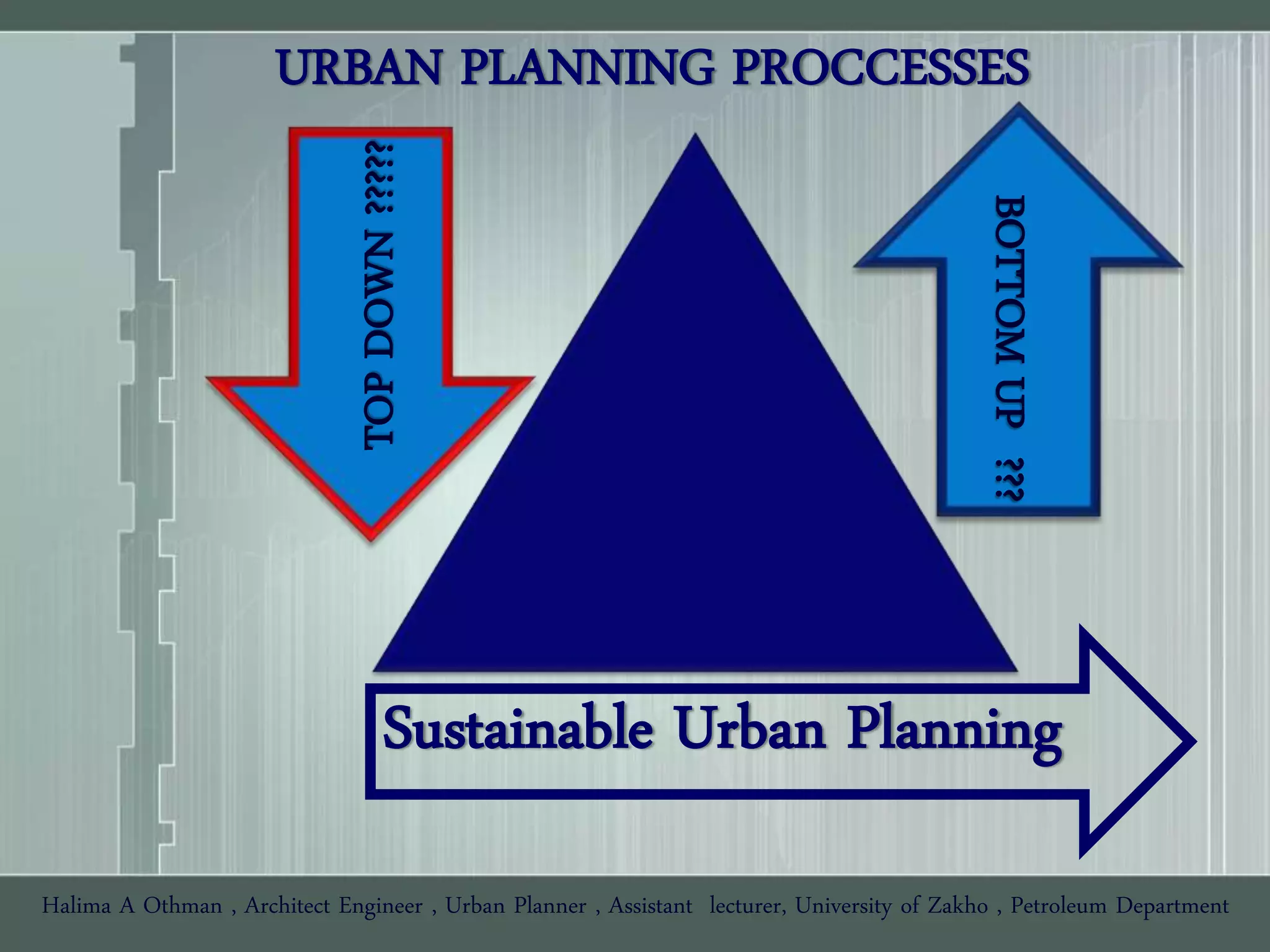
URBAN PLANNING PROCCESSES
BOTTOMUP???
TOPDOWN?????
Sustainable Urban Planning
Halima A Othman , Architect Engineer , Urban Planner , Assistant lecturer, University of Zakho , Petroleum Department
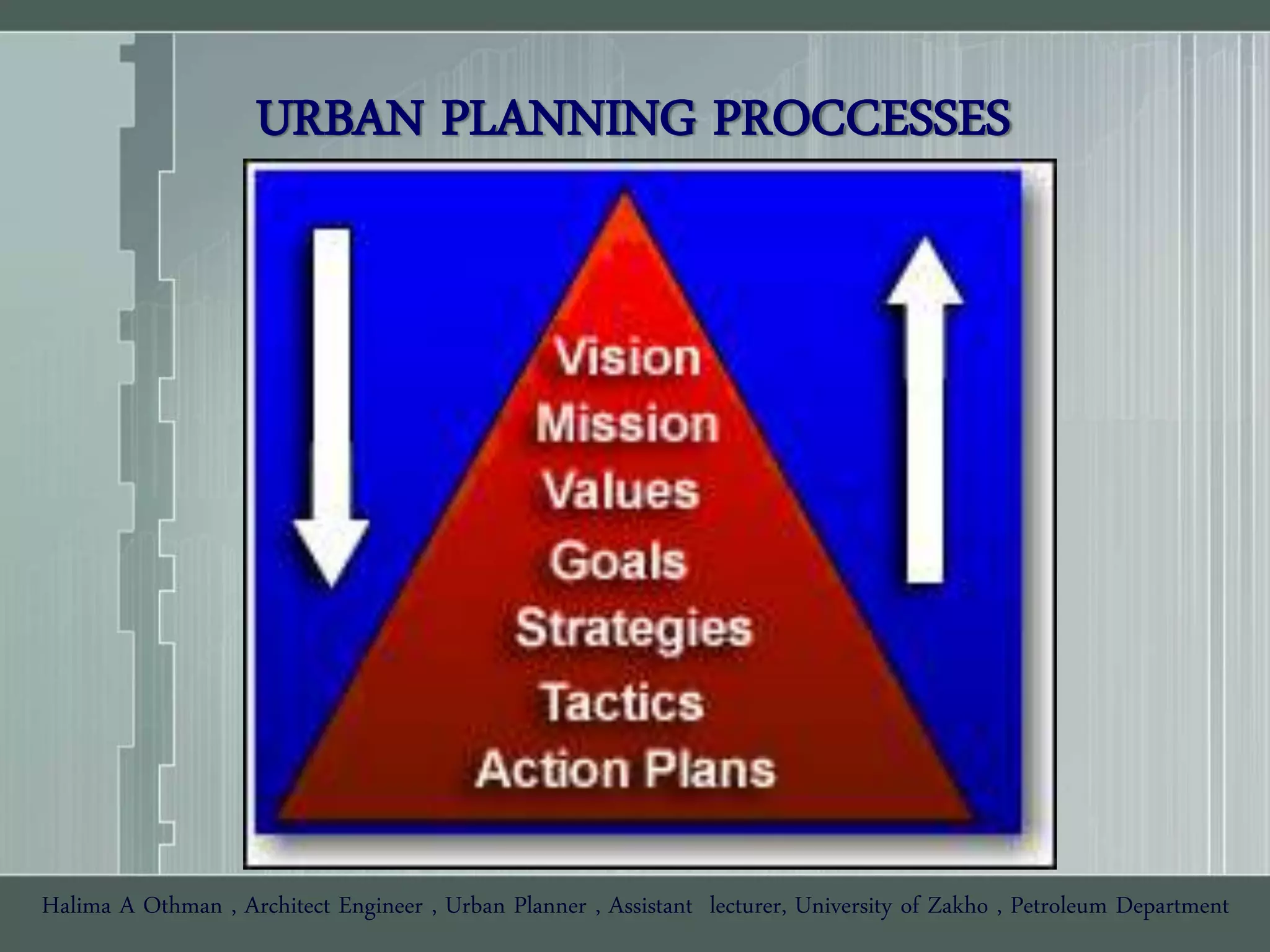
URBAN PLANNING PROCCESSES
Halima A Othman , Architect Engineer , Urban Planner , Assistant lecturer, University of Zakho , Petroleum Department
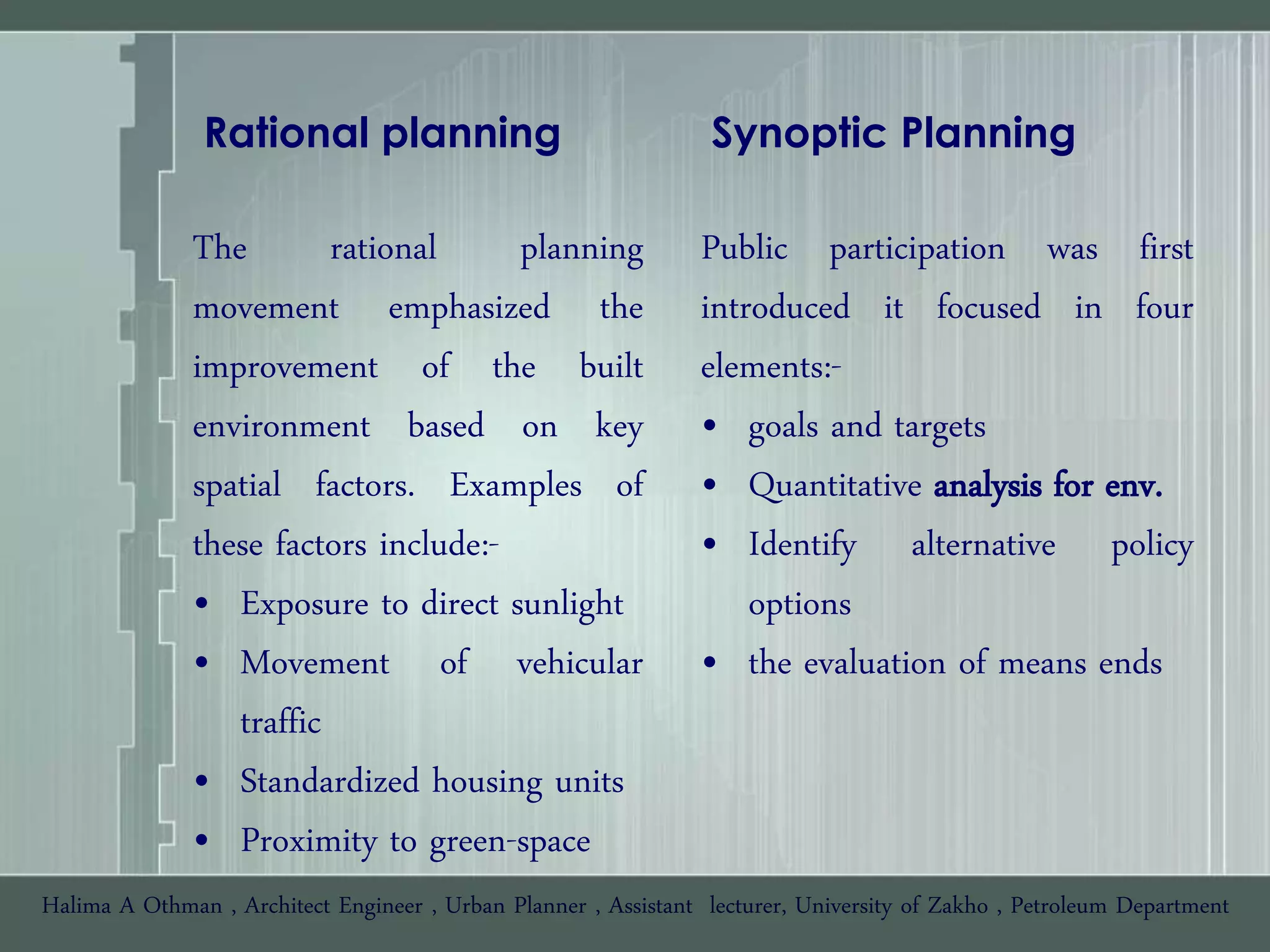
Rational planning
The rational planning
movement emphasized the
improvement of the built
environment based on key
spatial factors. Examples of
these factors include:-
• Exposure to direct sunlight
• Movement of vehicular
traffic
• Standardized housing units
• Proximity to green-space
Public participation was first
introduced it focused in four
elements:-
• goals and targets
• Quantitative analysis for env.
• Identify alternative policy
options
• the evaluation of means ends
Synoptic Planning
Halima A Othman , Architect Engineer , Urban Planner , Assistant lecturer, University of Zakho , Petroleum Department
Advocacy planning
Public participation is a central
tenet of this model. A plurality
of public interests is assumed,
and the role of planner is
essentially the one who either
advocates directly for
underrepresented groups
directly or encourages them to
become part of the process.
The most interesting part
of this theory of planning
is that makes public
participation the central
dynamic in the decision-
making process. Decisions
are made first and foremost
by the public, and the
planner plays a more
minor role.
Bargaining Planning
Halima A Othman , Architect Engineer , Urban Planner , Assistant lecturer, University of Zakho , Petroleum Department
Communicative approach
Participation plays a central role under this model. The model
seeks to include as a broad range of voice to enhance the
debate and negotiation that is supposed to form the core of
actual plan making. In this model, participation is actually
fundamental to the planning process happening. Without the
involvement of concerned interests there is no planning.
• Aesthetics
• Safety and security
• Infrastructure
• Environmental factors
• Green spaces
• Transport
• Slums
• Decay
• Reconstruction and renewal
• New master-planned cities
• Scope of zoning act
URBAN PLANNING ASPECTS
Halima A Othman , Architect Engineer , Urban Planner , Assistant lecturer, University of Zakho , Petroleum Department
Aesthetics
The most beautiful are the result of
dense, long lasting systems of
prohibitions and guidance about
building sizes, uses and features.
These allowed substantial freedoms,
yet enforce styles, safety, and often
materials in practical ways. Many
conventional planning techniques
are being repackaged using the
contemporary term SMART
GROWTH.
Cities have often grown onto coastal and
flood plains at risk of floods and storm
surges. Urban planners must consider
these threats. Extreme weather, flood,
secure emergency evacuation routes and
emergency operations centers. Many cities
will also have planned, built safety
features, such as levees, retaining walls,
and shelters.
Some city planners try to control
criminality with designed structures.
Safety and Security
Halima A Othman , Architect Engineer , Urban Planner , Assistant lecturer, University of Zakho , Petroleum Department
Infrastructure
Mainly represented by access:-
• clean drinking water
• Swage system
• Disposal system
• Electricity
The Smart Growth seeks to:-
• Improve quality
• Reduce the cost
• Reduce the co2
Environmental protection and
conservation are of utmost importance
to many planning systems across the
world. Not only are the specific effects
of development to be mitigated, but
attempts are made to minimize the
overall effect of development on the
local and global environment. This is
commonly done through the assessment
of Sustainable urban infrastructure and
microclimate.
Environmental factors
Halima A Othman , Architect Engineer , Urban Planner , Assistant lecturer, University of Zakho , Petroleum Department
Green spaces
Urban open space is often
appreciated for the recreational
opportunities it provides. Recreation
in urban open space may include
active recreation (such as organized
sports and individual exercise) or
passive recreation, which may
simply entail being in the open
space. Time spent in an urban open
space for recreation offers a reprieve
from the urban environment.
Transport within urbanized areas
presents unique problems. The density
of an urban environment increases
traffic, which can harm businesses and
increase pollution unless properly
managed. Parking space for private
vehicles requires the construction of
large parking garages in high density
areas. This space could often be more
valuable for other development.
Transportation
Halima A Othman , Architect Engineer , Urban Planner , Assistant lecturer, University of Zakho , Petroleum Department
PRACTICE OF URBAN PLANNING
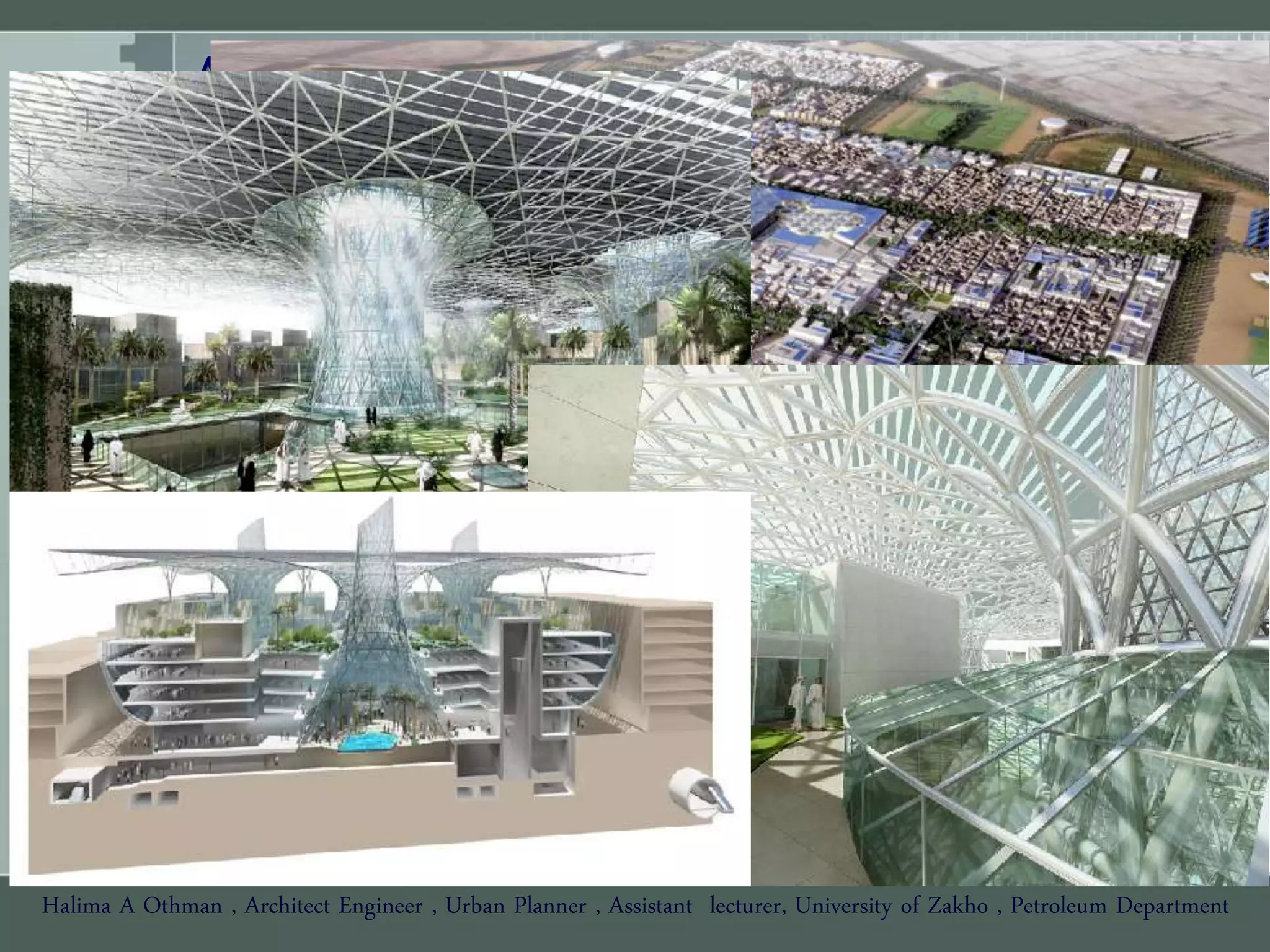
New master-planned cities
In the 21st Century, countries in Asia and the Middle-East have embarked on
plans to build brand new large cities. Masdar City, a new city in UAE, cost $18
billion.
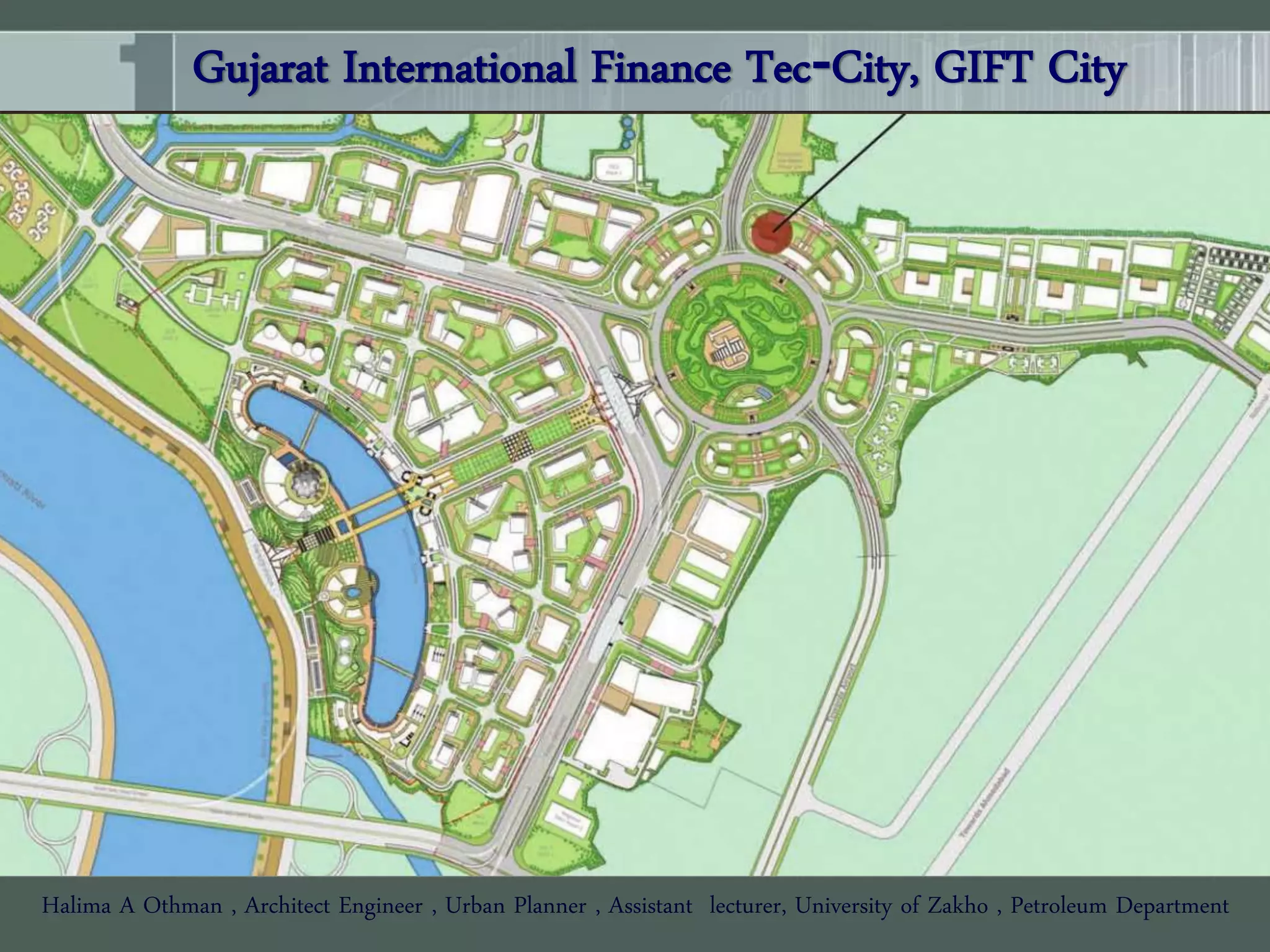
Many of these new cities are built to use new technologies such as District cooling
and automatic waste collection in GIFT City or Personal Rapid Transit in Masdar
City.
Saudi Arabia is building 5 new cities to control congestion and sprawl in existing
cities. While India is building 7 new cities to provide space and facilities that are
missing in existing cities, such as cycling paths, parks and public transport within a
10 minute walk to every office and home
Halima A Othman , Architect Engineer , Urban Planner , Assistant lecturer, University of Zakho , Petroleum Department
AL Masder City
Halima A Othman , Architect Engineer , Urban Planner , Assistant lecturer, University of Zakho , Petroleum Department
Gujarat International Finance Tec‐City, GIFT City
Halima A Othman , Architect Engineer , Urban Planner , Assistant lecturer, University of Zakho , Petroleum Department
• National level
1. Policy making
2. Strategic objectives
• Regional level
1. Land act
2. Regional plans, Transportation
• Municipal level
1. Land development plan
2. Land use plan
3. Master plan
URBAN PLANNING LEVELS
Halima A Othman , Architect Engineer , Urban Planner , Assistant lecturer, University of Zakho , Petroleum Department
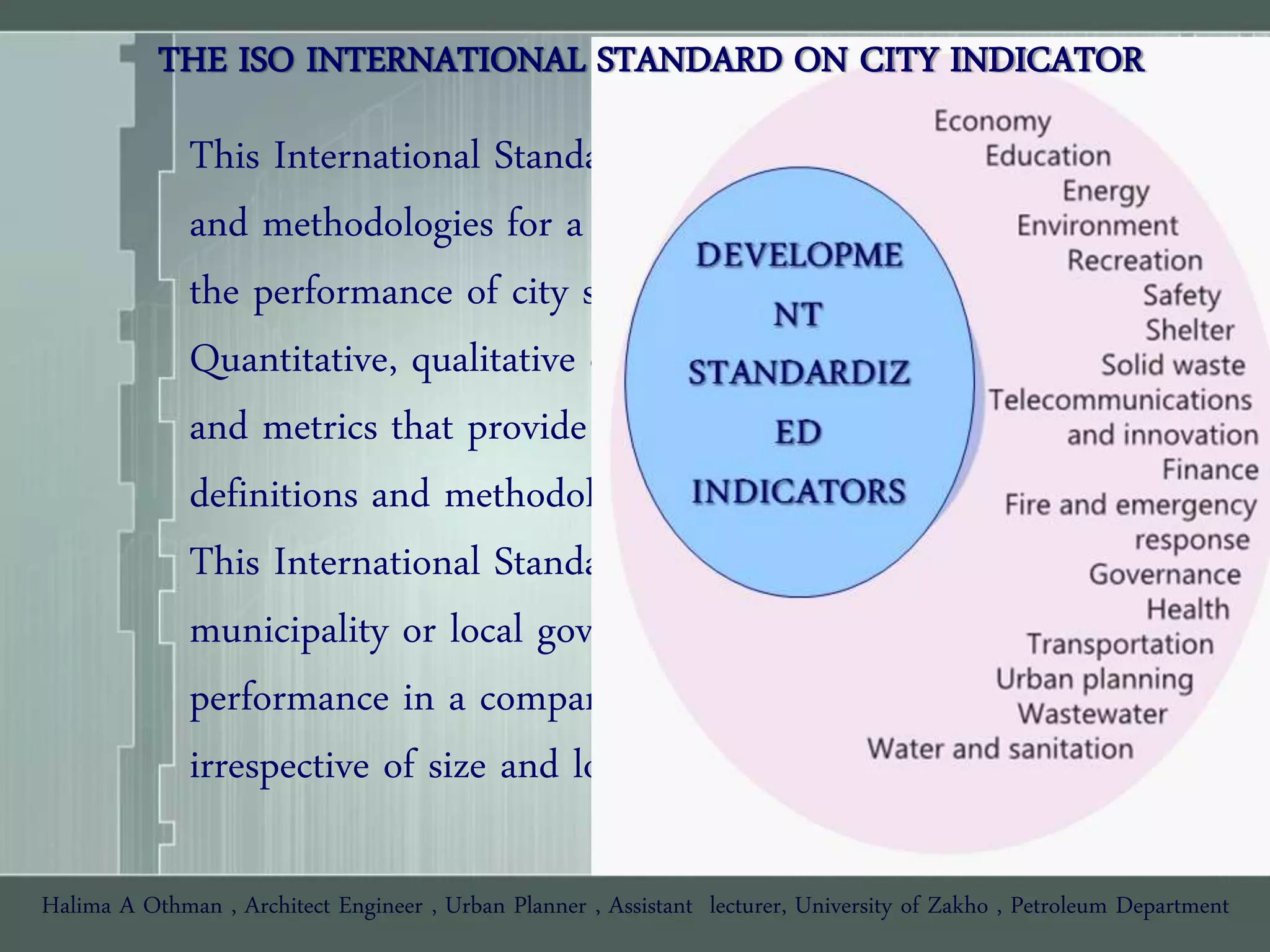
This International Standard defines and establishes definitions
and methodologies for a set of indicators to steer and measure
the performance of city services and quality of life.
Quantitative, qualitative or descriptive sets of measurements
and metrics that provide a globally standardized set of
definitions and methodologies.
This International Standard is applicable to any city,
municipality or local government that undertakes to measure its
performance in a comparable and verifiable manner,
irrespective of size and location or level of development
THE ISO INTERNATIONAL STANDARD ON CITY INDICATOR
Halima A Othman , Architect Engineer , Urban Planner , Assistant lecturer, University of Zakho , Petroleum Department
Person’s happiness needs to be more important than
achieving efficient and convenient smart city. An essential
issue for achieving human centered smart city.
Urban planning Impacts
Dose Smart cities make people happier ?
Halima A Othman , Architect Engineer , Urban Planner , Assistant lecturer, University of Zakho , Petroleum Department
kids who cycled or walked to school, rather than traveling
by car or public transportation, performed measurably
better on tasks demanding concentration, such as solving
puzzles, and that the effects lasted for up to four hours
after they got to school. According to the results of a Danish study
Dose Smart cities make children smarter?
Urban planning Impacts
Halima A Othman , Architect Engineer , Urban Planner , Assistant lecturer, University of Zakho , Petroleum Department
Criminality control, theories say that an urban
environment can influence individuals' obedience to social
rules and level of power.
Dose Smart cities control criminality?
Urban planning Impacts
Halima A Othman , Architect Engineer , Urban Planner , Assistant lecturer, University of Zakho , Petroleum Department
1. HELSINKI — ASPECTS OF URBAN DEVELOPMENT AND PLANNING, Bernhard BUTZIN,
GeoJournal, Vol. 2, No. 1, Urban Development (1978), pp. 11-26
2.
3. Hippodamus and the Planned City, Alfred Burns, Historia: Zeitschrift für Alte Geschichte, Published by:
Franz Steiner Verlag, Article Stable URL: http://www.jstor.org/stable/4435519
4.
5. Traditions and Transitions in Israel Studies: Books on Israel, Volume VI, Laura Zittrain Eisenberg, Neil
Caplan?, Naomi B. Sokoloff?, Mohammed Abu-Nimer
6.
7. AEA11 2013. Envisioning Architecture: Design, Evaluation, Communication, Eugenio Morello, Barbara
E.A. Piga, National-level Planning in Democratic Countries: An International Comparison, R. Alterman?
8. Spatial Development and Spatial Planning in Germany , Federal Office for Building and Regional
Planning Deichmannsaue 31-37 D-53179 Bon.
9. WCCD and ISO 37120 Indicators for city services and quality of life, Professor Patricia McCarney
President & CEO, World Council on City Data Director, Global Cities Institute, University of Toronto
10. urban planning -- Encyclopedia Britannica.htm
11. Planning - Sepro Technologies.htm
12. Resources on Urban Planning and Management.htm
13. Urban planning - Wikipedia, the free encyclopedia.htm
THANK YOU
Halima A Othman , Architect Engineer , Urban Planner , Assistant lecturer, University of Zakho , Petroleum Department

Urban planning presentation 01

  • 1.
    URBAN PLANNING Sustainable development HalimaA Othman , Architect Engineer , Urban Planner , Assistant lecturer, University of Zakho , Petroleum Department
  • 2.
    Definition History Theory Aspects Practice Impacts Halima A Othman, Architect Engineer , Urban Planner , Assistant lecturer, University of Zakho , Petroleum Department
  • 3.
    By whom ?????? Forwhom ?????? Where ????? When ????? What for ????? Halima A Othman , Architect Engineer , Urban Planner , Assistant lecturer, University of Zakho , Petroleum Department
  • 4.
    Which process ????? Whichscale ?????? How long duration?????? Halima A Othman , Architect Engineer , Urban Planner , Assistant lecturer, University of Zakho , Petroleum Department
  • 5.
    Urban Planning:- designand regulation of the uses of space that focus on the physical form, economic functions, and social impacts of the urban environment and on the location of different activities within it. involving goal setting, data collection and analysis, forecasting, design, strategic thinking, and public consultation. Three actors have main role in urban planning • The decision-makers • The technicians • The users DEFINITION Halima A Othman , Architect Engineer , Urban Planner , Assistant lecturer, University of Zakho , Petroleum Department
  • 6.
    The first recordeddescription of urban planning is described in the Epic of Gilgamesh, Designed cities were characteristic of the Minoan, Mesopotamian, Harrapan, and Egyptian civilizations of the third millennium BC. HISTORY Halima A Othman , Architect Engineer , Urban Planner , Assistant lecturer, University of Zakho , Petroleum Department
  • 7.
    “Hippodamus invented thevision of cities" Aristotle. therefore he was called the father of Urban planning 5th century BC. ideal cities centrally planned in the 15th century, in 1876 the term urbanization posed by Ildefons Cerdà due to re construction processes Classical and Medieval Europe followed by Renaissance&Enlightenment Halima A Othman , Architect Engineer , Urban Planner , Assistant lecturer, University of Zakho , Petroleum Department
  • 8.
    Planning and architecturewent through a paradigm shift at the turn of the 20th century. The industrialized cities of the 19th century had grown at a tremendous rate, with the pace and style of building largely dictated by private business concerns. The evils of urban life for the working poor were becoming increasingly evident as a matter for public concern Modern urban planning Halima A Othman , Architect Engineer , Urban Planner , Assistant lecturer, University of Zakho , Petroleum Department
  • 9.
    Howard wanted todesign an alternative to the overcrowded and polluted industrial cities of the turn of the century, and his solution centered on creating smaller “garden cities” (with 32,000 people each) in the country linked by canals and transit and set in a permanent greenbelt. The Garden City by Ebenezer Howard Halima A Othman , Architect Engineer , Urban Planner , Assistant lecturer, University of Zakho , Petroleum Department
  • 10.
    Le Corbusier’s envisionedbuilding up, not out. His plan, also known as “Towers in the Park,” proposed exactly that: numerous high-rise buildings each surrounded by green space.”) Modernism, Le Corbusier’s Radiant City Halima A Othman , Architect Engineer , Urban Planner , Assistant lecturer, University of Zakho , Petroleum Department
  • 11.
    The Street Grid,By Frank Lloyd Wright The simple, rational street grid has been a default choice of planners for industrial centuries, By Frank Lloyd Wright in 1950s Halima A Othman , Architect Engineer , Urban Planner , Assistant lecturer, University of Zakho , Petroleum Department
  • 12.
    Planners increasingly talktoday about issues involving transportation, the economy and the environment not at the scale of communities or cities, but within whole regions where multiple metros link together. Principles enforced like:- • Setback principle so that daylight would still reach the streets below. • Transect used by planners as a visual tool to divide landscapes into multiple uses The Megaregion Halima A Othman , Architect Engineer , Urban Planner , Assistant lecturer, University of Zakho , Petroleum Department
  • 13.
    Reaction , NewUrbanism By the late 1960s and early 1970s, many planners felt that modernism's clean lines and lack of human scale sapped vitality from the community, blaming them for high crime rates and social problem. Various current movements in urban design seek to create sustainable urban environments with long-lasting structures, buildings and a great livability for its inhabitants. The most clearly defined form of walkable urbanism is known as the Charter of New Urbanism. reducing sprawl and supporting sustainable transport. Mixing instead of separating uses Creating Sustainable Places of lasting economic, social, cultural, and environmental value and The public participation Halima A Othman , Architect Engineer , Urban Planner , Assistant lecturer, University of Zakho , Petroleum Department
  • 14.
    Urban Sprawl Halima AOthman , Architect Engineer , Urban Planner , Assistant lecturer, University of Zakho , Petroleum Department
  • 15.
    Slum, Informal settlements HalimaA Othman , Architect Engineer , Urban Planner , Assistant lecturer, University of Zakho , Petroleum Department
  • 16.
    Climate change ,The Hockey Stick “The idea that there’s a connection between the shape of cities and the patterns of settlement and their climate impact is so powerful.” by climate scientist Michael Mann Halima A Othman , Architect Engineer , Urban Planner , Assistant lecturer, University of Zakho , Petroleum Department
  • 17.
    Planners argue thatmodern lifestyles use too many natural resources, polluting or destroying ecosystems, increasing social inequality, creating urban heat islands, and causing climate change. Many urban planners, therefore, advocate sustainable cities The term sustainable development came to represent an ideal outcome in the sum of urban planning goals. Sustainability refers to “development that meets the needs of the present without compromising the ability of future generations to meet their own needs.” Halima A Othman , Architect Engineer , Urban Planner , Assistant lecturer, University of Zakho , Petroleum Department SUSTAINABLE DEVELOPMENT
  • 18.
    1. Compact 2. Efficientland use and recourses 3. Less automobile use, Better access 4. Less pollution & Less waste 5. Restoration of Ecosystem 6. Good housing and living environments 7. Healthy social ecology 8. Sustainable economy 9. Community participation, Involvement 10. Preservation of local culture & Wisdom Halima A Othman , Architect Engineer , Urban Planner , Assistant lecturer, University of Zakho , Petroleum Department
  • 19.
    Planning theory isgenerally called procedural because it generally concerns itself with the process through which planning occurs and whether or not that process is valid, they relate to public participation. 1. Rational planning 2. Synoptic planning 3. Participatory Planning 4. Mixed scanning model 5. Advocacy planning 6. Bargaining model 7. Communicative approach URBAN PLANNING THEORIES Halima A Othman , Architect Engineer , Urban Planner , Assistant lecturer, University of Zakho , Petroleum Department
  • 20.
    URBAN PLANNING PROCCESSES BOTTOMUP??? TOPDOWN????? SustainableUrban Planning Halima A Othman , Architect Engineer , Urban Planner , Assistant lecturer, University of Zakho , Petroleum Department
  • 21.
    URBAN PLANNING PROCCESSES HalimaA Othman , Architect Engineer , Urban Planner , Assistant lecturer, University of Zakho , Petroleum Department
  • 22.
    Rational planning The rationalplanning movement emphasized the improvement of the built environment based on key spatial factors. Examples of these factors include:- • Exposure to direct sunlight • Movement of vehicular traffic • Standardized housing units • Proximity to green-space Public participation was first introduced it focused in four elements:- • goals and targets • Quantitative analysis for env. • Identify alternative policy options • the evaluation of means ends Synoptic Planning Halima A Othman , Architect Engineer , Urban Planner , Assistant lecturer, University of Zakho , Petroleum Department
  • 23.
    Advocacy planning Public participationis a central tenet of this model. A plurality of public interests is assumed, and the role of planner is essentially the one who either advocates directly for underrepresented groups directly or encourages them to become part of the process. The most interesting part of this theory of planning is that makes public participation the central dynamic in the decision- making process. Decisions are made first and foremost by the public, and the planner plays a more minor role. Bargaining Planning Halima A Othman , Architect Engineer , Urban Planner , Assistant lecturer, University of Zakho , Petroleum Department
  • 24.
    Communicative approach Participation playsa central role under this model. The model seeks to include as a broad range of voice to enhance the debate and negotiation that is supposed to form the core of actual plan making. In this model, participation is actually fundamental to the planning process happening. Without the involvement of concerned interests there is no planning.
  • 25.
    • Aesthetics • Safetyand security • Infrastructure • Environmental factors • Green spaces • Transport • Slums • Decay • Reconstruction and renewal • New master-planned cities • Scope of zoning act URBAN PLANNING ASPECTS Halima A Othman , Architect Engineer , Urban Planner , Assistant lecturer, University of Zakho , Petroleum Department
  • 26.
    Aesthetics The most beautifulare the result of dense, long lasting systems of prohibitions and guidance about building sizes, uses and features. These allowed substantial freedoms, yet enforce styles, safety, and often materials in practical ways. Many conventional planning techniques are being repackaged using the contemporary term SMART GROWTH. Cities have often grown onto coastal and flood plains at risk of floods and storm surges. Urban planners must consider these threats. Extreme weather, flood, secure emergency evacuation routes and emergency operations centers. Many cities will also have planned, built safety features, such as levees, retaining walls, and shelters. Some city planners try to control criminality with designed structures. Safety and Security Halima A Othman , Architect Engineer , Urban Planner , Assistant lecturer, University of Zakho , Petroleum Department
  • 27.
    Infrastructure Mainly represented byaccess:- • clean drinking water • Swage system • Disposal system • Electricity The Smart Growth seeks to:- • Improve quality • Reduce the cost • Reduce the co2 Environmental protection and conservation are of utmost importance to many planning systems across the world. Not only are the specific effects of development to be mitigated, but attempts are made to minimize the overall effect of development on the local and global environment. This is commonly done through the assessment of Sustainable urban infrastructure and microclimate. Environmental factors Halima A Othman , Architect Engineer , Urban Planner , Assistant lecturer, University of Zakho , Petroleum Department
  • 28.
    Green spaces Urban openspace is often appreciated for the recreational opportunities it provides. Recreation in urban open space may include active recreation (such as organized sports and individual exercise) or passive recreation, which may simply entail being in the open space. Time spent in an urban open space for recreation offers a reprieve from the urban environment. Transport within urbanized areas presents unique problems. The density of an urban environment increases traffic, which can harm businesses and increase pollution unless properly managed. Parking space for private vehicles requires the construction of large parking garages in high density areas. This space could often be more valuable for other development. Transportation Halima A Othman , Architect Engineer , Urban Planner , Assistant lecturer, University of Zakho , Petroleum Department
  • 29.
    PRACTICE OF URBANPLANNING New master-planned cities In the 21st Century, countries in Asia and the Middle-East have embarked on plans to build brand new large cities. Masdar City, a new city in UAE, cost $18 billion. Many of these new cities are built to use new technologies such as District cooling and automatic waste collection in GIFT City or Personal Rapid Transit in Masdar City. Saudi Arabia is building 5 new cities to control congestion and sprawl in existing cities. While India is building 7 new cities to provide space and facilities that are missing in existing cities, such as cycling paths, parks and public transport within a 10 minute walk to every office and home Halima A Othman , Architect Engineer , Urban Planner , Assistant lecturer, University of Zakho , Petroleum Department
  • 30.
    AL Masder City HalimaA Othman , Architect Engineer , Urban Planner , Assistant lecturer, University of Zakho , Petroleum Department
  • 31.
    Gujarat International FinanceTec‐City, GIFT City Halima A Othman , Architect Engineer , Urban Planner , Assistant lecturer, University of Zakho , Petroleum Department
  • 32.
    • National level 1.Policy making 2. Strategic objectives • Regional level 1. Land act 2. Regional plans, Transportation • Municipal level 1. Land development plan 2. Land use plan 3. Master plan URBAN PLANNING LEVELS Halima A Othman , Architect Engineer , Urban Planner , Assistant lecturer, University of Zakho , Petroleum Department
  • 33.
    This International Standarddefines and establishes definitions and methodologies for a set of indicators to steer and measure the performance of city services and quality of life. Quantitative, qualitative or descriptive sets of measurements and metrics that provide a globally standardized set of definitions and methodologies. This International Standard is applicable to any city, municipality or local government that undertakes to measure its performance in a comparable and verifiable manner, irrespective of size and location or level of development THE ISO INTERNATIONAL STANDARD ON CITY INDICATOR Halima A Othman , Architect Engineer , Urban Planner , Assistant lecturer, University of Zakho , Petroleum Department
  • 34.
    Person’s happiness needsto be more important than achieving efficient and convenient smart city. An essential issue for achieving human centered smart city. Urban planning Impacts Dose Smart cities make people happier ? Halima A Othman , Architect Engineer , Urban Planner , Assistant lecturer, University of Zakho , Petroleum Department
  • 35.
    kids who cycledor walked to school, rather than traveling by car or public transportation, performed measurably better on tasks demanding concentration, such as solving puzzles, and that the effects lasted for up to four hours after they got to school. According to the results of a Danish study Dose Smart cities make children smarter? Urban planning Impacts Halima A Othman , Architect Engineer , Urban Planner , Assistant lecturer, University of Zakho , Petroleum Department
  • 36.
    Criminality control, theoriessay that an urban environment can influence individuals' obedience to social rules and level of power. Dose Smart cities control criminality? Urban planning Impacts Halima A Othman , Architect Engineer , Urban Planner , Assistant lecturer, University of Zakho , Petroleum Department
  • 37.
    1. HELSINKI —ASPECTS OF URBAN DEVELOPMENT AND PLANNING, Bernhard BUTZIN, GeoJournal, Vol. 2, No. 1, Urban Development (1978), pp. 11-26 2. 3. Hippodamus and the Planned City, Alfred Burns, Historia: Zeitschrift für Alte Geschichte, Published by: Franz Steiner Verlag, Article Stable URL: http://www.jstor.org/stable/4435519 4. 5. Traditions and Transitions in Israel Studies: Books on Israel, Volume VI, Laura Zittrain Eisenberg, Neil Caplan?, Naomi B. Sokoloff?, Mohammed Abu-Nimer 6. 7. AEA11 2013. Envisioning Architecture: Design, Evaluation, Communication, Eugenio Morello, Barbara E.A. Piga, National-level Planning in Democratic Countries: An International Comparison, R. Alterman? 8. Spatial Development and Spatial Planning in Germany , Federal Office for Building and Regional Planning Deichmannsaue 31-37 D-53179 Bon. 9. WCCD and ISO 37120 Indicators for city services and quality of life, Professor Patricia McCarney President & CEO, World Council on City Data Director, Global Cities Institute, University of Toronto 10. urban planning -- Encyclopedia Britannica.htm 11. Planning - Sepro Technologies.htm 12. Resources on Urban Planning and Management.htm 13. Urban planning - Wikipedia, the free encyclopedia.htm
  • 38.
    THANK YOU Halima AOthman , Architect Engineer , Urban Planner , Assistant lecturer, University of Zakho , Petroleum Department