
INternational
D i s a s t e r
R e s i l i e n t
Architecture
A holistic approach towards
International Disaster Resilient Architecture
by learning from vernacular construction
Soichiro Yasukawa
Programme Specialist of DRR UNESCO
Natural hazards
International DRR policy
Non-engineered construction
Vernacular architecture
Contemporary vernacular
Policy opportunities
Challenges – needs
INDRA
INternational
D i s a s t e r
R e s i l i e n t
Architecture
Natural hazards
International DRR policy
Non-engineered
construction
Vernacular architecture
Contemporary vernacular
Policy opportunities
Challenges – needs
INDRA
INDRA
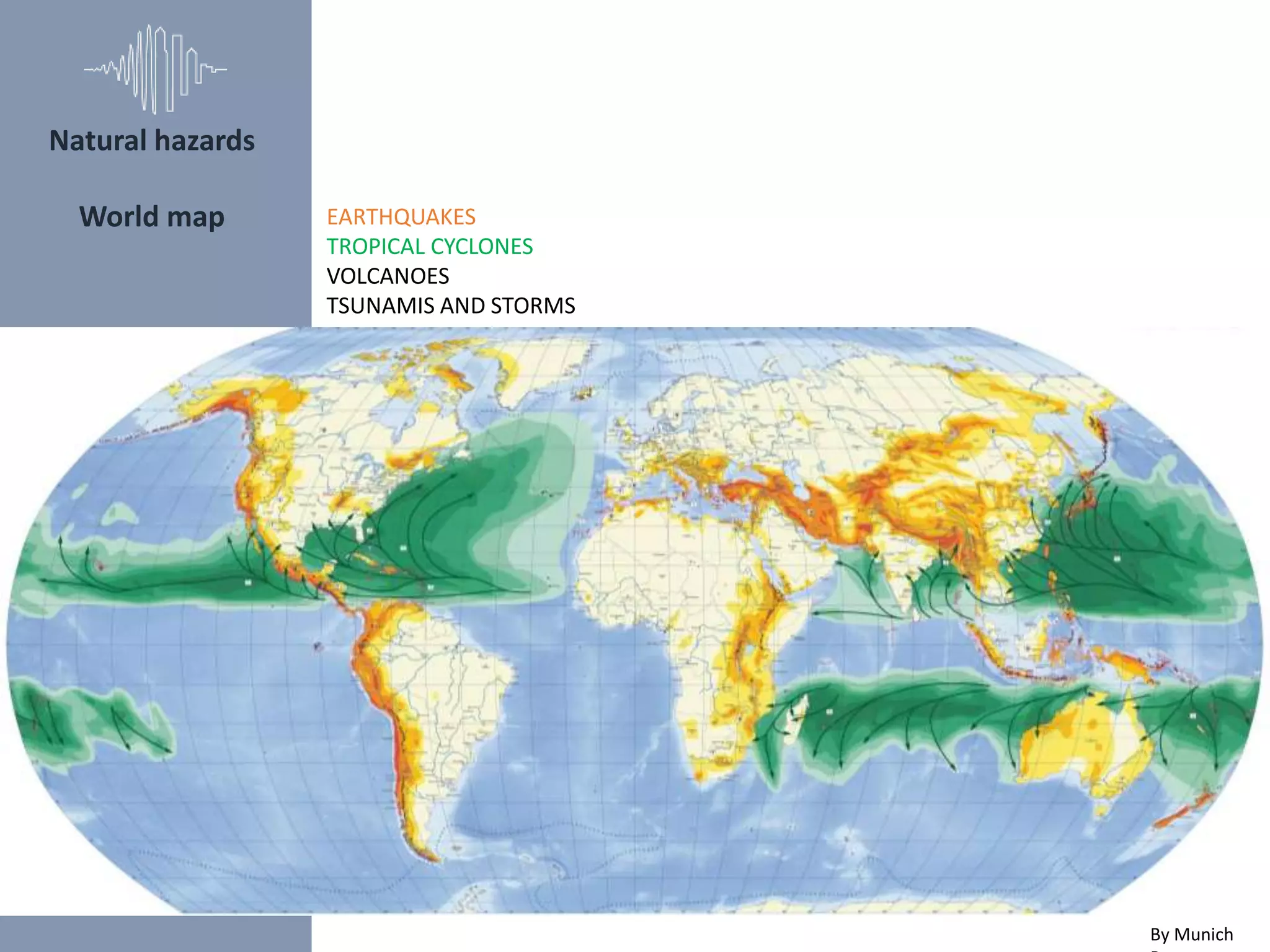
Natural hazards
World map
By Munich
EARTHQUAKES
TROPICAL CYCLONES
VOLCANOES
TSUNAMIS AND STORMS
Natural hazards
Numbers
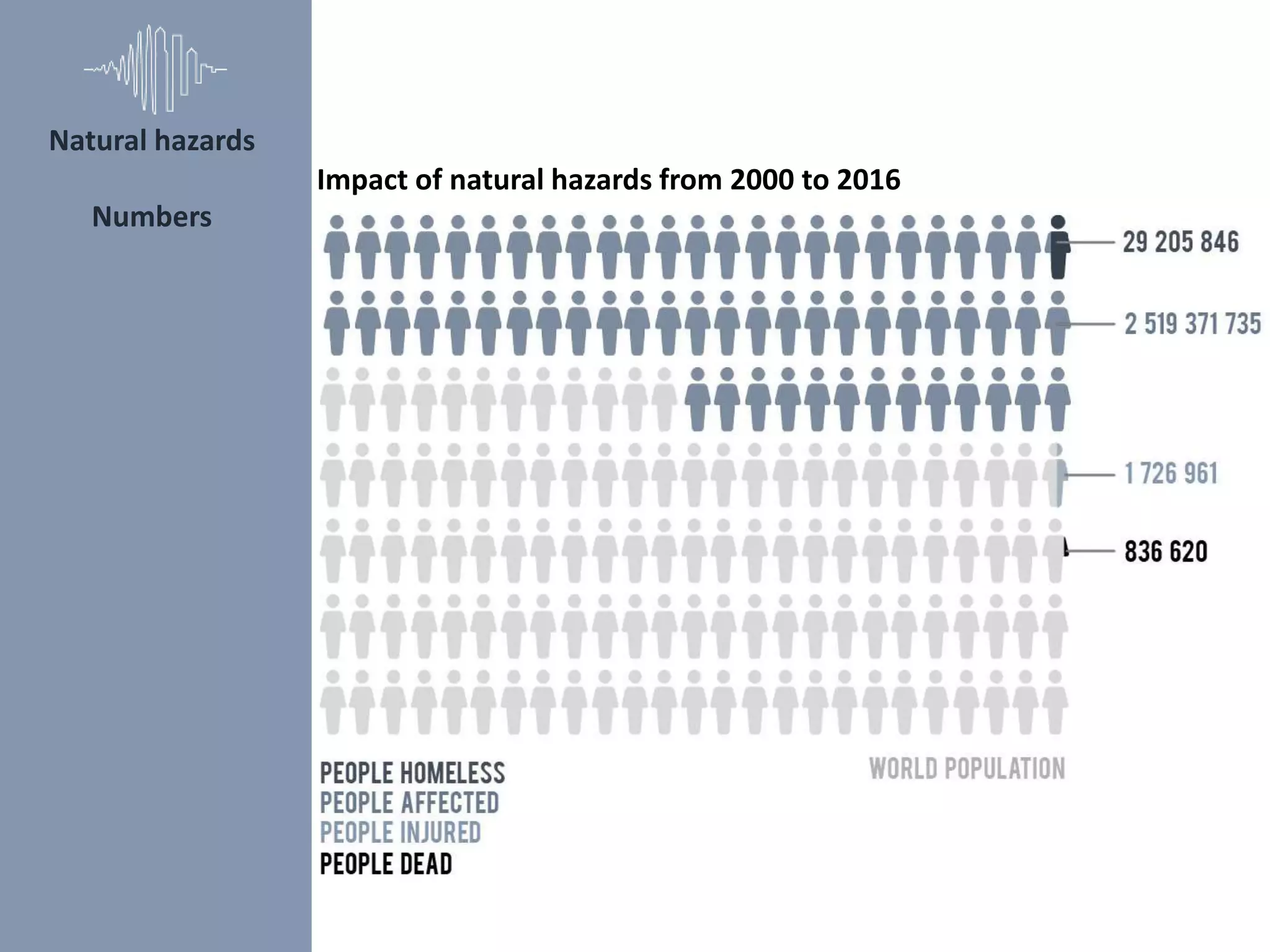
Impact of natural hazards from 2000 to 2016
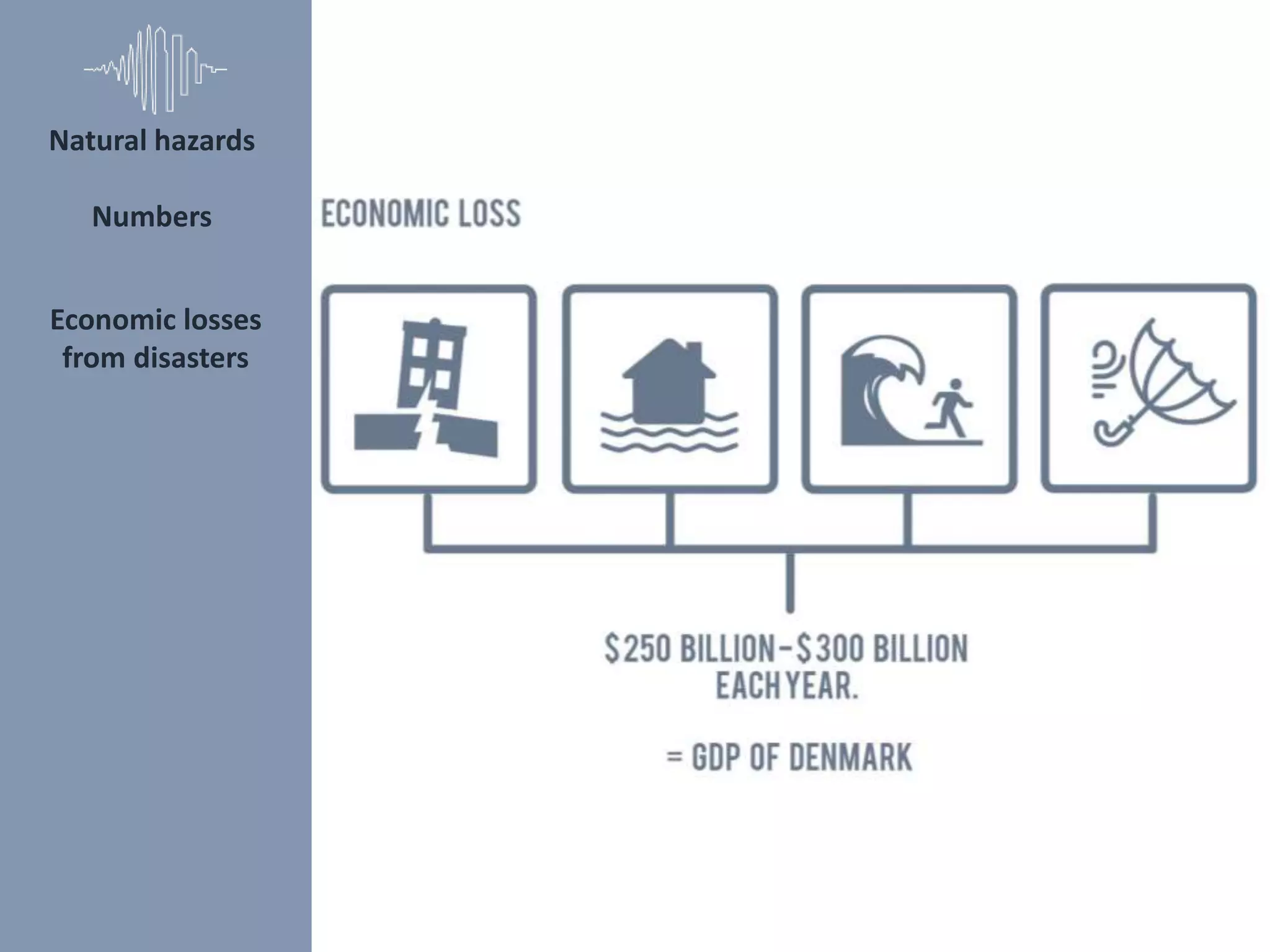
Economic losses
from disasters
Natural hazards
Numbers
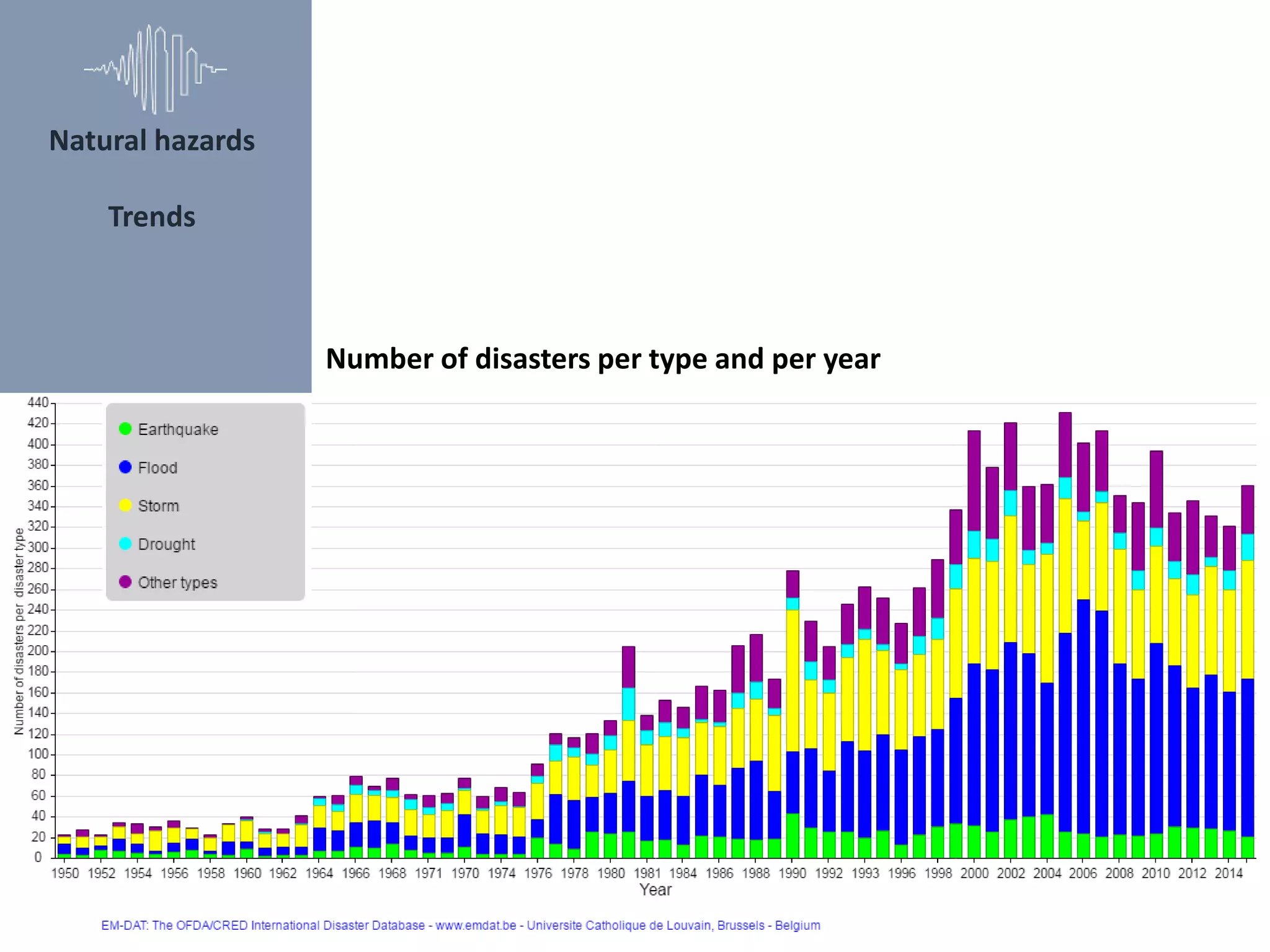
Number of disasters per type and per year
Natural hazards
Trends
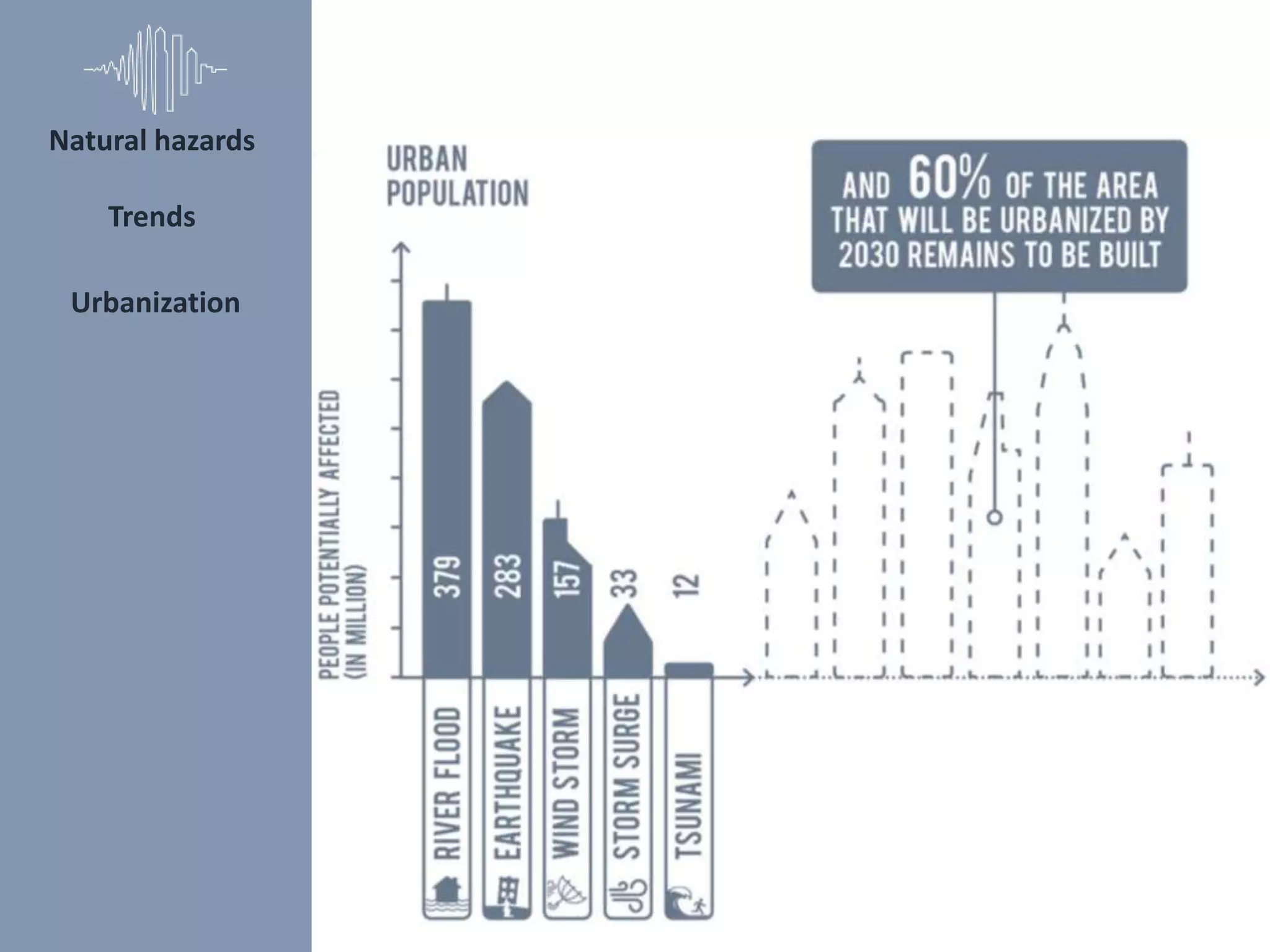
Urbanization
Natural hazards
Trends
Most affected
people
Natural hazards
Trends
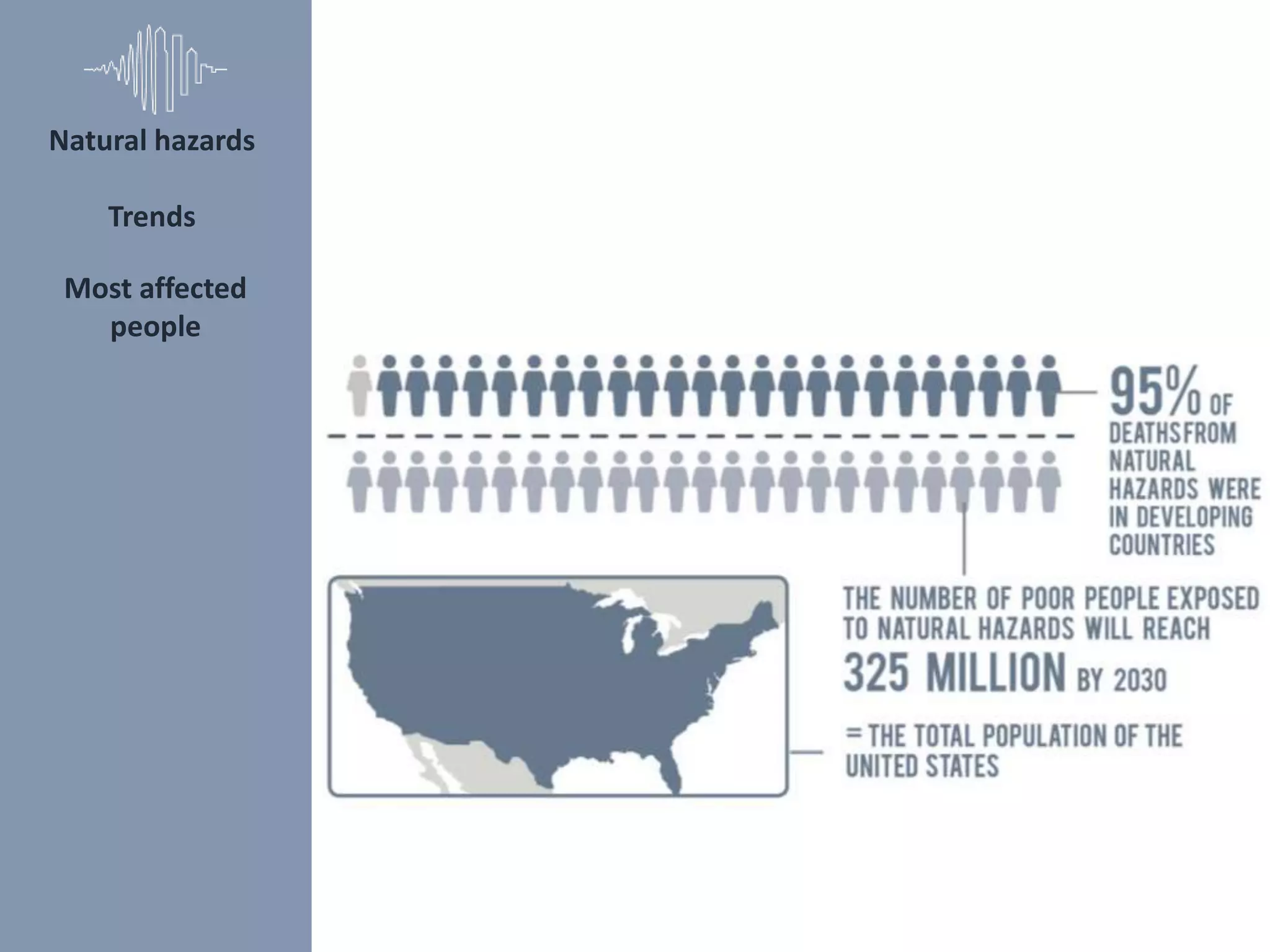
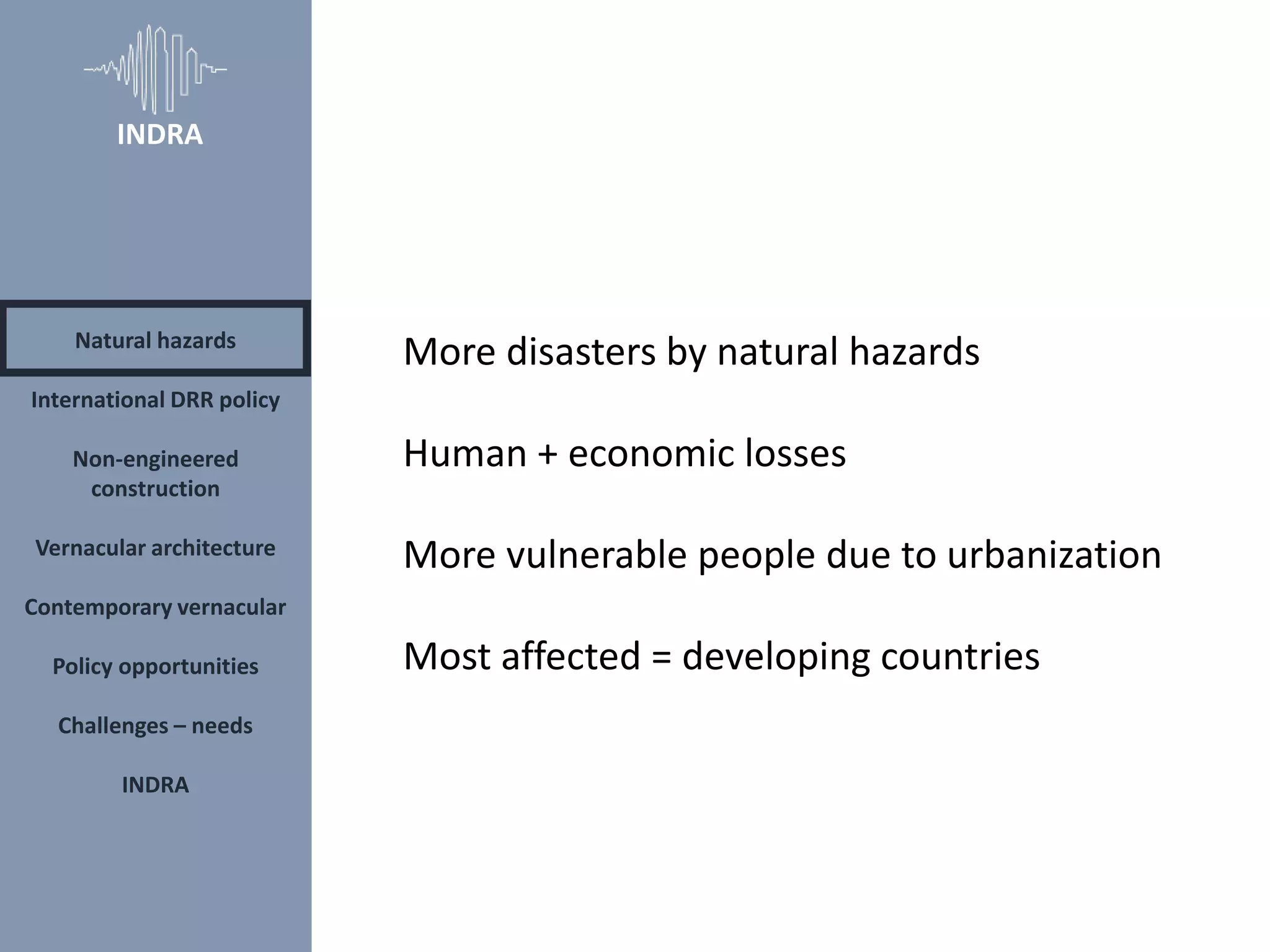
More disasters by natural hazards
Human + economic losses
More vulnerable people due to urbanization
Most affected = developing countries
Natural hazards
International DRR policy
Non-engineered
construction
Vernacular architecture
Contemporary vernacular
Policy opportunities
Challenges – needs
INDRA
INDRA
Natural hazards
International DRR policy
Non-engineered
construction
Vernacular architecture
Contemporary vernacular
Policy opportunities
Challenges – needs
INDRA
INDRA
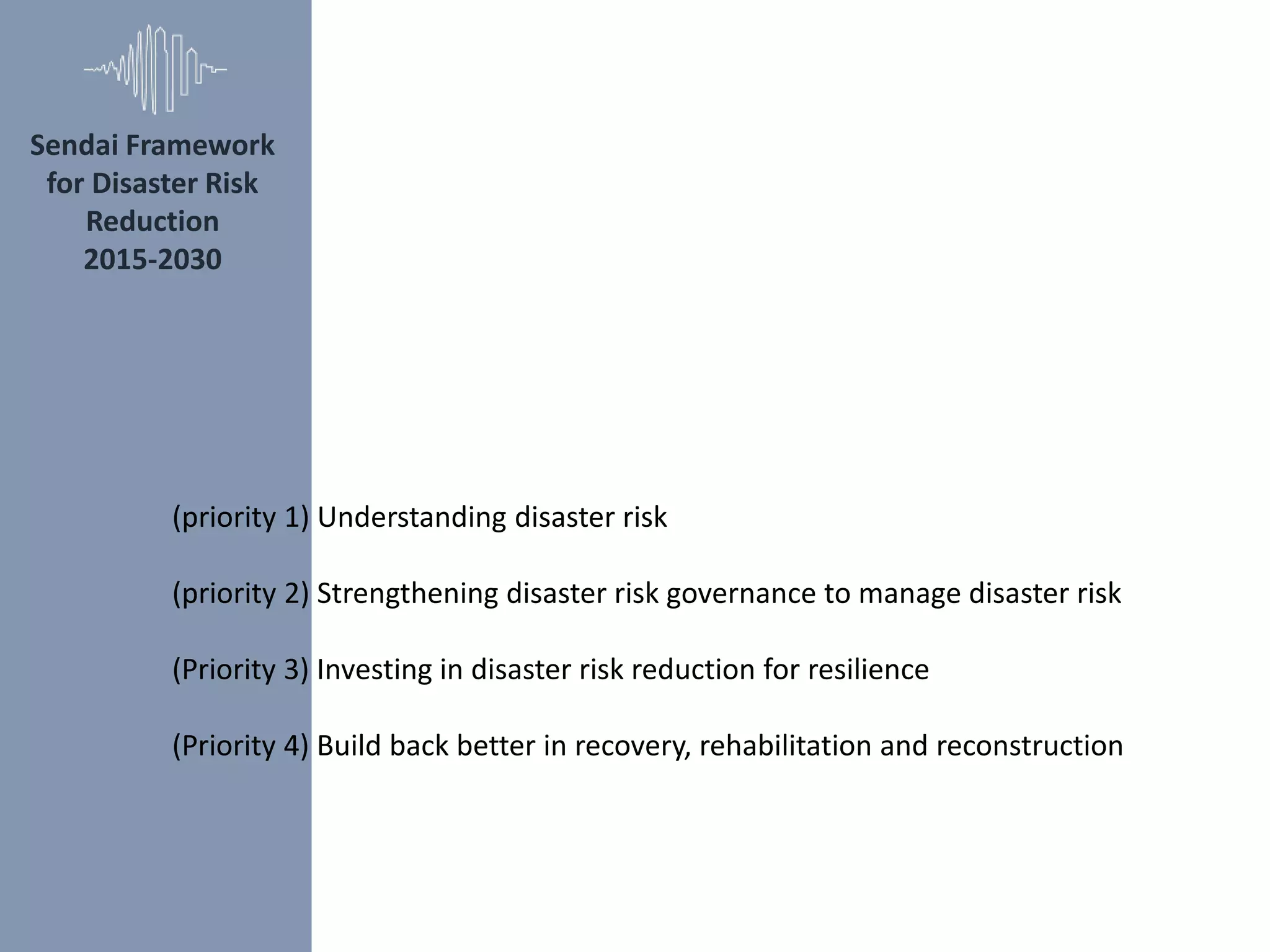
Sendai Framework
for Disaster Risk
Reduction
2015‐2030
(priority 1) Understanding disaster risk
(priority 2) Strengthening disaster risk governance to manage disaster risk
(Priority 3) Investing in disaster risk reduction for resilience
(Priority 4) Build back better in recovery, rehabilitation and reconstruction
11.1 Ensure access for all to adequate, safe and affordable housing and basic
services and upgrade slums
11.3 enhance inclusive and sustainable urbanization and capacity for participatory,
integrated and sustainable human settlement planning and management in all
countries
11.4 strengthening efforts to protect and safeguard the world’s cultural and
natural heritage
11.5 significantly reduce the number of deaths and the number of people affected
and substantially decrease the direct economic losses relative to global gross
domestic product caused by disasters, including water-related disasters, with a
focus on protecting the poor and people in vulnerable situations
11.b substantially increase the number of cities and human settlements adopting
and implementing integrated policies and plans towards inclusion, resource
efficiency, mitigation and adaptation to climate change, resilience to disasters, and
develop and implement, in line with the Sendai Framework for Disaster Risk
Reduction 2015-2030, holistic disaster risk management at all levels
11.c Support least developed countries, including through financial and technical
assistance, in building sustainable and resilient buildings utilizing local materials
17.6 Enhance North-South, South-South and triangular regional and international
cooperation on and access to science, technology and innovation and enhance
knowledge sharing on mutually agreed terms, including through improved
coordination among existing mechanisms, in particular at the United Nations
level, and through a global technology facilitation mechanism
17.8 Fully operationalize the technology bank and science, technology and
innovation capacity-building mechanism for least developed countries by 2017
and enhance the use of enabling technology, in particular information and
communications technology
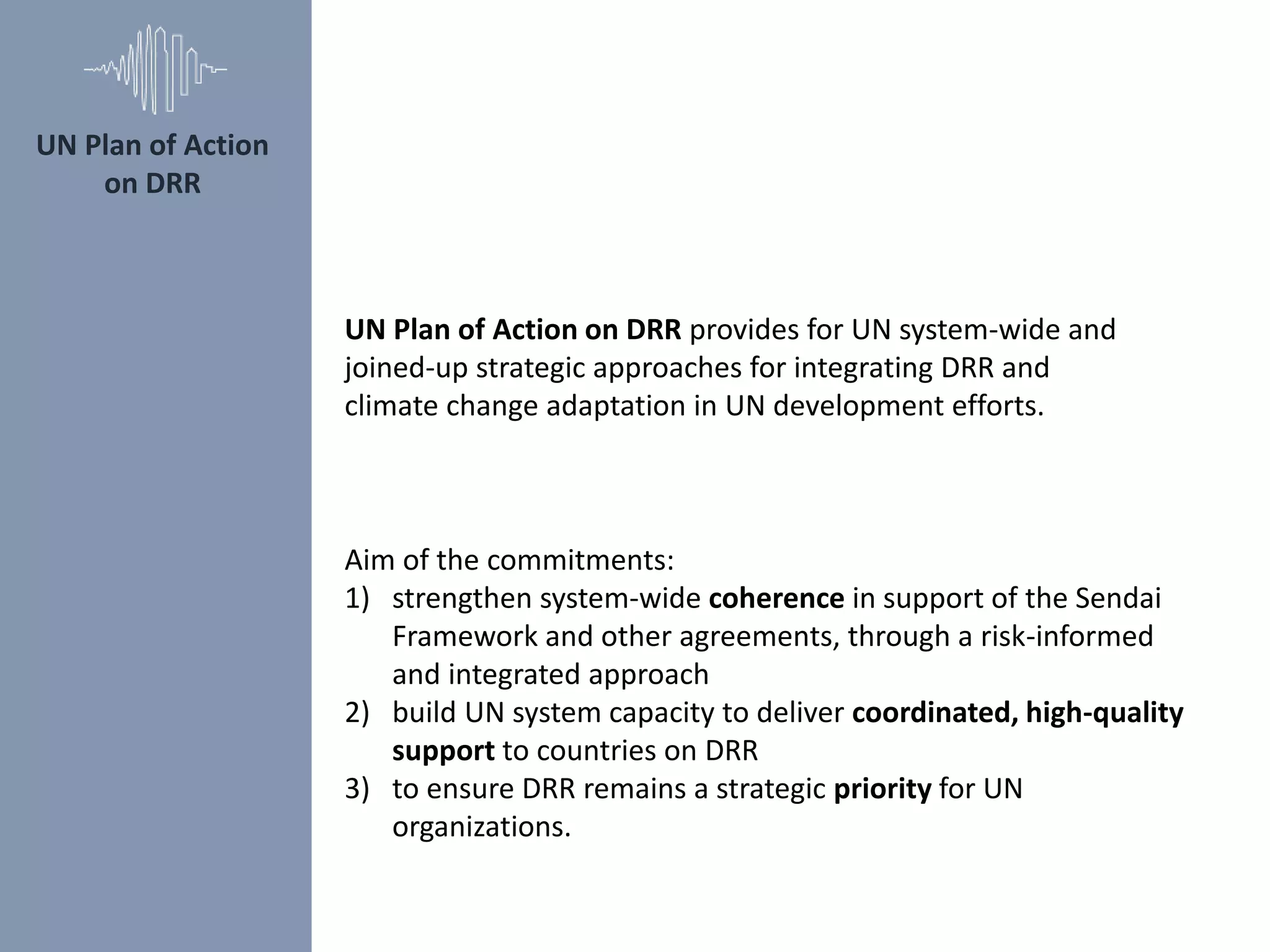
2030 Agenda for Sustainable Development
UN Plan of Action on DRR provides for UN system-wide and
joined-up strategic approaches for integrating DRR and
climate change adaptation in UN development efforts.
Aim of the commitments:
1) strengthen system-wide coherence in support of the Sendai
Framework and other agreements, through a risk-informed
and integrated approach
2) build UN system capacity to deliver coordinated, high-quality
support to countries on DRR
3) to ensure DRR remains a strategic priority for UN
organizations.
UN Plan of Action
on DRR
Natural hazards
International DRR policy
Non-engineered
construction
Vernacular architecture
Contemporary vernacular
Policy opportunities
Challenges – needs
INDRA
INDRA
0
100000
200000
300000
400000
500000
0 500 1000 1500 2000 2500 3000
Totaldeaths
Occurence
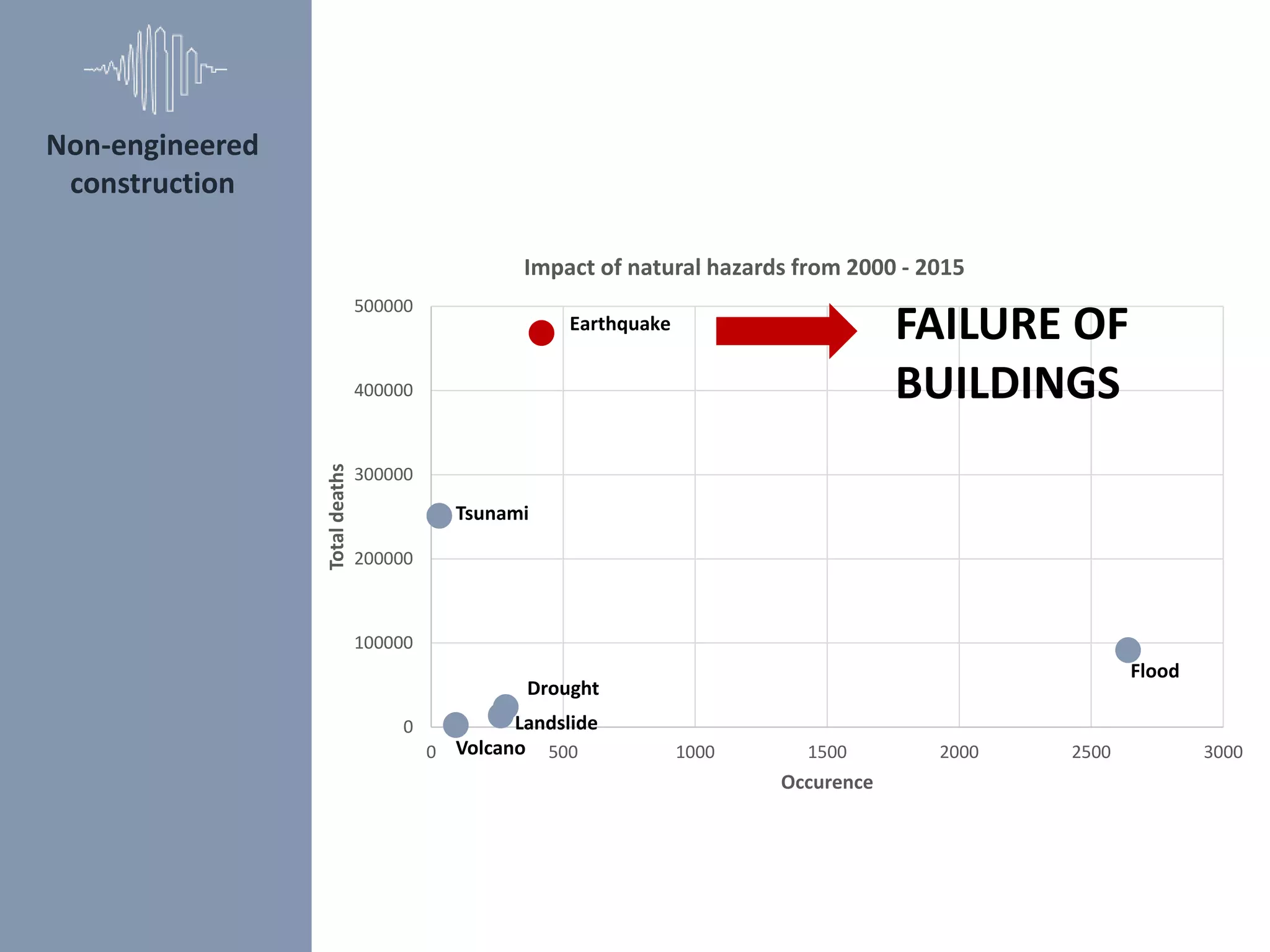
Impact of natural hazards from 2000 - 2015
Earthquake
Non-engineered
construction
Tsunami
Volcano
Landslide
Drought
Flood
FAILURE OF
BUILDINGS
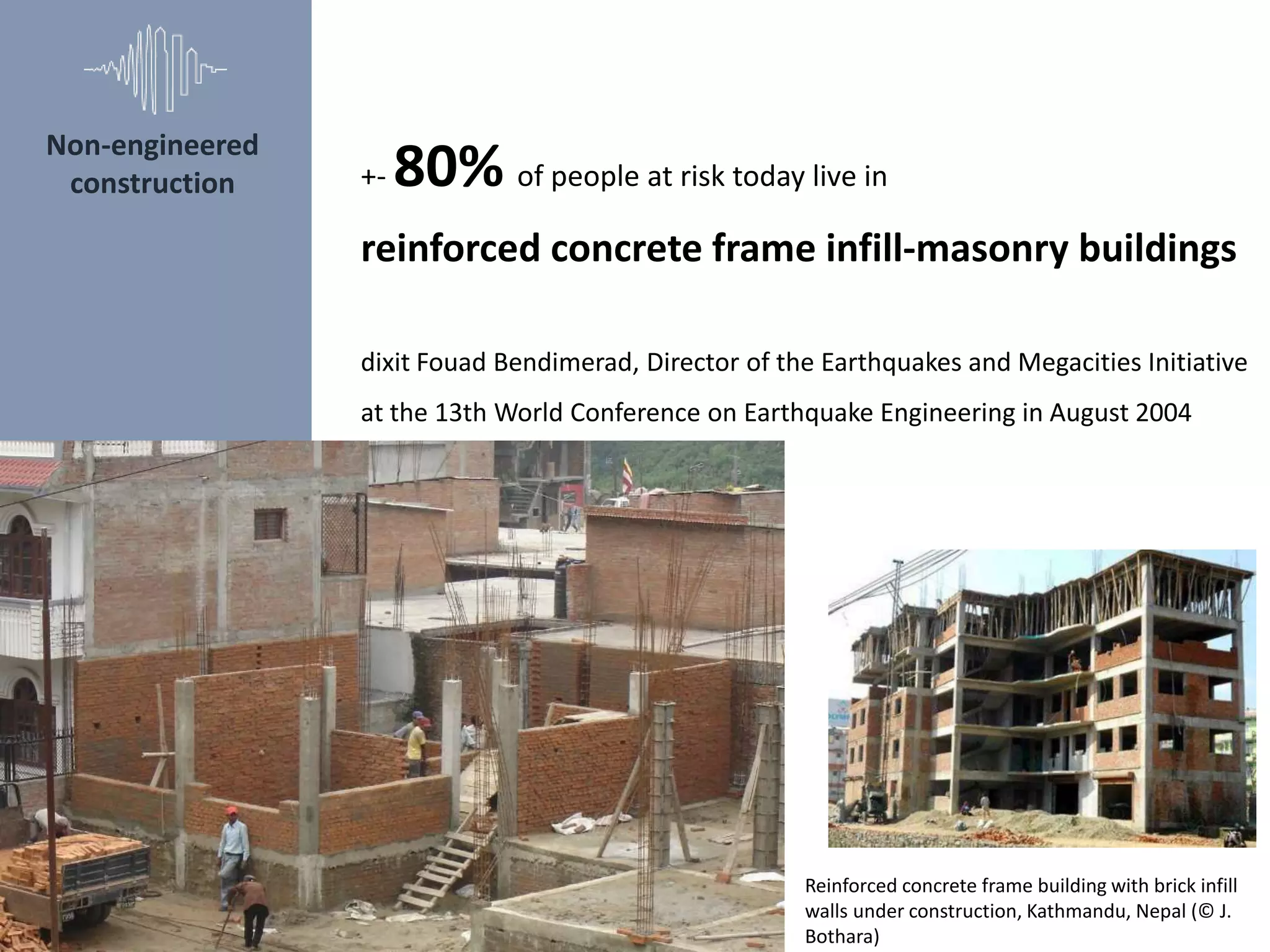
Non-engineered
construction +- 80% of people at risk today live in
reinforced concrete frame infill-masonry buildings
dixit Fouad Bendimerad, Director of the Earthquakes and Megacities Initiative
at the 13th World Conference on Earthquake Engineering in August 2004
Reinforced concrete frame building with brick infill
walls under construction, Kathmandu, Nepal (© J.
Bothara)
Non-engineered
construction
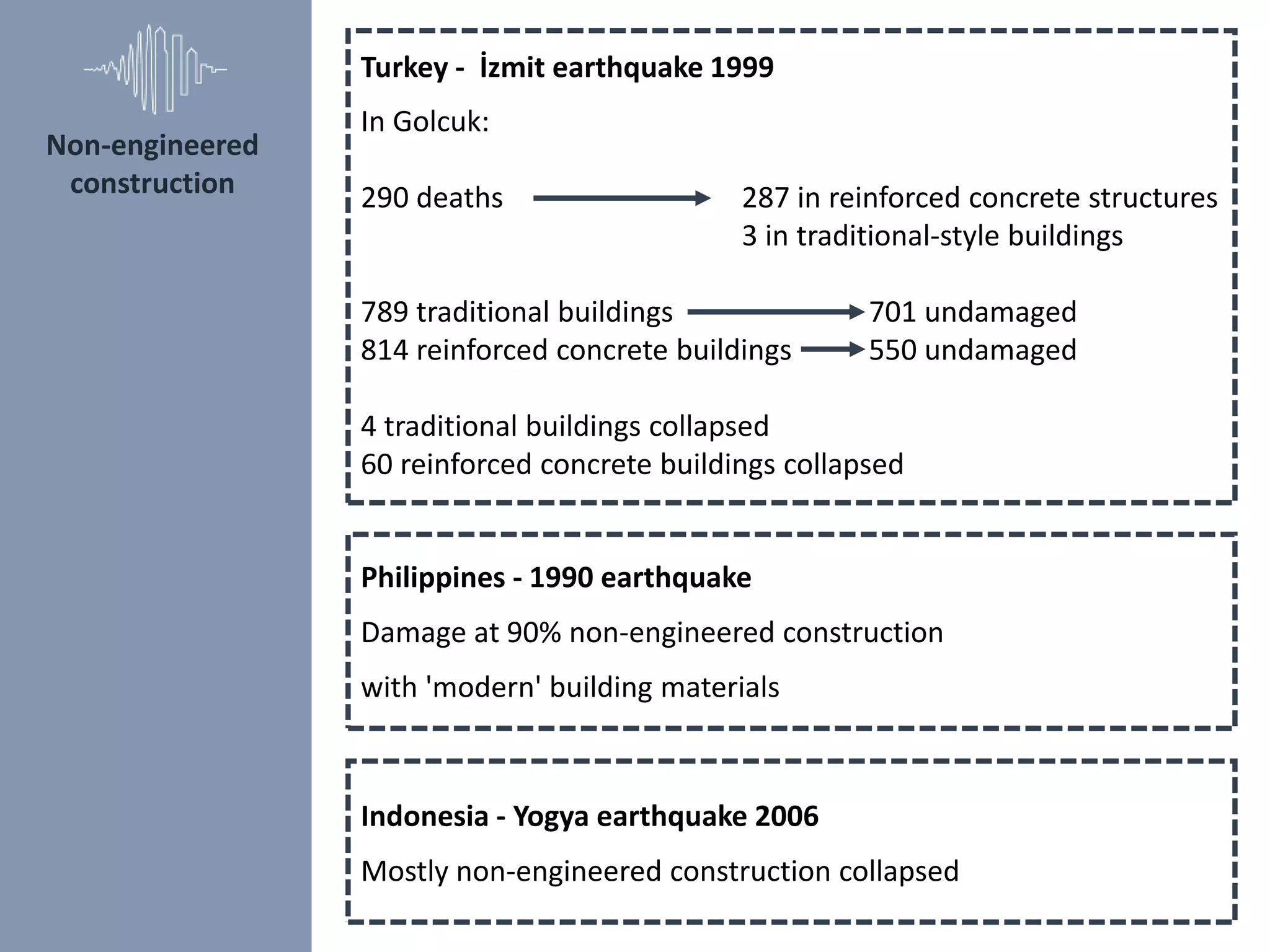
Turkey - İzmit earthquake 1999
In Golcuk:
290 deaths 287 in reinforced concrete structures
3 in traditional-style buildings
789 traditional buildings 701 undamaged
814 reinforced concrete buildings 550 undamaged
4 traditional buildings collapsed
60 reinforced concrete buildings collapsed
Philippines - 1990 earthquake
Damage at 90% non-engineered construction
with 'modern' building materials
Indonesia - Yogya earthquake 2006
Mostly non-engineered construction collapsed
Non-engineered
construction
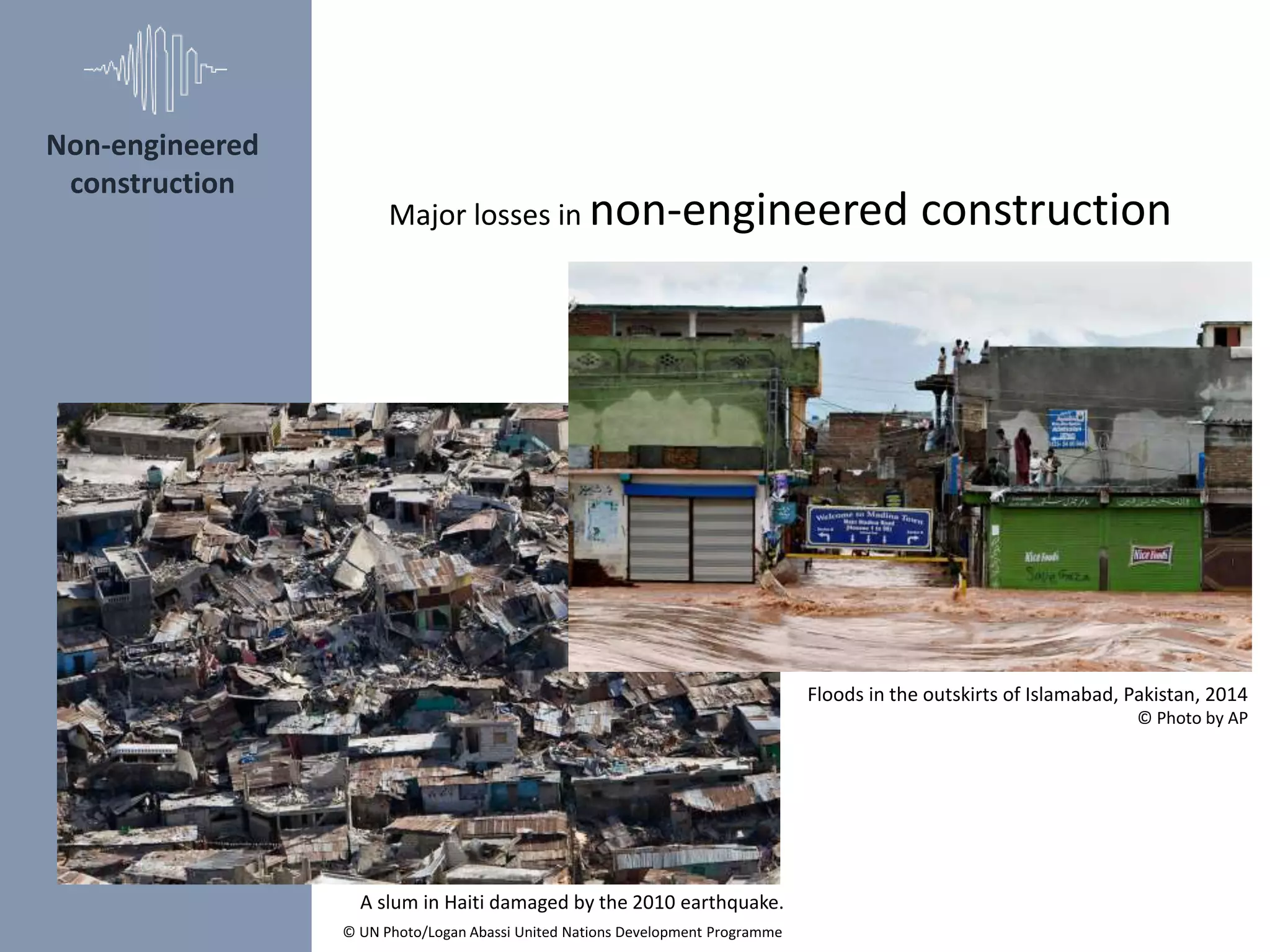
A slum in Haiti damaged by the 2010 earthquake.
© UN Photo/Logan Abassi United Nations Development Programme
Major losses in non-engineered construction
Floods in the outskirts of Islamabad, Pakistan, 2014
© Photo by AP
Non-engineered
construction
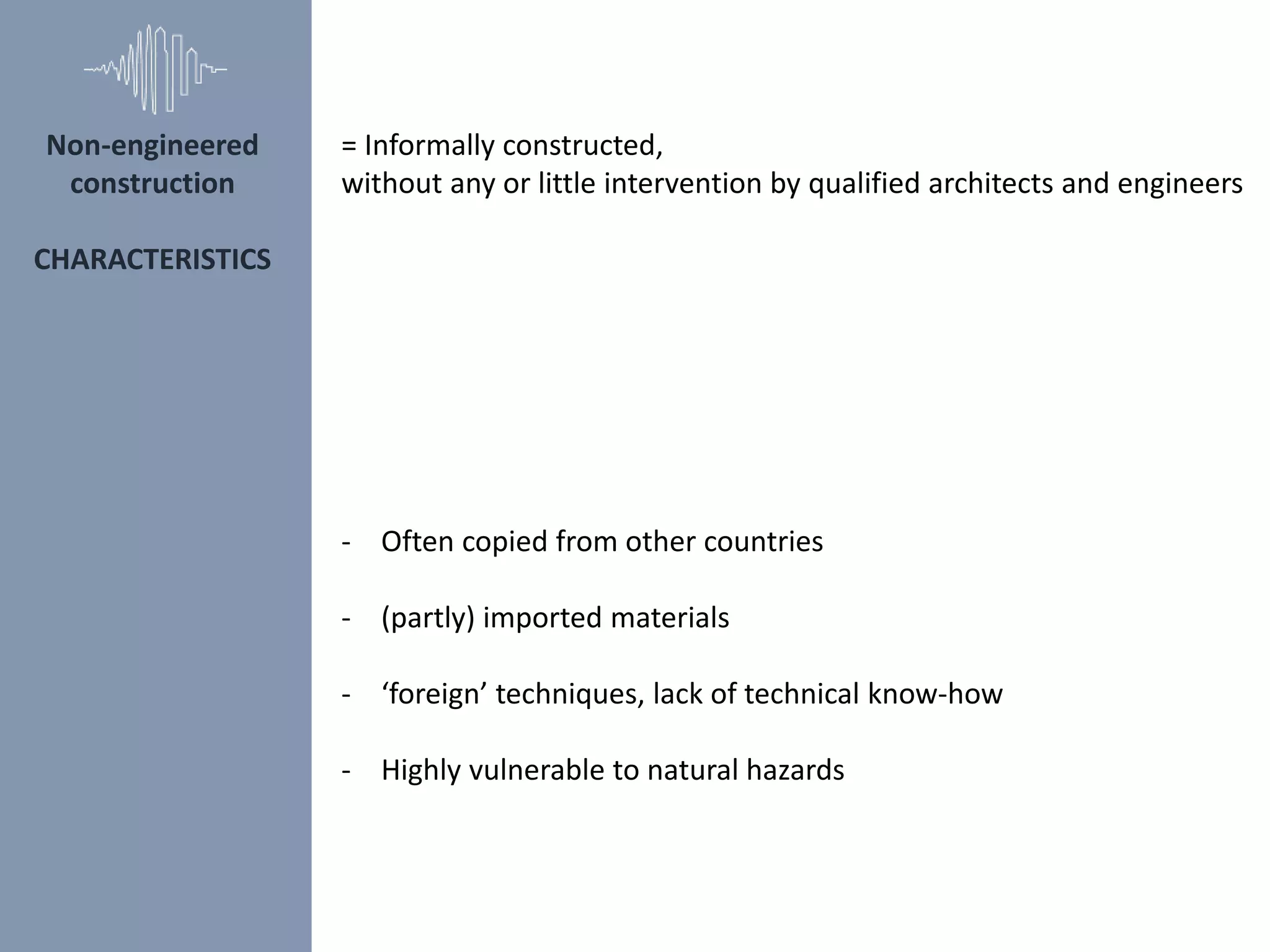
CHARACTERISTICS
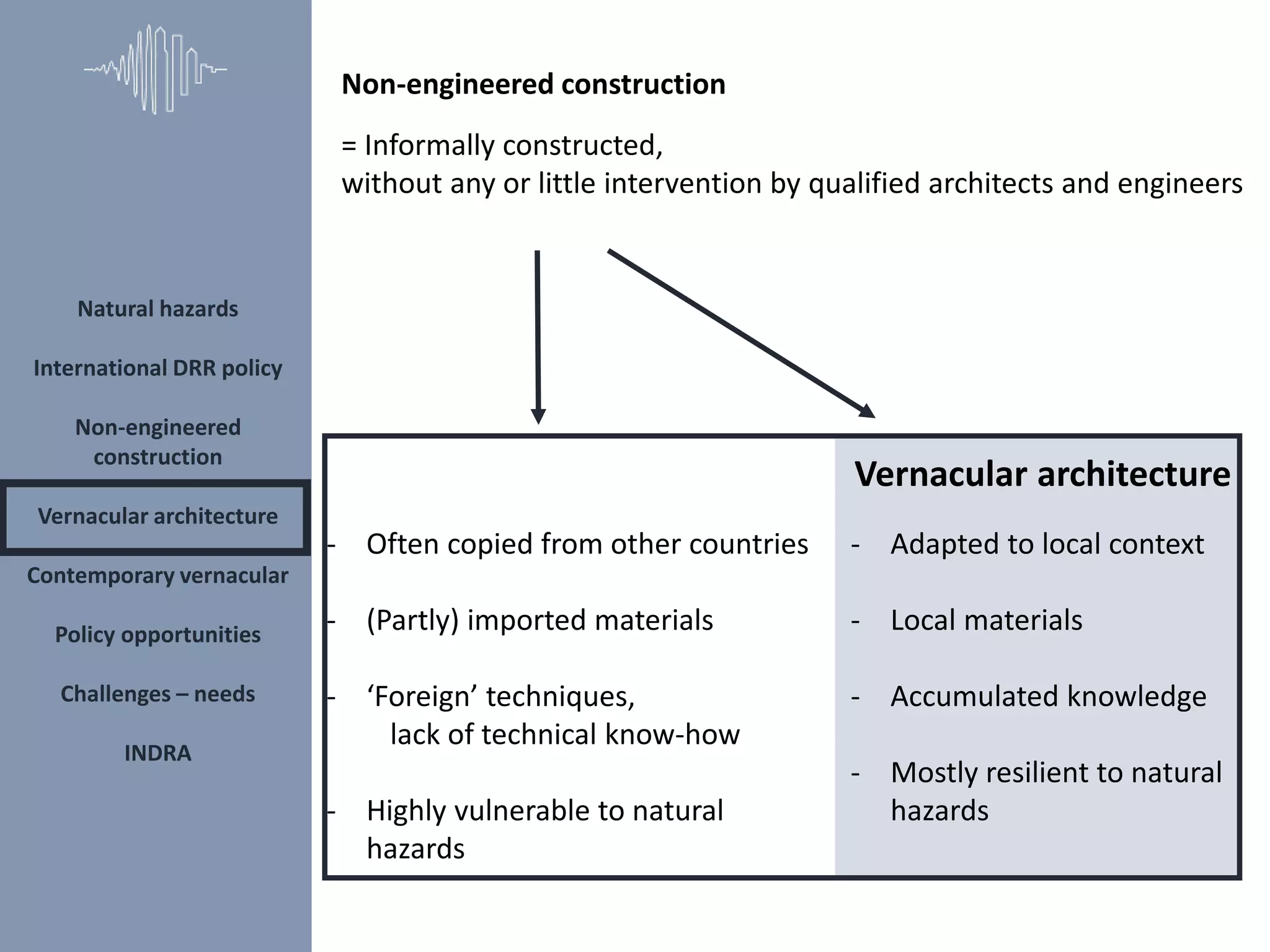
- Often copied from other countries
- (partly) imported materials
- ‘foreign’ techniques, lack of technical know-how
- Highly vulnerable to natural hazards
= Informally constructed,
without any or little intervention by qualified architects and engineers
Non-engineered
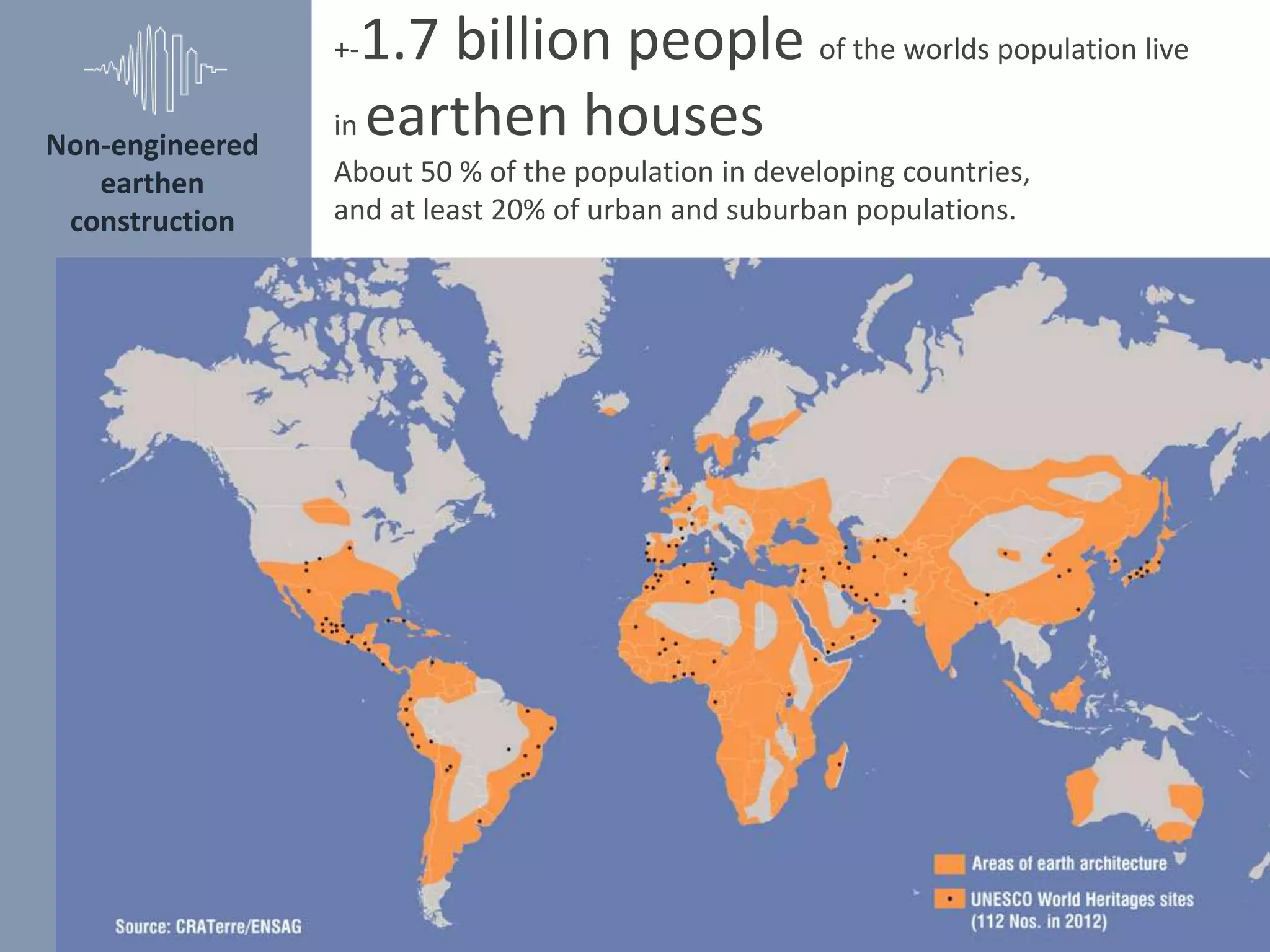
earthen
construction
+-1.7 billion people of the worlds population live
in earthen houses
About 50 % of the population in developing countries,
and at least 20% of urban and suburban populations.
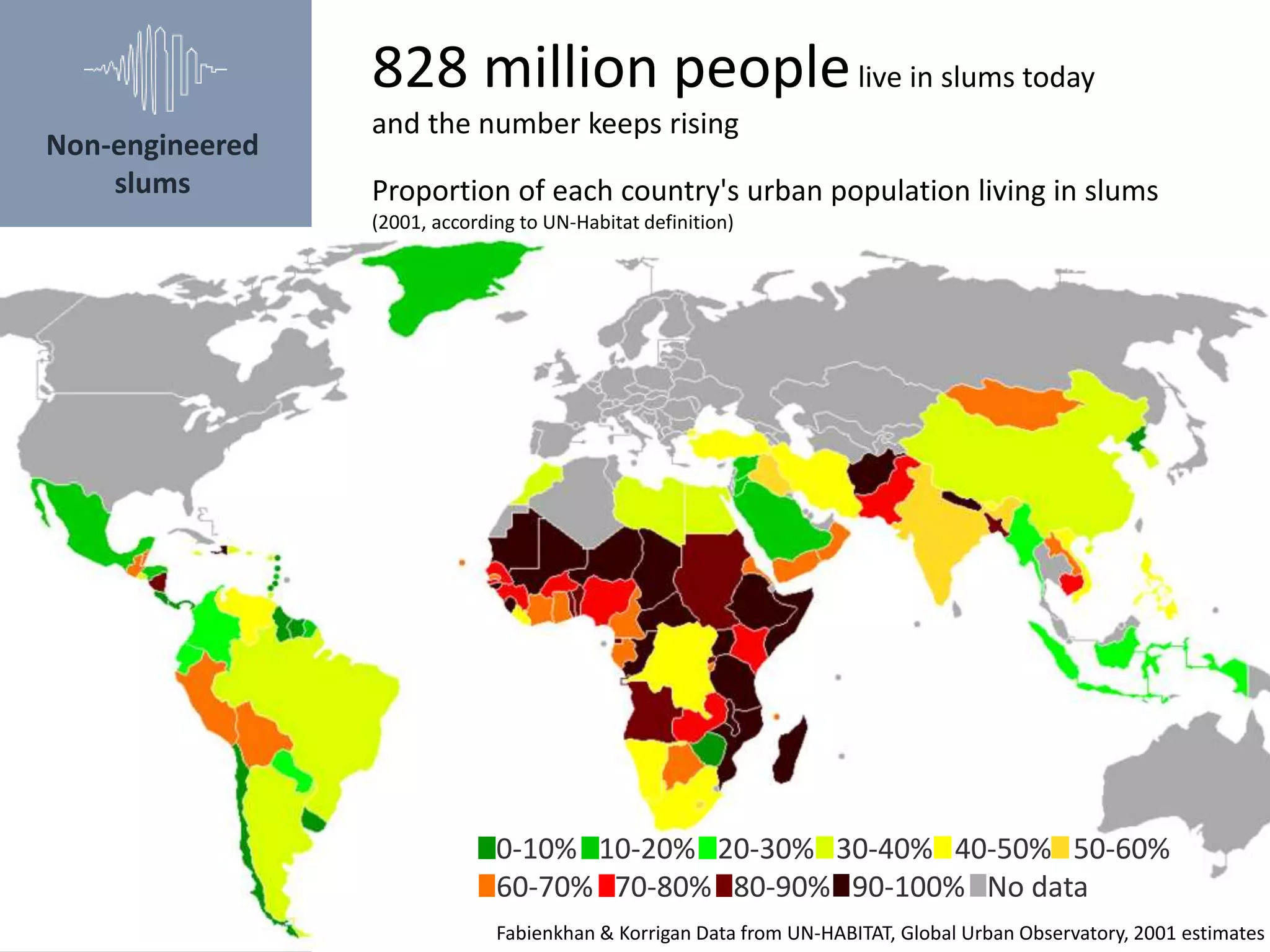
Non-engineered
slums
0-10% 10-20% 20-30% 30-40% 40-50% 50-60%
60-70% 70-80% 80-90% 90-100% No data
Fabienkhan & Korrigan Data from UN-HABITAT, Global Urban Observatory, 2001 estimates
Proportion of each country's urban population living in slums
(2001, according to UN-Habitat definition)
828 million peoplelive in slums today
and the number keeps rising
Natural hazards
International DRR policy
Non-engineered
construction
Vernacular architecture
Contemporary vernacular
Policy opportunities
Challenges – needs
INDRA
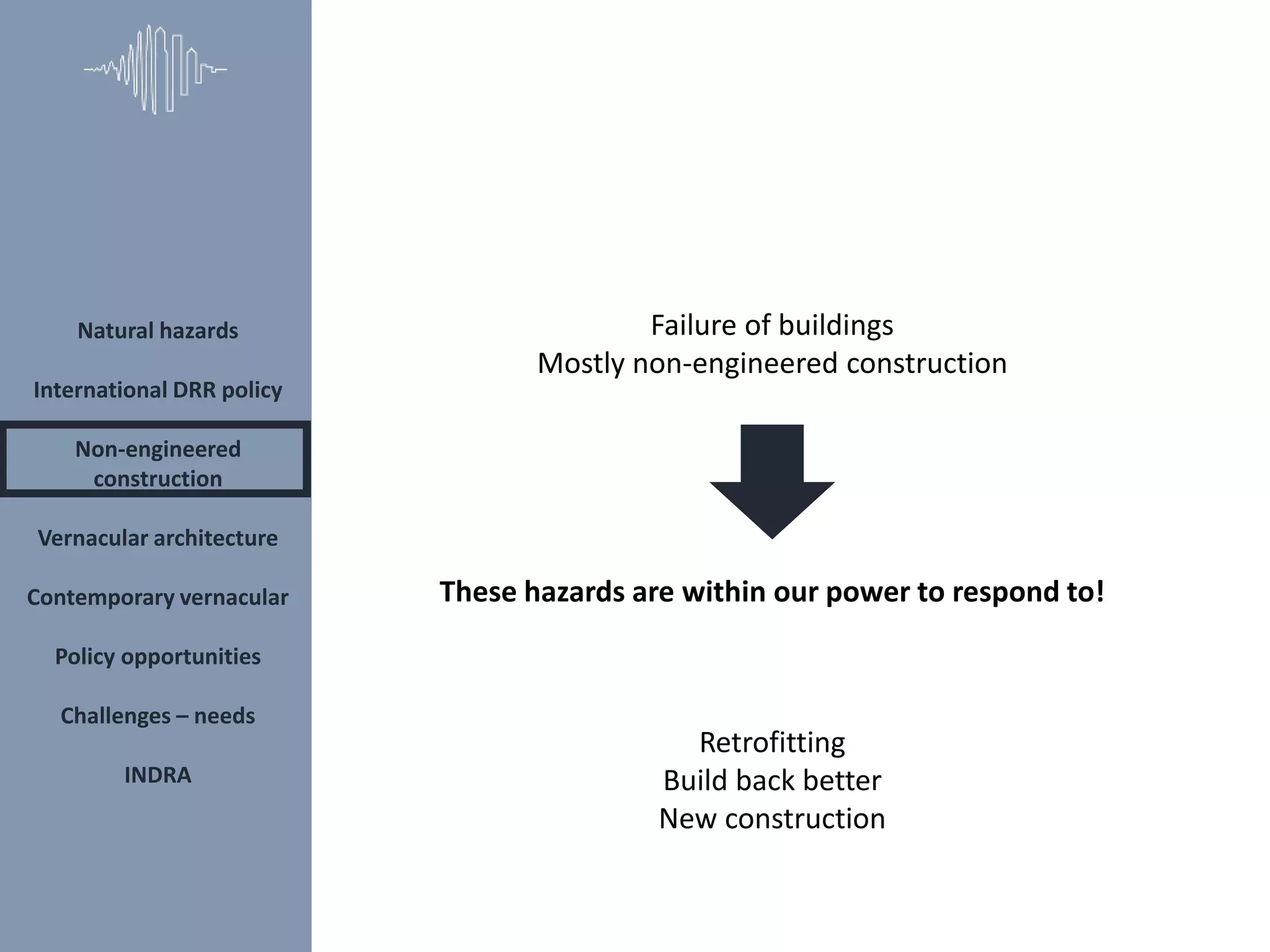
Failure of buildings
Mostly non-engineered construction
These hazards are within our power to respond to!
Retrofitting
Build back better
New construction
Natural hazards
International DRR policy
Non-engineered
construction
Vernacular architecture
Contemporary vernacular
Policy opportunities
Challenges – needs
INDRA
INDRA
Natural hazards
International DRR policy
Non-engineered
construction
Vernacular architecture
Contemporary vernacular
Policy opportunities
Challenges – needs
INDRA
- Often copied from other countries
- (Partly) imported materials
- ‘Foreign’ techniques,
lack of technical know-how
- Highly vulnerable to natural
hazards
= Informally constructed,
without any or little intervention by qualified architects and engineers
- Adapted to local context
- Local materials
- Accumulated knowledge
- Mostly resilient to natural
hazards
Vernacular architecture
Non-engineered construction
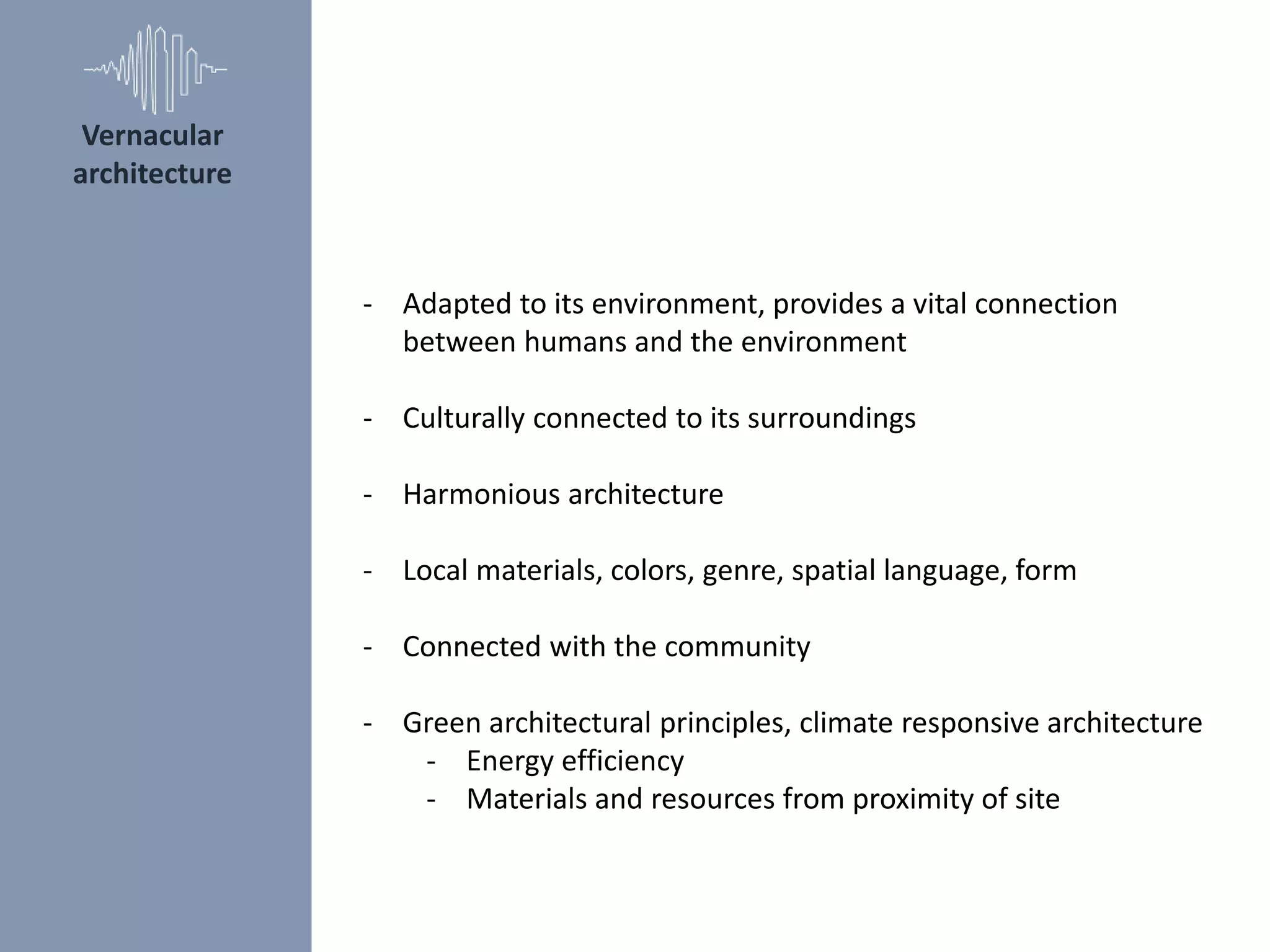
- Adapted to its environment, provides a vital connection
between humans and the environment
- Culturally connected to its surroundings
- Harmonious architecture
- Local materials, colors, genre, spatial language, form
- Connected with the community
- Green architectural principles, climate responsive architecture
- Energy efficiency
- Materials and resources from proximity of site
Vernacular
architecture
Vernacular
architecture
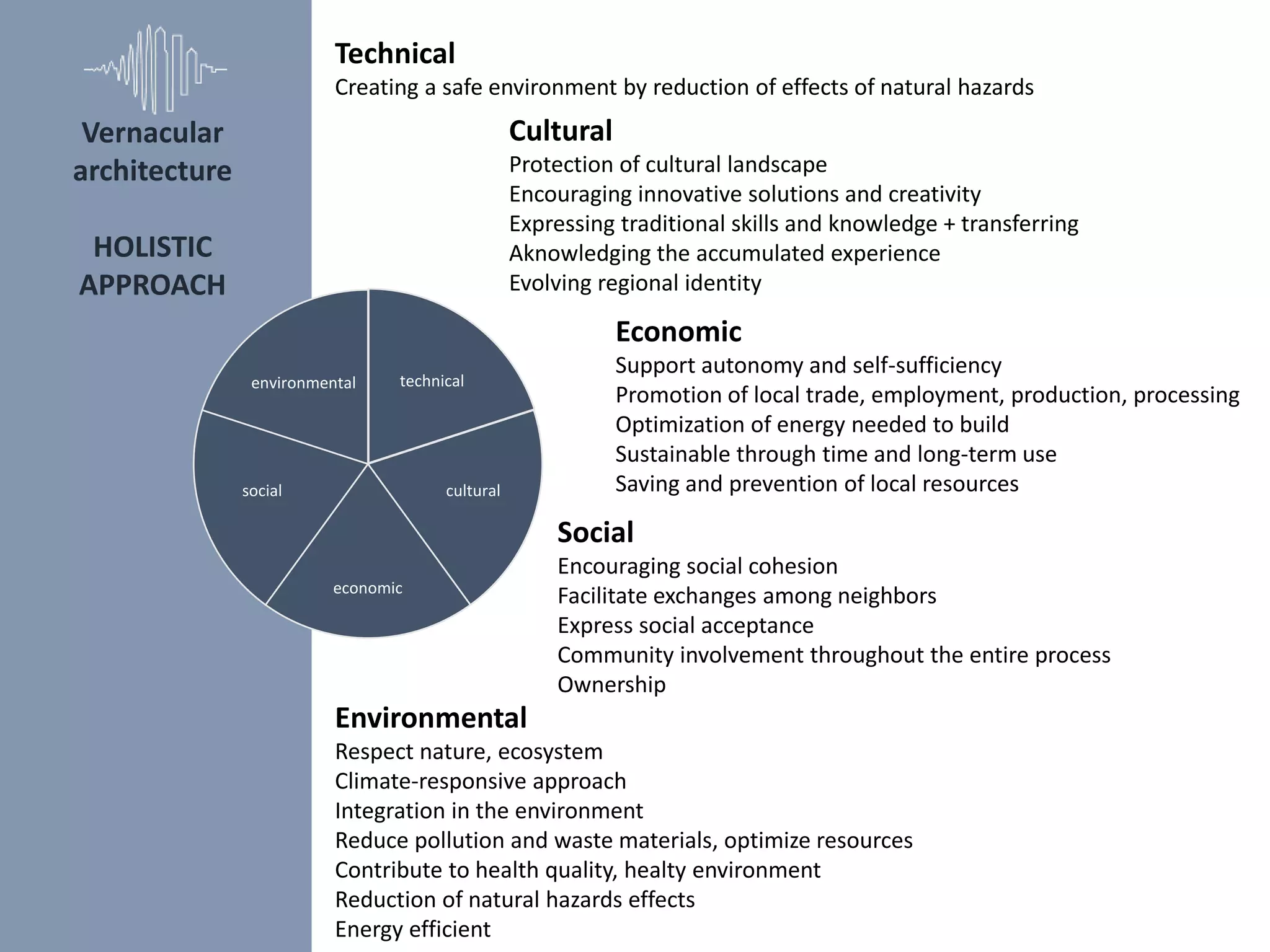
HOLISTIC
APPROACH
technical
cultural
economic
social
environmental
Technical
Creating a safe environment by reduction of effects of natural hazards
Cultural
Protection of cultural landscape
Encouraging innovative solutions and creativity
Expressing traditional skills and knowledge + transferring
Aknowledging the accumulated experience
Evolving regional identity
Economic
Support autonomy and self-sufficiency
Promotion of local trade, employment, production, processing
Optimization of energy needed to build
Sustainable through time and long-term use
Saving and prevention of local resources
Social
Encouraging social cohesion
Facilitate exchanges among neighbors
Express social acceptance
Community involvement throughout the entire process
Ownership
Environmental
Respect nature, ecosystem
Climate-responsive approach
Integration in the environment
Reduce pollution and waste materials, optimize resources
Contribute to health quality, healty environment
Reduction of natural hazards effects
Energy efficient
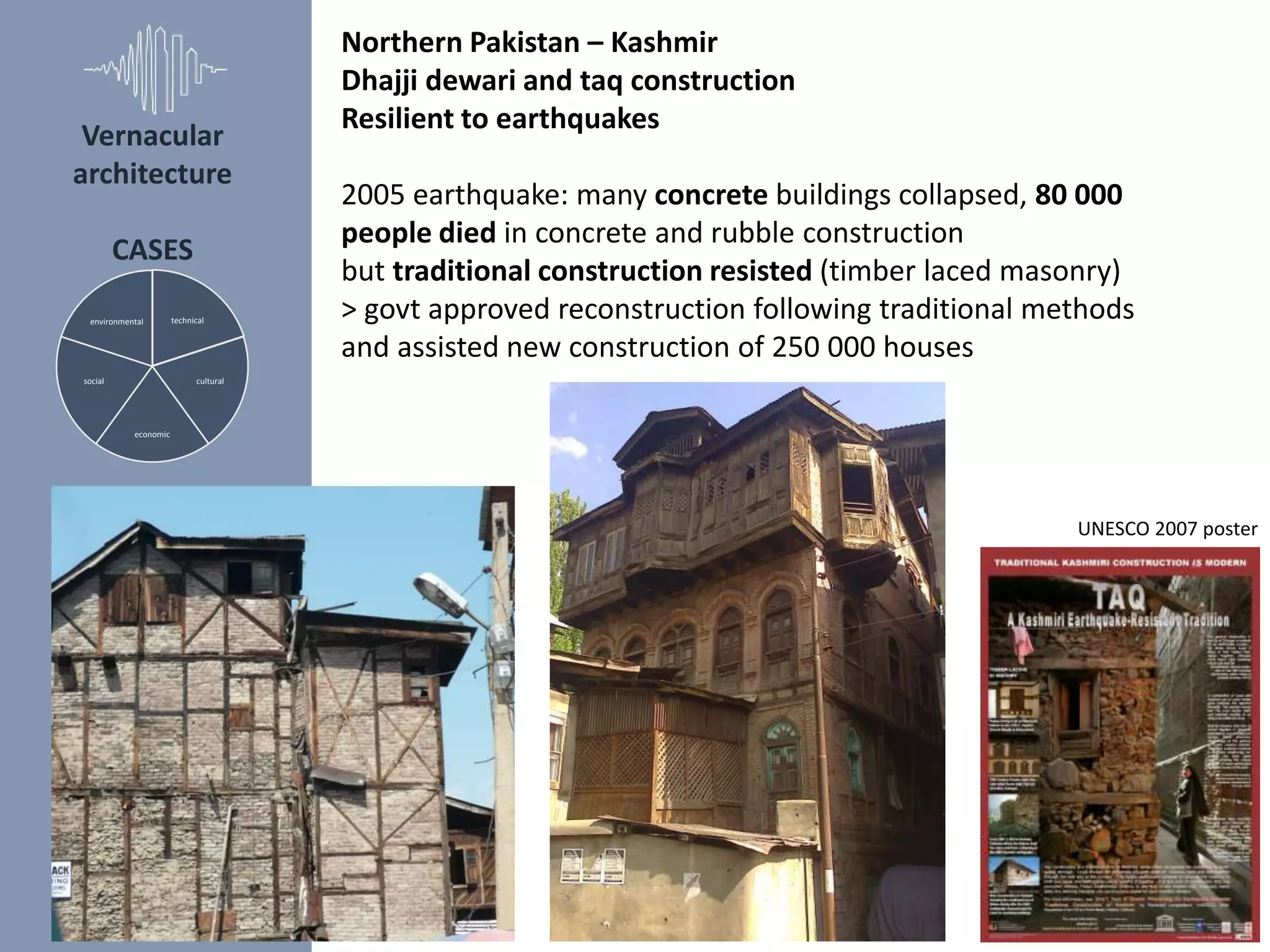
Northern Pakistan – Kashmir
Dhajji dewari and taq construction
Resilient to earthquakes
2005 earthquake: many concrete buildings collapsed, 80 000
people died in concrete and rubble construction
but traditional construction resisted (timber laced masonry)
> govt approved reconstruction following traditional methods
and assisted new construction of 250 000 houses
technical
cultural
economic
social
environmental
UNESCO 2007 poster
Vernacular
architecture
CASES
technical
cultural
economic
social
environmental
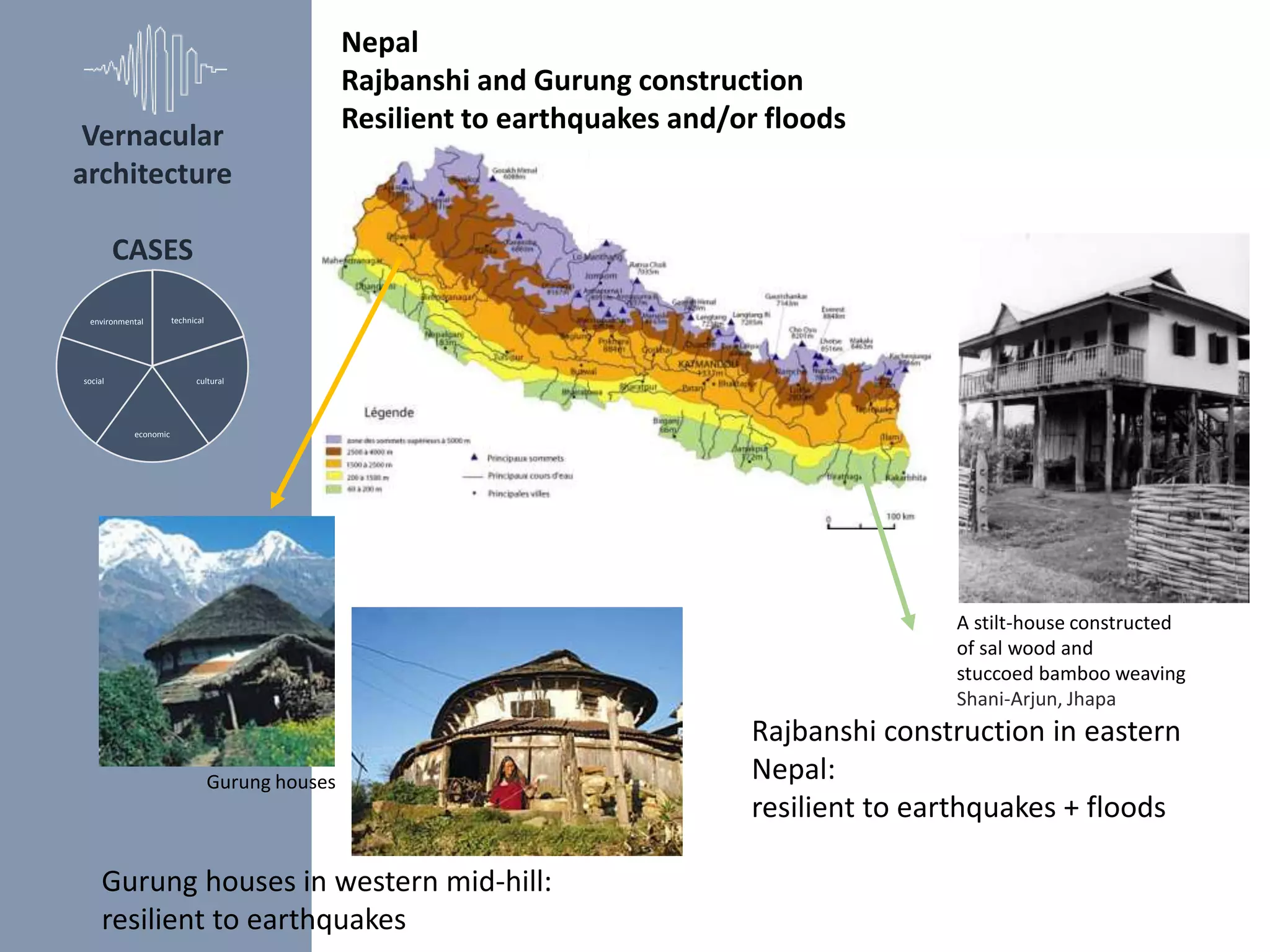
A stilt-house constructed
of sal wood and
stuccoed bamboo weaving
Shani-Arjun, Jhapa
Rajbanshi construction in eastern
Nepal:
resilient to earthquakes + floods
Gurung houses in western mid-hill:
resilient to earthquakes
Gurung houses
Nepal
Rajbanshi and Gurung construction
Resilient to earthquakes and/or floods
Vernacular
architecture
CASES
technical
cultural
economic
social
environmental
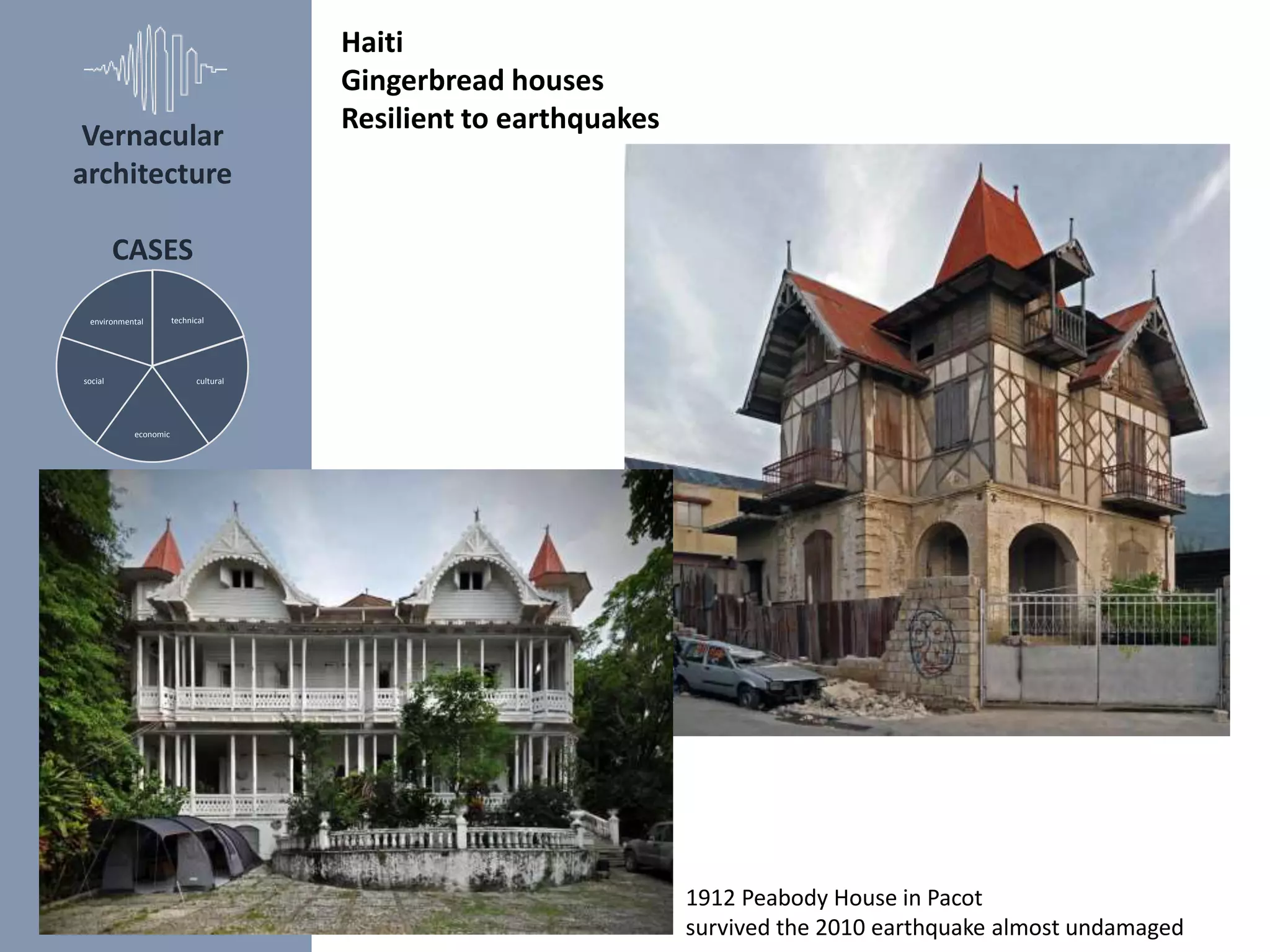
1912 Peabody House in Pacot
survived the 2010 earthquake almost undamaged
Haiti
Gingerbread houses
Resilient to earthquakes
Vernacular
architecture
CASES
technical
cultural
economic
social
environmental
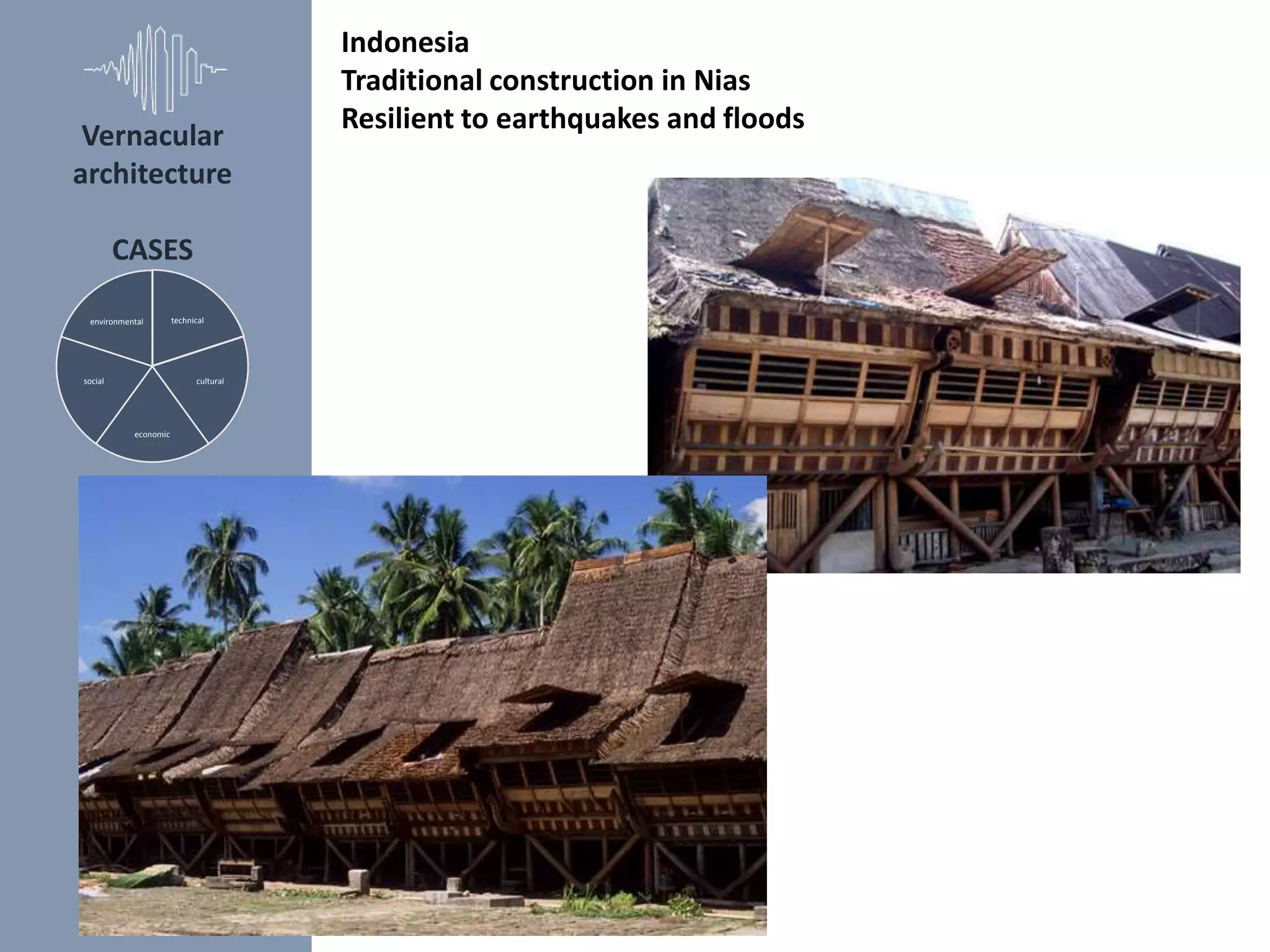
Indonesia
Traditional construction in Nias
Resilient to earthquakes and floods
Vernacular
architecture
CASES
technical
cultural
economic
social
environmental
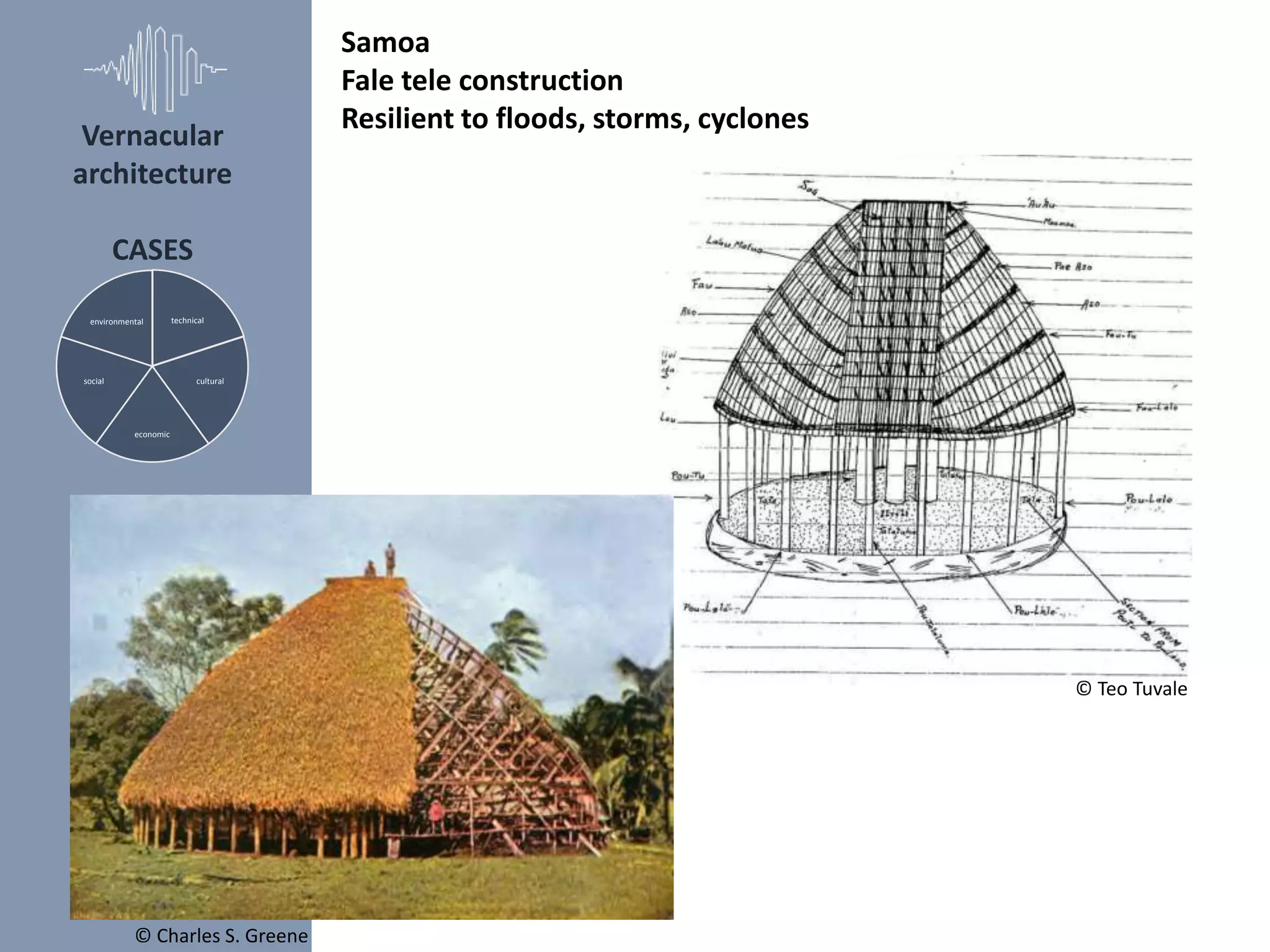
© Teo Tuvale
© Charles S. Greene
Samoa
Fale tele construction
Resilient to floods, storms, cyclones
Vernacular
architecture
CASES
technical
cultural
economic
social
environmental
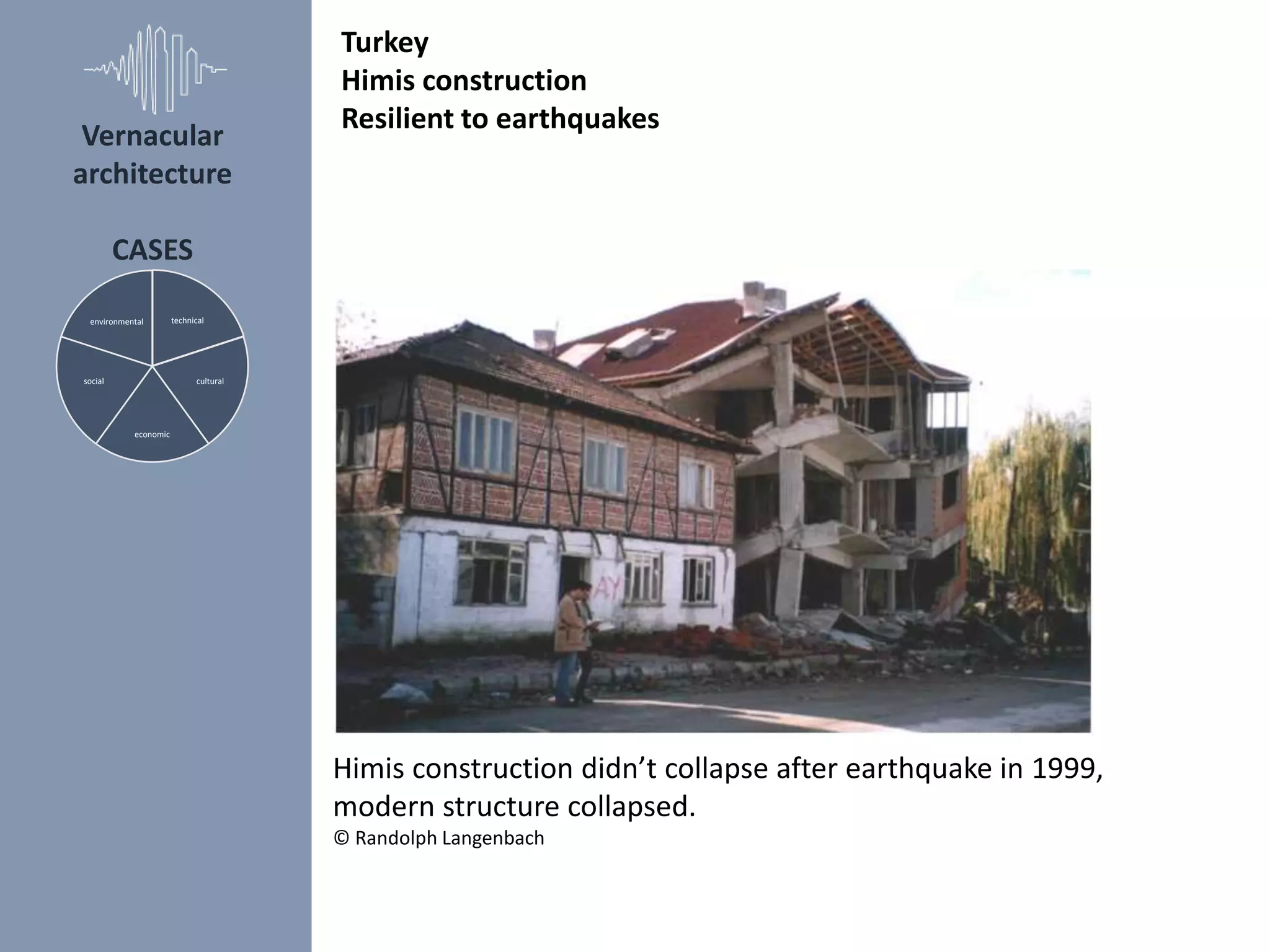
Himis construction didn’t collapse after earthquake in 1999,
modern structure collapsed.
© Randolph Langenbach
Turkey
Himis construction
Resilient to earthquakes
Vernacular
architecture
CASES
Vernacular
architecture
CASES
technical
cultural
economic
social
environmental
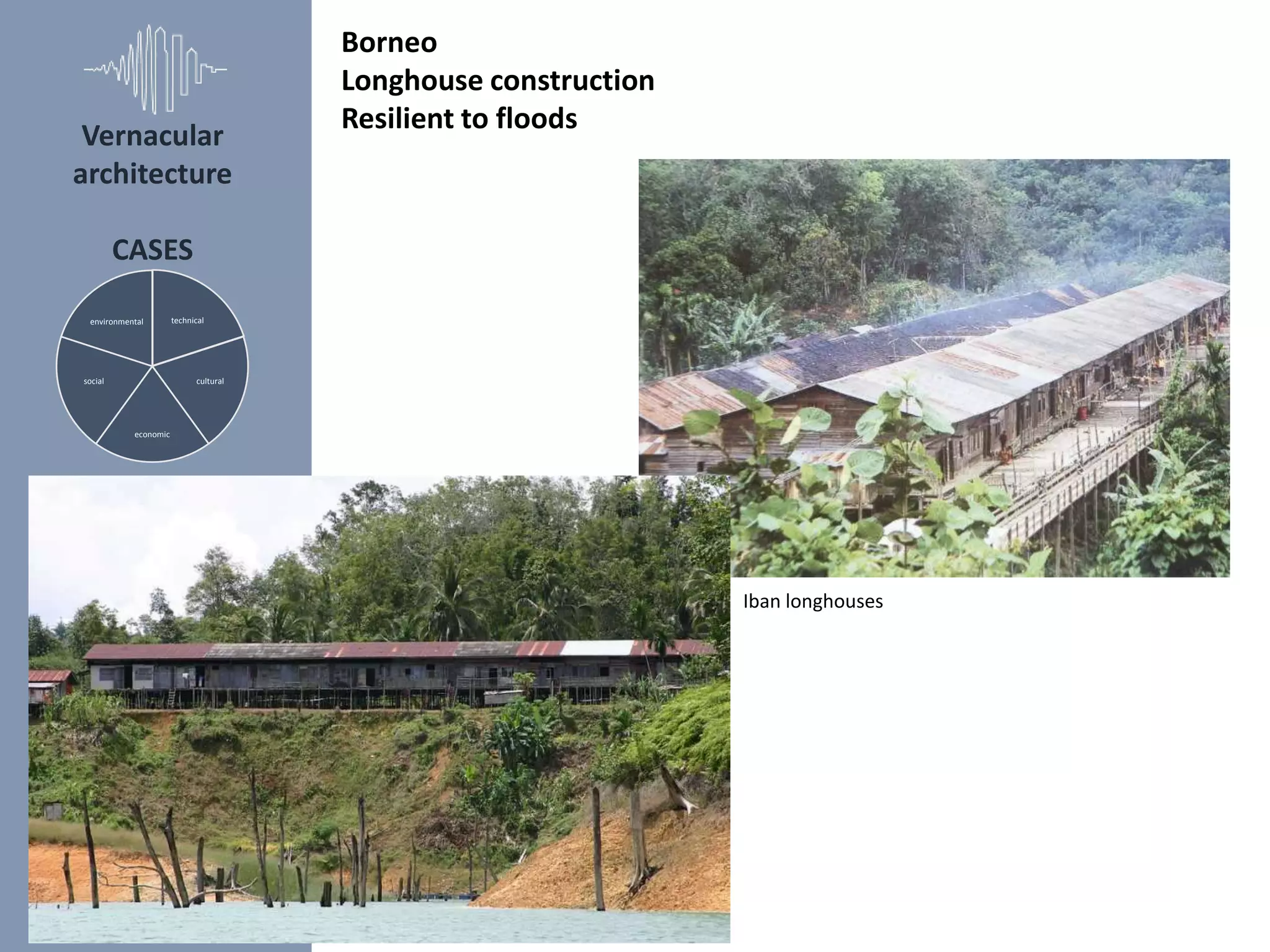
Iban longhouses
Borneo
Longhouse construction
Resilient to floods
Natural hazards
International DRR policy
Non-engineered
construction
Vernacular architecture
Contemporary vernacular
Policy opportunities
Challenges – needs
INDRA
INDRA
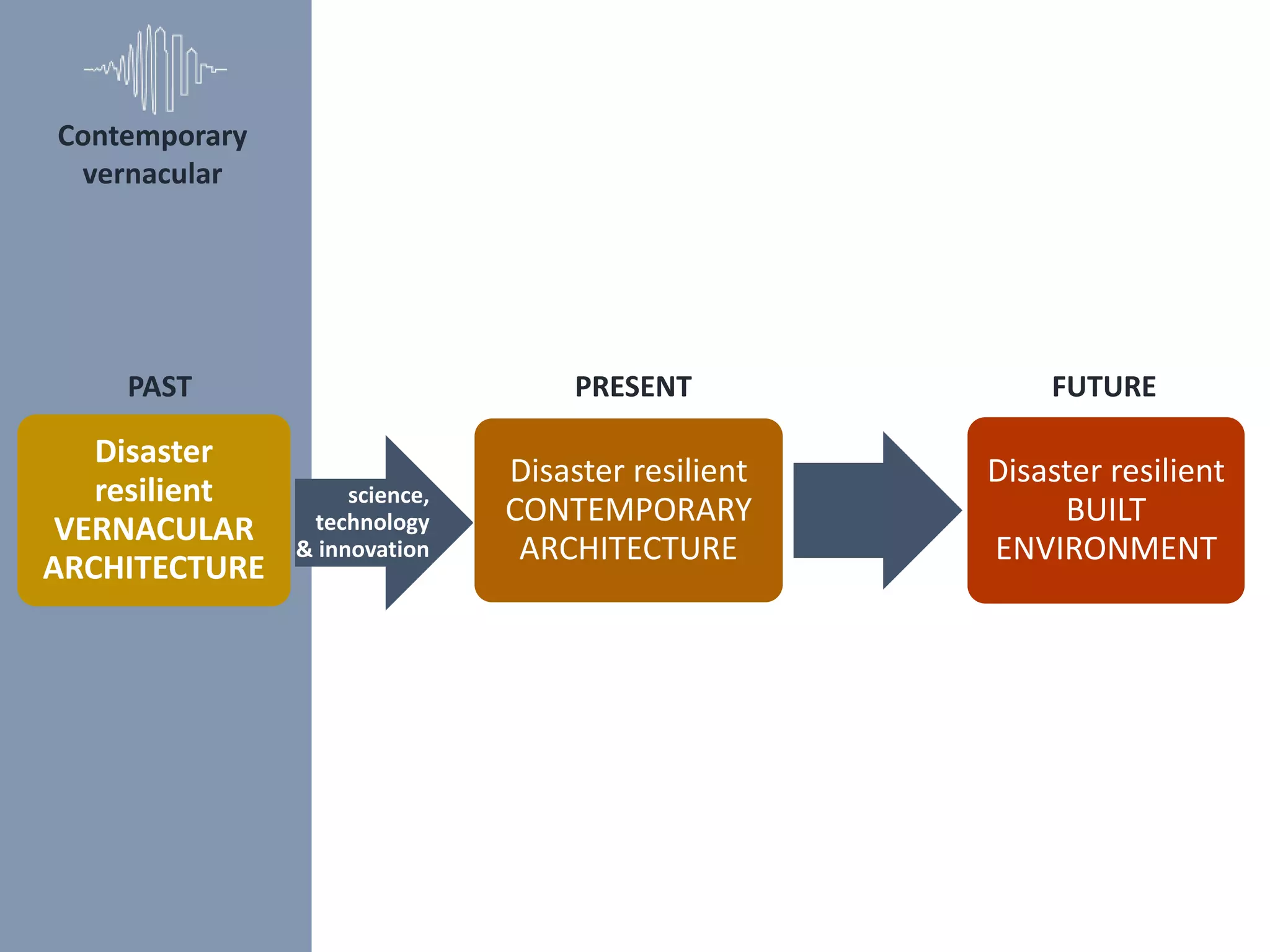
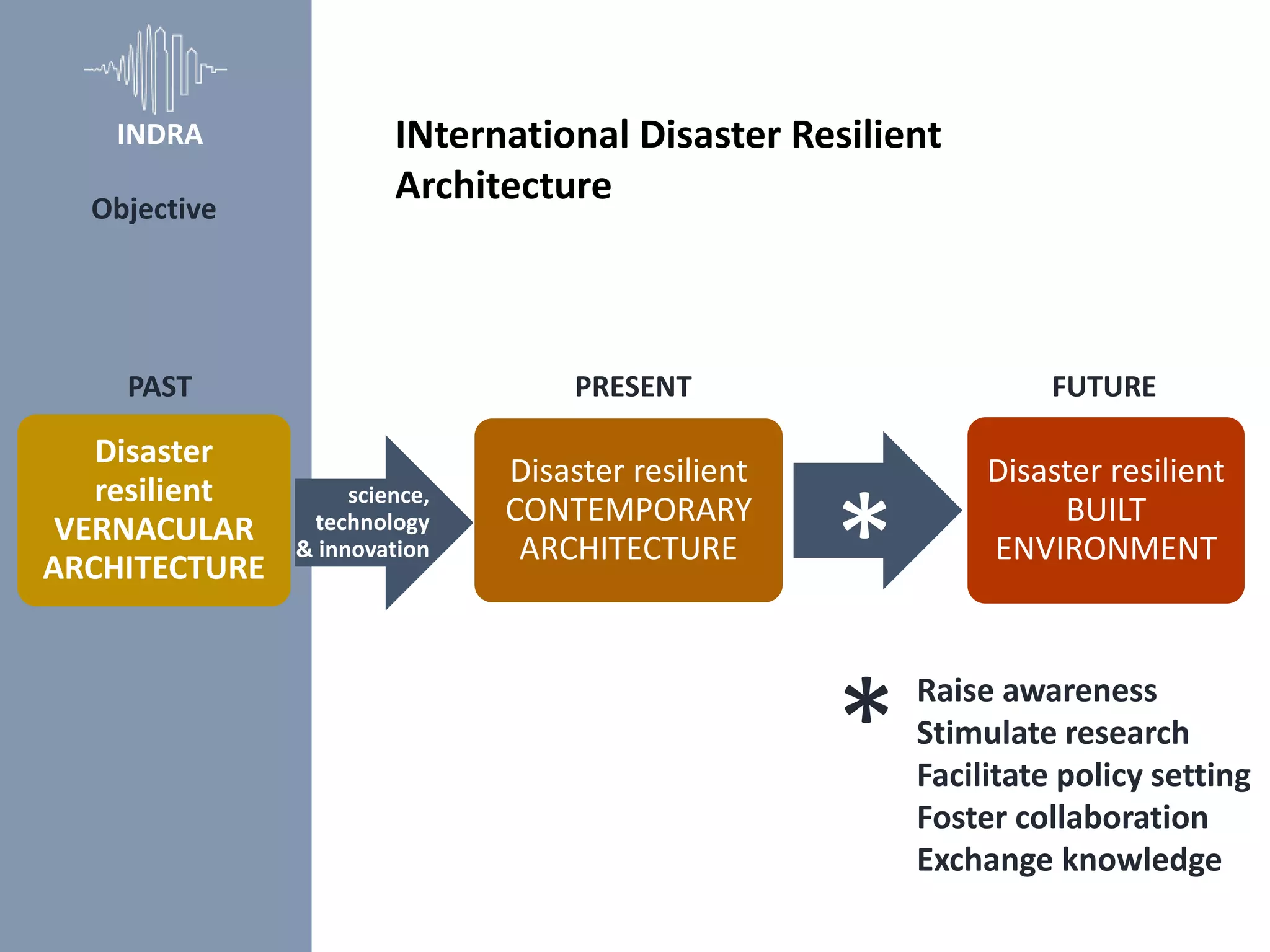
Disaster
resilient
VERNACULAR
ARCHITECTURE
science,
technology
& innovation
Disaster resilient
CONTEMPORARY
ARCHITECTURE
Disaster resilient
BUILT
ENVIRONMENT
PAST PRESENT FUTURE
Contemporary
vernacular
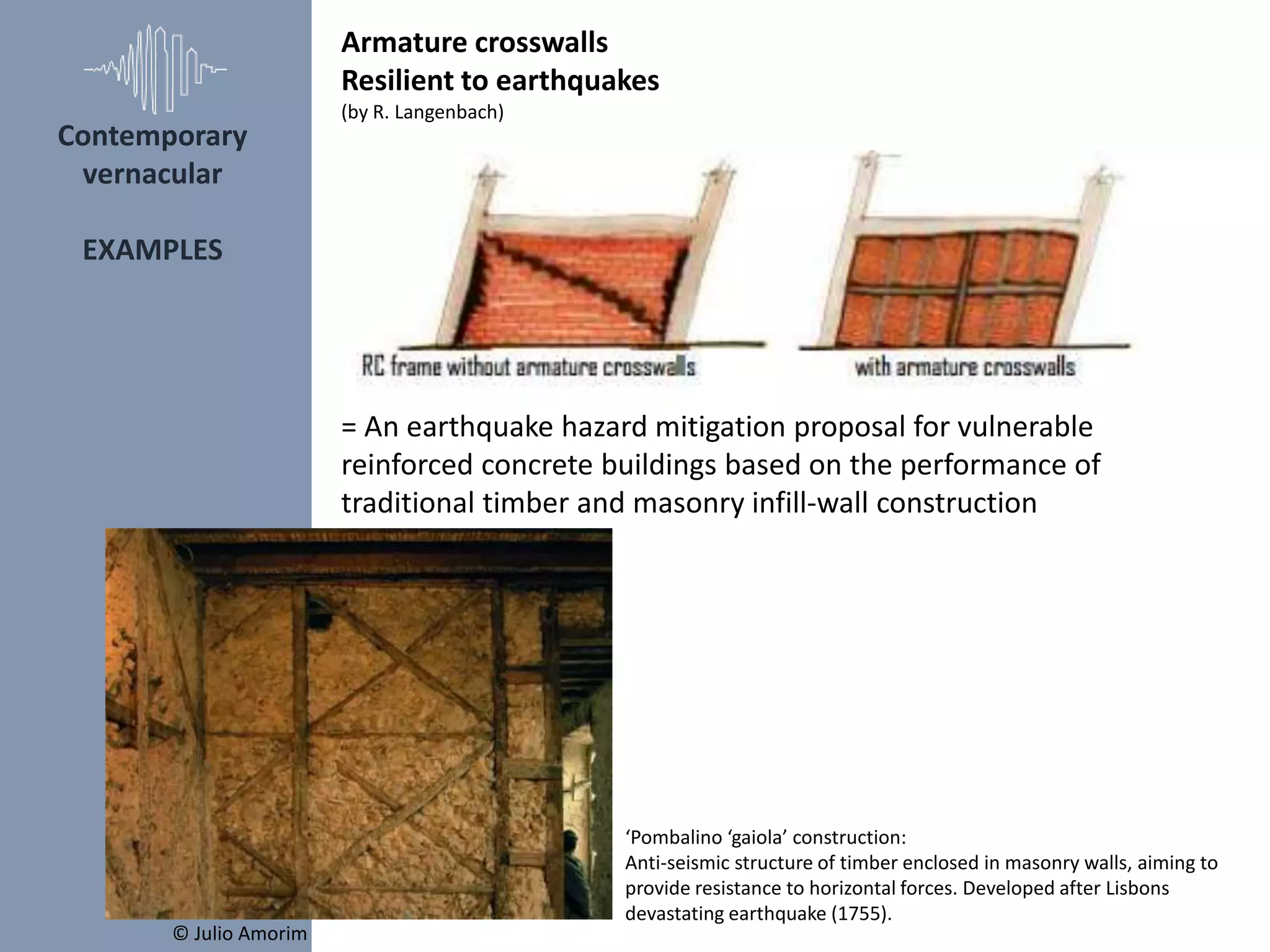
= An earthquake hazard mitigation proposal for vulnerable
reinforced concrete buildings based on the performance of
traditional timber and masonry infill-wall construction
‘Pombalino ‘gaiola’ construction:
Anti-seismic structure of timber enclosed in masonry walls, aiming to
provide resistance to horizontal forces. Developed after Lisbons
devastating earthquake (1755).
© Julio Amorim
Armature crosswalls
Resilient to earthquakes
(by R. Langenbach)
Contemporary
vernacular
EXAMPLES
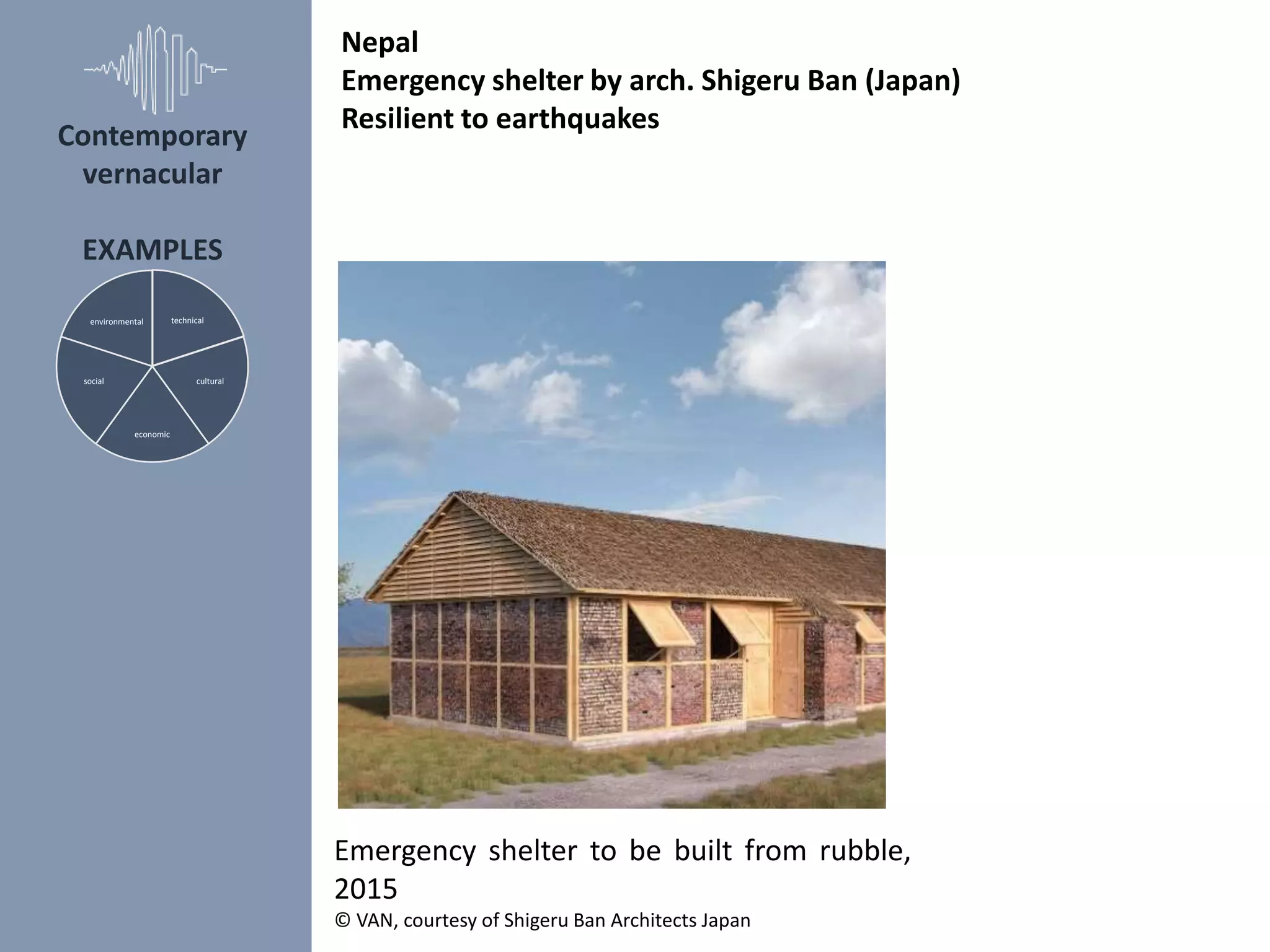
Emergency shelter to be built from rubble,
2015
© VAN, courtesy of Shigeru Ban Architects Japan
Nepal
Emergency shelter by arch. Shigeru Ban (Japan)
Resilient to earthquakes
technical
cultural
economic
social
environmental
Contemporary
vernacular
EXAMPLES
technical
cultural
economic
social
environmental
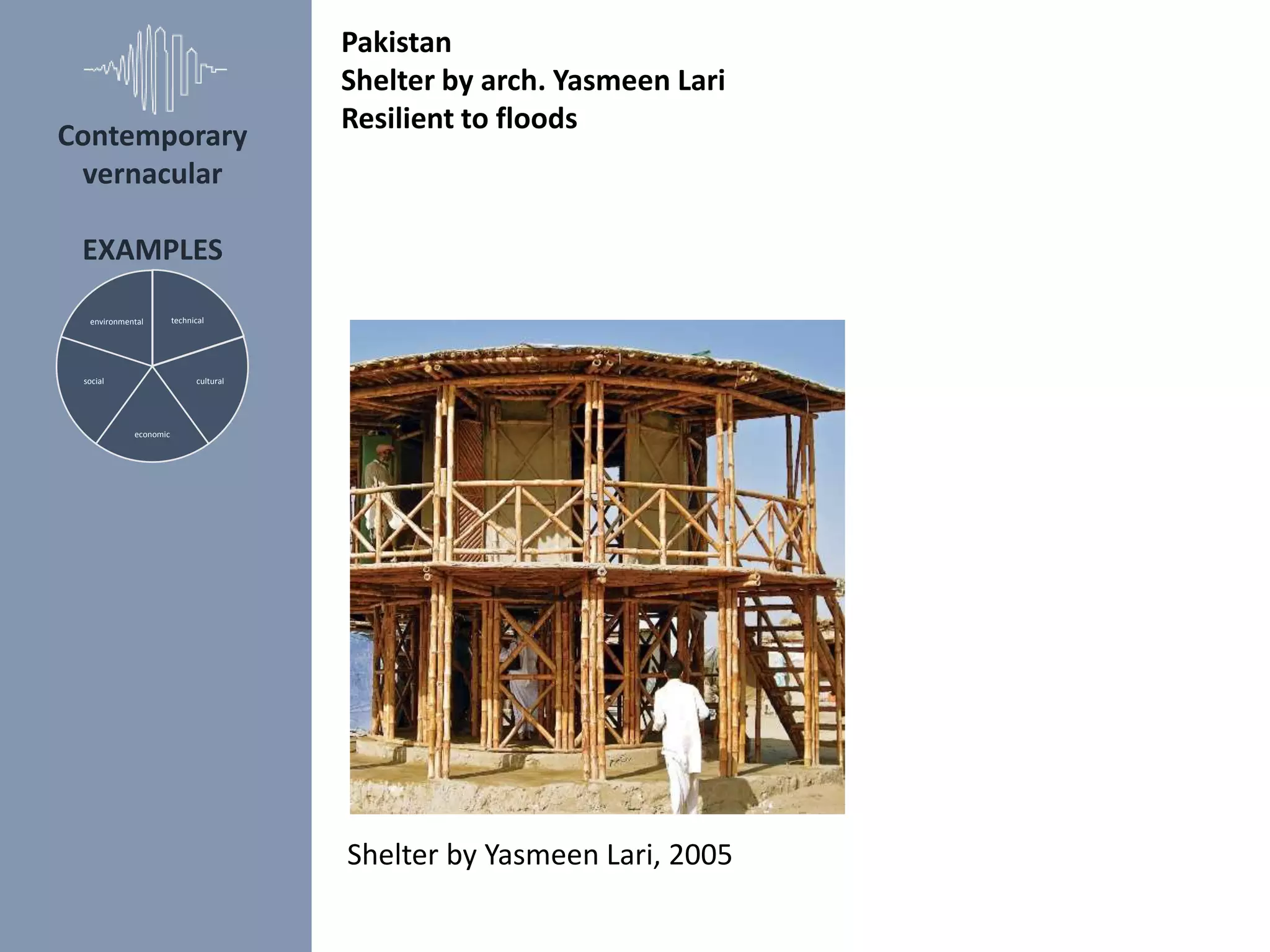
Shelter by Yasmeen Lari, 2005
Pakistan
Shelter by arch. Yasmeen Lari
Resilient to floods
Contemporary
vernacular
EXAMPLES
technical
cultural
economic
social
environmental
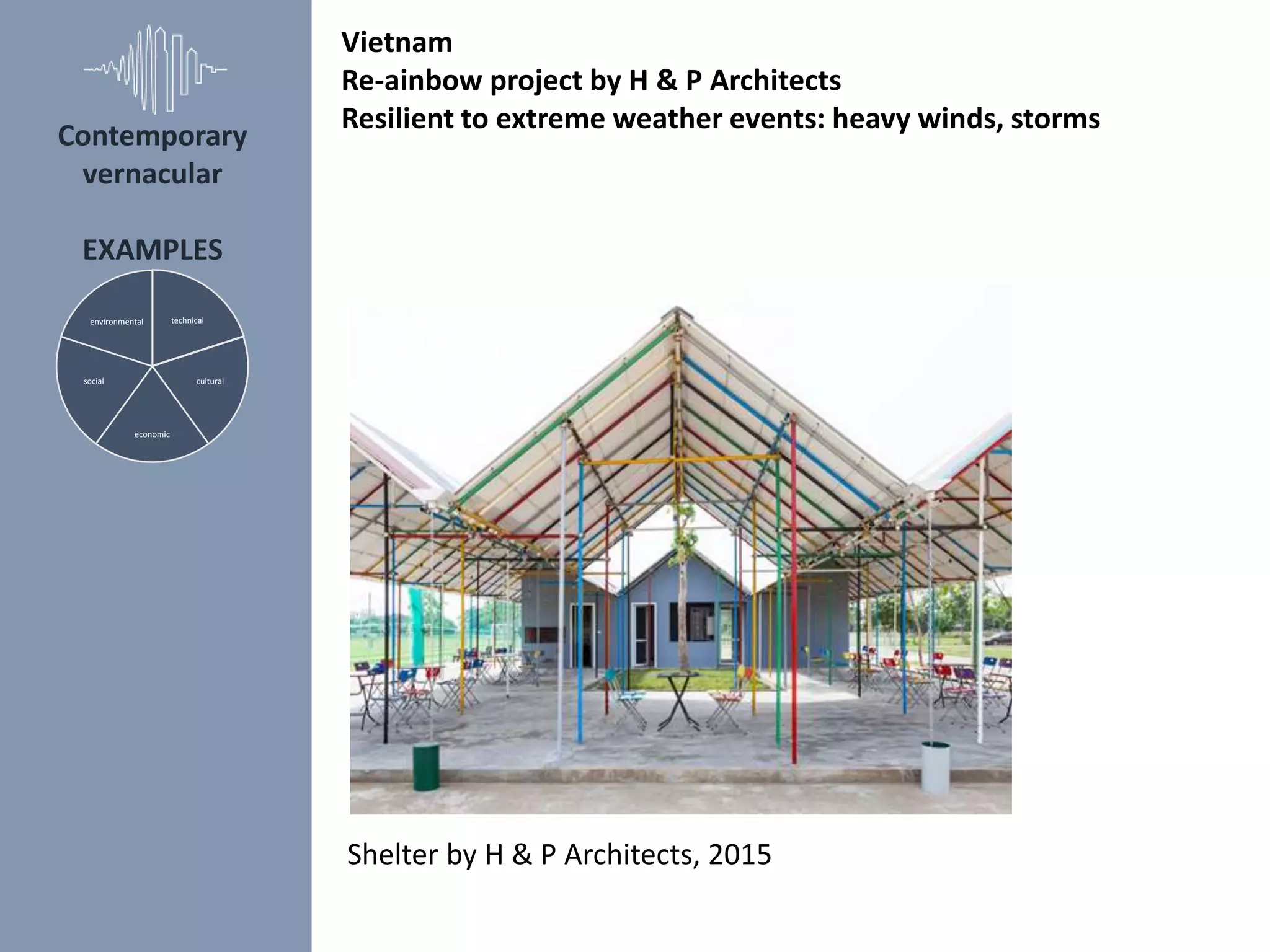
Vietnam
Re-ainbow project by H & P Architects
Resilient to extreme weather events: heavy winds, storms
Shelter by H & P Architects, 2015
Contemporary
vernacular
EXAMPLES
Contemporary
vernacular
EXAMPLES
technical
cultural
economic
social
environmental
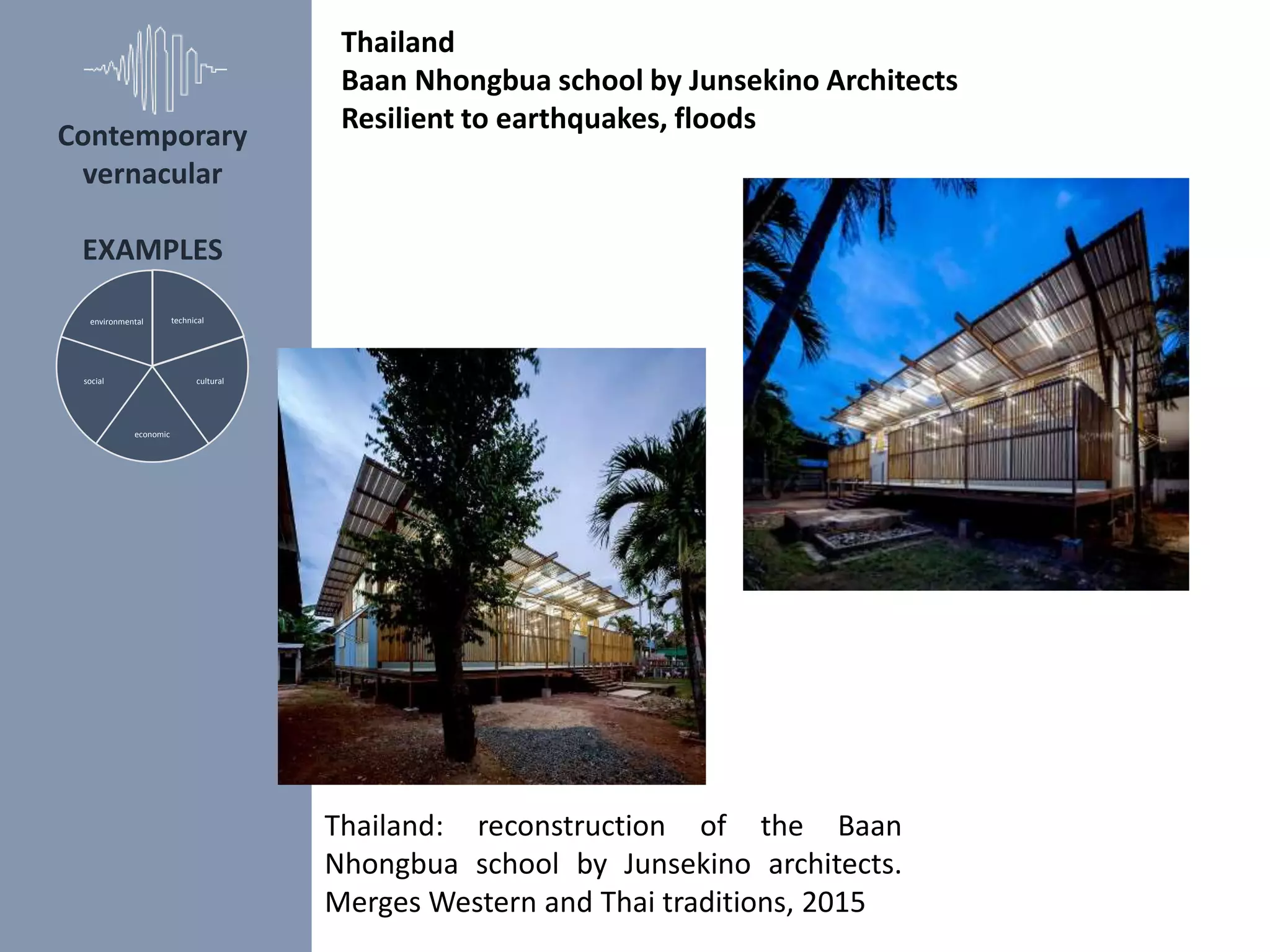
Thailand
Baan Nhongbua school by Junsekino Architects
Resilient to earthquakes, floods
Thailand: reconstruction of the Baan
Nhongbua school by Junsekino architects.
Merges Western and Thai traditions, 2015
Contemporary
‘modern’
EXAMPLES
technical
cultural
economic
social
environmental
Contemporary
‘modern’
EXAMPLES
technical
cultural
economic
social
environmental
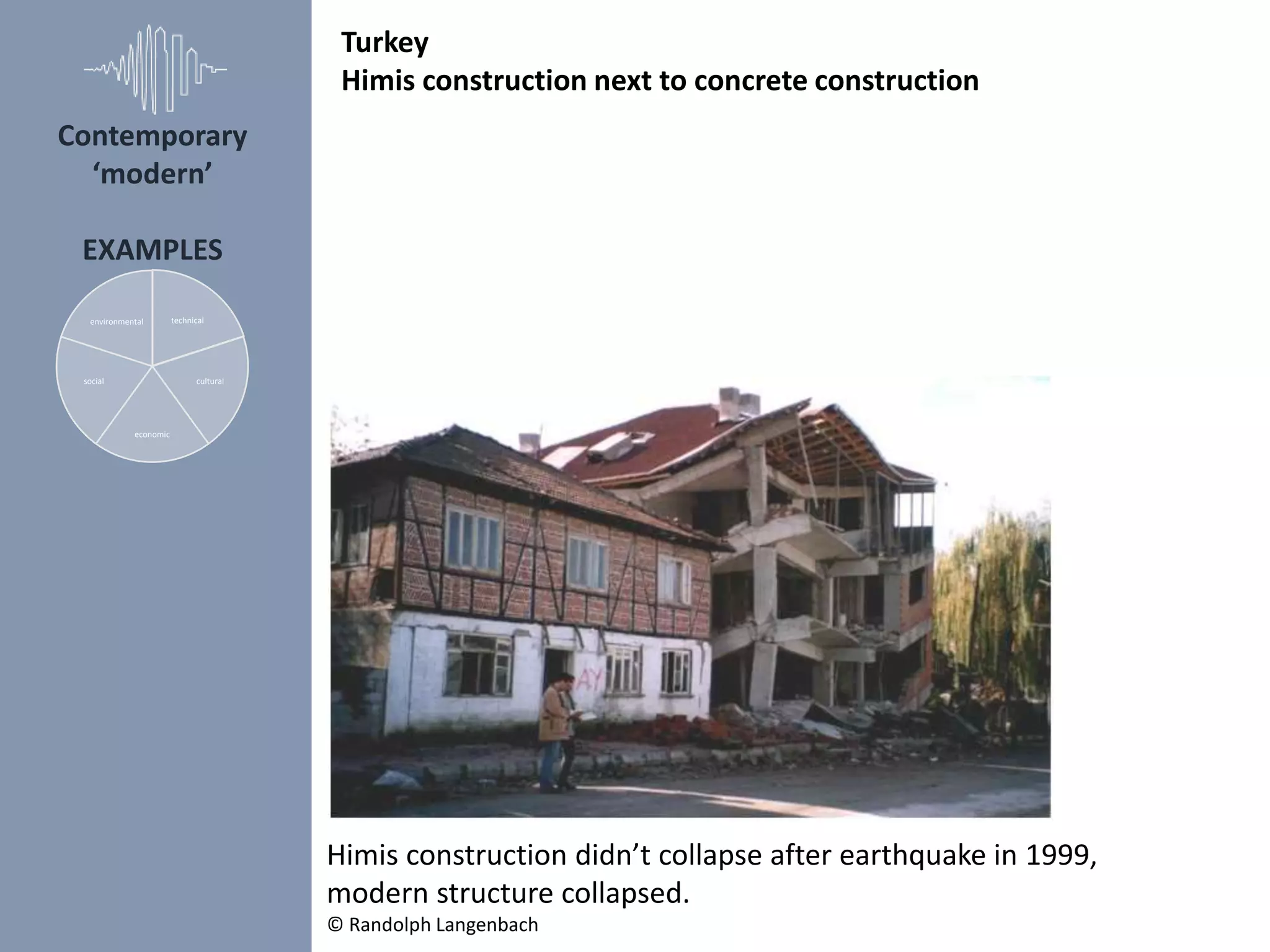
Turkey
Himis construction next to concrete construction
Himis construction didn’t collapse after earthquake in 1999,
modern structure collapsed.
© Randolph Langenbach
Contemporary
‘modern’
EXAMPLES
technical
cultural
economic
social
environmental
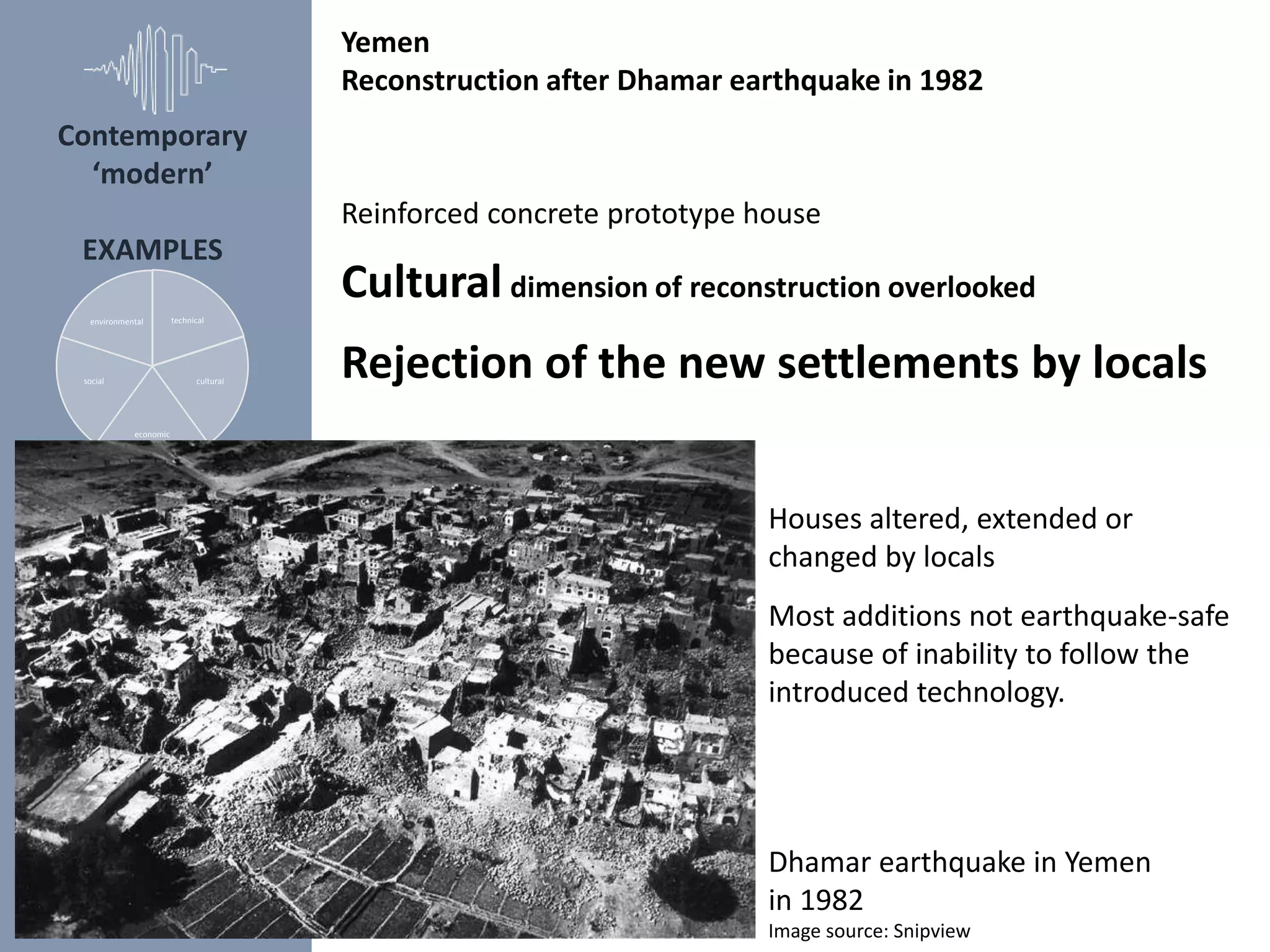
Yemen
Reconstruction after Dhamar earthquake in 1982
Image source: Snipview
Dhamar earthquake in Yemen
in 1982
Cultural dimension of reconstruction overlooked
Rejection of the new settlements by locals
Reinforced concrete prototype house
Houses altered, extended or
changed by locals
Most additions not earthquake-safe
because of inability to follow the
introduced technology.
Contemporary
‘modern’
EXAMPLES
technical
cultural
economic
social
environmental
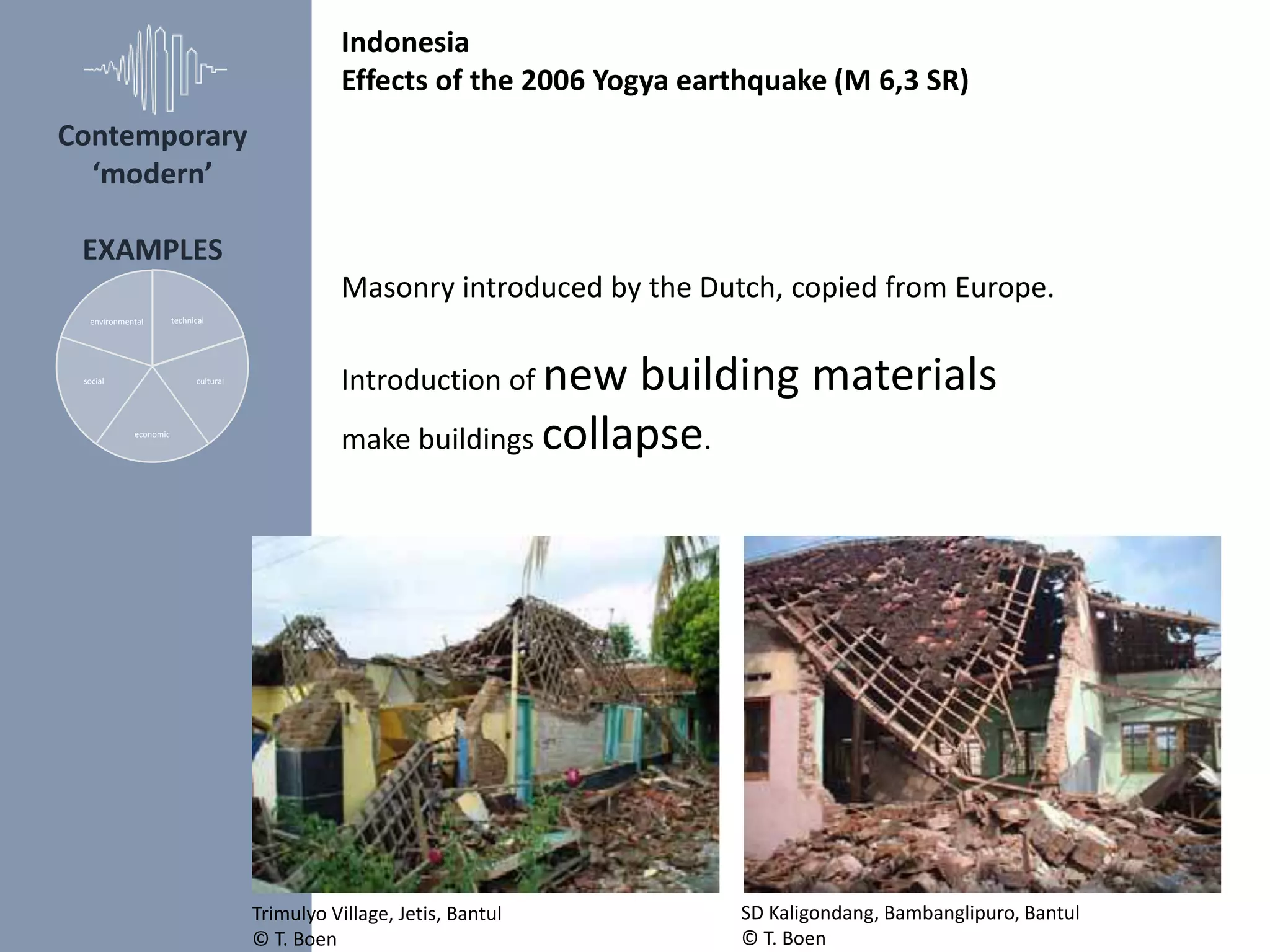
Indonesia
Effects of the 2006 Yogya earthquake (M 6,3 SR)
Masonry introduced by the Dutch, copied from Europe.
Introduction of new building materials
make buildings collapse.
Trimulyo Village, Jetis, Bantul
© T. Boen
SD Kaligondang, Bambanglipuro, Bantul
© T. Boen
Contemporary
‘modern’
EXAMPLES
technical
cultural
economic
social
environmental
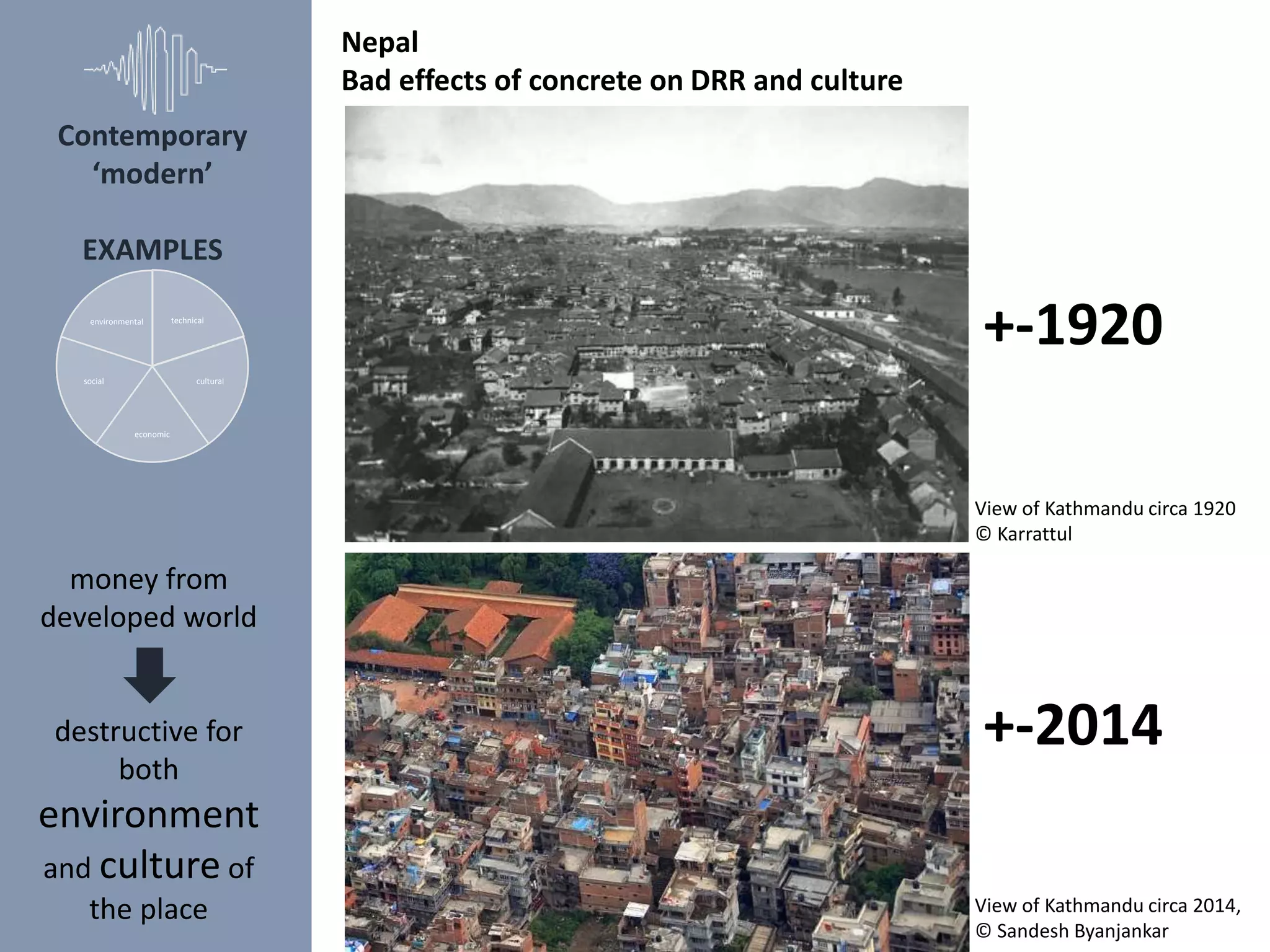
Nepal
Bad effects of concrete on DRR and culture
money from
developed world
destructive for
both
environment
and culture of
the place View of Kathmandu circa 2014,
© Sandesh Byanjankar
View of Kathmandu circa 1920
© Karrattul
+-1920
+-2014
Contemporary
‘modern’
EXAMPLES
technical
cultural
economic
social
environmental
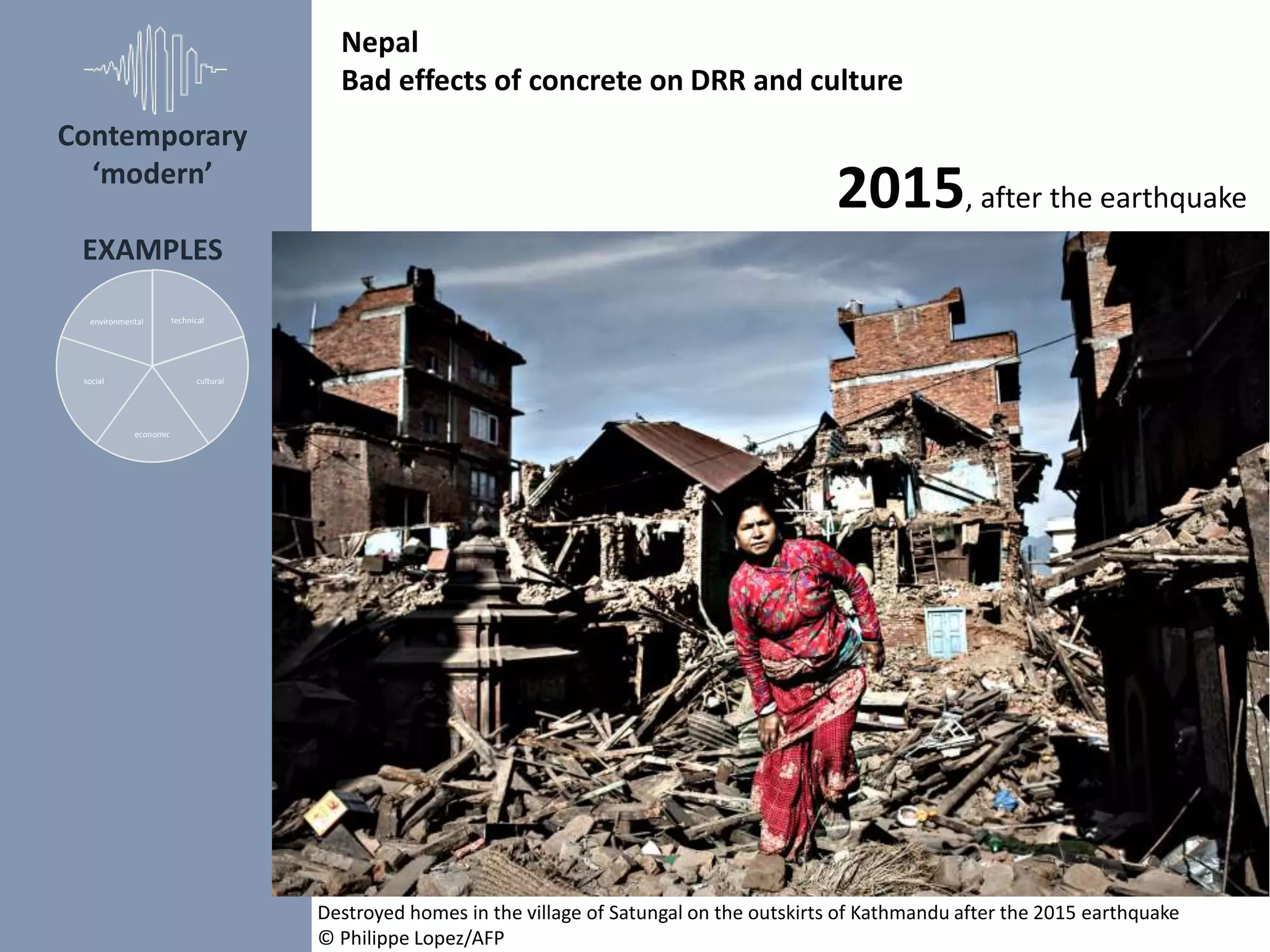
Nepal
Bad effects of concrete on DRR and culture
Destroyed homes in the village of Satungal on the outskirts of Kathmandu after the 2015 earthquake
© Philippe Lopez/AFP
2015, after the earthquake
Natural hazards
International DRR policy
Non-engineered
construction
Vernacular architecture
Contemporary vernacular
Policy opportunities
Challenges – needs
INDRA
INDRA
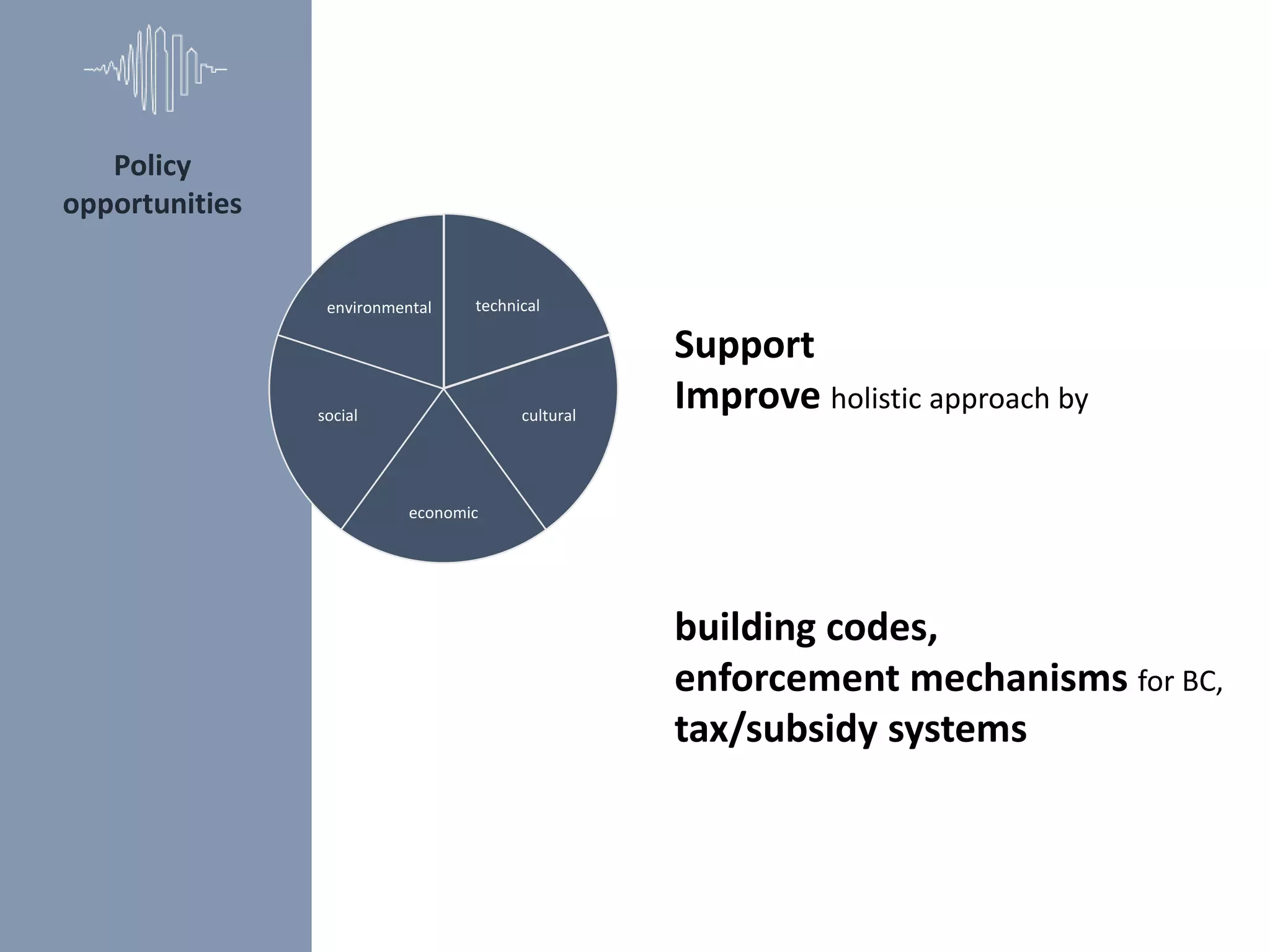
Policy
opportunities
Support
Improve holistic approach by
building codes,
enforcement mechanisms for BC,
tax/subsidy systems
technical
cultural
economic
social
environmental
Policy
opportunities
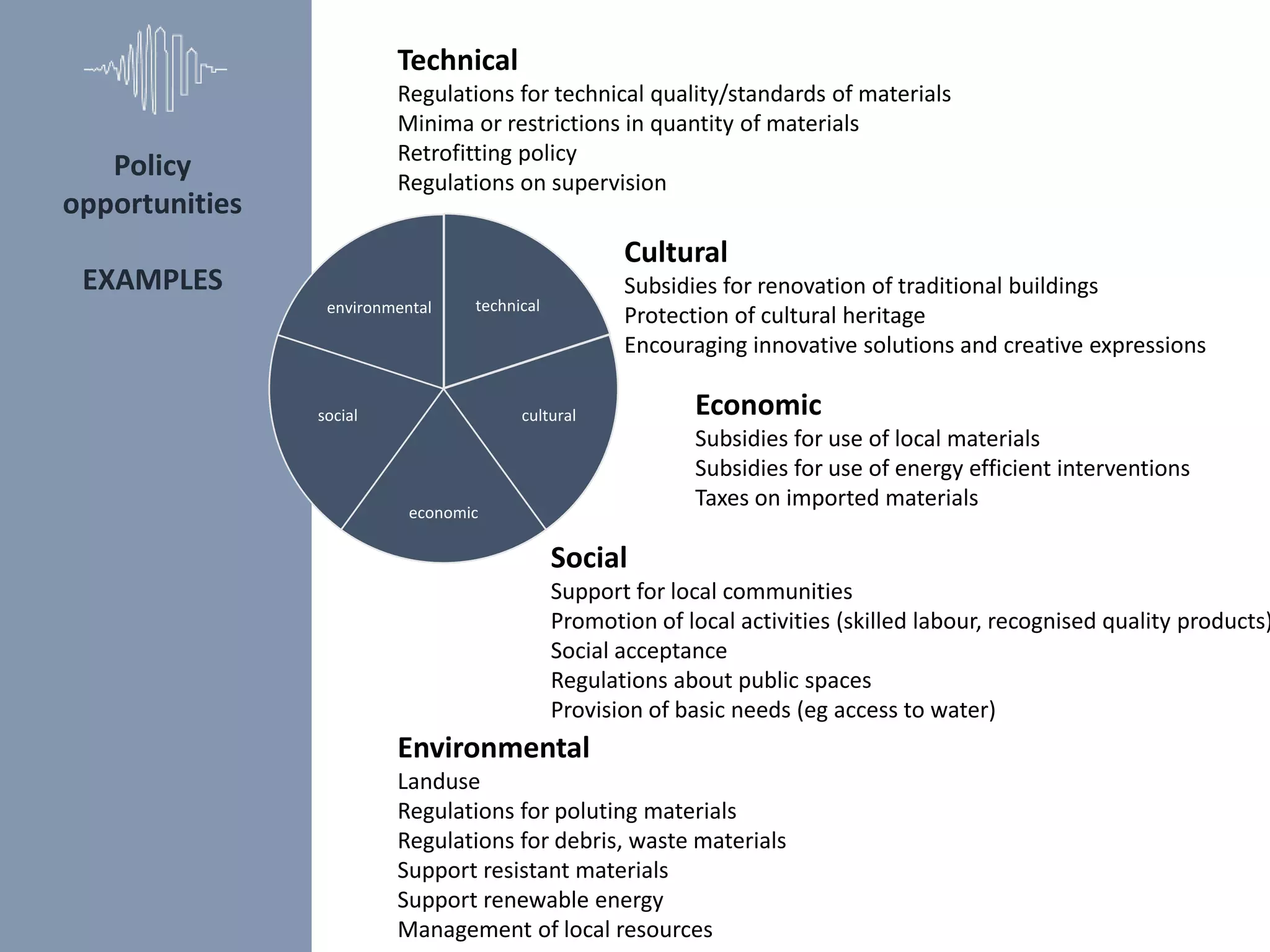
EXAMPLES
technical
cultural
economic
social
environmental
Technical
Regulations for technical quality/standards of materials
Minima or restrictions in quantity of materials
Retrofitting policy
Regulations on supervision
Environmental
Landuse
Regulations for poluting materials
Regulations for debris, waste materials
Support resistant materials
Support renewable energy
Management of local resources
Economic
Subsidies for use of local materials
Subsidies for use of energy efficient interventions
Taxes on imported materials
Cultural
Subsidies for renovation of traditional buildings
Protection of cultural heritage
Encouraging innovative solutions and creative expressions
Social
Support for local communities
Promotion of local activities (skilled labour, recognised quality products)
Social acceptance
Regulations about public spaces
Provision of basic needs (eg access to water)
Natural hazards
International DRR policy
Non-engineered
construction
Vernacular architecture
Contemporary vernacular
Policy opportunities
Challenges – needs
INDRA
INDRA
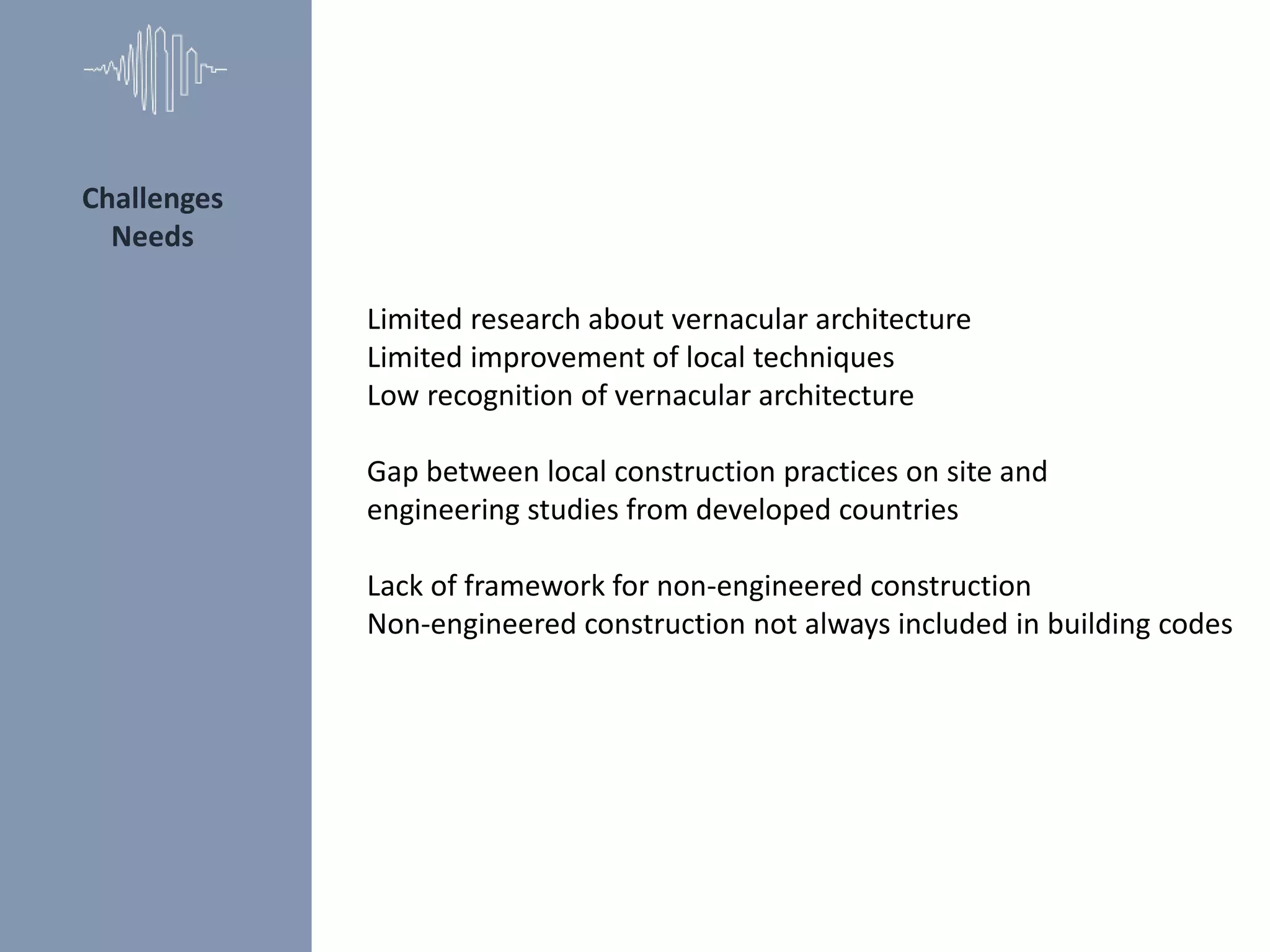
Limited research about vernacular architecture
Limited improvement of local techniques
Low recognition of vernacular architecture
Gap between local construction practices on site and
engineering studies from developed countries
Lack of framework for non-engineered construction
Non-engineered construction not always included in building codes
Challenges
Needs
Natural hazards
International DRR policy
Non-engineered
construction
Vernacular architecture
Contemporary vernacular
Policy opportunities
Challenges – needs
INDRA
INDRA
INternational Disaster Resilient
Architecture
Raise awareness
Stimulate research
Facilitate policy setting
Foster collaboration
Exchange knowledge
Disaster
resilient
VERNACULAR
ARCHITECTURE
science,
technology
& innovation
Disaster resilient
CONTEMPORARY
ARCHITECTURE
Disaster resilient
BUILT
ENVIRONMENT
PAST PRESENT FUTURE
*
*
Objective
INDRA
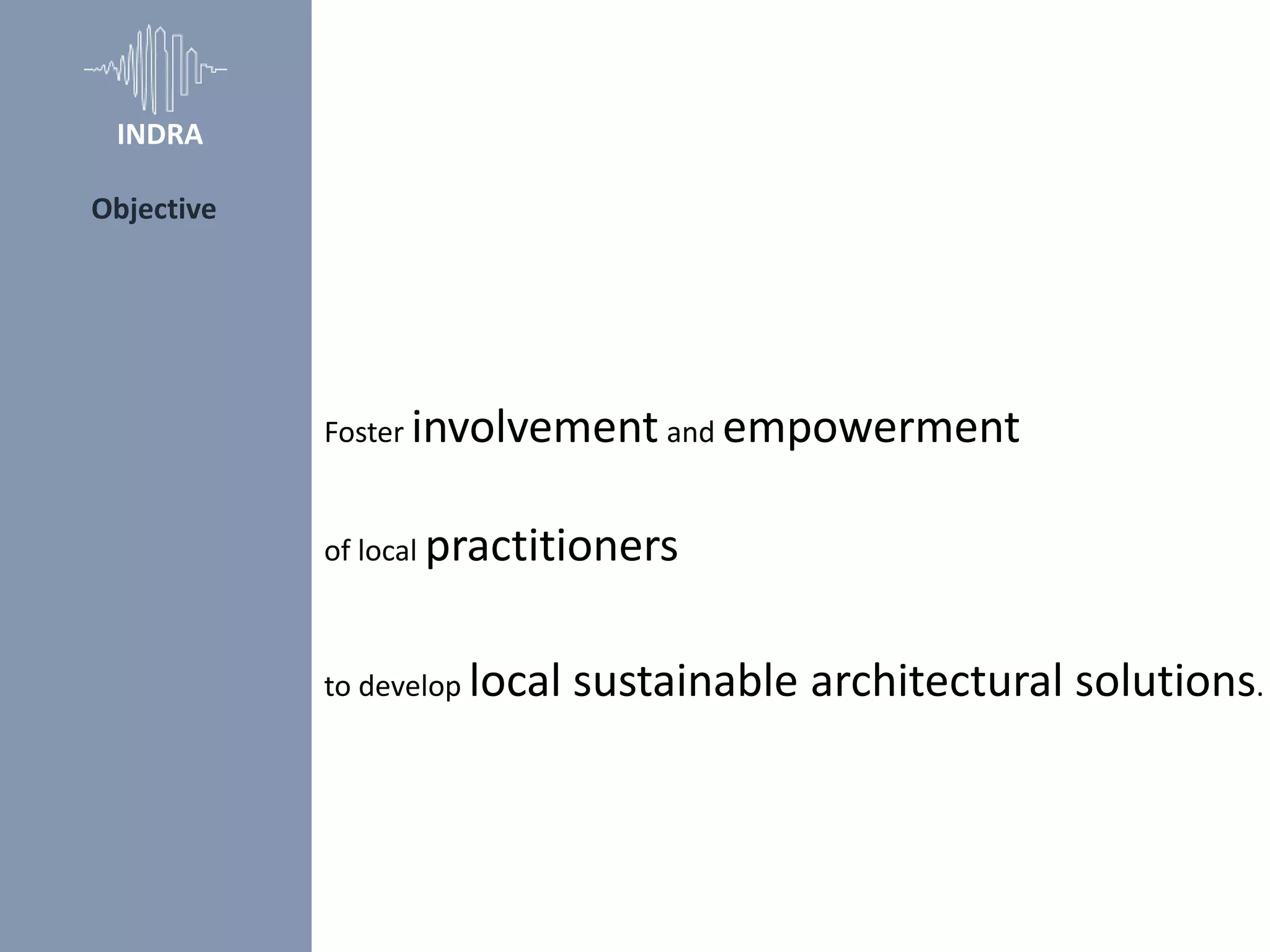
Foster involvement and empowerment
of local practitioners
to develop local sustainable architectural solutions.
Objective
INDRA
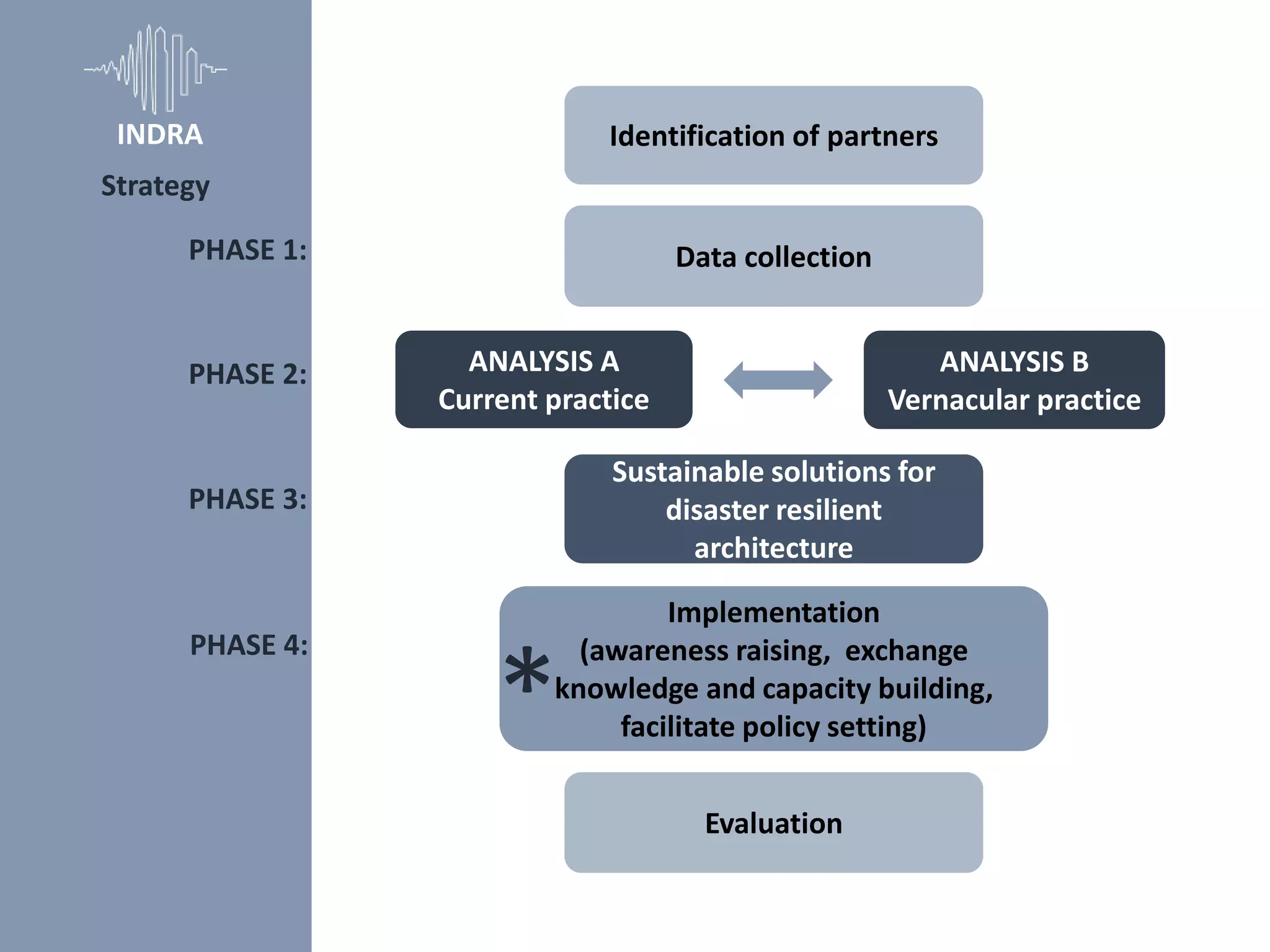
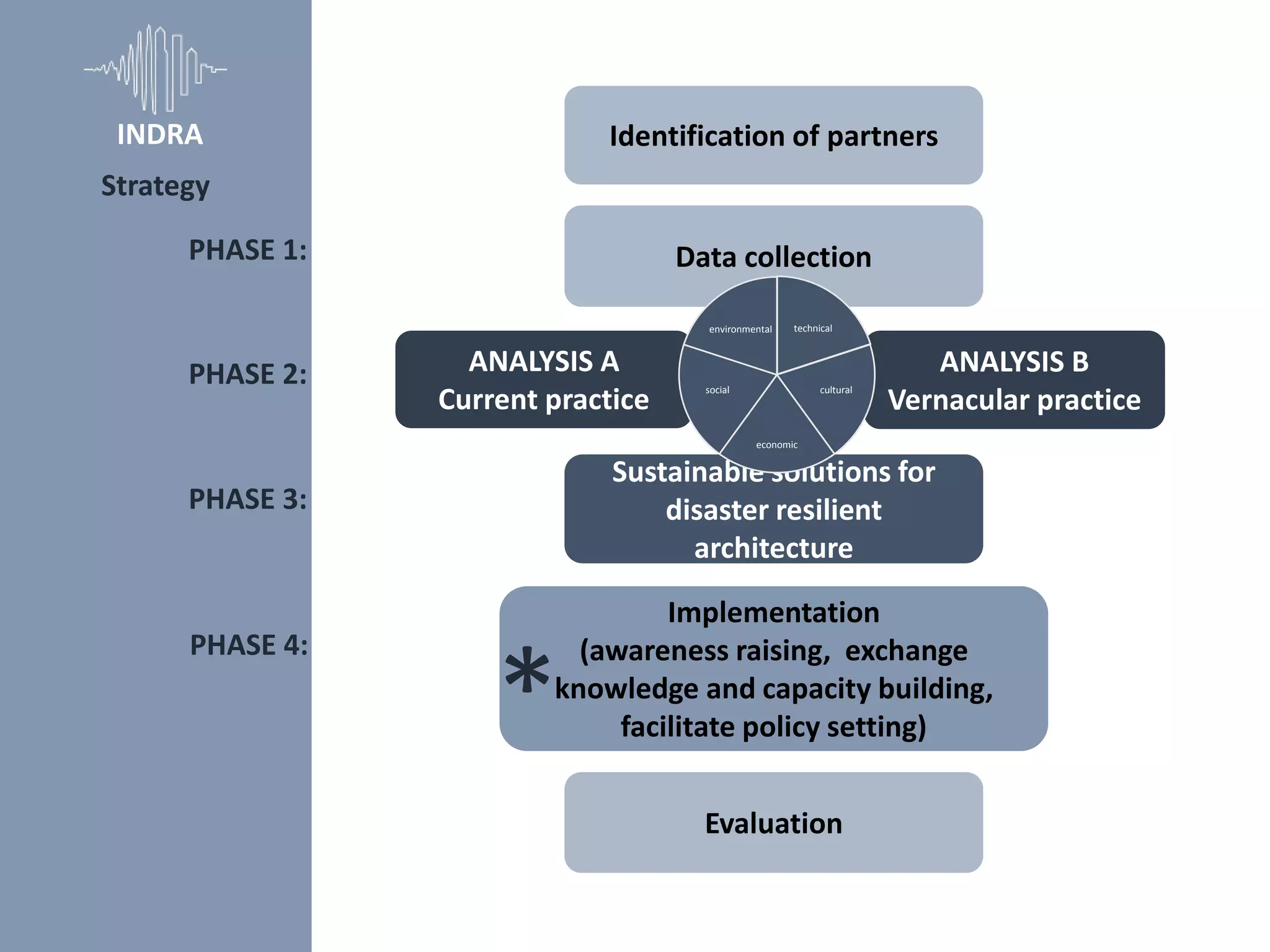
PHASE 1:
ANALYSIS A
Current practice
ANALYSIS B
Vernacular practice
Sustainable solutions for
disaster resilient
architecture
Implementation
(awareness raising, exchange
knowledge and capacity building,
facilitate policy setting)
Data collection
PHASE 2:
PHASE 3:
PHASE 4:
Identification of partners
Evaluation
*
Strategy
INDRA
PHASE 1:
ANALYSIS A
Current practice
ANALYSIS B
Vernacular practice
Sustainable solutions for
disaster resilient
architecture
Implementation
(awareness raising, exchange
knowledge and capacity building,
facilitate policy setting)
Data collection
PHASE 2:
PHASE 3:
PHASE 4:
Identification of partners
Evaluation
*
technical
cultural
economic
social
environmental
Strategy
INDRA
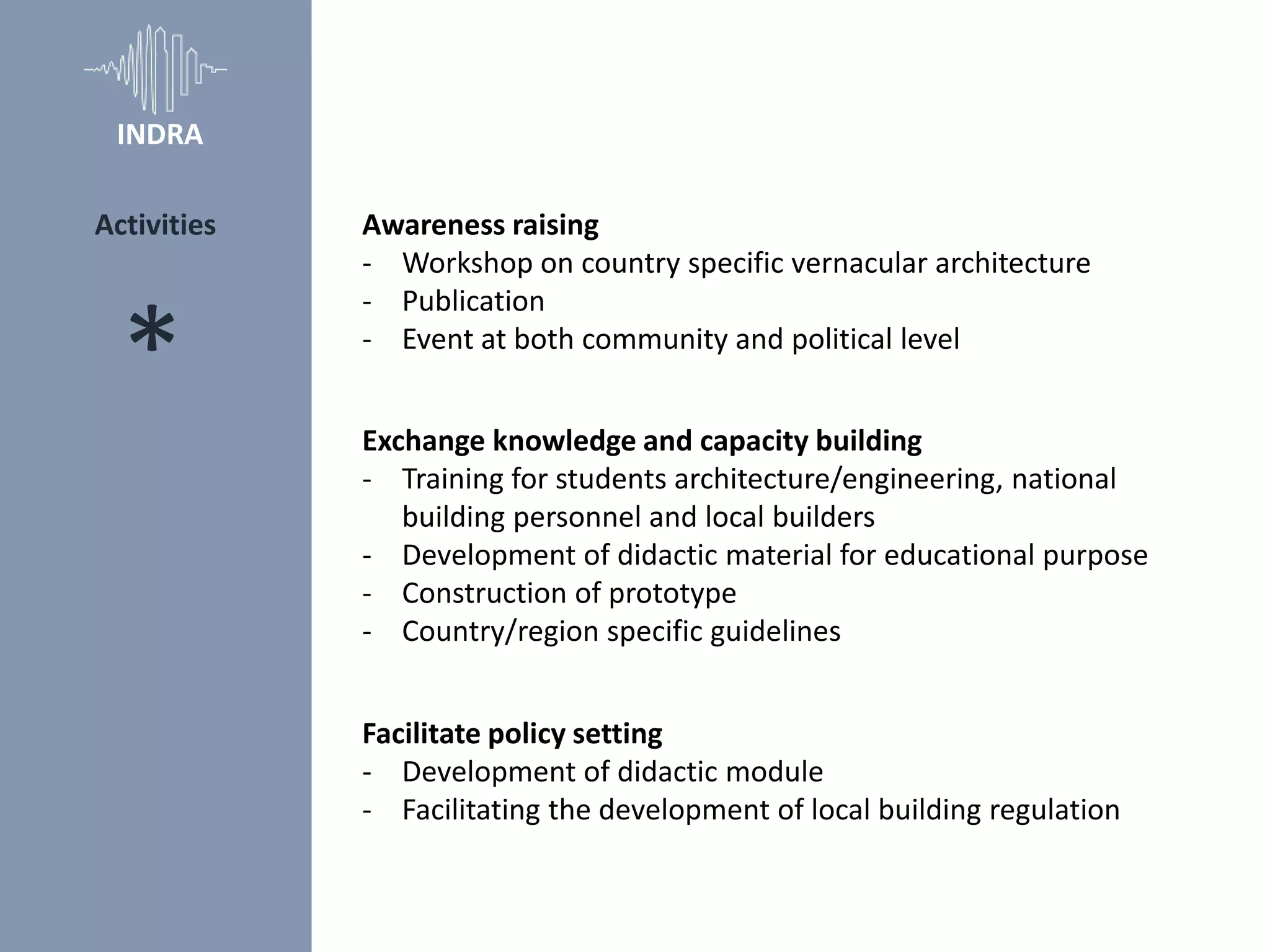
Awareness raising
- Workshop on country specific vernacular architecture
- Publication
- Event at both community and political level
Exchange knowledge and capacity building
- Training for students architecture/engineering, national
building personnel and local builders
- Development of didactic material for educational purpose
- Construction of prototype
- Country/region specific guidelines
Facilitate policy setting
- Development of didactic module
- Facilitating the development of local building regulation
*
Activities
INDRA
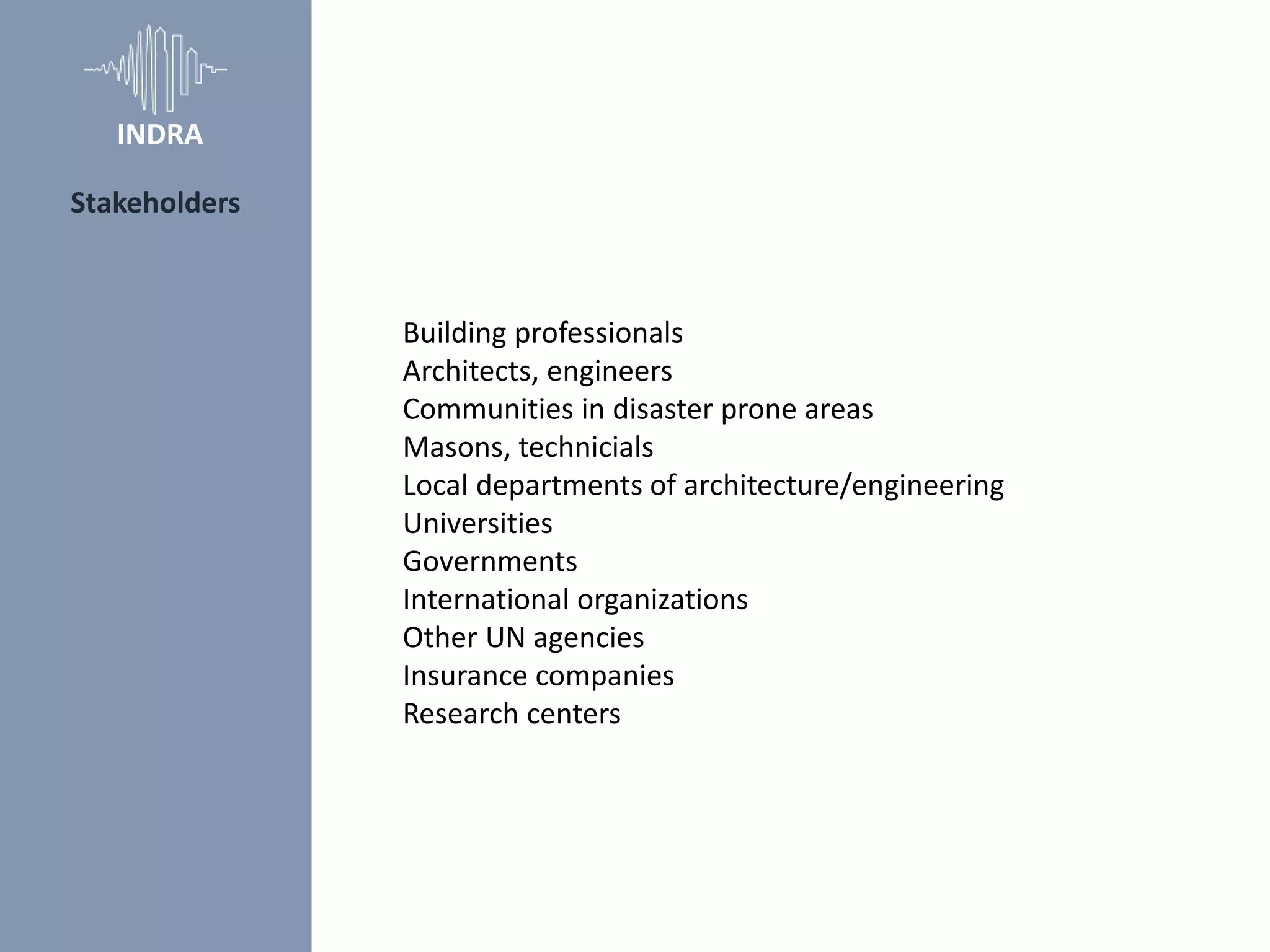
Building professionals
Architects, engineers
Communities in disaster prone areas
Masons, technicials
Local departments of architecture/engineering
Universities
Governments
International organizations
Other UN agencies
Insurance companies
Research centers
Stakeholders
INDRA
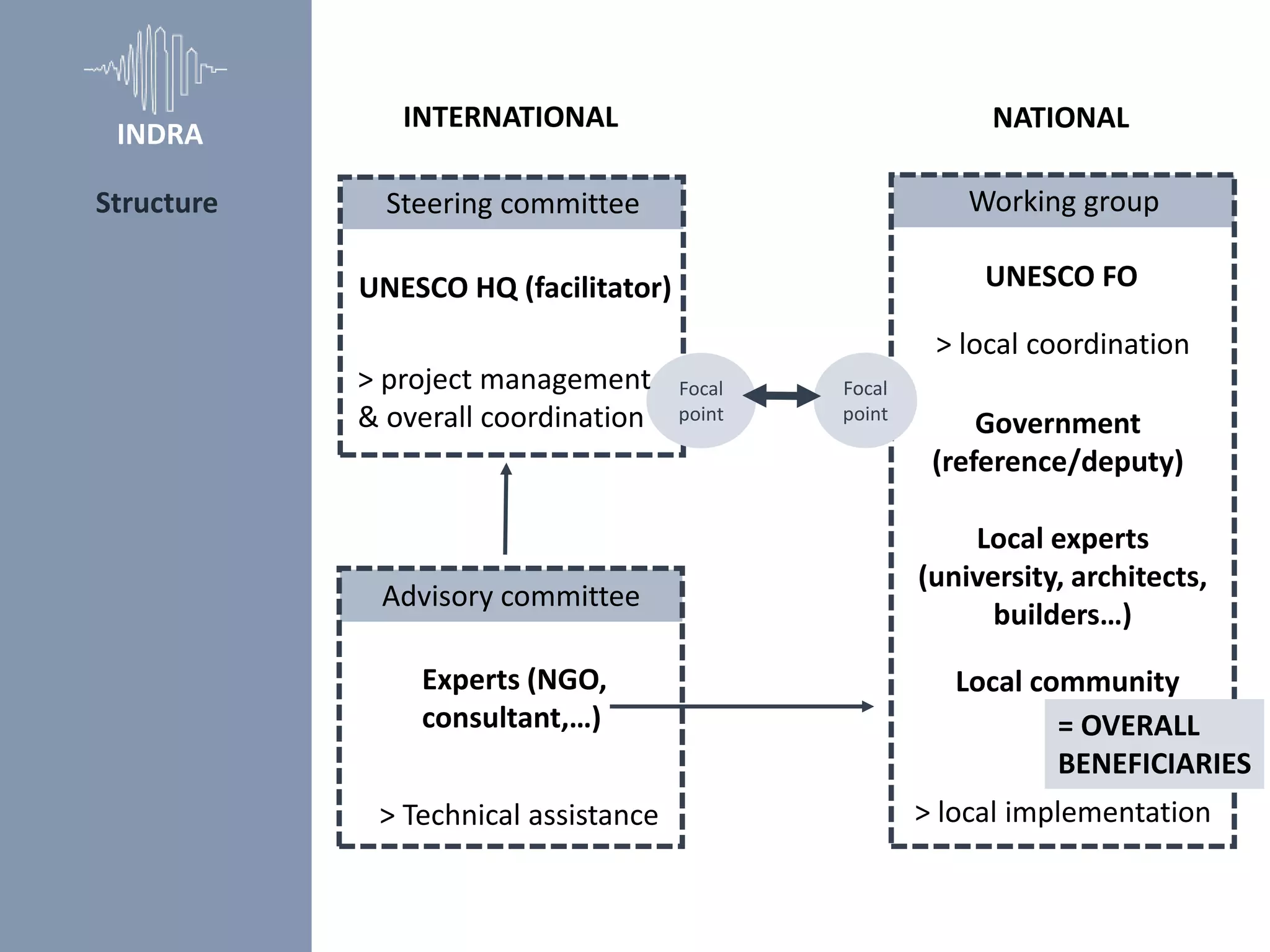
UNESCO HQ (facilitator) UNESCO FO
INTERNATIONAL NATIONAL
Experts (NGO,
consultant,…)
Government
(reference/deputy)
Local experts
(university, architects,
builders…)
Local community
Steering committee
Advisory committee
Working group
= OVERALL
BENEFICIARIES
Structure
Focal
point
Focal
point
> local implementation
> project management
& overall coordination
> Technical assistance
> local coordination
INDRA
INDRA
ONE MAN CANNOT BUILD A HOUSE,
BUT 10 MEN CAN EASILY
BUILD 20 HOUSES.
NUBIAN PROVERB
INDRA
Please contact
Soichiro Yasukawa s.yasukawa@unesco.org
Leontien Bielen l.bielen@unesco.org
A Holistic Approach Towards International Disaster Resilient Architecture by Learning from Vernacular Architecture, Soichiro YASUKAWA

A Holistic Approach Towards International Disaster Resilient Architecture by Learning from Vernacular Architecture, Soichiro YASUKAWA

  • 1.
    INternational D i sa s t e r R e s i l i e n t Architecture A holistic approach towards International Disaster Resilient Architecture by learning from vernacular construction Soichiro Yasukawa Programme Specialist of DRR UNESCO
  • 2.
    Natural hazards International DRRpolicy Non-engineered construction Vernacular architecture Contemporary vernacular Policy opportunities Challenges – needs INDRA INternational D i s a s t e r R e s i l i e n t Architecture
  • 3.
    Natural hazards International DRRpolicy Non-engineered construction Vernacular architecture Contemporary vernacular Policy opportunities Challenges – needs INDRA INDRA
  • 4.
    Natural hazards World map ByMunich EARTHQUAKES TROPICAL CYCLONES VOLCANOES TSUNAMIS AND STORMS
  • 5.
    Natural hazards Numbers Impact ofnatural hazards from 2000 to 2016
  • 6.
  • 7.
    Number of disastersper type and per year Natural hazards Trends
  • 8.
  • 9.
  • 10.
    More disasters bynatural hazards Human + economic losses More vulnerable people due to urbanization Most affected = developing countries Natural hazards International DRR policy Non-engineered construction Vernacular architecture Contemporary vernacular Policy opportunities Challenges – needs INDRA INDRA
  • 11.
    Natural hazards International DRRpolicy Non-engineered construction Vernacular architecture Contemporary vernacular Policy opportunities Challenges – needs INDRA INDRA
  • 12.
    Sendai Framework for DisasterRisk Reduction 2015‐2030 (priority 1) Understanding disaster risk (priority 2) Strengthening disaster risk governance to manage disaster risk (Priority 3) Investing in disaster risk reduction for resilience (Priority 4) Build back better in recovery, rehabilitation and reconstruction
  • 13.
    11.1 Ensure accessfor all to adequate, safe and affordable housing and basic services and upgrade slums 11.3 enhance inclusive and sustainable urbanization and capacity for participatory, integrated and sustainable human settlement planning and management in all countries 11.4 strengthening efforts to protect and safeguard the world’s cultural and natural heritage 11.5 significantly reduce the number of deaths and the number of people affected and substantially decrease the direct economic losses relative to global gross domestic product caused by disasters, including water-related disasters, with a focus on protecting the poor and people in vulnerable situations 11.b substantially increase the number of cities and human settlements adopting and implementing integrated policies and plans towards inclusion, resource efficiency, mitigation and adaptation to climate change, resilience to disasters, and develop and implement, in line with the Sendai Framework for Disaster Risk Reduction 2015-2030, holistic disaster risk management at all levels 11.c Support least developed countries, including through financial and technical assistance, in building sustainable and resilient buildings utilizing local materials 17.6 Enhance North-South, South-South and triangular regional and international cooperation on and access to science, technology and innovation and enhance knowledge sharing on mutually agreed terms, including through improved coordination among existing mechanisms, in particular at the United Nations level, and through a global technology facilitation mechanism 17.8 Fully operationalize the technology bank and science, technology and innovation capacity-building mechanism for least developed countries by 2017 and enhance the use of enabling technology, in particular information and communications technology 2030 Agenda for Sustainable Development
  • 14.
    UN Plan ofAction on DRR provides for UN system-wide and joined-up strategic approaches for integrating DRR and climate change adaptation in UN development efforts. Aim of the commitments: 1) strengthen system-wide coherence in support of the Sendai Framework and other agreements, through a risk-informed and integrated approach 2) build UN system capacity to deliver coordinated, high-quality support to countries on DRR 3) to ensure DRR remains a strategic priority for UN organizations. UN Plan of Action on DRR
  • 15.
    Natural hazards International DRRpolicy Non-engineered construction Vernacular architecture Contemporary vernacular Policy opportunities Challenges – needs INDRA INDRA
  • 16.
    0 100000 200000 300000 400000 500000 0 500 10001500 2000 2500 3000 Totaldeaths Occurence Impact of natural hazards from 2000 - 2015 Earthquake Non-engineered construction Tsunami Volcano Landslide Drought Flood FAILURE OF BUILDINGS
  • 17.
    Non-engineered construction +- 80%of people at risk today live in reinforced concrete frame infill-masonry buildings dixit Fouad Bendimerad, Director of the Earthquakes and Megacities Initiative at the 13th World Conference on Earthquake Engineering in August 2004 Reinforced concrete frame building with brick infill walls under construction, Kathmandu, Nepal (© J. Bothara)
  • 18.
    Non-engineered construction Turkey - İzmitearthquake 1999 In Golcuk: 290 deaths 287 in reinforced concrete structures 3 in traditional-style buildings 789 traditional buildings 701 undamaged 814 reinforced concrete buildings 550 undamaged 4 traditional buildings collapsed 60 reinforced concrete buildings collapsed Philippines - 1990 earthquake Damage at 90% non-engineered construction with 'modern' building materials Indonesia - Yogya earthquake 2006 Mostly non-engineered construction collapsed
  • 19.
    Non-engineered construction A slum inHaiti damaged by the 2010 earthquake. © UN Photo/Logan Abassi United Nations Development Programme Major losses in non-engineered construction Floods in the outskirts of Islamabad, Pakistan, 2014 © Photo by AP
  • 20.
    Non-engineered construction CHARACTERISTICS - Often copiedfrom other countries - (partly) imported materials - ‘foreign’ techniques, lack of technical know-how - Highly vulnerable to natural hazards = Informally constructed, without any or little intervention by qualified architects and engineers
  • 21.
    Non-engineered earthen construction +-1.7 billion peopleof the worlds population live in earthen houses About 50 % of the population in developing countries, and at least 20% of urban and suburban populations.
  • 22.
    Non-engineered slums 0-10% 10-20% 20-30%30-40% 40-50% 50-60% 60-70% 70-80% 80-90% 90-100% No data Fabienkhan & Korrigan Data from UN-HABITAT, Global Urban Observatory, 2001 estimates Proportion of each country's urban population living in slums (2001, according to UN-Habitat definition) 828 million peoplelive in slums today and the number keeps rising
  • 23.
    Natural hazards International DRRpolicy Non-engineered construction Vernacular architecture Contemporary vernacular Policy opportunities Challenges – needs INDRA Failure of buildings Mostly non-engineered construction These hazards are within our power to respond to! Retrofitting Build back better New construction
  • 24.
    Natural hazards International DRRpolicy Non-engineered construction Vernacular architecture Contemporary vernacular Policy opportunities Challenges – needs INDRA INDRA
  • 25.
    Natural hazards International DRRpolicy Non-engineered construction Vernacular architecture Contemporary vernacular Policy opportunities Challenges – needs INDRA - Often copied from other countries - (Partly) imported materials - ‘Foreign’ techniques, lack of technical know-how - Highly vulnerable to natural hazards = Informally constructed, without any or little intervention by qualified architects and engineers - Adapted to local context - Local materials - Accumulated knowledge - Mostly resilient to natural hazards Vernacular architecture Non-engineered construction
  • 26.
    - Adapted toits environment, provides a vital connection between humans and the environment - Culturally connected to its surroundings - Harmonious architecture - Local materials, colors, genre, spatial language, form - Connected with the community - Green architectural principles, climate responsive architecture - Energy efficiency - Materials and resources from proximity of site Vernacular architecture
  • 27.
    Vernacular architecture HOLISTIC APPROACH technical cultural economic social environmental Technical Creating a safeenvironment by reduction of effects of natural hazards Cultural Protection of cultural landscape Encouraging innovative solutions and creativity Expressing traditional skills and knowledge + transferring Aknowledging the accumulated experience Evolving regional identity Economic Support autonomy and self-sufficiency Promotion of local trade, employment, production, processing Optimization of energy needed to build Sustainable through time and long-term use Saving and prevention of local resources Social Encouraging social cohesion Facilitate exchanges among neighbors Express social acceptance Community involvement throughout the entire process Ownership Environmental Respect nature, ecosystem Climate-responsive approach Integration in the environment Reduce pollution and waste materials, optimize resources Contribute to health quality, healty environment Reduction of natural hazards effects Energy efficient
  • 28.
    Northern Pakistan –Kashmir Dhajji dewari and taq construction Resilient to earthquakes 2005 earthquake: many concrete buildings collapsed, 80 000 people died in concrete and rubble construction but traditional construction resisted (timber laced masonry) > govt approved reconstruction following traditional methods and assisted new construction of 250 000 houses technical cultural economic social environmental UNESCO 2007 poster Vernacular architecture CASES
  • 29.
    technical cultural economic social environmental A stilt-house constructed ofsal wood and stuccoed bamboo weaving Shani-Arjun, Jhapa Rajbanshi construction in eastern Nepal: resilient to earthquakes + floods Gurung houses in western mid-hill: resilient to earthquakes Gurung houses Nepal Rajbanshi and Gurung construction Resilient to earthquakes and/or floods Vernacular architecture CASES
  • 30.
    technical cultural economic social environmental 1912 Peabody Housein Pacot survived the 2010 earthquake almost undamaged Haiti Gingerbread houses Resilient to earthquakes Vernacular architecture CASES
  • 31.
    technical cultural economic social environmental Indonesia Traditional construction inNias Resilient to earthquakes and floods Vernacular architecture CASES
  • 32.
    technical cultural economic social environmental © Teo Tuvale ©Charles S. Greene Samoa Fale tele construction Resilient to floods, storms, cyclones Vernacular architecture CASES
  • 33.
    technical cultural economic social environmental Himis construction didn’tcollapse after earthquake in 1999, modern structure collapsed. © Randolph Langenbach Turkey Himis construction Resilient to earthquakes Vernacular architecture CASES
  • 34.
  • 35.
    Natural hazards International DRRpolicy Non-engineered construction Vernacular architecture Contemporary vernacular Policy opportunities Challenges – needs INDRA INDRA
  • 36.
  • 37.
    = An earthquakehazard mitigation proposal for vulnerable reinforced concrete buildings based on the performance of traditional timber and masonry infill-wall construction ‘Pombalino ‘gaiola’ construction: Anti-seismic structure of timber enclosed in masonry walls, aiming to provide resistance to horizontal forces. Developed after Lisbons devastating earthquake (1755). © Julio Amorim Armature crosswalls Resilient to earthquakes (by R. Langenbach) Contemporary vernacular EXAMPLES
  • 38.
    Emergency shelter tobe built from rubble, 2015 © VAN, courtesy of Shigeru Ban Architects Japan Nepal Emergency shelter by arch. Shigeru Ban (Japan) Resilient to earthquakes technical cultural economic social environmental Contemporary vernacular EXAMPLES
  • 39.
    technical cultural economic social environmental Shelter by YasmeenLari, 2005 Pakistan Shelter by arch. Yasmeen Lari Resilient to floods Contemporary vernacular EXAMPLES
  • 40.
    technical cultural economic social environmental Vietnam Re-ainbow project byH & P Architects Resilient to extreme weather events: heavy winds, storms Shelter by H & P Architects, 2015 Contemporary vernacular EXAMPLES
  • 41.
    Contemporary vernacular EXAMPLES technical cultural economic social environmental Thailand Baan Nhongbua schoolby Junsekino Architects Resilient to earthquakes, floods Thailand: reconstruction of the Baan Nhongbua school by Junsekino architects. Merges Western and Thai traditions, 2015
  • 42.
  • 43.
    Contemporary ‘modern’ EXAMPLES technical cultural economic social environmental Turkey Himis construction nextto concrete construction Himis construction didn’t collapse after earthquake in 1999, modern structure collapsed. © Randolph Langenbach
  • 44.
    Contemporary ‘modern’ EXAMPLES technical cultural economic social environmental Yemen Reconstruction after Dhamarearthquake in 1982 Image source: Snipview Dhamar earthquake in Yemen in 1982 Cultural dimension of reconstruction overlooked Rejection of the new settlements by locals Reinforced concrete prototype house Houses altered, extended or changed by locals Most additions not earthquake-safe because of inability to follow the introduced technology.
  • 45.
    Contemporary ‘modern’ EXAMPLES technical cultural economic social environmental Indonesia Effects of the2006 Yogya earthquake (M 6,3 SR) Masonry introduced by the Dutch, copied from Europe. Introduction of new building materials make buildings collapse. Trimulyo Village, Jetis, Bantul © T. Boen SD Kaligondang, Bambanglipuro, Bantul © T. Boen
  • 46.
    Contemporary ‘modern’ EXAMPLES technical cultural economic social environmental Nepal Bad effects ofconcrete on DRR and culture money from developed world destructive for both environment and culture of the place View of Kathmandu circa 2014, © Sandesh Byanjankar View of Kathmandu circa 1920 © Karrattul +-1920 +-2014
  • 47.
    Contemporary ‘modern’ EXAMPLES technical cultural economic social environmental Nepal Bad effects ofconcrete on DRR and culture Destroyed homes in the village of Satungal on the outskirts of Kathmandu after the 2015 earthquake © Philippe Lopez/AFP 2015, after the earthquake
  • 48.
    Natural hazards International DRRpolicy Non-engineered construction Vernacular architecture Contemporary vernacular Policy opportunities Challenges – needs INDRA INDRA
  • 49.
    Policy opportunities Support Improve holistic approachby building codes, enforcement mechanisms for BC, tax/subsidy systems technical cultural economic social environmental
  • 50.
    Policy opportunities EXAMPLES technical cultural economic social environmental Technical Regulations for technicalquality/standards of materials Minima or restrictions in quantity of materials Retrofitting policy Regulations on supervision Environmental Landuse Regulations for poluting materials Regulations for debris, waste materials Support resistant materials Support renewable energy Management of local resources Economic Subsidies for use of local materials Subsidies for use of energy efficient interventions Taxes on imported materials Cultural Subsidies for renovation of traditional buildings Protection of cultural heritage Encouraging innovative solutions and creative expressions Social Support for local communities Promotion of local activities (skilled labour, recognised quality products) Social acceptance Regulations about public spaces Provision of basic needs (eg access to water)
  • 51.
    Natural hazards International DRRpolicy Non-engineered construction Vernacular architecture Contemporary vernacular Policy opportunities Challenges – needs INDRA INDRA
  • 52.
    Limited research aboutvernacular architecture Limited improvement of local techniques Low recognition of vernacular architecture Gap between local construction practices on site and engineering studies from developed countries Lack of framework for non-engineered construction Non-engineered construction not always included in building codes Challenges Needs
  • 53.
    Natural hazards International DRRpolicy Non-engineered construction Vernacular architecture Contemporary vernacular Policy opportunities Challenges – needs INDRA INDRA
  • 54.
    INternational Disaster Resilient Architecture Raiseawareness Stimulate research Facilitate policy setting Foster collaboration Exchange knowledge Disaster resilient VERNACULAR ARCHITECTURE science, technology & innovation Disaster resilient CONTEMPORARY ARCHITECTURE Disaster resilient BUILT ENVIRONMENT PAST PRESENT FUTURE * * Objective INDRA
  • 55.
    Foster involvement andempowerment of local practitioners to develop local sustainable architectural solutions. Objective INDRA
  • 56.
    PHASE 1: ANALYSIS A Currentpractice ANALYSIS B Vernacular practice Sustainable solutions for disaster resilient architecture Implementation (awareness raising, exchange knowledge and capacity building, facilitate policy setting) Data collection PHASE 2: PHASE 3: PHASE 4: Identification of partners Evaluation * Strategy INDRA
  • 57.
    PHASE 1: ANALYSIS A Currentpractice ANALYSIS B Vernacular practice Sustainable solutions for disaster resilient architecture Implementation (awareness raising, exchange knowledge and capacity building, facilitate policy setting) Data collection PHASE 2: PHASE 3: PHASE 4: Identification of partners Evaluation * technical cultural economic social environmental Strategy INDRA
  • 58.
    Awareness raising - Workshopon country specific vernacular architecture - Publication - Event at both community and political level Exchange knowledge and capacity building - Training for students architecture/engineering, national building personnel and local builders - Development of didactic material for educational purpose - Construction of prototype - Country/region specific guidelines Facilitate policy setting - Development of didactic module - Facilitating the development of local building regulation * Activities INDRA
  • 59.
    Building professionals Architects, engineers Communitiesin disaster prone areas Masons, technicials Local departments of architecture/engineering Universities Governments International organizations Other UN agencies Insurance companies Research centers Stakeholders INDRA
  • 60.
    UNESCO HQ (facilitator)UNESCO FO INTERNATIONAL NATIONAL Experts (NGO, consultant,…) Government (reference/deputy) Local experts (university, architects, builders…) Local community Steering committee Advisory committee Working group = OVERALL BENEFICIARIES Structure Focal point Focal point > local implementation > project management & overall coordination > Technical assistance > local coordination INDRA
  • 61.
    INDRA ONE MAN CANNOTBUILD A HOUSE, BUT 10 MEN CAN EASILY BUILD 20 HOUSES. NUBIAN PROVERB
  • 62.
    INDRA Please contact Soichiro Yasukawas.yasukawa@unesco.org Leontien Bielen l.bielen@unesco.org

Editor's Notes

  • #2 Structure of the presentation with different chapters
  • #3 Structure of the presentation with different chapters
  • #4 Start with general overview of natural hazards
  • #5 Map shows all regions prone to natural hazards
  • #6 Some numbers about natural hazards, to show their impact. The impact of these natural hazards has been very high.
  • #7 Not only human losses but also economic losses are very high.
  • #8 Trends in natural hazards: Graph shows the number of disasters per year and per type, from 1950 to 2015. > disasters are increasing!
  • #9 Trends in natural hazards: Urbanization: urban population is growing fast > growing number of vulnerable people An enormous volume of capital is expected to flow into urban development in the coming decades, particularly in south Asia and sub Saharan Africa. Challenge + opportunity: +- 60% of the area expected to be urbanized by 2030, remains to be built
  • #10 Trends in natural hazards: Most affected people live in developing countries From 1970 to 2008 e.g., more than 95% of deaths from disasters caused by natural hazards, were in developing countries. The number of poor exposed to natural hazards will reach 325 million by 2030.
  • #11 Summary: Hazards are increasing Not only human but also huge economic losses Due to urbanization, the number of vulnerable people is also increasing Most affected are people in developing countries
  • #12 International DRR policy
  • #14 The SDGs call for safe housing, sustainable urbanization, safeguarding heritage, a holistic disaster risk management and resilient buildings. Moreover, they state to cooperate more and foster science, technology and innovation capacity-building mechanism.
  • #15 The UN Plan of Action on DRR calls for cooperation and coordinated, high-quality support. It aims also to ensure that DRR remains a priority for UN organizations.
  • #16 More detailed insight in where disasters occur the most and where and how the most affected people live.
  • #17 Graph of the impact of natural hazards from 2000-2015 - Number of deaths Occurrence of disasters > Floods occur the most, but EQ cause the most deaths because of failure of buildings
  • #18 Why failure of buildings? The inability of reinforced concrete to withstand a major earthquake when it is used incorrectly and with substandard building practices could lead to an unprecedented disaster. If used correctly and under the best conditions, concrete structures, reinforced with steel bars, can withstand earthquakes. The problem is that the methods and raw materials often are not ideal. And once a building is up, the quality of the concrete is nearly impossible to judge. CASE Turkey: (At the first Earthquake Safe International Conference, sponsored by UNESCO, Turkey's Ministry of Public Works, and the International Council on Monuments and Sites.) During the conference, Turkish architects Demet Gulhan and Inci Ozyoruk Guney presented the first hard evidence that people living in modern, reinforced concrete structures died at a much higher rate than people living in older, traditional houses during the Marmara earthquake. In one example from their study, the Sehitler district of Golcuk had a roughly equal number of reinforced concrete and traditional structures. Yet of the 290 deaths, 287 occurred in reinforced concrete structures and only three occurred in traditional-style buildings. Of the 789 traditional buildings, 701 survived the quake undamaged, but of the 814 reinforced concrete buildings, only 550 escaped damage.   Of the buildings that collapsed, only four were traditional buildings, while 60 were made of reinforced concrete. "Reinforced concrete frame structures presented a high level of damage due to low-quality concrete, inadequate engineering, incorrect construction techniques, poor detailing, inadequate inspection or observation of construction, and lax attitudes of authorities in the application of the building code," Gulhan said during her presentation.   Most of Turkey is considered vulnerable to earthquakes. Yet according to Turgut Cansever, one of the conference speakers, "approximately 70 percent of the building stock of Istanbul was built without technical assistance.“   Turkish architect Hayim Beraha, who was touring the settlement with Langenbach, was more direct. "This will collapse," he said. "These people are from the countryside. And where they came from, they used to know better. The problem is the perception that living in a modern house is living in a concrete house."
  • #19 Why failure of buildings? The inability of reinforced concrete to withstand a major earthquake when it is used incorrectly and with substandard building practices could lead to an unprecedented disaster. If used correctly and under the best conditions, concrete structures, reinforced with steel bars, can withstand earthquakes. The problem is that the methods and raw materials often are not ideal. And once a building is up, the quality of the concrete is nearly impossible to judge. CASE Turkey: (At the first Earthquake Safe International Conference, sponsored by UNESCO, Turkey's Ministry of Public Works, and the International Council on Monuments and Sites.) During the conference, Turkish architects Demet Gulhan and Inci Ozyoruk Guney presented the first hard evidence that people living in modern, reinforced concrete structures died at a much higher rate than people living in older, traditional houses during the Marmara earthquake. In one example from their study, the Sehitler district of Golcuk had a roughly equal number of reinforced concrete and traditional structures. Yet of the 290 deaths, 287 occurred in reinforced concrete structures and only three occurred in traditional-style buildings. Of the 789 traditional buildings, 701 survived the quake undamaged, but of the 814 reinforced concrete buildings, only 550 escaped damage. Of the buildings that collapsed, only four were traditional buildings, while 60 were made of reinforced concrete. "Reinforced concrete frame structures presented a high level of damage due to low-quality concrete, inadequate engineering, incorrect construction techniques, poor detailing, inadequate inspection or observation of construction, and lax attitudes of authorities in the application of the building code," Gulhan said during her presentation.   Most of Turkey is considered vulnerable to earthquakes. Yet according to Turgut Cansever, one of the conference speakers, "approximately 70 percent of the building stock of Istanbul was built without technical assistance.“   Turkish architect Hayim Beraha, who was touring the settlement with Langenbach, was more direct. "This will collapse," he said. "These people are from the countryside. And where they came from, they used to know better. The problem is the perception that living in a modern house is living in a concrete house."
  • #21 What is non-engineered construction?
  • #22 Specific type of non-engineered construction = earthen buildings
  • #23 Other form of non-engineered construction = slums
  • #24 Not only bad news but also opportunity.
  • #25 Specific type of non-engineered construction
  • #26 Before: what is non-engineered construction Characteristics of most non-engineered construction But: vernacular architecture: - Characteristics
  • #27 Characteristics
  • #28 Vernacular architecture follows a holistic approach and takes into account a combination of several aspects.
  • #29 Examples of vernacular architecture and its disaster resilience. “We have moved from a very efficient system to a very bad system,” says Iftikhar Ahmad Hakim, Chief Town Planner Kashmir.
  • #30 disaster resilient vernacular housing technology depending on region
  • #32 Since the March 2005 earthquake, the indigenous practices used to construct traditional houses in Nias have been studied and have gained a reputation for their earthquake resistant quality. However, whilst this example of indigenous practice is celebrated, the devastating impact of the March 2005 earthquake on Nias Island, its population and its economy, must not be forgotten. This seems ironic given that Nias Island was at the time and still is home to one of the world’s best example of earthquake resistant architecture. This irony shows us firstly that isolated examples of indigenous practice alone cannot contribute significantly to disaster risk reduction. Secondly, it demonstrates that as the traditional is given up in favor of the modern, communities can be left exposed to the risk of disasters. Modernization has played a big part in the rapidly disappearing traditional architecture of Nias. The status symbol which is represented by this shift to modern design and lifestyle is adequate reason for most people to choose the less resistant Malayan houses over the traditional wooden structures. Deforestation has exacerbated the situation. The hardwood needed to build traditional houses is in scarce supply. As a consequence many of the methods and techniques used to build traditional houses are slowly being forgotten since concrete and bricks have replaced timber as construction material.
  • #33 There are many examples of traditional building methods in Pacific islands. Due to the frequency of natural disasters in the region, many building styles demonstrate the traditional Samoan fale tele, which is mounted on a high stone foundation to prevent flooding and storm surges. It has a high dome ceiling to combat humidity and has open sides to allow winds to pass through. Such traditional dwellings incorporate architectural styles that enable them to withstand extreme weather and strong winds. Even in the event of the structure failing, replacement materials are readily available and sustainable, and the collapse generally would not injure the inhabitants. Many of the traditional aspects of vernacular housings in the Pacific have eroded with the introduction of Western building techniques and materials, including corrugated iron and concrete. Construction is often unregulated, and buildings are not built according to proper building standards and codes. This makes the Western-style buildings more vulnerable to environmental hazards and more dangerous to inhabitants.   In Samoa, the builders of houses were also the architects who belonged to an ancient guild of master builders, tufuga fau fale. The Samoan word tufuga denotes the status of master craftspeople or Living Human Treasures. The Post-Disaster Needs assessment following Cyclone Evan that hit Samoa in December 2012 recommended these skills will enhance the resilience of communities by reinvigorating the positive features of traditional buildings in Samoa. This will be particularly relevant as cyclone intensity is predicted to increase in the region due to climate change.
  • #35 The longhouse is considered to be one of the oldest architectural forms in Sarawak and can be found throughout Borneo Island Known as a “village under one roof,” a longhouse is a type of elevated communal dwelling comprising a series of interconnected apartments arranged linearly. Each apartment is connected to a communal gallery space on the side. On the other side of the apartments are kitchens and bathrooms. Longhouses are traditionally constructed of wood with a thatch roof, but more recently many have tin roofs. Example: longhouse burnt. Villagers began building individual temporary homes. Living in individual homes has resulted in a more visible and apparent difference of income between families, a factor which was less visible in the old longhouse. The longhouse’s communal gallery (ruai) has been lost, resulting in a loss of communication. This weakens the community, hinders development, and gives no opportunity for greeting guests, an important part of Iban custom. The longhouse is deeply rooted in Iban culture, encompassing many Iban traditions and values in its built form. Longhouse planning involves a long process of discussions, designing,… The longhouse stands as a built symbol of community collaboration, economic revitalization and pride that has conquered homelessness. The Iban are an ethnic group in the province of Sarawak, Malaysian Borneo, that traditionally lives in longhouses consisting of up to 100 family apartments. Communities in their egalitarian society choose their leaders and follow longstanding customs that maintain harmonious relationships between people.
  • #37 We can learn from vernacular architecture
  • #38 What can we learn from vernacular architecture? Examples
  • #39 In July 2015, Ban began a project to rebuild homes for the victims of Nepal Earthquake. The structures of the homes are wood framing for flexibility and built fully with brick walls: quick and easy to build. Also, the Nepali community can use them for many other purposes, such as schools etc. In his architecture, Shigeru Ban uses many themes and methods found in traditional Japanese architecture (such as shōji).
  • #40 Pakistan's first female architect One of the most successful providers of disaster relief shelters in the world. She has built more than 36,000 houses for victims of floods and earthquakes in Pakistan since 2010 using techniques from vernacular architecture (lime, mud bricks) lime mortar = limestone + sand used in 14th century necropolis ‘Makli’ = waterproof
  • #41 RE-AINBOW: 2015 = health station, public restrooms and ancillary areas, classroom, art performance theater, meeting place, sports fitness center, refreshment tent, areas for physical training such as volleyball, badminton, long jump, and other outdoor activities Re-use of waste items and efficient use of energy. A collection and reuse of a variety of old/ broken construction materials such as scaffolding steel pipes, sheet metals, bricks, ashlars, bathroom ware, tables and chairs,…with the local people’s involvement in manual construction are proposed in order to create a structure secure enough to stand heavy storms. Ventilation and natural lighting are also dealt with efficiently. Solar energy is converted into electricity for lighting facilities and heating water for daily use. Rain water and used water are also utilized.
  • #42 Elevated building Frame is designed to offer a degree of flexibility that could help to absorb vibrations in future earthquakes. circulation of natural air, and the penetration of natural light into the building
  • #43 Holistic approach is important. To show importance of holistic approach, here examples if this approach has not been followed.
  • #44 ‘Modern’ concrete frame building didn’t take into account environment, local building materials, local capacity, cultural aspects,…
  • #45 Prototype house layout was repeated in its thousands by different contractors on different sites, using the same technology of reinforced concrete. Cultural dimension of reconstruction overlooked. Result: total rejection of the new settlements by local people. Houses altered, extended or changed by locals. Consequence: most of the subsequent additions to houses did not have earthquake-safe features because of the inability to follow the introduced technology.
  • #46 Masonry introduced by the Dutch (19th century), copied from Europe. The strength of mortar is dependent on moisture. So buildings were annually white washed with porous mix so that rain could penetrate. BUT: introduction of new building materials > acrylic, weather shield paints. So rain cannot penetrate and mortar became brittle.
  • #47 Kathmandu: during the last half-century, huge transformation: Large amounts of money have flowed into the country from the developed world under the premise of improving the well-being of what has been viewed as an ‘underdeveloped’ country, , but much of this ‘development’ has been destructive of both the environment and the culture of the place.
  • #48 Kathmandu: during the last half-century, huge transformation: Large amounts of money have flowed into the country from the developed world under the premise of improving the well-being of what has been viewed as an ‘underdeveloped’ country, , but much of this ‘development’ has been destructive of both the environment and the culture of the place.
  • #49 The previous slides showed how important these 5 aspects are. Which role can policy play to ensure qualitative construction?
  • #50 Policy can support and improve this holistic approach by Building codes Enforcement mechanisms fro BC Tax/subsidy systems
  • #51 Examples of policy measures per aspect
  • #57 The strategy of the project with different phases.
  • #58 During data collection, analysis and developing sustainable solutions, the 5 elements must be considered.